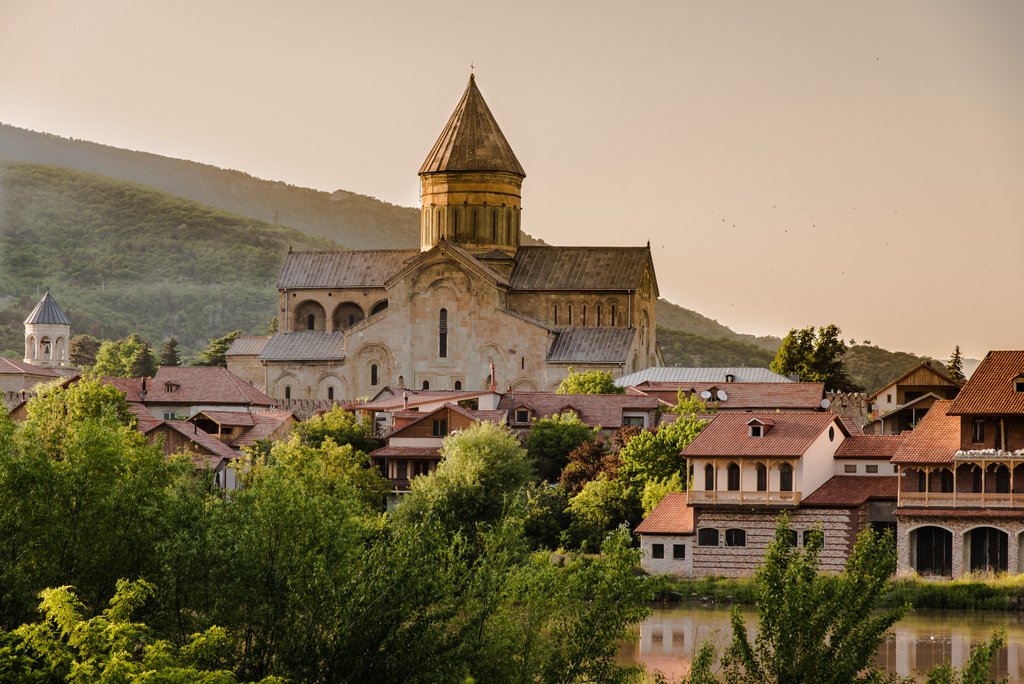
(globalpost.com) A movement is underway to reintroduce traditional religious chants to Georgian youth.
TBILISI, Georgia — With her gray hair tucked into a black knit cap and a grin stretched from ear to ear, Lia Salakaia stands with a group of children inside the entrance of a Tbilisi church. As the Georgian Orthodox service finishes, Salakaia raises her hands and the children begin to sing slow, mournful chants, their eyes closely following Salakaia's every direction. The harmonies these children struggle to sing are notable both for their complexity and their rarity.
Georgian sacred chants, with their unusual three-part harmonies and minimal vibrato, date back to the 10th century. But the sounds are relatively new to modern Georgia. Georgian religious traditions like sacred chant were suppressed under Soviet rule. Only since Georgia regained its independence in 1991 have the old songs been resurrected.
Now a movement is underway to reintroduce traditional religious chants to Georgian youth, hungry for a deeper connection to their country's cultural past.
Salakaia is the first stop for many children eager to learn the music. The petite 66-year-old earned the title “godmother of Georgian chant," for her passionate teaching and the gentle way she coaxes children to learn these difficult, often dissonant-sounding harmonies.
“I say to them, 'No one taught you how to speak. You just listened to your parents, and you started to speak. So you can listen to me sing, and step by step you will learn how to sing,'” she says. “And most of them do.”
Salakaia travels constantly, bringing these chants almost single-handedly back to Georgia's network of small towns and rural villages. “I don't want to miss any child,” she says.
After graduating from Salakaia's introductory choirs, some students continue their studies with Malkhaz Erkvanidze, director of the Sakhioba Ensemble and one of the chief scholars of the sacred music movement.
Following Georgia's independence from Soviet rule in the 1990s, Erkvanidze was one of the music scholars who pushed to bring sacred chant from obscurity back to church services. He and others unearthed a small cache of sacred chant recordings from the state archive. It was an important find, given most of the chants had only been passed down orally.
He says the last recordings were made in 1966 by an 80-year-old master chanter who sang all three parts by himself to demonstrate how the voices work together. “He was the last master who was still alive,” Erkvanidze says, adding that the man died a few months after the 1966 recordings were made.
Erkvanidze transcribed the chants into songbooks and opened Tbilisi's first chant school where young men, most sporting trim dark beards, attend classes Monday through Friday. Only a few students have completed the new program, but those who have already plan to teach.
“It's become a debt that we've studied, and now it's important for us to teach the next generation,” says recent chant school graduate Giga Jalaghonia.
Since Erkvanidze's chant school only allows men to enroll, the young women like Baia Zhuzhunadze who want to pursue sacred music head to Tbilisi's conservatory. Zhuzhunadze is studying cultural musicology at the conservatory. She says that at first, European classical music was easier for her ears. But when she and her friends began listening to Georgian traditional music, they felt as though they rediscovered their identity.
“We think European music is great,” Zhuzhunadze says. “But Germans and French can research their own culture's music. We Georgians, we are too few, we must do something to preserve this music.”
This hunger to connect with their country's roots is common among young Georgians, says Timothy Blauvelt, country director for American Councils in Georgia and a professor of Soviet studies at Ilia State University. He says Zhuzhunadze's generation has the time and opportunity to explore their Georgian identity because, although the unemployment rate is high, times are better than during her parents' or grandparents' youth.
“You have the parents who grew up at the tail end of the Soviet period or the bad years of the 1990s, when there was a civil war and no electricity. That generation wanted very material things—food on the table and a car in the garage," says Blauvelt. “This generation has grown up with more stability. They have less materialistic values, and their interests are expanding beyond basic survival.”
Zhuzhunadze says the communism and atheism of Soviet times prevented many elder Georgians from passing on cultural traditions to the younger generation. “Now the younger generation, my generation, are discovering it on our own. And we are getting our parents interested in it too,” she says.
At least one elder Georgian is sharing her knowledge of old traditions. The gray-haired Lia Salakaia continues to make her rounds through Georgia's small towns, with no cell phone, just “a pair of iron shoes,” she says.
“It's like if Georgians couldn't speak the Georgian language without going to classes. I want to help children understand their country's music,” she says. “My job is to unfreeze their ears.”
Research for this report was supported by a 2012 Knight Luce Fellowship for Reporting on Global Religion. The fellowship is a program of the University
of Southern California's Knight Chair in Media and Religion.
Showing posts with label Global Post. Show all posts
Showing posts with label Global Post. Show all posts
Tuesday, September 10, 2013
CULTURE: Sacred chants make a comeback as Georgia's cultural history resurfaces. By Caitlan Carroll (globalpost.com)


Sunday, August 25, 2013
POLITICS: Power struggle damaging image and future of Georgia. By Silvia Stoeber (globalpost.com)
 |
| Georgia's Prime Minister Bidzina Ivanishvili speaks during a joint news conference with NATO Secretary General Anders Fogh Rasmussen in Tbilisi on June 26, 2013. (DAVID MDZINARISHVILI/AFP/Getty Images) |
HAMBURG, Germany — New Georgian Prime Minister Bidzina Ivanishvili and still-reigning President Mikhail Saakashvili are fighting for power. Now Christian Democrats in the European Parliament are mixing in the fight, levying strong criticism against Ivanishvili.
The conflict arose mostly from the political constellation that has existed in Georgia since the parliamentary elections in October. On the one side is the president, Saakashvili, whose term runs until the fall. For the past nine years, his National Movement party (UNM) ran the government and controlled the parliament.
On the other side is the prime minister, Ivanishvili, a fledgling politician and billionaire whose “Georgian Dream” coalition won the majority of seats in the parliament last October. His people now run the government.
The formal transfer of governmental power took place smoothly. But soon thereafter both sides fell back into campaign mode. They outdid one another in denying the other’s democratic credentials.
The fact that Ivanishvili earned his fortune in Russia leads repeatedly to criticism of his being a Kremlin lackey. Relations between Russian President Vladimir Putin and the Western-oriented Saakashvili have for years been toxic.
Conservative deputies from the European Peoples’ Party (EPP) of the European Parliament have also played an active role in the power struggle.
Christian Democratic Party politician Elmar Brok charges Ivanishvili with having engineered “a total seizure of power.” Mayors from the Saakashvili era were pushed from office, as were leading officials of the state-run radio. Christian Democratic deputy Joachim Zeller charges that Ivanishvili’s government has abandoned the search for a democratic consensus.
In a joint letter signed by 21 EPP deputies, the prime minister was charged with closing Georgia’s doors to Europe.
Saakashvili’s UNM is a member of the EPP. He regularly takes part in EPP gatherings at the highest level. At a recent meeting, EPP deputies approved a resolution threatening to withhold its approval of an EU Association Agreement with Georgia, a treaty creating a framework for cooperation that would offer important benefits to its struggling economy.
EPP politicians, unsurprisingly, refrain from criticizing Saakashvili. But Swiss Ambassador Günther Bächler has called the remarks by EPP deputies “Soviet style propaganda.” In a highly unusual letter to Ivanishvili, the diplomat spoke of biased remarks by the deputies that did not reflect realities in Georgia. He then praised Ivanishvili and his government for their efforts at reform and their readiness to listen to advice from non-governmental organizations and international institutions.
While modernizing much of the government administration during his presidency, Saakashvili also concentrated power in his own hands, facilitated elite corruption, conducted surveillance of government critics and initiated tax investigations against businesses that did not support his policies.
Legitimate questions can also be asked about the new government. In particular, a series of confusing statements by the new prime minister — who still needs to learn that everything he says and does will be judged by public opinion — has sown some doubt.
Public pressure is demanding retribution for suffering, real or imagined, from illegal activities by the Saakashvili government. Thousands of claims have been filed with the general prosecutor. Ex-PM and former interior minister Vano Merabishvili, who is now UNM's secretary general, and more then 20 former ministerial officials are awaiting trials for malfeasance.
Many Georgians wonder why, despite these facts, Ivanishvili is still so much the focus of criticism.
EU circles in Brussels are also unhappy with the comments by EPP deputies. Expansion Commissioner Stefan Füle says he is satisfied with the new government. Negotiations with the EU are progressing steadily, and “with some subjects we are doing better than under the old government,” Füle said in an interview.
Above all, the EU is interested in demonstrating a success for its Eastern Neighborhood Policy at the summit in Vilnius in November. The five other nations of the Eastern Partnership — Armenia, Azerbaijan, Ukraine, Moldavia and Belarus — have little or no progress to report.
Even so, Saakashvili and his supporters never tire of painting a threatening picture abroad of the situation in Georgia. Saakashvili and other leaders of the 2003 “Rose Revolution” succeeded in recent years finding supporters in the EU and in Washington, primarily among conservative politicians. Many leaders were so impressed by Georgia’s goal to join NATO, they were willing to overlook the lack of progress towards democracy.
Sympathetic statements by foreign politicians helped Saakashvili legitimize his policies with his own population. Lacking viable political institutions at home, his political opponents sought to attract foreign ambassadors as referees — the reason why comments by Swiss Ambassador Bächler are important. American Ambassador Richard Norland has also become an unofficial mediator between the political camps and appears to be an advisor to Ivanishvili, with whom he speaks often.
To the extent that the Saakashvili and Ivanishvili camps carry out their conflict on the international stage, they are also damaging both the image and the future of Georgia. And when European parliamentarians heat up the debate by presenting a one-sided, negative picture of the situation in Georgia, they are also limiting their own maneuvering room.
During an interview, CDU politician Brok seemed ready to compromise, saying: “We are trying to build bridges and to help moderate the situation in Georgia. I have invited Prime Minister Ivanishvili to a meeting of the Foreign Affairs Committee of the European Parliament. There is still time to talk and to put things in order.”
Silvia Stoeber is a freelance journalist from Germany who has specialized on South Caucasus topics for more then six years. She regularly works for several media in Germany, Switzerland and Georgia.
Subscribe to:
Posts (Atom)