Politik, Kultur, Geschichte, Wirtschaft, Internet und andere Aspekte über den Süd-Kaukasus // Politic, Culture, History, Economy, Internet And Other Aspects About South-Caucasus // Re-Blogged & Posted By Ralph Hälbig
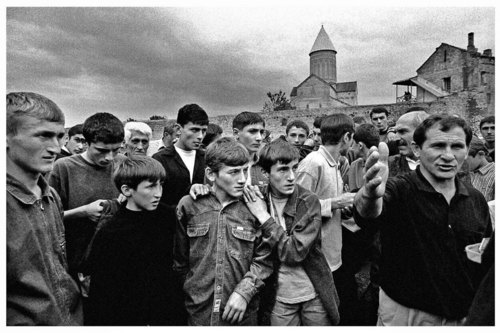
(lensculture.com) Working, traveling and living of the shepherds in Tusheti, a historic region in northeast Georgia.
Traditionally, the Tushs are sheep herders.Tushetian cheese and high quality wool was famous and was exported to Europe and Russia.
Even today sheep and cattle breeding is the leading branch of the economy of highland Tusheti. The local shepherds spend the summer months in the highland areas of Tusheti but live in the lowland villages of Zemo Alvani and Kvemo Alvani in wintertime.
About Dmitry Gomberg, Voor five years, I stayed in the mountains of the Caucasus and documented the lives of the local shepherds. These people have cheesemakers since long before the birth of Christ. The life that I discovered was simple and hard.
Was born in Moscow in 1980. Moved to New York in 2000. After changing many jobs and professions, got into photography in 2005. Went to the ICP, finished one-year course in documentary. Soon after the ICP moved to the Republic of Georgia where was introduced to the life of high mountain shepherds in Tusheti. Stayed with them for 5 years. All this resulted in hundreds of photographs and a dream to make a book.
This is a story about the life of the shepherds and the route they take in the mountains twice a year.
I After the death of my companions, (the shepherds had given me for this entire period) decided to stop.
-Dmitry Gomberg
Interview:
Because of its seemingly documentary photographs, Dmitry Gomberg mixes real life with dreams, in an attempt to show the varied responsibilities of the camera. Assistant editor Alexander Strecker crossed via e-mail to find out his story.
I was born in the Soviet Union. For a Soviet person, the Caucasus and the area around the Black Sea is a kind of heaven. Once I had moved to New York, I met a group of amazing Georgians. As Steinbeck wrote: "If one tried to describe Georgia using a single word, the correct word would surely be hospitality." I was with these words in my head, can not resist the repeated invitations to their country.
When I arrived, the father of a friend told me about a pass in the mountains, where the Tusheti shepherds go. I found his story and wanted to see these people with my own eyes. I was introduced to Vazha Kaadze, the man who was my guide and mentor.
In the beginning, some of the pastors do not like me taking pictures of them. But I got their trust. She started to call me "American Shepherd." For five years, I visited many miles with Vazha and his crew. I came to a lifestyle that I had never seen understand.
The biggest challenge I faced in making this project was not to get drunk all the time. I am on this, it completely failed. But seriously, I did not really miss when I was there. Some good coffee, a nice lady perhaps? What really gave me joy was nature: the wind, the stars and the horses. Even today, I still dream about.
In terms of photography, this project taught me two things. First, the photography is very simple; all you need is curiosity, some technical skill and luck. Secondly, people believe pictures more than words. But in my pictures, I show both a reality and my own dreams. I hope people realize that photography is much more than an objective document of the world. I hope these pictures can help you share that point.
(lensculture.com) Amurvelashvili is a freelance photographer and member of the online platform and collective, Georgianphotographers.com. Originally trained in philology, mastering the German language and literature, Amurvelashvili began working as a staff photographer for the daily Georgian newspaper 24 Hours in 2002 and for UNICEF’s Georgia office in 2004. Her work has been exhibited in Belgium, the Czech Republic, France, Georgia, Germany, Poland, Romania, Slovakia, and Switzerland. Her photographs have also been selected for the 2010 Angkor Photo Festival, the Tbilisi Photo Festival, the 2011 Chobi Mela Festival, the 2012 Aleppo International Photo Festival, and les Rencontres d’Arles. In 2010, Amurvelashvili was selected to participate in a young photographers’ artist-in-residence program and master class in Niort, France, and in 2011 was shortlisted for the Lucie Foundation Scholarship. In 2008, Amurvelashvili won first prize in KARAT Coalition’s photo competition and exhibition, “Through Their Eyes, Through Ours.” In 2013 she received OSF (Open society Foundation) documentary photography grant. 2014 her work "puzzles of us" was selected for Angkor photo festival. Her first book "Endless Questions" will be published by "Damiani" in March 2016.
(lensculture.com) Keep Working, No Matter What: Learning about Life Through Visual Storytelling
For this photographer, 15 years of doggedly pursuing personal projects resulted in one of photography’s most esteemed awards. Discover the tenacity it takes to produce meaningful work.
For 15 years, Polish-born, Georgia-based freelance photographer Justyna Mielnikiewicz has been committed to discovering stories and sharing them with others using her camera. Dedicated and passionate (she would even say stubborn), Mielnikiewicz has stuck through the inevitable highs and lows of independent work to produce personal projects she is truly proud of. Her commitment to narrative photography was recognized in 2016 when she was awarded the prestigious W. Eugene Smith Fund grant in humanistic photography, which came with $30,000 to support new work.
Next month, she will be hosting a workshop in Georgia in collaboration with Tbilisi Photo Festival (more info below). In advance of her workshop, LensCulture managing editor Alexander Strecker exchanged emails with Mielnikiewicz to learn more about her dogged pursuit of visual storytelling that has taken her far from her roots in Poland— Full Interview here >>>
Justyna Mielnikiewicz discusses her journey from a village in Poland to Tbilisi, and her unique path to becoming a successful international photographer.
www.letuscook.destellt eine zweisprachige – deutsch-georgische Webseite dar. Hier
finden Sie verschiedenste Rezepte zum Nachkochen sowie Tipps und Tricks
für Anfänger und Kochliebhaber. Die Rezepte sind schrittweise
beschrieben und mit dazugehörigen Fotos unterstützt. Ich möchte Sie gerne dazu auffordern mir Ihre Rezepte und Bilder zu schicken. Ich hoffe, dass mit Hilfe von www.letuscook.de oder www.facebook.com/Letuscook.de ein interessanter Informations- und Meinungsaustausch zwischen den beiden „Sprachseiten“ zu Stande kommt. Ihre Meinungen, Vorschläge und Verbesserungswünsche sind sehr willkommen.
Ich stehe Ihnen für die Fragen gerne zu Verfügung.
Ich hoffe, www.letuscook.de gefällt Ihnen und inspiriert Sie und natürlich hoffe ich, Sie schauen öfters mal vorbei. Viel Spaß beim Nachkochen!
Translate in your Language
OAT Gallery and artcafe 144 stairs in Tbilisi
in old tbilisi
under the narikala fortress
- artcollection
- exhibitions and events
- home cuisine
- private dinners and parties
- guest studio for rent
Lohnenswert: Dokumentarfilm von Ruth OlshanWIE LUFT ZUM ATMENist eine Reise in ein kleines Land zwischen Asien und Europa, das zu unrecht zwischen den Grenzen der Kulturen vergessen wird: Georgien, das hier in seiner ganzen Schönheit, seinem Zauber und seiner Vielfältigkeit eingefangen ist. Der Dokumentarfilm von Ruth Olshan entdeckt vor allem die beeindruckende Musik Georgiens, in der die kulturelle Identität seiner Bewohner tief verwurzelt ist. In den fast verloren gegangenen und wieder entdeckten Gesängen und Tänzen, die die UNESCO auf die Liste des Weltkulturerbes gesetzt hat, meint man Stimmen und Lieder aus einer vergangenen Zeit zu hören.
Musik sei für sie so wichtig wie die Luft zum Atmen, erzählt eine Protagonistin im Film und man versteht sie sofort. Ruth Olshans vielschichtiges Porträt eines Landes, seiner Menschen und ihrer Musik zeigt, was das Besondere an der georgischen Musik ist: die Lebendigkeit der Folklore im Alltag, die aufrecht erhaltene Tradition, die in den Texten gespeicherten Mythen, das soziale Erleben der Musik, die regionale Unterschiedlichkeit der Kultur, und die Musiker, die die Musik heute auch in Pop- und Jazzbereiche weiterführen."Großartige Bilder, sympathische Protagonisten und schöne, unvertraute Musik!" (filmdienst)
"Ruth Olshan hat einen sehr feinen Musikfilm gemacht, der einen Ort 90 Minuten zum Klingen bringt" (zitty)
"Eine berückende Hommage an ein Volk, dessen große Kultur durchströmt wird von Gesang" (Rheinischer Merkur)
"Folklore kann ganz schön cool sein!" (Die Welt)
"Ein ‚Hit’ für musikbegeisterte Weltreisende im Kino!" (programmkino.de)
Ruth Olshan in her film portrays musicians who work with different approaches: a male choir searching and cultivating old folk songs in the Caucasus region, a female choir, a school dance company and musicians who enhance Georgian folk music. There is a common denominator that links the diverse protagonists in Olshan’s film: Singing, dancing and music are crucial elements of their lifestyle. Music is as important as “air to breath,” explains the director of the female choir . The subtle camera work discreetly catches moments and spontaneous encounters, showing that the rehearsals and the singing brings moments to these women where they are taken away from their normal course of life. For life in Rustavi, a small town near Tiflis, seems bleak. The industry is dead, the unemployment rate is enormous. You ask yourself how people can live. The choir women’s beauty and positive energy exude an affirmative sign of life, even in mournful moments. Men and women sing and dance both joy and sorrow off their chest. In Georgia, music seems to be omnipresent, almost existential. Even if a young singer does not think folk music is “sexy”, he still gets hooked. It gets under his skin. The film pays tribute to this fascination, vitality, and spiritedness.