Showing posts with label vimeo. Show all posts

Monday, October 21, 2019

VIDEO: ERTI Gallery presents Koka Ramishvili's solo exhibition "Light Machines", curated by Karine Tissot. Project partner SOLO, Galleries X Tbilisi Photo Festival


Koka Ramishvili
Light Machines
Curator: Karine Tissot
Project Partner: SOLO
Galleries x Tbilisi Photo Festival
ERTI Gallery, 19 P. Ingorokva str / 5 9April str, 0108 Tiflis
September 15 - October 23 

Link: Koka Ramishvili's solo show "Light Machines" curated by Karine Tissot [artsy.net]

Koka Ramishvili’s Light Machines are much more than still lifes for they are systematically animated by movement – which situates the work in a perfect contradiction of a genre normally characterized by the inertia of the motif (still life). Nor can they be reduced to a mere expression of a certain experimentation since there is a deliberately studied aesthetic to them.

Between art and a sort of demonstration, Ramishvili creates geometrical shapes – sometimes inspired by the world of de Chirico or the sculptures of Brancusi –to reveal, through photography, a light that the artist breaks down into a monochrome array of soft grays. No black and white contrasts that would strictly separate the tones and reduce the world to a Manichean view of things. On the contrary, a generous array of nuances with blurred outlines offers the eye the chance to penetrate these intermediary worlds lying between bright and dark, somewhere between dreams and reality, beyond a truth that is unique, sharp, and caught in a fraction of a second by a photo journalist.

Koka Ramishvili works the light of his photos and acts on the very way light is perceived. Eschewing all spiritual meaning, he fosters a perceptual, sensory experience where time is superimposed over transparency. Everything moves towards impermanence. Everything is becoming. Process is essential. Here lies the essence of this work. In the challenge of expressing light as an abstract structure, he animates the installations of his invention so that they retain a fleeting impression. Thanks to movement, real objects shed their materiality in subtle plays of shade and light. His images thus create visions that are inaccessible to the human eye and his simplest staged scenes suddenly verge on the abstract, making the photograph nothing less than photography, in other words, a writing with light in the etymological sense of the word. On the other hand, when he is looking outside the studio to express a form of combustion in the landscape, Ramishvili will occasionally polish the image in the touching-up process. Light is manipulated after the fact. A pair of real-looking suns, for instance, appears in an immaculate sky (Ascension, pp. 22-23), and three glowing celestial bodies create a sequence on the horizon (Three Stars (Evolution), 2019, pp. 30-31), while a bright illumination takes over a face (The Shining (Face) – 2017, p. 24).

As a visual artist who has always sought to slip his thinking into multiple mediums – while making sure to master them perfectly, each according to its use – Koka Ramishvili took up photography again in 2016. Having abandoned the documentary practice seen in the early years of his career, he is now devoting himself to photography as he would were he working on a painting, that is, his compositions are first elaborated conceptually before they are executed, making his work both a form of thinking and a realization, a perfect marriage of content and form, a paragon of comprehensiveness. They promise to stretch the limits of representing the world thanks to his working of the light. Indeed, although his work follows in the wake of themes in art that go back centuries – like portraiture or landscape – Ramishvili regularly puts light at the center of his thinking and reminds us of what Laszlo Moholy-Nagy pointed out in 1925 in his foundational book, Painting Photography Film, “I am convinced that a new art of light is being born.” Until then the history of art had been punctuated by works that placed front and center the play of shadows and light, from the research of Renaissance painters into chiaroscuro to the expression of the sensation of light by Turner and Monet, although photography opened a field of possibilities that proved vaster by far.

Koka Ramishvili is following a trail first blazed by modernity a century ago. Nevertheless, his experience, renewed by the summers he has spent in Greece over the last few years, feeds into a singular approach filled with striking patches of white, reliefs formed from gentle lines, and clement skies that give voice to a harmonious world in black and white, whose light is the condition of the visible. It is indeed what makes the perception of shapes and limits of objects and spaces possible. If the role played by light in art has often been inextricably linked to the deepening of scientific knowledge and the appearance of technologies that put it to work, Koka Ramishvili raises it to the level of the main protagonist in order to speak about the essence of art and life in a singular impulse of freedom and intuition that avoids the pitfall of the cliché.

Karine Tissot, 2019

more links:
haeusler-contemporary.com/koka-ramishvili
www.kokaramishvili.org

Friday, May 17, 2019

DOCUMENTARY: The City Where Women Run The Nightlife - Nightlife & Clubs in Tbilisi. By Noemi Hatala and Rebecca Gin

Partying in Tbilisi is a political statement. Like Berlin in the early 90s, raves in Tbilisi have a social and political element that make them more than entertainment.

Clubbing has become a way for young people to rebel against the conservative regime in power. People with “radical” ideas about liberal politics or sexual identity are accepted in clubs and can act freely.

Tbilisi has five major clubs. Four of them are owned or co-owned by women.

This short documentary introduces these strong female characters who are running Tbilisi’s nightlife and are shaping the thinking of a new generation.

Producer, director, cameraperson, editor: Noemi Hatala
noemihatala.com
Cameraperson, consultant: Rebecca Gin
rebeccagin.com


The City Where Women Run The Nightlife from Noemi Hatala on Vimeo.

With Keta Gabunia (Owner of Mtkvaarze Club www.mtkvarze.com), Tamuna Axander (Owner of KHIDI www.khidi.ge), Naja Orashvili (Co-Founder of BASSIANI www.bassiani.com), Sophy Ebralidze (Manager of KHIDI www.khidi.ge), Nia Gvatua (Owner of SUCCESS BAR)

This Video Will Introduce You To The Women Behind Tbilisi’s Thriving Techno Scene (Source: electronicbeats.net)

'The City Where Women Run The Nightlife' is a new video that explores how women have built the city's current day techno scene.

Club culture is political everywhere, but it’s especially political in Tbilisi. There, clubs like Bassiani and Khidi provide free spaces for people to gather and explore ideas about liberal politics and sexual identity at odds with the country’s ultra-conservative government. (For more information about the government’s policies, read our exposé Behind Bars: Meet The Georgian Producer Making Music From Prison)

“There are five major clubs in Tbilisi. Four of them are owned or co-owned by women,” says Keta Gabundia, owner of the popular Mtkvarze club, in a new short video documentary called, The City Where Women Run The Nightlife.

The video, which is available in full above, examines the role that women have played in developing the city’s current club scene, and also explains the challenges they face moving forward in the wake of last year’s Government-instigated club raids and ensuing protests.

The City Where Women Run The Nightlife was made by Noemi Hatala and Rebecca Gin. More info can be found here.

Read more: Behind Bars: Meet The Georgian Techno Producer Making Music From Prison


Soundcloud:
https://soundcloud.com/bassiani
https://soundcloud.com/khidi
https://soundcloud.com/search?q=mtkvarze

Saturday, August 04, 2018

#GeorgianWine: Amber Revolution. How the World learnded to love #OrangeWine. By Simon J Woolf - Review by David Crossley [wideworldofwine.co]

[wideworldofwine.co] Simon Woolf’s Amber Revolution fits firmly in that category, and has generated a massive amount of excitement already on social media since its publication a few weeks ago. A pic of its striking cover is almost as ubiquitous right now as a bottle of Ganevat (in this case it’s a good thing)

We often think of orange wines in connection with amphora, and specifically the Georgian qvevri, a clay vessel with a small aperture, traditionally buried in the ground, in which the wine more or less makes itself. What we should remember is that amber/orange wine is actually made in a range of containers, even including epoxy tanks and stainless steel.

Full text here ...

Amber Revolution – How the World Learned to Love Orange Wine is written by Simon J Woolf, with a Foreword by Les Caves’ Doug Wregg, who has probably imported significantly more different orange wines into the UK than anyone else has, or will. The book is published in The Netherlands by Morning Claret (www.themorningclaret.com) at €35/£30, and in the USA by Interlink Books, Northampton, Massachusetts ($35). I understand that wider UK and European distribution will be forthcoming within a couple of months, but contact Simon Woolf on the above link for sales enquiries in the meantime.
more:
twitter.com/simonjwoolf
www.themorningclaret.com/


Saturday, July 14, 2018

EASTSPECTION: CAUCASIAN MOOD - eine poetische Dokumentation über Georgien und Armenien. Von Tomas Zebis & Tom Kretschmer

A poetic documentary through associative, subjective and emotional eyes of the transient and a journey through Georgia and Armenia – a world which might soon disappear. The film suggests the rapid changes and the loss of social values and inspires a reflection on Western culture.


Caucasian Mood I Teaser from eastspection on Vimeo. Full Version: vimeo.com


CAUCASIAN MOOD dokumentiert Stimmung pur. Maloche, Müßiggang und Wärme fließen dahin bis Idylle und Tristesse sich einen. Die kollektive Pause einer Weinernte im Schatten des einzigen Baumes. Saftige eingemachte Speisen werden aus der Zeitung gerollt und geteilt. Es wird gelacht und geträumt, junge Burschen vereint mit der Weisheit der Alten, Ursprünglichkeit und Seelenruhe.

Assoziative Ordnungsprinzipien lassen subjektive Bilder kaleidoskopisch verschmelzen und Raum und Zeit verschwimmen. Zurück bleibt eine Ambivalenz zwischen materieller Armut und menschlichem Reichtum. Der Film deutet die rapiden Wandlungsprozesse und den Verlust sozialer Werte an und inspiriert zu einer Reflexion über die westliche Kultur.


CAUCASIAN MOOD documents moods. To sweat something away, the idleness and a warmth flow until Idyll and tristesse become one. The collective break during a vintage in the shadow of the only tree. Food is being rolled out of newspaper and shared. They laugh and dream – young fellows united with the wisdom of the old folks – nativeness and peace of mind.

Associative ordering principles allow the kaleidoscopic merging of subjective images and make space and time become blurry. What remains is an ambivalence between material poverty and human wealth.

Links:
eastspection.com/caucasian-mood
eastspection.com/armenia
eastspection.com/georgia

Die Faszination für die Länder der heutigen postsozialistischen Staaten ist die Triebfeder für ihre gemeinsamen Projekte. Es ist der Wunsch die rapiden Wandlungsprozesse in Bildern festzuhalten und somit eine Reflexion über die westliche Kultur anzuregen. Dabei steht der Mensch im Mittelpunkt.

Tom Kretschmer: seit 1976 in Ostberlin sozialisiert, studierte nach seiner Ausbildung zum Fotografen visuelle Kommunikation. Er experimentiert als freischaffender Künstler zwischen Fotografie, Grafik und Film. Sein erster poetischer Dokumentarfilm über den sich im Wandel befindlichen Bahnhof Ostkreuz gewann international zahlreiche Preise.

Tomas Zebis: wurde 1980 in der Tschechoslowakei geboren. Bereits sechs Jahre später erfolgt die Republikflucht mit anschließender Emigration in die BRD. Der studierte Kommunikationsdesigner ist als freischaffender Videodesigner und bildender Künstler tätig. Eine geistige Verwandtschaft zu den Flaneuren des 20. Jahrhunderts ist nicht zu leugnen.

E-Mail: hi@eastspection.com

Tuesday, January 23, 2018

PHOTOGRAPHY: Mariam Amurvelashvili

(lensculture.com) Amurvelashvili is a freelance photographer and member of the online platform and collective, Georgianphotographers.com. Originally trained in philology, mastering the German language and literature, Amurvelashvili began working as a staff photographer for the daily Georgian newspaper 24 Hours in 2002 and for UNICEF’s Georgia office in 2004. Her work has been exhibited in Belgium, the Czech Republic, France, Georgia, Germany, Poland, Romania, Slovakia, and Switzerland. Her photographs have also been selected for the 2010 Angkor Photo Festival, the Tbilisi Photo Festival, the 2011 Chobi Mela Festival, the 2012 Aleppo International Photo Festival, and les Rencontres d’Arles. In 2010, Amurvelashvili was selected to participate in a young photographers’ artist-in-residence program and master class in Niort, France, and in 2011 was shortlisted for the Lucie Foundation Scholarship. In 2008, Amurvelashvili won first prize in KARAT Coalition’s photo competition and exhibition, “Through Their Eyes, Through Ours.” In 2013 she received OSF (Open society Foundation) documentary photography grant. 2014 her work "puzzles of us" was selected for Angkor photo festival. Her first book "Endless Questions" will be published by "Damiani" in March 2016.


Gallery: Endless Questions by Mariam Amurvelashvili
Book: Mariam Amurvelashvili: Endless Questions
Gallery: Another memory by Mariam Amurvelashvili
Georgia’s Old Prisons Were Sites of Documentary Photography, But New Prisons Are Sites of Video, Rape, Beatings and Scandal. By Mariam Amurvelashvili [prisonphotography.org]
Khevsureti. By Mariam Amurvelashvili [oseweb]
Endless Questions Mariam Amurvelashvili [issuu.com]
For Georgian photographer Mariam Amurvelashvili, a camera is the means of self-expression. She considers her camera to be an inseparable part of her body and mind, capable of constructing a chronology and accommodating everything of significance to her in one frame. Endless Questions is not only a story about children, narrated by a mother with love. In 70 photos, Amurvelashvili gives us an intimate look at the world of brother and sister.
Mariam Amurvelashvili [jmcolberg.com]
Mariam Amurvelashvili - Endless questions [josefchladek.com]
"For Georgian photographer Mariam Amurvelashvili, a camera is the means of self-expression. She considers her camera to be an inseparable part of her body and mind, capable of constructing a chronology and accommodating everything of significance to her in one frame. Endless Questions is not only a story about children, narrated by a mother with love. In 70 photos, Amurvelashvili gives us an intimate look at the world of brother and sister. Composed portraits of the children are accompanied by candid photos of them in the Giorgian landscape. Drawings by Amurvelashvili’s daughter are interspersed among the photographs, giving the book the feeling of a family album."

Facebook: facebook.com/mariam.amurvelashvili
Instagram: Iphonephotography only @mariamamurvelashvili


Tuesday, January 16, 2018

DOCUMENTARY: Men Between Mountains: Masculinity in Georgia. Photography by Ian McNaught Davis, @ianmc0davis


Ian McNaught Davis long-term photography project explores facets of masculinity in the post-Soviet republic of Georgia.

Wedged amongst the rugged and formidable Caucuses Mountains, Georgia lies at the crossroads of Asia, Europe and the Middle East. Because of its explosive location, it has clashed with empires for centuries, including the Romans, Persians, Byzantines, Arabs, Khazars, Arabs, Turks, Mongols and Russians.

He is interested in photographing moments that reflect manhood in a battle-hardened society that finds itself in a state of limbo – when warriors have no wars to fight – and the shift in gender roles that war can leave in its wake.

Georgia it finds itself in fascinating time of transition. Paradoxes and contradictions abound in this small country. Secular attitudes collide with the dogma of the Orthodox Christian Church, and city-dwellers must negotiate their paternalistic family loyalties and traditions rooted in the countryside and villages.

For him, its political and ideological landscapes seem apt locations to explore the murkiness and complexities of masculinity.

His work can be viewed at www.ianmcnaughtdavis.com

Facebook: facebook.com/ianmcnaughtd
Twitter: twitter.com/ianmc0davis
Vimeo: vimeo.com/ianmcnaughtdavis
Instagram: instagram.com/ianmc0davis

Tuesday, September 05, 2017

BOOK: Memories of Tiflis. Edited by Nicolas V. Iljine (iljine.net)

(iljine.net) Memories of Tiflis, edited by Nicolas V. Iljine, December 2017, 194 pages + attached image.

Richly illustrated with articles about history, art, architecture, music, festivities etc.

Documentary about Josph Brodsky

Film about and with Joseph Brodsky recorded in Venice in 1991. Directed by Nathan Fedorovski & Harald Lüders; Speaker Piotr Olev; Produced by Lufthansa / Nic Iljine

Sunday, August 06, 2017

REPORTAGESCHULE: Morgen in Georgien

Ein kleines Land am Kaukasus strebt nach Europa. Seit März 2017 haben seine Bürger Visafreiheit. Die Euphorie ist groß: Es gibt EU-Infocenter, in der Hauptstadt hisst die Regierung schon heute die Europäische Flagge, und von den Hängen des Kaukasus fließt oranger Wein in die Länder der Union. Georgien ist aber auch ein Land, in dem man Stalin im Einkaufszentrum begegnet. Hier trennt Stacheldraht den Bauern von seinen Kühen, junge Frauen vermieten ihre Gebärmutter, dürfen aber nicht alleine wohnen. Und die Georgier sagen von ihren Gästen, sie seien von Gott gesandt. Elf Reporter der Zeitenspiegel Reportageschule wollten wissen, was das für ein Land ist, mit dem Europa so heftig flirtet. Gemeinsam mit drei kaukasischen Kollegen machten sie sich auf die Reise.

Mit Händen und Füßen. Von Sophie Herwig und Marc Pfitzenmaier
Die Gastfreundschaft der Georgier ist legendär. Um sie zu testen, durchkreuzen zwei junge Reporter/innen das Land – aus der Haupstadt Tiflis bis ans Schwarze Meer.


Mit Händen und Füßen - Ein Roadtrip durch Georgien from Zeitenspiegel-Reportageschule on Vimeo.


Mehr hier: reporterreisen.com/Morgen In Georgien

Mit Edita Badasyan, Ilkin Hasanov, Giorgi Janelidze, Franziska Grillmeier, Lilith Grull, Cristina Helberg, Sophie Herwig, Julia Jürgens, Meret Michel, Florian Niedermann, Tanja Mokosch, Marc Pfitzenmaier, Dunja Smaoui, Rike Uhlenkamp


facebook.com/Zeitenspiegel-Reportageschule Reutlingen - Journalistenschule

Thursday, July 27, 2017

TRAILER: I Didn’t Cross the Border, The Border Crossed Me (English subtitles). Documentary by Toma Chagelishvili


I Didn’t Cross the Border, The Border Crossed Me (English subtitles) from Rise and Shine on Vimeo.
The villagers of Churvaleti knew since the end of the Georgian war in 2008 that they were living on a border. Life was simple, but not far from normal. Until a while ago, when Russian patrols started drawing the borderline and putting up barbed wire fences. In Churvaleti, the barbed wire fence goes right through the village. Families and communities got divided. Every other hour border patrols pass by and put anyone in captivity who come close to the fence. In spite of this menace, the villagers find ways to stay in touch with their relatives and friends across the line. Life goes on, but will it ever be the same again?


Zu sehen am 25. August in Berlin
Screening: I didn´t cross the border, the border crossed me


Georgia / Germany 2015
Wann: Freitag, 25. August 20:30 Uhr
Wo: 800A | Stettiner Straße 19, 13357 Berlin
Veranstaltung organisiert von 18591KM www.18591km.org


Nach dem Film folgt eine Diskussionsrunde zwischen dem Regisseur Toma Chagelishvili, dem kreativen Produzenten Veronika Janatková und dem Publikum

SYNOPSIS
Seit dem Ende des Georgien-Krieges im Jahr 2008 leben die Dorfbewohner von Churvaleti direkt an der russischen Grenze. Bisher war das Leben einfach. Doch dann begannen russische Soldaten eine Grenze zu ziehen und Stacheldrahtzäune aufzustellen. In Churvaleti verläuft die Absperrung quer durch das Dorf. Familien und Gemeinden sind seither getrennt. In regelmäßigen Abständen patrouillieren Soldaten entlang der Grenze und nehmen jeden fest, der ihr zu Nahe kommt. Trotz der gefährlichen Konsequenzen finden die Dorfbewohner aber immer wieder Wege den Kontakt mit ihren Verwandten und Freunden über den Stacheldrahtzaun aufrecht zu halten. Das Leben geht weiter aber wird es jemals sein, wie vorher?
 
Weitere Veranstaltungen auf www.kulturgeorgien.com

Monday, July 03, 2017

MUSIC VIDEO: Metamatics - Liquid Gel


Metamatics - Liquid Gel [OFFICIAL MUSIC VIDEO] from sandrojaparidze on Vimeo.


Director & Director of Photography - Sandro Japaridze
facebook.com/alexandre.japaridze

Cast - Ana Kurtubadze
facebook.com/ana.kurtubadze
Metamatics -  Lee Anthony Norris
facebook.com/metamatics_lee.anthony.norris

Location - Berlin
Format - Full HD RAW
Shot on Blackmagic Pocket Cinema Camera (BMPCC)

Saturday, June 17, 2017

REEL: Sandro Japaridze - Cinematography 2016 / 2017


Reel - 2016 / 2017 from sandrojaparidze on Vimeo.

(dasauge.de) Den ersten Film sah ich mit fünf, im Jahr 1994, in einem kleinen georgischen Dorf, am Abend, als meine Mutter mich ins Open Air Kino brachte. Die Bauern fuhren mit Baggern über das große Feld Richtung Dorfplatz, wo die Filmvorführung stattfinden sollte. Alle waren dabei, Frauen mit Kindern, ältere Leute, sogar der Dorfvorsitzende. Jeder von uns hat mit großer Aufregung auf etwas ganz Besonderes gewartet. Das war der schwarz-weiße Film "Captain America" von 1944. – "I know what damn man you are, mr. Bradley..." Bis heute kann ich mich noch an die Zitate, Stimmen, Bilder und Geräusche erinnern. Im Schnitt: Porträts, eindrucksvolle Augen, die zueinander blickten, und nicht zu vergessen, die Hand, die zum Revolver griff.Direkt nach dem Revolverschuss explodierte die Eingangstür, als ob eine kleine Kugel eine solche Explosion verursachen könnte. Ein Mann mit einem weissen Stern auf der Brust und einem Schild in der Hand erschien im Eingang - Captain America. Das Schild hielt er eigentlich in der linken Hand, aber für mich war es die rechte, denn im "" gab es keinen freien Platz mehr, daher habe ich den Film von der anderen Seite der Leinwand angeschaut. Es war mein erster Film, der erste Eindruck und der erste brennende Wunsch herauszufinden, wie die Menschen sich auf dem weißen, aneinander genähten Bettlaken bewegten.

Zu meiner Abiturzeit versank das ganze Land im Chaos – ständige Stromausfälle, verdunkelte Straßen, bewaffnete Menschen und die angespannte Stimmung kurz vor dem Bürgerkrieg. Ich begann in einem Medizincollege zu studieren und lief im weißen Kittel, Stethoskop und Fotokamera um den Nacken,der alten Nikon FE2, herum und fotografierte alles, was in mein Blickfeld fiel. Durch Zufall traf ich auf der Straße einen georgischen Kameramann Goga Devdariani, wie sich später herausstellte, einen der Besten, dem ich meine bereits entwickelten Fotos zeigte. Da sie ihm gut gefielen, bot er mir an, nicht nur zu fotografieren, sondern auch Videos zu drehen. Durch ihn lernte ich zu beobachten. Es war der wichtigste Tag in meinem Leben, denn dieses zufällige Treffen zeigte mir, was ich im Leben eigentlich machen wollte und wo meine Bestimmung war. Also hängte ich den weißen Kittel und das Stethoskop an den Nagel und entschied mich für die faszinierende Kinowelt, die mich bereits mit fünf Jahren in ihren Bann gezogen hatte. "Machst du es für einen Applaus oder wegen der Berufung?" "Kannst du eine neue Wirklichkeit erzeugen?" - das sind die Fragen, die er mir damals stellte und die für mich bis heute wegweisend und ausschlaggebend sind.


Sandro Japaridze


Weitere Links:
japaridzesan.wixsite.com/sandrojaparidze
www.facebook.com/alexandre.japaridze
soundcloud.com/sandroj
www.crew-united.com
www.imdb.com

Saturday, June 10, 2017

GALLERY: Some "Masterpieces for Masterpieces" - Paintings & Drawings by the Georgian Artist Mai Lashauri - based in Tbilisi

Paintings and Drawings by Georgian Artist Mai Lashauri
Mouseover for the Gallery


more links:
saatchiart.com
instagram.com/mai lashauri
facebook.com/mai lashauri
tgnili.com/mai lashauri

Thursday, June 01, 2017

PHOTOGRAPHY & VIDEO: Zikr in Pankisi Valley - Chechen enclave in northern Georgia. By Swiatoslaw Wojtkowiak

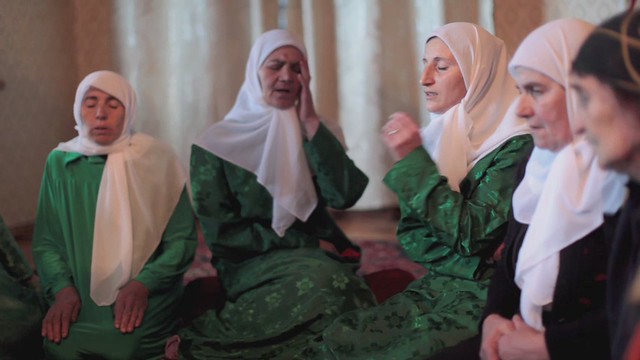
Zikr in Pankisi

Sufi of Pankisi Valley. The women gather to sing, praise Allah and pray for peace. Their message is expressed in an explicit way by their charismatic leader and organizer, Badi : Make love not war.

You can see more here: www.pankisi.org

This is another face of islam in Caucasus, you dont see it too often , not so much as terrorist accusation by Russian regime, self fullfilling prophecy. Angry young men, their culture ridiculed, their freedom taken away, turn to fundametalism. Wahhabism is getting sponsored by Gulf countries, by Saudis, but these women, those religious communities refuse to believe wahhabist propaganda that their old traditions of Sufism are heresy. They preach peace.


Chechen sufi zikr from Swiatoslaw Wojtkowiak on Vimeo.

Zikr in Pankisi Valley - Chechen ladies from Pankisi Valley performing Sufi zikr ritual , singing message of love to God and other people, and asking for peace in Caucasus.

Sunday, April 23, 2017

WETTBEWERB: LASS DEN SOMMER NIE WIEDER KOMMEN I let the summer never come again I ნეტავ აღარასდროს მოვიდეს ზაფხული

achtung berlin - new berlin film award I Wettbewerb I Kategorie Spielfilm

23 April I 18:00 I Wolf Kino I Weserstraße 59

25 April I 21:00 I Filmtheater am Friedrichshain I Bötzowstr. 1-5
R+K: Alexandre Koberidze
C: Mate Kevlischvili, Giorgi Bochorishvili
Producer/innen Nutsa Tsikaridze, Keti Kipiani, Alexandre Koberidze
Erzähler: Tamuna Pkhaladze, Ilia Qorqashvili.
Produktion Deutsche Film- und Fernsehakademie Berlin (dffb) DE 2017, 202 Min., georgische OmeU


Ein junger Mann zieht aus der georgischen Provinz nach Tiflis, um dort Tänzer zu werden. Dort angekommen, nimmt er an illegalen Faustkämpfen teil und schläft mit Männern, um Geld zu verdienen – bis er sich in einen Mann verliebt, der später in den Krieg ziehen wird. Lass den Sommer nie wieder kommen ist eine abenteuerliche Reise durch einen aufgepixelten, fast impressionistisch anmutenden Großstadtjungel, untermalt von diffusen Originaltönen, urbanen Geräuschkulissen und Orchestermusik. Ein Film, der beobachtet, wie ein stiller, aber aufmerksamer Betrachter, der die Ereignisse nahezu ungefiltert aufsaugt. Ein Kinoereignis der besonderen Art.


www.kulturgeorgien.com
www.achtungberlin.de


TRAILER - LET THE SUMMER NEVER COME AGAIN from DFFB on Vimeo.

Thursday, February 16, 2017

PHOTOGRAPHY. Natela Grigalashvili’s Georgia by Nathan Thornburgh (roadsandkingdoms.com)

(roadsandkingdoms.com) The Georgians, while famously expansive as hosts, also have ancient customs that no man wants to cross. A wiry, smiling Georgian explained this on the first day of my first visit ever to the country years ago: “For example,” he said, “if you said something bad about my sister, I would have to kill you. Or at least try. I don’t know if I could kill you, but I would definitely try.” 


And yet there is an unalloyed charm to these customs. Georgia, for all its faults and sorrows, has kept its culture alive, in part because of the vibrant and intact agrarian life that is the heart of Georgia. That’s why Europeans and Americans who visit Georgia often fall so deeply for the place: its rural traditions remind us of who we used to be.

Very few photographers out there tell the story of rural Georgia in as raw and intimate a way as Natela Grigalashvili. She is from the countryside herself, and after a pioneering start as the first female photojournalist in post-Soviet Georgia, she has turned her eye toward the villages. Her stunning new project is called Georgian ABC, and she is currently funding it on Kisskissbankbank, a European Kickstarter of sorts. Go pitch in your bit there. It’s a book that deserves to be published.

I was honored to have the chance to speak with Grigalashvili from Tbilisi on Skype recently. Here is our conversation, only lightly redacted: roadsandkingdoms.com/2013/grigalashvili


Georgian ABC book from Natela Grigalashvili on Vimeo.

more links:
Homepage: www.natelagrigalashvili.com
Facebook: www.facebook.com/Natela Grigalashvili
instagram.com/Natela Ggrigalashvili
www.freundevonfreunden.com/Natela Grigalashvili
ProjectArtBeat - Georgian photographer Natela Grigalashvili
The Doukhobors' Land (thequietamerican.org)
Natela Grigalashvili’s “Ethnic Minorities in Georgia” exhibited in Flensburg
The Aftermath Project.org: Refugees Georgian Villages
Georgian photographer captures life at troubled Iraq-Iran border


Saturday, January 31, 2015

ANIMATION: ბებო (Granny). By Sandro Katamashvili (20steps.ge)


Director: Sandro Katamashvili
Screenplay: Nikoloz Mdivani, Achi Tabukashvili, Sandro Katamashvili
Producer: Vladimer Katcharava

Award:
10th Int. Short Film Fest "Sesily" - Sept 2014 "Best Animated Short"

Festivals:
12th Animae caribe - October 2013
3rd Animax Skopje - November 2013
15th Animated Dreams - November 2013
9th Athens Animfest – March 2014
6th Go-Short Nijmegen - April 2014
5th Golden Kuker Sofia – May 2014
5th "Cinesogni" Int. Short Film Festival - May 2014
10th Detmold Short filmfest – July 2014
44th Giffoni Experience - July 2014
10th Varna Festival of animated films – Sept 2014
21st Int. Anim. Film Festival "Krok" - Sept 2014
16th Int. Anim. Film Festival "Animaevka" - Sep 2014
8th Golden Anteaters - Oct 2014
23rd Festival De Cine Madrid - Oct 2014
6th "ReAnimania" Festival of Yerevan - Oct 2014
7th KLIK! Amsterdam Animation Festival - Nov 2014
3rd Libèlula Aniam. Festival Barcelona - Nov 2014
12th Asiana Int. Short Film Festival - Nov 2014

Special Screenings:
14th Melbourne Int. Animation Festival - June 2014
15th Hiroshima Int. Animated film festival – Jul 2014
Insomnia Film Fest (St.Petersburg) – August 2014
6th Int. Film Festival DIDOR DUSHANBE - Oct 2014
Moma NY / Berkeley Art Museum and Pacific Film Archives "Discovering Georgian Cinema" - Dec 201

Source: 20steps.ge

Wednesday, January 28, 2015

CROWDFUNDING CAMPAIGN: Lost Territories - photo project in Central Asia. By SPUTNIK PHOTOS (indiegogo.com)

(indiegogo.com) 5 photographers, 5 exciting stories from post soviet countries in Central Asia.


Lost Territories - crowdfunding campaign from SPUTNIK PHOTOS on Vimeo.

Please support this project here - indiegogo.com >>>


Who are we?

Sputnik Photos is an international collective founded in 2006 by documentary photographers from Central and Eastern Europe. We are united by a desire to observe and describe what surrounds us, as well as by our common experience of living in post-transformation countries.

Our achievements to date include important international awards, such as World Press Photo and Pictures of the Year International. Together we have organized several exhibitions around the world and published 8 photobooks. Our projects have been featured at photography festivals, in galleries and magazines worldwide. 


About our project.

We would like to invite you to support our artistic project in post-soviet countries of Central Asia. Twenty-five years after the fall of the USSR five Sputnik Photos photographers are setting out on a journey to five former soviet republics: Kazakhstan, Uzbekistan, Turkmenistan, Tajikistan and Kyrgyzstan.

For a number of years, we have been documenting changes taking place in post-communist countries, particularly in the former republics of the Soviet Union, always referring to our own individual experience of the transformation period. Recently, we have focused on Belarus, Ukraine, Moldavia, Armenia and Georgia. In the face of an increasing political tension in the region, photography documenting everyday life, and the changes and myths of the countries still falling under Russian influence, becomes even more relevant. 

Rafal Milach - from the series “Black sea of concrete.”
At the current stage, we are planning further trips to the former Soviet empire, focusing on Central Asia, and we hope you will support our efforts.

We are interested in what is happening in the countries that used to be part of the Soviet Union, and still remain under Russian influence, because their history is also our history and it concerns us directly. We are immersing ourselves in this complex and multi-faceted world. We are uncovering the nations’ nostalgia for the empire, their drive to democracy, traces of former propaganda, poverty, but also the emergence of the new and hope for a better future. We are aware that our project will give neither a diagnosis nor simple and straightforward answers to the questions relevant for the region. Yet, we want to make discoveries and show them to others. We believe that 25 years after the change is a perfect time to sum up the efforts our nations have made to date.

Your help can make it happen! 

Agnieszka Rayss - from the series "I reminesce and cry for life."
The funds raised will enable each of us to go on a single trip to one of the countries we focus on:

Kazakhstan: Agnieszka Rayss

Uzbekistan: Michał Łuczak

Turkmenistan: Rafał Milach

Tajikistan: Adam Pańczuk

Kyrgyzstan: Jan Brykczyński 

Adam Panczuk - from the sersies "I_AM_IN_VOGUE@BELARUS.BY".
The amount will cover return flights, films, their developing and scanning, accommodation and guides. In other words, a minimum that allows 5 people to make 5 independent trips and create 5 extraordinary stories. 

Jan Brykczynski - from the series "Primary forest".
The project will be rounded off in 2016 by a mobile exhibition and a photobook for audiences across the globe. It will show all the 15 countries that used to be part of the USSR. 

Michal Luczak - from the series "Spitak".
more:
sputnikphotos.com
facebook.com/sputnikphotos

Friday, December 19, 2014

VIDEO: Streiraum - Denk ich an Russland mit Nino Haratischwili (vimeo.com)


Denk ich an Russland...... from streitraum on Vimeo.


Alice Bota, Marina Davydova, Nino Haratischwili und Katja Petrowskaja im Gespräch mit Carolin Emcke

(vimeo.com) Obgleich über Russland nahezu täglich zu lesen und zu hören ist, scheint es uns immer fremder zu werden. Die politischen Debatten über die Ukraine sind gegenwärtig aufgeladen mit Zorn und wechselseitigen Vorwürfen. Vielleicht hilft es da, einen Blick auf Russland aus eher ästhetischer-literarischer Perspektive zu werfen. Wie lässt sich in dieser Situation von Russland (oder der Ukraine) erzählen, wie suchen Schriftstellerinnen, Dramaturgen und Journalistinnen nach einer Form, nach einer Sprache, in der sich nach einem Zugang zur Geschichte, zu den Menschen suchen lässt? Ist es der Fiktion möglicherweise eher möglich, ein genaues Dokument der Gegenwart zu zeichnen? Hilft die Nähe der Beobachtung oder hilft Distanz?

Wednesday, June 18, 2014

REISEPORTRÄTS: Bergkarabach. Von Bastien Dubois - Samstag, 28. Juni um 14:26 Uhr (arte.tv)

(arte.tv) Bastien Dubois‘ Animationsfilmreihe "Reiseporträts" greift das Erfolgsrezept seines Kurzfilms "Madagaskar, ein Reisetagebuch" auf, der 2011 für den Oscar nominiert wurde. Die Serie ist eine sehr subjektive Reise um die Welt, ein Geflecht aus originellen Geschichten, die nach Art eines Reisetagebuchs in Szene gesetzt werden. 

vimeo.com/bastiendubois

Saturday, May 31, 2014

In-Print Photobook Video #37: Promising Waters by Mila Teshaieva (vimeo.com)

(vimeo.com) Melanie McWhorter shares with us Promising Waters by Mila Teshaieva published by photolucida and Kehrer Verlag. Purchase the book from photo-eye Bookstore here: photoeye.com/bookstore

Promising Waters.
Photographs by Mila Teshaieva.
Kehrer Verlag, Heidelberg, 2013. 120 pp., 52 color illustrations, 9½x8½".

Publisher's Description
»Everything is great on the Caspian Sea: the expectations for future oil and gas revenues, ambitious development projects, promises and hopes. Everything is uncertain on the Caspian Sea: the fate of the environment and the direction of its people; even the status of these promising waters is as yet undefined…« Christoph Moeskes

For over four years, photographer Mila Teshaieva has documented the transformation of the three former Soviet republics on the shores of the Caspian Sea: Azerbaijan, Kazakhstan and Turkmenistan. The battle for control of the region’s vast oil and gas reserves and the search for a national identity have led to far-reaching changes for the population, the environment and general social values. Teshaieva’s images reveal an atmosphere of insecurity, where people pin their hopes and expectations on a transformation whose direction remains uncertain. The photos leave the viewer with unanswered questions as to the relationship between the state and private identity, the ties between past, present and future, and how to pinpoint the boundary between a region’s rise or fall.

Mila Teshaieva (b. 1974 in Ukraine) lives today in Berlin. Her work has been recognized with numerous awards – including the Prix de la Photographie Paris, the Humanistic Prize of Phodar Biennal, the NPPA Best of Photojournalism and the PDN Photo Annual 2013 – and has been exhibited at galleries and festivals across Europe. Teshaieva is the winner of Photolucida’s Critical Mass Book Award 2012, which made the publication of this photo book possible.

View the video presentation by Melanie McWhorter on photo-eye Blog. 


In-Print Photobook Video #37: Promising Waters by Mila Teshaieva from photo-eye on Vimeo.

Book Review: Promising Waters [gupmagazine.com]