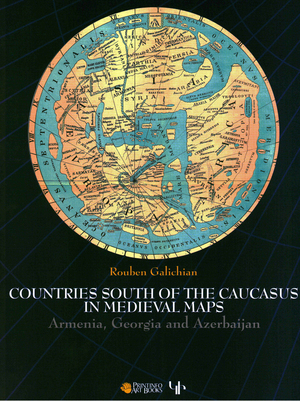
PanARMENIAN.Net/ According to the author Rouben Galichian, the intent of this work is to familiarize the reader with medieval cartography on Armenia, Georgia and Arran (Caucasian Albania, or present Republic of Azerbaijan), situated south of the Caucasus range. It is arranged in four chapters: Introduction to Early Medieval Maps, Early [European] Medieval Maps, Islamic Maps, and Late Medieval Maps. List of Maps appears at the beginning of the book, Conclusion, Bibliography and Index of Toponyms and People at the end. The author has investigated collections of medieval maps in several European major libraries and those of Yerevan, Istanbul, Teheran etc., trying to give the reader a broad historical background on medieval maps, both European and Islamic. The author depicts and describes 82 main maps (mappa mundi. European and Islamic), with 26 details, mainly showing Armenia and the neighboring territories in three well-balanced chapters (two to four). Chapter two includes 32 European medieval maps (Nos1-32) and nine details, beginning with a simple T-O map by Caius Crispus Sallustius, known as Sallust (86-34 BCE), a Roman senator and historian. This pictured manuscript copy dates from the 9'h or 10'h century, drawn on vellum and kept at the University of Leipzig.
Chapter four contains images and descriptions of 27 later [European] medieval maps (Nos 56-82) and 15 details.
The author concludes that in medieval times, due to lack of border demarcations and the rule of force, few borders were fixed for long, or could be even approximately determined. Consequently, most medieval maps lack bordering lines between countries which are shown just by mentioning their names somewhere in the area they occupied. Armenia appears in almost every map showing some sort of detail, and in many cases both Greater and Lesser-Armenia (Armenia Major and Minor) are depicted. Perhaps a more prominent position given to Armenia is due to the fact that it was the oldest and easternmost Christian nation, which proclaimed Christianity as the state religion in 301 CE, and due to the Biblical account of the Flood and Mount Ararat, where Noah’s Ark came to rest, Komitas Institute reported.
more: centralasiaharvard.blogspot.com
AmazonShop: Books, Maps, Videos, Music & Gifts About The Caucasus
Showing posts with label Rouben Galichian. Show all posts
Showing posts with label Rouben Galichian. Show all posts
Wednesday, March 25, 2009
BOOK: “Countries South of the Caucasus in Medieval Maps – Armenia, Georgia and Azerbaijan” book published (panarmenian.net)


Saturday, December 27, 2008
HISTORY: R. Galichian: Countries South of the Caucasus in Medieval Maps. Armenia, Georgia and Azerbaijan. By Rouben Galichian.
 Ort: Yerevan, London
Verlag: Gomidas Institute
Jahr: 2007
ISBN: 978-1-903656-69-3
Umfang/Preis: 208 S.; € 41,70
Rezensiert für geschichte.transnational und H-Soz-u-Kult von: Dittmar Schorkowitz, Geisteswissenschaftliches Zentrum Geschichte und Kultur Ostmitteleuropas (GWZO), Universität Leipzig E-Mail: schorkowitz@t-online.de
Mit seinem jüngsten Buch bietet Rouben Galichian einem an historischer Geographie interessierten Fachpublikum einen erneut spannenden Einblick in seine Studien zur Kartographie des europäischen Mittelalters. Dies geschieht nicht ohne politischen Hintergrund. Hatte sein Erstlingswerk [1] sowohl den historischen Platz Armeniens unter den Ländern Osteuropas, Kleinasiens und des Mittleren Ostens als auch die kulturgeschichtliche Zugehörigkeit westarmenischer Gebiete Ostanatoliens sowie des formal noch zu Aserbaidschan gehörigen, ostarmenischen Arcach zu Armenien veranschaulicht, so geht es ihm nun im Kontext der Europäischen Nachbarschaftspolitik um das Aufzeigen von Bezügen der drei südkaukasischen Staaten zu Europa.
Das vorgestellte Kartenwerk verweist damit auf große Perspektiven. Denn sollte die Türkei wirklich Mitglied der Europäischen Union werden, was zum gegenwärtigen Zeitpunkt eher fraglich erscheint, dann würden Armenien, Georgien und Aserbaidschan zu unmittelbaren Nachbarn der EU. Seit 2004 ist die Union daher im Vorfeld schon bemüht, die wirtschaftlichen und rechtlichen Strukturen der südkaukasischen Staaten europäischen Standards anzugleichen. Und hier will Rouben Galichian gleichsam im Gegenzug auch Europa einen Begriff von Südkaukasien geben.
Der ganze Text >>>
Erläuterungen zu den wunderbaren nachfolgenden Karten finden sie ebenfalls hier >>>
AmazonShop: Books, Maps, Videos, Music & Gifts About The Caucasus
Subscribe to:
Posts (Atom)