Ein Menschenleben später begeben sich 3 Freunde aus dem Kaukasus auf einer Reise. Ein Featurefilm der Reiseagentur Kaukasus-Reisen. Grenzenlos Reisen in Georgien, Armenien und Aserbaidschan - nach Corona.
Mit Bukhuti Papuashvili, Levon Ishkhano & Farik Aliev.
Musik & Musikanten: Ramizi Shubitidze & Rostomi Kirkitadze (GEO), Trio Aguas (ARM), Alafsar Rahimov & Shahriyar Imanov (AZE)
Showing posts with label Armenia. Show all posts
Showing posts with label Armenia. Show all posts
Sunday, May 03, 2020
VIDEO: Grenzenlos - Unterwegs mit Kaukasus-Reisen in Georgien, Armenien, Aserbaidschan. via @kaukasus-reisen


Saturday, July 14, 2018
EASTSPECTION: CAUCASIAN MOOD - eine poetische Dokumentation über Georgien und Armenien. Von Tomas Zebis & Tom Kretschmer
A poetic documentary through associative, subjective and emotional eyes of the transient and a journey through Georgia and Armenia – a world which might soon disappear. The film suggests the rapid changes and the loss of social values and inspires a reflection on Western culture.
Caucasian Mood I Teaser from eastspection on Vimeo. Full Version: vimeo.com
CAUCASIAN MOOD dokumentiert Stimmung pur. Maloche, Müßiggang und Wärme fließen dahin bis Idylle und Tristesse sich einen. Die kollektive Pause einer Weinernte im Schatten des einzigen Baumes. Saftige eingemachte Speisen werden aus der Zeitung gerollt und geteilt. Es wird gelacht und geträumt, junge Burschen vereint mit der Weisheit der Alten, Ursprünglichkeit und Seelenruhe.
Assoziative Ordnungsprinzipien lassen subjektive Bilder kaleidoskopisch verschmelzen und Raum und Zeit verschwimmen. Zurück bleibt eine Ambivalenz zwischen materieller Armut und menschlichem Reichtum. Der Film deutet die rapiden Wandlungsprozesse und den Verlust sozialer Werte an und inspiriert zu einer Reflexion über die westliche Kultur.
CAUCASIAN MOOD documents moods. To sweat something away, the idleness and a warmth flow until Idyll and tristesse become one. The collective break during a vintage in the shadow of the only tree. Food is being rolled out of newspaper and shared. They laugh and dream – young fellows united with the wisdom of the old folks – nativeness and peace of mind.
Associative ordering principles allow the kaleidoscopic merging of subjective images and make space and time become blurry. What remains is an ambivalence between material poverty and human wealth.
Links:
eastspection.com/caucasian-mood
eastspection.com/armenia
eastspection.com/georgia
Die Faszination für die Länder der heutigen postsozialistischen Staaten ist die Triebfeder für ihre gemeinsamen Projekte. Es ist der Wunsch die rapiden Wandlungsprozesse in Bildern festzuhalten und somit eine Reflexion über die westliche Kultur anzuregen. Dabei steht der Mensch im Mittelpunkt.
Tom Kretschmer: seit 1976 in Ostberlin sozialisiert, studierte nach seiner Ausbildung zum Fotografen visuelle Kommunikation. Er experimentiert als freischaffender Künstler zwischen Fotografie, Grafik und Film. Sein erster poetischer Dokumentarfilm über den sich im Wandel befindlichen Bahnhof Ostkreuz gewann international zahlreiche Preise.
Tomas Zebis: wurde 1980 in der Tschechoslowakei geboren. Bereits sechs Jahre später erfolgt die Republikflucht mit anschließender Emigration in die BRD. Der studierte Kommunikationsdesigner ist als freischaffender Videodesigner und bildender Künstler tätig. Eine geistige Verwandtschaft zu den Flaneuren des 20. Jahrhunderts ist nicht zu leugnen.
E-Mail: hi@eastspection.com
Caucasian Mood I Teaser from eastspection on Vimeo. Full Version: vimeo.com
CAUCASIAN MOOD dokumentiert Stimmung pur. Maloche, Müßiggang und Wärme fließen dahin bis Idylle und Tristesse sich einen. Die kollektive Pause einer Weinernte im Schatten des einzigen Baumes. Saftige eingemachte Speisen werden aus der Zeitung gerollt und geteilt. Es wird gelacht und geträumt, junge Burschen vereint mit der Weisheit der Alten, Ursprünglichkeit und Seelenruhe.
Assoziative Ordnungsprinzipien lassen subjektive Bilder kaleidoskopisch verschmelzen und Raum und Zeit verschwimmen. Zurück bleibt eine Ambivalenz zwischen materieller Armut und menschlichem Reichtum. Der Film deutet die rapiden Wandlungsprozesse und den Verlust sozialer Werte an und inspiriert zu einer Reflexion über die westliche Kultur.
 |
Foto: eastspection.com
|
CAUCASIAN MOOD documents moods. To sweat something away, the idleness and a warmth flow until Idyll and tristesse become one. The collective break during a vintage in the shadow of the only tree. Food is being rolled out of newspaper and shared. They laugh and dream – young fellows united with the wisdom of the old folks – nativeness and peace of mind.
Associative ordering principles allow the kaleidoscopic merging of subjective images and make space and time become blurry. What remains is an ambivalence between material poverty and human wealth.
Links:
eastspection.com/caucasian-mood
eastspection.com/armenia
eastspection.com/georgia
Die Faszination für die Länder der heutigen postsozialistischen Staaten ist die Triebfeder für ihre gemeinsamen Projekte. Es ist der Wunsch die rapiden Wandlungsprozesse in Bildern festzuhalten und somit eine Reflexion über die westliche Kultur anzuregen. Dabei steht der Mensch im Mittelpunkt.
Tom Kretschmer: seit 1976 in Ostberlin sozialisiert, studierte nach seiner Ausbildung zum Fotografen visuelle Kommunikation. Er experimentiert als freischaffender Künstler zwischen Fotografie, Grafik und Film. Sein erster poetischer Dokumentarfilm über den sich im Wandel befindlichen Bahnhof Ostkreuz gewann international zahlreiche Preise.
Tomas Zebis: wurde 1980 in der Tschechoslowakei geboren. Bereits sechs Jahre später erfolgt die Republikflucht mit anschließender Emigration in die BRD. Der studierte Kommunikationsdesigner ist als freischaffender Videodesigner und bildender Künstler tätig. Eine geistige Verwandtschaft zu den Flaneuren des 20. Jahrhunderts ist nicht zu leugnen.
E-Mail: hi@eastspection.com
Friday, June 29, 2018
CALL: Project Description “Traces Of Togetherness” - Stories of common roots of each others culture in Azerbaijan, Armenia, Georgia and Russia
The project ToT brings together citizens of Russia, Azerbaijan, Armenia and Georgia to find and publish stories of common roots of each others culture.

The second goal is to provide people from the participating countries - which partly face difficult political situations - the posibility to share, on a non-political basis their opinions and get to know each other better.
Five people from each of the countries will meet each other for ten days, End of August 2018 in the Russian city of Uljanovsk to present there stories of traces of Russian culture from their home countries and to research and present stories from traces of Caucasian life in Uljanowsk. Project language will be english (and russian).
Each country – group from the Caucasus will be joined by a mentor who chooses the participating "citizen journalists" and coordinates the activities of the group in their home countries as well as during the workshop periode in Russia. After the workshop he/she promotes and partialy coordinates the following online story competition in their home countries.
It is also important to know, that the project funding is not 100% certain until now.
I hope to get definite commitments until mid of June....
Three "citizen journalists" and one mentor of each of the following countries:
Azerbaijan, Armenia, Georgia and Russia will meet in August in Uljanowsk/ RU to develope and/or improve their journalistic/media skills in text, photography, videography, multimedia storytelling and social media. We look for participants who are interested in journalism/storytelling and are NOT professional journalists. If they have experiences in some of the journalistic technics that would be fine. They also should speak - in best case – both English and Russian or at least one of those languages.
Beside the technical aspects the project aims to promote intercultural understanding and communication as well as empowerment of the members of the civil society.
Therefor the topic of the workshop is "traces of togetherness", wich means that the participants will focus on different traces of other/foreign cultures in their own surroundings. That means specifically that each caucasian country team will research and produce between one and three stories (photostory and/or video and/or text and/or multimedia) about Russian traces in there home countries, which will be shown at the beginning of the workshop stay in Uljanowsk.
In Uljanowsk each group together with Russian participants will research and produce stories about caucasian traces in the City of Uljanowsk.The results will be shown at the end of the stay in Uljanowsk as well. All of the stories will be published online as well as some of them in a publication after the workshop week. To give that project a perspective and to invite more people to start a carrier as citizen journalist in this four countries there will be an open (citizen journalistic) competition in September where everyone who is interested can participate ...

The tasks for the mentor of each country team are basically
•to find and select the participants who are open, interested and willing to be part of this project
•to coordinate the production of the first story(s) which will be produced before August in each country
•to coordinate (partly) the preparation of the travel
•to coordinate (partly) the stay of the group in Uljanowsk and
•to help with the preparation of the story competition after the stay in Russia in their own countries
For the participants/mentors all travel/visa cost and costs of living in Uljanowsk as well as the costs for the journalistic trainer will be covert. The mentors receive an allowance of 600 Euro for the whole project.
So generally we are looking for open minded people who enjoy exchanging there experiences with others despite of political, ethnical and /or social differences.
If you are interested or if you have more questions please email or call me
(Whats App, Messenger, Viber )!
My mobile number is +49 (0) 179 5420 175
matthias_schumann@yahoo.com
All the Best, Matthias Schumann
Funding is the Kulture Aktiv e.V., supported by Department of Foreign Affairs in Germany.
Wednesday, January 10, 2018
CLASSIC: Tigran Mansurian (1939): Requiem (2011). For soprano, baritone, mixed choir & string orchestra
I. 00:07 Requiem aeternam: Lento, solenne
II. Kyrie: Moderato, articolando
III. Dies irae: Con moto, passionato
IV. 16:21 Tuba mirum: Moderato, cantando
V. 21:05 Lacrimosa: Tranquillo
VI. 27:30 Domine Jesu Christe: Feroce
VII. Sanctus: Tranquillo, misterioso
VIII. 39:08 Agnus Dei: Lento, como preghiera
Kristine Muldma, soprano
Rainer Vilu, baritone
Eesti Filharmoonia Kammerkoor
Tallinna Kammerorkester
Tõnu Kaljuste
2 November 2016, Kaarli Kerk, Tallinn (Estonia)
For copyright issues: tim.poulus@gmail.com
Publisher (Schott): https://goo.gl/rRsbwZ
Composer: https://goo.gl/3MUjpJ
Broadcast (ERR): https://goo.gl/wMgQX7
This work is dedicated to the victims of the Armenian genocide. During its composition, I was confronted by the problem of differing interpretations of the canonical texts laid down by the Armenian and Roman-Catholic churches. Armenian Christians conceive for example the intonation of the 'Kyrie eleison' according to the Western tradition somehow different from their tradition. I naturally selected the Armenian tradition; I had no wish to copy the rhetoric and gestures of a rite to which I am unaccustomed. I hope that the interlinking of ancient sacred and secular music of Armenia with the Latin text has created something unexpected and even slightly paradox in my music. (Tigran Mansurian)
Tigran Mansurian has created a Requiem dedicated to the memory of the victims of the Armenian Genocide that occurred in Turkey from 1915 to 1917. Co-commissioned by the Munich Chamber Orchestra and the RIAS Choir Berlin, Mansurian’s Requiem reconciles the sound and sensibility of his country’s traditions with those of Western practices, the combination of ancient Armenian religious and secular music with the Latin Requiem text “giving rise to something unexpected,” the composer says. This is profoundly moving contemporary composition, illuminated by the “glow of Armenian modality,” as Paul Griffiths puts it in his booklet essay. The work is a milestone for Mansurian, widely acknowledged as Armenia’s greatest composer. The Los Angeles Times has described his music as that “in which deep cultural pain is quieted through an eerily calm, heart-wrenching beauty.” (challengerecords.com)
homepage: tigranmansurian.com
Facebook: facebook.com/Tigran Mansurian
links:
Tuesday, January 09, 2018
VIDEO: Zu Tisch in Armenien via @ARTEde
ZU TISCH
Die armenische Küche ist von türkischen, arabischen und russischen Traditionen beeinflusst und gehört zu den ältesten in Transkaukasien. Die Zutaten stammen oft aus eigenem Anbau oder vom Markt. Ob Lammspieße oder Süßspeisen: Viele Gerichte werden in einem im Boden eingelassenen Lehmofen, dem sogenannten Tonir, zubereitet. In diesem Ofen wird außerdem das armenische Brot Lavash gebacken: Dazu werden hauchdünne Teigplatten an den heißen Steinwänden erhitzt. Als Beilage zum Hauptgericht stehen neben Bulgur stets auch wilde Kräuter wie Koriander, Petersilie und Minze in Schalen verteilt auf dem Tisch.
DIE REGION
Inmitten der Bergketten des Kleinen Kaukasus, zwischen der Türkei, Georgien, Iran und Aserbaidschan, liegt Armenien – ein Land, das sich zu 90 Prozent auf über 1.000 Metern Höhe erstreckt. Erst seit 21 Jahren ist das Land unabhängig, bis 1991 gehörte es zur Sowjetunion. Der Staat ist so groß wie Belgien, aber nur dünn besiedelt: So lebt von ins-gesamt drei Millionen Eiwohnern circa eine Million allein in der Hauptstadt Jerewan.
Die Geschichte des Landes ist von großen Emigrationswellen gezeichnet, die politischen Konflikten geschuldet sind und zu einer immensen Diaspora geführt haben: Sechs Millionen Armenier leben außerhalb ihres Heimatlandes, die meisten sind nach Russland und in die USA ausgewandert. Die Überweisungen größerer Geldbeträge von im Ausland lebenden Armeniern an ihre Verwandten beeinflussen sogar das Bruttoinlandsprodukt des Landes.
TYPISCH ARMENIEN
Armenien gilt als das älteste christliche Land der Welt: Hier wurde im Jahr 301 das Christentum zur Staatsreligion erklärt. Die erste Staatskirche, heute UNESCO-Weltkulturerbe, steht in Etschmiadsin. Inzwischen sind Staat und Religion getrennt, jedoch ist die Armenische Apostolische Kirche die „nationale Kirche Armeniens“ – ihr gehören 93 Prozent der Bevölkerung an.
Das Land hat eines der ältesten Weinanbaugebiete der Welt zu bieten: Schon vor 2.500 Jahren wurde hier Wein kultiviert, seit 150 Jahren zudem Weinbrand destilliert, den die Armenier als Cognac bezeichnen – in der EU ist der Begriff den Franzosen vorbehalten. Der Kaukasus-Weinbrand ist bei Kennern sehr beliebt, zu ihnen gehörte auch Churchill.
DAS REZEPT
Gata
Armenischer Butterkuchen
Teig: 1 EL Trockenhefe, 1 Tasse Schlagsahne, 1 Tasse Butter, 1 Ei, 1 EL Öl, 1 EL Essig, 3 Tassen Mehl; Füllung: 1 Tasse Butter, 2 Tassen Mehl, 1 Tasse Zucker, 3 Pck. Vanillezucker; Glasur: 2 Eigelb
Teig: Hefe mit der Sahne mischen. 10 Min. ruhen lassen. Zerlassene Butter, Ei, Öl und Essig hineinrühren. Mehl zufügen. Teig kneten, mind. 1 Stunde kalt stellen. Füllung: Zerlassene Butter, Mehl, Zucker und Vanillezucker mischen. Ofen auf 180 Grad vorheizen. Teig ausrollen, Füllung darauf verteilen und verschließen, erneut ca. 2 cm dick ausrollen. Mit Ei bestreichen und 30 Min. backen. Bari achordschak!
Link: www.arte.tv/zu tisch in armenien
Sunday, May 14, 2017
BUCH: Herbert Maurer; Und Gott spricht armenisch. Zwischen Menschen und Sprache. (herbertmaurer.at)

Ohne die eigene Schrift, die eigene uralte Sprache, die Passion für Geschichten und Geschichte gäbe es die Armenier, gäbe es Armenien wohl nicht mehr – immerhin hat sich eine kleine Republik im Süden des Kaukasus durch die sowjetische Zeit und die Umbrüche der Systeme gerettet, wenn auch große Teile des historischen Landes im heutigen Ostanatolien verloren scheinen. Das Jahr 2015 bedeutet 100 Jahre Völkermord, den schicksalhaften Jahrestag des ersten Holocausts im 20. Jahrhundert. Für die Armenier bedeutet diese nur von Teilen der Weltgemeinschaft anerkannte Katastrophe zweierlei: Stolz auf die eigene Kultur, Zukunft in gelebter Internationalität, Perspektive für neue, weltoffene Varianten des Eigenen, Neuerfindung einer nationalen und internationalen Identität, Verantwortung für das Leiden anderer.
Herbert Maurer weiß als Autor, Übersetzer, Reporter und Zeitzeuge des politischen und gesellschaftlichen Wandels in Armenien über alle diese Hintergründe bestens Bescheid. Er erzählt seine persönliche Geschichte einer Begegnung mit der Sprache, der Literatur, der Kultur der Armenier. 3 Jahre leben und verstehen Lernen bedeutet für ihn stets:
Wie lässt sich die Realität ins Poetische übersetzen? Wie funktioniert Widerspruch zwischen Sowjetsozialismus und uraltem Christentum heute? Wie erfindet sich ein Land, ein Volk im internationalen Kontext neu? Über viele Jahrhunderte waren die Armenier die Übersetzer schlechthin: zwischen Orient und Okzident, zwischen Mittelalter und Moderne. Wie kann man das heutige Armenien literarisch übersetzen?
Herbert Maurer versucht in diesem Buch, Armenien zu interpretieren, die einzigartige Mentalität der Menschen verständlich zu machen, mit dem Leser durch die Straßen, durchs Land zu gehen.
Ein Erzählen, um vertraut zu machen: Mit einer Sprache, mit Kultur und Literatur, mit der Chance, das komplizierte Armenisch einfach und charmant zu verstehen. Damit wird die Lektüre zur Reise, zum Abenteuer zwischen dem biblischen Berg Ararat und den Kaffeehäusern des modernen Yerevan in der Sonne, zwischen den Geheimnissen des Mittelalters mit seinen Klöstern und der jungen Generation mit Kompetenz und Neugier, zwischen Kriegsalltag in Nagorny Karabach und der schillernden Welt der Jazz- und Film – Festivals, zwischen der Not eines Landes, das von den Nachbarn isoliert ist und der Hoffnung, eine neue Zukunft mit Literatur und guten Kompositionen zu konstruieren – Armenien ist mitten in der Welt, das Abenteuer lebt auch im
Auf all diese erzählerischen Reisen nimmt Herbert Maurer uns mit, denn der lesende Mensch ist vor allem in Armenien mitten in der Zukunft und ein Wanderer zwischen den Welten.
weiter >>
Tuesday, April 18, 2017
DOCUMENTARY: Silk Road IV 1/5 "South Caucasus - The Flame and the Cross"
Silk Road IV Central and West Asia (2007)
Episode 1 of 5 - The Flame and the Cross -- The South Caucasus
Surrounded by 5,000-meter high mountains, the South Caucasus was a strategic point tying together all directions of the Silk Road. Home to 50 ethnic groups, the region is a cultural treasure trove of unique ethnic music, religious architecture, wines, and so on. It has also been invaded by the Roman, Mongol, and Ottoman empires. Wars still rage even now, and over one million people have become refugees. The region is truly representative of both the blessings and the historical calamities brought on by the Silk Road. This leg of the journey will take you to three countries -- Azerbaijan, Armenia, and Georgia -- countries that have long fostered unique cultures tempered by the flames of war.
Launched in 1980, NHK's renowned Silk Road series was the first foreign TV program allowed to film Silk Road inside communist China. The series sparked enormous interest. A quarter of a century later, NHK re-visits Silk Road with high-definition cameras, and continues further through Central and West Asia.
Wednesday, February 15, 2017
DOKUMENTATION: Aghet - Ein Völkermord an den Armeniern. Ein Film von Eric Friedler
Der Dokumentarfilm "Aghet" (armenisch: "die Katastrophe") von Eric Friedler erzählt von einem der dunkelsten Kapitel des 1. Weltkriegs: dem Genozid an den Armeniern, bei dem bis zu 1,5 Millionen Menschen im Osmanisch-Türkischen Reich starben.
AGHET – Ein Völkermord, der 90-minütige Dokumentarfilm (armenisch: “die Katastrophe”), erzählt von einem der dunkelsten Kapitel des Ersten Weltkriegs: dem Genozid an den Armeniern.
Zwischen 1915 und 1918 wurden bis zu 1,5 Millionen Menschen im Osmanischen Reich (heute Türkei) ermordet. Dieser Völkermord, der sich am 24. April 2012 zum 97. Mal gejährt hat, wurde von Raphael Lemkin, dem Schöpfer der 1948 von der UN verabschiedeten Anti-Genozid-Konvention, als der erste systematisch ausgeführte Völkermord des 20. Jahrhunderts bezeichnet. Er wird allerdings bis heute von den Verantwortlichen und ihren Nachkommen geleugnet und von der Welt weitgehend verdrängt. Wie konfliktgeladen das Thema des armenischen Völkermords noch immer in der Türkei ist – und für diejenigen, die es kritisch in die Öffentlichkeit tragen, oft sogar lebensgefährlich – zeigen die Ermordung des armenisch-türkischen Journalisten Hrant Dink am 19. Januar 2007 und die Anklagen gegen den Nobelpreisträger Orhan Pamuk.
Seit Jahren beschäftigt sich Autor und Regisseur Eric Friedler (“Das Schweigen der Quandts”, 2007) mit den politischen Motiven, die noch heute stark genug sind, um die historische Tatsache des Armenier-Genozids zu verschweigen und zu unterdrücken. Er sprach mit internationalen Regierungschefs und der intellektuellen Elite der Türkei, befragte Historiker, Zeitzeugen und Wissenschaftler in der Türkei, Deutschland, USA, Frankreich, Syrien und Armenien, aber auch Vertreter der weltweiten armenischen Diaspora wie den Boxer Arthur Abraham, den französischen Minister Patrick Devedjan oder den ehemaligen armenischen Außenminister Rafi Hovannisian.
mehr dazu: aghet1915.wordpress.com
weitere links:
Aghet - Ein Völkermord - Diskussion 1 [phoenix.de]
Aghet - Ein Völkermord - Diskussion 2 [phoenix.de]
Aghet - ein Völkermord [3sat]
Fernsehfilm "Aghet – ein Völkermord": "Das ganze Land war ein Schlachthaus". Von Michael Thumann [zeit.de]
»Aghet war der erste Völkermord in der Geschichte des 20. Jahrhunderts« [http://sz-magazin.sueddeutsche.de]
Sunday, February 21, 2016
EINLADUNG: Internationale Konferenz Berlin "The Displacement, Extinction and Genocide of the Pontic Greeks. 1916-1923" (ruhr-uni-bochum.de)

Sehr geehrte Damen und Herren,
hiermit möchten wir Sie herzlichst zu unserer internationalen Konferenz „The Displacement, Extinction and Genocide of the Pontic Greeks. 1916-1923.“ einladen.
Die Konferenz findet am 25. und 26. Februar 2016 im Senatssaal der Humboldt-Universität zu Berlin statt. Anbei finden Sie sowohl die Konferenzankündigung als auch das Tagungsprogramm.
In den vergangenen Jahren erhielt der Völkermord an den Armeniern zunehmend mehr Aufmerksamkeit, sowohl in der Forschung als auch in der breiten Öffentlichkeit. Folgt man allerdings den neusten internationalen Forschungsarbeiten, so muss der jungtürkische Genozid an den Armeniern vielmehr als nur ein Kapitel einer allumfassenderen anti-muslimischen/anti-türkischen Kampagne der Jungtürken und Kemalisten verstanden werden. So waren neben den Armeniern insbesondere griechische Bevölkerungsgruppen in Kleinasien von den Maßnahmen wie Deportation und Gewalttaten betroffen, die im Interesse spezifisch jungtürkischer und kemalistischer Visionen des osmanischen Raums zwischen 1913 und 1923 durch den osmanischen Staat begangen wurden. In diesem Zusammenhang erreichte die anti-griechische Kampagne ihren gewaltvollen Höhepunkt in dem Genozid an der griechischen Bevölkerung in der Pontos-Region an der Schwarzmeerküste. Obgleich die Vernichtung der Pontos-Griechen vor allem im US-amerikanischen Raum eine zunehmend prominentere Stellung in der historiographischen Landschaft eingenommen hat, stellt die Erforschung dieser Geschehnisse im europäischen Raum doch noch weitestgehend ein Desiderat der historischen Forschung dar.
Es ist daher das Ziel der anstehenden Konferenz sowohl dafür ein Bewusstsein zu schaffen, was der pontos-griechischen Bevölkerung unter der jungtürkischen und kemalistischen Herrschaft widerfahren ist, als auch die internationale und interdisziplinäre wissenschaftliche Zusammenarbeit innerhalb dieses Forschungsfeldes zu fördern. Darüber hinaus beabsichtigt die Konferenz, das Expertenwissen von Wissenschaftlern, die zu den Bereichen Spätes Osmanisches Reich, Jungtürkismus, Kemalismus, griechisch-türkische Beziehungen und der griechischen Diaspora geforscht haben, zusammenzubringen.
Die Konferenzsprachen sind Deutsch und Englisch. Alle Beiträge werden simultan übersetzt.
Gäste sind herzlich willkommen, wir würden Sie aber bitten sich bei pontic@rub.de anzumelden. Die Teilnahme ist kostenlos.
Für weitere Informationen besuchen Sie bitte: www.ruhr-uni-bochum.de/pontic
Wir würden uns sehr freuen, wenn Sie diese Konferenzankündigung an alle Kolleginnen und Kollegen weiterleiten würden, für die dieses Thema von Interesse ist.
Mit freundlichen Grüßen
Institut für Diaspora und Genozidforschung
Ruhr-Universität Bochum
Historisches Institut
Postanschrift: Universitätsstr. 150, D-44801 Bochum
Besucher: Gebäude NA, Etage 6 Nord
E-Mail: pontic@rub.de / idg@rub.de
IDG: www.ruhr-uni-bochum.de/idg
+++
Dear Sir or Madam,
we are pleased to invite you to our international conference „The Displacement, Extinction and Genocide of the Pontic Greeks. 1916-1923.“
The conference will take place on February 25 & 26, 2016, at the Senatssaal, Humboldt University in Berlin.
Over the last years, the genocide committed against the Armenians has received more and more scientific and popular attention. However, as recent international research has emphasized, the Armenian genocide by the Young-Turkish government has to be understood as only one chapter of an overall campaign of the Young-Turkish and Kemalist government against the non-Muslim (and later non-Turkish) communities. Besides the Armenians, particularly Greek communities in Asia Minor were affected most in terms of forced migration and atrocities, committed in the interests of specific Young-Turkish and Kemalist visions of the Ottoman space between 1913 and 1923. In this regard, the governmental campaign reached its violent climax in the genocide of the Greek communities in the Pontic area at the shores of the Black Sea. Albeit the killing of the Pontic Greek has become increasingly prominent in Anglo-American historical research, it still continues to be a desideratum within the European field of research.
The aim of the upcoming conference is thus both to raise awareness about what happened to the Pontic-Greek community during the Young-Turkish and Kemalist regimen and to promote the international and interdisciplinary collaboration within this field of research. As the displacement and extinction of the Pontic-Greek community has to be contextualized as part of the complex socio-political relations between Muslim/Turkish hegemony and non-Muslim/non-Turkish communities, the conference intends to bring together the expert knowledge of international scholars working within the fields of the late Ottoman, Young-Turkish and Kemalist period, Greco-Turkish relations and the Greek diaspora.
The conference will be held in German and English with simultaneous interpretation.
Guests are very welcome. Please register with pontic@rub.de. There is no registration fee.
For further information, please visit: www.ruhr-uni-bochum.de/pontic
We would be very pleased if you could forward this invitation to all persons interested in the subject.
With kind regards
Tuesday, January 26, 2016
LITERATUR: Die vierzig Tage des Musa Dagh. Von Franz Werfel in: Lesezeit | MDR FIGARO | 25.01.-26.02.2016 [mdr.de]
(mdr.de) Eine armenische Familie flieht vor der Ausrottung durch die Türken. Auf dem Berg Musa Dagh leisten sie einen aussichtslosen Widerstand. Franz Werfel schrieb seinen Roman basierend auf den Eindrücken von Zeitzeugen. Das Buch wurde 1933 in Deutschland verboten. Werfel emigrierte 1938 in die USA, wo er 1945 starb. Er erhielt 2006 posthum die armenische Staatsbürgerschaft verliehen.
 |
| Foto: Ralph Hälbig |
Hoffnung in finsteren Zeiten
Vor diesem historischen Hintergrund wird die Geschichte Gabriel Bagradians als militärischer Kopf des Widerstandes erzählt: Er war Offizier der Reserve in der türkischen Armee. Über vierzig Tage halten die Armenier auf dem Berg aus, vierzig Tage zwischen Verzweiflung und Hoffnung, vierzig Tage zwischen Mut und der Gewissheit doch zu sterben. Am Ende naht Rettung in Form französischer und britischer Schiffe, aber Rettung wohin?
Die Wahrheit mitteilen
Noch immer ist es schwierig, den Völkermord an den Armeniern in den
Jahren 1915 bis 1917 beim Namen zu nennen. Als Franz Werfel 1930 durch
Anatolien reiste, schockierten ihn die Begegnungen mit Zeitzeugen und er
begann, akribisch für einen Roman zu recherchieren.
"Die vierzig Tage des Musa Dagh" beschreiben das Schicksal einer armenischen Familie, die langsam ausgegrenzt und schließlich mit Waffengewalt verfolgt wird. Auf dem Heimatberg, dem Musa Dagh, leistet ihre Dorfgemeinschaft der Vertreibung Widerstand. Umsichtig und differenziert, mit einer klaren, fließenden Sprache verwandelt Werfel diese historische Katastrophe in ein eindrucksvolles Epos.
Der Schriftsteller Franz Werfel
Geboren 1890 in Prag, verließ Franz Werfel 1912 seine Heimatstadt und
arbeitete als Lektor im Leipziger Kurt Wolff Verlag. Während des Ersten
Weltkrieges war er Soldat. "Die vierzig Tage des Musa Dagh" beschreiben das Schicksal einer armenischen Familie, die langsam ausgegrenzt und schließlich mit Waffengewalt verfolgt wird. Auf dem Heimatberg, dem Musa Dagh, leistet ihre Dorfgemeinschaft der Vertreibung Widerstand. Umsichtig und differenziert, mit einer klaren, fließenden Sprache verwandelt Werfel diese historische Katastrophe in ein eindrucksvolles Epos.
Der Schriftsteller Franz Werfel
In den 1920er- und 1930er-Jahren avancierte Werfel zu einem der meistgelesenen deutschsprachigen Autoren. 1938 emigrierte er nach Frankreich, 1940 über Spanien in die USA. Er starb 1945 in Beverly Hills.
"Die vierzig Tage des Musa Dagh" erschien 1933 in Wien und Berlin und wurde in Deutschland zwei Monate später verboten.
Es liest Christian Brückner
Alle Folgen hier: mdr.de/mdr-figaro/Franz Werfel: vierzig Tage des Musa Dagh
Thursday, January 14, 2016
PHOTOGRAPHY: Frédéric Chaubin. Cosmic Communist Constructions Photographed
Thirteen former Soviet Republics. Nearly 90 astonishing structures. Frédéric Chaubin’s award-winning tour of late USSR architecture now redesigned for iPad, with original architectural drawings, an interactive map, audio commentaries, and exclusive video introduction.
In his book Cosmic Communist Constructions Photographed, French photographer Frédéric Chaubin captures the eerie beauty of Soviet brutalism. In his quest to document Brezhnev-era architecture, he stumbled upon 90 Soviet buildings scattered across 14 former-USSR republics. The diversity and lack of a recurring theme across the buildings signaled the end of the Soviet Union.
Cosmic Communist Constructions Photographed by Frederic Chaubin, published by TASCHEN.
More Links:
Frédéric Chaubin and Taschen present: Cosmic Communist Constructions Photographed (VIDEO)
In pictures: Frédéric Chaubin's subversive Soviet superstructures
Frédéric Chaubin surveys the relics of the former Soviet Union
Cosmic Communist Constructions Photographed by Frederic Chaubin
Sunday, April 19, 2015
ARMENIAN GENOCIDE: Worldwide Reading Commemorating the Centenary of the Armenian Genocide (massispost.com)
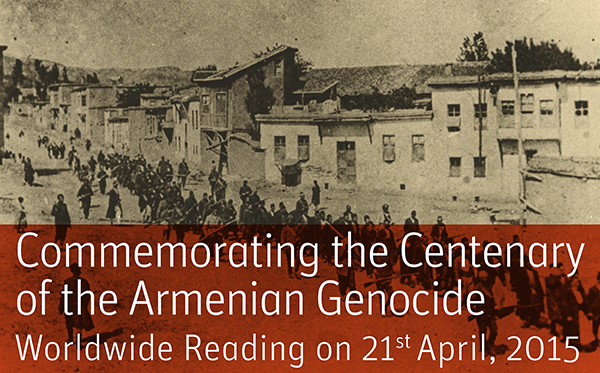
The text selected for the reading has been taken from chapters seven and eight from The Book of Whispers by Varujan Vosganian. The text is available in 15 languages on www.worldwide-reading.com . Shortly more information will be available about where readings will be taking place.
More than 300 authors from more than 65 countries are supporting this initiative, among them Nobel Prize for Literature laureates Mario Vargas Llosa, Herta Müller, Elfriede Jelinek, Orhan Pamuk, Günter Grass and John M. Coetzee.
To organize a reading, send relevant information by the 30th of March 2015 to worldwidereading@literaturfestival.com, including details of the exact location and time of event as well as the name of the participants.

Sunday, July 06, 2014
RELIGION: The rise of Mormons and Jehovah's Witnesses in the Caucasus. By Tara Isabella Burton @T_I_Burton via via @AJAM (america.aljazeera.com)
(america.aljazeera.com) Armenia and Georgia were the first to adopt Christianity as their state religion; now, American evangelical sects beckon
In the Armenian town of Artashat, a grid of Soviet concrete and corrugated tin roofs an hour from the capital city of Yerevan, few buildings stand out like the meeting hall of the Church of Jesus Christ of Latter-day Saints (LDS). Unlike the crumbling towers that surround it, this building sports an impeccably white façade. On one Sunday in May, more than a hundred Armenians — most in their 40s and 50s — are sharing what Mormons call spiritual “testimony,” their words translated via earpiece to attending American missionaries.
Here in the Caucasus region, ethnicity and faith are often treated as one. Christians in Armenia and Georgia — which in the fourth century became the first two countries worldwide to adopt Christianity as their state religion — almost uniformly belong to the Armenian Apostolic and Georgian Orthodox Churches, respectively (93 percent in Armenia, 83 percent in Georgia).
But a near-century of Soviet-imposed secularism dramatically weakened the standing of state churches. Now, many ethnic Armenians and Georgians are gravitating toward American evangelical sects with an emphasis on attracting converts and a strong missionary presence in the region, such as LDS and Jehovah’s Witnesses. In Armenia, the number of Jehovah’s Witnesses here hovers around 11,000; LDS claims more than 3,000 members (also known as Mormons). These may be small numbers, but they are significant in this country of 3 million, where practitioners of other faiths tend to be members of minority ethno-religious groups, such as Jews or Muslim Kurds.
Both Jehovah’s Witnesses and Mormons identify as Christians, although their non-Trinitarian doctrine — both deny that Jesus Christ shares a single fundamental divine essence with God the Father and the Holy Spirit — has often brought them into conflict with mainline Christian tradition.
“Ask any Armenian on the street and they’ll say, ‘Yes, I believe in God. I believe in Jesus,’ ” says Varuzhan Pogosyan, president of the LDS Mission in Armenia. “But they don’t always practice.”
Pogosyan’s journey started shortly after the fall of the Soviet Union. Then an expatriate in Russia, he attended a local Armenian church, both for spiritual reasons and for the opportunity to socialize with other ethnic Armenians. But an encounter with a Mormon missionary made him realize he could do more than just attend services. “I could participate,” he says. “I could be involved in the life of the church.” In the absence of formal clergy, the LDS church offers ordinary members a greater role in church affairs, Pogosyan explains.
It is this sense of involvement that inspired his colleague, Margarit Ayvazyan, to convert. Like Pogosyan, Ayvazyan grew up nonreligious during Soviet rule, adopting atheism as a philosophically inclined teenager. Yet her encounters with LDS missionaries in the early 90's left her with a sense of spiritual fulfillment she had not found in her parents’ Armenian Apostolic services. In a traditional Armenian service, she says, “You just stand there and the priests pray.” Many Armenians cannot even understand the classical Armenian used in services. In LDS, where congregants are encouraged to share their experiences and participate in Bible-study classes, she has a role to play. Even those church members who do not become missionaries are encouraged to circulate information among family and friends, recruit curious “investigators” to visit services and keep track of lapsed members. Pogosyan says most converts here grew up like Ayvazyan: secular under the Soviet regime, but now seeking something more.
In some ways, he says, their history makes his mission easier, as “Armenians have always been religious.” Soviet-era secularism was a temporary aberration, and organizations such as LDS are ideally situated to reach those whose religious needs have not been met elsewhere or who feel that the Armenian Apostolic Church has failed them. After all, in all the years since he left the Church, he’s never once been contacted by any priests trying to win him back or find out why he left: a striking contrast with the LDS church, whose members actively identify and reach out to those whose attendance has lapsed.
Of course, there are challenges. Smoking, drinking and abortion were all permissible under the Soviet regime, Pogosyan says, and encouraging new converts to maintain what he calls a “healthier” way of life is a struggle. The American missionaries at Artashat tell stories of priests who attacked their brethren in neighboring towns, boys who throw rocks at them as they walk down Yerevan streets (“I think [the boys] thought we were Jehovah’s Witnesses,” one laughs. “They can’t tell the difference”).
But the biggest challenge for those seeking to convert others may be reconciling converts’ faith with their ethnic identity. Many of Pogosyan’s countrymen see those who leave the Apostolic Church as less Armenian. He takes pains to emphasize the long-standing relationship between Armenia and the LDS church, which first took hold in the Armenian diaspora in 19th-century Constantinople, as well as the increasing number of foreign missionaries of Armenian descent who have come to their ancestral homeland to serve. He is also careful to stress the cultural similarities between Armenia and the LDS church. “We’re very big on family values in Armenia,” he says, making the LDS church here a perfect fit. Ultimately, his faith has made him more Armenian, not less. It has strengthened his relationship with his family, his local community. “It has made me a better citizen.”
Minority evangelical Christian sects face similar challenges in Armenia’s northern neighbor, Georgia, where religion and nationalism are even more closely intertwined. Between 1999 and 2003, Jehovah's Witnesses lodged almost 800 complaints of religiously-motivated incidents of conflict, many violent, says Manuchar Tsimintia, a lawyer and practicing Jehovah's Witness who frequently defends the church in human rights cases. Following Georgia's bloodless Rose Revolution in 2008 and the subsequent installation of Western-leaning Mikhail Saakashvili as president, things drastically improved, but tensions remain. This situation isn’t ameliorated by the fiercely Orthodox, nationalist stance of the ruling Georgian Dream coalition, which has succeeded Saakashvili's United National Movement. In early May, a group of teenagers destroyed a cart of pamphlets Jehovah’s Witnesses were using to proselytize in Tbilisi’s city center, although, Tsimintia is pleased to report, the police charged and fined the culprits responsible.
Still, he estimates that there are about 20,000 baptized converts; another 20,000 or so attend meetings and worship: such figures, if accurate, would comprise nearly 1 percent of Georgia's population. Like the Mormons in Armenia, adherents say they converted because of disillusionment with Soviet-style anti-clericalism and existing ecclesiastical institutions and a desire to participate more fully in the activities of their church.
“It was the end of the communist regime,” Tsimintia says of his joining the Jehovah’s Witnesses. “All people were seeking God.” But Tsimintia, then enrolled in college, felt dissatisfied by the Georgian Orthodox Church, which stirred him emotionally, but could not provide him with the answers he sought. “Who is God? Who are we? Where do we come from?” It was through independent Bible study, Tsimintia says, that he came to the conclusion the Jehovah’s Witnesses had access to spiritual truth.
Increasingly, he says, those who came of age after the collapse of the Soviet Union are also finding themselves disillusioned with what they see as hypocrisy and corruption within the current hierarchy of the Georgian Orthodox Church, whose vast wealth and close financial relationship with the country’s ruling classes have often attracted scrutiny. In 2009, for example, each of Georgia’s 10 archbishops received a luxury SUV from the Georgian government. And the disenchantment has only grown more common in recent years as the church has attempted to wield greater political influence through its alliance with the Georgian Dream party ruling coalition. Many youths are also critical of the church’s tacit approval of violence; in May 2013, local Tbilisi priests, leading a mob of 20,000, attacked a small group of unarmed anti-homophobia protesters, injuring at least 12.
“They are not living according to Bible standards,” Tsimintia says. “[That is what] young people see.”
His colleague Tamaz Khutsishvili recalls a friend who sought spiritual guidance from an Orthodox priest, only to have the priest turn up at his home “so drunk he could not stand up.” One potential convert became disillusioned with his own church after a local priest with whom he had entrusted some money for temporary safekeeping informed him he had spent the funds on the construction of a new church. And both Khutsishvili and Tsimintia condemn the Orthodox church-sanctioned anti-gay violence last year as an example of church hypocrisy. The Bible, they say, condemns aggression. “Even if [people] are doing something we see as against the Bible,” Khutsishvili says, “we must never talk of violence.”
Yet here, too, converts struggle with reconciling their cultural and religious identities. “You are not Christian. You are not Orthodox. You are not Georgian. I must have heard that 10 times a day,” says Tsimintia.
Still, as with the Mormons in Armenia, Tsimintia and Khutsishvili choose to appeal to history to defend the essential Georgianness of their choice. “Once our ancestors were pagans,” Khutsishvili says. “Then they found the truth and became Orthodox. Now we’re finding truth again — and converting. We are following our ancestors.”
Thursday, April 10, 2014
PHOTOREPORTAGE: Post-Crimea, Phantom of Armenian Separatism Haunts Georgia. By Paul Rimple and Photography by Justyna Mielnikiewicz (eurasianet.org)
 |
| Amarcum Arakyan, an ethnic Armenian, cuts the hair of Josif Petriashvili, a Georgian, in the city of Akhaltsikhe. |
Slideshow with Photos are here >>>
(eurasianet.org) For many in Georgia, Russia’s annexation Crimea is reigniting fears about separatism rooted in ethnic conflict and Kremlin meddling. But now Georgians aren’t just worrying about the breakaway entities of Abkhazia and South Ossetia, they also are concerned about the loyalty of the predominantly ethnic-Armenian region of Samtskhe-Javakheti.
While locals dismiss separatism concerns as nonsense, some say the speculation on the issue is indicative of a failure on the Georgian central government’s part to address complaints of the country’s Armenian-speaking minority in Samtskhe-Javakheti, which is roughly a three-hour drive south of the Georgian capital, Tbilisi. Officials contend progress has been made, but concede more can be done on the inclusivity issue.
A mountainous, ragtag region bordering both Turkey and Armenia, Samtskhe‐Javakheti contains roughly 250,000 ethnic Armenians; 55 percent of the region’s total population, according to Georgia’s latest census, compiled in 2002. Knowledge of the Georgian language here can run thin. At the same time, in the view of some outsiders, sympathy for Russia, which, until 2007, operated a 15,000-man base in the regional town of Akhalkalaki, can run strong.
Over the past few weeks, suspicions among Georgians about the country’s Armenian minority have risen, fueled by memories of Tbilisi’s 2008 conflict with Russia, as well as the Kremlin’s recent land-grab in Crimea. Underscoring those suspicions was the appearance of unconfirmed media reports about ethnic Armenians from Samtskhe-Javakheti allegedly applying, en masse, to receive Russian passports.
Senior Georgian government officials have denied categorically these reports, but, as Russia-Ukraine tension threatens to boil over, such media coverage, condemned as sensationalism by three local watchdog groups, could well continue. “Somebody is interested in stirring up the water,” commented Seda Melkumian, the Samtskhe‐Javakheti representative for the Ombudsman’s Office. “So far, I haven’t met one person with a Russian passport.”
Interethnic suspicion stems from a long-time tug-of-war over greater language rights for the region’s Armenian speakers; for some Georgians, it’s a campaign reminiscent of ethnic Russians’ complaints in Crimea.
But residents adamantly deny that such a struggle could encourage them to break with Tbilisi. “We aren’t separatists,” asserted Melik Raisian, a former member of the ruling Georgian Dream coalition from Akhalkalaki. “We are Georgian citizens. Why do we always have to prove we’re not separatists for wanting our rights?”
The separatist perception is generally connected to the United Javakh Democratic Alliance (“Javakh”), a nationalist movement that has called for political autonomy in the past. Many of the movements’ key members, including leader Vahag Chakhalian, were arrested in 2008 following a fatal bombing near the home of a police chief in the town of Akhalkalaki. Chakhalian was released in 2013 as part of Georgia’s mass amnesty of prisoners.
Javakh has little influence today, although many can identify with its grievances. The 2007 closure of Akhalkalaki’s Russian army base left many locals unemployed; as of 2012, the official unemployment rate stood at 7.5 percent. Many had hoped to find work on the Kars–Tbilisi–Baku railway, which goes through Javakheti, yet few have been employed.
The lack of economic opportunities drives many residents to Russia for work. Melkumian estimates that about half of Javakheti’s families have some family member in Russia. “In the villages, every family has somebody there,” she said.
That situation, though, is no different from elsewhere in Georgia, noted Ewa Chylinski, director of the European Center for Minority Issues in Tbilisi. As of this January, the Russian Federation ranked as the largest source of Georgia’s remittances, roughly $46.6 million in 2013, according to the National Bank of Georgia.
Nonetheless, the money trail does not mean a desire for independence. Chylinski rejected the notion of a separatist threat in Javakheti as “groundless.” The main problem is not autonomy, but language, she said. People cannot participate in Georgian society if they do not speak Georgian.
But for many in Samtskhe-Javakheti, that does not affect their identification with Georgia. “I’m Armenian, but I was born in Georgia. My father was born in Georgia. His father was born in Georgia and I will live in Georgia,” declared octogenarian Artush Artkopian, speaking via a teenage translator in Armenian since his knowledge of Georgian and Russian is limited.
Last year, Akhalkalaki's local council announced plans to petition the Georgian parliament to ratify the European Charter for Regional of Minority Languages, a Council of Europe convention that would make Armenian an official local language for Samtskhe-Javakheti. Getting no support in Tbilisi, where opposition from the Georgian Orthodox Church and politicians runs strong, the matter was soon dropped.
The central government, though, has taken some concrete steps to increase knowledge of Georgian. In 2010, the Ministry of Education established a program, called the “4 + 1” system,” which established a 5-percent quota for ethnic minorities in Georgian universities. Minority applicants to four-year higher educational facilities take an entrance exam in their own language, as well as an intensive one-year Georgian-language course.
Shorena Tetvadze, director of the Akhalkalaki branch of the Zurab Zhvania School of Public Administration, deems the program a success. After six years of 4 + 1, 130 ethnic Armenians graduated from Georgian universities in 2013, compared with only two in 2006, she said.
Akhalkalaki’s five grammar schools all teach Georgian, a policy the State Ministry for Reconciliation and Civic Equality calls a relative success. Three are Armenian-language schools, one is Russian and the other a Georgian school, with an enrollment of 120. Tetvadze, who is half ethnic Armenian, thinks more parents would enroll their children in the Georgian school if they did not fear assimilation. But 45 kilometers north of Akhalkalaki, in the ethnically mixed regional seat of Akhaltsikhe, 68-year-old barber Ambarcum Arakian dismissed that concern.
“Here, we’re all natives. The Georgians know Armenian and the Armenians know Georgian,” Arakian emphasized. He added that his grandson is attending university via the 4+1 program, and his granddaughter is going to a Georgian-language kindergarten “so she will know Georgian better.”
“I’m not afraid of assimilation,” he said. “We won’t lose our culture.”
Editor's Note: Paul Rimple is a freelance reporter based in Tbilisi. Justyna Mielnikiewicz is a freelance photojournalist also based in Tbilisi.
Sunday, March 09, 2014
REZENSION: Als hätten wir Italien im Kaukasus vergessen - Stephan Wackwitz: Die vergessene Mitte der Welt. Unterwegs zwischen Tiflis, Baku, Eriwan. Von Olga Grjasnowa (welt.de)
(welt.de) Sehnsuchtsländer: Stephan Wackwitz reist durch Georgien, Armenien, Aserbaidschan. Von Olga Grjasnowa
 Die vergessene Mitte der Welt" von Stephan Wackwitz ist eines der klügsten und schönsten Bücher, die ich im letzten Jahrzehnt über den Kaukasus gelesen habe. Für den Autor selbst "nicht mehr als ein zeithistorischer Zwischenbescheid" eines ausländischen und sprachunkundigen fellow travellers, ziehen sich lange Spaziergänge als Leitmotiv durch das Buch, die an den Flaneur im Sinne Walter Benjamins oder auch an den Amerikaner Teju Cole erinnern. Ausgehend von kaukasischen Landschaften, mäandert Wackwitz souverän durch die Kulturgeschichte und zeichnet auch aktuelle politische Ereignisse nach – wie etwa die gewaltsamen Übergriffe von Erzkonservativen und orthodoxen Priestern auf eine Demonstration gegen Homophobie im vergangenen Jahr.
 Behutsam erzählt Wackwitz auch die Geschichte des armenischen Völkermordes während des Ersten Weltkrieges, die er sehr richtig als "Holocaust" bezeichnet: "Dieser Holocaust wurde zum Ursprungsmythos moderner armenischer Staatlichkeit und zum universalen Bezugspunkt armenischer Identität überall auf der Welt." Heute kopiert Armenien in vielen Punkten den Staat Israel – das armenische Genozid Museum in Eriwan hat nicht nur architektonisch und didaktisch vieles mit der Holocaust-Gedenkstätte Yad Vashem in Jerusalem gemeinsam, und unlängst wurde auch in Armenien das Programm "Birthright" eingeführt.
Allerdings wird der Genozid an den Armeniern von Israel offiziell nicht anerkannt – um die diplomatischen Beziehungen zur Türkei nicht noch weiter zu gefährden. Der in Baku geborene und 1990 nach Israel ausgewanderte Josef Shagal von der rechten Partei Israel Beiteinu erklärte gegenüber aserbaidschanischen Medien 1998: "Ich finde es zutiefst beleidigend, und sogar blasphemisch, den Holocaust an den europäischen Juden während des Zweiten Weltkrieges mit der Massenvernichtung der Armenier während des Ersten Weltkrieges zu vergleichen. Juden wurden getötet, weil sie Juden waren, doch die Armenier provozierten die Türkei und sind selbst schuld." Shagal saß von 2006 bis 2009 in der Knesset, dem israelischen Parlament. In Aserbaidschan wurden noch 1990 an den Armeniern Pogrome verübt.
"Die vergessene Mitte der Welt" ist ein atmosphärisch dichtes Buch, mit großen literarischen Passagen: "Der Blick über flache Sumpf- und Schilflandschaften auf die turmhohen Schornsteine des Stahlwerks in der Entfernung. Die diesige Luft des heißen Nachmittags. Der Geruch der Nadelgehölze am staubigen Straßenrand. Die Vergeblichkeit einer industriell-utopischen Zukunftsvision, die nie in der Wirklichkeit angekommen ist. Und nachdem ich diese zufällig am Wegesrand aufgeschnappten Atmosphären in den folgenden Wochen nicht hatte vergessen können, machte ich mich an einem Wochenende im späten August auf, einen Samstagnachmittag in Rustawi zu verbringen und mich davon überraschen zu lassen, welche Einsichten und Epiphanien dort auf mich warten würden."
Wenn nicht gerade in Baku wie 2012 ein Eurovision Song Contest stattfindet, taucht der Kaukasus in den internationalen Medien kaum auf, vor allem nicht mit Kulturnachrichten. Was Literatur und Essayistik angeht, gibt es zwar einige Bücher über den Tschetschenien-Krieg, und zwar ausgerechnet von Nichtrussen, etwa die "Dreihundert Brücken" von Bernardo Carvalho, "Die niedrigen Himmel" von Anthony Marra oder die wunderbaren Essays von Juan Goytisolo "Landschaften eines Krieges". Auch versucht die in Moskau lebende Alisa Ganieva, Dagestan auf die literarische Weltkarte zu bringen; doch bleibt der Kaukasus bis heute vor allem der Sehnsuchtsort der russischen Klassiker: Lermontow, Puschkin, Tolstoi, Gasdanow und viele andere reisten durch diese Region. Sie verarbeiteten ihre Erlebnisse mit einem romantisch-verklärten und eben noch nicht postkolonial-kritischen Blick, der auch noch heute in Russland in naiver Weise sehr lebendig ist.
Wackwitz vergleicht die Verklärung des Kaukasus mit der deutschen Italien-Sehnsucht: "Und dabei ist mir, seit ich hierhergekommen bin, als hätten wir mit Georgien ein nicht weniger mediterranes Land als Italien vergessen." Und an einer anderen Stelle heißt es: "Zur Entschuldigung meiner georgischen Aus- und Anfälle könnte ich außerdem eine lange Reihe von berühmten literarischen Entlastungszeugen benennen und literaturhistorische Präzedenzfälle ersten Ranges anführen. Denn ich bin hier, was seinerseits wiederum viel Peinliches hat, sozusagen nach einem literarischem Thema verzückt. Georgien ist seit Puschkin und Lermontow das russische und später sowjetische Italien. Eine Gegend, die man erobern muss und von der man träumen will."
Stalin sah das Ganze übrigens ein wenig anders, er hatte vor, aus Georgien ein sowjetisches Florida zu machen. Zwar wurde sein Plan niemals ganz in die Tat umgesetzt; ein begehrtes Urlaubsgebiet für die sowjetischen Bürger blieb das Gebiet allemal.
Stephan Wackwitz beschreibt eindringlich, wie rasant und grundlegend sich der Wandel in der georgischen Hauptstadt auch vollzieht: "Besucher, die ein Jahr lang nicht mehr in Tiflis waren, erkennen das Straßenbild nicht wieder. Georgische Politiker, die 2011 fast allmächtig schienen, sitzen 2013 in Untersuchungshaft." Das lässt sich auf fast alle Regionen im Kaukasus übertragen, mit unterschiedlichsten Auswirkungen: Auch das Straßenbild von Baku, der aserbaidschanischen Hauptstadt, verändert sich rasant – aber auch wie in Georgien nicht immer zum Besten.
Architektonisch passt sich Baku immer an Dubai und Riad an, sowjetische Hochhäuser werden mit glänzenden modernistischen Fassaden ummantelt, das marode Innere wird jedoch nicht restauriert, sondern verfällt. Aserbaidschanische Neubauten sind megaloman. Man kennt die drei 190 Meter hohen Hochhäuser, die über der Küste thronen und an Flammen erinnern sollen; die für den ESC erbaute Crystal Hall, die mehr als 23.000 Zuschauern Platz bieten könnte (wenn es nur einen Anlass gäbe), oder die angeblich weltgrößte Nationalflagge vor der Crystal Hall – 70 Meter breit, 35 Meter lang, angebracht an einen 162 Meter hohen Flaggenmast. Gefeiert wird nur bedingt die Glorie des Landes, es geht um die Ehre der Machthaber, die das Land als persönliches Eigentum betrachten.
Das Regime der Autokraten regiert sogar bis in die Kunstproduktion hinein. Auch zieht sie nur selten die Aufmerksamkeit der Weltöffentlichkeit auf sich, und wenn, dann meist über einen Skandal, wie bei der 54. Kunstbiennale von Venedig, als die Skulpturen der Künstlerin Aidan Salachowa auf Anweisung des aserbaidschanischen Präsidenten Ilham Alijew entfernt werden mussten. Schon Hejdar Alijew war zu Zeiten der UdSSR Erster Sekretär des Politbüros der Kommunistischen Partei der Sowjetunion in Aserbaidschan gewesen und später Vollmitglied der KPdSU in Moskau, 1993 wurde er Präsident des unabhängigen Aserbaidschans; nach seinem Tod übernahm sein Sohn Ilham den Posten.
Das Alijew-Regime hat sich auch in das Stadtbild eingeschrieben. Der Unterschied zur sowjetischen Polit-Ikonografie ist nicht sonderlich groß, die Gesichter der Alijew-Männer sind überall, ganz und gar im orwellschen Sinn. Ihre überdimensionalen Porträts – Vater und Sohn in verschiedensten Versionen – gehören zum Stadtbild dazu, genau wie die nach ihnen benannten Straßen und Gebäude: Da gibt es den Hejdar-Alijew International Airport, das von der irakisch-britischen Architektin Zaha Hadid entworfene schneeweiße Hejdar-Alijew-Kulturzentrum, den Hejdar-Alijew-Park und nicht zuletzt das riesige Grab am Ehrenfriedhof. Jede aserbaidschanische Stadt hat mindestens eine Statue von Hejdar Alijew, auch im Ausland sind sie keine Seltenheit – etwas in Kiew, Bukarest, Belgrad und zwischenzeitlich sogar Mexiko City.
Alles in allem zeichnet Wackwitz' Kaukasus-Buch vor allem von Georgien ein hoffnungsvolles Porträt. Für die anderen Staaten der Region scheint der Weg noch etwas weiter.
Olga Grjasnowa wurde 1984 in einer jüdischen Familie in Baku geboren. Seit 1996 lebt sie in Deutschland. 2012 erschien ihr Debütroman "Der Russe ist einer, der Birken liebt" (Hanser).
Stephan Wackwitz: Die vergessene Mitte der Welt. Unterwegs zwischen Tiflis, Baku, Eriwan. S. Fischer, Frankfurt. 256 S., 19,99 €.
AmazonShop: Books, Maps, Videos, Music & Gifts About The Caucasus
Subscribe to:
Posts (Atom)