Showing posts with label Dan Peleschuk. Show all posts

Monday, April 22, 2013

FOOD & WINE: Letter from Georgia: Doing the chacha. By Dan Peleschuk (guardian.co.uk)

(guardian.co.uk) A few shots of the national drink allow travellers to gaze on Tbilisi with fresh eyes


Our guide, Lasha, couldn't find any other words: "Have a couple shots," he kept saying with a wry smile, "and you'll be set."
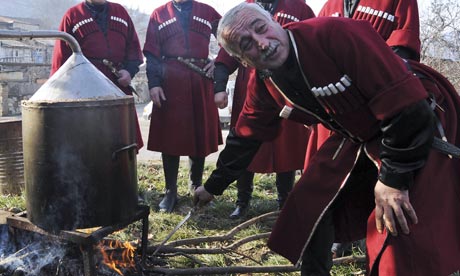
Georgia making chacha
Distilling the national spirit ... Georgian men in traditional clothes cook chacha during a holiday celebration. Photograph: Vano Shlamov/Getty
All afternoon, Lasha's attempts to describe the taste, strength and effects of chacha – Georgia's national spirit – had left us intrigued. We had spent the day touring the picturesque south Caucasian country, known for its majestic peaks, savoury cuisine and the hospitality of its locals. And Lasha, naturally, served as our source for all matters of local history and culture. But whenever the conversation turned toward chacha, a predominantly grape-based liquor reputed for its flavour and strength, he seemed at a loss for words.
So in the evening, as we headed back towards the capital of Tbilisi, a forlorn, roadside mess hut caught our attention. "Maybe they have it," Lasha wondered aloud as we pulled over.
He surveyed the kitchen, and we waited in the adjacent dining room. Minutes later, an apron-clad woman entered with a tray of khinkali, or boiled meat dumplings, and a bottle of clear, inconspicuous liquid. Success.
Once the khinkali had cooled, we raised our glasses, and toasted to one another. The subtle taste of grape tingled through my mouth as the high alcohol content registered, lighting my sinuses ablaze. A quick gulp of the salty juices from the khinkali neutralised the residual bitterness, but the satisfying burn remained. We repeated the process several times as the smile on my face grew larger. I soon realised Lasha was right: I was set.
The trip back to Tbilisi was swift. I began pulsating with excitement to explore the tree-lined streets and decaying, Tsarist-era buildings – sights we'd seen before, but not after several rounds of chacha. We bade Lasha farewell and escaped into the night, popping into one cafe after another. Somehow, the chacha changed everything. I was not drunk, but electric. My head wasn't spinning – it was sprinting ahead, along Tbilisi's winding streets.
The next morning, as we prepared to return home, Lasha appeared with a pair of two-litre water bottles filled with that same inconspicuous liquid. It was our own, home-brewed souvenir.
"Now I know you," he said with a smile. "Next time you come to Georgia, we'll celebrate properly."
• Every week Guardian Weekly publishes a Letter from one of its readers from around the world. We welcome submissions – they should focus on giving a clear sense of a place and its people. Please send them toweekly.letter.from@guardian.co.uk

Tuesday, August 28, 2012

ARTICLE: Letter from Azerbaijan: off the map. By Dan Peleschuk (guardian.co.uk)

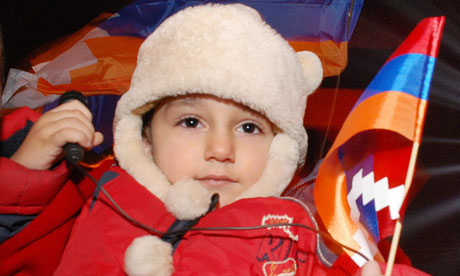
(guardian.co.uk) The leafy boulevards of Stepanakert, in Nagorno-Karabakh, are beginning to attract visitors, but to most of the international community the republic doesn't exist.

Dan Peleschuk, Guardian Weekly, Tuesday 28 August 2012

letter nagorno-karabakh
Photograph: Karen Minasyan/AFP/Getty
In many ways, Stepanakert resembles a small American town on the rise. Its main boulevards have been repaved, locals stroll through the renovated central square past its elegant fountain, and hotels have sprouted on every other block to hold the new influx of visitors.

But as some people see things, it doesn't really exist, and neither does the ethnic Armenian Nagorno-Karabakh Republic, of which Stepanakert is the capital. According to the rest of the world, the region belongs to Azerbaijan, and no one – not even Armenia, Karabakh's patron state – recognises it.

But that doesn't stop the self-proclaimed country from celebrating its 20 years of de facto independence this year. Patriotic banners flutter above Stepanakert's streets, and posters of the soldiers who during a bloody war in the early 1990s helped wrest the land away from Azerbaijan line the sidewalks.

Not long ago much of the city was in ruins and the economy virtually non-existent. Today locals meander along leafy streets lined with new banks, stores and government buildings. A tourism industry is slowly taking root, as travellers from across the world descend on the tiny republic, population about 141,000, in increasing numbers.

But under the surface are scars of a war that left more than 30,000 dead and many displaced. War is the only reason the Nagorno-Karabakh Republic exists. War – the memories of it, the fears of its return – is what makes it tick. Perhaps the best reminder of this is Aghdam, the ghostly shell of a former Azeri settlement levelled by Armenian forces in 1993. Just a short drive from Stepanakert, the one-time city of around 30,000 was reduced to grassy craters and jagged stone remnants of former apartments, schools and community centres. Visible from the only road that leads north to Karabakh's famed ancient monasteries, it is easy to notice.

Yet ordinary Karabakh Armenians are trying to capitalise on the relative post-war stability. Even as border tensions have escalated in recent months, which have seen deadly skirmishes between Armenian and Azeri forces, small-time businessman Ashot Simonyan says foreign visitors have continued to stream through his spare rental apartments.

"Everyone who comes here really loves it," he says with a salesman's grin. "We have everything a tourist needs – it's completely normal here."

Every week Guardian Weekly publishes a Letter from one of its readers from around the world. We welcome submissions – they should focus on giving a clear sense of a place and its people. Send them to weekly.letter.from@guardian.co.uk

• This article was inadvertently published on the web a week early, and with a different headline.