Während die Bauten der Sowjetmoderne in Georgien schon seit einigen Jahrzehnten weltweit Anerkennung genießen, harrt die baubezogene Kunst dieser Epoche – die monumental-dekorativen Mosaiken – noch ihrer internationalen Entdeckung und Würdigung. Damals wie heute sind diese farbenprächtigen Mosaikbilder ein selbstständiger und dennoch untrennbarer Bestandteil der Architektur in Georgien: Sie verweisen auf die Nutzung des jeweiligen Gebäudes, strukturieren seine Fassade oder verschmelzen gar mit ihm zu einem kunstvollen Ganzen. Gegenwärtig sind jedoch viele dieser Werke, die weit mehr als nur Träger staatlicher Propaganda waren, von der Zerstörung bedroht.
Diese Publikation ist die erste systematische Dokumentation dieser einzigartigen Relikte sowjetgeorgischer Mosaikkunst. Kenntnisreich führen Nini Palavandishvili und Lena Prents anhand von Fotos und kurzen Essays durch die facettenreiche Welt der sowjetischen Mosaiken in Georgien, die im Vergleich zu anderen sowjetischen Orten eigene Besonderheiten aufweist. Indem sie auf dieses bemerkenswerte künstlerische Erbe einer vergangenen Epoche aufmerksam machen sowie dessen Schönheit und kulturelle Bedeutung aufzeigen, plädieren sie zugleich nachdrücklich für seinen Schutz und Erhalt.
135 x 245 mm
280 Seiten
350 Abbildungen
Softcover
ISBN 978-3-86922-692-7
Mehr dazu >>>
Showing posts with label Lena Prents. Show all posts
Tuesday, September 18, 2018
GESCHICHTE: Georgien. Baubezogene Kunst. Mosaiken der Sowjetmoderne 1960 bis 1990. Von Nini Palavandishvili und Lena Prents [dom-publishers.com]
Thursday, July 06, 2017
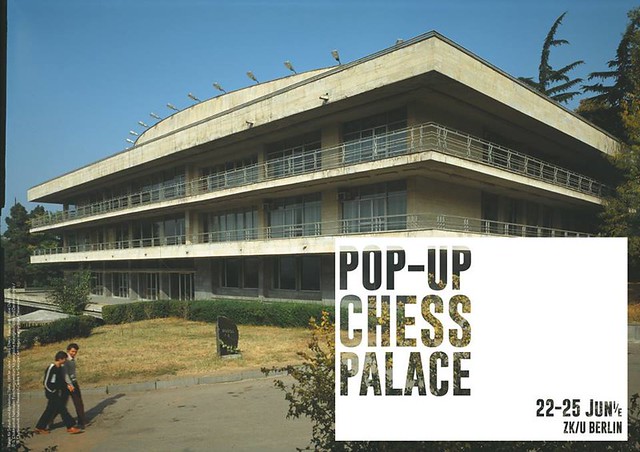
EXHIBITION: Pop-Up Chess Palace - On Architecture, Ideology and Chess, June 22-26, 2017, ZK/U Berlin
Curated by Nini Palavandishvili and Lena Prents
Participating artists: Atu Gelovani, Lasha Kabanashvili, Aleksander Komarov, Lado Lomitashvili, Magdalena Pięta, Nino Sekhniashvili, Tatia Skhirtladze and Naili Vakhania
Chess program: Uli Huemer
"Chess palace" may sound unusual in the Western European context. However, it was a common idea in the Soviet Union, where chess was widely played in its pioneer palaces, cultural houses and workers' clubs. In a few years after the October Revolution, the young Soviet Union managed to turn a "useless game of the bourgeoisie" into a sensible pastime of the working masses. After the Second World War Soviet domination in chess became an important ideological argument for the superiority of the system. In the 1970s the special palaces were created for chess - not in the centre though, but in the peripheral Soviet republics of Georgia, Armenia and Belarus. These buildings are distinguished by their striking architecture, sophisticated design and intelligent placement into the urban environment.
The exhibition Pop-Up Chess Palace focuses on Tbilisi Chess Palace and Alpine Club - architecturally the most demanding and ambitious one among these palaces. The curators of the exhibition question how to generally deal with the unique features of the modernist socialist architecture and how the ideal content of these buildings can be lived today.
The exhibition is funded by the Ministry of Culture and Monument Protection of Georgia in the frame of German-Georgian Friendship Year 2017 program.
Photos by David Meskhi
More: geoair.ge/8x8 future neve -happened
Participating artists: Atu Gelovani, Lasha Kabanashvili, Aleksander Komarov, Lado Lomitashvili, Magdalena Pięta, Nino Sekhniashvili, Tatia Skhirtladze and Naili Vakhania
Chess program: Uli Huemer
"Chess palace" may sound unusual in the Western European context. However, it was a common idea in the Soviet Union, where chess was widely played in its pioneer palaces, cultural houses and workers' clubs. In a few years after the October Revolution, the young Soviet Union managed to turn a "useless game of the bourgeoisie" into a sensible pastime of the working masses. After the Second World War Soviet domination in chess became an important ideological argument for the superiority of the system. In the 1970s the special palaces were created for chess - not in the centre though, but in the peripheral Soviet republics of Georgia, Armenia and Belarus. These buildings are distinguished by their striking architecture, sophisticated design and intelligent placement into the urban environment.
The exhibition Pop-Up Chess Palace focuses on Tbilisi Chess Palace and Alpine Club - architecturally the most demanding and ambitious one among these palaces. The curators of the exhibition question how to generally deal with the unique features of the modernist socialist architecture and how the ideal content of these buildings can be lived today.
The exhibition is funded by the Ministry of Culture and Monument Protection of Georgia in the frame of German-Georgian Friendship Year 2017 program.
Photos by David Meskhi
More: geoair.ge/8x8 future neve -happened
Wednesday, May 31, 2017
EXHIBITION: Pop-Up Chess Palace - On Architecture, Ideology and Chess - in Berlin
![]() |
PHOTO: Tigran Petrosian Chess House, Yerewan, Armenia @ Zhanna Mesheryakova’s personal archive
|
22. Juni - 26. Juni - daily open from 12:00
"Chess palace" may sound unusual in the Western European context. However, it was a common idea in the Soviet Union, where chess was widely played in its pioneer palaces, cultural houses and workers' clubs. In a few years after the October Revolution, the young Soviet Union managed to turn a "useless game of the bourgeoisie" into a sensible pastime of the working masses. After the Second World War Soviet domination in chess became an important ideological argument for the superiority of the system. In the 1970s the special palaces were created for chess - not in the centre though, but in the peripheral Soviet republics of Georgia, Armenia and Belarus. These buildings are distinguished by their striking architecture, sophisticated design and intelligent placement into the urban environment.
The exhibition Pop-Up Chess Palace focuses on Tbilisi Chess Palace and Alpine Club - architecturally the most demanding and ambitious one among these palaces. The curators of the exhibition question how to generally deal with the unique features of the modernist socialist architecture and how the ideal content of these buildings can be lived today.
Program:
∆ Thursday, June 22, 19:00
Opening of the exhibition and OPENHAUS at ZK/U
∆ Friday, June 23, 19:00
Speisekino Moabit 2017
Open Air Cinema and Georgian Food
∆ Saturday, June 24, 13:00
Open Chess Tournament.
Registration 13:00 – 13:30, end: 19:30. (Limited number of participants, pre-registration is possible at: popupchesspalace@gmail.com)
In cooperation with the Chess Club Rotation e.V. Berlin-Mitte
∆ Sunday, June 25, 13:00-17:00
Chess afternoon for children
Curated by Nini Palavandishvili and Lena Prents
Participating artists: Atu Gelovani, Lasha Kabanashvili, Aleksander Komarov, Lado Lomitashvili, Magdalena Pięta, Nino Sekhniashvili, Tatia Skhirtladze and Naili Vakhania
Chess program: Uli Huemer
For further info, please contact: popupchesspalace@gmail.com
The exhibition is funded by the Ministry of Culture and Monument Protection of Georgia
---
Pop-Up Chess Palace
Über Architektur, Ideologie und Schach
22. Juni-26. Juni 2017, täglich ab 12 Uhr
Die Wortschöpfung "Schachpalast" mag für das westeuropäische Ohr seltsam klingen. In der Sowjetunion dagegen stellten Gebäude zum Zweck des Schachspiels keine Besonderheit dar. Die junge Sowjetunion hat es in nur wenigen Jahren nach der Oktoberrevolution geschafft, ein „nutzloses Spiel der Bourgeoisie“ in einen sinnvollen Zeitvertreib der Arbeitermassen umzuwidmen. Nach dem Zweiten Weltkrieg wurde die sowjetische Dominanz im Schach zu einer wichtigen ideologischen Argumentation für die Überlegenheit des Systems. In den 1970er Jahren entstanden eigens fürs Schachspiel erbaute Paläste – jedoch nicht im Zentrum, sondern in den peripheren Sowjetrepubliken Georgien, Armenien und Belarus. Diese Gebäude zeichnen sich durch eine auffällige Architektur, ausgeklügeltes Design und eine intelligente Einfügung in den städtischen Raum aus.
Der Fokus der Ausstellung liegt auf dem georgischen Schachpalast – dem architektonisch anspruchsvollsten und ambitioniertesten. Kuratorinnen stellen die Frage, wie man generell mit den Unikaten der modernistischen sozialistischen Architektur umgehen soll und wie der ideelle Gehalt dieser Bauten heute gelebt werden kann.
Programm:
∆ Donnerstag, 22. Juni um 19 Uhr
Eröffnung der Ausstellung und des OPENHAUS des ZK/U
∆ Freitag, 23. Juni um 19 Uhr
Speisekino Moabit 2017
Open Air Kino und Georgisches Essen
∆ Samstag, 24. Juni um 13 Uhr
Offenes Schachturnier.
Anmeldung 13.00 – 13.30, Ende ca. 19.30. (Beschränkte Teilnehmerzahl. Eine Voranmeldung ist möglich unter: popupchesspalace@gmail.com)
In Kooperation mit dem Schachverein Rotation e.V. Berlin-Mitte
∆ Sonntag, 25. Juni, 13-17 Uhr
Schachnachmittag für Kinder
Kuratiert von Nini Palavandishvili und Lena Prents
Teilnehmende Künstlerinnen und Künstler: Atu Gelowani, Lascha Kabanaschwili, Aleksander Komarov, Lado Lomitaschwili, Magdalena Pięta, Nino Sekhniaschwili, Tatia Skhirtladze und Naili Vachania.
Schachprogramm: Uli Huemer
Anfragen können an popupchesspalace@gmail.com gerichtet werden.
Die Ausstellung wird vom Ministerium für Kultur und Denkmalschutz von Georgien finanziell unterstützt.
Facebook: facebook.com/events/Pop-Up Chess Palace - On Architecture, Ideology and Chess
Subscribe to:
Posts (Atom)