Showing posts with label Nino Sekhniashvili. Show all posts

Thursday, July 06, 2017

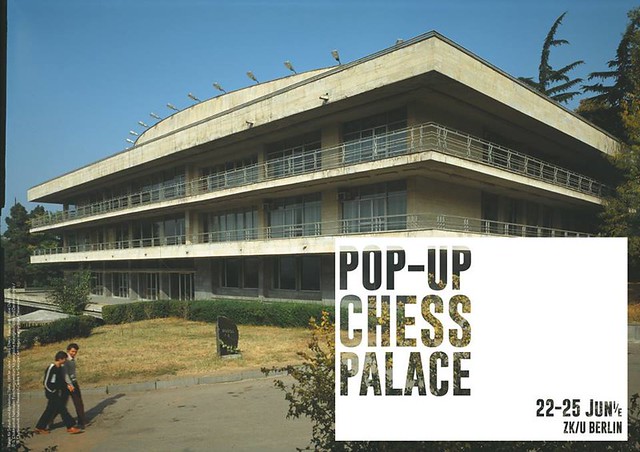
EXHIBITION: Pop-Up Chess Palace - On Architecture, Ideology and Chess, June 22-26, 2017, ZK/U Berlin

Curated by Nini Palavandishvili and Lena Prents

Participating artists: Atu Gelovani, Lasha Kabanashvili, Aleksander Komarov, Lado Lomitashvili, Magdalena Pięta, Nino Sekhniashvili, Tatia Skhirtladze and Naili Vakhania
Chess program: Uli Huemer

"Chess palace" may sound unusual in the Western European context. However, it was a common idea in the Soviet Union, where chess was widely played in its pioneer palaces, cultural houses and workers' clubs. In a few years after the October Revolution, the young Soviet Union managed to turn a "useless game of the bourgeoisie" into a sensible pastime of the working masses. After the Second World War Soviet domination in chess became an important ideological argument for the superiority of the system. In the 1970s the special palaces were created for chess - not in the centre though, but in the peripheral Soviet republics of Georgia, Armenia and Belarus. These buildings are distinguished by their striking architecture, sophisticated design and intelligent placement into the urban environment.

The exhibition Pop-Up Chess Palace focuses on Tbilisi Chess Palace and Alpine Club - architecturally the most demanding and ambitious one among these palaces. The curators of the exhibition question how to generally deal with the unique features of the modernist socialist architecture and how the ideal content of these buildings can be lived today.

The exhibition is funded by the Ministry of Culture and Monument Protection of Georgia in the frame of German-Georgian Friendship Year 2017 program.

Photos by David Meskhi


More: geoair.ge/8x8 future neve -happened

EXHIBITION: Pop-Up Chess Palace - On Architecture, Ideology and Chess, June 22-26, 2017, ZK/U Berlin

Wednesday, May 31, 2017

EXHIBITION: Pop-Up Chess Palace - On Architecture, Ideology and Chess - in Berlin

PHOTO: Tigran Petrosian Chess House, Yerewan, Armenia @ Zhanna Mesheryakova’s personal archive


22. Juni - 26. Juni - daily open from 12:00

"Chess palace" may sound unusual in the Western European context. However, it was a common idea in the Soviet Union, where chess was widely played in its pioneer palaces, cultural houses and workers' clubs. In a few years after the October Revolution, the young Soviet Union managed to turn a "useless game of the bourgeoisie" into a sensible pastime of the working masses. After the Second World War Soviet domination in chess became an important ideological argument for the superiority of the system. In the 1970s the special palaces were created for chess - not in the centre though, but in the peripheral Soviet republics of Georgia, Armenia and Belarus. These buildings are distinguished by their striking architecture, sophisticated design and intelligent placement into the urban environment.

The exhibition Pop-Up Chess Palace focuses on Tbilisi Chess Palace and Alpine Club - architecturally the most demanding and ambitious one among these palaces. The curators of the exhibition question how to generally deal with the unique features of the modernist socialist architecture and how the ideal content of these buildings can be lived today.

Program:

∆ Thursday, June 22, 19:00
Opening of the exhibition and OPENHAUS at ZK/U

∆ Friday, June 23, 19:00
Speisekino Moabit 2017
Open Air Cinema and Georgian Food

∆ Saturday, June 24, 13:00
Open Chess Tournament.
Registration 13:00 – 13:30, end: 19:30. (Limited number of participants, pre-registration is possible at: popupchesspalace@gmail.com)

In cooperation with the Chess Club Rotation e.V. Berlin-Mitte

∆ Sunday, June 25, 13:00-17:00
Chess afternoon for children

Curated by Nini Palavandishvili and Lena Prents

Participating artists: Atu Gelovani, Lasha Kabanashvili, Aleksander Komarov, Lado Lomitashvili, Magdalena Pięta, Nino Sekhniashvili, Tatia Skhirtladze and Naili Vakhania

Chess program: Uli Huemer

For further info, please contact: popupchesspalace@gmail.com

The exhibition is funded by the Ministry of Culture and Monument Protection of Georgia


---

Pop-Up Chess Palace
Über Architektur, Ideologie und Schach
22. Juni-26. Juni 2017, täglich ab 12 Uhr

Die Wortschöpfung "Schachpalast" mag für das westeuropäische Ohr seltsam klingen. In der Sowjetunion dagegen stellten Gebäude zum Zweck des Schachspiels keine Besonderheit dar. Die junge Sowjetunion hat es in nur wenigen Jahren nach der Oktoberrevolution geschafft, ein „nutzloses Spiel der Bourgeoisie“ in einen sinnvollen Zeitvertreib der Arbeitermassen umzuwidmen. Nach dem Zweiten Weltkrieg wurde die sowjetische Dominanz im Schach zu einer wichtigen ideologischen Argumentation für die Überlegenheit des Systems. In den 1970er Jahren entstanden eigens fürs Schachspiel erbaute Paläste – jedoch nicht im Zentrum, sondern in den peripheren Sowjetrepubliken Georgien, Armenien und Belarus. Diese Gebäude zeichnen sich durch eine auffällige Architektur, ausgeklügeltes Design und eine intelligente Einfügung in den städtischen Raum aus.

Der Fokus der Ausstellung liegt auf dem georgischen Schachpalast – dem architektonisch anspruchsvollsten und ambitioniertesten. Kuratorinnen stellen die Frage, wie man generell mit den Unikaten der modernistischen sozialistischen Architektur umgehen soll und wie der ideelle Gehalt dieser Bauten heute gelebt werden kann.

Programm:

∆ Donnerstag, 22. Juni um 19 Uhr
Eröffnung der Ausstellung und des OPENHAUS des ZK/U

∆ Freitag, 23. Juni um 19 Uhr
Speisekino Moabit 2017
Open Air Kino und Georgisches Essen

∆ Samstag, 24. Juni um 13 Uhr
Offenes Schachturnier.
Anmeldung 13.00 – 13.30, Ende ca. 19.30. (Beschränkte Teilnehmerzahl. Eine Voranmeldung ist möglich unter: popupchesspalace@gmail.com)
In Kooperation mit dem Schachverein Rotation e.V. Berlin-Mitte

∆ Sonntag, 25. Juni, 13-17 Uhr
Schachnachmittag für Kinder

Kuratiert von Nini Palavandishvili und Lena Prents

Teilnehmende Künstlerinnen und Künstler: Atu Gelowani, Lascha Kabanaschwili, Aleksander Komarov, Lado Lomitaschwili, Magdalena Pięta, Nino Sekhniaschwili, Tatia Skhirtladze und Naili Vachania.

Schachprogramm: Uli Huemer

Anfragen können an popupchesspalace@gmail.com gerichtet werden.

Die Ausstellung wird vom Ministerium für Kultur und Denkmalschutz von Georgien finanziell unterstützt.


Facebook: facebook.com/events/Pop-Up Chess Palace - On Architecture, Ideology and Chess


Monday, December 02, 2013

EXHIBITION: Georgian Contemporary Art on the Vilnius Summit (geoplatforma.blogspot.de)

(geoplatforma.blogspot.de) Georgian art world is also getting ready for the Vilnius summit; Gala Gallery, sponsored by the Georgian Ministry of Culture will present the Georgian Contemporary art to the wider European audience. Gala gallery belongs to the list of the few Georgian galleries who pay attention to the concept and context of their exhibitions. The series of Kote Sulaberidze, Vakho Bughadze and Murtaz Shvelidze take the central stage in the exposition curated by Dedika Bulia and Vato Tsereteli for the Kalnas gallery, Vilnius.

Dedika Bulia: ‘All three of the painters closely cooperate with the gallery and we have accomplished many projects together. All of them are the generation of 90s. These painters share the European value system and their art reflects their pro-European orientation, but at the same time do not lose their distinctiveness.’ Gala gallery is the first to have Georgian artan opportunity to present themselves to the European audience. The owner of the gallery and the author of the concept for the exhibition, Dedika Bulia claims to aim at presenting the good quality Georgian art and those artists, who strive for producing art of European standards.


The last two exhibitions - Jump by Murtaz Shvelidze and Vakho Bughadze’s Asprovalta are the two shows that the Lithuanian team have seen while visiting Georgia, consequently choosing the Gala gallery. The Jump is a series of 13 canvases. The 12 of them, dramatically cropped portray different people in various settings fixing their shoelaces. It is fascinating to see the shoes composing portraits of people. However, the point is that individuals regardless their social standing or the lifestyle, still create artificial problems and restrictions for themselves. The series culminates in a large canvas named Jump. The girl is portrayed in the process of jumping; as the other canvases, the depicted angle is unusual- her dress and legs floating in the air are the focus. The blue sky, green grass, thin dress create careless mood- such a contrast to the tight sneakers and uncomfortable shoes. This is the freedom, all of us have a potential of that we resist for no reason.

Asprovalta by Vakho Bughadze drastically differs from Murtaz Shvelidze's lively, almost toxic colours, however, it fits in perfectly in the gloomy palette of the painter. The focus of the series is the abandoned houses and homeless dogs, which echo many social problems of today. The faintly defined high-rise buildings translate the grey feel the city has attained; the windows indicated by grey rectangles hint on the non-existent life behind them; the dog alike figures on the foreground are destined for solitude. All of this is engulfed into pinkish mist, revealing a hint of hope that keeps these creatures alive. According to the painter these series reveal the memories from the past: the life he had been living and the unclear world, a desire or waiting for change and novelty.

The Sky-24 hours by Kote Sulaberidze has been exhibited in the Gala gallery while hosting the Artisterium V. The fragment from the painting is used as a poster for the exhibition. It is quite common for the artist to compose an artwork from multiple canvases; the Sky-24 Hours is made of 24 standard sized canvases, illustrating the sky and objects flying across it on different times of a day. Sometimes this is an airplane, angels or bombs, birds and strippers. Kote Sulaberidze: ' the Sky- 24 hours is a metaphor for life. Everything happens under the sky. All of us live under the sky. The bombs fall from the sky and the almighty God is also in the sky. Sometimes it rains and at times the warm sun is shining. This contrast makes it captivating and mysteriously beautiful.' Kote Sulaberidze is always modest when he has to talk about his art. His oeuvre reflects the lyricism, enthusiasm and inexhaustible optimism of the artist. His very aesthetic art never loses the humoristic touch, even when referring to some of the most acute social problems.

Kote Jincharadze has presented an installation System of Coordination- IV dimension. ‘The installation places Georgia on the geopolitical system of coordinates of the world.The ¾ of the coordinate system are the spaces reflected in the mirror, creating intersections of the trajectories- a kind of crossroad. The vectors of 4 different colours personifying countries, cross each other corresponding to the political interests and relations of these countries.

Red- Russia
Blue- West (Europe, USA)
Green- East (Asia)
Yellow- China

The mirror offers audience the visual trajectory of Georgia’s positioning and development. Each of the spectators can choose a rectangle and place it on the surface of the mirror, therefore, stating their opinion about the aspirations of Georgia.’ According to the artist this is the visualization of the value system. The interactive artwork is a kind of sociological research, when the audience reflected in the mirror record their opinion and the desirable future for Georgia. As Kote says every time he puts up the installation, the blue squares are always winning indicating the pro-European orientation of the Georgian society.

The Constructive Dialogue by Oleg Timchenko is about the newest history of Georgia, which exceeded the locality and became world news, namely the August war of 2008. Timchenko has summarised the provoking reasons, his attitude and the aftermath mood in the video collage. 'A fragment is taken from the film-ballet Othello. The flags of USA and Russia are inserted as the background. The most tragic fragment from the dance of Vakhtang Chabukiani, personifies Georgia. It is not accidental that this is the most dramatic, culminating moment in the ballet. The pain and the feeling of despair that the dancer has masterly translated is identified with the state of Georgia.' It was vital for the exposition presented on the summit to include the politics, especially the August war.

Vato Tsereteli curates Video Art section demanded by the Lithuanian side. Vato, artist himself is a head of CCA. The Center for Contemporary Art besides hosting some very interesting exhibitions takes students for a non-formal MA program. CCA provides the vital knowledge and freedom to the future artists that academy of fine arts in Tbilisi lacks. The artist sees the center as one of his artworks. 'I find it forced to discuss the contemporary art; art does not need specifying whether it is contemporary or not. What makes art contemporary is its relation to reality and time it is created in.’

Vato during his stay in Vilnius has to deliver a public lecture. 'It will concern the creative and art practices that are little known or defined, at least in Georgia. For example, we have an educational program, which in itself is an artistic product. I would like to talk about creativity not in terms of producing art, but other processes, for example creativity in the educational system. My lecture will be about the new territories in art. Our center is an exciting synthesis of the educational and exhibition practices, which in itself is an accidental discovery and has a promising perspective. Everyone is creative, but the artist is ingenious by profession, therefore, I think they should use this and it should exceed the gallery space and integrate into other spheres. For example we have a course of art and eco-farming; this is not about Land Art or exhibiting vegetables in a museum space, but about incorporating the capabilities and being productive into that domain.

Georgian society itself is marginalised and it is not the fault of people. I think this is a deeply traumatised society as a consequence of the Soviet Union and the following, 20 years; but we have agreed that this has to change. The society has to develop itself, has to awaken the sense of responsibility and desire to participate for us to form into a democratic country. Education plays the key role that's why we have the programs and courses. In my opinion contextual knowledge is vital, any human being needs to know and realise the context they wake up to, I mean awakening to the consciousness; when you do not have a clue about the reality you live in, the geo-political environment, historical and cultural heritage, you are not adequate; hence, the anachronistic moments in art as well as life. Art that is based on imagination has the ability to help the people lacking it. Koka Ramishvili has noticed that there is no science fiction genre in Post-Soviet countries, because this part of the brain, responsible for creative thinking is dumbed out. Art has the ability to activate it, so that people recognize their potential. This might prove crucial.'-Vato Tsereteli.

For the exposition Down Up Vato Tsereteli has chosen videos the Drawing Lesson, 2001 by Koka Ramishvili, Eye Trees,2003 Mamuka Japharidze and the Gripes, 2012 by Nino Sekhniashvili.

Vato Tsereteli: 'I have selected the artworks and not the artists. These videos are referential because of their complexity and visual quality. It is personal too; these are the artists I closely cooperate with. They relate to the exhibition contextually rather than thematically. The people living between the West and Georgia have produced these videos. Therefore, they seem to unite the two realities. The intensity and the accumulated energy of these works were the main attraction for me.'

Koka Ramishvili reverses the process of drawing and the video begins with the sketch being erased. The deconstructed painting stays in the memory. Therefore, art becomes writing, the drawing becomes a notebook; the story of an individual isolated from his usual habitat is written as a result. Ramishvili has created the Drawing Lesson after moving to Geneva. This video has marked the return to image that the artist had abandoned for 10 years. Koka Ramishvili:' back then this video went against the conventional video art production. I was creating something radical and eccentric. This was the biography I was writing with the drawn pictures. The sketches themselves were of quite low quality because my focus was the montage. I have created a sculpture in a virtual space, at that stage I was exploring compression and decompression. It was important for me to show the prohibited in the West, I wanted to portray the manual labor.' It is fascinating to observe Ramishvili opposing the drawing, as the traditional medium to the innovatory video; the two seemingly incomprehensible media create the art that highlights the craftsmanship in drawing. The soundtrack, the sound of lead pencil scratching the paper points to the acoustic side of the job. Employing the montage the artist breaks the central myth of the documentary and objective nature of video.

Nino Sekhniashvili is a very interesting conceptual artist. The Nectar Gallery is one of her projects in the Georgian Art scene. The expositions always manage to surprise the audience with the unlikely emphases. This is the only gallery that hosts the risky and alternative art, like the recent exhibition of Kutaisi and Tskaltubo artists.

The video Gripes was created while living in Zurich. 'In the Finnegan’s Wake there is an episode from Aesop's fable the Fox and the Grapes. Joyce customizes this with the different language, actually, no language at all. I have put the text onto the recording in the foam plastic factory- the huge objects were floating defying the gravity laws. At the time when I lived in Zurich on scholarship, I was attending the readings in the James Joyce society, which were quite comical for me, as they sounded delirious; therefore, I decided to work on the text. Gibberish is very important to me, as I often find myself incapable of expressing my thoughts.'- says Nino Sekhniashvili.

In Mamuka Japharidze’s video the trees resemble the human faces with the help of optical illusions. The mysterious feel of the video plays with the imagination of the spectator and lets them decide the narration and culmination for themselves. Mamuka Japharidze is the artist who has directed his creative potential into farming and has an Art farm in Shindisi, where he combines art and eco-farming; he also tries to engage the students and reads the lectures about soft farming to them.

The exhibition Down Up opened on the 20th of November, Vilnius,Lithuania, Gallery Kalnas and will last for a month. 

More Art here >>>

Sunday, September 09, 2012

AUSSTELLUNG: Bertha von Suttner und der Kaukasus. Schloss Harmannsdorf

Ausstellungsdauer: 27. Mai bis 9. September 2012

Seit 2009 lädt Kunst im öffentlichen Raum Niederösterreich zusammen mit dem Internationalen Bertha von Suttner Verein nationale und internationale KünstlerInnen ein, ihren Blick auf die vielschichtige Persönlichkeit der Bertha von Suttner zu richten. Beschäftigte sich die Ausstellung „Bertha von Suttner Revisited" 2009 stärker mit der gesellschaftspolitischen Dimension der Friedensnobelpreisträgerin und jene mit dem Titel „Die edlen Früchte und die Gouvernante" 2010 mit dem sozialen Status der Adeligen als Gouvernante im Dienste der Suttners im Schloss Harmannsdorf, wird 2012 ebendort Bertha von Suttners Zeit im vermeintlich wilden, tatsächlich aber vom europäischen Adel durchwachsenen Kaukasus von 8 verschiedenen künstlerischen Positionen beleuchtet mit Arbeiten von: Josef Dabernig, Katrina Daschner, Stefan Frankenberger, IRWIN, Helmut & Johanna Kandl, Sonia Leimer, Markus Schinwald, Nino Sekhniashvili

Ausgehend vom Einakter der jungen Bertha, „L'Éducation de Rosette", entdeckt von Helmut & Johanna Kandl im Genfer Völkerbundarchiv, thematisiert die gleichnamige von Brigitte Huck kuratierte Schau jene Zeit im Leben der Friedensaktivistin, als sie mit Arthur Gundaccar von Suttner an den Hof der Fürstin Dadiani von Mingrelien floh, um die familiären und gesellschaftlichen Konventionen ihrer unstandesgemäßen Ehe hinter sich zu lassen. 

+++


Im Zentrum der Ausstellung steht die an Originalschauplätzen in Georgien entstandene Arbeit "Wir holen uns das Goldene Vlies!" des Künstlerpaars Helmut & Johanna Kandl, die sich auf die Freundschaft des jungen Paars Bertha und Gundaccar von Suttner zur mingrelischen Fürstenfamilie Dadiani bezieht. Referenz für den Film ist der Einakter "L’Éducation de Rosette", den Bertha für das private Schlosstheater der Fürstin Dadiani schreibt. Helmut & Johanna Kandl spüren das Manuskript im Genfer Völkerbundarchiv auf, Oliver Hölzl übersetzt es vom Französischen ins Deutsche. Für die Aufführung der Gesellschaftskomödie in kleinstem Kreis übernehmen Bertha, Arthur und Mitglieder der Fürstenfamilie die Rollen. Bertha, die Sängerin werden wollte, schreibt sich Auftritte ins Stück und singt 'La Timbale d'Argent' aus der Operette von Léon Vasseur.

Diese und die ebenso vergessene Lacharie aus Manon Lescaut von Auber werden im Video, das die Künstler in der Umgebung der heute zur Ruine verfallenen Sommerresidenz der Dadianis in Gordi aufgenommen haben, durch die Gesangsstudentin Megi Chikhradze zu neuem Leben erweckt. Auf das antike Kolchis nehmen Helmut & Johanna Kandl ebenso Bezug wie auf das Motiv der Flucht von Liebenden (Medea/Jason, Manon/Des Grieux, Bertha/Arthur). Die Künstler verbinden griechische Mythologie mit der Geschichte Bertha von Suttners und stellen der historischen Situation die profane Welt der Strassen, Märkte und Überlebensstrategien im Tiflis der Gegenwart gegenüber.

Politische Konnotationen von Raum und die Präsenz des Strukturellen kennzeichnen die Wandzeichnung "Frozen Moments" des Künstlers und Filmautors Josef Dabernig in der Orangerie des Schlossgartens. Axonometrien, Perspektiven, Aufrisse und Schnitte dreier, die georgische Geschichte architektonisch rezipierender Gebäude, treten einander darin gegenüber: Der Wolkenkratzer des ehemaligen georgischen Transportministeriums, einer Architekturikone aus dem Jahr 1975, das megalomane "Haus des Volkes" in Bukarest und Schloss Plüschow, ein Landsitz, wie es Schloss Harmannsdorf für die Familie Suttner war.

Katrina Daschners Antwort auf die matronenhaft, strenge Darstellung Bertha von Suttners, wie sie durch den 1000 Schillingschein Verbreitung fand, ist der Film mit dem Titel "Bertha". Darin bezieht sich die Otto Mauer Preisträgerin auf Glamour, Sexualität, Fantasien und Begehren, inszeniert sie gegen den Strich von Wahrnehmungskonventionen und interpretiert die abenteuerliche Amour Fou Suttners als erotische, schrille Parabel.

Die Toninstallation „der unbekannte soldat“ des Soundkünstlers Stefan Frankenberger nimmt sich die Friedenskämpferin als Schriftstellerin vor. Verschiedene Angehörige des österreichischen Bundesheeres, konkret des Militärkommandos Niederösterreichs, lesen und interpretieren damit Texte von und über die Friedensnobelpreisträgerin. Geschnitten und zusammengestellt ist das im Schlossgarten zu hörende Tonmaterial mit Augenmerk auf Rhythmik, Spannung und Authentizität.

"Was ist Kunst, Tbilisi" fragt das slowenische Künstlerkollektiv IRWIN mit der gleichnamigen in Harmannsdorf ausgestellten Fotoarbeit, die in Kollaboration mit der Georgischen Armee 2007 entstand. Uniformierte Soldaten bilden vor der Kulisse Tbilisis diesen Satz als Artefakt nach. IRWIN setzt seine radikale Strategie der Appropriation von Symbolen staatlicher Ideologie ein, um die gemeinsamen Anliegen politisch engagierter Künstler zu formulieren.

Sonia Leimers Film "Western" zeigt das "zu erobernde" Land der Bertha von Suttner, jene atemberaubende georgische Landschaft, die als Kulisse für DDR-Produktionen des Genres diente. Im wilden Osten spielt ein Damenstreichsextett des State Orchestra Tbilisi die transkribierte Filmmusik Elmer Bernsteins aus "Die glorreichen Sieben" (1960) von John Sturges. Mit Blick auf das autonome Gebiet Südossetiens, das völkerrechtlich ein Teil Georgiens ist, geht es Leimer auch um Fragen nach Territorium, Identität und Staatsgefüge.

Mit "Meryl", verweist Markus Schinwald, 2011 österreichischer Vertreter auf der Biennale von Venedig, auf die prekäre Lage moderner, intellektueller Frauen im ausgehenden 19. Jahrhundert. Die Veränderung und Zurichtung privater bildnisdrucke der Zeit ist ein Werkkomplex, den der Künstler seit vielen Jahren kontinuierlich erweitert. Sein Interesse gilt dem Körper als kulturgeschichtliche Konstruktion. Gefangen in Paranoia und Melancholie verhilft Schinwald den biederen Fräuleins zu neuen, irritierenden Identitäten.

Die Skulptur "Chess" der Tifliser Künstlerin Nino Sekhniashvili, ein Schachbrett aus rohem Holz mit roter Farbe bedruckt, erzählt mit den darauf liegenden drei Schafsknochen von der georgischen Tradition, die Zukunft durch das Werfen von Tierknochen vorherzusagen.

Die Arbeit kann als Referenz auf jenen Lebensabschnitt gesehen werden, den die junge Comtesse Kinsky mit ihrer Mutter, einer notorischen Spielerin, in den europäischen Casinos verbrachte und Ekaterine Dadiani zum ersten Mal begegnete.

Das Projekt "Kunst im öffentlichen Raum Niederösterreich" ist eine Erfolgsgeschichte, die wesentlich mit der Kontinuität qualitätvoller Arbeit und der durchgehenden Bereitschaft zu Dialog und Diskussion zu tun hat. Nirgends sonst treffen Kunst und demokratische Öffentlichkeit so direkt aufeinander.
Landeshauptmann Dr. Erwin Pröll

„L'Éducation de Rosette - Bertha von Suttner und der Kaukasus“ ist zu sehen und zu hören bis 9. September 2012 im Schüttkasten und Garten des Schlosses Harmannsdorf.  
3713 Harmannsdorf 1, Freitag von 16.00 bis 19.00 Uhr / Samstag und Sonntag von 13.00 bis 19.00 Uhr

Kurzbiografien:
Helmut & Johanna Kandl, 1953 in Laa / Thaya und 1954 in Wien geboren, Zusammenarbeit ab 1995, leben in Wien und Berlin.
Josef Dabernig, 1956 in Kötschach-Mauthen geboren, lebt in Wien.
Katrina Daschner, 1973 in Hamburg geboren, lebt in Wien.
Stefan Frankenberger, 1977 in Rosenheim geboren, lebt in Wien.
IRWIN, 1983 in Ljubljana / Slowenien gegründet: Dûsan Mandič, Miran Mohar, Andrej Savski, Roman Uranjek und Borut Vogelnik.
Sonia Leimer, 1977 in Meran geboren, lebt in Wien.
Markus Schinwald, 1973 in Salzburg geboren, lebt in Wien und New York.
Nino Sekhniashvili, 1979 in Tiflis geboren, lebt in Tiflis und Berlin.

Eine Veranstaltung von Kunst im öffentlichen Raum Niederösterreich in Zusammenarbeit mit dem Internationalen Bertha von Suttner Verein und der Marktgemeinde Burgschleinitz-Kühnring.
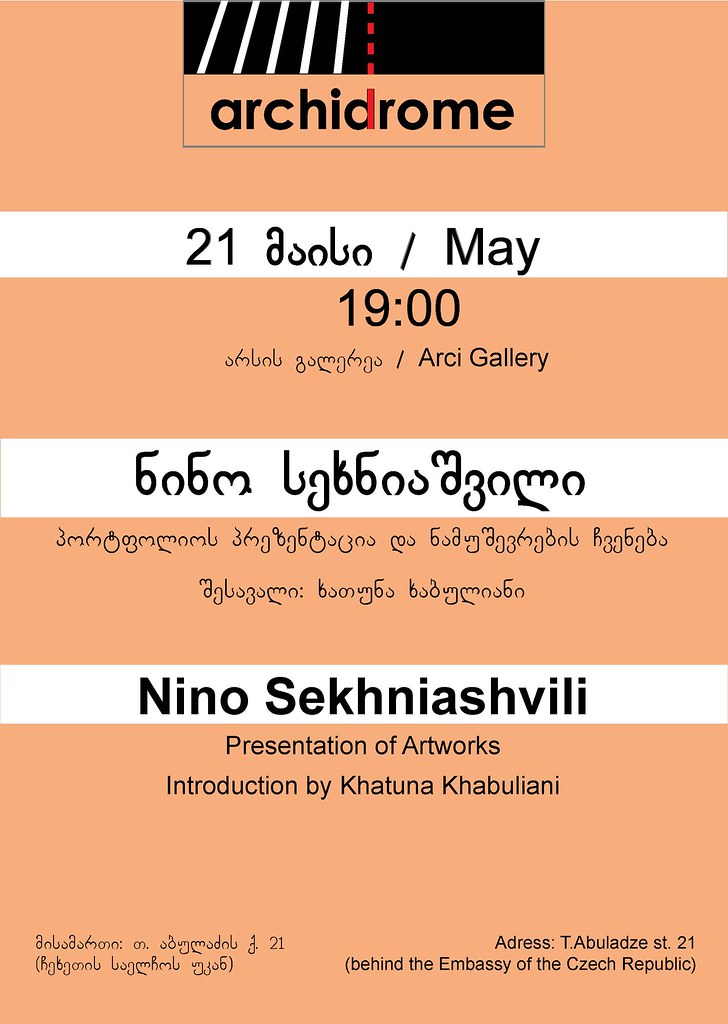
Saturday, May 24, 2008

EXHIBITION: Nino Sekhniashvili: Presentation of Artworks


21 May19:00 Arci Gallery
Nino Sekhniashvili: Presentation of Artworks
Introduction by Khatuna Khabuliani

Adress: T.Abuladze st. 21
(behind the Embassy of the Czech Republic)

Monday, February 04, 2008

KUNST: Nino Sekhniashvili ist Stipendiatin der Akademie Schloss Solitude

Die Solitude-Stipendiatin Nino Sekhniashvili sucht ihre Heimat - ihr Heimatgefühl:

Wenn Nino Sekhniashvili in ihrem Zimmer in der Akademie Schloss Solitude aus dem Fenster schaut, dann sieht sie Günther Oettingers Dienstvilla, sie sieht den Wald und sie hört - nichts. "Meistens ist es sehr ruhig hier oben", sagt sie. Seit Oktober lebt und arbeitet sie als Stipendiatin auf der Solitude. Die Ruhe an diesem Ort ist etwas, das sie lange nicht gekannt hat. Die 1979 geborene Künstlerin ist in Tiflis aufgewachsen. Politische Unruhen gehören zu ihren frühesten Kindheitserinnerungen. In den achtziger Jahren wurde der Protest gegen die sowjetische Besatzungsmacht in Georgien immer heftiger, bis er sich im Unabhängigkeitskrieg entlud. Sekhniashvili erlebte ihn als Zwölfjährige.

Leise und stockend erzählt sie von der ständigen Angst ihrer Eltern damals, der Sorge, nicht genug zu essen zu haben, der kindlichen Freude, nicht in die Schule geschickt zu werden. Zur Ruhe gekommen ist das Land an der Grenze zwischen Europa und Asien bis heute nicht. "In Georgien ist das Leben immer noch chaotisch", sagt Sekhinashvili. "Es gibt keine politische Ordnung, jeder ist auf sich allein gestellt und keiner weiß, wann die nächste Revolution kommt."

Ihr Leben im Schloss Solitude kommt ihr deshalb manchmal unwirklich vor, ein bisschen wie in Watte gepackt, zu ruhig und zu friedlich, um real zu sein. "In Georgien ist mein wirkliches Leben," sagt sie. Das sechsmonatige Stipendium auf der Solitude ist für sie der Ausnahmezustand.

mehr >>>

Link: Akademie Schloss Solitude

Nino Sekhniashvili in Artfacts.Net

DeutschlandRadio Kultur in Deutschland
Nino Sekhniashvili »Mao« Die konzeptuell arbeitende, aus Georgien stammende ... Nino Sekhniashvili (*1979 in Tiflis/Georgien) studierte experimentelle ...