Showing posts with label curator. Show all posts

Thursday, July 06, 2017

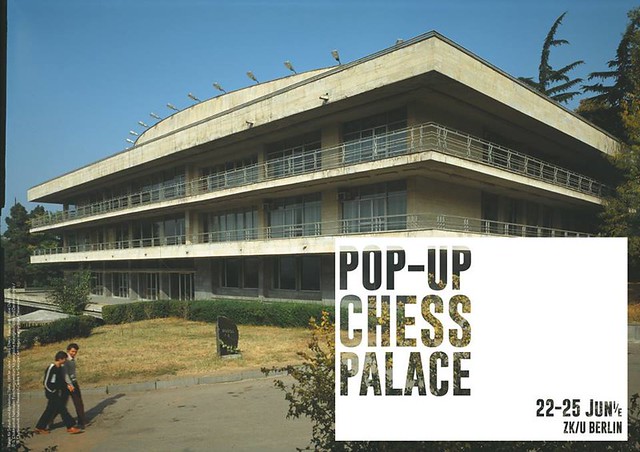
EXHIBITION: Pop-Up Chess Palace - On Architecture, Ideology and Chess, June 22-26, 2017, ZK/U Berlin

Curated by Nini Palavandishvili and Lena Prents

Participating artists: Atu Gelovani, Lasha Kabanashvili, Aleksander Komarov, Lado Lomitashvili, Magdalena Pięta, Nino Sekhniashvili, Tatia Skhirtladze and Naili Vakhania
Chess program: Uli Huemer

"Chess palace" may sound unusual in the Western European context. However, it was a common idea in the Soviet Union, where chess was widely played in its pioneer palaces, cultural houses and workers' clubs. In a few years after the October Revolution, the young Soviet Union managed to turn a "useless game of the bourgeoisie" into a sensible pastime of the working masses. After the Second World War Soviet domination in chess became an important ideological argument for the superiority of the system. In the 1970s the special palaces were created for chess - not in the centre though, but in the peripheral Soviet republics of Georgia, Armenia and Belarus. These buildings are distinguished by their striking architecture, sophisticated design and intelligent placement into the urban environment.

The exhibition Pop-Up Chess Palace focuses on Tbilisi Chess Palace and Alpine Club - architecturally the most demanding and ambitious one among these palaces. The curators of the exhibition question how to generally deal with the unique features of the modernist socialist architecture and how the ideal content of these buildings can be lived today.

The exhibition is funded by the Ministry of Culture and Monument Protection of Georgia in the frame of German-Georgian Friendship Year 2017 program.

Photos by David Meskhi


More: geoair.ge/8x8 future neve -happened
EXHIBITION: Pop-Up Chess Palace - On Architecture, Ideology and Chess, June 22-26, 2017, ZK/U Berlin

Tuesday, October 07, 2014

HISTORY: Exhibition featuring Nobel Prize winner opens today in Tbilisi (agenda.ge)


(agenda.ge) A vibrant exhibition of videos, paintings and more, detailing the life of a Nobel Prize winner when she lived in Georgia is opening today in Tbilisi.


The Tbilisi History Museum of Georgian National Museum will host an exhibition of Austrian artists and curators Johanna and Helmut Kandl that detailed the Nobel Prize winner Bertha von Suttnner’s activities in Georgia.

The exhibition, called Bertha von Suttner in Gordi, depicted the time when Austrian journalist and pacifist Bertha von Suttner stayed in Gordi, a palace of Georgian Nobles ‘Dadianis’ in western Georgia.

Bertha von Suttner became a common name in her home country Austria in the late 19th Century and early 20th Century for her effort as a peace activist and pacifist. Her novel Die Waffen nieder! (Lay Down Your Arms!) was published in 37 editions and translated into 12 languages.

On 10 December 1905 she received the Nobel Peace Prize and became the first female Nobel Prize winner. It is believed that she was a major influence in Nobel’s decision to include a peace prize among the prizes provided in his will.

Meanwhile the Austrian couple behind the exhibition, who are both Professors of the Academy of Fine Arts in Vienna, brought together videos, various installations and paintings in their exhibition with the aim of highlighting contemporary economic and social issues using examples from history.

The Kandls discovered an unknown manuscript of a play in the Geneva UN archive, which Bertha von Suttner wrote from Gordi palace, which will also be shown in the exhibition.

The Dadiani palace in Gordi. 19th Century
"The phenomenon of Bertha von Suttner and her activities in Georgia are very diverse and important. This is why [this exhibition] gives a very interesting perspective of her artistic approach combined with modern art,” read a statement released by Tbilisi History Museum.

An explanation of the project stated the exhibition portrayed "an idea about contemporary art and important historic issues, expresses the relationship between Bertha von Suttner and Dadian ancestral house and tells the story of her organised events in Gordi”.

The Bertha von Suttner in Gordi exhibition will continue until October 16 in Tbilisi.

Monday, May 07, 2012

PHOTOGRAPHY: Kolga Photo Contest in Tbilisi


It was a great pleasure to be in the jury of Kolga Photo Contest 2011.

We could feel an enthusiasm for photography in Tbilisi. Hundreds of visitors, mostly young people, came to the opening of the very good presentation of the winners and a big interest in our lectures and portfolio reviews.

This year the exhibition of the Kolga Photo Contest will be part of the new "Kolga Tbilisi Photo Meeting" with an extensive program of exhibitions, workshops, portfolio reviews and lectures by international photographers that Tina Schelhorn is curating and coorganizing. We will soon inform you with more details ...

bis 25.04.2012 Kolga Tbilisi Photo Prize 2012
 
KOLGA findet 2012 zum 11. Mal statt und wird international ausgeschrieben. Fotos können online zum Fotowettbewerb eingereicht werden und müssen dabei von einer PDF-Datei begleitet werden, die eine kurze Biografie und eine kurze Konzeptbeschreibung in englischer oder georgischer Sprache enthält.


»Entry fee is 15 EUR. Applicants can participate in any or all categories announced. After payment is made, you will be able to upload images using standard procedures. Applicants should only make one written entry for all their submissions.
Entry fees will be used for the winners’ prize money – 5000 USD.
The winner in each category will get 1000 USD (750 EUR).«

Photohaus KOLGA
Tbilisi History Museum KARVASLA
8, Sioni st.
0105 Tbilisi, Georgia

[Quelle: Tina Schelhorn und Herr Wolfgang Zurborn aus der Galerie Lichtblick in Köln unterstützen die Organisatoren des Fotowettbewerbs.]

Tuesday, March 29, 2011

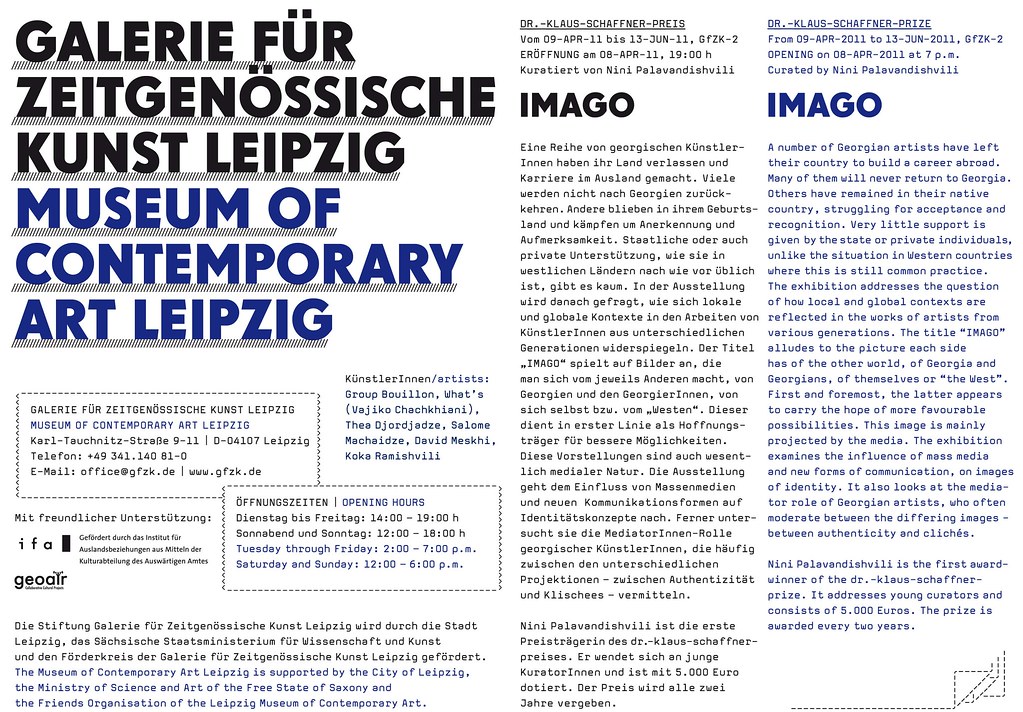
AUSSTELLUNG: IMAGO - Curated by Nini Palavandishvili (gfzk.de)

click on the flyer for a larger version!

Nini Palavandishvili ist die erste Preisträgerin des dr.-klaus-schaffnerpreises. Er wendet sich an junge KuratorInnen und ist mit 5.000 Euro dotiert. Der Preis wird alle zwei Jahre vergeben. (Congratulations!!!)

Vom 09-APR -2011 bis 13-JUN-2011, GfZK-2
Eröffnung am 08-APR -2011 um 19:00 h
Kuratiert von Nini Palavandishvili

From 09-APR -2011 to 13-JUN-2011, GfZK-2
Opening on 08-APR -2011 at 7 p.m.
Curated by Nini Palavandishvili

KünstlerInnen / Artists: Group Bouillon, What’s (Vajiko Chachkhiani), Thea Djordjadze, David Meskhi, Salome Machaidze, Koka Ramishvili

+++

Eine Reihe von georgischen KünstlerInnen haben ihr Land verlassen und Karriere im Ausland gemacht. Viele werden nicht nach Georgien zurückkehren. Andere blieben in ihrem Geburtsland und kämpfen um Anerkennung und Aufmerksamkeit. Staatliche oder auch private Unterstützung, wie sie in westlichen Ländern nach wie vor üblich ist, gibt es kaum. In der Ausstellung wird danach gefragt, wie sich lokale und globale Kontexte in den Arbeiten von KünstlerInnen aus unterschiedlichen Generationen widerspiegeln. Der Titel „IMAGO” spielt auf Bilder an, die man sich vom jeweils Anderen macht, von Georgien und den GeorgierInnen, von sich selbst bzw. vom „Westen“. Dieser dient in erster Linie als Hoffnungsträger für bessere Möglichkeiten. Diese Vorstellungen sind auch wesentlich medialer Natur. Die Ausstellung geht dem Einfluss von Massenmedien und neuen Kommunikationsformen auf Identitätskonzepte nach. Ferner untersucht sie die MediatorInnen-Rolle georgischer KünstlerInnen, die häufig zwischen den unterschiedlichen Projektionen – zwischen Authentizität und Klischees – vermitteln.

+++

A number of Georgian artists have left their country to build a career abroad. Many of them will never return to Georgia. Others have remained in their native country, struggling for acceptance and recognition. Very little support is given by the state or private individuals, unlike the situation in Western countries where this is still common practice. The exhibition addresses the question of how local and global contexts are reflected in the works of artists from various generations. The title “IMAGO” alludes to the picture each side has of the other world, of Georgia and Georgians, of ourselves or “the West”. First and foremost, the latter appears to carry the hope of more favourable possibilities. This image is mainly projected by the media. The exhibition examines the influence of mass media and new forms of communication, on images of identity. It also looks at the mediator role of Georgian artists, who often moderate between the differing images - between authenticity and clichés.

Mit freundlicher Unterstützung:
IFA (Instituts für Auslandsbeziehungen)
GeoAIR

Galerie für Zeitgenössische Kunst Leipzig
Museum of contemporar by art leipzig
Karl-Tauchnitz-Straße 9-11
D-04107 Leipzig
Telefon: +49 341.140 81-0
E-Mail:
office@gfzk.de www.gfzk.de

Friday, March 18, 2011

WIEN: Transkaukazja 2011: "My blood doesn't remember your history" (iz.or.at)

Hiermit darf ich Euch zu einer weiteren Transkaukazja Veranstaltung in Wien sehr herzlich einladen, kuratiert von Tatia Skirtladze, unter dem Titel "My blood does not remember your history". Unter diesem Titel präsentiert am 22. März (20h) die armenische Videokünstlerin Luisne Talalyan ihre Werke im Now-Wow Kino an der Universität für Angewandte Kunst in Wien (Oskar Kokoschka-Platz 2), was ich sehr empfehlen kann.

Lusine Talalyan wurde 1975 in Jerewan geboren. Von 1992 bis 1998 studierte sie an der Terlemezian Painting Academy und anschließend bis 2003 Cinematografie am Film und Theater Institut in Jere... wan. In dieser Zeit wechselte sie auch ihr Ausdrucksmedium: Die Videokamera wird zum Werkzeug ihres künstlerischen Schaffens. Sie arbeitet mit einer alten Kamera aus der Sowjet-Ära und dadurch erhält das Filmmaterial nochmals einen ganz eigenen Charakter. Seit 2009 arbeitet sie gemeinsam mit der Schriftstellerin Shushan Avagyan am Buch Zarubyan’s Women (Զարուբյանի կանայք). Außerdem ist Lusine Talalyan Mitglied der Gruppe "Queering Yerevan", die sich hauptsächlich in der virtuellen Welt bewegt: queeringyerevan.blogspot.com Programm- & Einladungsfolder anbei, sowie zum Download
hier >>>

Das Frauenrat Projekt der Oesterreichisch-Kaukasischen Gesellschaft wurde uebrigens fuer den Sozialmarie Preis nominiert, wem das gefaellt, bitte vor Ort "linken":

Weitere Termine rund um den Kaukasus werden folgen,
bis dahin alles Liebe,
Ziggy


Ihre Silvia de Carvalho
Leiterin des Informationszentrums für Zentralasien und Südkaukasien
Österreichische Orient-Gesellschaft Hammer-Purgstall
Orient-Akademie
A-1010 Wien
Dominikanerbastei 6/6
www.orient-gesellschaft.at

Tuesday, April 20, 2010

CALL: International Association of Art Critics. 5th Summer Seminars for Art Curators. (artservis.org)

Summer Seminars for Contemporary art Curators is an annual initiative organized by AICA-Armenia. It brings together newly practicing art curators from various contexts in a series of seminars, lectures, practical workshops, presentations and visits to art spaces. It started in 2006, and is organized annually, in July-August in Yerevan

Yerevan, Ijevan, Armenia
Event dates: August 15-20, 2010

International Association of Art Critics
5th Summer Seminars for Art Curators


Call for applications - Aesthetic Communities and Contextual Translation of Communal Art
www.aica.am

There is always a loss in any work of interpretation, and this does not necessarily refer to the loss of the original meaning (the original historical context or the authenticity of an art work) as such but to the loss of the original conditions of reception.
In regard to the Soviet art of Stalinism and beyond, art critic Viktor Tsupitsyn argues in The Museological Unconscious that these works were produced with the collective aspect of reception embedded in the very production and he describes this phenomenon as a “collective museological unconscious.”

With the loss of the communal aspects of seeing which came with the demise of communism, these monuments of the times past are inherently deterritorialized and displaced when viewed in the context of Western representational structures, which condition an atomized, isolated and individuated viewer.

The question then is, how is it possible to recapture or rather representationally translate communal reception when the embedded specificity of communist community has itself undergone such a radical transformation? What is the role of the curator in the perceptual politics that perpetuates through and around a work of art? Can a work of art intended for a collective optical unconscious in the original context of its production create new forms of undetermined and situational communities when exposed, represented and reinterpreted anew? What happens to the work when both its intended message and its addressee are lost? What becomes of a specific community in which the work is situated? What is the role of the one –the critic, curator, historian and writer, who exposes, reinterprets and repositions the communal work?

Would like to pose the double question of communal art’s function within communities in which these works are physically located as well as the aesthetic communities that come into being temporarily around a work of art.

The program is comprised of two parts. The first part entitled “Aesthetic Communities and Contextual Translation of Communal Art” will take place in Yerevan, in August 15-17th, while the second part “The Communal Function of a Monument” will be held in Ijevan, in August 18-20, a city located in Northern Armenia and close to the Georgian and Azerbaijani borders.

For the first part in Yerevan we would like to invite proposals that deal with various theoretical frameworks, historical experiences and examples of aesthetic communities and contextual aspects of reception in terms of the production of aesthetic experience.

The second part takes the artistic forum called “International Symposium for Sculpture” organized in Ijevan in 1985-1991 by art critic Saro Sarukhanian in the context of perestroika politics and dissipation of pressure of the centralised bureaucratic and ideological apparatus of the communist party as a starting point to pose questions related to curatorial practices. Can these practices be connected to community art or it is an artistic prerogative to produce a communally visible and viable art? How can aesthetic objects from the past be engaged in re-evaluation of a site specific public sculpture in ways that this re-evaluation may empower local communities to engage in the striving for cultural and social change? How can we communally re-evaluate the work in ways that might permit escape from oblivion on the one hand and sacralisation on the other?

The Program is structured to accommodate daily lectures by invited specialists, round-table discussions and presentations by the participants. The presentations should focus on curating and aesthetic communities or curating community art.

There is no fee for participation. However, the participants are expected to cover their own travel and accommodation costs. AICA-Armenia does not provide funding for logistics.

To participate, please send us your CV and a 300 word abstract of your proposed presentation.

All materials should be sent to Marianna Hovhannisyan at the e-mail address below.

More information on curating.info.


Deadline: 15/05/10

Contact:

International Association of Art Critics
Marianna Hovhannisyan
H. Kotchar str #13/99
0012 Yerevan
Armenia
phone: +374 10 264619
fax: +374 10 270472
m.a.hovhannisyan@gmail.com
www.aica.am

Sources: