(washingtonpost.com) By the time I reached the snowfield, four hours into the hike and roughly 11,000 feet up in the Caucasus Mountains of Georgia, it was raining, and a late afternoon fog was drifting in, soon to veil the rocky peaks. I kept climbing, kicking the toes of my sneakers into the remnant June snow for a foothold, scrabbling on my hands and knees over rocks in steep places. Near the top of the pass leading to Juta, the highest village of the Khevsureti people, I spied three hikers emerging out of the mist, shuffling downhill, exhausted. They were Slovakian. “We are lost,” one of them said. “Now we go down. We look for rest in the willage.”
They were lean and in their 20s, with enough common sense to have invested in stiff-soled, snow-suitable hiking boots. Which underscored how flimsy my own preparations had been. Did I really want to die in some half-baked scheme to conquer the Caucasus? I had started out that morning amid the winding dirt roads and the little stone houses of Georgia’s sparsely settled Khevsureti region; it was time to go back. So now I began slinking downhill behind the Slovaks, and in the endless creases of the valley below, I swear I heard a man snickering, his voice a gleeful mockery as it caromed off the rocks.
The Russian poet and novelist Mikhail Lermontov (1814-41) had been there in the Georgian Caucasus before me. These mountains are the setting of his signature work, the 1840 novel “A Hero of Our Time,” and I had become convinced that Mikhail and I hated each other.
Lermontov was a short, bowlegged man, prematurely balding, with a bent back and a nasty temper. After his mother died young, he was raised in Moscow by his indulgent grandmother, a society dowager who permitted little Mishenka to rage on the servants and tear out her manicured shrubbery. He was annoying right up until his death. The day before, his friend was fraternizing with a young woman Lermontov fancied. Lermontov goaded him into a duel with guns. Lermontov lost. We can credit him with the dumbest death in literary history.
Or we can remember him by his eyes. They were captivating and coal black and set in dark sockets. They were plaintive and sad. When you look at old oil paintings, it’s impossible to forget that this dyspeptic brat was also a sensitive Romantic artist. His eyes saw things. They saw beauty, even as Lermontov himself was consumed by a haughty nihilism. Most critically, they saw the Caucasus Mountains straddling Russia and Georgia, more than 900 miles from the salons of Moscow.
When Lermontov was 3 and suffering from rheumatic fevers, his grandmother packed him, along with his French tutor and German governess, into a horse-drawn wagon and set out for the curative airs of the mountains. Lermontov returned at ages 5 and 10, and again when he was in his 20s and an officer in Czar Nicholas I’s army. Russia was occupying Georgia then, engaged in a century-long campaign to conquer the Caucasus’s peoples: the Chechens and Ossetians, and the largest group, the Circassians. Lermontov spent a pivotal year fighting and gathering material for his novel.
“Hero” is a slim, ironically titled autobiographical tale that follows Pechorin, a young Army officer, as he womanizes his way up the Georgia Military Highway, northeast from the capital, Tbilisi, and over the Caucasus into what is today Russian Chechnya. It is filled with grandiose riffs. Lermontov writes, “The dark-blue mountain tops, furrowed with wrinkles, covered with layers of snow, were silhouetted against the pale horizon.”One Georgian damsel comes off as “beautiful: tall, slender, with black eyes which resembled that of a mountain gazelle.”
After Vladimir Nabokov rendered the definitive English-language translation of “Hero” with his son, Dmitri, in 1958, he said Lermontov’s language “is the tool of an energetic, incredibly gifted, bitterly honest, but definitely inexperienced young man.”
Lermontov had almost zero compassion. For him, Caucasians were noxious when they weren’t being exotic. “What wretched people,” his alter ego Pechorin remarks.
“An extremely foolish people,” adds a fellow officer, “incapable of any education.”
I was there in Georgia in part to see what Lermontov had vainly overlooked. But I was also there in homage, for I loved the thrill in Lermontov’s voice. I wanted to know this brilliant young man who tossed away all his talent but still looms large in the Caucasus, remembered by all, reviled by some, and as important to his region as, say, Nathaniel Hawthorne is to Americans. To this day, most Georgian and Russian schoolchildren read Lermontov.
I got down out of the snow, eventually. The slope grew gentler and the sky cleared as I began descending toward the village of Roscha, following goat paths through the clover. The valley grew wider, until it was about a half-mile across — a huge, stunning expanse of rocky green land set against the patchy snow in the distance. After an hour, I saw a few grazing cows.
The first house in Roscha was a crude bed-and-breakfast with a woodshed in the back yard and a cowshed affixed with a TV satellite dish. As I lay in my room there, resting, I could hear a man grunting in labor on the grass just below me. I went outside and found a large, muscle-bound athlete throwing 50-pound rocks. — so they thudded softly on the spongy turf.
Zviadi Gogochuri competes for Georgia’s national judo squad in the 90-kilogram weight class. He was oblivious to me, ensconced next in some exercise that involved pulling on a thick rubber chord. A kid stood nearby, spectating in rapt admiration. “He is training,” Uturga Tsiklauri, 16, said in careful English. “He comes to the mountains for the fresh air. It is important.”
Uturga lives at the bed-and-breakfast with his parents. His father was away overnight, so his mother entrusted him with all the manly duties — such as turning on the hot-water heater so I could take a shower out in one shed. His manner was watchful and serious. He knew things. When he took food scraps out to the chickens, he did so with a solemn reverence. And as we dined — the judoist, Uturga and I — Uturga worked his angles, ensuring that when I got a taxi out the next morning, he and his mother would ride along for free.
The cab arrived at 7:30. The road toward the next town, Korsha, was more of a path, cut into a steep mountainside and scattered with basketball-size boulders. We descended at seven miles an hour. At one point Uturga saw a stray rooster bobbing along through some scrub grass near a wooden drop-off. He leaped out and began chasing the bird into the woods, throwing smalls rocks at it. His mother leaped out, and (why not?) I, too, joined in the chase. By now the bird was scurrying at top speed, squawking in terror. I had an elevated vantage point, with the rooster running right before me. But Uturga, holding his arm up, stopped me. Then he trailed the rooster until it was cornered in the nook of a cliff. He grabbed it by its feet, then carried it upside down, wings flapping, back to the cab. We resumed rolling, now with a live, useful farm animal on board. In the back seat, Uturga’s mother laughed with pride and delight.
“Giji,” I said to the driver, drawing on my scant Georgian skills. “Crazy.”
The driver laughed, too, then pointed his finger to his head and said: “No. Smart.”
About half the size of Rhode Island and separated from Chechnya only by the Caucasus Mountains, the Khevsureti region is just 50 miles outside Tbilisi, but the route there is steep. The place has always felt remote, and its people — nature-worshiping Christians descended from the last crusaders of Europe — are fiercely independent. As late as 1915, Khevsureti men wore chain mail armor when they galloped their horses into Tbilisi.
Today, slender medieval stone watchtowers still dot the hillsides, bearing tiny slit windows, and in the ghost town of Shatili, on the Chechen border, there’s an ancient stone fortress.
The old Khevsureti is crumbling, though, challenged by Georgia’s mounting prosperity and urbanization, and the Khevsureti people boast few cultural preservationists. I was there in Korsha to stay with one of them — a visual artist named Shota Arabuli, who runs the Korsha Guesthouse.
One of my fellow guests, Otari Laliashvili, 62, is a painter and a night guard at a museum outside Tbilisi. A bald chain smoker with a wry, playful laugh, he has extensively studied Georgian history, honing a worldview that is at once hypernationalist and slightly surreal. “Georgians,” he told me, “were the first humans. Before the Tower of Babel, everyone spoke Georgian.” Laliashvili had read all of Lermontov, and his take was decisive: “Lermontov was an unhappy genius-idiot. He knew nothing about the Caucasus.”
Laliashvili had arrived with three friends and a five-liter decanter of red wine purchased at a gas station. As we sat in the airy dining room, we sampled that vintage and homed in on the Circassian war. Over 100 years, the Russians killed roughly 400,000 Circassians, and in 1864, Czar Alexander II formally expelled 500,000 more. Today, Islamic leaders in Chechnya still do not accept Russian authority.
“Lermontov was writing history from the perspective of an occupier,” Laliashvili told me. The novelist’s greatest error, Laliashvili felt, was his failure to lionize a Circassian ruler named Shamil, a guerrilla leader who defeated the Russians in several battles as he spent 25 years trying, unsuccessfully, to unite the disparate tribes of the Caucasus in battle. “Shamil was the true hero of the Circassian war,” Laliashvili said. “Shamil fought for his land, for his own earth. He had a reason to fight, and he told the Russians, ‘Your country is huge. I can ride my horse around my whole kingdom in a day. Why do you need it?’ ”
We replenished our wine glasses, and in time Laliashvili revised his take on the war. The true hero, he declared, was not Shamil, but his deputy, Boysangur, who upbraided Shamil when the warlord at last surrendered, in 1859. According to Laliashvili, Boysangur said: “Don’t give up. You are Shamil. Remember you said we should fight to the end?” Boysangur kept fighting. “It didn’t matter that he had only one arm, one leg and one eye,” Laliashvili said. “He fought until the Russians caught him and hanged him.”
By the end of the evening, we had finished the bottle.
The next morning, Laliashvili woke late and looked somewhat rumpled as shambled to the bathroom. “If you don’t drink, why live?” he said to me with a groggy smirk. “That is the philosophy of your friend Lermontov, and I have been sacrificing myself at his altar.”
Later in the day I settled down with my Lermontov books. There are few quiet moments in the works of Mikhail Lermontov. Reading him, you feel as if you are up in the middle of the night with insomnia — in some spare hotel room, perhaps, watching a super-dramatic old movie on a black-and-white TV, with the contrast dial notched up to 10. His epic poem, “The Demon,” stars an outcast soul who sadly flies over the sinful world, only to launch an ill-fated romance with a Georgian princess. Another long poem, “The Novice,” is about a young monk who flees his monastery (and organized religion) and contemplates dying “between the abrupt and dark rocks.” The poem begins with an epigraph paraphrasing the Bible’s First Book of Samuel: “I have barely tasted the honey; And I must die.”
“Hero’s” wanton antics can be hard to take, but there are passages that sing with enchantment. “All these snows burned with a ruddy glow,” Lermontov writes, “so merrily, so brightly, that it made one wonder why one should not stay here forever.” The Russian dramatist Nikolai Gogol said of one chapter, “No one among us has yet written a prose so perfect, so beautiful, so full of flavor.”
But I, myself, was taken most by a letter Lermontov wrote in 1837: “As I careered up and down the mountains in Georgia, I abandoned the cart and took to horseback; I’ve climbed the snowy mountain of the Cross to the very top, which isn’t altogether easy; from it, one can see half of Georgia as though it were on a saucer. … For me the mountain air is balm; the blues go to the devil, the heart thumps, the breast breathes high.”
By “the Cross,” Lermontov meant Mount Kazbek, a 16,512-foot peak that forms the border with Russia, looming over the Georgian village of Stepantsminda. I boarded a bus headed there the next afternoon. En route, we came upon a green hillside where throngs of people toiled up a narrow path, many wearing heavy crucifix necklaces as they towed bleating sheep on ropes. I deduced that things would not work out well for the sheep at the top.
I began climbing. Beside me were young families carrying children, and old women barefoot and bent over walking sticks. Finally, using hand signals to query my fellow travelers, I ascertained that we were all on a pilgrimage. It was Lomisoba, an ancient pagan feast updated 15 centuries ago after Christianity came to Georgia. We were climbing to the Lomisa Monastery to slaughter farm animals and pray at the stone shrine of Georgia’s patron, Saint George.
Lermontov had skipped this one, I’m pretty sure — it was beneath him to mingle with the hoi polloi — but I loved the sight of the crowds before me, moving now through a steep, shadowed meadow spotted with wildflowers. I loved that, even on this holy mission, they had weighted their backpacks with chacha, a grape-based moonshine.
It was dusk. The monastery sits on a knoll at 7,500 feet, and it took most people three hours to hike there. I didn’t have any food, never mind a tent for the inevitable night out in the chill. But I’d built up a certain trust in Georgians by now. Somehow I knew I’d find spirit and warmth up at the top.
There must have been 1,000 people there — a constellation of small groups scattered amid a jumble of giant boulders and grassy ravines. Campfires glimmered, and hundreds of believers waited for hours to light devotional candles before icons of George.
Mostly, though, the top was a party — and, for me, a primer on the delights and perils of chacha. Every time I opened my mouth, pilgrims swarmed around me with bottles of homemade chacha. A typical conversation, translated from Georgian and hand signals, went roughly like this:
Pilgrim: Drink! Drink!
Me: But I have already had four shots of chacha.
Pilgrim: But it is the national drink of Georg-ee-ah! You must take one more shot, for Georg-ee-ah!
Me: I, uh —
Pilgrim: Just one more, for Georg-ee-ah! For the friendship of nations!
A serious, bearded man, a frame maker who shared bread and cheese and olives with me, sold tiny framed portraits of Saint George bearing a broad sword and a gilt Byzantine halo. Some university students, English speakers, hailed me with Bob Dylan’s “Knockin’ on Heaven’s Door” as they strummed guitars by their campfire. I heard a long medley of patriotic folk songs as we perched there on rocks in the smoky darkness, and I remember thinking that, even now, 170-odd years after Lermontov’s death, Georgia is still overwhelmed by Russian imperialism. The two countries fought a war in 2008, over a tiny Caucasian territory, South Ossetia. Georgia got crushed, and the sting lingers. After each folk song, the woman sitting beside me synopsized the lyrics the same way: “Finally,” she said, “it is about Georgia.”
I learned the refrain to one song, kind of, but then things got blurry, and I got very tired of being asked to drink chacha. At about 1:30, I located a declivity in a remote meadow and, hiding inside it, drifted into a merciful sleep. Then I was rousted. “Drink!” commanded the man hovering above me with a bottle. “Drink!”
Finally, at 2:45, I began weaving back down the mountain. It was quiet, and in the pitch black hundreds more pilgrims were climbing to the top, intent on making the morning Mass. They scarcely spoke. I heard the hard rasp of their lungs and the slight patter of their feet on the soil.
I would never attempt Mount Kazbek after my vigorous worshiping at Lermontov’s altar. But when I reached the highway at dawn, I stuck out my thumb and caught a ride north, toward Stepantsminda, with a beefy Russian in a sports car. Russian techno music blared over the stereo, so loud the vehicle vibrated. I strapped on my seat belt. We swooped along through small towns, past churches and little stores and patches of snow. I watched the sun rise into the blue sky over the lofty crags of the Caucasus. I was on an adventure way up in the mountains, and at least part of me forgot how bratty and mean and difficult Mikhail Lermontov had been. For a moment, I wished that he were sitting right there beside me, savoring the thin mountain air.
Bill Donahue is a writer living in Portland, Ore.
Georgian highlights
What to do
The 17th-century Orbeliani Baths, in Tbilisi, offer communal sulfur pools beneath domed bathhouse roofs in a blue-tiled palace.
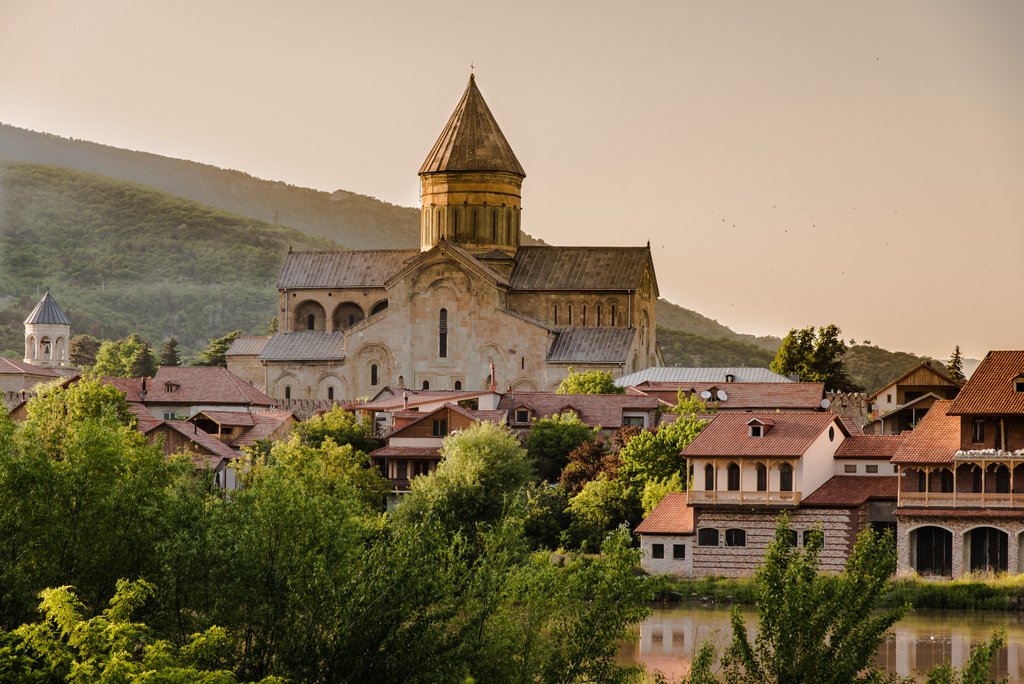
The Gergeti Trinity Church is a 14th-century stone church that sits on a hilltop in the shadows of snowcapped Mount Kazbek. Hike or drive there from the picturesque village of Stepantsminda.
Lomisoba is a holy celebration and a wild party. On a Wednesday near the summer solstice, thousands of people hike uphill from the village of Arakhveti to Lomisa ridge, to pray to Georgia’s patron, Saint George, and spend the night drinking homemade spirits before they greet the sunrise with a Mass.
Where to stay
Korsha Guesthouse. Two hours north of Tbilisi, this rustic six-room lodge features a stone replica of a Khevsureti tower and sprawling gardens with sculptures of animals carved out of sticks. 011-995-599-74-11-99 or e-mail korshaltd@gmail.com.
Where to eat
Rooms Hotel. Set in Stepantsminda, with a breathtaking view of Mount Kazbek, the restaurant here offers gourmet dining in an exquisitely renovated Soviet-era resort. 011-995-322-71-00-99.
— Bill Donahue
Showing posts with label Monastery. Show all posts
Showing posts with label Monastery. Show all posts
Wednesday, June 18, 2014
MAGAZINE: The Caucasus Mountains, in the spirit of writer Lermontov. By Bill Donahue (washingtonpost.com)


Wednesday, June 13, 2012
CULTURE: Georgia on the List of World Heritage in Danger (whc.unesco.org)
(whc.unesco.org) This document contains information on the state of conservation of thirty four natural and cultural properties inscribed on the List of World Heritage in Danger. The World Heritage Centre and Advisory Bodies therefore submit herewith reports for review by the Committee. Where appropriate, the World Heritage Centre or the Advisory Bodies will provide additional information during the session of the Committee.
here: whc.unesco.org (pdf)
30. Bagrati Cathedral and Gelati Monastery (Georgia) (C 710)
Year(s) of inscription on the List of World Heritage in Danger: 2010
Year of inscription on the World Heritage List: 1994
Criteria: (iv)
Threats for which the property was inscribed on the List of World Heritage in Danger
Irreversible interventions as part of major reconstruction of the structure of Bagrati Cathedral
Desired state of conservation for the removal of the property from the List of World Heritage in Danger
Adopted in Decision - 34COM 7B.88
See page whc.unesco.org/4196
Corrective measures identified
Adopted in Decision - 34COM 7B.88
See page whc.unesco.org/4196
Timeframe for the implementation of the corrective measures
Adopted in Decision - 34COM 7B.88
See page whc.unesco.org/4196
Previous Committee Decisions
See page whc.unesco.org/documents
International Assistance N/A
UNESCO extra-budgetary funds N/A
Previous monitoring missions
November 2003, June 2008 and and March 2010: Joint World Heritage Centre / ICOMOS reactive monitoring missions
Factors affecting the property identified in previous reports
a) General need for interior and exterior conservation work on the monuments;
b) Insufficient coordination between the Georgian Church and the national authorities;
c) Lack of co-ordinated management system;
d) Major reconstruction of the structure of Bagrati Cathedral.
Illustrative material
See page whc.unesco.org/710
Current conservation issues
At its 34th session the Committee requested the State Party to halt work on a monumental, stone-clad, reinforced concrete reconstruction of Bagrati Cathedral that had been started without its approval and decided to inscribe the property on the World Heritage List in Danger. At the 35th session, the Committee noted that work on reconstructing the Cathedral according to the monumental scheme had been halted.
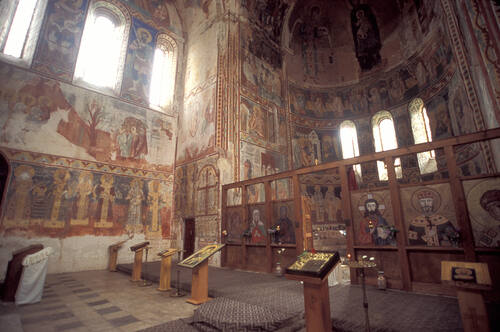 The Committee also took note that according to the international conservation architect appointed as a consultant for the Bagrati Cathedral that the incomplete structural condition of the Bagrati Cathedral was not sustainable, that it might not be feasible to reverse what has been recently built as the interventions are almost irreversible, and that a lightweight roof could be mounted on the existing concrete columns.
The Committee requested the State Party to produce a Rehabilitation Strategy that could allow the building to be brought back into use, while reversing the maximum amount of recent work and incorporating fragments of the original building where they form part of the walls.
The Rehabilitation Strategy was to be presented to the Committee for approval before a detailed rehabilitation project was submitted, and before any further work on the Cathedral was undertaken.
As also requested by the Committee at its 35th session, a joint World Heritage Centre/ICOMOS reactive monitoring mission visited the property from 22 to 28 April 2012 to discuss the Rehabilitation Strategy and to consider the overall state of conservation of the property.
At the time of drafting this report, only a preliminary mission report has been received. However, the report shows that a monumental re-building of the Cathedral using modern materials was well underway at the time of the mission.
The State Party submitted a State of Conservation Report on 31 January 2012. The report did not mention the fact that re-building work was well under way. The report addressed progress made with the drafting of the Rehabilitation Strategy for Bagrati Cathedral, with conservation work at Gelati monastery, and with drafting a retrospective Statement of Outstanding Universal Value. Further documents relating to the re-building of the Cathedral were submitted on 15 May 2012, after the mission had taken place. They included a revised Rehabilitation Strategy, details of the engineering work carried out, and a partial report on archaeological investigations, but no detailed plans of the re-building project.
a) Rehabilitation Strategy for Bagrati Cathedral
The State Party submitted a first draft of a Rehabilitation Strategy in January 2012. This was drafted following a round table discussion organised at the request of the State Party at the World Heritage Centre on 9 November 2011 and attended by representatives of the State Party, the World Heritage Centre, ICOMOS and ICCROM.
This meeting agreed that the purpose of the Rehabilitation Strategy was to set out a rationale for a project to allow the Cathedral to be brought back into use.
It was agreed that as the conservation history of Bagrati Cathedral is complex, and as recent interventions have to an extent limited certain options, the Rehabilitation Strategy needed to set out the necessary evidence to justify any rebuilding approach that was being suggested.
The meeting discussed a possible alternative approach to the monumental concrete option which could be based on a combination of reinforcement of the original parts of the fabric that had already been implemented (and agreed as being non-reversible), rebuilding using the four hundred or so stone blocks on site, where detailed evidence exists in the central and eastern part, and the insertion of modern construction in the west where evidence is lacking. The roof would be supported by lightweight steelwork and the whole construction would respect detailed archaeological research and allow for conservation of the original fabric. This approach would have the advantage of reversibility of the new construction.
The first draft of the Rehabilitation Strategy submitted by the State Party in January 2012 set out an approach based on recreating the eastern and central part of the Cathedral for which evidence exists, and completing the building with new structures at the western end where there is no evidence or little original material remains.
The draft Strategy was reviewed by ICOMOS who considered that in some places there was a need for further information and analysis in order to provide a clearer understanding as to the extent of the interventions to the fabric so far, the technical and conservation issues that these create. In general terms, ICOMOS considered that Strategy needed to be clearer on what could be reversed and what could not be reversed and how much of the existing recent work was needed from a structural point of view, what would be modified, and how new strengthening would be addressed. ICOMOS also considered that there was a certain amount of overlap between the strategy and the resulting project which needed to be resolved in the document. ICOMOS stressed that no approval had been given for the re-building project – as inferred in the draft strategy.
It was agreed that the reactive monitoring mission should discuss these comments with the State Party, so that a revised Rehabilitation Strategy could be submitted to the Committee at its forthcoming session.
This aim has however been overtaken by the resumption of work on the Cathedral which appears to have started after the last session of the Committee.
A second draft of the Rehabilitation Strategy was submitted by the State Party on 15 May 2012. However, as by this time reconstruction work was well under way, the purpose of the strategy as a document that could inform a reconstruction project is no longer relevant. The document has become a justification for work already carried out. In it the State Party concludes that the impact on the Outstanding Universal Value is negligible.
b) Stabilisation works of the Bagrati Cathedral
Although the State Party report states that some urgent stabilization works were undertaken to the west wall necessary for further supporting structures that might be needed for the rehabilitation strategy, as explained in a letter to the World Heritage Centre of 27 September 2011 to which the World Heritage Centre responded in the affirmative on 5 October 2011, the mission observed a very different situation.
Work on re-building the Cathedral was seen to be progressing non-stop to achieve a full reconstruction of the building, using stone-clad reinforced cement in the central and eastern parts, together with modern interventions in the western part, mostly along the lines of the original monumental project combined with the plans drawn up by the international conservation architect. A cast concrete cupola had already been partially raised up. The State Party confirmed to the mission that the inauguration of the Cathedral is being planned for September 2012.
The idea of restoring those parts of the building where evidence exists, on the basis of careful documentation and research, and conservation of the original fabric, has been abandoned.
c) Structural additions:
The mission was provided with information on the major structural interventions undertaken so far, and these have been confirmed in further information received from the State Party. These are:
- Completion of consolidation work on interior and exterior foundations of the load bearing walls;
- Creation of four central concrete pillars on the bases of the original ones;
- Installation of underground reinforced concrete beams, connecting the four pillars with the underground foundation of the exterior walls, which according to Georgian engineers, are placed under the archaeological level;
- Covering of the interior surface of the church walls with stone cladding, on a reinforced base – a totally irreversible process.
Although these works were stated to be necessary for the stability of the church in an earthquake zone, in reality these drastic interventions actually allowed the realisation of the first phase of the reconstruction project, in providing the necessary stability to allow for the proposed concrete cupola and the new roof.
d) Re-construction:
The mission observed the following work being undertaken:
- Western part:
In this end of the church, where inadequate original material and evidence exists for a full reconstruction, reinforced concrete beams have been installed in order to support the new stone and metal roof.
- North-west corner:
A metal construction has been prepared (with iron inserts into the original fabric), to support the new staircase and a lift that will lead to a first floor museum.
- Central part:
A reinforced concrete dome has been installed, theoretically supported by the four central concrete pillars together with concrete arches to supplement the concrete pillars, although the latter are still under construction. All the new (interior and exterior) surfaces are stone-clad. The only non-clad surface is in the area of the proposed museum. The gaps in the interior of the fabric are grouted with cement.
- Northern and southern wings:
Raised over the historical porticos with their famous stone reliefs, are reinforced concrete constructions, with iron supports for the metal roof covering.
- Eastern end:
This is being completed by continuing the reconstruction work of the 1950’s. It is being roofed over in a similar way to the rest of the building.
The mission observed that the current work has not been based on conservation of the existing fabric, some of which was acknowledged as being in an extremely fragile state during the previous mission in 2010, has not respected the archaeological layers, is not reversible.
Furthermore all these interventions have completely ignored the evidence brought to light by recent archaeological research. This identified the precise place of almost 400 of the original building stones that survived on the site. Of these, only two or three have been placed in their original position as examples.
In the Mission’s view the necessary stabilisation of the Cathedral could have been achieved in other less drastic ways and should have been submitted as part of the rehabilitation strategy for discussion.
The second draft of the Rehabilitation Strategy submitted by the State Party attempts to justify the reconstruction now being undertaken and states that the reconstruction will respect and rescue all the original material that existed at the time of inscription. However, the mission noted that only two of the four hundred fallen blocks were being re-used. The covering of the original fabric under a contemporary stone cladding on a reinforced concrete base will irreversibly damage the authenticity of the original structure, and also eliminate any historical evidence of the past interventions that are part of the history of the church.
In order to support the new reinforced concrete dome, excavations have been made in the central part of the church, to install additional sub-foundations for the parametric walls and large reinforced concrete beams have destroyed much of the archaeological layers, including, it appears, important discoveries of tombs inside the church, as reported in the media.
The overall approach was not considered by the mission to respect the aim to rehabilitate the church in a way that respected its fabric, archaeological layers and overall its Outstanding Universal Value, as had been envisaged by the Committee.
The second draft of the Rehabilitation Strategy states that at the time of inscription the monument was not totally in a ruined condition with parts reconstructed. This was accepted at the time of inscription but it is no justification for a monumental re-building that is being carried out without prior approval either as a strategy or in terms of detail by the Committee.
A detailed appraisal of this second draft Rehabilitation Strategy will be undertaken by ICOMOS and submitted to the State Party.
e) Topological and Archaeological Surveys around Bagrati Cathedral
The State Party report provides details of work undertaken to increase knowledge of the wider archaeological area around the Cathedral. In addition to topographic and cadastral surveys of the site carried out in early 2011, a non-intrusive archaeological survey of the entire Bagrati Cathedral part of the property was undertaken in November-December 2011. The results of this survey revealed a high density of archaeological layers in the survey area, including evidence of fortifications and royal residences.
The mission considered that the resulting data is highly important for understanding the significance of the context of the property. Such evidence could have been used as the basis of a Master Plan for the property and its setting to allow understanding of the way the area has evolved.
f) Gelati Monastery conservation work
The State Party reports that conservation works were continued within the framework of the Gelati Monastery Conservation Master Plan. The mission assessed the on-going works, which focused in 2011 on the Rehabilitation of the palace of Bishop Gabriel.
Through a cooperation agreement between the Restoration Faculty at the State Academy of Fine Arts (NACHPG) and Lugano University, and with the financial support of the Swiss National Science Foundation, international conservation specialists were involved in the stone and wall painting conservation programme during 2010-2011. Within the framework of a complex programme for the systematic conservation and restoration of the interior wall-paintings and mosaics in Gelati Monastery churches. As a result of this co-operation the following works were undertaken:
- Assessment of condition of mural paintings in the St. Marine chapel of the main church of Gelati;
- Stone condition assessment of the St. George church of Gelati and risk mapping;
- Conservation of carved stone frame around the entrance door of the St. George church of Gelati.
With the support of the NACHPG, it is planned to continue the involvement of these international specialists and with their associated students in future stone and wall painting conservation work.
The mission noted that the State Party has made significant progress in implementing the requested corrective measures regarding this component of the property.
A clear institutional coordination mechanism, ensuring that the conservation of the Gelati Monastery receives priority consideration within relevant governmental decision-making processes, has been established. A complex programme for the structural conservation and restoration of the churches in Gelati Monastery is being implemented.
The Gelati Monastery master plan presented in 2010 gives adequate answers to problems relating to the needs of the monastic community, and of the visitors to the monastic complex. The mission confirms that there is a proper organization of the functions inside the monastery grounds, taking into consideration the fact that the property is a living monument.
As already mentioned by the 2010 mission, there is also provision in case of a rising number of the monks, for them to be established in a nearby place, outside of the monastery grounds. The master plan dissociates the visitors’ facilities from the monks’ life, proposing that the new visitors’ buildings be erected outside the monastery grounds, while the visitors would follow an organized route inside the monastic complex.
g) Retrospective Statement of Outstanding Universal Value
The draft retrospective statement of Outstanding Universal Value submitted by the State Party is still under review by the Advisory Bodies.
Conclusions
The World Heritage Centre and the Advisory Bodies note the observations of the mission that notwithstanding the agreement between the World Heritage Centre and the State Party in November 2011 that only emergency work might be undertaken to stabilise the building, in reality a full-blown re-construction of the Cathedral is well underway, largely according to the monumental concrete and stone clad plans rejected by the Committee at its 34th session, but with a lighter modern construction at the western end.
The mission also noted that although exemplary investigative work has been undertaken on the monument and its surroundings, no attempt has been made to undertake an archaeological reconstruction using original stones, where they exist, nor to to conserve the original fabric, some of which was in a fragile state, and apparently no attempt has been made to protect the archaeological layers where reinforced concrete beams have been installed below ground, and the recently discovered tombs.
The World Heritage Centre and the Advisory Bodies note with disappointment that in spite of apparently positive meetings in 2011 between the State Party, the World Heritage Centre and the Advisory Bodies on the basis of a clear understanding that the Reconstruction Strategy should be developed and presented to the Committee for approval before any re-construction work was undertaken, and that such a strategy should acknowledge the need for a careful analysis of the existing fabric, and that some of the recent interventions should be reversed to give maximum exposure of the original stone, this strategic approach has apparently been ignored. Similarly, the Committee’s explicit request made at its 35th session, that it approve such a strategy before any commitment to rebuild was not respected. The World Heritage Centre and the Advisory Bodies also note that after almost complete implementation of the monumental project, the State Party has submitted in May 2012 a second draft of the Rehabilitation Strategy that attempts to justify the work underway without however providing an explanation as to why a solution that respects the original fabric and is reversible has not been developed. The World Heritage Centre and the Advisory Bodies recommend that the Committee express deep regret that the opportunity to undertake a careful, reversible reconstruction of the majority of the building based on clear evidence of what previously existed, with sensitive new work introduced where evidence is lacking, which could have allowed the Cathedral to be re-used and valued as part of contemporary society has not been taken. They consider that the decision to inaugurate a new reconstructed Cathedral of Bagrati in September 2012 has prevailed over the commitment of the State Party to implement the Committee's decisions to allow future removal of the property from the List of World Heritage in Danger, as well as over the responsibility to sustain the Outstanding Universal Value of the property.
While the State Party has made significant progress in implementing the corrective measures regarding the Gelati Monastery, they consider that the work undertaken at Bagrati Cathedral does not respect the Corrective Measures agreed by the Committee nor will it contribute towards achieving the Desired State of Conservation. The new work has overwhelmed the original masonry to such an extent that the authenticity of the Cathedral has been irreversibly destroyed. Bagrati Cathedral can no longer be said to contribute to the criterion for which the property was inscribed on the World Heritage List.
Draft Decision: 36 COM 7A.30
The World Heritage Committee,
1. Having examined Document WHC-12/36.COM/7A.Add,
2. Recalling Decision 35 COM 7A.29, adopted at its 35th session (UNESCO, 2011),
3. Welcomes the progress in the implementation of the rehabilitation programme and the conservation master plan for Gelati Monastery, as well as the progress in the establishment of a clear institutional coordination mechanism within the framework of the State Programme for Cultural Heritage in Georgia, involving all stakeholders concerned;
4. Notes with extreme concern that a reconstruction of Bagrati Cathedral is already well advanced, largely in line with plans, rejected by the Committee at its 34th session, for a monumental re-building using reinforced concrete, including a cast concrete cupola, and installing stone facing that covers much of the original stonework;
5. Further notes that, notwithstanding exemplary topological and archaeological surveys of the buildings, no attempt has been made to re-use the majority of the surviving fallen stones in their original places, in spite of the precise locations for some 400 stones having been identified;
6. Deeply regrets that no conservation of the original stonework has been undertaken, prior to the new work being started and that such work will now be impossible due to the irreversible nature of the recent interventions;
7. Expresses its great concern that, notwithstanding the production of a draft Rehabilitation Strategy for Bagrati Cathedral , as requested by the Committee, the subsequent comments by the Advisory Bodies, and the appointment of an international conservation architect, a strategic approach that would have optimised the retention of original stonework and allowed new interventions to be reversible and readily understood, has not been retained, and considers that the opportunity to bring the Bagrati Cathedral back into use, while at the same time sustaining its contribution to the Outstanding Universal Value of the property has been lost;
8. Also considers that the Bagrati Cathedral has been altered to such an extent that its authenticity has been irreversibly compromised and that it no longer contributes to the justification for the criterion for which the property was inscribed;
9. Deeply regrets that the decisions of the Committee at its 34th and 35th sessions have failed to protect Bagrati Cathedral;
10. Requests the State Party to submit, by 1 February 2013, a request for a major boundary modification for the property to allow Gelati Monastery to justify the criterion on its own;
11. Further encourages the State Party to seek the advice of the World Heritage Centre and the Advisory Bodies in developing the boundary modification;
12. Decides to retain Bagrati Cathedral and Gelati Monastery (Georgia) on the World Heritage List in Danger.
+++
31. Historical Monuments of Mtskheta (Georgia) (C 708)
Year of inscription on the World Heritage List 1994
Criteria (iii) (iv)
Year(s) of inscription on the List of World Heritage in Danger 2009 to present
Threats for which the property was inscribed on the List of World Heritage in Danger
a) Lack of a management mechanism;
b) Privatisation of surrounding land;
c) Loss of authenticity of some components due to restoration works conducted with unacceptable methods.
Desired state of conservation for the removal of the property from the List of World Heritage in Danger
Adopted, see page whc.unesco.org/4103
Corrective measures identified
Adopted, see page whc.unesco.org/4103
Previous Committee Decisions
See page whc.unesco.org/documents
International Assistance
Global amount granted to the property: USD 97,660
For details, see page whc.unesco.org/assistance
UNESCO extra-budgetary funds N/A
Previous monitoring missions November 2003, June 2008, March 2010 and April 2012:
Joint World Heritage Centre / ICOMOS reactive monitoring missions.
Factors affecting the property identified in previous reports
a) Lack of a management mechanism;
b) Lack of definition of property and buffer zones;
c) Privatisation of surrounding land;
d) Natural erosion of stone;
e) Loss of authenticity in recent works carried out by the Church;
f) Insufficient coordination between the Georgian Church and the national authorities.
Illustrative material
See page whc.unesco.org/708
Current conservation issues
 On 31 January 2012 the State Party submitted a detailed state of conservation report that addresses progress with the implementation of the corrective measures, including conservation work at Jvari Monastery, surveys of Svctitskhoveli Cathedral, clarification of boundaries and progress with the Management Plan. Details are also provided regarding a proposed visitor centre at Jvari Monastery.
A joint World Heritage Centre / ICOMOS reactive monitoring mission visited the property between 23 and 28 April 2012, as requested by the World Heritage Committee at its 35th session (UNESCO, 2011).
a) Boundaries issues
The State Party has submitted to the World Heritage Centre updated retrospective cartographic documentation clarifying the boundaries of the property. However, the mission reported that there has not yet been any definition of the buffer zone. This work is seen as a pre-condition for the development of the Management Plan and for possible minor boundary modification of the property.
b) Management Plan
The State Party reported that the drafting of the Management Plan will take place during 2012 within the framework of an approved International Assistance Request and with the support of the National Agency for Cultural Heritage Preservation. This project will also consider the management system for the property and the possibility of establishing working groups to allow for the participation of representatives of the church authorities, NGOs and the Mtskheta civil society. The mission stressed the need for the Management Plan to acknowledge that the property is an ensemble of religious monuments within a very sensitive historical environment and thus needs to be managed as a cultural landscape.
c) Long-term consolidation, conservation and monitoring measures
The State Party reported that during 2012, a comprehensive conservation assessment of archaeological components of the property was undertaken and recommendations set out for their management. Conservation work was carried out on the roof, walls and stone plaques of the Jvari monastery, with the participation of an ICCROM expert, and of the wall paintings in the southern part of Svetitskhoveli Cathedral. At the Cathedral, another capacity-training project headed by an international expert addressed the production of up to date measured drawings during 2010-2011. This resulted in a full set of measured drawings for the Cathedral that will form the basis for developping of a comprehensive conservation plan. At Samtavro nunnery, a project is being prepared to strengthen the southern support wall taking into account the 2010 mission recommendations.
The State Party reported that in 2011 the National Agency for Cultural Heritage Preservation had allocated a special budget for monitoring of the property. In addition, a special project was implemented for monitoring the groundwater fluctuations around Svetitskhoveli Cathedral. It is anticipated that by the end of 2012, additional monitoring mechanisms will be proposed for all elements of the property.
d) Proposal for a Visitor Centre at Jvari Monastery
The State Party included in its report revised plans for the visitor centre at Jvari Monastery. These are said to take into account the comments made by ICOMOS on the initial plans in 2011. These plans will now be reviewed by ICOMOS and comments sent to the State Party.
e) Urban Land-Use Master Plan
At the initiative of the local authorities, work has begun on a systematic data collection of the urban topology, related development and other studies. This data will form the basis for an Urban Master Plan of the town which is being prepared and is due to be completed by the end of the year.
f) Urban development pressure
The 2010 mission report highlighted the need for special care to be given to the sensitive area extending along the river Mtkvari bank, between the Svetitskhoveli Cathedral and Jvari church. It recommended that the area where the rivers converge should not be developed and that the historic landscape be restored. However, the 2012 mission noted that the State departments, in cooperation with the local authorities have proceeded with the construction of new administrative buildings (Police and Courts buildings and Conference Hall) in this area. The 2012 mission was also informed that a new Museum building is to be erected on the same area, the plans of which have already been approved, as well as a hotel complex. The mission also saw a new tourist information building in front of the entrance of the Svetitskhoveli Cathedral, constructed in inappropriate style without any respect of the property’s value.
The 2012 mission noted that these considerable developments have been undertaken within one of the most sensitive areas of the property, in the visual corridor between the Svetitskhoveli Cathedral and the Jvari hill, is currently being assessed independently of the directions that may be developed by the Urban Master Plan and the Management Plan that are both under preparation. The mission further noted that although all these interventions have an immediate impact on the property, they have not been notified to the World Heritage Centre, in line with Paragraph 172 of the Operational Guidelines.
g) State Programme for Cultural Heritage in Georgia - towards a strategic World Heritage country programming
The World Heritage Centre has been informed by the World Bank that a “Regional Development Program: An Integrated Approach to Urban Regeneration, Cultural and Natural Heritage for Economic Growth and Job Creation” is under implementation in Georgia. On 23 April 2012, the Minister of Finance of Georgia presented an “Innovative Approach to Regional Development” during a meeting organised by the Cultural Heritage and Sustainable Tourism Thematic Group, the Europe and Central Asia (ECA) Sustainable Development Department and the South Caucasus Regional Management Unit at the World Bank Headquarters.
The 2012 mission has been informed that the Governor of Mtskheta discussed with the World Bank representative the possibility to extend this project to Mtskheta. The mission recommended to the authorities to establish, in coordination with the World Heritage Centre and the Advisory Bodies, a global approach for all projects and activities which could be developed for the World Heritage properties in Georgia.
During the meeting with the Deputy Minister of Foreign Affairs of Georgia and the National Commission of Georgia for UNESCO, the mission underlined the urgency to develop this global approach towards a strategic World Heritage country programming in coherence and alignment with the State Programme for the protection of Georgian cultural heritage prepared by the National Agency for Cultural Heritage Preservation. It was discussed that this country-based approach could be developed using the 5C Strategic Objectives in order to achieve greater coherence, efficiency and effectiveness at country level of all activities related to the protection, management and use of the World Heritage properties, and to avoid fragmentation and duplication of projects and activities.
Conclusions
The World Heritage Centre and the Advisory Bodies note the detailed report from the State Party which includes and assessment of what has so far been achieved – identified as strengths, and its conclusion that the main weakness is the lack of a Management Plan and of a consolidated vision for the development of the property, both of which will be addressed this year.
The World Heritage Centre and the Advisory Bodies wish to highlight to the Committee their concern that despite the 2010 mission recommendation regarding the sensitive area extending along the river Mtkvari bank, between the Svetitskhoveli Cathedral and Jvari church, the State Party authorised new constructions in this area and plans new developments which will impact on the Outstanding Universal Value of the property, without any submission of these projects to the World Heritage Centre, in conformity with Paragraph 172 of the Operational Guidelines, for review and comments prior to any approval.
The World Heritage Centre and the Advisory Bodies underscore the fact that Mtskheta is an ensemble of religious monuments within a very sensitive historical environment. Taking into account that the most sensitive areas of Mtskheta’s landscape are being compromised by new buildings, they recommend that the World Heritage Committee retains the Historical Monuments of Mtskheta (Georgia) on the List of World Heritage in Danger.
The World Heritage Centre and the Advisory Bodies suggest that the World Heritage Committee might recommend that the State Party develop a national law for all World Heritage properties in Georgia, as well as initiate a “5C strategic World Heritage country programme” proposal. This could serve as a consolidated basis for cooperation within the country to enhance the implementation of its commitments within the framework of the World Heritage Convention and take into account the need for a more sustainable longer-term approach. It could be developed on the basis of the analysis of the challenges, corrective measures and the national priorities and strategies as set out in the Periodic Report.
Draft Decision: 36 COM 7A.31
The World Heritage Committee,
1. Having examined Document WHC-12/36.COM/7A.Add,
2. Recalling Decision 35 COM 7A.30 adopted at its 35th session (UNESCO, 2011),
3. Acknowledges the detailed information provided by the State Party on the progress made to implement the corrective measures and urges the State Party to continue its work on all the corrective measures adopted at its 34th session (Seville, 2010);
4. Also urges the State Party to define the buffer zone of the property to allow a clear understanding of the archaeological and visually sensitive areas around the property and to submit this proposal as a minor boundary modification of the property;
5. Expresses its great concern regarding developments being undertaken by the State Party in the vicinity of the property within the area of the river Mtkvari bank, between the Svctitskhoveli Cathedral and Jvari church, and further urges the State Party to halt developments within the property and its setting until details of proposed developments, together with Heritage Impact Assessments, have been submitted to the World Heritage Centre, in conformity with Paragraph 172 of the Operational Guidelines, for review and comments by the Advisory Bodies before any irreversible decisions have been made;
6. Notes that the State Party intends to complete a Management Plan for the property by the end of 2012, requests the State Party to ensure that this Plan recognises that the property is an ensemble of religious monuments within a very sensitive historical environment, and also requests it to submit the draft of this plan to the World Heritage Centre for review by the Advisory Bodies;
7. Invites the State Party to consider the development of a national law for all World Heritage properties in Georgia;
8. Further requests the State Party, in coordination with the World Heritage Centre and Advisory Bodies, to develop a “5C strategic World Heritage country programme” proposal, based on the State Programme for the protection of Georgian cultural heritage, to serve as a consolidated basis for cooperation within the State Party to enhance the implementation of its commitments within the framework of the World Heritage Convention;
9. Requests furthermore the State Party to submit to the World Heritage Centre, by 1 February 2013, an updated report on the state of conservation of the property and the implementation of the above, for examination by the World Heritage Committee at its 37th session in 2013;
10. Decides to retain the Historical Monuments of Mtskheta (Georgia) on the List of World Heritage in Danger.
Timeframe for the implementation of the corrective measures
Adopted, see page whc.unesco.org/4103
Wednesday, October 13, 2010
KULTUR: UNESCO sieht Weltkulturerbe in Georgien in Gefahr (georgien-nachrichten.de)
Das UNESCO-Welterbekomitee hat bei seiner 34. Sitzung in dieser Woche den aktuellen Stand der ins Erbe aufgenommen Landschaften und Immobilien weltweit beurteilt. In Deutschland zeigte sich das Komitee mit dem Bau einer Brücke über den Rhein in der Nähe des berühmten Felsens der Loreley einverstanden. In Georgien hingegen nahm das Komitee die Bagrati Kathedrale und das Kloster Gelati in die Liste der gefährdeten Bestandteile des Weltkulturerbes auf.
Das Komitee drückte in beiden Fällen seine Sorge aus über unumkehrbare Renovierungsarbeiten in Georgien, die die Authentizität der Bauwerke in Frage stellen. Die Bauarbeiten sollten sofort eingestellt werden, forderte das Komitee.
Vertreter der Regierung Saakaschwili ließen ihre Bereitschaft erkennen, über die Bauarbeiten zu reden.
Interpressnews, 30.07.2010
Das Komitee drückte in beiden Fällen seine Sorge aus über unumkehrbare Renovierungsarbeiten in Georgien, die die Authentizität der Bauwerke in Frage stellen. Die Bauarbeiten sollten sofort eingestellt werden, forderte das Komitee.
Vertreter der Regierung Saakaschwili ließen ihre Bereitschaft erkennen, über die Bauarbeiten zu reden.
Interpressnews, 30.07.2010
Tuesday, July 15, 2008

Saturday, May 24, 2008

Monday, April 07, 2008
PHOTOGRAPHY: Nontraditional Looking Icons
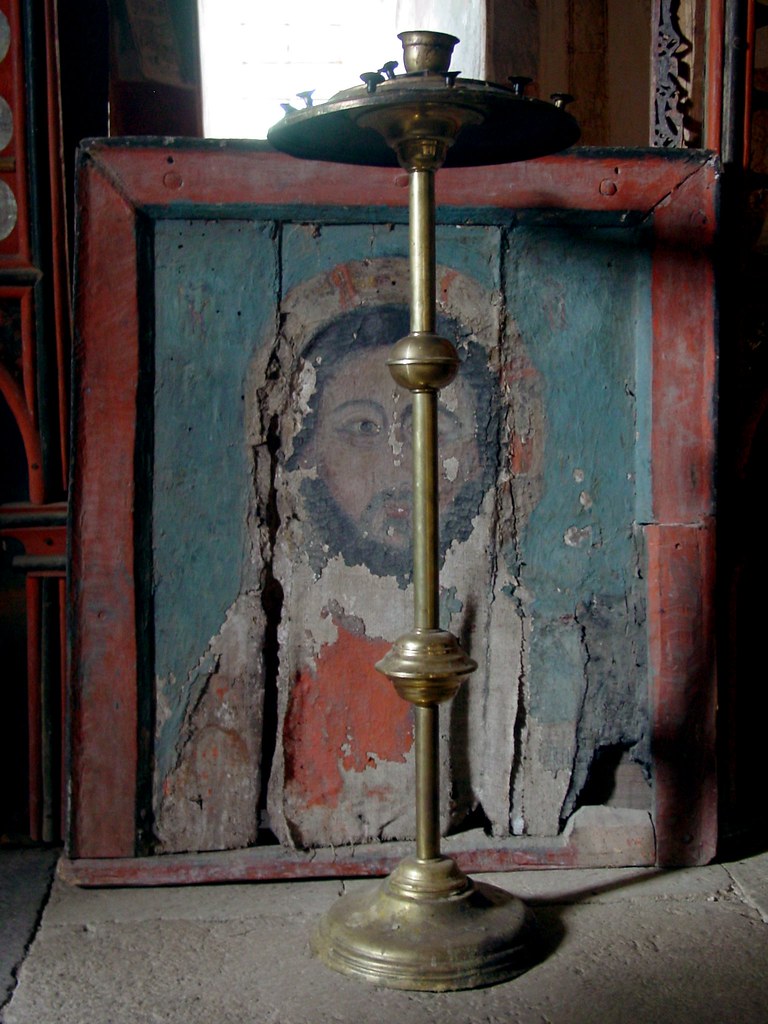 Foto 3. Mai 2006 von Vladimer Shioshvili
Kutaisi (Album)
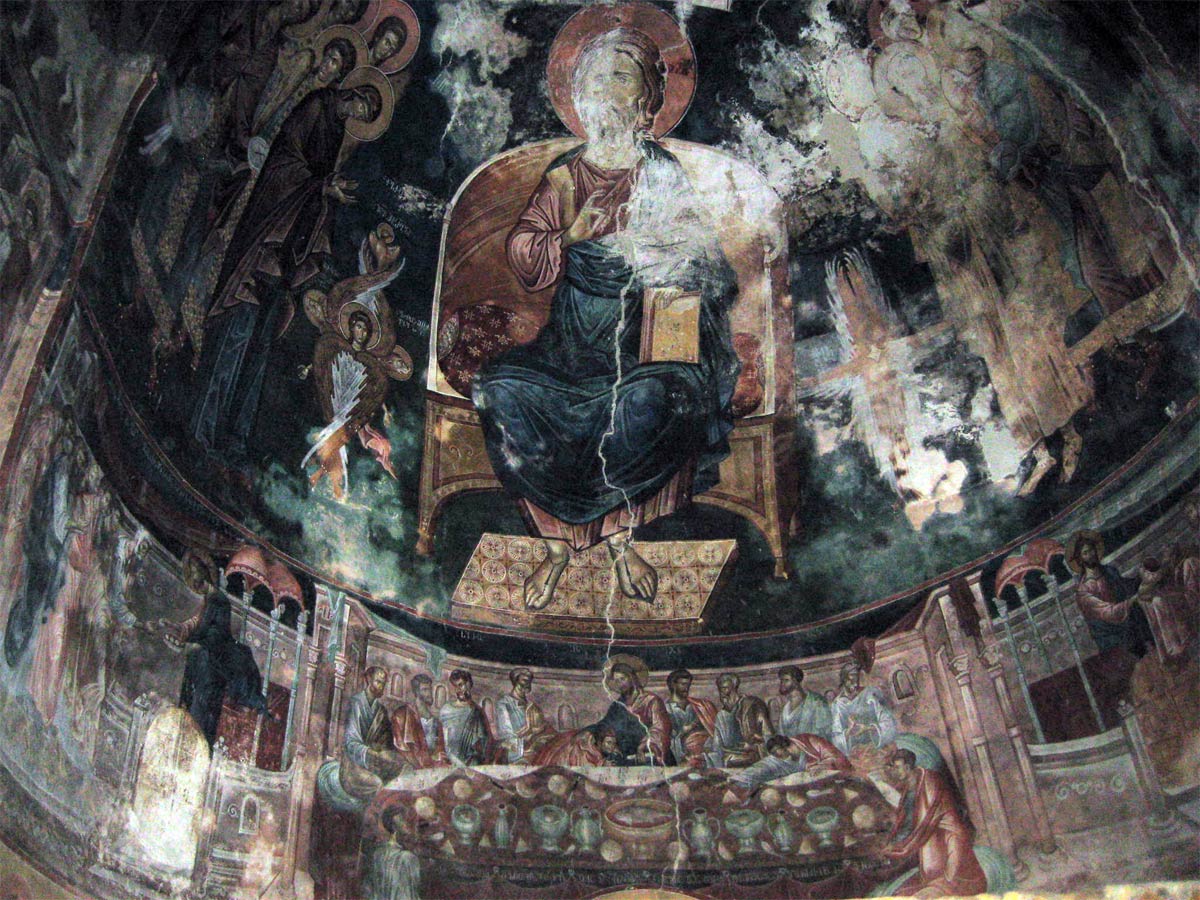
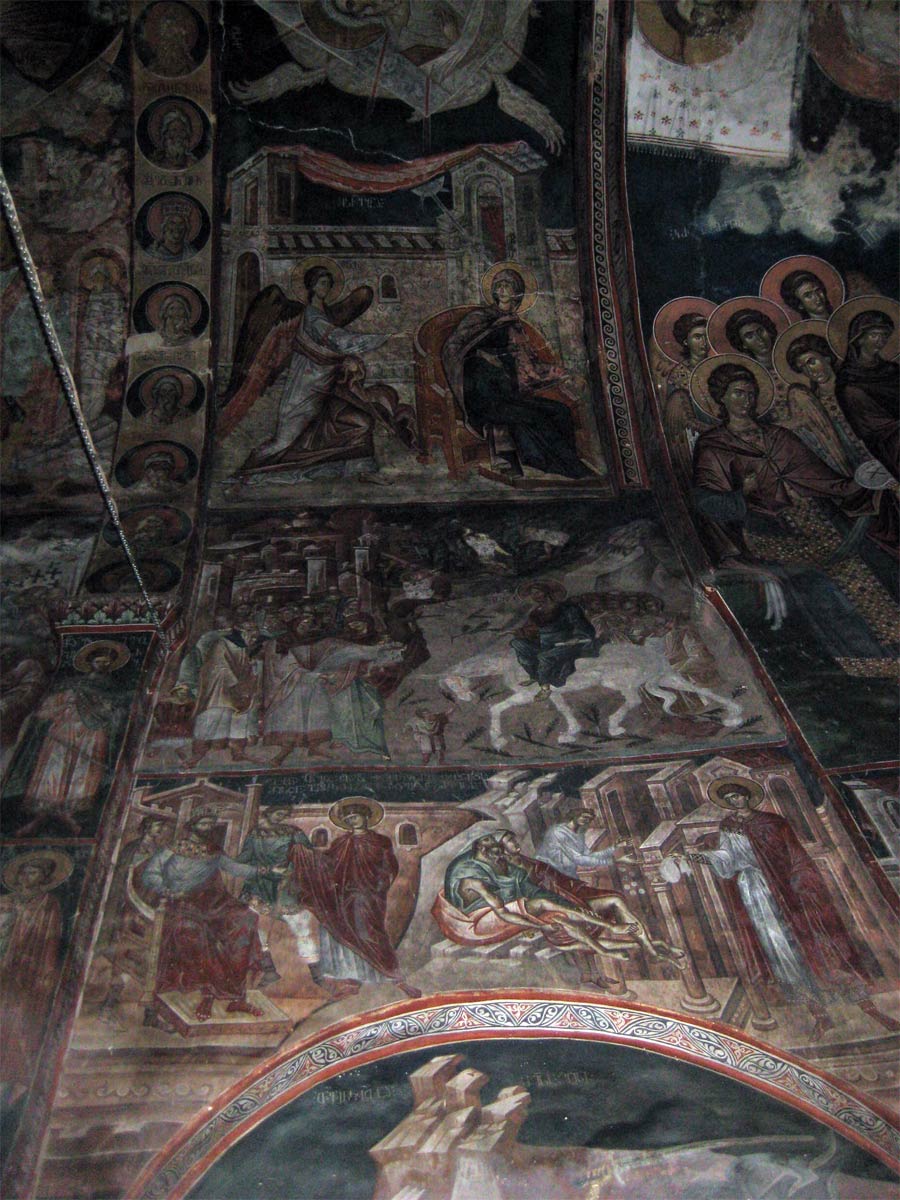
In a small room in Gelati, filled with somewhat nontraditional looking icons.
omelovicz sagt:
Let me guess 19th century icons with Russian court-style influence?Great picture and great setting. Geschrieben: vor 19 Monaten.
shioshvili sagt:
it seems that you know more about this stuff than I do. It does seem non-traditional, hence it probably Russian influence (or even Russian icon). This room had somewhat odd collection (depiction of hell at one wall, this in at the other). It is sad that it has to be this way and not either identified, or taken care of.
Monday, March 10, 2008
TRAVEL-TOUR: Discovering Medieval Monasticism in Georgia: A Guided Tour
 Monastery Tour 2008: In our third season, join us for an exploration of Georgia's oldest monasteries, founded in the sixth century by Christian ascetics from Syria. Be among the first westerners to rediscover the ancient architecture, frescoes, and acoustics of these remarkable monuments, set amidst rolling vineyards, towering peaks, and the desert vistas of the Caspian basin. Led by chant team Luarsab Togonidze, John A Graham, and Aurelia Shrenker, this unique tour seeks to investigate the sounds and wonders of medieval Georgia, while presenting the world-famous hospitality and charm of modern Georgia...
Source: www.georgianchant.org
Downloads
2008 Application Form.doc Word, 36 KB
2008 Application Form.pdf PDF, 60 KB
What to Bring.doc Word, 104 KB
What to Bring.pdf Adobe, 92 KB
2008 Itinerary.doc Word, 64 KB
2008 Itinerary.pdf Adobe, 80 KB
Contact:
John A Graham
25 Greenview Ave.
Princeton, NJ 08542
(802) 922-3264 (email preferred)
Subscribe to:
Posts (Atom)