Showing posts with label Church. Show all posts
Showing posts with label Church. Show all posts
Sunday, December 01, 2013
VIDEO: Georgien: Mtskheta - Die Wunder der Nino (swr.de)
(swr.de) Der Film führt nach Mtskheta, der alten Hauptstadt Georgiens. Sie gilt als heiligster und geschichtsträchtigster Ort des Landes.
Hier entstanden die ersten Kirchen und von hier aus begann im 4. Jahrhundert die Christianisierung, um die sich - typisch georgisch - wundersame Geschichten ranken. Oft ist dabei von der kräuterkundigen Heilerin "Nino" die Rede, der auch eine Beteiligung am Bau der Kirchen nachgesagt wird.
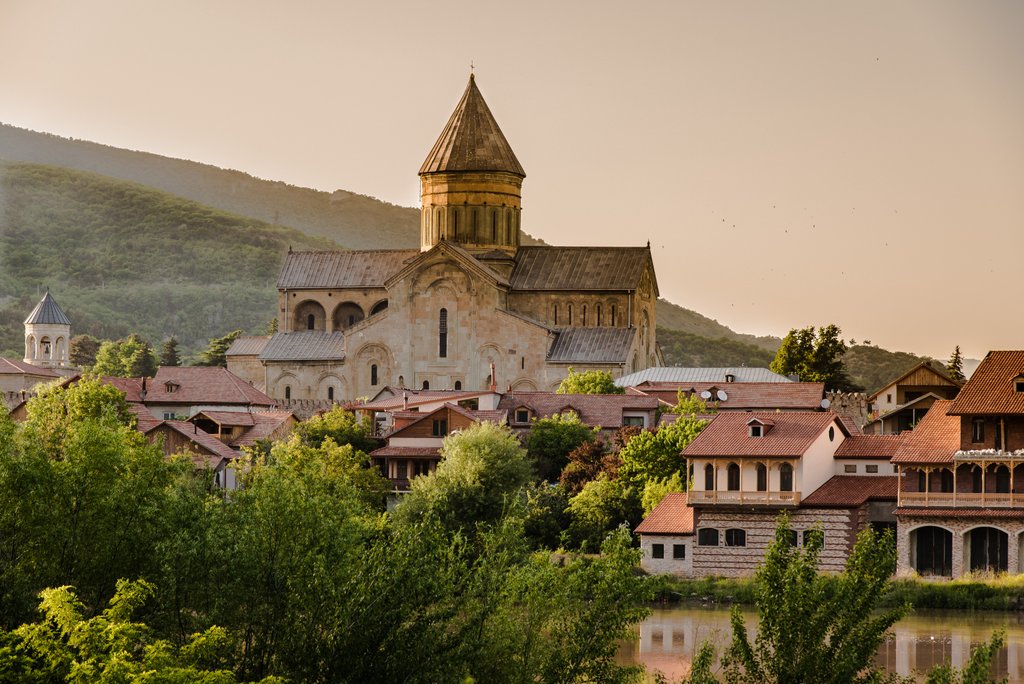
In der Ortsmitte liegt die über 1000 Jahre alte Sweti-Zchoweli-Kathedrale, bis heute Sitz des georgischen Patriarchen. Von der Dschwari-Kirche, der ältesten Kreuzkuppelkirche Georgiens, erschließt sich eine unglaubliche Aussicht auf die Stadt, auf die sanften Bergketten ringsherum sowie auf die zerklüfteten Gebirgszüge des Kaukasus am Horizont.
Mtskheta - ein Ort, an dem die Geschichte der Christianisierung, georgische Baukunst und die Wunder der Nino zusammenfallen.


Monday, August 12, 2013
PRESS RELEASE: The Armenian Diocese in Georgia - Joint campaign in Shaumyan village
The Armenian Diocese in Georgia
18, Armazi Street, 0103, Tbilisi, Georgia
Phone: +995322546411
Cell: +995593397170
Fax: +995322751790
Email: contact@armenianchurch.ge
Website: www.armenianchurch.ge
Facebook: https://www.facebook.com/officialhayartun
Joint campaign in Shaumyan village conducted by Armenian youth from Tbilisi and from Armenian-inhabited villages of Marneuli district
On 5 August 2013 a group of young Georgian Armenians from Tbilisi, under the leadership of deacon Gevorg Antonyan, the Head of the Youth Department of the Armenian Diocese in Georgia and the Spiritual supervisor of the `Hayartun' Centre, and Levon Isakhanyan, Adviser to the Head of the Diocese and the Head of the Legal Department of the Diocese, joined by young Armenians from Armenian-inhabited villages of Marneuli district, visited Shaumyan village where they conducted gathering of statistic data about local Armenian community and information gathering about problems faced by the community. In the meantime donations were collected for restoration of Shaumyan's Surb Astvatsatsin Church.
The information gathering campaign ascertained that main problems faced by the local community are the following: inadequate supply of potable water, gas supply, and lack of information about various State programs.
In order to facilitate solution of the identified problems Armenian Diocese in Georgia has sent letters to relevant ministries.
Photo reportage is available at: facebook.com/media/set
Tuesday, July 09, 2013
REISE: 28. Juli: Kwirikoba in Swanetien - Ein arachisches Wallfahrtsfest (kaukasische-post.com)
(kaukasische-post.com) Lagurka heißt die
wichtigste Wallfahrtskirche in Swanetien. Sie liegt hoch auf einer
Felsnase über dem Enguri im Dorf Kala, nur noch eine Autostunde von
Uschguli entfernt. Der Aufstieg ist sehr beschwerlich, er führt durch
einen zauberhaften Wald, einem den Swanen heiligen Hain, in dem kein
Baum jemals gefällt werden darf. Der Baumkult – solch heilige Haine gibt
es in jedem Dorf – ist ein Teil der vorchristlichen swanischen
Volkskultur, die sich über Jahrtausende erhalten hat und mit
christlichen Riten zu einer unvergleichlichen Einheit verschmolzen ist.
Jedes Jahr feiern
die Swanen auf Lagurka ihr wichtigstes Wallfahrtfest, Qurikoba. Es ist
nach dem heiligen Kwirike benannt, dem Schutzheiligen der Kirche. Ein
archaisches Ritual mit Gebeten und Trinksprüchen. Im Kirchhof wird ein
Ochse geopfert, der dann von Hunderten swanischer Pilger verzehrt wird,
bei Wein und Raki, dem swanischen Gerstenschnaps. Kwirikoba findet in
diesem Jahr am 28. Juli statt.
ERKA-Reisen
bietet Interessenten eine Dreitagestour zu diesem außergewöhnlichen Fest
an. Abfahrt nach Mestia ist am 27. Juli, übernachtet wird zweimal im
Hotel Old Seti (oder einem privaten Gästehaus). Am Sonntag Teilnahme am
Wallfahrtsfest mit einem Kurzbesuch von Uschguli. Rückfahrt am Montag.
Selbstfahrer können sich der Tour gerne anschließen.
Mehr Infos auf: www.erkareisen.de
Sunday, October 07, 2012
TIME: LightBox Pictures of the Week: September 28 – October 5 (lightbox.time.com)
 |
| ITAR-TASS /Landov |
(lightbox.time.com) Oct. 1, 2012. Billionaire Bidzina Ivanishvili, the leader of the opposition coalition Georgian Dream, and his spouse Ekaterina Khvedelidze hold candles at the 'Sioni' Cathedral of the Dormition.
Friday, September 07, 2012
RESTORATION: Bagrati Cathedral – Copy or Original? By Author Irina Bagauri (en.tabula.ge)
 (tabula.ge) "The authenticity of the Cathedral has been irreversibly destroyed. Bagrati Cathedral can no longer be said to contribute to the criterion for which the property was inscribed on the World Heritage List,” reads a preliminary “state of conservation” report prepared for the Thirty-Sixth Session of the UNESCO World Heritage Committee. The ancient Georgian monument is in serious jeopardy of losing its World Heritage status because of “irreversible interventions as part of major reconstruction of the structure of Bagrati Cathedral,” according to the preliminary assessment.

Specifically, the World Heritage Committee has expressed “extreme concern that a reconstruction of Bagrati Cathedral is already well advanced, largely in line with plans, rejected by the Committee at its 34th session, for a monumental re-building using reinforced concrete, including a cast concrete cupola, and installing stone facing that covers much of the original stonework.”
Nika Vacheishvili, the Director General of the National Agency for Cultural Heritage Preservation of Georgia, strongly disputes the preliminary conclusions drawn by UNESCO. He insists that the UNESCO assessment is based on incorrect information provided by experts who had not conducted a thorough study of the monument. Speaking with Tabula, Vacheishvili offered his own assessment of both the UNESCO preliminary opinion and the work completed at Bagrati Cathedral:
"That opinion, in my view, is very incompetent. Even though we tried to show every facet to an expert from the International Council on Monuments and Sites (ICOMOS) and to avoid superficial discussions regularly provided him with materials, the expert still arrived in Georgia unprepared and, therefore, the [UNESCO] document is riddled with mistakes. We have reacted to that, having sent a letter to the relevant entity. We expect that the one-sidedness that exists today will be balanced and the situation will be brought in line with the reality.
“Many things in the opinion have been regrettable lies. I do not know what turned that person blind. Those four hundred stones, which we had discovered during these recent years and found place for each of them, are not just abandoned but are being installed to the places they belonged originally. Openings in the dome, the width of the dome, the number and form of arches are documented with these very stones. It is therefore a pity that such competent organizations have drawn such incompetent conclusions. There have been instances, however, when UNESCO has disagreed with ICOMOS opinions and I hope that the case of Bagrati will be such an instance.
 “Bagrati is a very complex project and, the closer the reconstruction comes to its completion, the more convinced I become that we have embarked on the correct path; that is, a balance between the old and the new. We have smaller modern inserts which reflect the Twenty-First Century, thus avoiding sham replication of the old. There, both old and modern are appreciated. And all that is combined in the fabric of the Cathedral.”
Modern inserts imply a glass lift. For some unknown reason, the existence of this object within the religious space has caused exaggerated concern among people interested in the fate of the Cathedral even though the UNESCO opinion itself says nothing extraordinary about the glass lift. Instead, the preliminary assessment is focused mainly on other more conspicuous interventions. In comments to media, architectural restorers and art critics alike have confirmed the fact that the glass lift is the least alarming problem among interventions endangering the authenticity of the Cathedral. In order to facilitate the movement of handicapped and elderly people, lifts, like wheelchair ramps, are considered desirable in buildings of any type or age. However, in the case of Bagrati Cathedral, questions have been raised about the engineering design which envisaged installation of the lift on the façade. Whether that design was prompted by the necessity to make lift access conspicuous or just to add yet another element of décor is a topic of separate discussion.
According to modern restoration theory formulated by Italian art historian Cesare Brandi, a ruin that is part of a monument of cultural heritage represents an independent work of art whereas the entire reconstruction of a building in ruins is merely a copy of an authentic building and is not justifiable either esthetically or historically.
The initiative to reconstruct Bagrati Cathedral originated with the Georgian Patriarchate. At the request of the Georgian Patriarch, discussions on the full reconstruction of Bagrati started in the 1990s. On 21 January 2008, Georgian President Mikheil Saakashvili chose Bagrati Cathedral as the site of his inauguration for a second term. There, the President addressed the nation after his swearing-in, declaring: “We are completing the ceremony and starting to rebuild Georgia. As a symbol of Georgia’s revival and strength, we pledge – with the blessing and supervision of the Patriarch as well as with the best specialists – to start restoration works on Bagrati in the forthcoming weeks.”
This year, President Saakashvili responded publicly to criticism that erupted following ongoing reconstruction work at the Cathedral. Speaking at the 26 May inauguration ceremony of the new Georgian Parliament building in Kutaisi, the President remarked: “Many people kept telling me that the reconstruction of the Bagrati Cathedral was barbarism, that no one reconstructed the Acropolis in Greece. I think, though, that Bagrati was built for people to pray there and now it must be restored for modern Georgians to pray there as well.”
Nika Vacheishvili, in his interview with Tabula, addressed the question of whether responsible people have to make a choice between the symbolism of the Cathedral and its authenticity:
“I want to specify that the entire authenticity is preserved. Anyone who will go to the Bagrati Cathedral will see that the main glory of the Cathedral comes from the Eleventh not the Twenty-First Century. That is that nuance which has been thoroughly observed in the project. UNESCO is a very respectable organization. But, when you are one-hundred percent sure that you meet all the criteria which is certified by national as well as by renowned international experts, I think you would agree with me that we could not stay inactive for the threat of hypothetical criticism, especially taking into account the reality that the Cathedral was on the verge of perishing. Bagrati is a national symbol of unity and it would be incorrect to preserve it in the form of ruins. Therefore, instead of just being on the UNESCO World Heritage List, it is better to make something innovative that would become an example for others. And I am sure that UNESCO will appreciate that risk. So far, it has maintained that cathedrals should not be touched but only preserved. This project, however, has shown that there is a solution between the preservation of antiquity, the restoration of a cathedral and the maintenance of it as a church.”
Tabula also contacted Andrea Bruno, the Italian architect in charge of restoration of Bagrati. In Bruno’s view, the plan of Bagrati rehabilitation – the largest part of which was drawn up by Georgian architect Ivane Gremelashvili – is “innovative” and in line with modern standards. As Bruno explained:
 “The Bagrati Cathedral and the entire adjacent area, which have been distinguished for its construction stratigraphy for centuries, represent a synthesis of material and non-material values of certain importance. That treasury is acknowledged by international bodies and included in the World Heritage List. An innovative project which is being implemented on the left wing of the construction enables the reconstruction of a gallery which will house a museum in the future. Archeological items and photos of construction of the Cathedral displayed there will allow visitors to get acquainted with the history of Georgia from that angle.
“That project was presented from the very beginning as an innovative gesture in restoration, focused on identifying values of earlier structures and simplifying the reading of palimpsest of the Cathedral. I believe that after the completion of ongoing works, cultural and creative values of the Cathedral and its entire area will be shown more conspicuously.
“My creative plan, which I started to develop in January 2011 along with restoration interventions, involves the identification and study of values of the construction and that part which lies within the adjacent entire archeological area. I think that this is a necessary condition in order to fully meet the requirement of bodies in charge of preservation of cultural heritage, to increase the interest toward the monuments on the Cultural Heritage List and possibilities of determining their values. The work on these issues will start after the completion of the reconstruction process.”
The Cathedral of the Dormition, more commonly known as Bagrati Cathedral, is a monument of medieval Georgian architecture built during the reign of King Bagrat III in Kutaisi. Construction of the Cathedral started at the end of the Tenth Century and, according to the inscription discovered on the Northern façade of the Cathedral, was completed in the year 1003. The first serious damage to the Cathedral occurred during the invasion of the Ottomans in 1691, when the dome of the cathedral caved in as a result of an explosion of gunpowder. In 1770, under the order of General Gottlieb Totleben, Russian cannons fired at the Kutaisi fortress destroyed the upper part of the Cathedral. In the following centuries, the damage worsened.
In the 1950s, the restoration-conservation of the damaged monument started under the direction of Georgian architect Vakhtang Tsintsadze. The initial restoration work was divided into six stages and continued through 1994. That same year, UNESCO experts acknowledged the Bagrati Cathedral, along with the Gelati Monastery, as a World Heritage site and one of the distinguished monuments of Medieval-Age architecture.
The reconstruction work undertaken in the following years, however, has raised questions about the authenticity of the Bagrati and Gelati monuments. In 2010, both sites were demoted to the List of World Heritage in Danger. UNESCO has since repeatedly called on Georgia to halt the reconstruction. The UNESCO preliminary conservation opinion published on 1 June 2012 confirms the fears of experts that the monument may be removed from the List of World Heritage. Whether or not UNESCO will take that very drastic step should become clear during the Thirty-Sixth UNESCO session scheduled for 24 June through 6 July in Saint Petersburg. That will determine whether Georgia will preserve the reconstructed Bagrati as a historically authentic cathedral or a modern replica.
Editor’s Note: The UNESCO World Heritage Committee decided at its meeting in St. Petersburg to postpone any final resolution of the issue of Bagrati Cathedral until the year 2013. A group of international experts will arrive in Georgia in September 2012 to assess the status of the Georgian monuments on the UNESCO Cultural Heritage List.
This article first appeared in Tabula Georgian Issue # 106, published 25 June 2012.
Monday, September 03, 2012
GEORGIA: Orthodox Church Looks Askance at Proliferation of Yoga Studies. By Molly Corso (eurasianet.org)
(eurasianet.org) A growing number of Georgians are turning to yoga to shake off the stress of daily life. But their quest for inner calm and smaller waists is generating hostility from the powerful Georgian Orthodox Church.
Over the past two years, yoga has gone from a largely unknown Eastern tradition to a popular fitness routine in the Georgian capital, Tbilisi. Georgian National Yoga Federation President Giorgi Berdzenishvili, a passionate practitioner for the past 15 years, called the trend a “dynamic” process that started under former Soviet leader Mikheil Gorbachev’s glasnost’ policies in the late 1980s.
 During the Soviet era, when religious beliefs were discouraged, yoga tended to be viewed as a fringe health-oriented practice, devoid of spirituality, Berdzenishvili noted. But slowly, over the past several years, amid increased Internet usage and travel abroad, yoga has moved into the mainstream in Georgian society.
Today, yoga’s popularity is at an all-time high, instructors say. Classes are full, leading to the opening of several new studios in Tbilisi over the past year. This phenomenon has some Georgian Orthodox priests worried, due to yoga’s spiritual roots in Hinduism, and its perceived association with Buddhism.
While the Patriarchy, the body that governs the Georgian Orthodox Church, did not respond to requests from EurasiaNet.org for the Church’s official position on yoga, dozens of websites devoted to the faith have published articles and blogs that are critical of the practice.
Orthodoxy.ge, a website run by priests at Sioni Cathedral, the former headquarters of the Georgian Orthodox Church, warns the faithful that yoga is full of false “charms” that lure people away from God.
In a long entry entitled “Eastern Culture,” the priests caution that even people who perform “simple yoga exercises … gradually develop some spiritual thoughts” (a broad reference to meditation) that are not compatible with Christianity.
The Church is widely viewed as the most trusted institution in Georgia, and, by extension, Georgian Orthodox priests often wield considerable influence, providing guidance on everything from family planning to purchasing a car.
Local yoga instructors told EurasiaNet.org that priests’ concerns about yoga have stopped some Georgians from taking up the discipline, and have prompted others to abandon it. Mariam Ubilava, a certified yoga teacher at Sun Yoga Tbilisi, said that newcomers often ask before class if meditation is part of the program. “Georgians don’t like meditation so much,” Ubilava said. “Georgians are very strong in their religion and they think if they start meditation, this is related to Buddha and India, and they avoid [it].”
Three years ago, when 38-year-old Nino Kokosadze decided to take up yoga, she noticed that some of the women attending her early morning yoga classes bowed out of the group after their priests “forbade” them from attending.
Kokosadze, who turned to yoga to help with chronic back pain, decided after a few lessons to check with her priest as well. “I am Orthodox, a religious person and already six years I am attending church,” she said during a break at an outdoor yoga session not far from downtown Tbilisi. But Kokosadze’s priest took a more tolerant view. “I told him that some priests prohibited it,” she recounted. “He said that those who know what is yoga won’t prohibit it.”
Many Georgians simply need more information about yoga and meditation, said yoga instructor Ubilava. “[Meditation] doesn’t mean that you become Buddhist or following [sic] the Buddhist religion. It means you forget your daily life, meditate on something.”
Nidhin Kochath Sugathan, a yoga instructor from the Indian state of Kerala, agrees, saying he’d encountered the same concern when he started teaching at Tbilisi’s Yoga Ananda studio. “Georgians had the wrong knowledge that yoga means sitting in the lotus position and chanting only,” Sugathan said.
With time, as practitioners realized that “[b]y chanting one ‘Om,’ they’re not going to change their religion,” the objections vanished, he said.
Nonetheless, after conversations with priests, National Yoga Federation President Berdzenishvili decided to develop a more culturally sensitive version of yoga practice for use in the federation’s classes; one that focuses on fitness, rather than meditation, and does not encourage participants to adopt yoga “spiritual names” or specific forms of dress.
Olga Ramer, the owner of Tbilisi Yoga Cave, one of the first yoga studios to open in the city, noted, that most Georgians today appear as interested in both the spiritual and physical aspects of yoga. “I would say there are more expats who are interested just in [the] physical part,” Ramer said. “The locals who come are actually very spiritual and they want both the physical and the spiritual.”
Those dual aspects of yoga have paid off for Kokosadze, who says that, after three years of regular yoga practice, her back is feeling better and her spiritual life has improved with the stronger powers of concentration acquired from yoga. The three-hour church services she attends each week “pass like a minute because now I am focused on what is happening.”
“[Yoga] has really helped me to concentrate on the main thing,“ she said. “You realize what is the most important in your life.”
Editor's note: Molly Corso is a freelance journalist who also works as editor of Investor.ge, a monthly publication by the American Chamber of Commerce in Georgia.
Tuesday, August 28, 2012
VIDEO: Tbilisi Resident Builds Church from Scratch (pik.tv)
(pik.tv) Jimmy Matuashvili, a sculptor and musician from Tbilisi, was an atheist all his life. But he built a church when he turned 50. He built the St. Catherine Church in the Mukhiani district literally with his hands.
Jummy usually avoids journalists and does not speak on camera. Our correspondent was an exception. Svetlana Vovchenko reports on a simple man with a complicated story.
Monday, August 27, 2012
JOB: Projektbearbeiter/in Finanz. Foerderung Kaukasus u. Zentralasien, Brot fuer die Welt (eed.de)

Projektbearbeiter/in Finanzielle Förderung Kaukasus und Zentralasien
Im Umfang von 50% einer Vollzeitstelle
Ausschreibungsziffer 93
Die Referate sind für die Förderung von Projekten und Programmen im Rahmen der finanziellen, personellen Förderung und fachlichen Beratung von lokalen Partnerorganisationen sowie der regionalspezifischen Lobby- und Advocacyarbeit in den genannten Regionen zuständig. Hierfür werden Finanzmittel der Aktion "Brot für die Welt", des Bundes, des Kirchlichen Entwicklungsdienstes sowie der Europäischen Union eingesetzt.
Zu den Aufgaben der Projektbearbeitung gehören:
* Selbständige Bearbeitung von zugeordneten Projekten von Trägerprüfung, Antragsstellung und Begleitung bis Projektabschluss mit projektbezogenem Partnerdialog
* Sicherstellung des Bewilligungsverfahrens
* Finanzabwicklung der zugewiesenen Projekte
* Umsetzung von Methoden, Instrumenten, Qualifizierungen im Land/in der Region in Absprache mit dem/der zuständigen Referent/in
* Unterstützung für den/die zuständige RegionalreferentIn in ihren Aufgaben der Programmplanung und -umsetzung
* Dienstreisen und Organisation von Partnerbesuchen
* Unterstützung bei Lobby- und Advocacyaktivitäten
* Mitwirkung in der Öffentlichkeits- und Gemeindearbeit: Vermittlung von Kontakten und Aufbereitung von Berichten von Partnerorganisationen sowie Gemeindearbeit je nach Verfügbarkeit
* Mitarbeit in Arbeitsgruppen der Querstruktur, aktiver Informationsaustausch im Referat sowie Kommunikation mit relevanten Abteilungen
* Übernahme allgemeiner administrativer Aufgaben
* Der Stelleninhaberin/dem Stelleninhaber können Sonderaufgaben außerhalb ihres/seines üblichen Arbeitsbereichs zugewiesen werden.
Die Anforderungen an die Stelleninhaberin / den Stelleninhaber sind:
* Fachhochschulabschluss oder vergleichbare Qualifikation in relevantem Fach
* Mind. einjährige entsprechende Berufserfahrung und Auslandserfahrung
* Fremdsprachenkenntnisse: Englisch sehr gut in Wort und Schrift sowie Russisch gut in Wort und Schrift
* Kenntnisse der Ökumene, entwicklungspolitische Grundkenntnisse und Genderkompetenz
* Gute betriebswirtschaftliche Kenntnisse
* Fähigkeit zur konstruktiven Zusammenarbeit, Belastbarkeit, Lernbereitschaft und Gründlichkeit
* Souveränität im Umgang mit Menschen in unterschiedlichen Kontexten
* Reflektiertheit von christlichen Werten im täglichen Handeln
* Mitgliedschaft in einer der ACK angehörenden Kirche
* Tropentauglichkeit und Bereitschaft zu Auslandsdienstreisen
Die Mitgliedschaft in einer evangelischen oder der ACK angehörenden Kirche und die Identifikation mit dem diakonischen Auftrag setzen wir voraus. Bitte geben Sie Ihre Konfession im Lebenslauf an.
Wir freuen uns über Bewerbungen von Menschen mit Behinderung.
Die Vergütung erfolgt in Anlehnung an den TVöD, Entgeltgruppe 10, nach der Dienstvertragsordnung der Evangelischen Kirche in Deutschland (DVO.EKD).
Ihre Bewerbung richten Sie bitte unter Angabe der Ausschreibungsziffer per Email mit einem Anhang im PDF-Format und einer maximalen Dateigröße von 3 MB bis zum 2. September 2012 an:
Personal und Soziales
Frau Marion Klinger
Ulrich-von-Hassell-Str. 76
53123 Bonn
Vertraulichkeit wird zugesichert.
Monday, June 25, 2012
BUCH: Lichtstreifen im Schwarzen Garten. Die kaukasische Kirche an der Kreuzung zwischen Ost und West. Von A. Bjorn Jorgensen (bajarch.dk)
 (bajarch.dk) Das Buch ist der Höhepunkt einer vor kurzem abgeschlossenen Reise des Architekten Bjorn A. Jorgensen (2008) im Kaukasus, wo er überzeugend die frühchristlichen Kirchen in der Umgebung dokumentiert: Diese unglaublich schönen Kirchen in der Wüste und im Kaukasus sind bisher kaum beachtet wurden und niemand hat das mit solcher Gründlichkeit dokumentiert. Diese Kirchen sind ein einzigartiges Beispiel für eine kulturelle Form in Armenien, in der Ost und West sich treffen - gegen vorherrschenden Vorstellungen vom Kampf der Kulturen.
Das Buch ist ein zutiefst faszinierendes und monumentales Werk. Diese Synthese von Architektur, Kunstgeschichte, Kulturgeschichte und Theologie hilft, neue Perspektiven zum Verständnis der Architektur zu geben. (Kaufen Sie das Buch finden Sie unter BAJsale)
+++
FRAGMENTS OF LIGHT AROUND THE BLACK GARDEN
The Caucasian Church at the crossroad between East and West
»look inside the book«
ISBN: 978-87-92614-08-7
Format: 333x206 mm, landscape,
Richly illustrated. Full text in Danish,
380 pages, € 60
Mail order the book from publisher, mail to cc@bajarch.dk
For use of photo material lectures etc. contact baj@bajarch.dk
Here is a monumental, 380 page, well-researched, professionally photographed book about Armenian Church history and architecture in Danish language by Bjørn A. Jørgensen. A good material for events, expos, stands and a good present for family or friends even if knowledge of Scandinavian languages is not an option! Free samples here bajarch.dk/kaukasus and a free PDF sample here - ikarospress.dk (pdf).
You can compare prices here bog.nu before you buy. This website sells for 277NOK - gucca.dk or check with your online bookstores.


Sunday, April 08, 2012
ARTICLE: The high church: Chapel that really IS that little bit closer to God. (dailymail.co.uk)

Experts believe the building - near
the city of Chiatura in the former Soviet republic of Georgia - was
constructed on the mountain between the sixth and eight centuries.
(dailymail.co.uk) This is the church where religious leaders really are preaching from on high - perched 130ft on top of a pillar of rock.
The tiny church sits precariously on a jagged cliff which has been eroded by weather over almost 14 centuries.
It
is believed that pagans built the temple in the bizarre location as the
pillar was thought to symbolise their god of fertility.
Konstantin Murtkhveladze, 25, braved the perilous ascent up the pillar using a rusty ladder to take some pictures.
'The old ladder on the side of the pillar looks like it could snap at any time', he told the Daily Mirror.
Konstantin,
from Tbilisi in Georgia, added: 'But once you get up there it sends a
chill down your spine. It feels like a very special place.
'You can see the church poking above the landscape from far away as you approach. It’s an unbelievable sight.'

It is not known how the pagans who
built the temple carried the materials up the steep pillar without large
cranes that are used today.
The church is currently being restored with the help of brave volunteers who carry vital materials up the steep ladder.
Father Maxim, 55, who has lived in the church for 18 years, says he dreamed of living there as a child.
'Since I was a child I dreamed of settling on the top of this pillar as other hermits did in ancient times,' he said.
'When I came here with my friends I envied the monk who had lived there long ago – now I am here too I am happy.'
Saturday, February 26, 2011
NEWS: RFE/RL Caucasus Report, January 29, 2011 - February 25, 2011 (rferl.org)
A review of RFE/RL reporting and analysis about the countries of the South Caucasus and Russia's North Caucasus region. For more stories on the Caucasus, please visit and bookmark our Caucasus page .
Who Are Kabardino-Balkaria's 'Black Hawks'? The Kabardino-Balkaria-Karchai jamaat headed by Asker Jappuyev will have to contend with a second adversary in the shape of the "Black Hawks," a band of armed, masked, black-clad men who have vowed to kill him and others for having "brought shame upon their race" by killing innocent civilians and by aligning themselves with Chechen insurgent commander Doku Umarov. More
Abkhazia Asks Georgia To Hand Over Former Guerrilla Commander The Abkhaz delegation to confidence-building talks has demanded that Georgia hand over Dato Shengelia, commander of the now-disbanded Forest Brothers guerrilla group. More
Azerbaijani Anticorruption Campaign Unfolds Before Wary Public Eyes Three weeks have passed since the Azerbaijani government launched a well-publicized anticorruption campaign, but authorities have so far failed to convince the public of the sincerity of their intentions. More
A Look Inside Kadyrov's Villa Thanks to the Internet, we now have photos of Ramzan Kadyrov's mansion in Tsentoroi. The photos don't tell us much about the man aside from a penchant for expensive, if tasteless, furnishings. More
Proposed U.S. Budget Trims Assistance To Caucasus, Central Asia While the State Department isn't experiencing the same belt-tightening pressure as other branches of the U.S. government, an effort to cut corners -- and to free up funds for Iraq, Afghanistan, and Pakistan -- has resulted in a proposed reduction in funding for assistance programs in Central Asia and the Caucasus in 2012. More
Rift Opens In Georgia Between The Church And State Georgia's plans with Turkey to sign an accord preserving religious heritage sites in the two countries has exposed a growing rift between the government and the Orthodox Church. More
Aliyev Steps Up Corruption Fight Azerbaijan's president has called for more vigilance in the fight against corruption and urged people to help heal what he called the "wounds" of sleaze. More
Rally Against Iran Held In Baku A rally took place on February 9 in front of the Iranian Embassy in Baku to protest what are widely perceived to be anti-Azerbaijani statements appearing in the Iranian media and Iran’s warmer ties with Armenia. More
Facebook Lands Activist In Hot Water An Azerbaijani opposition activist has been questioned by police after using his Facebook page to call on people to protest against the government. More
Mr. Bryza: They're Locking Up Our Youth After nearly a year and a half, a new U.S. ambassador has finally taken up residence in Baku. Matthew Bryza became the seventh U.S. ambassador to Azerbaijan last December and says he wants to deepen U.S.-Azeri ties. His timing is perfect. His arrival has coincided with a renewed government crackdown on youth activists. More
Armenian Daily Fined For Libel An Armenian court has found the country's leading pro-opposition daily newspaper guilty of libel and ordered it to pay a fine. More
Chechen Rebel Says He Ordered Russian Bombing Chechen Islamist rebel leader Doku Umarov says he ordered a suicide bombing that killed 36 people at Russia's busiest airport last month. More
Protests At Baku's Mubarak Statue A group of Azerbaijani youth activists staged a demonstration February 6 near a statue of Egyptian President Hosni Mubarak in Baku, in a gesture of solidarity with anti-Mubarak protesters in Egypt, More
Azeri Activist Detained On Drugs Charges An opposition youth activist has been detained on drugs-possession charges his supporters say are trumped up. More
Foreign Investors Eye Nagorno-Karabakh A group of entrepreneurs from Austria, the Czech Republic, and Slovakia have visited the breakaway Azerbaijani region of Nagorno-Karabakh to look at investment opportunities. More
Largest Flag Flying Again In Baku The troubled Azerbaijani flag recognized as the world's largest -- when mounted -- is flying again. More
Small Corners Of Hell Russian investigative journalist Anna Politkovskaya was gunned down in Moscow in October 2006 primarily for her articles criticizing Russian policy in Chechnya, in particular the vindictiveness, intimidation, corruption and arbitrary brutality that are the hallmarks of the pro-Moscow Chechen leadership. More
Armenia To Probe Noncombat Deaths Armenian President Serzh Sarkisian said he would pay "special attention" to investigations into noncombat army deaths after being confronted by angry parents of dead soldiers. The parents are concerned that the authorities are not telling the truth or taking the deaths seriously. More
Mubarak Sitting Pretty In Azerbaijan Despite troubles at home, Egyptian President Hosni Mubarak is still sitting pretty in Azerbaijan. More
It May Be Too Late For A New North Caucasus Policy Faced with the galloping jihadization in the region, Russian experts are ever more frequently calling for a new state policy for the North Caucasus. Such calls are misguided insofar there can be no one-size-fits-all set of measures, only individually tailored solutions for specific republics. More
Armenian Economy Rebounded In 2010 Armenia's economy grew 2.6 percent last year as it rebounded from a sharp decline in 2009 caused by the global financial crisis. Growth in 2010 was driven primarily by industry and the mining sector, which benefited from a rally in prices for nonferrous metals. More
Was Daghestan Jamaat Behind Domodedovo Bombing? No group has yet claimed responsibility for the deadly blast at Moscow's Domodedovo airport. But Russian media have floated the idea that the suicide bomber was linked to the Daghestan wing of the North Caucasus insurgency, whose leader warned last October that his men would continue to "inflict horrors on the unbelievers" on their own territory. More
Why Is Georgia So Quiet About Tunisia’s Revolution? When I asked several Georgian politicians from the ruling party what the country’s position on the recent events in Tunisia is, they were caught by surprise. It is worth saying a few things about this Georgian indifference to the so-called Jasmine Revolution. More
Azeri Activist Held Over Military Service Police detained Baxtiyar Haciyev while he was on his way to neighboring Georgia. Haciyev told RFE/RL that police kept him in the police station in the western town of Qazax until 3 a.m. He was then transferred to the western city of Ganca. More
Georgia Offers Russian-Language Alternative To Kremlin TV Georgia begins broadcasts of a new Russian-language television station that seeks to bring balanced news about the Caucasus to Russian-speaking countries around the world. The director of the Kanal PIK station says the move is meant to shed light on the strategically important region of the Caucasus by breaking the Kremlin's near-monopoly on coverage. More
Russians Rethink Security President Dmitry Medvedev vows to destroy "the nests of the bandits" who perpetrated the devastating attack on Moscow's premier airport. More
Your Responses: 'What Boorishness...It Is To Talk Politics When People Are Dying!' Russians have reacted with shock and grief to the tragic terrorist bombing of Moscow’s Domodedovo airport on January 24. Here we present translations of some of the comments left on the website of RFE/RL’s Russian Service and other popular Russian-language websites. More
Armenia Downplays Tax Revenue Armenian Finance Minister Vache Gabrielian has downplayed a more than 13 percent rise in the tax revenues, saying more needs to be done to improve tax collection in the country. More
Azerbaijani Commits Self-Immolation An Azerbaijani villager has died after setting himself and his home ablaze in desperation after police pressured him to pay a fine for chopping down trees. More
Azeri Islamic Leader Gets 90 Days The chairman of the unregistered Islamic Party of Azerbaijan (AIP), Movsum Samadov, has been sentenced to three months in pretrial detention on charges of illegal arms possession, inciting terror, and seeking to change the constitutional system, Samadov was initially detained along with several members of his party on January 7 and was held for 13 days for allegedly resisting police. Samadov's lawyer says his client will appeal the detention. More
Armenian Soldier Killed In Karabakh An Armenian soldier was shot dead in continuing truce violations at Armenian-Azerbaijani "line of contact" around the breakaway Azerbaijani region of Nagorno-Karabakh. More
Yerevan Street Traders Protest Ban Yerevan's city administration is facing angry streets protests after its decision to ban street traders, Mayor Karen Karapetian ordered the ban after taking office last month. Police began enforcing it this week. Hundreds of traders now risk losing their sole source of income. More
Tuesday, February 01, 2011
GESPRÄCH: Der rechtliche Status von Kirchen und Religionsgemeinschaften in Georgien (kas.de)
Datum/Uhrzeit: 2. Februar 2011, 14.00 - 17.30
Ort: Deutsches Haus Tiflis, ელენე ახვლედიანის აღმართი № 4, Tiflis, Georgien
mit Paata Gachechiladze, Union “21 Century“
Zakaria Kutsnashvili, Jurist
Expertengespräch
Die Konrad-Adenauer-Stiftung unterstützt die Union “21 Century“ bei der Durchführung eines Expertengesprächs zum rechtlichen Status von Kirchen und Religionsgemeinschaften in Georgien.
14.00 Uhr
Eröffnung
Katja Christina Plate
Konrad-Adenauer-Stiftung
Leiterin des Regionalprogramms Politischer Dialog Südkaukasus
14.10 Uhr
Einführung in den aktuellen Rechtsstatus von Kirchen und Religionsgemeinschaften in Georgien
Paata Gachechiladze
Union “21 Century“
14.20 Uhr
Der Rechtsstatus und die Registrierungsverfahren für Religionsgemeinschaften nach dem georgischen Recht
Zakaria Kutsnashvili
Jurist
14.50 Uhr
Die Ansichten der Kirchen und Religionsgemeinschaften
Armenische Apostolische Kirche
Evangelisch-Baptistische Kirche in Georgien
Evangelisch-Lutherische Kirche in Georgien
Jüdische Gemeinde in Georgien
Katholische Kirche in Georgien
Amt der Muslime im Südkaukasus
15.30 Uhr
Die Ansichten der Staatlichen Institutionen
Georgisches Parlament
Justizministerium
Ministerium für Reintegration
16.00 Uhr
Die Ansichten Internationaler Experten
Internationale Standards
Die Erfahrung der Europäischen Union
Die Erfahrung der USA
Die Erfahrung Georgiens
16.30 Uhr
Abschlussdiskussion
17.00 Uhr
Ende
Ansprechpartner
Bidzina Lebanidze
Projektkoordinator "Parteienzusammenarbeit und Regionale Zusammenarbeit" (Büro Tiflis)
Tel. +995 32 459113
Fax +995 32 747887
bidzina.lebanidze@kas.de
Webportal Friedensdialog der KAS Südkaukasus
Thursday, January 27, 2011
EINLADUNG ZUM LÄNDERABEND: Die Autorität der orthodoxen Kirche in Georgien (copernicus-stipendium.de)
 Copernicus Berlin e.V. lädt am Mittwoch, dem 2. Februar 2011, um 19.00 Uhr zu einem Länderabend mit dem Thema "Die Autorität der orthodoxen Kirche in Georgien" in die Räume der Heinz-Schwarzkopf-Stiftung in der Sophienstraße 28/29, Berlin Mitte herzlich ein.
Die orthodoxe Kirche Georgiens ist eine der ältesten christlichen Kirchen der Welt. Bei der Nationalbildung des Landes hat sie eine wichtige Rolle gespielt. Auch heute weist die orthodoxe Kirche in Georgien nicht nur zwischen Georgiern, sondern auch zwischen Aserbaidschanern, Armeniern, Katholiken und Juden eine hohe Autorität auf. Die georgische Copernicus-Stipendiatin Nino Gugushvili studiert Sozial- und Politikwissenschaften an der Staatlichen Universität Ivane Javakhishvili in Tiflis. Nino gibt einen Einblick in ihr Heimatland und diskutiert, welche Rolle die orthodoxe Kirche in der Geschichte Georgiens hatte und welche Rolle sie heute einnimmt. Welche Probleme gab es nach dem Zerfall der Sowjetunion? In welcher Beziehung stehen Kirche und Regierung zueinander? Geht eine Gefahr aus dem religiösen Extremismus hervor? Anschließend besteht die Möglichkeit, Fragen zum Thema zu stellen und die Diskussionsrunde mit eigenen Beiträgen zu bereichern.
Der Verein lädt die Teilnehmer im Anschluss an die Veranstaltung zu weiteren Gesprächen im informellen Rahmen bei einem kleinen Buffet mit Getränken und selbst zubereiteten, osteuropäischen Spezialitäten ein. Der Eintritt ist frei.
Spenden für die Arbeit des Vereins sind willkommen. Diese Einladung kann gerne an Freunde und andere Interessenten weitergegeben werden!
Mit freundlichen Grüßen
Vorstand und PR-Team von Copernicus Berlin e.V.
Copernicus Berlin e.V.
im Internet: Webseite +++ Blog +++ bei Facebook +++ bei Twitter
Copernicus Berlin e.V. ist ein von Studenten, Absolventen und jungen Berufstätigen getragener gemeinnütziger Verein, der in den zehn Jahren seines Bestehens 69 Studenten aus 20 Ländern ein Stipendium in Berlin ermöglicht hat. Neben dem Studium an einer deutschen Universität absolvieren die Stipendiaten ein mehrmonatiges Praktikum und werden von Mentoren intensiv und persönlich betreut. Das Stipendium wird über Stiftungsgelder, Spenden und Patenschaften finanziert. Einen besonderen Aspekt des Copernicus-Stipendienprogramms ist die Unterbringung und Verpflegung der Stipendiaten in Berliner Gastfamilien.
Für weitere Informationen steht Ihnen unser Pressebeauftragter per E-Mail: presse@copernicus-stipendium.de zur Verfügung.
Copernicus Berlin e.V., Paulinenhof, Sophienstrasse 28/29, 10178 Berlin - Vorstand: Clara Kemme, Nicole Haag, Sina-Mareen Grasmück - Vereinsregisternummer: VR 20436 B - Spendenkonto: Kontonummer 993 940 400 / Bankleitzahl 100 800 00 / Dresdner Bank
Monday, December 28, 2009
NEWS: 26 Nov 09 | Caucasus Reporting Service 521 until 24 Dec 09 | Caucasus Reporting Service 525 (iwpr.net)
24 Dec 09 Caucasus Reporting Service 525
Armenia: Nuclear Plant Controversy
Yerevan pushes ahead with new station in face of protests from ecologists. By Gayane Mkrtchyan in Yerevan (CRS No. 525, 24-Dec-09)
Georgian Conflict Exploitation Concerns
Some observers suspect the authorities are taking advantage of people caught up in Georgia’s wars. By Natia Kuprashvili in Tbilisi and Davit Gaimsonia in Gori (CRS No. 525, 24-Dec-09)
18 Dec 09 Caucasus Reporting Service 524
Armenia: Media Reach Out to Turkey
But commentators say they should not be too quick to let down their guard. By David Muradian and Sara Khojoian in Yerevan (CRS No. 524, 18-Dec-09)
Azeris Turn to Satellite TV in Propaganda Battle
Armenians wooed with TV news broadcasts from the enemy. By Samira Hasanli in Baku (CRS No. 524, 18-Dec-09)
Chechens Mark Ten Years of Exile
A decade after they fled their homeland, Chechens in Georgia still fear it is unsafe to go back. By Lizaveta Zhahanina in Tbilisi (CRS No. 524, 18-Dec-09)
Abkhazia Gets Recognition Boost After Poll
Bagapsh says his re-election showed Abkhaz desire to be independent. By Anaid Gogorian in Sukhum (CRS No. 524, 18-Dec-09)
11 Dec 09 Caucasus Reporting Service 523
Greens Protest Over Georgian Airport Plans
Environmentalists oppose controversial hub close to Black Sea nature reserve. By Lasha Zarginava in Poti (CRS No. 523, 09-Dec-09)
Gyumri Residents Recall Catastrophic Tremor
Destructive force of 1988 earthquake was so swift that people thought the Armenian city had been bombed. By Ashley Killough in Gyumri (CRS No. 523, 09-Dec-09)
4 Dec 09 Caucasus Reporting Service 522
Tbilisi Criticised Over Repatriation Requests
Tens of thousands of Meskhetians apply to come home, but Georgian officials accused of not doing enough to help them. By Fati Mamiashvili in Tbilisi (CRS No. 522, 04-Dec-09)
Georgia: Collapse of Armenian Church Provokes Row
Armenian minority say incident illustrates their limited rights in the country. By Lela Iremashvili in Tbilisi and Hasmik Hambardzumyan in Yerevan (CRS No. 522, 04-Dec-09)
Azeris Face Spending Crunch
Economic experts warn budget cut resulting from falling oil revenues could harm most vulnerable. By Kenan Guluzade in Baku (CRS No. 522, 03-Dec-09)
Project Highlights
Caucasus: Oct/Nov ‘09
IWPR Karabakh workshop participants find out how web journalism can enhance work of journalists and activists. By IWPR staff (4-Dec-09)
Reporting Impact
Caucasus: Oct/Nov ‘09
IWPR discussion events prompt Tbilisi officials to cooperate with Georgian NGOs on refugee issues. By IWPR staff (4-Dec-09)
26 Nov 09 Caucasus Reporting Service 521
Azerbaijan: Ethnic Azeri Immigrants in Rights Struggle
They say the country’s immigration law makes it hard for them to gain permanent residence permits. By Samira Ahmedbeyli in Baku (CRS No. 521, 24-Nov-09)
Armenia Surprised by Anti-Russian Agitation
Emails and text messages seek to spark campaign over military bases. By Naira Melkumyan in Yerevan (CRS No. 521, 24-Nov-09)
Abkhazia Sees Tourism Boom
Russians flock to breakaway territory despite accommodation shortage and poor service. By Anaid Gogorian in Sukhum (CRS No. 521, 26-Nov-09)
Subscribe to:
Posts (Atom)