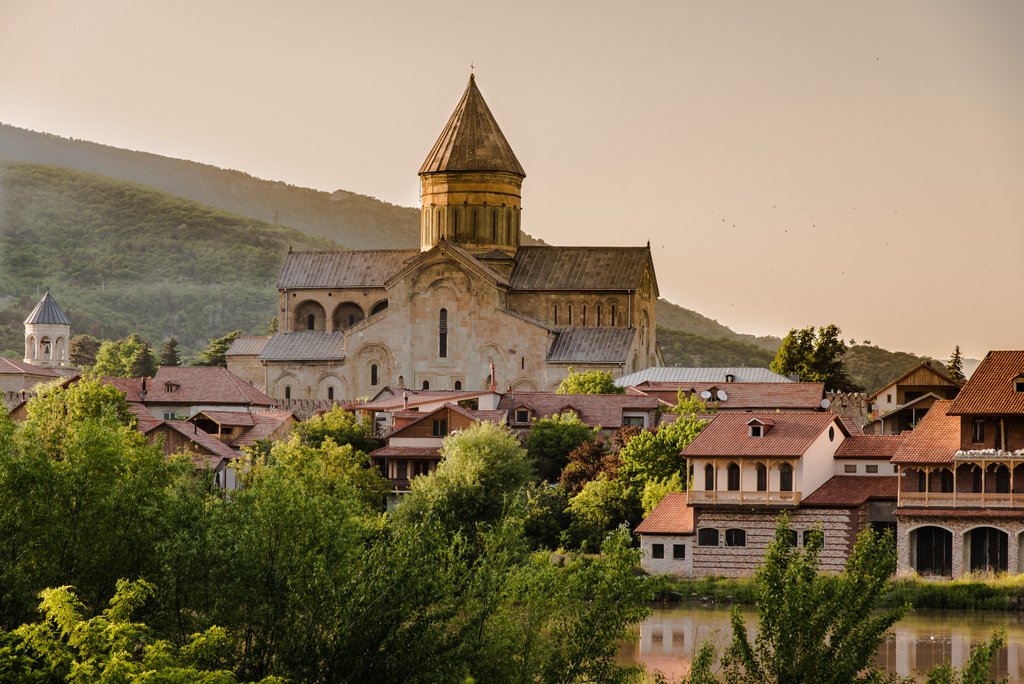
To the eastern side of the Black Sea, in the central and western parts of the southern Caucasus there is a country of Georgia (Sakartvelo), which was created by the Georgian people (under the leadership of the king Parnavaz) before the birth of Christ on the verge of the IV-III centuries. The country was sometimes unified, sometimes broke up into the separate feudal entities, it even lost the territories but has still maintained the statehood and sovereignty up to date.
Georgia, like a certain number of European countries, consists of historical-geographical parts. These parts are inhabited by the relevant ethnographical groups, who also speak the dialects of the Georgian language. However, historically, one thing was characteristic for Georgia: to certain extent, this ethnographical group spoke not the dialect of the Georgian language but its own language. These languages were spoken only in the families. So, from the socio-linguistic point of view they were equal to the dialects of the Georgian language (It is true even now!). These groups are: the Megrels (on the Black Sea Coast), the Svans (on the southern slopes of the Caucasian mountains, in the north-west part of the country). Both the Megrels and Svans speak the languages closer to Georgian language.
Historically, the same can be said about the Dvals who live in the mountains of central Caucasus. The Dvals used their own family-spoken language, too. They speak one of the Georgian languages which were between the Svan and Zan languages but had more proximity to Zan. The part of the Dvals scattered in the mountains and lowland, part of them were assimilated with the Ossethians in the XV-XVI centuries. As for the fourth, most interesting group for us – the Tsova-Tushs or as they are known in the science, the Batsbs, they speak one of the Vainakh languages. They lived in Tusheti - the historical-ethnographical part of the mountainous Georgia. Today they live in Kakheti - the lowland of eastern Georgia. The Tsova-Tushs (the Batsbs) are the inseparable and linguistic part of the Georgian people.
Thus, the Georgian ethnos that was formed centuries ago, besides the Georgian language speaking historical-ethnographical groups, also united the groups which spoke other languages. As mentioned above, from the socio-linguistic point of view in the general ethnological literature their languages are equal to the various dialects of the Georgian language (Arutynov, 1989, p. 45; Jorbenadze, 1995, p. 20; Oniani, 1997; Putkaradze, Kikvidze, 1997; Kurdiani, 1997). Throughout the whole history of Georgia the Georgian language was the state, literary and church language for the Megrels, Svans, Dvals as well as for Tsova-Tushs. They were not passive in the Georgian ethnical structure and contributed respectively to the development of the Georgian language and culture. The fact that all the documents of the XIII-XIV centuries in Svaneti were created by the local inhabitants will serve us as an example. The linguists have several arguments to confirm it.
A Russian ethnographer S. A. Arutynov wrote the following about the Svans and Tsova-Tushs (the Batsbs): “in the mountainous Georgia the Batsbs and Svans, according to all ethnographical measures, should be considered as special people by their peculiar manners, absolutely solitary languages, and it is required to recognize them as the Georgians” (Arutynov. 2002. p. 437). The author is right when he writes that both the Svans and Tsova-Tushs (Batsbs) consider themselves as the Georgians. Regarding the fact that as if they required to be recognized as the Georgians, is not true. Whether the Svans and Tsova-Tushs were the Georgians or not has never been at issue. It was only in the interests of Russia to declare them as the different ethnos. In the XIX century both the Tsova-Tushs (Batsbs) and Svans certainly required to be considered as the Georgians. S Arutynov even mentioned that by the ethnographical sign, the Batsbs as well as the Svans, should be considered as special people. We would add that the Tsova-Tushs (Batsbs) and Svans cannot be thought as special people from this particular ethnographical point of view. Ethnographically, they are not different from other Georgian ethnographical groups. If there is something that makes them different, it is caused by the natural-geographic circumstances. We will speak about the Tsova-Tushs (Batsbs) below and we will be able to see that from the ethnographical point of view (economical activities, material culture, social relations, spiritual culture), they almost were not distinguished from the same Georgian-speaking Tushs and the other ethnographical groups of Georgian eastern mountains.
more photos & text by Alexander Bainbridge:
* The Bats People
* WHO ARE THE BATS PEOPLE?