Monday, January 21, 2013


Sunday, January 20, 2013
INTERVIEW: Tinatin Gurchiani about her Film "The Machine Which Makes Everything Disappear" (allaboutindiefilmmaking.com)
(allaboutindiefilmmaking.com) Road to Sundance 2013: The Machine Which Makes Everything Disappear, directed by Tinatin Gurchiani
 |
| Tinatin Gurchiani (Photo credit: Levan Kherkheulidze) |
Tell us about your film. What inspired you to make it?
My film is The Machine Which Makes Everything Disappear, and
it will be in the World Documentary Competition category. My
inspiration was my own search to try to bridge the gap I felt between
two worlds.
I lived for a long time in Europe. I
studied there. When I came back, I had many ideas for fiction films.
But here I noticed that the stories I wanted to tell didn’t match the
people I met. You know when you look at a person you can imagine what
their background is, what stories they could tell. And I had changed
while in Europe, and my stories just weren’t compatible with the
Georgian people anymore.
So, instead of trying to force the people to fit my stories, I thought I needed to find out these peoples, my peoples, real stories, to find out how we can come together again. I wanted to find the commonalities (universal truths), that would bridge this gap.
What do you love about your film?
What I love about this film is the people, and how they open themselves up to you completely. How ready they are to expose
their basic core - their desire, despair and dreams. They act in front
of the camera as in front of the court of God - just really, honest,
naked, helpless and intense. It
was their one chance and they could say only the most important truths
in their heart, the most essential pieces of their soul. And
they try - with the help of the magic of cinema and the camera they are
standing in front of - to create moments of eternity for themselves,
out of their ordinary human lives. I love this energy in our film. It
is unique. I hope this film will make you happy in a strange way even if its not a happy film, but because of all those beautiful people.
How long did it take you to make your film?
This film was made
in one breath, in a trance-like state by passionate people, all of us
was on the border between dreaming and perfect concentration. The reason
for this was that we had very very low budget for this film. So we had
to be very focused in our work. I counted that the money we had would be
enough for 20 shooting days, so I tried to do the best possible in this
time. The editing period was about two very intense months, without
breaks or weekends. And we wrote the musical score over 5 sleepless days
via Skype, because the composer was in Germany and I was in Georgia. It
was like we were all together: crew, actors, myself – one organism and
everything we did moved towards the completion of the film.
How did you finance your film?
We got
some support from the Georgian National Filmcenter, about 20,000 USD,
and a little bit of support from Goethe Institute and Robert Bosch
Foundation for research. This subsidy from the Georgian National
Filmcenter was the largest sum that anyone in Georgia can get for a
documentary. The problem was that this money had to be spent by the end
of the year, so in 6 months. It was very difficult to start with such a
small sum, but we decided not to wait because films have to be made when
they “burn." This means, when they are potent and passionate and not
just when there is enough money. So all of us worked for many months
without payment, but full of heart and enthusiasm. And then, when we had
the material edited, there was a lot of interest in it and we were able
to find post-production companies that were willing to help us in the
post-production for free. There were so many people who they supported
us so that the film could be finished without money. Dok-Incubator,
especially helped us. It is a unique
documentary workshop in Europe, that supports films in the rough cut
stage, in order to emphasise their international potential and help them
to break into the market.
What was the most challenging part of the filmmaking process and how did you overcome it?
I
worked on this film very intuitively, even irrationally--like writing a
poem, but in this case I had real people with real dramas in it. It was
emotionally very charged and intense. I had never been in situations like this before. The biggest challenge was staying with each protagonist a maximum of two or three days and then to go. I
would become completely immersed in the most personal issues of their
lives, and then we would have to go our separate ways. I became very
close with these people, and had to find a way to show the truth of
their stories while keeping in mind how showing this film around the
world would impact their lives.
Tell us about your experience getting into Sundance.
After
the film was completed (only a couple of days before!), we had a
national première at DOK_Leipzig and IDFA. Many important international
experts saw our film there and loved it, so they asked us to try to
submit to Sundance, even though the deadline had passed. And of course
they recommend the film to them as well. So we tried our luck and got
the invitation.
If you had to make the film all over again, would you do anything different?
I
think I would change a lot, but it doesn’t make sense to think about
it--it would make me crazy and anyway it would be a different film. I've
changed, the time and circumstances around me have changed and this
would have a lot of influence on it. Now this film is ready and
interesting and exciting for me as well. I can watch over it like a
child. I raised it, but it's grown up and out in the real world. It has
some qualities I hoped for, some I would preferred to be otherwise, but I
can’t change them. Now I’m also like a part of audience and can
emotionally react as all of you seeing this film.
What’s next for your film? Do you have distribution? If so, when and how can people see it and if not, what are your hopes for the film?
This
film gets a lot of invitations every month from all around the world
and I have to travel a lot. Of course, is always very exciting for me to
see how the people with very different background react, to see if they
laugh and cry at the same moments as I do or as audiences in my own
country do.
For The Machine Which Makes Everything Disappear we
already have the World Sales-Deckert Distribution, with a lot of
influencing european directors of our days, but we got also great
distributor-Icarus Films-especially for North American countries. We
hope a big U.S. audience will see our film.
Jonathan Miller,
head of Icarus Films, said: "After such a hectic year in 2012, it's
wonderful to begin 2013 with a lovely, unexpected film from a new
talent, and from a land we know too little about. I think people will
fall in love with the film the way we did. It may be winter, but it
didn't feel that way watching Tinatin's film. We can't wait to bring it
to American audiences."
For me, already new projects form in
my mind and I will work on them as soon as possible. I have to take
care of them. I miss the shootings, the magic atmosphere around film. I
already have a screenplay written for a fiction film and I’m very
excited about it. It’s a drama about a man, who decided to give
everything to others but trying not to get (trying to refuse) anything
back. I’m thinking about it, in which country I will realize it. And I
also have 2 feature documentaries I work on.
Can you provide any advice to other filmmakers who dream of getting their films made and into Sundance?
FOOD & WINE: Tbilisi, Georgia - One of 7 Places to Travel for Food in 2013. By Elyse Pasquale (huffingtonpost.com)
(huffingtonpost.com) Culinary travel is the next big thing, from cooking classes in
Tuscany to street-food tours in Istanbul. So where will you plan your
next foodie adventure? Whether you prefer chasing Michelin stars or
channeling your inner Andrew Zimmern, these global destinations will wow
your taste buds. Here are the top seven places to eat around the world
in 2013.
-
Tbilisi, Georgia
The Republic of Georgia is one of the world's most fascinating up-and-coming culinary destinations. The tiny country's cuisine is influenced by its geography, resulting in a remarkable combination of Middle Eastern and Eastern European flavors. In Tbilisi you'll fall in love with khachapuri, a pizza-like flatbread stuffed with molten cheese. Other traditional foods include meaty soup dumplings, cilantro-spiked red beans, thick buffalo yogurt and unleavened bread cooked over hot coals. And then there's the wine; Georgia invented it. According to oeno-historians, Georgia has the oldest recorded history of fermenting grapes to make wine, dating back to 5000 BCE. Today, an ancient technique of making wine underground in clay vessels called qvevri is being revitalized. Attend a supra, or Georgian feast, where food and wine meet traditional music.
The Republic of Georgia is one of the world's most fascinating up-and-coming culinary destinations. The tiny country's cuisine is influenced by its geography, resulting in a remarkable combination of Middle Eastern and Eastern European flavors. In Tbilisi you'll fall in love with khachapuri, a pizza-like flatbread stuffed with molten cheese. Other traditional foods include meaty soup dumplings, cilantro-spiked red beans, thick buffalo yogurt and unleavened bread cooked over hot coals. And then there's the wine; Georgia invented it. According to oeno-historians, Georgia has the oldest recorded history of fermenting grapes to make wine, dating back to 5000 BCE. Today, an ancient technique of making wine underground in clay vessels called qvevri is being revitalized. Attend a supra, or Georgian feast, where food and wine meet traditional music.
- Osaka, Japan - San Sebastian, Spain - Lima, Peru - Kiev, Ukraine - Palermo, Sicily - Antigua, Guatemala
Sundance 2013: Icarus Films Nabs 'The Machine Which Makes Everything Disappear' (thewrap.com)
 (thewrap.com) Icarus Films has acquired North American rights to "The Machine Which Makes Everything Disappear."
The documentary offers a penetrating look at life in Georgia -- the
former member of communist Russia, and not the home of Atlanta. It is
making its U.S. premiere at the Sundance Film Festival this week and
competing for the world documentary prize.
Directed by the young Georgian filmmaker Tinatin Gurchiani, the film
tracks her search for young adults in her native land, aged 15-23, in
order to make a film about growing up in the Eurasian country. Her goal
is to try to make sense of a region and a land that has yet to fully
shake off its Soviet past.
Icarus plans to release the film theatrically, although dates have not been set, a spokesman told TheWrap.
The deal was negotiated by Icarus Films president Jonathan Miller and Deckert Distribution's Heino Deckert.
"I think people will fall in love with the film the way we did. It
may be winter, but it didn't feel that way watching Tinatin's film,"
Miller said in a statement. "We can't wait to bring it to American
audiences."
CALL for PAPERS: 3rd ASCN Annual Conference (ascn.ch)
“Political
Transformation and Social Change in the South Caucasus: Georgia,
Armenia and Azerbaijan in Perspective” - 21-22 June 2013, Tbilisi -
Georgia
(ascn.ch) The Academic Swiss Caucasus Net (ASCN) is pleased to announce its 3rd Annual ASCN Conference that will take place this year in Tbilisi, Georgia on 21 and 22 June 2013.
 Content and Objectives
The conference aims to gather junior scholars and researchers from various disciplines of the social sciences (political science, sociology, anthropology, etc.) involved with the South Caucasus. More specifically, the conference will address the following points of interest:
• It will provide opportunities for researchers vested in Armenia, Georgia and Azerbaijan to engage, network, exchange and discuss their research projects, papers and findings;
• It will provide a forum for discussion regarding the contradictions and ambivalences of the transformation process in the South Caucasus;
• It will provide a forum for discussion regarding the challenges social science researchers in the South Caucasus are confronted with.
Call for Papers
Deadline for the submission of abstracts (300 words): 12 February 2013
Eligibility
• PhD students and recent PhD graduates (2009 or later) dealing with Armenia, Georgia and Azerbaijan who are eager to present and discuss their research work (especially current PhD projects and/or research results) with colleagues from the region and beyond.
The papers to be presented must deal specifically with one of the above-mentioned countries. Papers with a comparative dimension including at least one of the three countries are also accepted.
Topics
Proposals must be linked to one of the following themes:
- Migration, IDPs, Diasporas and Social Inclusion
- Civil Society, Social Capital and Trust
- Media, Social Networks and Public Space
- State Structures, Regimes, Elites and Democratisation
- State Reforms, Public Policies and Governance
- Nationalism, Identities, Religious and Cultural Capital
- Social Change (Youth Identity, Youth Employment, Values Systems, Gender Politics, etc.)
Selected candidates will have the opportunity to present and discuss their papers in one of the thematic panels, wherein researchers involved in ASCN research projects will also present their research results. For more information about current ASCN research projects, please consult the ASCN website, section ‘Research’.
Submission Instructions
All interested scholars are requested to submit an abstract (no more than 300 words) of their paper together with a short biographical statement (including author, affiliation, postal address, phone number and e-mail address) and a CV (maximum 2 pages). Applicants are requested to mention into which of the proposed topics the abstract would fit. Submissions must be sent no later than 12 February 2013 to info@ascn.ch and to jan.kreuels@unifr.ch with the following email subject: ASCN Annual Conference 2013. All documents have to be in English and need to be merged into a single PDF file. The result of the selection process will be announced in the beginning of March 2013.
Selected candidates will then be invited to submit full papers (5,000 words) by 3 June 2013.
Venue, Accommodation and Transport
The ASCN programme will cover travel and accommodation expenses for all selected participants. Opportunities for co-financing will arise should the travel costs in individual cases exceed the average expenses per participant attending the conference.
The selected participants will be informed about the programme, the specific conference panels and the format of the paper to submit, as well as organisational details, in due time.
Timeline
• Application deadline: 12 February 2013
• Selection of abstracts: beginning of March 2013
• Submission of papers: 3 June 2013
• Papers online on conference website: 12 June 2013
• Conference: 21-22 June 2013
Websitewww.ascn.ch, "Events" section
Further Information
Denis Dafflon, ASCN Programme Coordinatorinfo@ascn.ch; denis.dafflon@unifr.ch
Further Information
Denis Dafflon, ASCN Programme Coordinatorinfo@ascn.ch; denis.dafflon@unifr.ch
About ASCNASCN
is a programme aimed at promoting the social sciences and humanities in
the South Caucasus (primarily Georgia and Armenia). Its different
activities foster the emergence of a new generation of talented
scholars. Promising junior researchers receive support through research
projects, capacity-building trainings and scholarships. The programme
emphasizes the advancement of individuals who, thanks to their ASCN
experience, become better integrated in international academic networks.
The ASCN programme is coordinated and operated by the Interfaculty
Institute for Central and Eastern Europe (IICEE) at the University of
Fribourg (Switzerland). It is initiated and supported by Gebert Rüf
Stiftung.
+++
Denis Dafflon
Programme Coordinator
ACADEMIC SWISS CAUCASUS NET (ASCN)
University of Fribourg / Interfaculty Institute for Central and
Eastern Europe (IICEE)
Bd de Pérolles 90
1700 Fribourg/Switzerland
Phone: +41 26 300 79 82
Mobile: +41 79 303 43 44
E-mail: denis.dafflon@unifr.ch
Website: www.ascn.ch
+++
Denis Dafflon
Programme Coordinator
ACADEMIC SWISS CAUCASUS NET (ASCN)
University of Fribourg / Interfaculty Institute for Central and
Eastern Europe (IICEE)
Bd de Pérolles 90
1700 Fribourg/Switzerland
Phone: +41 26 300 79 82
Mobile: +41 79 303 43 44
E-mail: denis.dafflon@unifr.ch
Website: www.ascn.ch
Saturday, January 19, 2013
CALL for PARTICIPANTS: Study Visit for Georgians in Finland.
Academy for Peace and Development announces a CALL for PARTICIPANTS for the STUDY VISIT in FINLAND.
Study visit will take place between March 3 – 11 and aims to share the experience of Finnish NGOs in youth work and adapt and apply the best practices by participants in their countries. Representatives of NGOs, working with youth are eligible to apply.
Venue: Suomenlinna, Metsäkartano youth centre, Hyvärilä Youth centre, Villa Elba youth centre.
Venue: Suomenlinna, Metsäkartano youth centre, Hyvärilä Youth centre, Villa Elba youth centre.
Dates: 3rd – 11th March 2013
Countries participants: Finland, Belarus, Lithuania, GEORGIA
Working language: English
Costs: Project will be financed by the Youth in Action Programme. Accommodation, food and lodging costs will be covered by the Project organisers. For all selected Project participants 70% of travel costs within the dates of the project and 100% visa costs will be reimbursed.
Participation fee: 40 euro will be deducted from the reimbursement of visa and travel costs in order to cover local transportation.
How to apply: The completed application form, must be sent tsisana.popkhadze@gmail.com
Deadline: Tuesday, January 22, 18:00
SEMINAR: Carl Friedrich Goerdeler-Kolleg für Good Governance
Das Kolleg qualifiziert die nächste Generation von Führungskräften aus
Armenien, Aserbaidschan, Belarus, Georgien, Moldau, Russland, der Türkei
und der Ukraine im Bereich Good Governance weiter und unterstützt so verantwortungsvolles und nachhaltiges Handeln im öffentlichen Sektor dieser Länder.
20 deutschsprachige Young Professionals sind eingeladen, sich ueber ein Jahr hinweg fortzubilden und an einem eigenen Projekt in ihrer Heimatinstitution zu arbeiten. Das Programm beginnt mit einem dreiwoechigen Seminar in Berlin und Warschau vom 31. August bis 21. September 2013 und schliesst im August 2014 mit einem Seminar in Berlin ab.
Die Seminarsprache ist deutsch.
Weitere Informationen finden Sie im Anhang und unter www.goerdeler-kolleg.de. Der Bewerbungsschluss ist am 28. Februar 2013.
20 deutschsprachige Young Professionals sind eingeladen, sich ueber ein Jahr hinweg fortzubilden und an einem eigenen Projekt in ihrer Heimatinstitution zu arbeiten. Das Programm beginnt mit einem dreiwoechigen Seminar in Berlin und Warschau vom 31. August bis 21. September 2013 und schliesst im August 2014 mit einem Seminar in Berlin ab.
Die Seminarsprache ist deutsch.
Weitere Informationen finden Sie im Anhang und unter www.goerdeler-kolleg.de. Der Bewerbungsschluss ist am 28. Februar 2013.
Friday, January 18, 2013
FOTOGRAFIE: Rena Effendi. Land ohne festen Boden (photonews-blogbuch.de)
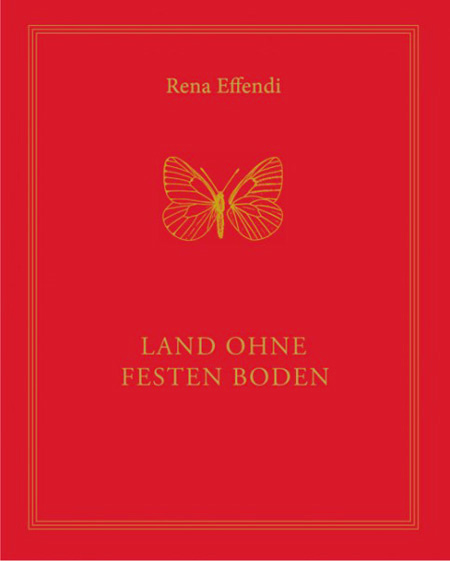 (photonews-blogbuch.de) Mit seinem roten Kunststoffumschlag gaukelt das kleinformatige Buch irgendwas zwischen Mao-Bibel, Lehrbuch und privatem Fotoalbum vor. Ein Schmetterling ist auf der Front eingeprägt, dazu Name und Titel. In Gold. Das Vorsatzpapier besteht aus ornamentalen Mustern, genaueres Hinsehen identifiziert diese als Reihungen weiterer Schmetterlinge. Das mag ein wenig zu viel des Guten sein, verweist aber auf den Inhalt: In der Tat findet man in dem Buch immer wieder Bilder von Schmetterlingen. Mein liebster Schmetterling ist jener mit grün-weißer Färbung, der uns aus der Dunkelheit ins Licht entgegen schwebt. Aber dann ist es gar kein Schmetterling, sondern ein kleines Mädchen, das aus der Tiefe des Raumes kommt. Der halb entblößte Körper ist über und über mir grünen Farbschlieren bedeckt. Eine Creme gegen Windpocken, wie man aus dem Titel kombinieren kann.
Ein Rückblick: Rena Effendi, 1977 in Aserbaidschan geboren, ist zunächst als Übersetzerin, später als Fotografin für die großen Ölgesellschaften in ihrem Heimatland tätig. Nachdem sie für diese einen PR-Kalender über die Pipeline fotografiert hat, regt sich ihr soziales Gewissen. Ein zweites Mal bereist die Insiderin die 1700 km lange Route der Pipeline, die vom Kaspischen Meer bis zum Mittelmeer reicht. Sie porträtiert deren Anwohner, die, im Gegensatz zu den Adressaten des Rohstoffes, bitterarme Existenzen führen. Ihre Langzeit-Dokumentation, die in dem Buch „Pipe Dreams“ mündet, wird schließlich mit Preisen überhäuft.
„Land ohne festen Boden“ knüpft an das Thema an, denn die Fotografin schildert das Leben derjenigen, die auf der Halbinsel Abşeron am Kaspischen Meer leben, dem wichtigsten Erdölförderungsgebiet Aserbaidschans. Was für ein drastischer Unterschied zu dem offiziellen Bild des Landes, welches während des letztjährigen Eurovision Song Contest von Baku aus in die Welt vermittelt wurde. An den Rändern von Baku und anderer Städten leben jene, die in der Hoffnung auf bessere materielle Versorgung aus der Provinz gekommen sind, in provisorischen Behausungen zwischen Ölfeldern, Metallschrott und stillgelegten Fabriken. Die Konsequenzen, die sich aus der unerbittlich vorangetriebenen Erdölförderung ergeben, sehen hier so aus: das Trinkwasser ist kontaminiert, die Luft durch Erdöldämpfe verpestet, das Erdreich unter den Häusern instabil, da Öl an die Oberfläche sickert.
 Rena Effendi bedient den Betrachter mit düsteren Ansichten, die die Unwirtlichkeit der Randbezirke vorführen. In Ermangelung irgendwelcher Spielplätze hängen die Kinder zwischen den Ruinen der Flüchtlingsunterkünfte und auf den Bergen der riesigen Mülldeponien rum. Die Gewässer, die Effendi dem fröstelnden Betrachter vorführt, sind mit schillernden Ölfilmen überzogen, der Erdboden ist erodiert, die Vegetation ausgelöscht. Es ist die Hölle.
Und die Fotografin zeigt uns weiter: Bewohner, die sich in dem verlassenen Rohbau eines riesigen Unfallkrankenhauses eingerichtet haben. Eine durch Vandalismus zerstörte Bibliothek aus Sowjetzeiten, in der überall Bücher verstreut sind. Ein umgeworfener, verrotteter Kiosk-Pavillon. Vergammelnde Industrieanlagen, Uferflächen, die über und über mit Unrat versehen sind, ungehobene Schiffwracks. Vor dem Betrachter entfaltet sie das drastische Bild eines in Armut versinkenden Milieus. Erschütternd, wie das Elend hier ausgebildet ist, in dem jeder ums Überleben kämpft. Effendi klagt die Verhältnisse mit einer fotografischen Wucht an, die den Betrachter unweigerlich dazu zwingt, sich die Fragen der Akteure zu eigen zu machen.
Damit allein wäre ja schon ohne weiteres jede Zielsetzung erreicht. Aber Effendi bietet nicht einfach eine Sozialreportage, sie nimmt einen Umweg, um ihr Sujet aufzubereiten. So heißt es am Anfang: „Mein Vater Rustam Effendi – ein Dissident, Wissenschaftler und Entomologe, der sein Leben lang dem Studium, Jagen und Sammeln von über 30.000 Schmetterlingen in der Sowjetunion gewidmet hatte- war mein Co-Autor…“ Der Vater ist aber schon lange tot und seine riesige Schmetterlingssammlung ist an das Staatliche Institut für Zoologie gegangen, um dort tragischerweise zu Staub zu zerfallen. Geblieben sind 50 Fotos von bedrohten Arten, die er einst für ein geplantes Buch erstellt hatte.
Effendis Buch ist auch als Erinnerungsalbum zu begreifen und erzählt in einem Prolog die Geschichte des Vaters, der zeit seines Lebens die Familie zugunsten seines wissenschaftlichen Ehrgeizes vernachlässigt. Die Tochter erbt eine Kiste mit Fotos, die neben besagten Schmetterlingsfotos eine Reihe biografischer Fotos enthält, die von einem behänden Umgang des Vaters mit dem Medium Fotografie zeugen. Mit einigen dieser Porträts füttert Effendi ihren Erinnerungstext. Als Leser erkennt man, dass dieses Buch eine Annäherung an ihren Vater darstellt. So beschreibt sie, wie dieser tage- und nächtelang auf der Jagd nach einer bestimmten Schmetterlingsart war, um schließlich für ihr eigenes Handeln zu konstatieren: „Wenn ich nach meinen Menschengeschichten jage und auf ein Bild warte oder frustrierende Stunden, Tage oder Monate damit verbringe, Zugang zu einem meiner Sujets zu gewinnen, denke ich an den flüchtigen Brahmaspinner meines Vaters, und diese Erinnerung mahnt mich zu mehr Geduld und mehr Gelassenheit im Umgang mit der Zeit.“
Viel Geduld hat sie für ihre eigentliche Serie aufgebracht, so dass ihr ein eindrücklicher Einblick in das kaum erträgliche Chaos der durch Umweltverschmutzung verrohten Siedlungen gelingt. Neben den schon beschriebenen Ansichten, die die Zustände gnadenlos sezieren, gibt es Bilder, die von leisen Tönen geprägt sind. Die Porträts der Bewohner, vor allem der Kinder, drücken trotz traumatischer Situation so etwas wie Zuversicht aus. Eine Katze balanciert auf der Gasleitung, die durch das Dorf führt. Quer über ein Ölfeld verläuft eine Wäscheleine, an der die weiße Wäsche baumelt. Jungen führen gymnastische Kunststücke auf der Straße auf. Manchmal gibt es tatsächlich so etwas wie Normalität. Dabei bestechen ihre elaborierten Bilder immer wieder durch Farb- und Lichtgestaltung.
 Effendi nimmt eine überaus wirksamen Kunstgriff vor. Zwischen Bilder ihrer eigentlichen Serie schmuggelt sie die wissenschaftlichen Schmetterlingsstudien ihres Vaters. Das Konzept geht tatsächlich auf, ohne zu pathetisch zu wirken. Es entstehen verblüffende Korrespondenzen, die sich meist auf Farbe und Form beziehen. Das kann so offensichtlich sein wie bei jenem Diptychon, das ein Mädchen mit einem Stoffleopard zeigt, dessen Fellzeichnung sich in dem gegenübergestellten Schmetterling wiederfindet. Meist sind die Anspielungen und Parallelen wesentlich subtiler. Das tiefe Schwarz des Trauermantel-Schmetterlings spiegelt sich in dem dunklen Blick des gegenübergestellten Jungen. Vielleicht ist es auch nur dessen Kragen, der eine Flügelform andeutet.
Effendi ist eine kluge Erzählerin, die Gespür für die Dramaturgie einer Geschichte entwickelt und die Grenzen des Erzählens neu auslotet, in dem sie auf bestimmte Konventionen pfeift. Es gibt den traurigen Anblick eines Schmetterlings, der auf einem Abfallhaufen sitzt. Aber ach, das, was wir für einen Schmetterling mit blasser Flügelfärbung halten, ist gar kein Schmetterling, sondern ein achtlos weggeworfenes Hochzeitskleid. Peter Lindhorst
Benteli Verlag. Bern 2012. ISBN 978-3-7165-1744-4. 114 S. mit 140 Farbfotos. Geb. 38,00 €
AmazonShop: Books, Maps, Videos, Music & Gifts About The Caucasus
Thursday, January 17, 2013
FOOD & WINE: Georgian wine companies to attend Green Week in Berlin (news.hvino.com)
 (news.hvino.com) 17.01.2013 (Hvino News). With support of the Ministry of Agriculture of Georgia and German Development Cooperation (GIZ) several Georgian wine companies will be presented at International Green Week in Berlin on 18-27 January. Kindzmarauli, Tibaneli, Badagoni, Chateau Mukhrani, Mildiani, Schuchmann Wines, GWS will attend the Berlin trade show.
Georgian delegation will be headed by David Kirvalidze, Minister of Agriculture of Georgia, and includes Levan Davitashvili, head of National Wine Agency. On 19th of January the Ministerial Summit in Berlin will be held.
Established in 1926, International Green Week (IGW) is taking place for the 78th time in 2013. The IGW is a one-of-a-kind international exhibition for the food, agricultural and horticultural industries. IGW is also the point of origin for the Global Forum for Food and Agriculture (GFFA) with more than 60 departmental ministers.
© Hvino News
FEATURE: Tangle in the Caucasus. Iran and Israel Fight for Influence in Azerbaijan. By Alex Vatanka (foreignaffairs.com)
 |
| David Mdzinarishvili / Courtesy Reuters) |
(foreignaffairs.com) As Iran’s progress on its nuclear program continues unabated, 2013 may well mark the climax of the long-standing impasse between the Islamic Republic and the West. Hopes for a diplomatic solution are fading, and an Israeli or a U.S. military strike on Iran’s nuclear program seems increasingly likely. The potential fallout from such an action for the United States, Europe, and the Middle East has been the object of frequent speculation; far less discussed, although no less pertinent, is what a violent confrontation would mean for the South Caucasus -- an area just north of Iran where the standoff between the Islamic Republic and the West is already palpable in everyday life. Long considered a powder keg, the region, which includes Armenia, Azerbaijan, and Georgia, is once again on the brink.
At the center of the tensions in the region lies Azerbaijan, a country with firm historical and cultural connections to Iran but one whose interests have overlapped with those of Israel, the Islamic Republic’s mortal enemy. During his visit to Baku last October, Iranian President Mahmoud Ahmadinejad described his country’s relationship with Azerbaijan as “brotherly and very deep,” drawing on the two countries’ shared ethnic and religious heritage. (Ethnic Azeris populate much of the northwest region of Iran, which is also known as Azerbaijan, and both countries are predominantly Shia.) Ahmadinejad’s statement, however, blatantly misrepresented the current state of affairs; today, it is not historical affinity but rather intense suspicion and rivalry that shape ties between Baku and Tehran. The same month Ahmadinejad made the statement, a court in Baku gave lengthy prison sentences to 22 Azerbaijanis charged with spying for Iran’s Islamic Revolutionary Guards Corps (IRGC) and plotting to carry out attacks against U.S. and Israeli targets in Azerbaijan. Meanwhile, in December, Tehran kicked up a fuss after ethnic separatists from the northwest Iranian region of Azerbaijan held a conference in Baku.
Yet Ahmadinejad’s statement in Baku was not entirely insincere. Over the past few months, Iranian officials and the state-controlled media have stressed Tehran’s desire for friendlier relations with Baku; at the same time, they are prodding the Azerbaijani government to reconsider its foreign policy alignments -- principally its close ties with Israel. Nowhere in its immediate neighborhood does Iran see such an unambiguous Israeli footprint as it does in Azerbaijan. Israel and Azerbaijan share the common goal of containing Iranian influence. In this joint front, Azerbaijan provides proximity to Iran -- with much speculation about Azerbaijani soil being used as a staging ground for Israeli military operations -- while Israel possesses superior weapons technologies and other resources. But the Azerbaijani-Israeli partnership does not rely solely on the question of Iran; it spans broader economic and military cooperation, trade and investment, and mutual diplomatic support. For Iranian leaders, this uncomfortable reality has raised the stakes, forcing them to vacillate between threats and overtures in their attempts to sever Baku’s relationship with Israel.
Nevertheless, although the Israeli presence in Azerbaijan is a significant security concern for Iran, it represents only one aspect of Tehran’s interests in the South Caucasus. In fact, the three countries of the region view their large southern neighbor through very different lenses. Iran enjoys cordial ties with Georgia and intimate relations with Armenia, which has helped Tehran evade sanctions through its banking sector. As the Western standoff with Iran plays out over the next year, scholars and policymakers alike cannot afford to ignore the parallel developments in the South Caucasus.
INTERTWINED HISTORY
It has been nearly 200 years since Iran lost its foothold in the South Caucasus. In 1813 and 1828, having repeatedly failed to repel invading Russian armies, the Persian Qajar dynasty signed the treaties of Gulistan and Turkmenchay. With the two agreements, Persia relinquished to the Russian Empire its territorial claims on most of the eastern parts of present-day Georgia and the territories that now make up Armenia and Azerbaijan. In Iran, the word “Qajar” is still synonymous with territorial loss and national humiliation.
Occasional statements from Tehran leave no doubt that many Iranians still consider the South Caucasus part of their historical domain, a sphere where deference to Iranian interests is expected if not vocally demanded. In August 2011, General Hassan Firouzabadi, the chief of staff of Iran’s armed forces, lambasted the Azerbaijani government for its secular policies and ties to Israel. In an explicit threat, Firouzabadi warned of insurrection in Azerbaijan, stating that “Iranian blood flows in the veins of the people of [Azerbaijan], and their hearts beat for Islam.”
As two of only four Shia-majority countries in the world, Azerbaijan and Iran share important religious ties. And there are more ethnic Azeris living in Iran (estimated at 15-20 million) than in the Republic of Azerbaijan itself (around nine million). Many families have branches on both sides of the Azerbaijani-Iranian border. With so many commonalities, Azerbaijan and Iran would seem likely to be natural allies.
But the opposite has been the case. When Azerbaijan broke away from the Soviet Union in 1991, Tehran quickly recognized it as an independent state, hoping that it would serve as fertile ground for spreading the Islamic revolution. But from the early days of independence, the Azerbaijani elite evinced no interest in emulating Iran’s marriage of religion and politics, looking instead to secular Turkey as its prime political and economic partner. Iran’s initial euphoria at the prospect of a new Shia state quickly turned into dread, as Baku expressed irredentist sentiments and promoted the idea of a “Greater Azerbaijan,” which would unite Azerbaijan (the country) and Azerbaijan (the region in northwest Iran). Fearing Baku’s intentions to fuel secessionism inside its borders, Iran provided vital backing to Armenia in its war against Azerbaijan over the disputed region of Nagorno-Karabakh, which dragged on from 1988 to 1994 and ended in an inconclusive cease-fire. In Azerbaijan, Iran’s stance in that unfinished war has never been forgiven, and Tehran has continued to support Armenia ever since.
From the end of the Nagorno-Karabakh war in 1994 to the early years of the twenty-first century, formal relations between Azerbaijan and Iran grew more stable. Tehran broadly acknowledged that the South Caucasus fell within Russia’s sphere of influence and thus avoided playing its Islamist card too blatantly in Azerbaijan; Moscow is highly sensitive to Islamism on its southern flank. Meanwhile, during the tenure of Azerbaijani President Heydar Aliyev, from 1993 to 2003, Baku quieted its calls for unification with the northwest Iranian region of Azerbaijan. In recognition of the improved relations, Iran rewarded Azerbaijan with a consulate in the northern Iranian city of Tabriz, the world’s second-largest Azeri-populated city.
Since Ilham Aliyev became president of Azerbaijan in 2003, however, Baku has grown both considerably richer -- thanks to revenues from energy exports -- and noticeably bolder in its foreign policy. Nothing exemplifies this latter shift more vividly than the close ties Azerbaijan has forged with Israel, despite knowing full well that this would anger Iran. Azerbaijan has been adamant that Iran has no basis to criticize its ties with the Jewish state given that Tehran has long ignored Baku’s pleas to shun Christian Armenia.
When Tehran has appealed to Azerbaijan’s Islamic identity, the Azerbaijanis quickly point out that Tehran’s relations with Armenia have been trouble-free compared with its ties with its Muslim neighbors. Armenia and Iran have signed more than 30 bilateral agreements, and Iran provides Armenia with roughly 23 percent of its natural gas supply -- the country’s chief source of energy. As Araz Azimov, Azerbaijan’s deputy foreign minister, recently put it: “Iran gives life to Armenia.”
A PRECARIOUS BALANCE
A cycle of provocation and retaliation has become the central characteristic of Iranian-Azerbaijani relations in recent years. Tit-for-tat measures have included arrests of each other’s citizens on charges of espionage, most recently in March and July 2012; deadly border incidents in July and October of the previous year; the recall of ambassadors in May 2012, after Tehran protested against the burning of pictures of Iran’s supreme leader, Ayatollah Ali Khamenei, at a rally in Baku; and plenty of incendiary rhetoric.
Last February, when Azerbaijan signed a $1.6 billion defense deal with Israel that included air defense systems, intelligence equipment, and unmanned aerial vehicles, Iran was swift to condemn the Aliyev government. Tehran claims that Baku has given the Mossad a blank check to conduct operations against Iran from Azerbaijani soil. Esmail Kosari, a senior member of the Iranian parliament and a former IRGC commander, said that “Azerbaijan’s cooperation with the U.S. and Israeli spy agencies will harm the Azeri people” and claimed that Iran had documents showing “Azeri officials have helped Mossad and CIA agents” in “the assassination of Iranian nuclear scientists.” (The documents have not yet been publicly released.) Baku, meanwhile, complains that Tehran does not respect Azerbaijan’s sovereignty, finances radical Islamist groups in the region, and is willing to go to any length to undermine the legitimacy of its leadership, including sponsoring anti-Aliyev broadcasts in the Azeri language.
Yet, despite all the acrimony, neither side appears ready to let ties plunge much further. At the Non-Aligned Movement conference in Tehran last September, the Azerbaijani Foreign Minister Elmar Mammadyarov reportedly told his Iranian hosts that “Azerbaijan will never allow an action against Iran from its soil.” Shortly thereafter, Iran’s vice president, Hassan Mousavi, extended an olive branch by visiting Aliyev in Baku, and Iran released two Azerbaijanis who had been arrested on charges of espionage. In turn, Baku released an Azerbaijani citizen who had been charged with spying for Iran.
Tehran’s recent overtures to Azerbaijan are part of a broader effort to limit Iran’s isolation and prevent Baku from aiding or joining an Israeli or U.S. military operation against its nuclear program. But these worries are vastly exaggerated. Baku fully understands the security risks it would face in the event of a war between Iran and the West, including mass refugee inflows, inaccessibility to the semi-autonomous exclave of Nakhchivan (an Azerbaijani region sandwiched between southern Armenia and northern Iran), and, in the worst case, direct Iranian military retaliation. Moreover, there is no evidence that Baku would look to an attack on Iran as an opportune moment to realize its irredentist dreams. It is clear that the idea lacks momentum among Azeris living in Iran, a fact that the leadership in Baku is well aware of. As one senior Azerbaijani parliamentarian, Asim Mollazade, put it to me in Baku, “No serious person in Azerbaijan speaks of unification [with the south].”
The standoff between Iran and the West also threatens Armenia. Ever since Armenia’s borders with Turkey and Azerbaijan closed in 1993, Yerevan has grown reliant on Iran and Georgia, which have become Armenia’s sole avenues to world markets and its principal trading partners. A war involving Iran, therefore, would almost definitely harm Armenia’s economic interests.
And the political impact could be greater still: the main fear in Yerevan at the moment is that Tehran might be forced to reassess its close ties with Armenia as a result of the impasse. If Iran wants to mollify Azerbaijan to ensure that it does not aid the United States or Israel in a military operation, Tehran might agree to distance itself from Armenia. From Armenia’s perspective, however, this would be the worst-case scenario, because it could embolden Azerbaijan and tempt it to seek a military solution in Nagorno-Karabakh. Armenian President Serzh Sargsyan recently suggested that Baku’s defense buildup could be a precursor to a new round of war: in 2003, Baku spent $175 million on defense; in 2012, the figure was estimated at $4.3 billion. Government officials across the South Caucasus are now experiencing first-hand the cost of the region’s three unresolved territorial disputes (Nagorno-Karabakh, South Ossetia, and Abkhazia): when the status quo is so fragile, any jolt to the geopolitical landscape has the potential to reignite old, violent conflicts.
Where does Iran fit in the geopolitical landscape of the South Caucasus? For starters, Tehran’s latest political maneuvers vis-à-vis Azerbaijan are driven by the perception that its security is at risk. Although it is debatable whether Azerbaijan has agreed to become a launchpad for Israeli operations, that is Tehran’s assumption, which in turn guides the mix of Iranian threats and conciliatory measures aimed at Baku. But there is also a larger factor at play: the ascendency of Azerbaijan as an economic and military player. That, more than anything else, is forcing Tehran to recalibrate its overall approach to the South Caucasus.
Whether or not the confrontation between Iran and the West comes to a head in 2013, the South Caucasus will remain entangled in the stalemate with much at stake. Azerbaijan is unlikely to abandon its deepening ties with Israel or pursue adventurous actions against Iran. From Baku’s perspective, being wooed by both Iran and Israel has its benefits, despite the fact that Israel is the more reliable partner. This regional dynamic, in turn, weakens the hand of Armenia, which understandably fears a more aggressive Azerbaijani posture. On the whole, the standoff between Iran and the West is shifting the geopolitics of the South Caucasus. Both a more stable peace and another descent into war seem but a hair’s breadth away.
+++
The standoff between Iran and the West has moved into the Caucasus, where both the Islamic Republic and Israel are trying to woo Azerbaijan -- a country with firm historical connections to Iran but whose interests have overlapped with those of Israel. The dynamic is upsetting the regional balance of power and threatening to overturn nearly two decades of uneasy peace.
ALEX VATANTKA is a scholar at the Middle East Institute.
POLITIC REVIEW: No Need to Panic Over Georgia-Iran Ties. By Michael Cecire (worldpoliticsreview.com)
 (worldpoliticsreview.com) On Dec. 5, the U.S. House Foreign Affairs Subcommittee on Europe and Eurasia heard testimony from American Enterprise Institute resident scholar Michael Rubin on Iran’s influence in the South Caucasus. While Rubin detailed Iran’s close ties to Armenia and contrasted them to Iran’s uneasy relationship with Azerbaijan, he closed his testimony with unexpected warnings of a potential Georgian alignment with Iran (pdf).
“The victory of [Prime Minister] Bidzina Ivanishvili's Georgian Dream party in October 2012 elections threatens to radically reorient the Republic of Georgia, which, under President Mikheil Saakashvili, has been reliably pro-Western,” cautioned Rubin, adding that Ivanishvili’s pledge to improve ties with Moscow could be a prelude to a Russia-Iran-Georgia axis. “A reorientation of Georgia’s relationship with Iran might accompany its shift to Moscow.” Yet, despite the enormity of this allegation, Rubin provided no evidence that any such reorientation is actually imminent.
In fact, the implication that Georgia’s recently elected government could be building a haven for Iranian anti-Western activities is unsubstantiated, and it ignores the previous government’s many overtures toward Tehran. However, there are legitimate concerns that Iranian investments in and accords with Georgia could help the Islamic Republic to evade the crippling international sanctions regime.
The victory of Ivanishvili’s upstart Georgian Dream coalition over Saakashvili’s formerly ruling United National Movement (UNM) almost certainly does not presage any kind of Tbilisi-Tehran alignment. While relations between Georgia and Iran have improved over the past several years, it was the UNM-led government that spearheaded and eagerly pursued this improvement while it was in power. In 2010, Georgia and Iran signed accords opening a new Iranian Consulate in Batumi and eliminating visa requirements for each other’s citizens, which led to an influx of Iranian tourists to Georgia’s Black Sea resorts. The accords came only months after Saakashvili hailed the much-criticized, and soon aborted, nuclear fuel swap deal between Iran and Turkey, which he described as “diplomatic heroism, which will go down in history.”
Under the UNM, the volume of trade between Iran and Georgia more than tripled from 2006 to 2011, according to the National Statistics Office of Georgia. In the same period, foreign direct investment from Iran increased almost 25-fold. However, Iran still represents only a modest portion of Georgian trade and FDI, at approximately $81 million and a little more than $1 million in 2011, respectively.
For its part, the new Georgian Dream government, which won a surprise victory over the UNM in October’s parliamentary elections, has made no indication that it plans to build upon the UNM’s generous outreach to Iran. If anything, the new government’s prioritization of domestic issues is likely to keep Iran from featuring prominently on Ivanishvili’s agenda, barring any major geopolitical developments. And perhaps more importantly, even Tbilisi’s pre-existing relationship with Iran is more a function of regional dynamics than any concerted attempt to forge an alliance.
Kornely Kakachia, a political scientist at Tbilisi State University and the executive director of the Georgian Institute of Politics, has argued that “Georgia’s current policy toward Iran is not irrational.” In analyzing Georgia-Iran relations (.pdf), Kakachia concluded that “Georgia’s shrewd game of regional realpolitik neither shifts its core foreign policy orientation nor conflicts with its primary goals of integration with the [European Union] and NATO.”
Instead, while Georgia’s ties with Iran do serve to diversify Tbilisi’s foreign policy portfolio, the relationship is more about markets and investment. For example, when Russia suddenly closed the spigot of natural gas to the Georgian market in 2006, Iran continued to supply Georgia despite Moscow’s strong objections.
Though Georgia’s cultivation of ties with Iran might be logical -- and unlikely to bloom into anything more significant -- Georgia-Iran relations nonetheless have implications for U.S. efforts to contain Iran’s controversial nuclear program. On a visit to the South Caucasus in mid-December, Luke Bronin, the U.S. deputy assistant secretary of the treasury for terrorist financing and financial crimes, warned in particular about Iran’s attempts to bypass international sanctions through third-party states.
“As Iran comes under increasing financial pressure, it will look for opportunities to build new relationships to evade sanctions,” he said at the time. “It is important for financial institutions and others, including here in Georgia, to recognize the serious risks of engaging with Iran.”
George A. Lopez, a political scientist at the University of Notre Dame and an expert on sanctions finance, notes that Bronin’s concerns could have something to do with Iran’s investments in Georgia, which it might hope to use to bypass international sanctions.
“The facilitation of sanctions evasion occurs in how the Iranians, with or without the knowledge and cooperation of Georgians, would seek to move cash, [or] use a legitimate investment as a cover for illegitimate flow of materials that are banned under the sanctions, and how the open visa relationship could permit travel of individuals on the sanctions list in ways that undercut their existing constraints under sanctions,” explains Lopez. “Thus, while building a big hotel for tourists is in and of itself legitimate, the question is whether or not the tourists from Tehran are bringing bags filled with cash that cannot be moved any other way to buyers of Iranian products that are on the sanctions list.”
Given that Georgia has gained a reputation as a regional nexus for nuclear smuggling, suspicions about ulterior motives behind Iranian investments there are all too plausible. And with the former government’s embrace of Iranian investments and tourists, there is always the possibility that legitimate enthusiasm for economic benefits could have trumped due diligence, providing Iran with avenues for sanctions evasion.
Georgia’s relationship with Iran does deserve careful scrutiny. Given the size and pace of Iranian involvement in Georgia since 2006, there are sure to be issues and questions concerning means and ends. But dubious, politically charged conjecture directed against Georgia's new government only serves as an unhelpful distraction at a time when cooperation between Tbilisi and Western capitals should be preserved and expanded in the service of common interests.
Michael Hikari Cecire is a Black Sea/Eurasia regional analyst and associate scholar at the Foreign Policy Research Institute, where he contributes to the Project on Democratic Transitions. He is also a contributing analyst for Wikistrat.
Photo: Georgian Prime Minister Bidzina Ivanishvili, Oct. 2, 2012 (Voice of America photo).
BLOG: Georgia’s Holy Trinity. By Giorgi Lomsadze (eurasianet.org)
 |
| President Mikheil Saakashvili and Prime Minister Bidzina Ivanishvili vie in pleasing the patriarch |
(eurasianet.org) Georgia’s two squabbling rulers, the prime minister and the president, both need love . . . the love of the country’s spiritual leader, the guardian of national unity, the primus inter pares, Georgian Orthodox Church Patriarch Ilia II.
“You love him more,” Prime Minister Bidzina Ivanishvili, apparently in a sudden grip of jealousy, told the patriarch at a January 14 gathering, pointing at President Mikheil Saakashvili, who stood towering over both men with a happy smile.
“Now, why would you say he loves me more?” responded the president, tapping his diminutiverival on the shoulder.
The aging prelate, caught in the middle of the awkward exchange, maintained a diplomatic silence.
The footage of the meeting cuts there, so we don’t know the outcome of this telling conversation, but the party at the patriarch’s showed rather clearly that Georgia’s political system is not a diarchy, but a triumvirate, and that secular leaders need to vie for the holy graces of the chief of the Georgian Orthodox Church.
Georgians’ infatuation with their political leaders is pretty much a one-night stand and they tend to lose interest the moment leaders take office. But the patriarch always tops the national love charts.
And, so, well aware of the patriarch’s star power, Saakashvili and Ivanishvili turned up at the celebrations that marked Orthodox New Year, plus Ilia II's 80th birthday and the anniversary of his 1977 enthronement ; “a celebration of love,” as the church leader himself put it.
Aside from other Georgian politicians, also on hand were visiting foreign clerics, including the Ecumenical Patriarch of Constantinople Bartholomew I, head of the Eastern Orthodox Church, who came over from Istanbul to wish His Holiness many happy returns of the day.
There, in a crowd of beards, cassocks and skufias, the president, the prime minister and Parliamentary Speaker Davit Usapashvili sat sharing a tight sofa and holding candles. “I wish that 2013 is the year of love in Georgia,” said Ivanishvili. Then, passing a microphone to the president, he said, without much love, “Here, hold this, Misha.”
Aside from other Georgian politicians, also on hand were visiting foreign clerics, including the Ecumenical Patriarch of Constantinople Bartholomew I, head of the Eastern Orthodox Church, who came over from Istanbul to wish His Holiness many happy returns of the day.
There, in a crowd of beards, cassocks and skufias, the president, the prime minister and Parliamentary Speaker Davit Usapashvili sat sharing a tight sofa and holding candles. “I wish that 2013 is the year of love in Georgia,” said Ivanishvili. Then, passing a microphone to the president, he said, without much love, “Here, hold this, Misha.”
“I’d like to join the toast,” the president began. The prime minister wasn't having it: “That would be enough, let’s go,” he interrupted.
And then, as the stately patriarch was walking his two key guests out, a little boyish competition again emerged -- whom would Ilia II bid goodbye first, and, hence, who is his favorite son?
The patriarch later spoke of the need for love. Georgia could indeed use some.
Wednesday, January 16, 2013
REISE: Armenien – Visumfreiheit für Staatsbürger der EU (expat-news.com)
(expat-news.com) Seit dem 10. Januar 2013 können Staatsangehörige der EU-Länder sowie
Staatsangehörige von Island, Liechtenstein, Norwegen und der Schweiz visumfrei
nach Armenien einreisen. Dies gilt für einen Aufenthalt von 180 Tagen pro
Kalenderjahr und für sämtliche Reisezwecke. Bei
längeren Aufenthalten, sollte unbedingt vor Ablauf der 180-Tage-Frist eine
Verlängerung beantragt werden, andernfalls muss mit einer Geldstrafe oder einer
Einreisesperre gerechnet werden.
Aufgrund der Neuheit der Regelung sollten Reisende mit Ziel Armenien momentan
vor der Reise mit der Fluggesellschaft Kontakt aufnehmen, um sicherzugehen, dass
die neue Regelung auch wirklich umgesetzt wird.
Armenien ist ein Binnenstaat im Kaukasus und seit der Auflösung der
Sowjetunion 1991 unabhängig. Die wirtschaftliche Entwicklung ist nach
krisenbedingten Einbrüchen seit 2010 wieder positiv. Deutschland ist ein
wichtiger Handelspartner Armeniens. Der bilaterale Handel konnte sich ebenfalls
im Jahr 2010 wieder leicht verbessern. Daneben bieten auch die Bereiche
Obstverarbeitung, Informationstechnologie, Tourismus sowie erneuerbare Energien
potential für kleine und mittlere Unternehmen aus Deutschland.
Quelle: VisumCentrale
VIDEO: _Terminal #2 Street Art (youtube.com)
Which is what the public thinks of vandalism, some real art? This street art - most of the art, the art that combines the aesthetics of expression and the various equipment and access to the arts for everyone: do not need to study it in the gallery.
"Terminal" Art on the street to tell you, with Miró. Miro is a man who first brought the gray walls of a creative attack. What is going on with us and what stage is the street art world? With Miró, Carlos Gonzalez exclusive video - and even some delicate details along with background material, new year "terminal" Street Art were detained somebody. In addition, the program allows, delicious cherry pie baking lesson.
Special thanks to:
George Tabidze
Carlos Gonzalezs / www.theonepointeight.com
Magda
Tuesday, January 15, 2013
PHOTOGRAPHY: Christoph Grill, Short Stalks at Distant Shores - Imaging Post-Soviet Space (hatjecantz.de)

(hatjecantz.de) Texte von Ulf Brunnbauer, Christoph Grill, Ulrich Tragatschnig, Gestaltung von Elke Ederer, Christoph Grill
Deutsch/Englisch
2012. 192 Seiten, 106 Abb.
34,70 x 28,80 cm
gebunden
Lieferbar
ISBN 978-3-7757-3398-4
Präzise und unbestechlich: der Blick von Christoph Grill auf die Staaten der ehemaligen Sowjetunion
Christoph Grill (*1965 in Österreich) dokumentiert in großartigen Bildern den Weg der Nachfolgestaaten der Sowjetunion in die Unabhängigkeit sowie die damit verbundenen ökologischen und ökonomischen Umwälzungen. Seine Fotografien aus Russland und Weißrussland, der Ukraine, Litauen, Lettland, Estland, der Republik Moldau, Armenien, Georgien, Aserbaidschan, Kasachstan, Turkmenistan, Usbekistan, Kirgisistan und Tadschikistan halten unsentimental den Alltag fest: In den Ruinen kommunistischer Utopien spielen Kinder, Triumphbögen stehen im Nirgendwo, in den Ritzen eines Exerzierplatzes wächst Gras. Grills fotografische Notizen verorten das auf seinen Reisen Gesehene, die Begegnungen mit den Menschen und deren Überlebenswillen, auch und gerade angesichts unübersehbarer Zerfallserscheinungen.
SOMMERSCHULE: Faszination Südkaukasus 2013 - Kultur, Gesellschaft, Politik Go East Sommerschule (iliauni.edu.ge)
 (iliauni.edu.ge) Staatliche Ilia-Universität Tbilisi (Georgien) lädt Studierende der
deutschen Hochschulen zur Sommerschule „Faszination Südkaukasus 2013 -
Kultur, Gesellschaft, Politik“ ein. Die Sommerschule findet bereits zum
vierten Mal in Zusammenarbeit mit dem Deutschen Akademischen
Austauschdienst, im Rahmen des Programms „GoEast“ statt.
(iliauni.edu.ge) Staatliche Ilia-Universität Tbilisi (Georgien) lädt Studierende der
deutschen Hochschulen zur Sommerschule „Faszination Südkaukasus 2013 -
Kultur, Gesellschaft, Politik“ ein. Die Sommerschule findet bereits zum
vierten Mal in Zusammenarbeit mit dem Deutschen Akademischen
Austauschdienst, im Rahmen des Programms „GoEast“ statt. Die Sommerschule setzt sich zum Ziel, das Verständnis des Kaukasus (im umfassendsten Sinne) zu fördern und dadurch einen Beitrag zur kulturellen und politischen Annäherung zwischen europäischen und kaukasischen Ländern zu leisten. Die Sommerschule bietet den Teilnehmern die Möglichkeit, sich mit ausgewählten Aspekten der kaukasischen Kultur und Politik bekannt zu machen, und zwar nicht nur theoretisch - durch die Seminararbeit, sondern auch praktisch – durch den unmittelbaren Kontakt mit der georgischen Wirklichkeit, die in mehreren Ausflügen und durch die Erfahrung des Alltagslebens in einer georgischen Familie zugänglich gemacht wird. Die im Rahmen der Sommerschule erworbenen Kenntnisse und interkulturellen Kompetenzen sollen eine Grundlage für weiterführende Studien auf dem Gebiet der Kaukasusstudien bilden und möglicherweise zum Grundbaustein einer künftigen Zusammenarbeit werden.
Die Sommerschule dauert zwei Wochen (06.09.2013-20.09.2013) und besteht aus Seminaren und Gastvorträgen. Die Seminare werden vom Herrn Dr. Uwe Halbach (Stiftung Wissenschaft und Politik Berlin) und Herrn Dr. Florian Mühlfried (Friedrich-Schiller-Universität Jena) gehalten. Nach der Seminararbeit (4 Stunden pro Tag, insgesamt 40 Unterrichtsstunden) werden Experten, Künstler und Politiker aus Georgien mit ergänzenden Vorträgen zu Wort kommen, an die sich Diskussionen anschließen sollen. Die Veranstaltungssprachen sind Deutsch (Seminare) und Englisch (ein Teil der Gastvorträge). Die Teilnahme wird mit Zertifikaten ausgezeichnet. Es werden 3 ECTS vergeben. Die Voraussetzung des Scheinerwerbs ist ein Referat zu einem im voraus angekündigten Thema.
Seminare und Vorträge werden in Tbilisi und in Abastumani gehalten. Während der Ausflüge (Mtskheta, Kazbegi, Vardzia, Khertvisi) werden vor Ort Kulturdenkmäler und Landschaften besichtigt und Kurzvorträge gehalten. Die erste Woche verläuft in Tbilisi, ein Teil der zweiten Woche der Sommerschule findet in Abastumani auf dem Territorium des astrophysischen Observatoriums statt, gefolgt von Seminaren wieder in Tbilissi. Es wird auch Möglichkeit bestehen, georgische (Berg-)Dörfer zu besuchen, um mit Leben auf dem Land in Berührung zu kommen.
Vom DAAD werden 20 Studierende der deutschen Hochschulen gefördert, die schwerpunktmäßig Geistes- oder Sozialwissenschaften studieren. Das Stipendium (1.260,00 €) muss beim DAAD beantragt werden (http://goeast.daad.de). Im Falle der Selbstfinanzierung können weitere 5 Studierende aufgenommen werden. Es wird von allen Studierenden eine Teilnahmegebühr in Höhe von 535 € erhoben. Die Überweisung erfolgt auf das Bankkonto der Universität. Die Überweisunggebühren (max. 40 Euro je nach der Art der Überweisung) sollen von den Studierenden geleistet werden.
Die Studierenden werden in Tbilisi bei Gastfamilien oder in angemieteten Wohnungen untergebracht, in Kazbegi und Abastumani – in Unihotels. Es wird eine Beteiligung von Studierenden an einigen Kosten erwartet: Das Wohnen in Tbilisi (12 Übernachtungen inkl. Frühstück in einer georgischen Familie) kostet 120 €, die Übernachtung und volle Verpflegung in Abastumani (3 Tage) - 105 €, die Übernachtung und volle Verpflegung in Kazbegi (1 Tag) - 35 €. Für die Verpflegung in Tbilisi sollen die Studierenden selbst sorgen. Es wird ferner eine Essenskasse für Ausflüge gesammelt. Jeder Teilnehmer zahlt 50 Euro bar nach der Ankunft in Georgien. Während aller Ausflüge werden Teilnehmer daraus verpflegt.
Die Sommerschule bietet keine Versicherung an.
Die Studierenden, die sich um die Teilnahme an der Sommerschule bewerben wollen, müssen folgende Unterlagen bis 31.05.2013 Herrn Prof. Levan Tsagareli (Ilia State University) per E-Mail (levan_tsagareli@iliauni.edu.ge) zusenden:
- Lückenloser tabellarischer Lebenslauf (CV)
- Begründung der Teilnahme an der Sommerschule (Motivationsschreiben)
- Empfehlungsschreiben
Die Entscheidung wird bis zum 30. Juni 2013 bekannt gemacht.
Bei Fragen können sich die Bewerber bei dem Leiter der Sommerschule, Herrn Prof. Levan Tsagareli (School of Arts and Sciences, levan_tsagareli@iliauni.edu.ge) oder dem Koordinator der Sommerschule, Herrn Giorgi Chantladze (Head of Student Service Centre, gchantladze@iliauni.edu.ge) melden.
Subscribe to:
Posts (Atom)