(loc.gov) November 17, 2005 (!)
presented by Malkhaz Erkvanidze, Ethnomusicologist, scholar and performer
The Anchiskhati Choir, will assist him with performance
of material he and the members of his ensemble have collected.
Lecture/Performance
Director
- Malkhaz Erkvanidze.
Ensemble: Dato Zatiashvili, Koba Beriashvili, Gocha Balavadze, Grigor Bulia, Vasil Tsetskhladze,
Zaal Tsereteli, Dato Shugliashvili, Levan Veshapidze, Mamuka Kiknadze, David Megrelidze, Gocha Giogadze
Ensemble: Dato Zatiashvili, Koba Beriashvili, Gocha Balavadze, Grigor Bulia, Vasil Tsetskhladze,
Zaal Tsereteli, Dato Shugliashvili, Levan Veshapidze, Mamuka Kiknadze, David Megrelidze, Gocha Giogadze
Free and open to the public
Closest Metro Stop: Capitol South (orange and blue lines), located one block south of the Madison Building main entrance
Thursday, November 17, 2005
12 noon-1:00 p.m.
James Madison Hall
1st floor, Madison Building,
Library of Congress
101 Independence, Ave., SE
Washington, DC
12 noon-1:00 p.m.
James Madison Hall
1st floor, Madison Building,
Library of Congress
101 Independence, Ave., SE
Washington, DC
 Georgian choral polyphony is unique within world music. It consists
of three main styles - chanting, singing and humming. In church chanting,
three separate melodies are brought together within a modal harmonic
structure, a tradition that was current in the seventh century AD,
three hundred years before polyphony developed in other parts of Europe.
The
seven-member ensemble, Dzveli Kiloeb (Old Modes), has been developed
within the Anchiskhati Choir to research and perform this ancient music.
Georgian choral polyphony is unique within world music. It consists
of three main styles - chanting, singing and humming. In church chanting,
three separate melodies are brought together within a modal harmonic
structure, a tradition that was current in the seventh century AD,
three hundred years before polyphony developed in other parts of Europe.
The
seven-member ensemble, Dzveli Kiloeb (Old Modes), has been developed
within the Anchiskhati Choir to research and perform this ancient music.
The roots of church chanting lay in the secular music that pre-dates Christianity
and survives today in the folk music of the Georgian regions. The songs
and dance music relate to the circumstances of village life - the weddings,
funerals, lullabies, harvest and hunting songs - and contain vocal techniques,
such as Krimanchuli (a kind of yodelling), unique to Georgia. The Anchiskhati
Choir researched and now perform the songs; and are expert players of the
rare Georgian folk instruments.
 The unique traditions of polyphonic singing in Georgia began before Christianity,
but were incorporated into church worship during the early Middle Ages.
Choral singing flourished in the remote mountain monasteries. The Anchiskhati
Choir has researched the age-old carols and hymns that celebrated Easter,
Christmas and Harvest festivals and has recorded them with a "glorious
exuberance and spirituality".
The unique traditions of polyphonic singing in Georgia began before Christianity,
but were incorporated into church worship during the early Middle Ages.
Choral singing flourished in the remote mountain monasteries. The Anchiskhati
Choir has researched the age-old carols and hymns that celebrated Easter,
Christmas and Harvest festivals and has recorded them with a "glorious
exuberance and spirituality".
The secular music is equally remarkable. These folk songs celebrate every
aspect of village life - hunting, feasting, courtship, marriage, funerals
and lullabies. They are performed within an unfamiliar but haunting harmonic
mode, and demand exotic vocal techniques, such as Krimanchuli, a kind of
yodelling, from Western Georgia.
The members of the Anchiskhati Choir come from different regions of Georgia
and have absorbed the traditions of this unique musical sound world from
their parents and grandparents, as well as from listening to the singing
in the villages. But they are all expert musicians and passionate ethno-musicologists,
who teach, hold workshops and regularly perform at the 6th Century Anchiskhati
Church in Tbilisi, Georgia.
Malkhaz Erkvanidze the leader of Anchiskhati Choir since 1988, is a world authority on Georgian polyphonic choral music. He has spent his life rescuing the church hymns and prayers that were suppressed under Soviet communism. His four books of Georgian hymns have been published with CDs; and he has written many articles about the distinctive musical structure of Georgian polyphony. He leads the "Dzveli Kiloebi" or Old Modes group within the Anchiskhati choir, dedicated to preserving the authentic Georgian tuning system with the traditional singing styles. He teaches at the Tbilisi State Conservatoire, the State Seminary and the Academy of Theology; and is the consultant to the Patriarch of Georgia, Ilia the Second, on liturgical chant. He plays several stringed folk instruments, including the Chonguri, Panduri and Chuniri, to accompany the choir. With Anzor Erkomaishvili from the Rustavi Choir, Malkhaz Erqvanidze is a founder member of the International Centre for Georgian Folk Music, which now has branches and members world-wide. He is married with two children and loves playing jazz on the piano.
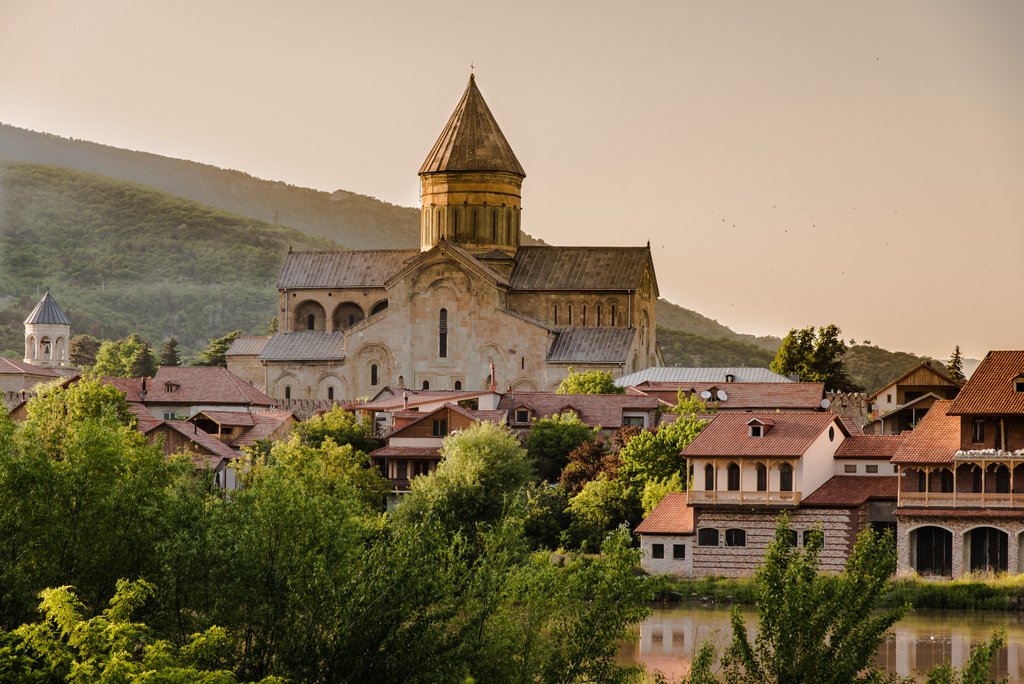
The Anchiskhati Church dates from the sixth century AD and is the oldest
Orthodox church in Tbilisi, the capital city of Georgia. Its name derives
from "the sacred icon (khati) of Anchi" (a community or tribe);
and it has been a centre for Georgian culture since the Middle Ages. But
under Soviet communism, church music was prohibited in Georgia for three
generations, but in 1989, Malkhaz Erkvanidze and members of the Anchiskhati
choir researched and revived the hymns in their appropriate settings.
- Changi a triangular harp, from the Svaneti region, which is claimed in legend to have derived directly from David's biblical harp.
- Chiboni a bagpipe made from goatskin, from the Ajara region in Western Georgia.
- Gudastviri a goatskin bagpipe from Racha, in the Caucasus mountains.
- Panduri a three-stringed plucked instrument, from Eastern Georgia.
- Chonguri a larger, three stringed plucked instrument, with a fourth fixed stringed that plays a high drone, from Western Georgia.
In this webcast ethnomusicologist, scholar and performer Malkhaz Erkvanidze talks about collecting traditional sacred and secular music in the Republic of Georgia. Members of the Anchiskhati Choir assist him with performance of material he and the members of his ensemble have collected.
Malkhaz Erkvanidze is a world authority on Georgian polyphonic choral music. He has spent his life rescuing the church hymns and prayers that were suppressed under Soviet communism. His four books of Georgian hymns have been published with CDs; and he has written many articles about the distinctive musical structure of Georgian polyphony. He leads the "Dzveli Kiloebi" or Old Modes group within the Anchiskhati choir, dedicated to preserving the authentic Georgian tuning system with the traditional singing styles. He teaches at the Tbilisi State Conservatoire, the State Seminary and the Academy of Theology; and is the consultant to the Patriarch of Georgia, Ilia the Second, on liturgical chant.
The Anchiskhati Choir is the world's leading exponent of Georgian polyphonic choral music. Members of the Anchiskhati Choir come from different regions of Georgia where they have absorbed the unique singing traditions of their parents and grandparents. Singing weekly in the famous 6th century Anchiskhati church in Tbilisi, Georgia, the ensemble collaborates as a group of expert and passionate ethno-musicologists, who collect, teach, hold workshops and regularly perform in Georgia and abroad.
For more information see:
External link (Anchiskhati Choir site)
External link (Anchiskhati Choir site)