Showing posts with label Petroglyphs. Show all posts

Friday, May 24, 2013

RESEARCH: Armenian Rock Art Research Academy - Tir (armrockart.nt.am)

(armrockart.nt.am) Our ancestors' rock-carving endeavors have spanned the period between the 7th and 1st Millennia BC, as attested by historical-cultural comparisons. In one of fundamental problems of Rock-Art researches (Petroglyphology), their dating, we attach importance to complex materialogical - traceological, cosmological and mythological studies, and in general, all types of complex approaches. We believe that the classification of available material is a prerequisite for the development of this branch of science. This can be done through nearly 365 parameters and properties, grouped in six categories:  monument,  rock, surface,  furrow,  image,  clusters.

The most significant elements of mentality and existence of prehistoric man have been reflected in artifacts, which in prehistoric/pre-script times involved Rock-Art as well. As a specific form of expression of emotions and information, rock-carvings represent a medium of communication. And if back then Rock-Art possessed recording, storage and conveying functions, for us now it has aesthetic and cognitive functions. These are the bases that allow us to designate petroglyphs as reliable sources, and, therefore, means of revealing the past.

In considering Rock-Art we put it in historical-archaeological culture context, and try to define and determine the Rock-Art tradition and Rock-Art culture. Attaining this aim is possible only through a classification which takes into account the influence of almost all known natural and human factors, beginning from the formation of rock-fragments through to engraving and up to our days. We believe that due to such theoretical and practical classification we will be able to reveal the meaning, role and function of each rock-carving, each group of rock-images and, finally, of Rock-Art in general.


 Rock-Art of Armenia was mentioned for the first time by Movses Khorenatsi, the founder of Armenian historiography (5th ce. AD), followed by Anania Shirakatsi, Armenian philosopher, astronomer and mathematician (7th ce. AD). 
Although rock-carvings were discovered as early as in the beginning of the 20th century (Mesrovb Ter-Movsessyan, 1902, Levon Lisitsyan, 1972, Ashkharhbek Kalantar, 1935), real academic work has only been undertaken since the early 1960s. Thus far, it has been primarily Armenian archaeologists (Haroutyun Martirossyan, Sandro Sardaryan, Grigor Karakhanyan and others) who have published four volumes of their studies (with 1320 images of rock-carvings) on the subject in association with the Institute of Archaeology and Ethnography of Academy of Sciences of Armenia. This area of research is currently coordinated by the Institute of History and by the “Armenian Rock Art Research Academy – Tir”.

The Republic of Armenia (RA), which comprises one tenth of the territory of the Armenian Highland, has a plenitude of rock-carvings. Five large Rock-Art areas are well known and nearly 20 thousand carved rock-pieces have been discovered so far. 12000 of these are located in the vicinity of the Geghama and Vardenis Mountain Ranges (2500-3200 m above sea level) and more than 6000 in the Syunik Mountains (3000-3400 m) in the south of RA. Another 2000 have been found on the slopes of Aragats (1100-3000 m), the highest peak of RA (4094 m) and on the slopes of Navasar, near the second peak of RA -- Kaputjugh (3904 m). There are also hundreds of rock-carvings in the Qarvachar Region of Artsakh.

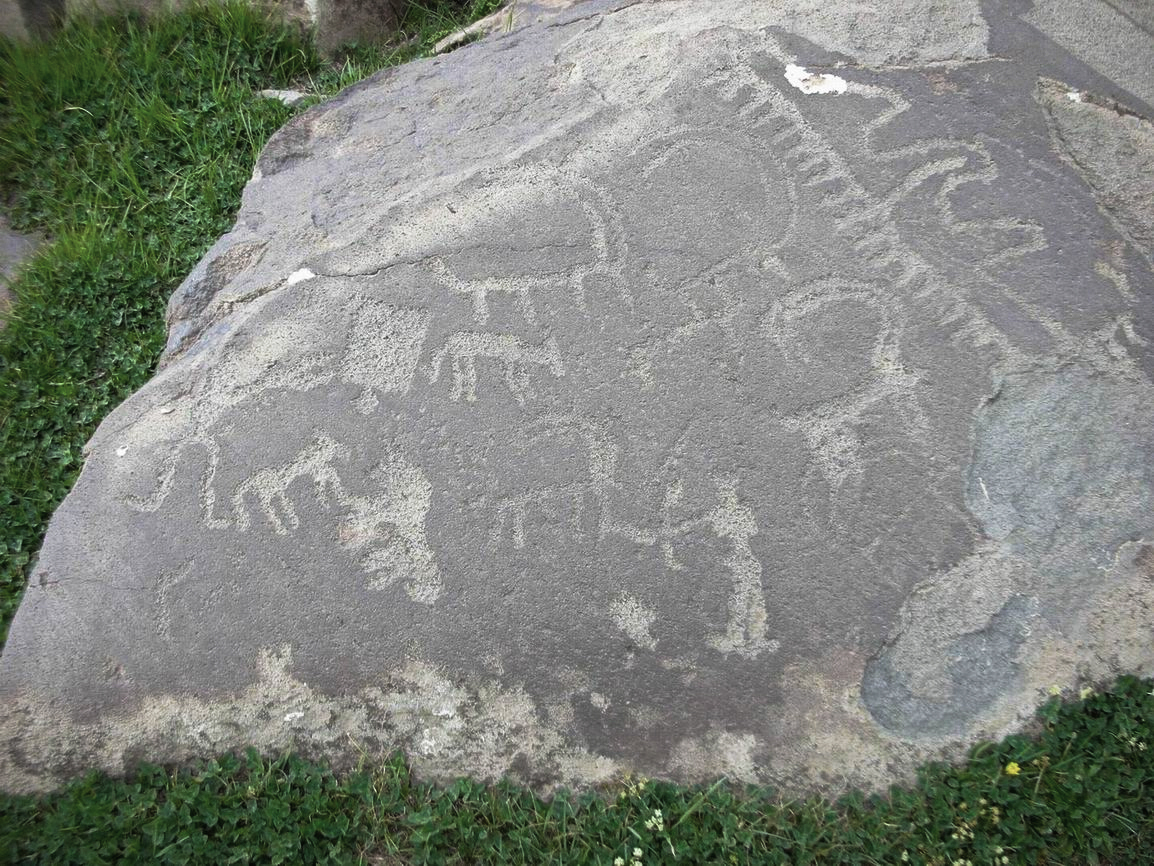
A great number of rock-carvings has been found in Western Armenian provinces in modern Turkey and in the Kobustan area of Azerbaijan. All of the carvings located in Azerbaijan and eastern Turkey are similar in subject, style and technique to those in RA, and similar to those presented here (Photos) which are all from the Geghama Mountains.

Almost all aspects of human life are reflected in Rock-Art. Most images depict men in scenes of hunting and fighting, cultivating land, competing and dancing. Different animals, especially goats, deer and panthers, as well as the mythological creatures – “vishaps” (dragon-like steles) are pictured. Some rock-images reflect the adoration of maternity, the ancestors, heroes, spirits, fertility and time. Geographic elements are also featured: rivers, lakes, springs etc., followed by astronomical bodies and phenomena: the Sun, the Moon, stars, stellar constellations and starry sky, bolide, comet, and lightning. There are many images of carriages and various structures, maps, water-grids, starry sky, as well as carved compasses, solar and lunar calendars.

Like rock art monuments elsewhere in the world, the petroglyphs of Armenia, by their great number, styles and diverse content, occupy a unique place in our cultural heritage from the ancient world.

CULTURE: Ughtasar: The Petroglyphs of Armenia. By Maro Siranosian (haytoug.org)


(haytoug.org) The petroglyphs, or rock engravings, of Ughtasar can be found all over Yerevan; they are inscribed onto silver jewelry, painted onto coffee cups, traced into hand-made pottery, and they adorn the walls of cafes. Reaching the actual petroglyphs of Ughtasar (“ught” meaning camel and “sar” meaning mountain, due to the resemblance of its peaks to the humps of a camel) can be a bit of a challenge, and as with most of Armenia’s noteworthy sites this provides half of the trip’s excitement and intrigue.

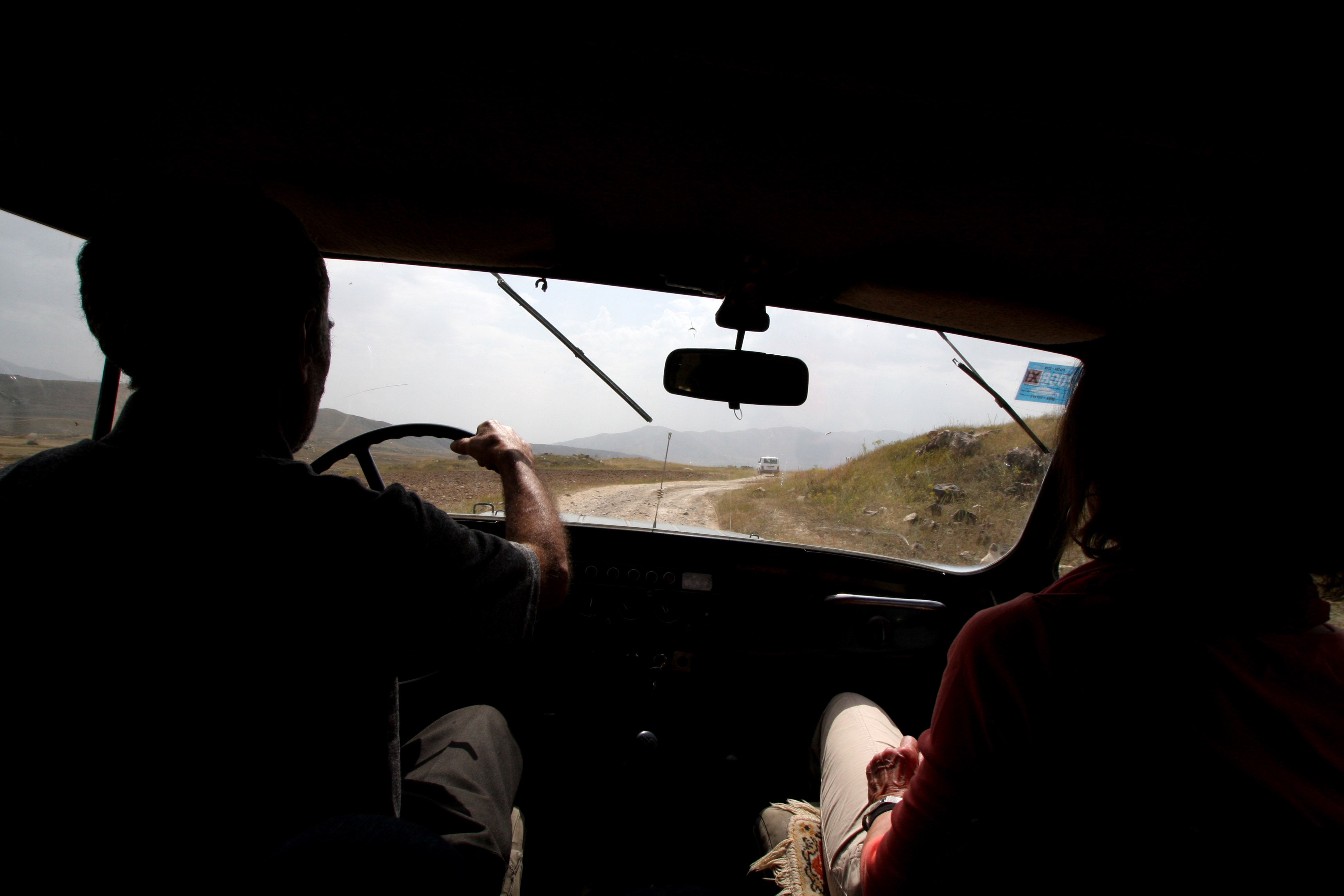
Located in the Syunik mountain range about 20 miles from Sisian in southern Armenia, the petroglyphs can only be accessed by an uphill climb in a Soviet-era UAZ. UAZ stands for Ulyanovsky Avtomobilny Zavod, or the Ulyanovsk Automobile Plant where the sturdy Russian 4×4 is manufactured. The trek up the mountain is much like riding Disneyland’s beloved Indiana Jones Adventure 200 times without stopping. Your slight, unassuming Armenian driver will be transformed into a superb navigator at the helm, maneuvering through ditches and over large boulders with ease as you bounce around the back of the UAZ desperately trying to absorb some of the pristine scenery without knocking your head against the window too many times. At some point after the first hour of driving you have no choice but to get out of the vehicle and continue on foot, as the road becomes too steep for even the tank-like UAZ to scale it with so many passengers. This is the part of the trip when some members of your party, possibly your father or mother, will start cursing the moment they agreed to come here with you in the first place; this was, after all, supposed to be a vacation.

After you pass the worst of it and can climb back into the car, it’s only a short drive to the lake and the petroglyphs at the top of the mountain. The first glimpse of the small, crystalline glacial lake makes the drive worth it, no matter how much you may have been knocked around: it is glass-like and still, providing a perfect mirror of the sky and the surrounding peaks, and over 2,000 decorated rock fragments extend to the foot of the mountain. If the sun is shining, the rocks glisten with a greenish iridescence. The petroglyphs, some believed to date back to the Paleolithic Era (12,000 BCE), are carved onto dark brownish-black volcanic stones left behind by an extinct volcano. Although the site was discovered in the early 20th century, it was not really studied until the 1920s and again in the late 1960s; it is still not fully understood today.

The carvings on the rock fragments depict hunting scenes, a wide array of animals, spirals, circles and geometric shapes, and even zodiac signs. Research suggests that the area served as a temporary dwelling for nomadic cattle-herding tribes, and studies of the rock carvings indicate that they were in use for hundreds of years, with peoples of later eras adding their ownengravings to the stones. According to the research of Hamlet Martirosyan, the pictograms of Ughtasar represent a writing system called “goat writing”.

Many scholars believe that this was due to the large number of goats drawn on the stones, but according to Martirosyan it is because in the ancient Armenian language, the words “goat” and “writing” were homonyms (words of differing meaning that sound the same). They would use these homonyms to express concepts through pictures, thus the abstract concept of “writing” (which in ancient Armenian can be expressed with words like “shar” – arrange, “sarel” – compile, “tsir” – a line) found its reflection in the representation of a goat (“zar”), because the words for “writing” and “goat” sounded the same. As English speakers, we can think of it as representing the pronoun “you” with a picture of a ewe (a female sheep). Goats are a prevalent theme on the stones, possibly because the word “dig” in ancient Armenian meant goat and was close enough to “diq,” the ancient word for gods. By combining abstract signs with the images of animals and people in horizontal or vertical rows, prehistoric engravers were able to convey specific messages.

The true beauty of Ughtasar lies in its seemingly untouched nature. You won’t find traces of khorovadz (barbeque) fires next to the lake or trash sprinkled among the rocks; there isn’t a visitor center selling mugs and postcards; there are no tour guides hounding you to listen to the history of the petroglyphs. You are free to roam the mountainside and sit among the prehistoric graphic expressions, pondering what might have caused ancient Armenians to scale the uninviting peaks and leave their mark. At about 10,500 feet above sea level, the air is some of the cleanest you’ll breathe in Armenia outside of a climb to the top of Mount Aragats, Armenia’s highest point. Due to its elevation the climate is always crisp and patches of snow speckle the mountain year-round.

Today, the mountain perch hosts annual spiritual gatherings and retreats. Surrounded by the marks of peoples past, modern visitors partake in the same natural beauty, serenity, and mystery that the lake has provided for thousands of years.

When you finally reach Sisian again after practically tumbling down the mountainside, you feel like you’ve just returned from a trip to the moon or some equally far-flung and unreachable place. You feel as if you’re waking from a dream, a dream whose constant jerking scenery caused you to fall from your bed, hitting your head a few times along the way. You are left with some amazing bruises to help you recall it instantly for days to come.

WISSENSCHAFT: Forscher dokumentieren Felsmalerei in Armenien. Von Von Gregor Klaudius, dpa (suedkurier.de)

(suedkurier.de) Das Forschungsprojekt ist aufwendig und ungewöhnlich: Archäologen aus Sachsen-Anhalt haben es sich zur Aufgabe gemacht, weltweit einzigartigen Felsmalereien in Armenien zum Weltkulturerbe-Titel der Unesco zu verhelfen.

Die Wissenschaftler um den Direktor des Landesamtes für Archäologie, Harald Meller, dokumentierten bislang etwa 500 von tausenden aus der Bronzezeit stammende Felsmalereien. Erstmals zeigt das Landesamt Fotos der Forschungsergebnisse in einer Ausstellung in Berlin.

«Das Weltkulturerbe bekommt man schwer, aber die armenischen Felsmalereien haben gute Chancen», sagt Meller in Halle. Sein Team aus 15 Vermessungsingenieuren, Archäologen und Grabungstechnikern hatte im vergangenen Sommer die Felsbilder von Ughtasar im armenischen Hochland erstmals leibhaftig in Augenschein genommen. Auf Höhen von 2000 bis 3500 Metern erforschten die Wissenschaftler 40 Hektar einer erloschenen Vulkanlandschaft, die aus tausenden Basaltbrocken besteht. Auf vielen der dunklen Gesteinsbrocken fanden sie bronzezeitliche Felsmalereien etwa von Steinböcken, Leoparden, Kriegern, Bären oder Ziegen.

Was die Bilder so einzigartig macht, ist nicht nur ihre hohe Anzahl, die über mehrere Jahrhunderte entstanden sein muss. «Die Tiere und Menschen sind sehr eindeutig aufs Charakteristische beschränkt», erklärt Sachsen-Anhalts Chefarchäologe. Die 4000 Jahre alten Felsmalereien seien sowohl gestalterisch wie auch handwerklich gekonnt in Szene gesetzt und gut erhalten.

Mit einem ferngesteuerten Mini-Helikopter haben die Experten das Gebiet in vier Wochen vermessen und fotografiert. Die Fundstätte war zwar seit Jahrzehnten bekannt, doch den Armeniern fehlte die Technik für die Erforschung. Und die Bemühungen britischer Wissenschaftler der Universität Reading reichten nicht aus, um dem Ziel rasch näher zu kommen, zum Weltkulturerbe zu gehören.

Also vereinbarten Armenien und Sachsen-Anhalt ein gemeinsames Forschungsprojekt. Sachsen-Anhalt vertritt Deutschland seit dem Jahr 1996 bei der kulturellen Zusammenarbeit. Grundlage ist ein Kulturabkommen der Bundesrepublik mit der Republik Armenien. Laut Sachsen-Anhalts Kultusministerium kooperieren das Landesamt und die Wissenschaftliche Akademie Armeniens seit dem Jahr 2008 eng miteinander bei archäologischen und Denkmalschutzprojekten. Neben den Felsmalereien von Ughtasar gehören prähistorische Goldbergwerke und rätselhafte Steinanhäufungen zu den Projekten der deutschen Forscher in Armenien.

Wenn alles klappt, will Armenien mit Hilfe der Sachsen-Anhalter binnen der nächsten zehn Jahre den Weltkulturerbe-Titel beantragen. «Dazu müssen die zentralen Fragen beantwortet werden, was es alles für Motive gibt und wie sie zueinander stehen», sagt Meller. Bislang seien die Archäologen mit Deutungen der Motive noch sehr zurückhaltend, weil der Bestand zunächst weiter erforscht werden müsse. Meller schätzt, dass sein Team bei einem erneuten Projekt in diesem Sommer noch einmal mehr als 500 Felsmalereien dokumentieren wird.

Die Aussichten auf den Weltkulturerbe-Titel für das armenische Hochland an der Grenze zu Aserbaidschan bewertet Meller als «sehr gut, weil die Felsmalereien wissenschaftlich hoch bedeutsam» seien. Grundvoraussetzung für den Titel sei eine wissenschaftliche Dokumentation der Bilder. Die Unesco als Organisation der Vereinten Nationen verleiht den Titel Weltkulturerbe an Orte, die wegen ihrer Einzigartigkeit, Authentizität und Integrität als weltbedeutend gelten. Vorgeschlagen werden die Stätten von den Staaten, in denen sie liegen.

«Armenien hat sicher gute Chancen auf den Welterbetitel, weil es in dieser Region im Gegensatz zu Europa oder den USA noch nicht viele Welterbestätten gibt», sagt Doris Hartmann vom Lehrstuhl für Materielles und Immaterielles Kulturerbe der Universität Paderborn. Für einen Welterbe-Antrag sei allerdings viel Vorarbeit notwendig, um die Besonderheiten einer Stätte herauszustellen. Die Unesco fordere sehr umfangreiche Anträge. Es gebe bereits mehrere Welterbestätten mit Felsmalereien, beispielsweise in Frankreich oder Spanien. Dass nun die armenischen Felsbilder wissenschaftlich aufgearbeitet würden, sei ein gutes Anliegen, meint Hartmann.


In einer Ausstellung unter dem Titel «Bilder für die Ewigkeit - Petroglyphen im Hochland Armeniens» im Auswärtigen Amt, das die Projektkosten größtenteils trägt, sind nun erstmals Fotos von den Felsmalereien und Forschungsarbeiten zu sehen. Die prähistorische Felskunst in den Jahrtausende alten Bergsteppen sei ein wesentlicher Teil des kulturellen Erbes Armeniens, sagt eine Sprecherin des Auswärtigen Amtes in Berlin. Zudem sei diese Bilderwelt im Gegensatz zu vielen mitteleuropäischen Felsbildregionen, die seit Jahren zum Welterbe der Unesco zählten, bis heute nahezu unbekannt.

Austellung: Auswärtiges Amt, Lichthof, Werderscher Markt 1, 10117 Berlin
Die Ausstellung kann vom 21.05. bis zum 12.06.2013, wochentags von 10 bis 18 Uhr, besichtigt werden. Der Eintritt ist frei.


Mehr Links: 
Felsmalereien: Das geheimnisvolle Freilichtmuseum von Ughtasar (spiegel.de) 
Die einzigartigen Bilder von Ughtasar (n24.de)
Ughtasar Petroglyphs (armeniapedia.org)
Armenische Auszeichnung für Sachsen-Anhalts Landesarchäologen (hallespektrum.de)


 Mehr zu den Petroglyphen (wikipedia.org)