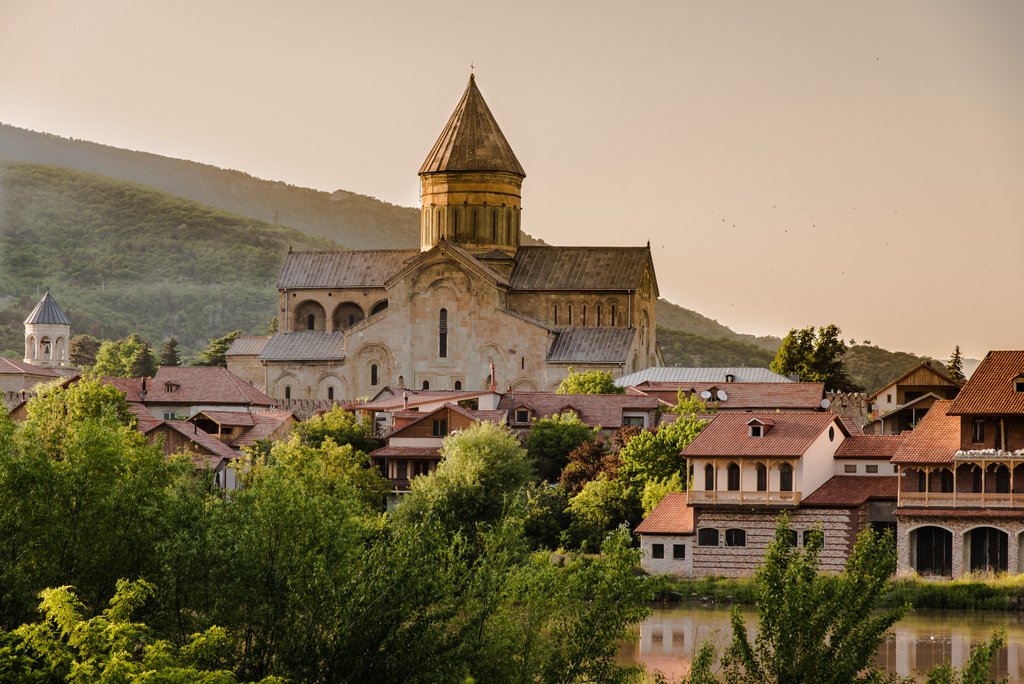
Wild Grapes is a vinous journey through the Republic of Georgia, the birthplace of wine, presented in three distinct acts. For more than 8,000 years, wine has permeated Georgian culture, and Wild Grapes, hosted by Whetstone founder and former sommelier Stephen Satterfieldrfield, is an exploration of the ways in which this considerable legacy has endured throughout the millennia.
Whetstone Founder Stephen Satterfield visits the Republic of Georgia, the cradle of wine, to explore its origins and the ways in which it continues to permeated the culture today.
More: Whetstone PRESENTS: Wild Grapes [whetstonemedia.co]
Our debut film, Wild Grapes is a vinous journey through the Republic of Georgia, the birthplace of wine, presented in three distinct acts. For more than 8,000 years, wine has permeated Georgian culture, and Wild Grapes, hosted by Whetstone founder and former sommelier Stephen Satterfield, is an exploration of the ways in which this considerable legacy has endured throughout the millennia.
Act 1: About 45 minutes north of the Turkish border, we visit Giorgi Natenzahe, a preservationist and winemaker stewarding a 400 year-old grape vine, the oldest known in the world that continues to produce wine.
In Act 2 we travel to Pankisi Gorge, a Muslim village on the Chechen border at the valley floor of the Caucasus Mountains. at Leila’s Guesthouse, a local b+b, we eat extraordinary Chechen cuisine prepared by the talented namesake proprietor, Leila Achishvili. During the stay, she describes the region’s complex history as a recruitment hub for Islamic militants, including a devastating story about the loss of her own sons.
In Act 3 we visit the village of Lagodekhi to experience the most quitessecitial of all Georgian holidays, Easter Sunday. In Georgia, the holiday is commemorated with successive days of feasting culminating with a cemetery picnic in which the entire village comes to celebrate with friends and family past and present.
Showing posts with label grapes. Show all posts
Showing posts with label grapes. Show all posts
Sunday, December 09, 2018


Sunday, June 18, 2017
#GEORGIANWINE: Georgische Winzer auf der RAW WINE FAIR 2016 in Berlin
Quevriweine auf der RAW WINE FAIR 2016 in Berlin
Autor: Ralph Hälbig
Kamera: Ralph Hälbig
Schnitt: Katrin Molnár
Berlin-Kreuzberg, Ende November. Nach London und New York fand die große Natur-Wein-Messe in diesem Jahr auch erstmals in Berlin statt. Hundertneununddreißig Winzer aus der ganzen Welt waren vor Ort, darunter sieben Weinartisten aus Georgien.
Dass die Georgier hier sind, haben sie vor allem Elena Kikanadse von der georgischen "Wine Agency" zu verdanken. Sie hat sie nach Berlin eingeladen.
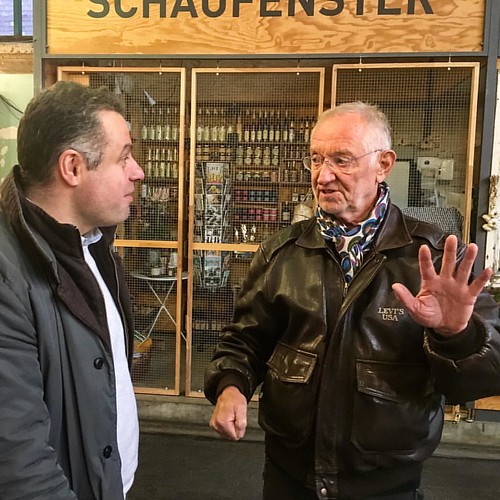
Giorgi Natenadze, Winzer: This is the oldest grape, which I found three years ago. This is first time that I made wine for this grapes. It is a wild grape. It's very limited. Let's taste it!
Giorgi Natenadze sucht seit über zehn Jahren nach den alten (autochthon, indigenous) Weinen Georgiens. In der Zeit der osmanischen Herrschaft wurden viele Sorten in seiner Heimat Meskheti zerstört - der Geburtsort georgischen Weines:
Giorgi Natenadze, Winzer: Also Kachetiens says: the birthplace of Georgian Wine is Meskheti. There are many legends about how it is spread all over Georgia.
80% of my region is now part of Turkey. So I am going there and I am searching and finding some grapes and taking back to my region.
Natenadze erforscht eigenhändig türkische Wälder und alte Dörfer. 24 ursprüngliche Traubensorten seiner Heimat hat er schon wiedergefunden.
Die Leidenschaft für ursprüngliche, natürlich gereifte Dinge teilt auch der Deutsche Udo Hirsch. Er sucht ebenfalls nach alten Rebsorten in der Türkei. Und er produziert seinen Kvevri-Wein auch dort. Kein Problem, trotz Islam:
Udo Hirsch: In der osmanischen Zeit gab es allein 1600 Weinrestaurants in Istanbul. Also bitte! Und auf dem Lande wurde traditionell weiter getrunken. Außerdem gibt es 20 Millionen Aleviten, die Wein trinken dürfen! Für die ist es nicht verboten. Die trinken auch. Also man soll das nicht so eng sehen mit dem Islam.

Udo Hirsch arbeitet mit Nika Bakhia und dem Winzer Soliko Tsaishvili zusammen. Gemeinsam vermarkten sie ihre Naturweine unter einem Label. Nika Bakhia macht seine Weine ohne jegliche Zusatzstoffe - ein Risiko, denn er überlässt den Wein komplett sich selbst.
Auf der RAW WINE Messe werden nur Weine präsentiert, die ohne chemische Behandlung gewachsen sind (biologischer Anbau) und auch natürlich gekeltert werden (biodynamisch). Diese besonderen Weine haben viele Fans. Es geht um Weine, die so gut wie gar nicht manipuliert werden - wie sonst üblich bei Industrieweinen.
Die ehemalige Präsidentenberaterin Rusudan Gorgiladze betreibt in Berlin-Kreuzberg ihr georgisches Restaurant "Schwiliko". Sie will die kaukasische Küche in der deutschen Hauptstadt populär machen und sucht dafür den richtigen Wein.
(2017 soll ihr Kochbuch "Savouring Georgia" auf Deutsch erscheinen.)
Rusudan Gorgiladze, Restaurantbesitzerin: Das ist eine der seltensten Rebsorten und sie wächst nur in Imereti. Die Traube ist sehr, sehr selten. Der Wein ist einer der besten - "Otskhanuri Sapere" ist der Name.
Ein Wein übertrifft hier den anderen. Die älteste bekannte Art des Weinausbaus im Kvevri findet weltweit immer mehr Beachtung und wird zu einer ernst zu nehmenden Konkurrenz für andere Qualitätsweine. Ein echter Erfolg für die georgischen Winzer.
Die traditionelle Idee von Wein als Kunst sowie seine Bedeutung als Qualitätsprodukt, das eine ganz bestimmte Region verkörpert, rücken gerade auch die Georgier auf dieser Weinmesse in den Vordergrund. Und das kam gut an.
Mouseover for the Gallery
Didi madloba!! ... for the great times there to Paata Bolotashvili, Nika Bakhia, Soliko Tsaishvili, Alexander Buchashvili, Georgien Wein, Gotsa Wines, Giorgi Natenadze, Matthias Unger, Kahka Berishvili, Kakha Tchotiashvili, Mako Avqopashvili, Guram Avqopashvili
Friday, May 12, 2017
#GEORGIANWINE: Great Map from Wine Regions in Georgia. By Malkhaz Kharbedia

#GEORGIANWINE: The National Wine Agency is a legal entity of public law under the Ministry of Agriculture of Georgia (georgianwine.gov.ge/eng)
 (georgianwine.gov.ge/eng) Main directions of activity: Popularizing and raising awareness of Georgian wine; Promotion of the growth of export potential; Popularization of Georgian vine origination; Restoration of the unique and rare Georgian grape varieties; Creation of a vineyard register; Popularization of the oldest Georgian traditional methods of qvevri wine making; Supporting the development of wine tourism
Georgia has an 8,000 year history of continuous wine making tradition, which is evidenced numerous archaeological discoveries. Georgians have shared the love for the grape the time immemorial and remains loyal to it through to modernity. Numerous displays related to wine making practices dating to millennia have been kept in Georgian museums.
Archaeologists discovered several grape pips of ancient millennia in Kvemo Kartli, to the south of Tbilisi, in the Marneuli Valley, in the ruins of the Dangreuli Gora. In accordance with morphological and ampelographic features, they then assigned the pips to a cultivated variety of grapevine, Vitis Vinifera Sativa.
The earliest traces of viticulture and wine were found in the ancient Neolithic settlements in the neighborhood of Dangreuli Gora (Shulaveri Hill, Cut Hill, Khrami Big Hill, Arukhlo Hill, Khizanaant Hill and others). Besides grape seeds, archaeologists have unearthed the remains of cultural wheat and legumes, agricultural implements and pottery, proving that in the Neolithic period, the inhabited humans developed agricultural activities including viticulture and wheat growing.
The fragments of clay wine vessels found during excavations of the settlements testify to the fact that as early as the Neolithic period there was not a fledgling, but rather an already well-developed stage of agriculture, indicating that people started the domestication of the vine on the territory of Georgia an even earlier period.
The qvevri vessels dating the Neolithic era were discovered during different archaeological excavations, as were cultural vine fossil seeds, tartaric acid sediment on the fragments of earthenware vessels for wine and resin the domesticated grapevine. The diversity of the wild and indigenous grape varieties, the unique wine vessel (the qvevri) and the oldest technologies of making wine by qvevri all confirm that Georgia is truly an ancient wine making country.
Of the artifacts the Shulaveri-Shomu Tepe period, a ceramic vessel for wine found in Didi Gora (Khrami Big Hill), believed by scientists to be an ancestor of the qvevri which deserves the greatest attention. Currently, it is exhibited in the National Museum of Georgia and is considered the world’s oldest wine vessels.
Since the pagan period, wine has had a ritual and mystical destination. In Georgian folk belief, the Aguna, or Angura, is considered a patron saint of viticulture. In Guria, the sacrifice ritual to Aguna is still well preserved as a theatrical performance.
With the spread of Christianity and wine’s association with the blood of Christ, vineyards and wine in Georgia gained even greater importance. A disseminator of Christianity named St. Nino appeared in Georgia with a cross tied with vine branches. Holy wine has always been made in large quantities in monasteries and old cellars (Marani) still remain in many monasteries. Georgians considered the wine a holy drink and often donated it to the saints and the church. This wine is called Zedashe.
The majority of linguists agree that semantic meaning of the word “wine” is rooted only in Georgian language, and supposedly it is derived the verb “Ghvivili”. The root of the word, “ghv,” is purely Georgian and is found in many Georgian words.
Wild sorts of vine are still spread throughout Georgian territory. the 1980s, the forest vine has been included on Georgia’s the red list as an object of state protection. Along with the wild vine, over 500 Georgian domesticated vine types are described in Georgia. Of those, around four hundred thirty are protected in various state and private collection vineyards.
Development
Georgians have been engaged in viticulture and wine making for almost eighty centuries. During this period, a rich culture of grapevine and wine developed using a diversity of grape varieties. This was also the period during which the domestication of wild grapes was realized, systems of vineyard plantation and care were elaborated, wine vessels were improved and the establishment of the culture of Qvevri occurred. Kakhetian and Imeretian technologies of wine making were also established in this period.
The 19th century is considered one of the most important periods in the history of Georgian wine. During this period, Georgian poet and public man Aleksandre Chavchavadze made great efforts to get Georgian wine closer to European wine. Since the 1830s, some places of origin wines, which are still very popular today, have been made on Chavchavadze’s estate. In the beginning of the 1890s, Tsinandali, Mukuzani, Napareuli and Teliani wines were produced on regular basis. In the same period, in the village of Ruispiri, a well known German wine expert Lenz created a wine cellar Georgian and foreign sorts were cultivated. Viticulture was also developed in Tbilisi after the German colonists settled in the city suburbs and imported foreign sorts into the country.
In the 1870s, Georgian wine Ivan Mukhran–Batoni’s cellar was exported Georgia. In the mid-19th century, scientific studies of Georgian grapevine varieties began. In the 1870s, characteristics of the Georgian grape varieties appeared for the first time in descriptions published in Paris and London.
In the 19th century, Georgia participated in multiple wine exhibitions. At that time Europe became acquainted with Georgian wines and brands. In the Paris exhibition of 1900, Georgian wine making already held a respectable place in European culture, as reported by the newspapers of that time. Georgia’s success at this time was also supported by pictures of the wine cellar “Kakhetian Princely Viniyards,” manuscripts describing rather large collections of grape clusters (Rkatsiteli, Saperavi, Tavkveri, Tita, etc), as well as wine samples in bottles, small casks (tikebi), etc. During this period, Georgian wine paved the road to international arena and has since reached great success.
Friday, May 03, 2013
INTERVIEW: Lagvinari – the new Georgian winery from Isabelle Legeron (hvino.com)
(hvino.com) 28.04.2013. With Georgian wine’s reputation growing all the time, we
were delighted to hear that Isabelle Legeron MW, author of the website
That Crazy French Woman, has set up her own Georgian wine project in
Kakheti, producing the natural, artisan wines that are so close to her
heart. We caught up with her to find out more.
 You have set up a new winery called Lagvinari – can you tell us a bit about it? Where did the name come from?
Lagvinari is an old Mengrelian word for kvevri. The vineyards are located in Kakheti at about 400 m above sea level, with chalky/clay/gravelly soil. A bit of a mix. Climate is very cold and snowy in winter (given that we are in the foothills of the Caucasus) and baking hot in summer, which is why it helps to be at a little altitude.
You are currently growing organic rkatsiteli and saperavi grapes for your wines. Why did you choose those two grapes in particular, and what are their characteristics?
Rkatsiteli is a Kakhetian grape, meaning ‘red horn’ as the stem of the grape is pink/redish when it is ripe. Rkatsiteli is very popular in the Alazani Valley in Kakheti, but is can also be found in Kartli and in small quantities in west Georgia too.
Rkatsiteli prefers hot climate conditions but it is a pretty resilient variety that adapts well to its surroundings, which is why it is quite widespread in Georgia. It is also quite a vigorous and high-yielding variety, which I presume is why the Soviets favoured its adoption for mass production, so it does need some restraining. We decided to produce our first wine using rkatsiteli because it is readily available and since I am only interested in working with organic grapes we were also that much more constrained. I was also curious to see whether or not it was possible to create a truly fine wine from such a tough, workhorse grape, and we were delighted with the result. Rkatsiteli is excellent for producing traditional Kakhetian style wine.
Saperavi means “colouring” in Georgian – more specifically, “peri” means “colour” because this is a teinturier variety, which means that it gives off a LOT of colour when you press it. In fact, last autumn I made a tiny test batch of saperavi that I was experimenting with in our friend’s kitchen in Tbilisi and even though I decided to separate the juice from the pips and stems after only 10 mins, the juice was already thick and very dark purple – our arms and feet took days to scrub clean!
Like rkatsiteli, saperavi is widespread in Kakheti, mainly because it is hardy (it can survive in extremely cold weather conditions) and because it is a high-yielding variety. Saperavi shows surprisingly different tones depending on its place of origin and the microclimate of the area. In fact, we founded the vineyards where we did precisely because of an old Georgian Ampeological Research manual from the 1960s that stated that “the best full-bodied, traditional saperavi wine came from Kardanakhi & Bakurtsikhe, where rich forest soils dominated”.
Many people might consider the presence of stems in a wine as a mistake or a fault, but like many other kvevri wines you macerate the wine on the skins and stems for up to 6 months – why is this? What impact does this have on the final product?
The use of stems in white winemaking is a practice that dates back thousands of years. Stems, when ripe, add floral notes and more complex tannins to the wine. Stems are widely used in red wine making so why not do the same with whites?
Do you have plans to increase your number of grape varieties?
Absolutely. Our long term goal is to use indigenous grape varieties from other regions as well, especially from west Georgia and Kartli, which are home to some very interesting grape varieties that have been neglected for far too long.
How would you characterise your wines? Do you have an ethos or a concept behind them?
This is from the back of our bottle:
LAGVINARI is a small, organic winery in Georgia, founded by Eko Glonti in partnership with THAT CRAZY FRENCH WOMAN, Isabelle Legeron MW. We work closely with local, artisan grape growers and use both indigenous grape varieties and ancient winemaking techniques, to promote sustainable Georgian farming and preserve its rich cultural heritage.
Your wines are produced in kvevri – how is it used in your wines? What qualities and characteristics does it bring to the wine, and why?
Kvevri making has a long history in Georgia – it is an ancient winemaking vessel. Thousands and thousands of years old. But what is perhaps more remarkable is that they are still very much in use today. It is not just commercial companies that use them, in fact, it is extremely common for individuals to have their own kvevri in their backyard or basement!
Kvevris are fermenting wine vessels made from clay, which are buried underground – which is great as the earth insulates the vessel and regulates the temperature of the sleeping wine. You basically just harvest your grapes and you stick them, pips, skins, stems and all into the pot, which you then leave to ferment and eventually seal off until spring when you open up your kvevri (always a bit of a gut-wrenching experience as you are never sure how it will have turned out since you don’t have a tasting tap like in modern wineries!).
Because the juice is left to macerate on the skins and stems for such a long time, whites are orange, tannic and show a lot savoury notes like dried herbs, although our Lagvini is also deliciously aromatic with an apricot/orange blossom nose. I love it.
The quality of the clay used in the making of the kvevris is very important and there are particular regions in Georgia that are famous for the quality of their clay – as kvevri.org once explained to me, some of the particularly good clays contain high amounts of silver content, which is of note as silver has pronounced anti-bacterial properties. Kvevri.org is an NGO dedicated to the understanding and use of the kvevri and they work closely with German research institutions for the advancement of ‘kvevri science’ if you like – they are coming to the artisan wine fair that I organize each May called RAW (www.rawfair) and are bringing with them a real, life-size kvevri that you will be able to get up close and personal with!
Kvevri-making is an artisan craft. Each one is handmade and takes a long time to build – they are effectively giant pots and, because of their size, can be very fragile. They vary in size but the biggest ones are generally hold about 2 tonnes of wine, although I have heard rumours that in times past, kvevrimakers used to build kvevris that were the size of houses!
Your winery is in Kakheti, where the vast majority of Georgian wines are produced. Why is Kakheti such a good wine producing region?
The valley floor in Kakheti, where most of the vineyards are located, has a very rich soil and a multitude of different microzones, which I imagine must be a key reason for why winemaking developed in Kakheti. It is also extremely hot and dry in summer in the lead up to harvest, which makes the farming part a lot easier (less likelihood of mildew or disease for instance).
Kakheti has been an ancient viticultural land for centuries. In fact, the oldest winemaking academy in the world (I guess it was probably the UC Davis of its day!) is located in Kakheti – Ikalto Academi. For centuries, during the Dark Ages of Europe, Ikalto was a centre of learning, with a particular emphasis on winemaking and winemaking technologies.
Given that you come from France, the most prestigious wine producing country in the world, what attracted you to Georgia as a country to produce your wines?
Georgia is a wonderful country, where seasonality and simplicity of produce are still paramount. This is quality that has to some extent been lost in western Europe. In Georgia, that is not the case. Everyone eats properly and produce is delicious – coriander smells powerfully of coriander and tomatoes of tomatoes. You only have to step into a food market in Tbilisi to get how true this is. I fell in love with the country the minute I set foot out there a number of years ago. It is an infectious country.
Georgian wine making has been completely transformed since we first started four years ago. How would you characterise the current state of Georgian wine making, and what major developments can we expect over the next few years?
I hope we’ll be seeing lots of delicious, organic, natural, kvevri wines hitting the shelves over the next few years. Georgian wine production is currently dominated by large, volume-driven brands, focused on ‘European’ winemaking techniques. I hope we will see a renaissance in high-quality, traditional, artisan wines – there are only a dozen or so producers who sell this type of wine commercially. I’d love to see more come out of the woodwork as I really believe that there is a market out there for them.

Lagvinari is an old Mengrelian word for kvevri. The vineyards are located in Kakheti at about 400 m above sea level, with chalky/clay/gravelly soil. A bit of a mix. Climate is very cold and snowy in winter (given that we are in the foothills of the Caucasus) and baking hot in summer, which is why it helps to be at a little altitude.
You are currently growing organic rkatsiteli and saperavi grapes for your wines. Why did you choose those two grapes in particular, and what are their characteristics?
Rkatsiteli is a Kakhetian grape, meaning ‘red horn’ as the stem of the grape is pink/redish when it is ripe. Rkatsiteli is very popular in the Alazani Valley in Kakheti, but is can also be found in Kartli and in small quantities in west Georgia too.
Rkatsiteli prefers hot climate conditions but it is a pretty resilient variety that adapts well to its surroundings, which is why it is quite widespread in Georgia. It is also quite a vigorous and high-yielding variety, which I presume is why the Soviets favoured its adoption for mass production, so it does need some restraining. We decided to produce our first wine using rkatsiteli because it is readily available and since I am only interested in working with organic grapes we were also that much more constrained. I was also curious to see whether or not it was possible to create a truly fine wine from such a tough, workhorse grape, and we were delighted with the result. Rkatsiteli is excellent for producing traditional Kakhetian style wine.
Saperavi means “colouring” in Georgian – more specifically, “peri” means “colour” because this is a teinturier variety, which means that it gives off a LOT of colour when you press it. In fact, last autumn I made a tiny test batch of saperavi that I was experimenting with in our friend’s kitchen in Tbilisi and even though I decided to separate the juice from the pips and stems after only 10 mins, the juice was already thick and very dark purple – our arms and feet took days to scrub clean!
Like rkatsiteli, saperavi is widespread in Kakheti, mainly because it is hardy (it can survive in extremely cold weather conditions) and because it is a high-yielding variety. Saperavi shows surprisingly different tones depending on its place of origin and the microclimate of the area. In fact, we founded the vineyards where we did precisely because of an old Georgian Ampeological Research manual from the 1960s that stated that “the best full-bodied, traditional saperavi wine came from Kardanakhi & Bakurtsikhe, where rich forest soils dominated”.
Many people might consider the presence of stems in a wine as a mistake or a fault, but like many other kvevri wines you macerate the wine on the skins and stems for up to 6 months – why is this? What impact does this have on the final product?
The use of stems in white winemaking is a practice that dates back thousands of years. Stems, when ripe, add floral notes and more complex tannins to the wine. Stems are widely used in red wine making so why not do the same with whites?
Do you have plans to increase your number of grape varieties?
Absolutely. Our long term goal is to use indigenous grape varieties from other regions as well, especially from west Georgia and Kartli, which are home to some very interesting grape varieties that have been neglected for far too long.
How would you characterise your wines? Do you have an ethos or a concept behind them?
This is from the back of our bottle:
LAGVINARI is a small, organic winery in Georgia, founded by Eko Glonti in partnership with THAT CRAZY FRENCH WOMAN, Isabelle Legeron MW. We work closely with local, artisan grape growers and use both indigenous grape varieties and ancient winemaking techniques, to promote sustainable Georgian farming and preserve its rich cultural heritage.
Your wines are produced in kvevri – how is it used in your wines? What qualities and characteristics does it bring to the wine, and why?
Kvevri making has a long history in Georgia – it is an ancient winemaking vessel. Thousands and thousands of years old. But what is perhaps more remarkable is that they are still very much in use today. It is not just commercial companies that use them, in fact, it is extremely common for individuals to have their own kvevri in their backyard or basement!
Kvevris are fermenting wine vessels made from clay, which are buried underground – which is great as the earth insulates the vessel and regulates the temperature of the sleeping wine. You basically just harvest your grapes and you stick them, pips, skins, stems and all into the pot, which you then leave to ferment and eventually seal off until spring when you open up your kvevri (always a bit of a gut-wrenching experience as you are never sure how it will have turned out since you don’t have a tasting tap like in modern wineries!).
Because the juice is left to macerate on the skins and stems for such a long time, whites are orange, tannic and show a lot savoury notes like dried herbs, although our Lagvini is also deliciously aromatic with an apricot/orange blossom nose. I love it.
The quality of the clay used in the making of the kvevris is very important and there are particular regions in Georgia that are famous for the quality of their clay – as kvevri.org once explained to me, some of the particularly good clays contain high amounts of silver content, which is of note as silver has pronounced anti-bacterial properties. Kvevri.org is an NGO dedicated to the understanding and use of the kvevri and they work closely with German research institutions for the advancement of ‘kvevri science’ if you like – they are coming to the artisan wine fair that I organize each May called RAW (www.rawfair) and are bringing with them a real, life-size kvevri that you will be able to get up close and personal with!
Kvevri-making is an artisan craft. Each one is handmade and takes a long time to build – they are effectively giant pots and, because of their size, can be very fragile. They vary in size but the biggest ones are generally hold about 2 tonnes of wine, although I have heard rumours that in times past, kvevrimakers used to build kvevris that were the size of houses!
Your winery is in Kakheti, where the vast majority of Georgian wines are produced. Why is Kakheti such a good wine producing region?
The valley floor in Kakheti, where most of the vineyards are located, has a very rich soil and a multitude of different microzones, which I imagine must be a key reason for why winemaking developed in Kakheti. It is also extremely hot and dry in summer in the lead up to harvest, which makes the farming part a lot easier (less likelihood of mildew or disease for instance).
Kakheti has been an ancient viticultural land for centuries. In fact, the oldest winemaking academy in the world (I guess it was probably the UC Davis of its day!) is located in Kakheti – Ikalto Academi. For centuries, during the Dark Ages of Europe, Ikalto was a centre of learning, with a particular emphasis on winemaking and winemaking technologies.
Given that you come from France, the most prestigious wine producing country in the world, what attracted you to Georgia as a country to produce your wines?
Georgia is a wonderful country, where seasonality and simplicity of produce are still paramount. This is quality that has to some extent been lost in western Europe. In Georgia, that is not the case. Everyone eats properly and produce is delicious – coriander smells powerfully of coriander and tomatoes of tomatoes. You only have to step into a food market in Tbilisi to get how true this is. I fell in love with the country the minute I set foot out there a number of years ago. It is an infectious country.
Georgian wine making has been completely transformed since we first started four years ago. How would you characterise the current state of Georgian wine making, and what major developments can we expect over the next few years?
I hope we’ll be seeing lots of delicious, organic, natural, kvevri wines hitting the shelves over the next few years. Georgian wine production is currently dominated by large, volume-driven brands, focused on ‘European’ winemaking techniques. I hope we will see a renaissance in high-quality, traditional, artisan wines – there are only a dozen or so producers who sell this type of wine commercially. I’d love to see more come out of the woodwork as I really believe that there is a market out there for them.
Subscribe to:
Posts (Atom)