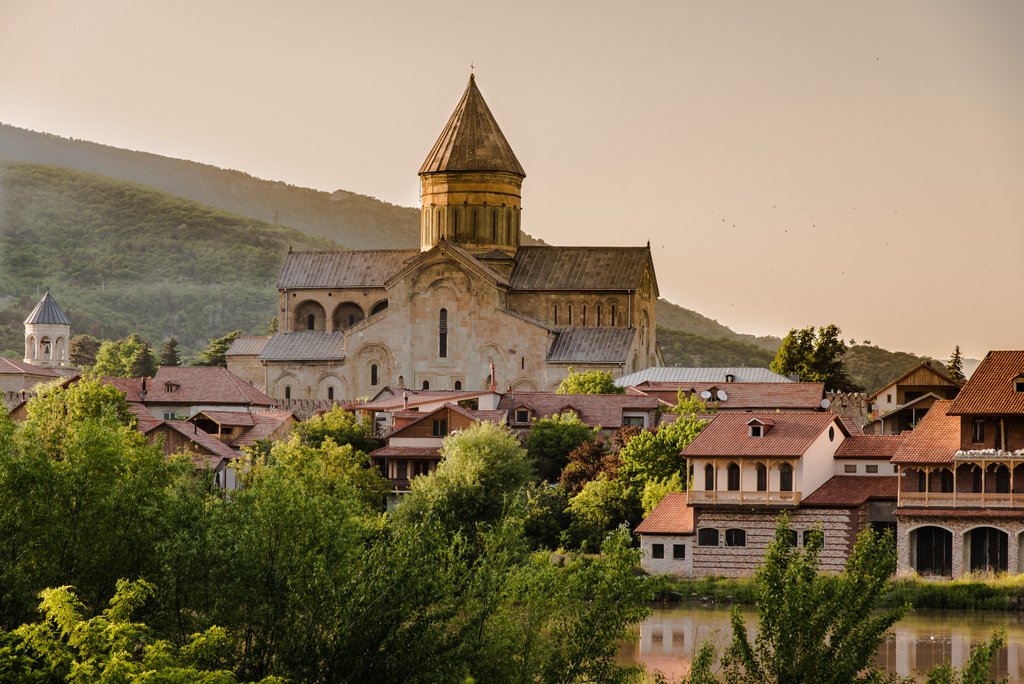
Source: berghahnbooks.com
Reviews
“This volume shares in a rich resurgence of writing on religious activity across the former Soviet Union and particularly in areas of the Caucasus, offering sharp insight into arguably one of the most popular religious traditions, shrine pilgrimage, about which we know surprisingly little. The editors have gathered the highly qualified scholars for the task, including a number of specialists from the Caucasus proper.” • Bruce Grant, New York University
Description
Though long-associated with violence, the Caucasus is a region rich with religious conviviality. Based on fresh ethnographies in Georgia, Armenia, Azerbaijan, and the Russian Federation, Sacred Places, Emerging Spaces discusses vanishing and emerging sacred places in the multi-ethnic and multi-religious post-Soviet Caucasus. In exploring the effects of de-secularization, growing institutional control over hybrid sacred sites, and attempts to review social boundaries between the religious and the secular, these essays give way to an emergent Caucasus viewed from the ground up: dynamic, continually remaking itself, within shifting and indefinite frontiers.
Tsypylma Darieva is a senior research fellow at the Centre for East European and International Studies (ZOiS) in Berlin and is teaching at Humboldt University Berlin. Her research and teaching interests include anthropology of migration, diaspora and homeland, urbanity, and sacred places in Central Eurasia. She has conducted fieldwork in Azerbaijan, Armenia, Kazakhstan, and Germany. Darieva is the author of Russkij Berlin: Migranten und Medien in Berlin und London (LIT, 2004), co-editor of Cosmopolitan Sociability: Locating Transnational Religious and Diasporic Networks (Routledge, 2011), Urban Spaces after Socialism: Ethnographies of Public Places in Eurasian Cities (Campus, 2011) and of the forthcoming volume Sakralität und Mobilität in Südosteuropa und im Kaukasus.
Florian Mühlfried is a social anthropologist in the Caucasus Studies Program at the Friedrich Schiller University of Jena. Previously, he was a research fellow at the Max Planck Institute for Social Anthropology and a visiting professor at UNICAMP, Brazil. He has published the monograph Being a State and States of Being in Highland Georgia (Berghahn, 2014), a book on feasting in Georgia (ibidem, 2006), and edited the volume Mistrust: Ethnographic Approximations (Transcript, 2018).
Kevin Tuite is Professor of Anthropology at the Université de Montréal. He also directed the Caucasus Studies Program at the FSU-Jena from 2011 to 2014. His publications include Language, Culture and Society: Key Topics in Linguistic Anthropology (co-edited with Christine Jourdan) (Cambridge, 2006).
Contents
List of Illustrations
Acknowledgements
Introduction
Tsypylma Darieva, Florian Mühlfried and Kevin Tuite
Chapter 1. Between ‘Great’ and ‘Little' Traditions? Situating Shia Saints in Contemporary Baku
Tsypylma Darieva
Chapter 2. Women as Bread-Bakers and Ritual-Makers: Gender, Visibility and Sacred Space in Upper Svaneti
Nino Tserediani, Kevin Tuite and Paata Bukhrashvili
Chapter 3. The Chain of Seven Pilgrimages in Kotaik, Armenia: Between Folk and Official Christianity
Levon Abrahamian, Zaruhi Hambardzumyan, Gayane Shagoyan and Gohar Stepanyan
Chapter 4. Sacred Sites in the Western Caucasus and the Black Sea Region: Typology, Hybridization, Functioning
Igor V. Kuznetsov
Chapter 5. The Power of the Shrine and Creative Performances in Ingiloy Sacred Rituals
Nino Aivazishvili-Gehne
Chapter 6. Accompanying the Souls of the Dead: The Transformation of Sacral Time and Encounters
Hege Toje
Chapter 7. Not Sharing the Sacra
Florian Mühlfried
Chapter 8. Informal Shrines and Social Transformations: The Murids as New Religious Mediators among Yezidis in Armenia
Hamlet Melkumyan
Chapter 9. Sharing the Not-Sacred: Rabati and Displays of Multiculturalism
Silvia Serrano
Index
Showing posts with label sociology. Show all posts
Tuesday, February 27, 2018
BOOK: Sacred Places, Emerging Spaces. Religious Pluralism in the Post-Soviet Caucasus. Edited by Tsypylma Darieva, Florian Mühlfried, & Kevin Tuite (berghahnbooks.com)
Sunday, January 20, 2013
CALL for PAPERS: 3rd ASCN Annual Conference (ascn.ch)
“Political
Transformation and Social Change in the South Caucasus: Georgia,
Armenia and Azerbaijan in Perspective” - 21-22 June 2013, Tbilisi -
Georgia
(ascn.ch) The Academic Swiss Caucasus Net (ASCN) is pleased to announce its 3rd Annual ASCN Conference that will take place this year in Tbilisi, Georgia on 21 and 22 June 2013.
The conference aims to gather junior scholars and researchers from various disciplines of the social sciences (political science, sociology, anthropology, etc.) involved with the South Caucasus. More specifically, the conference will address the following points of interest:
• It will provide opportunities for researchers vested in Armenia, Georgia and Azerbaijan to engage, network, exchange and discuss their research projects, papers and findings;
• It will provide a forum for discussion regarding the contradictions and ambivalences of the transformation process in the South Caucasus;
• It will provide a forum for discussion regarding the challenges social science researchers in the South Caucasus are confronted with.
Call for Papers
Deadline for the submission of abstracts (300 words): 12 February 2013
Eligibility
• PhD students and recent PhD graduates (2009 or later) dealing with Armenia, Georgia and Azerbaijan who are eager to present and discuss their research work (especially current PhD projects and/or research results) with colleagues from the region and beyond.
The papers to be presented must deal specifically with one of the above-mentioned countries. Papers with a comparative dimension including at least one of the three countries are also accepted.
Topics
Proposals must be linked to one of the following themes:
- Migration, IDPs, Diasporas and Social Inclusion
- Civil Society, Social Capital and Trust
- Media, Social Networks and Public Space
- State Structures, Regimes, Elites and Democratisation
- State Reforms, Public Policies and Governance
- Nationalism, Identities, Religious and Cultural Capital
- Social Change (Youth Identity, Youth Employment, Values Systems, Gender Politics, etc.)
Selected candidates will have the opportunity to present and discuss their papers in one of the thematic panels, wherein researchers involved in ASCN research projects will also present their research results. For more information about current ASCN research projects, please consult the ASCN website, section ‘Research’.
Submission Instructions
All interested scholars are requested to submit an abstract (no more than 300 words) of their paper together with a short biographical statement (including author, affiliation, postal address, phone number and e-mail address) and a CV (maximum 2 pages). Applicants are requested to mention into which of the proposed topics the abstract would fit. Submissions must be sent no later than 12 February 2013 to info@ascn.ch and to jan.kreuels@unifr.ch with the following email subject: ASCN Annual Conference 2013. All documents have to be in English and need to be merged into a single PDF file. The result of the selection process will be announced in the beginning of March 2013.
Selected candidates will then be invited to submit full papers (5,000 words) by 3 June 2013.
Venue, Accommodation and Transport
The ASCN programme will cover travel and accommodation expenses for all selected participants. Opportunities for co-financing will arise should the travel costs in individual cases exceed the average expenses per participant attending the conference.
The selected participants will be informed about the programme, the specific conference panels and the format of the paper to submit, as well as organisational details, in due time.
Timeline
• Application deadline: 12 February 2013
• Selection of abstracts: beginning of March 2013
• Submission of papers: 3 June 2013
• Papers online on conference website: 12 June 2013
• Conference: 21-22 June 2013
Websitewww.ascn.ch, "Events" section
Further Information
Denis Dafflon, ASCN Programme Coordinatorinfo@ascn.ch; denis.dafflon@unifr.ch
Further Information
Denis Dafflon, ASCN Programme Coordinatorinfo@ascn.ch; denis.dafflon@unifr.ch
About ASCNASCN
is a programme aimed at promoting the social sciences and humanities in
the South Caucasus (primarily Georgia and Armenia). Its different
activities foster the emergence of a new generation of talented
scholars. Promising junior researchers receive support through research
projects, capacity-building trainings and scholarships. The programme
emphasizes the advancement of individuals who, thanks to their ASCN
experience, become better integrated in international academic networks.
The ASCN programme is coordinated and operated by the Interfaculty
Institute for Central and Eastern Europe (IICEE) at the University of
Fribourg (Switzerland). It is initiated and supported by Gebert Rüf
Stiftung.
+++
Denis Dafflon
Programme Coordinator
ACADEMIC SWISS CAUCASUS NET (ASCN)
University of Fribourg / Interfaculty Institute for Central and
Eastern Europe (IICEE)
Bd de Pérolles 90
1700 Fribourg/Switzerland
Phone: +41 26 300 79 82
Mobile: +41 79 303 43 44
E-mail: denis.dafflon@unifr.ch
Website: www.ascn.ch
+++
Denis Dafflon
Programme Coordinator
ACADEMIC SWISS CAUCASUS NET (ASCN)
University of Fribourg / Interfaculty Institute for Central and
Eastern Europe (IICEE)
Bd de Pérolles 90
1700 Fribourg/Switzerland
Phone: +41 26 300 79 82
Mobile: +41 79 303 43 44
E-mail: denis.dafflon@unifr.ch
Website: www.ascn.ch
Labels:
anthropology,
Armenia,
ASCN,
Azerbaijan,
Call,
Georgia,
Paper,
Research,
Science,
sociology,
South-Caucasus
Monday, September 24, 2012
SCIENCE: Sociologist Thomas Luckmann to participate in conference in Yerevan
PanARMENIAN.Net - Yerevan State University (YSU) Faculty of Sociology, in partnership with DAAD Alumni Association, will organize an international science conference titled “Social Construction of Reality: Chances and Risks for Human Communications“, with famous sociologist Thomas Luckmann participating.
The opening of the conference is scheduled for September 25, 9 am.
Luckmann is a follower of the phenomenological school of sociology, established by the German-American scholar Alfred Schütz. In his works, he has developed a theory, known as social constructionism, which argues that all knowledge, including the most basic common sense knowledge of everyday reality, is derived from and maintained by social interactions. Luckmann is probably best known for the books The Social Construction of Reality, written together with Peter L. Berger in 1966, and Structures of the Life-World, which he wrote with Alfred Schütz in 1982.
Luckmann is a member of the Slovenian Academy of Sciences and Arts and holds honorary doctorates from the Universities of Linköping and Ljubljana.
Tuesday, May 22, 2012
GEORGIEN: Auf der Suche nach dem Ideal, das es nicht gibt … (einblickgeorgien.blogspot.de)
Eine Kultursoziologie aus der Erfahrung der „verspäteten Generation“
Für die junge Generation der georgischen Soziologen
Der folgende Essay entstand anlässlich des Vortrags „Die beiden Die zwei Körper des Nationalismus: Kirche und Palast im Formierungsprozess der politischen Elite in Georgien“, den der georgische Soziologe Emzar Jgerenai auf der Tagung „Politische Kultur und Kultur der politischen Eliten im östlichen Europa“, München, 10. – 13. November gehalten hat. Er versteht sich nicht als Replik, sondern als alternative Variation auf das dem Vortrag zugrundeliegende Motiv der Generationenerfahrung. Der Autor betrachtet die Soziologie nicht als gleichsam extramundane Wissenschaft, sondern als Ausdruck historisch-sozialer Intentionen, als wissenschaftliche Sondierung im Feld der projektiven Möglichkeiten. Das Chaos der Emirie wird durch existentielle Grunderfahrungen und die in ihr präsenten Willensakte thematisch geordnet. Insofern entstehen verschiedene - wenngleich nicht beliebig viele - Formen der soziologischen Erkenntnis. Die historische Konstellations-Soziologie ist keine Magd des modernen Zivilisationsprozesses, sondern das Organon der produktiven Antworten auf dieses Geschehen. Sie versteht sich als Instrument personaler schöpferischer Aktivität und insofern auch als Beitrag zur Beendigung des großen ideologischen Bürgerkriegs, der die Moderne entzweit.
Weiter lesen >>>
Für die junge Generation der georgischen Soziologen
Der folgende Essay entstand anlässlich des Vortrags „Die beiden Die zwei Körper des Nationalismus: Kirche und Palast im Formierungsprozess der politischen Elite in Georgien“, den der georgische Soziologe Emzar Jgerenai auf der Tagung „Politische Kultur und Kultur der politischen Eliten im östlichen Europa“, München, 10. – 13. November gehalten hat. Er versteht sich nicht als Replik, sondern als alternative Variation auf das dem Vortrag zugrundeliegende Motiv der Generationenerfahrung. Der Autor betrachtet die Soziologie nicht als gleichsam extramundane Wissenschaft, sondern als Ausdruck historisch-sozialer Intentionen, als wissenschaftliche Sondierung im Feld der projektiven Möglichkeiten. Das Chaos der Emirie wird durch existentielle Grunderfahrungen und die in ihr präsenten Willensakte thematisch geordnet. Insofern entstehen verschiedene - wenngleich nicht beliebig viele - Formen der soziologischen Erkenntnis. Die historische Konstellations-Soziologie ist keine Magd des modernen Zivilisationsprozesses, sondern das Organon der produktiven Antworten auf dieses Geschehen. Sie versteht sich als Instrument personaler schöpferischer Aktivität und insofern auch als Beitrag zur Beendigung des großen ideologischen Bürgerkriegs, der die Moderne entzweit.
Weiter lesen >>>
Labels:
Blog,
Einblick-Georgien,
Frank Tremmel,
Science,
sociology
Location:
Hamburg, Deutschland
Subscribe to:
Posts (Atom)