Showing posts with label Archidrome. Show all posts

Wednesday, April 20, 2011

GEOAIR: Exhibition and discussion on artists books /Philippine Hoegen & Banu Cennetoglu (geoairresidency.blogspot.com)


“Artists’ books are works of art realized in the form of a book. They are often published in small editions, though sometimes they are produced as one-of-a-kind objects referred to as “uniques” (Wikipedia).
On view, will be the complete
Bent Books (a series of artists’ books from Turkey), and a collection of artists’ books made by artists in Tbilisi both recently and in the past. Additionally there will be artists’ books from the BAS and GeoAIR/Archidrome archives.
Banu Cennetoglu and Philippine Hoegen will hold a brief introduction to the history and context of artists’ books as they have experienced them. Then they will invite the artists’ present for an exchange with the audience on their books, their approaches to the medium and its position in the local context.
This event about artists’ books is initiated by Banu Cennetoglu and Philippine Hoegen, editors of
Bent Artists’ Books, in collaboration with GeoAIR.

Banu Cennetoglu works with photography, installation and printed matter. After having a B.A in Psychology, she studied photography in Paris. Between 2002-2003 she was an artist in residence at the Rijksakademie, Amsterdam. In 2006 she initiated BAS, a project space in Istanbul focusing on collection and production of artists’ books and printed matter. Her recent exhibitions include Guilty feet have got no rhythm. / Kunsthalle Basel, Manifesta 8, Sample Sale / Rodeo, Istanbul, 53rd Venice Biennial, The Pavilion of Turkey (with Ahmet Ogut), 10th Istanbul Biennial, 1st Athens Biennial. Cennetoglu lives and works in Istanbul.

Philippine Hoegen lives in Amsterdam. She studied at the Royal Art Academy in The Hague and obtained a masters degree at the Piet Zwart Institute in Rotterdam. From 2004 to 2007 she lived and worked in Istanbul and co-initiated with BAS the series of artists’ books called Bent. She is founder and board member of Calcite Revolt, a platform for professional exchange for artists, curators and theorists. She is a tutor at the St Joost Academy in Den Bosch, NL. She works with photography, video, installations, text and printed matter. Her most recent publication, a collaboration with Carolien Stikker, is "Superstructure", published by the Dorsky Museum, New Palz, NY and the State University of New York in conjunction with our exhibition "Inscription".

+++

Open Call for Artists' Books!!!
Opening on the 20nd of April, there will be an exhibition of artists' books in Tbilisi.
"Artists' books are works of art realized in the form of a book. They are often published in small editions, though sometimes they are produced as one-of-a-kind objects referred to as "uniques"."
en.wikipedia.org/wiki/Artist
We hereby invite artists from Caucasus region who work in this medium to send in a copy of their artist's book.
All received books will be included in the exhibition. The exhibition is initiated by Banu Cennetoglu and Philippine Hoegen, editors of Bent Artists' Books*, in collaboration with GeoAIR*. The exhibition will also include a selection of books from the BAS* collection and publications.
*
www.facebook.com/group.php?gid=36676827213&ref=ts
*
www.b-a-s.info/bas/bent_en.html
* .
b-a-s.info
*
http://www.geoair.blogspot.com/
For delivering the books please contact Sophia Lapiashvili on the number +99599677307
GeoAIR office is on Zubalashvulebi street between 54 and 56.
After the exhibition your book can become part of the GeoAIR archive in Tbilisi or it can become part of the BAS archive in Istanbul. Alternatively it can be sent back to you. In this case please add sufficiently stamped envelope with your name and address.
For more information please contact:
Infogeoair:
infogeoair@gmail.com or Philippine Hoegen: p.c.hoegen@gmail.com

Tuesday, January 11, 2011

GEOAIR: Artist talk with Lado Darakhvelidze - Curated by Nini Palavandishvili (archidrome.blogspot.com)

Friday, January 14 · 6:00pm - 9:00pm

The Georgian artist Lado Darakhvelidze (1977 Kutaisi, Georgia) deals in his work with social and political changes and represents these in personal narratives. In his previous work, he reflected the ‘transitions’ and re-placements of national symbols in post-communist countries in a subtle and poetic way, which expands the political and opens it to mythology, history and storytelling. Darakhvelidze’s work was in the Istanbul Biennial ’What keeps mankind alive’ 2009, and Biennale Cuvee, Linz, 2010.


Lately Darakhvelidze has been working on the project Museum TV Station. The term ‘Museum TV Station’ (MTVS) refers to art activities in museums, biennials and related art events in which the artwork and curatorial events evoke actual political and engaged positions. Museum TV Station explores the museum as overlapping and entangled media, politics and histories. In these cultural events, the visitor has access to information that is usually not disclosed in mass media. In the case of the Museum TV Station, both the artist and curator transform the museum or biennial into what might be termed an open source information station.

By realizing Museum TV Station in different cultural settings it is an alternative to conventional information stations. The idea of Museum TV Station started as a publication featuring works by contemporary artists who could be considered as artist-journalist. MTVS then made its first appearance as an installation at the Berlin Kreuzberg Biennale (June-August 2010), was featured in at the ‘State of ArtEZ‘ at the Schouwburg Arnhem (November 2010) and at PS2 Squared in Belfast in December 2010.


'Museum TV Station'.- Lado Darakhvelidze. 29 November 2010


www.vladimer.net

Thursday, December 23, 2010

ARTISTS TALK: Walt Van Beek / Inge Vandensande. 24.12.10, 18.00 (geoairresidency.blogspot.com)

საუბარი ხელოვანებთან: ვალტ ვან ბეკი / ინგე ვანდენსანდე
Artists Talk: Walt Van Beek / Inge Vandensande

more: geoairresidency.blogspot.com

24.12.2010, 18.00

გეოეარი სტუმრად თბილისი სტუდიაში
GeoAIR visiting Tbilisi Studio
მისამართი დადიანის ქ. 20Address: Dadiani Str. 20
www.tbilisistudio.org

ვალტ ვან ბეკი - ბელგიელი ხელოვანი, ცხოვრობს და მუშაობს ბრიუსელში. 2009 წლის დასაწყისში ვალტ ვან ბეკმა დააარსა WaiWai Space, დამოუკიდებელი სახელოვნებო სივრცე ბრიუსელის ცენტრში იმ მიზნით, რომ გარდა საკუთარი ნამუშევრებისა ეჩვენებინა სხვა ხელოვანების ნამუშევრებიც და ეთანამშრომლა სხვა სახელოვნებო სივრცეებთან.ინგე ვანდენსანდე - გრაფიკოს დიზაინერი, ცხოვრობს და მუშაობს ბრიუსელში. ინგე ვანდენსადი უძღვება პროექტს M’ATUVU, რომელიც არის ადგილი საინტერესო ღონისძიებებისთვის, გამოფენებისთვის, კონცერტებისთვის ან რაიმე სხვისთვის ბრიუსელის ცენტრში მაღაზიის ვიტრინაში.საუბრის ენა: ინგლისური, ქართული თარგმანით

Walt Van Beek - artist, lives and works in Brussels. founder of WaiWai Space, an independent art space in the centre of Brussels with the intention to show his own work, works by other artists and to collaborate with other venues.

Inge Vandensande - Graphic designer, lives and works in Brussels. Runs the project M’ATUVU, a place for cool events, exposition, concert or whatever in funky shop window in Brussels city center.language: English with Georgian Translation

www.waiwaispace.blogspot.com
www.woutwalt.be

+++

www.geoair.blogspot.com
www.archidrome.blogspot.com
www.geoairresidency.blogspot.com

Thursday, June 03, 2010

GOETHE-INSTITUT: Georgien: die Kunstszene in Tbilissi – von Nino Tschogoschwili (goethe.de)


Das Schicksal der Stadt wurde im Wesentlichen durch ihre geopolitische Lage prädestiniert. In unterschiedlichen historischen Epochen lockte die Seidenstraße, die Okzident und Orient verband, die Karawanenroute, die Landmagistrale zum näheren Osten, Eroberer, Kaufleute und Länderentdecker an …

Das Zusammenleben vom Osten und Westen, die Koexistenz unterschiedlichter Kulturen prägten die eigenartige multikulturelle Landschaft und besondere eigenständige Atmosphäre der Stadt. Im 19. Jahrhundert versuchten zahlreiche Wanderer, Schriftsteller und Künstler den Charakter der Stadt um zu begreifen, zu verstehen, zu erforschen und zu studieren. In den 1910er- und den 1920er-Jahren entsteht in Tbilissi ein eigenartiges Zentrum der Avantgardekunst. Die 1918 von russischen und georgischen Dichtern und Avantgardekünstlern gegründete Gruppe „41°“ betonte, dass Tbilissi an den gleichen geografischen Breiten liegt, wie Istanbul, Rom, Barcelona, Chicago … Die Kunst, die sich heute in Tbilissi entfaltet, beherbergt jahrhundertlange georgische Kulturtraditionen und gleichzeitig enthalten Anklänge an heutige Realität.

Die Entfaltung der zeitgenössischen georgischen Kultur wird durch Prozesse geprägt, die sich im Land in den letzten zwanzig Jahren entwickeln. Die Ereignisse seit 1989 – politische und soziale Krisen – werden natürlich durch Kunst reflektiert. Mehrere Künstler mussten das Land verlassen. Immerhin ist das Kulturleben in Tbilissi nicht abgeglüht. Die Öffnung der Grenzen förderte Informationsaustausch und neue Verbindungen. Die noch zu Sowjetzeiten eingerichteten Institutionen wurden den zeitgenössischen Herausforderungen nicht mehr gerecht. Oftmals wurden sie durch private Initiativen oder Nichtregierungsorganisationen abgelöst. Internationale Organisationen zur Förderung des interkulturellen Austauschs und von Kunstprojekten (Goethe-Institut Georgien, British Council, Centre Culturel Francais, SDC – Swiss Agency for Development and Cooperetion u. a. m.) nahmen in Georgien ihre Aktivitäten auf.

Es gab internationale Austauschprogramme wie zum Beispiel das Internationale Austausch- und Ateliersprogramm Region Basel (iaab), an dem von 1991 bis 2008 einige Dutzende schweizerische, georgische und deutsche Künstler teilnehmen konnten. Die entstandenen Kontakte wuchsen zu Freundschaften und Kooperationen, was eine Reihe internationale Projekte zum Leben gerufen hat („Apendix“ – internationale Ausstellung der zeitgenössischen Kunst 2003; „Research Without Bounderies: Curating and Cultural Exchange innthe Intercultural Age“ 2004 u. a.). Seit 2007 wird die georgische Kultur durch das Programm des Ministeriums für Kultur Georgiens „Georgische Saison“ (www.georgianseason.ge ) gefördert, dank dessen markante Projekte georgischer Künstler realisiert wurden (Pavillons Georgiens 52 und 53 an der Artbiennale Venedig; „Atmosphäre 41° City“, Siemens, Senat Gallery Istanbul 2007; „Vojage a Tbilissi“, Musée des Beau-Arts de Nantes 2008, „Born in Georgia“, Cobra Muzeum 2009 u. a.).

Heute entfalten sich in der Kunst Georgiens unterschiedliche Tendenzen. Künstler von heute greifen zu unterschiedlichen Medien und beteiligen sich an internationalen Kunstprojekten, obwohl mehrere Fragen immer noch offen bleiben. Um die Kunstszene von Tbilissi kennenzulernen, braucht man gewisse Zeit und Kontakt zur Szene. Zeitgenössische Kunst befindet sich vorwiegend in Künstler-Ateliers, nicht in Galerien oder Museen. Bis heute gibt es in Tbilissi leider kein Zentrum für zeitgenössische Kunst, einen Ort, wo Materialien gesammelt wären, die neuste Kunstgeschichte reflektieren würden, und wo Wechselausstellungen organisiert würden. Weder das staatliche System der Galerien, noch das private sind reif genug. Trotz allem gibt es in Tbilissi einige Standorte, wo zeitgenössische Kunstprojekte verwirklicht werden.

Der besonders wichtige Standort, der sich seit Jahren bei dem an die zeitgenössische Kunst interessierten Publikum bewährt hat, und regionale wie auch internationale Projekte aufnimmt, ist Karvasla (Karavan-Saray) – das Museum für Geschichte Tbilissi (ein Teil des Nationalmuseums Georgiens) im historischen Gebäude eines Karavan-Gasthauses. Im ersten Obergeschoß befinden sich um den Innenhof herum die Räume für Wechselausstellungen.

Die Nationalgalerie (Nationalmuseum Georgiens), die für Wechselexpositionen geeignet ist, ist wegen der Renovierung und Sanierung vorübergehend geschlossen. Sie wurde 1855–1888 als ein Museumsgebäude erbaut. Sein Architekt ist Albert Salzman, der in Tbilissi geborene Deutsche. Seit Anfang des 20. Jahrhunderts wurde die Nationalgalerie auf dem Prospekt Rustaveli zum unmittelbaren Akteur und Schauplatz aller bedeutenden künstlerischen Begebenheiten. Seit Jahren wartet die Öffentlichkeit in Tbilissi auf die Neueröffnung der Nationalgalerie.

Was das Museum für Künste anbetrifft (das Nationale Museum Georgiens) mit seinen zahlreichen unikalen Expositionsobjekten – wie die goldene Schatzkammer, christliche Kunst des Mittelalters, Orientale Kunst, zwei Porträtschulen: Kadsharskaja und die von Tbilissi, das Werk von Pirosmani und die Moderne georgischer Künstler, so nimmt es heute eine Picasso-Ausstellung auf.

In Tbilissi funktioniert eine Zahl kleinerer Galerien, die meistens zentral liegen („Arsi“, „Vernissage“, `Hobby~ u.a.) Einige Galerien, Ausstellungsräume und Artcafes, die sich einst durch ihre interessanten Projekte bemerkbar gemacht hatten, mussten wegen finanziellen Problemen und ungenügender Entwicklung des Kunstmarktes schließen. Die meisten bestehenden Galerien haben einen Saloncharakter und stellen hauptsächlich mit kommerziellen Zielen aus. In der historischen und lebhaften Chardin-Straße liegen zwei kleineren Galerien – „Galerie Baya“ – eine der ältesten, und „Akademie+“ (die Galerie der staatlichen Akademie der Künste Tbilissi) – seit letzten Monaten realisiert die Galerie das Projekt „Freier Raum“ und ermöglicht den Studenten der Akademie der Künste und jungen Künstlern, ihre Arbeiten mietefrei auszustellen.

Seit zwei Jahren wird in Tbilissi „Artisterium“ – International Exhibition of Contemporary Art, „Modus Operandi – In Quest of a Different Way“ (www.artisterium.org ) veranstaltet. Diese Ausstellung umfasste im letzten Jahr beinahe alle Ausstellungsstandorte der Stadt und bekam ein gutes Echo. Im letzten Jahr wurde in Tbilissi die Vereinigung junger Kunstforscher und Künstler „Archidrom“ gegründet – das Archiv der zeitgenössischen Kunst, das regelmäßige Präsentationen der Künstler von heute veranstaltet.

Es sei zu bekräftigen, dass das Fehlen eines Museums oder eines Zentrums für zeitgenössische Kunst sowie der Mangel an aktuell orientierten Ausstellungsstandorten die Präsentation der zeitgenössischen Weltkunst und ihre Bekanntmachung für das Publikum erschweren, was das Kommunizieren von und das Interesse an aktueller Kunst hindert. Offensichtlich ist auch der Mangel an Kulturmanager und -Kuratoren, die ausgebildet und den Herausforderungen von heute gewachsen sind. Man kann wohl sagen, dass die georgische Kunstszene immer noch nach ihrem Weg und Niederlassungsort im lokalen wie auch globalen Raum der zeitgenössischen Kunst sucht.
+++

Wednesday, June 17, 2009

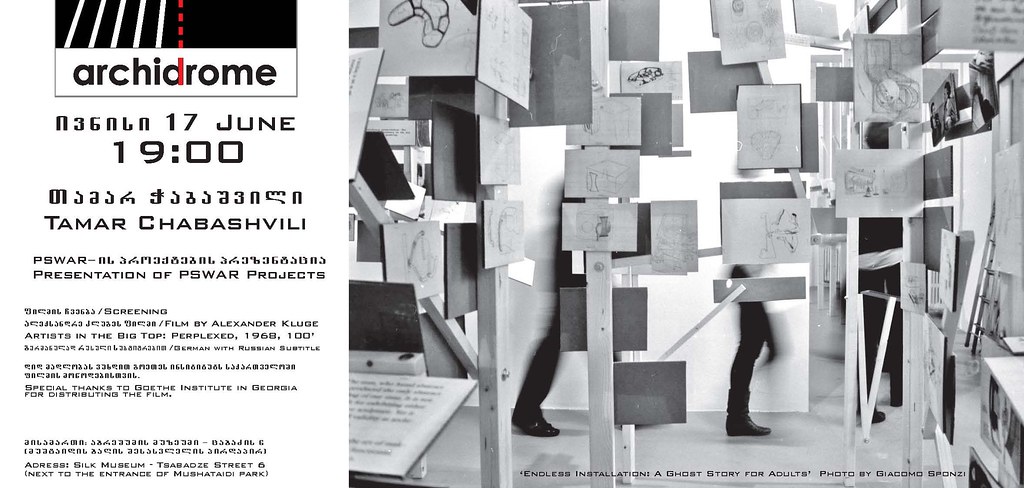
ART: Tamar Chabashvili, Presentation of PSWAR Projects (archidrome.blogspot.com)

Invitation: 17 June, 19:00
Silk - Museum, Tsabadze Street 6

AFTER the presentation FilmScreening
Film by Alexander Kluge - Artists in the Big Top: Perplexed, 1968, 100’
German with Russian Subtitle

Special thanks to Goethe Institute in Georgia for distributing the film.

archidrome.blogspot.com/
geoair.blogspot.com/


Friday, April 24, 2009

EXHIBITION: Sophia Tabatadze - Presentation Of Latest Works (archidrome.blogspot.com)

Silk Museum, 28 April, 18.00
archidrome.blogspot.com/
geoair.blogspot.com/


Wednesday, February 18, 2009

EXHIBITION: Archidrome presents Feminist Art Studio SPERO


The project Feminist Art Studio "Spero" aimed to promote feminist art in Georgia; to enable women artists in Georgia to work and become more visible; to ensure women's better access to art resources; to encourage a better representation of women artist in contemporary art of Georgia. The objectives of the project included the following: setting up a feminist art studio which serves female art students, artists and art lovers and is equipped with necessary facilities for creating a comfortable atmosphere for working; promoting feminist values among the participants; enabling them to paint and draw free of charge; raising public interest in feminist art and women artists' work through the studio discussions.

As a result of the project implementation, the Feminist Art Studio Spero worked for 6 months and provided studio space and art resources to 10 women artists; enabled them to work with models; organized two discussions on women artists and feminist art. The studio was equipped with all necessary materials for painting and drawing and created a pleasant and comfortable atmosphere for working. The studio served specifically to professional and amateur women artists, who are unable to afford expensive art materials and studios for working. 10 artists used all the studio resources free of charge during the six months of the project life. During the project implementation, two public discussions were organized devoted to the work of raising women artists' and public's consciousness about feminist art. The studio ensured women artists' access to expensive art materials and also, to albums and books on feminist and women's art.

1. Tamuna Archvadze
2. Tamar Bochorishvili
3. Nino Chabashvili
4. Ane Cheishvili
5. Salome Ganiashvili
6. Tamriko Gudushauri
7. Qristine Kakabadze
8. Nino Margvelashvili
9. Ana Tabatadze
10. Salome Tsagareishvili
11. Anuka Tsertsvadze
12. Gvantsa Jgharkava
13. Medea Qoqiashvili
14. Ia Khatiashvili

Curator: Nini Palavandishvili
archidrome.blogspot.com/
geoair.blogspot.com/
www.myspace.com/feministartstudio