Showing posts with label Sophia Tabatadze. Show all posts

Tuesday, April 14, 2015

ART: 'Spontaneous Frameworks' mit Künstlern aus Georgien/Tbilisi in KV, Bükü, HGB Gallery / 22/04 - 9/05 in Leipzig (hgb-leipzig.de)


(hgb-leipzig.de) Ein Ausstellungsprojekt von Kristina Semenova im Masterstudiengang Kulturen des Kuratorischen in Kooperation mit der Klasse Prof. Tina Bara, KV - Verein für zeitgenössische Kunst Leipzig und dem Kunstraum Бükü

+++

Exhibition project by Kristina Semenova in Master program Cultures of the Curatorial in cooperation with the class of Prof. Tina Bara, Бükü and KV - Leipzig

Eröffnungen/openings:
22/04 um 19 Uhr, KV
24/04 um 19 Uhr, Бükü
28/04 um 19 Uhr, HGB Galerie

KünstlerInnen/artists: Tina Bara, Aude Benhaïm, Fine Bieler, Natalia Bougai, Caroline Böttcher, Carmen Catuti, Ana Chaduneli, Tamar Chaduneli, Ana Chorgolashvili, Dali Dardzhaniya, David Datunashvili, Denise Fragner, Nora Frohmann, Zarah Gutsch, Matthias Julian, David Kukhalashvili, Marius Land, Sophia Lapiashvili, Natalia Nebieridze, Marcel Noack, Barbara Proschak, Teresa Schönherr, Steffi Schöne, Giorgi Tabatadze, Sophia Tabatadze, Anna Voswinckel

Kuratiert von/ curated by: Kristina Semenova in Zusammenarbeit mit/in association with Prof. Tina Bara und/and Anna Voswinckel 

Spontanität geht über geregelte Rahmen und festgeschriebene Gesetze hinaus. Als Eigenschaft wird sie dann als positiv empfunden, wenn man sie aus der Distanz beobachtet und in anderen Kulturen als etwas Authentisches und Emotionales wahrnimmt. Wenn man in Georgien unterwegs ist, so scheint Vieles von Spontanität geprägt zu sein. Spontane Handlungsresultate, die sich weniger auf lang verhandelte Planungen und Konzepte, sondern auf das schnelle Reagieren einzelner Menschen oder Bevölkerungsgruppen beziehen, werden in der Architektur, in der Dingwelt, aber auch in den sozialen Beziehungen sichtbar und erfahrbar. Die „spontane Architektur“ als inoffizielle und ohne Expertise errichtete Bausubstanz findet ihren Ausdruck in verschiedenen Formaten und prägt mittlerweile das Stadtbild von Tbilisi. Kamikaze loggias als eine Erweiterung des Wohnraumes, provisorische Architekturstützen als Schutz gegen den Einsturz von Häusern und spontane Kreuze als Gedenkmonumente ohne Genehmigung im öffentlichen Raum sind einige wenige Beispiele dafür. Sind solche spontanen Formen und Formate der Selbstorganisation eine Reaktion auf ökonomische Missstände oder wohnt diese Art von Spontanität der georgischen kulturellen Identität inne? Ist es der westliche Blick, der diese Spontanität erst als solche definiert? Und wie kann „spontane Architektur“ in künstlerische Arbeiten und in Ausstellungsräume übersetzt werden? 

Das Ausstellungsprojekt Spontaneous Frameworks zeigt Arbeiten Studierender von Prof. Tina Bara und eingeladener KünstlerInnen und ArchitektInnen aus Tbilisi, und versucht, eine transkulturelle Perspektive auf scheinbar lokales Phänomen der "spontanen Architektur' zu werfen. Drei parallel laufende Ausstellungen an drei verschiedenen Orten verhandeln das Thema durch das Prisma der linguistischen, räumlichen und kulturellen Bedeutungen des Begriffes Übersetzung.

+++

Spontaneity extends above and beyond regulated frameworks and written laws. As a feature it is then perceived as positive when gazed from a distance, and perceived as something authentic and emotional, in other cultures. When one travels in Georgia, so much seems to be characterised by spontaneity. Outcomes of spontaneous action, relate less to long-negotiated plans and concepts, than on the swift reactions of individuals. These outcomes are visible and tangible in architecture, in the world of objects, but also in social relations. 'Spontaneous architecture' as unofficial and crudely erected built structure, is expressed in various forms and characterises the current cityscape of Tbilisi. Kamikaze loggias as extensions of the living space, provisional architectural supports as protection against the collapse of houses, and spontaneous crucifixes, as unauthorised commemorative monuments within the public space, are but a few examples. Are such spontaneous forms and formats of self-organisation responses to economic inadequacies, or, are these types of spontaneity inherent to Georgian cultural identity? Is the Western gaze, the sole definer of this spontaneity as such? And how can 'spontaneous architecture' be translated in art works and exhibition spaces?

The exhibition project Spontaneous Frameworks showcases works of students studying under Prof. Tina Bara and invited artists and architects from Tbilisi in an effort to cast a transcultural perspective on seemingly local phenomena of 'spontaneous architecture'. Three exhibitions will run parallel in three different locations and negotiate the issue through the prism of linguistic, spatial and cultural meanings of the term translation.

Rahmenprogramm/frame program
22-29/04

Ana Chorgolashvili (Tbilisi):
Index: Soviet Architecture in Tbilisi
Künstleringespäch mit Videopräsentationen/artist talk with video screening, KV 25/04, 6 pm 
After the collapse of the USSR, Soviet urban planning and development in Georgia halted, particularly in the capital, Tbilisi. At the 20th century’s end, in the period of transformations and political and economic crisis, the centralised system of civic government failed, resulting in many micro schemes. Inhabitants began constructing spaces individually; some architectural hybrids originated, becoming spontaneous segments of the city, giving the capital a new look. From the beginning of the 21st century, 'new' building priorities were announced in Tbilisi, resulting in a massive city wide building process. Parts of old buildings disappeared, while other parts re-colored accordingly, had lost their original look and original message. A non-systemic approach has become a new governance system. Ana Chorgolashvili will speak about her ongoing research project Index focusing on Soviet architectural heritage in Tbilisi and its post-Soviet development.


Fahrradtour mit der Kuratorin durch die Ausstellungen
Guided bike tour with curator
29/04, 2 pm, Treffpunkt/meeting point: KV
Dauer/duration: 2 h 
Curator of the project Kristina Semenova who spent one month in Tbilisi at GeoAIR residency researching on the topic will introduce her curatorial concept as well as selected art works. 

Sophia Lapiashvili (Tbilisi):
Lost Utopias in Tbilisi. Mosaics from the Soviet period
Präsentation/lecture, KV 29/04, 6 pm 
Artist, curator and former coordinator of artist residency GeoAIR, Sophia Lapiashvili, presents a talk focused on the intensive changes within the public space that have been taking place throughout the last 20 years in Tbilisi, and have given rise to the interest of GeoAIR members in the monumental-decorative mosaics. Unsystematic transformation of urban environment, amateur interventions in forming the image of the city, and façade 'beautifications', have led to destruction of mosaics in Tbilisi’s public spaces. This became the reason behind documenting them, creating the database and online map. Lost Heroes of Tbilisi. Soviet Period Mosaics was a part of the SPACES project, funded by the European Union through the Eastern Partnership Culture Programme.
 

Sophia Tabatadze (Berlin/Tbilisi):
Pirimze: A Place transforming to a Non-Place
Vortrag/lecture, KV 29/04, 7 pm 
Artist and founder of artist residency GeoAIR, Sophia Tabatadze presents a talk on her three years of research into social and visual changes affecting Pirimze, a six-floor edifice from the Soviet era, built especially to house repair and maintenance services. The theme unfolds to a broader picture and shows what has been happening in Georgia since the Soviet Union’s collapse. One may view Pirimze, a 40 minute experimental documentary film, in the exhibition space of the HGB. Beginning as a curious journey though the labyrinths of Pirimze and observing fascinating skills performed by craftsmen who once worked there, the story moves beyond the façade of the newly renovated business center Pirimze Plaza, which replaced Pirimze, and questions the need and motives for this transformation.
 

Finissage KV 29/04, 7 pm 

Mehr Information/more information: www.buekue.eu

Gefördert durch/sponsored by IFA Institut für Auslandsbeziehungen Stuttgart, StuRa und Freundeskreis der Hochschule für Grafik und Buchkunst.

Öffnungszeiten/opening hours:
KV: 23/04 - 29/04, 16-19 Uhr
Kolonnadenstraße 6, www.kunstverein-leipzig.de

Бükü: 24/04 - 29/04, 16-19 Uhr, 30/04 - 09/05, Do-Sa, 15-19 Uhr
Aurelienstraße 48, www.buekue.eu

Galerie der HGB: 29/04. - 09/05, Di-Fr 14-18, Sa 12-16 Uhr
Wächterstraße 11, www.hgb-leipzig.de

www.buekue.eu
facebook.com/Büro für kulturelle Übersetzungen

Бükü – Büro für kulturelle Übersetzungen
Aurelienstrasse 48 | 04177 Leipzig
info@buekue.eu | www.buekue.eu
Tel.: +49 163 3737 534
Öffnungszeiten: Do – Sa 15.00 – 19.00 Uhr

Monday, October 10, 2011

ART: An ‘Intersection of Parallels’ in Yerevan (epress.am)

A weekend of discussions, lectures and presentations as part of an international contemporary art seminar titled “Intersection of Parallels” is set to take place in Yerevan from Oct. 14–16.

According to the event’s
Facebook page, organizers hope to create a new international network of alternative institutions of contemporary art.

The need for an international network of contemporary art institutions is explained through organizers’ depiction of the art scene in Armenia following the collapse of the Soviet Union:

“After the collapse of the Soviet Union, in [the] 90s, Armenia was going through difficult times by appearing in blockade and isolation, followed by economical breakdowns. Strangely enough the artistic scene has got some achievements at a time. There had been an institutional boom in Armenia, the institutions were emerging one after the other, but soon some of them were close[d] down or are going through financial difficulties at the moment. In this kind of situation there was a necessity of creating new organizations for the development of contemporary art for both the educational and exhibition practice purposes.

“Contemporary art in Armenia continues to be as marginalized, that explains the complete financial independence of the contemporary art from the government: none of now-existing organizations of contemporary art is supported by the state; all of them exist due to international foundations and local enthusiasts. In this situation we need the experience of similar non-profit organizations [and] artistic groups abroad who can introduce their strategy, tactics of existence, through which we can create a new international network of alternative institutions of contemporary art.”

Organizers hope that such a network will develop programs such as residencies for artists and curators in countries which are members of this network. “The continuous exchange of professionals (artists and curators) from different countries will contribute to the cross-cultural development and institutional diversity of contemporary art.”

The founding member countries of the network are Armenia, Georgia and Germany.

The weekend seminar, coordinated by independent curator Eva Khachatryan, will include the following lecturers, presenters and facilitators:
Ruben Arevshatyan (Armenia), Anna Barseghian (Utopiana, Armenia/Switzerland), Wibke Behrens (NGBK, New Society for Visual Arts, Germany), Berit Fischer (Germany), Susanna Gyulamiryan (Art and Cultural Studies Laboratory, Armenia), Nazareth Karoyan (AICA Armenia), Art Laboratory artists’ collective (Armenia), Azat Sargsyan (Gyumri Center of Contemporary Art, Armenia), Sophia Tabatadze (GeoAIR, Georgia), Wato Tsereteli (Center of Contemporary Art – Tbilisi, Georgia).

The seminar will take place in Yerevan at the
Suburb Cultural Center (Mekhitar Sebastatsi Eduactional Complex, Media Center, 57 Raffi St.), the Cafesjian Center for the Arts (Cascade Complex), and The Club (40 Tumanyan St.).

The program is as follows:

October 14
Suburb Cultural Center
held in English

11:00 – opening remarks by Eva Khachatryan
11:10 – round of introductions by participants

Talks:
11:40 – Ruben Arevshatyan: “Contemporary art institutions in Armenia as self-organizing structures”
12:20 – Nazareth Karoyan: “Institute for Contemporary Art: between education and production”
13:00 – Discussion
15:00 – Visit to ACCEA (Armenian Center for Contemporary Experimental Art) and Cafesjian Center for the Arts

Presentations at Cafesjian Center for the Arts (translation into Armenian and English)
18:00 – Wato Tsereteli “Initiative – The Aesthetics in Social Settings”
19:00 – Azat Sargsyan “On International Biennial of Contemporary Art in Gyumri” (via Skype)
20:00 – Discussion

October 15
Suburb Cultural Center
held in English

10:00 – Wibke Behrens: “What’s love got to do with it? Workshop for institutional non- believers”
14:00 – Susanna Gyulamiryan: “The Marginalization of the Mainstream and the Debacle of the Marginal (that of the mainstream)”
14: 40 – Anna Barseghian “Imagination as an institution”
15: 20 – Discussion
16:00 – Visit to the Yerevan Museum of Modern Art

Presentation at The Club (translation into Armenian and English)
18:00 – Berit Fischer “On Other Possible Worlds / Proposals on this Side of Utopia”
19:00 – Discussion

October 16
Suburb Cultural Center
held in English

10:00 – Sum up of the previous days, discussions and decision making concerning the network and programs which can be part of that network.
14:00 – Visit to AICA Armenia and AJZ space

Presentations at The Club (translation into Armenian and English)
18:00 – Sophia Tabatadze “GeoAIR activities”
19:00 – Art Laboratory artists’ collective
20:00 – Discussion

Thursday, September 01, 2011

FILM: Black Shorts. Fünf experimentelle Kurzfilme über den Alltag in Georgien. Fr, 16. Sep 2011, 20:15 im UT Connewitz (Leipzig - utconnewitz.de)

Auch in Bukarest, Berlin & Prag!!

"Black Shorts" sind 5 experimentelle Kurz-Dokus, gedreht in Georgien (ein Projekt von Plotki , Sakdoc Film and dem Centre for Arts and Culture der Central European University Budapest).

Sie sind das Resultat eines Film-Workshops, der im Mai und Juni stattfand und bei dem 20 Teilnehmer aus verschiedenen europäischen Ländern Facetten des georgischen Alltags erkundeten.

Die Filmemacher waren dabei auf der Suche nach dem Abwegigen und Hintergründigen jenseits von gängigen Bildern von Konflikten und Pipelines auf der einen Seite und folkloristisch-verklärenden Motiven auf der anderen. Herausgekommen sind dabei fünf ganz unterschiedliche Filme, die vor kurzem in Budapest Weltpremiere hatten ...

FUTURE Black Shorts Screenings


Bucharest, September 7th, NCRR, 21:00
Sala Horia Bernea, Str. Intrarea Monetăriei nr.3, muzeul
Tăranului Român, Bucharest

Leipzig, September 16th, UT Connewitz, 21:00
Wolfgang-Heinze-Strasse 12a, 04277 Leipzig

Berlin, September 19th, Lichtblick-Kino, 18:30
Kastanienallee 77, Berlin - Prenzlauer Berg

Prague, September 26th, Klub K4, 20:00
Celetná 20, Prague

Im Anschluss an die Leipzig Premiere wird es ein Publikumsgespräch geben – die Filmemacher werden anwesend sein.

Die Filme:


* hairminators (von Data Chigholashvili, Salome Joglidze und Birgit Kuch)
spielt dort, wo es getrimmt wird – in einem Friseursalon von Tbilisi, in dem sich in schnelllebigen Zeiten der Hauch des Alten bewahrt hat.

* chiatura, my pride (von Stephanie Endter, Max Kuzmenko, Lisa Müller, Ulrike Penk und Kajetan Tadrowski)
Chiatura gehörte einst zu den florierensten Industriestädten in Georgien, berühmt für seine reichen Vorkommen an Mangan und sein Seilbahnsystem, daß die Minen mit der Stadt verband. Mit der De-Industrialisierung schrumpfte die Manganindustrie und Chiatura ebenso: Doch die Seilbahnen bilden noch immer ein Netz zwischen der Stadt und ihren Bewohnern…

* gulo (von Elene Asatiani, Eliane Bots, Mirek Koranda und Sophia Tabatadze)
Gulo ist ein Film, der den Zwischenraum zwischen Leben und Tod untersucht und dabei Bestattungs-Rituale und deren Orte sichtbar macht. Gulo wurde in Kutaisi gedreht.

* harvest georgia (von Odeta Catana, Ian Cook, Angelika Herta, Zhenya Zakharova)
Von Badewannen, Bettfedern und Boilern über Töpfe und Pfannen, Konservendosen bis zu Kleiderständern wird in Harvest Georgia das Schrottgeschäft verfolgt: Der Film erzählt vom Sammeln, Wiegen und Exportieren der Gegenstände, deren Wert neu bestimmt wird und begibt sich in die Perspektive derer, die alltäglich mit Alteisen zu tun haben.

* under a (von Natalia Buier, Madis Kats, Filip Pospísil und Mikheil Svanidze)
ist ein Film über den Fußgängertunnel unter Tbilisis zentral gelegenem Freiheitsplatz und folgt dem Alltagsrhythmus einer Band im Untergrund ...


mehr in english: plotki.net

Source: utconnewitz.de

Tuesday, January 04, 2011

PROGRAMM: Art Residency in Tbilisi (geoairresidency.blogspot.com)

Guest at the time: Pelin Tan *
Resident in 2011
Pelin Tan (Turkey)
January 04-30
Presentation: Photos

The GeoAIR opened it's residency program in January 2010. This is a self directed residency program, that offers primarily curators and culture producers the opportunity to base themselves in Tbilisi, Georgia and use this location as a starting point to build networks, meet artists, cultural institutions and curators from the Caucasus region, and develop and deepen their knowledge and research of the Caucasus context. In return local artists, curators and organizations will have the opportunity to extend their knowledge about the innovative ways that many international curators are working. GeoAIR has designated her residency mainly for curators or cultural producers because it feels that they are most able to affect multiplier effects through exchange and production and are more equipped to use the residency as a platform from which to jump for to instigate future collaborations between the resident and artists and organizations form the Caucasus region.

Residents are expected to make at least one public presentation of their work or related topic for Georgia public.


more here: geoairresidency.blogspot.com

GeoAIR Art Residency Team:
Sophia Tabatadze, Nini Palavandishvili, Sophia Lapiashvili

Contact infogeoair@gmail.com

+++

* Pelin Tan is a sociologist and art historian. She was a researcher at the Institute of Social Sciences, Istanbul Technical University, Istanbul (2001-2010). Tan is a research fellow in Spring 2011 at the ACT (Art, Culture, and Technology) program of the Department of Architecture – School of Architecture and Planning, Massachusetts Institute of Technology. Previously she was a guest professor at the Academy of Fine Arts, Architecture and Urban Research MA Program, Nuremberg (2008); and guest lecturer at the History of Art Departments at the Technical University, Berlin (2006–2007) and Trier University, Trier (2004). Tan is currently working on the publication Unconditional Hospitality and Architecture (forthcoming) and co-edited (with Sezgin Boynik) the publication Güncel Sanatta Kamusal Alan Tartışmaları [Public Space Discussion in Contemporary Art] (2007). She is also editor of Muhtelif contemporary art magazine, and has contributed to numerous publications including: Becoming Istanbul, An Encyclopedia (2008); When Things Cast No Shadow (catalog, 5th Berlin Biennale) (2008); Megastructure Reloaded (2008); and Contemporary Art In Turkey: 1986–2006 (2007).

She is a member of the curatioral advisory board of DEPO Istanbul. Tan curated several research-based projects and exhibitions that are consisting of issues in contemporary art: Urban localities and social conflict, Alternative education formats, Institutional criticism, Social surplus value and dissemination. For 2011, Tan is working on a research project of artist run-spaces in Asia and labor; editing a special issue on social surplus, freelance teaching and curating Knut Asdam Solo show (June, DEPO).

Pelin Tan is based in Istanbul, works trans-locally.
www.tanpelin.blogspot.com

Residency stay of Pelin Tan is supported by: Open Society Institute, Arts and Culture Network Program

Monday, December 28, 2009

TEXT: RUINS OF OUR TIMES. By Joanna Warsza / Laura Palmer Foundation / Warsaw

The text will be published in Team Network magazine and in Obieg on-line.

Georgia and Armenia are full of landscapes of frozen moments. With the fall of the Communist regime, the trains stopped n mid-route, the cable car over one of the cnyons of Tbilisi has been abandoned halfway, and the housing estates of the never realized future found temporary settlers. Tracing the unwanted heritage of the Soviet past in the Caucasus, at times I had a strange sense of witnessing the future. The self-organized methods adopted in the years of post-collapse crises recall the most progressive contemporary theories of bottom-up structures and participatory urban planning: the cinema-theater Rossia in the middle of Yerevan found a secondary use as a market and mini-bus station, the never completed city of Gyumri in Armenia was finished by the motivated settlers themselves, the mikro-raion estates in Tbilisi have expanded with new parasite parts called kamikaze loggias. The Caucasus, following a process of Eastern Bloc Westernization, is fortunately still full of heterotopias, stunning ruins of our own age, and of self-organizing policies that tend to be forgotten in a time of ‘euroremonts’, and ‘Eurenovations.’


Ruines of the future, never accomplished project builidng, Mush, Armenia

FROZEN MOMENTS
On the western outskirts of Tbilisi one encounters a thrilling Caucasian picture. A cable-car supposed to link the unfinished University campus with the metro station was stopped at the very second the Soviet system collapsed in 1991. Since then it has been hanging in the air over a picturesque canyon, abandoned in the middle of its route, above the heads of people passing down in the valley who no longer even notice it. The Caucasus, with its tremendous landscapes, is full of this phantom heritage, when the Socialist reality became the past, when the world stopped and started again.
Coming myself from a post-Communist (though not post-Soviet country), I have been witnessing since 1989 how quickly the former Eastern Bloc, and Poland in particular, has been cleaning up its past. Westernization, pro-euroatlanticism and procapitalism (‘once Moscow, Brussels today’ policy), have become the new and only format for life. Georgians and Armenians have a good term for this phenomenon — the euroremont (‘eurenovation’). The Poles have performed especially well: we still live in the same housing blocks, but they were immediately repainted and wrapped in polystyrene, the streets were filled with endless early-capitalist vendor kiosks, and later with huge billboards and all sorts of advertising campaigns. Social Realist architecture in the big cities was quickly transformed, covered up, or lifted in order to be a part of a new narrative.
One of the very few examples of Polish Socialist Realist decay was the 10th-Anniversary Stadium in Warsaw. Built in 1955 from the rubble of a war-devastated city, it was to preserve Communism’s good name for forty years. In the early 1990s it fell into ruin, being at the same time “revived” by the Vietnamese intelligentsia and Russian traders, pioneers of capitalism, who established an open-air market. It became the only multicultural site in the city, a storehouse of biographies and urban legends, a piece of Land Art, a workcamp for anthropologists, botanists and archaeologists. It was in fact the one and only heterotopic zone in central Warsaw, free from the unwritten laws of westernisation and euroremonts.

KAMIKAZE LOGGIAS AND SELF-ORGANISED MICRORAYONS
The Georgian and Armenian situation was different. The Russians went home, but left behind their utopian infrastructures in the former republics. People started organically responding to the changes through a particular, self-organised relationship to the architecture. A refusal of the dominant structures, the provisional liberty, and scepticism as to all master plans led to participatory forms in the urban environment. Emergent movements started to occur, especially in the “microrayons” — the large-scale social-housing projects developed throughout the entire former Soviet Union, as well as in Vietnam and in Eastern Europe. A “microrayon”, or microdistrict, was initially supposed to be a self-sufficient unit affording its inhabitants comfort and the pleasure of living, thus realising Le Corbusier’s utopia of the collectivity and harmonious cohabitation through architectural and social engineering. If this happened it was not through a masterplan, but initiatives from the bottom-up.
At the beginning of the 1990s many owners of a block apartment would hire an engineer to design an extension to their home. This whole new parasite part, called a kamikaze loggia, would grow out one side of the building, expanding the living space. This was nothing new for Georgia; palimpsest structures and extensions have always been a commonly applied method of expanding a living surface in this country located on steep Caucasian slopes. One has to remember that Georgia was the “honey of the USSR” — the richest state, with quite oversized and representational houses. In the dark and poor Shevardnadze years after the fall of Communism, the extensions continued, even using found scrapmetal or other cheap materials of all kinds.


THE NON-EXISTENT MINISTRY OF A NON-EXISTENT COUNTRY
The Georgian palimpsest spirit is perhaps best reflected in an icon of Caucasian architecture, the former Georgian Ministry of Highways, (საქართველოს საავტომობილო გზების სამინისტროს შენობა) built in 1975 by architect George Chakhava, since last few years bought by a bank and standing empty, overgrown with vegetation. This fascinating building was meant to stand in harmony with the mountain villages. The structure consists of a monumental grid of interlocking concrete forms, five horizontal parts of two storeys each seeming to stand on top of each other.
The design is a reference to the concept of Ville Spatiale by Yona Friedman, who didn’t want to displace the city, but to raise a second city twenty meters above the existing one. Chakhava’s other reference was also a forest, with the cores as the trunk and the horizontal parts as the crowns, so as to provide a lot of free space for other living beings and nature. The former Ministry on Gagarin street also brings to mind the work of the Japanese Metabolists, whose flexible, and expandable structures built in the 1960s evoked processes of organic growth. With its unrealistic and multi-extensional structure, the building seems to be an unintended tribute to the most recent, early-capitalist architectural changes in the urban environment of Tbilisi, but carrying a long tradition of self-built palimpsests.

BACK TO THE FUTURE
Staying for two months in Georgia I sometimes had a strange sense of witnessing the future. The self-organized methods adopted in the years of crises after the collapse of the USSR recall the most progressive contemporary theories of bottomup structures and participatory urban planning. The Chilean architect and theoretician Alejandro Aravena created Elemental, a “do-tank” combining art, architecture and engineering, understanding the city to be a resource for building social equity. His statements, considered visionary, about buying half a house and filling the other half with years, are a kind of selffulfilling prophecy in Caucasus. People don’t ask themselves the developer-like question, “Where would you like to live?” but rather how to organize the city from its successive layers.

A project awarded a Golden Lion at the last Venice Architecture Biennale, The Afterlife of Buildings by Grzegorz Piatek and Jarosław Trybus, pictured an apocalyptic secondary use for famous Polish properties: a Warsaw airport terminal would be turned into a chicken farm, a Norman Foster building into a prison, or a financial centre into a crematory. Applying both theories the Caucasus could move ahead, full of secondary uses. One could cite the Yerevan cinema-theatre Rossia, build in 1979 as a youth palace, sports and concert complex, and museum, now turned into a huge market in the former screening rooms and hallways and a busy mini-bus station.
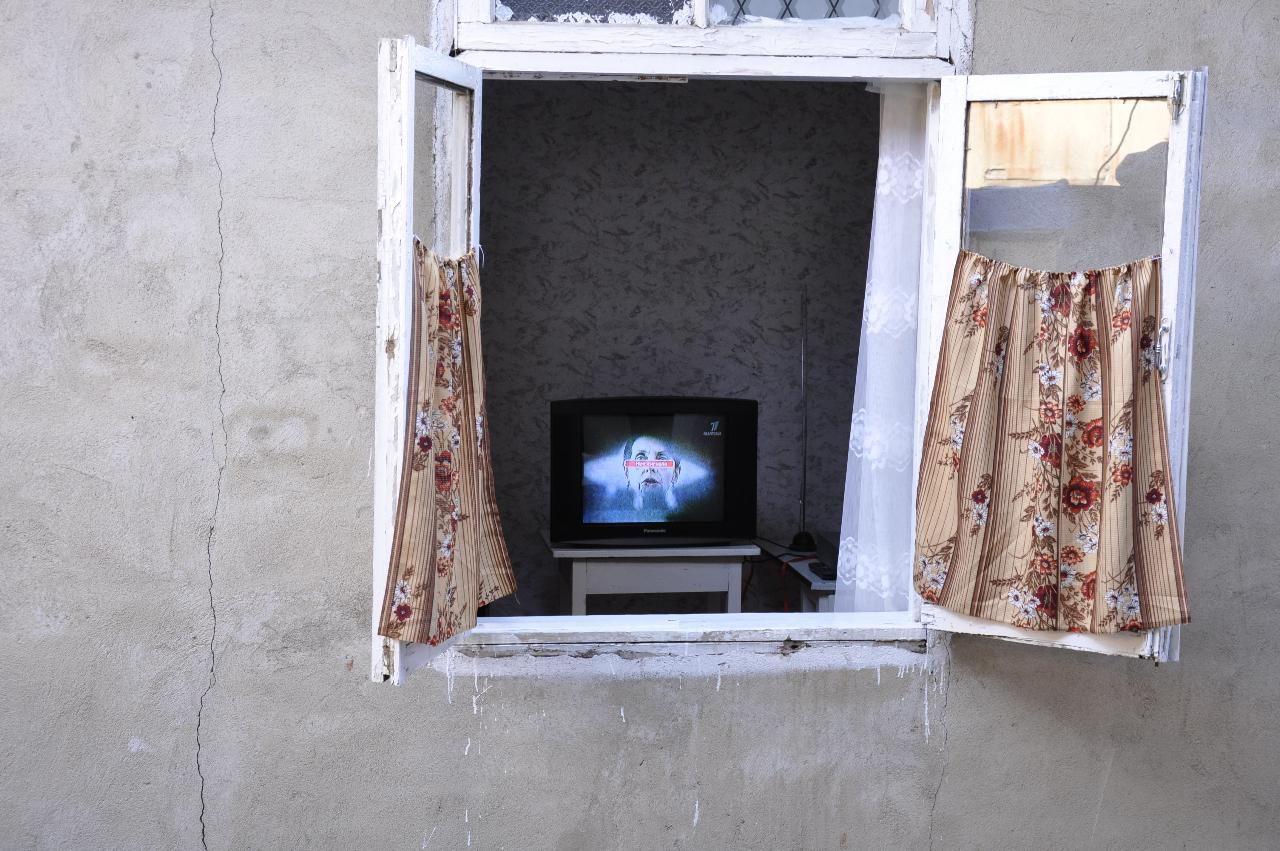
Some Caucasian artists have a great intuition of how to grasp these fantastic reality shifts. For more than ten years Georgians had no more than two hours of electricity per day — what they now call the dark years. Back then some foreign-channels were illegally broadcasting on Georgian channels frequencies. As a result two logos appeared on the screen and the quality of transmission was sometimes interrupted, bringing the image to a standstill. Rusiko Oat, a curator and the owner of the New Art Cafe in Tbilisi made an artwork resulting from the infamous electricity cuts. No Signal was an image created, as she puts it, by electro-waves. On the screen there suddenly appeared a dramatic image of the face of an old lady superimposed on a commercial and captioned with the mysterious Russian inscription Niet signala. In the logic of media marketing, this was a kind of electronic magic, allowing for one’s own interpretation of the neo-now, quite remote from the original idea of an advertising spot and bearing fantastic information.
Two Amsterdam-based artists, Rosell Heijmen and Lado Darakhvelidze, one Dutch, the other Georgian, mapped the city of Tbilisi through its endless marschrutka lines. Marschrutkas are the minibuses that serve as a means of public transport. Anyone can start a new line in a second-hand mini-van brought over from Germany. There are over 200 marschrutka tours in the city and even more in the countryside. Because they stop everywhere, they have an advantage over other public transport (regular buses and electricity have been in service only since the advent of the Saakashivili regime) but are forbidden on the main avenues. After the Rose Revolution, most of the squares and street names were changed, but the marschrutkas signs kept the old ones written in the Georgian alphabet. As a result only the citizens of Tbilisi have knowledge of where a marschrutka is heading. The destination signs somehow tell the recent history of the city. Heijmen and Darakhvelidze produced a marschrutka map in English, seeing the mini-vans as vehicles taking one back in time, letting the non-Georgian find her way, to translate the past and the present and grasp a specific reality of the city. The wide avenue leading from the airport to downtown is named after George W. Bush, and prior to his visit all the facades had been repainted and touched up only from the front side.
Sophia Tabatadze, a Georgian artist based in Berlin, has been observing the changes in post-Soviet Georgia following the transformation of one of these Tbilisi blue facades. She documented the changes on a building between 2003 and 2008. In In a Country with a Flourishing Democracy, even Plastic Flowers Will Blossom, she depicts how, while Georgia has been rushing from one system to the other, this facade has been quickly adapting and making itself look more and more European.

GHOST CITY
Gyumri is the second largest city in Armenia and suffered a terrible earthquake in 1988. In order to help those who lost their homes, the Soviet Government decided to build a new residential area called Mush, after the name of one of the Armenian cities from the Turkish genocide of 1915. The new Mush was supposed to be a large social-housing project adjacent to Gyumri. Construction began in 1988 but was never completed because of the fall of Communism in 1991. Mush stands in the middle of the fields as an unfinished city, with blocks, administration buildings, and playgrounds. The city has been left at mercy of time and weather and politics. It takes ten minutes by taxi to get there from the centre of Gyumri. A few buildings were completed by the motivated settlers themselves, who made up the variously styled windows or doors, quite often out of materials found in neighbouring empty houses. Walking through Mush one experiences a special aura. It might be a never realised “radiant future”, the obscure and difficult Armenian past, a menace of global catastrophe to come, a promise of a secondary use. Mush might recall the idea of the ‘transition towns’ created in Ireland with the aim of equipping communities for the challenges of climate change and peak oil. The chosen communities try to live in a sustainable manner and build local resilience in the near future, trying to reduce the energy use and increase their own self-reliance by repairing or re-using the old items rather than throwing them away.
Mush was brought to the arts and to public debate by Armenian artist Vahram Aghasyan who photographed the site for several months. In his thrilling series Ghost City from 2006-on going he observes the silent Mush and shows other possible scenarios to come, such as a gigantic deluge echoing the Great Flood from the Bible, which took place not far from there. In the totality of his work, as in Ruins of Our Time (deserted bus stops from the 1960s), or Ruins of Private Property (the demolition of an illegal gated community near Istanbul), he profoundly analyses the cultural and socio-political changes in Armenia through images of spectacular contemporary remnants and post-Soviet entropy.

A DERVISH ONCE SAID: BETWEEN WESTERN ALIENATION AND EASTERN SUBMISSION I’LL TAKE: A BATH*
One main critique of Edward Said’s Orientalism was that he had only examined the relations of the first and the third world, omitting the complex and never discussed hierarchical structures within the second world, meaning Eastern Europe or Euroasia. The international collective Slavs and Tatars (Kasia Korczak, Payam Sharifi, Boy Vereecken, and Victoria Camblin) takes a great lesson of emancipation from out of the culture of less visible nations and countries between the east of the former Berlin Wall and the west of the Great Wall of China, focusing on the sphere of influence shared by Slavs, Caucasians and Central Asians. Their books and installations combine scholarly research with pop culture, urban legends, their own experiences, and postcolonial studies. Their last art book Kidnapping the Mountains, addresses the complexity of identities, languages, stories and time in the Caucasus. Their previous publication, A 13th Month Against Time, was inspired by an old form of the Jalali calendar, used by the Zoroastrians and still in use in Iran and Afghanistan. Originally, in the 11th century, it added an additional month every six years. Slavs and Tatars published a calendar of the 13th month with 32 days (or pages) as a libretto of reflections on the defeatist approach to time. Their art-based research, rooted in critical theory and glamour, goes against both the superiority of Western gaze and exploration and Eastern Westerncentrism.
The Tbilisi performative-art Bouillon Group also act as selfproclaimed anthropologists, taking non-questioned culture elements as material for their artwork and seeking to reveal the conflict between comfort and nonconformity. The artists created a descriptive deconstruction of a figure of Mother Georgia, an aluminium statue overlooking Tbilisi erected in 1958 (similar ‘Mothers’ were then erected in Armenia, Ukraine and Russia), meant to protect the country. Mother Georgia holds a bowl of wine to greet those who come as friends, and a sword to defend herself from enemies. Bouillon saw the statue as a hermaphroditic and ambiguous figure, a product of Georgian circumstances.

FORMER WEST
After the long and effective process of self-applied Westernisation by many Central European countries, we now hope to witness the coming out of a cognitive East. The Warsaw Museum of Modern Art is leading a complex research project to rewrite an European art history not only with Western names, but identifying with our part of Europe. For Charles Esche, a critic and director of the Van Abbemuseum in Eindhoven, the Netherlands, to be Western stands for being short-sighted and lacking the openness and tools to experience things in their plurality. Together with several other European institutions he is launching the research platform called “Former West”. This term, never extensively employed as a counterpart to the widely used “former East”, is meant to examine what impact the events of 1989 had on the art of the “West”.
I recently participated in a conference about art-world standards where many speakers debated how to have the East change and live up to Western standards. One Ukrainian artist stood up and riposted, “And I want to ask you when the West will change?!” Eastern Europe no longer exists, though perhaps with some Georgian and Armenian exceptions.

* after the title of Slavs and Tatars’ work in: Kidnapping Mountains, Book Works, London 2009. Slavs and Tatars investigates different forms of knowledge than those available to us in the West: be it emotional, critical, spiritual, or political. Despite the rampant Islamophobia in the west, dervish and Sufism seem to remain the most palatable, ‘white’-friendly form of Islam. The dervish print addresses the East versus West divide, first as a choice and then immediately as one to be altogether avoided.

Joanna Warsza is curator on the cusp of performing and visual arts, working mostly in public space with the invisible, the ephemeral or staged situations. Recently she made two public art projects in Tbilisi, Georgia dealing with the legacy of post-soviet architecture. Director of a NGO - Laura Palmer Foundation, for projects between fiction and reality, writer for Obieg Magazine.

The research trip to Georgia and Armenia was possible with the generous help of European Culture Foundation and Open Society Institute Budapest.
www.eurocult.org
www.soros.org

links:
http://picasaweb.google.com/Laura.Palmer.Foundation
and
www.artzona.pl

House of poets where SARTRE and BEAUVOIR stayed, Lake Sevan, Armenia

Bouillon group in Supra performance debating on Mother Georgia gender issues / Betlemi mikro-raioni / October 2009 / ArtZone

Rusiko Oat, No Signal - Art created by electro-waves / Betlemi mikro-raioni curated by Joanna Warsza / ArtZone Festival, Tbilisi, October 2009

The balcony with the view over a blue apartment building referring to Sophia Tabatadze's work In Country with Flourishing Democracy, Even Plastic Flowers Will Blossom, / Betlemi mikro-raioni curated by Joanna Warsza / ArtZone Festival, Tbilisi, October 2009

Vahram Aghasyan, Ruins of private property / Betlemi mikro-raioni curated by Joanna Warsza, Tbilisi, October 2009, ArtZone festival

slideshow >>>

Friday, April 24, 2009

EXHIBITION: Sophia Tabatadze - Presentation Of Latest Works (archidrome.blogspot.com)

Silk Museum, 28 April, 18.00
archidrome.blogspot.com/
geoair.blogspot.com/


Saturday, March 14, 2009

EXHBITION: GeoAir (Sophia Tabatadze) will presenting Reciprocal Visit project in Tbilisi

Presentation of the Reciprocal Visit project in Tbilisi
04.04 2009

State Silk Museum
Address:
Tsabadze Street 6

(Next to the entrance of Mushtaidi Park)

Participant artists: Endam Acar, Selda Asal, Volkan Aslan, Serdar Ateser, Fatma Ciftci, Zeren Goktan, Gozde Ilkin, Ceren Oykut and Sophia Tabatadze.

Reciprocal Visit is project by Apartment Project in Istanbul . This project is associated with the work of the visual artist and the founder of the artist initiative Selda Asal who is the originator of the project’s concept. The project is organized and curated by Serra Ozhan.

Iade-i Ziyaret / Reciprocal Visit is an experimental workshop project made up of photographs, videos, writings, interactions, and talks by participants from a variety of disciplinary backgrounds such as photography, video, music, performance, painting, sociology. It takes its name from the culture of ‘reciprocal visit’ that is alive and well in Armenia, Iran, Azerbaijan, and Georgia as well as in many Arab countries and Turkey. This project is called ‘iade-i ziyaret’ because it will consist of our visits to Iran, Azerbaijan, Georgia, and Armenia and of the reciprocal visits of two artists from each country: a concept that is familiar to both the artists from these countries and to us. It’s a concept that connects.

The artistic material is created while participants are on the road, at places where they stop, visit, or stay.

The exhibition will open with
Natalia Mali’s work who has been invited to Istanbul to present her performance I am Black or Black Cancellation.

For further information: www.apartmentproject.com
Source:
geoair.blogspot.com

Wednesday, October 15, 2008

OFF EUROPA: Art Blog by Nadia Tsulukidze & Sophia Tabatadze - Performance, installation, movement, speech.

Khinkali Juice - General Concept

In 2005 Sophia Tabatadze (1977, visual arts) and Nadia Tsulukidze (1976, performing arts/contemporary dance) started working together and combining different art disciplines. These are visual, media, movement, music and speech art forms combined in polyphonic way. In our performance/installations different disciplines play equal roles. The forms are there to supplement and support content and form rather than illustrate or decorate each other. The performances are always site-specific. Each performance is different depending on their reaction as well as characteristics of the space we use. Given that in the past few years borders between different disciplines within the contemporary art became thinner relevance and importance to create interdisciplinary projects grew. The themes of performances deal with social events surrounding us. The problems are not approached directly and aggressively but they go through the artistic processes and gain weight, humor and importance as we go along. The dramaturgy is based on the abstract principle and develops during the working process, mirroring specific social situations. We do not use written scenario beforehand. The themes like male-female dependence, cultural and professional habits, questioning the Georgian toasting traditions, growing importance of the religion in Georgia, the blind copy-pasting from the West etc. are worked on and brought into the discussion.

Projects realized in 2007
• "Let's drink to love!", "Progressive Nostalgia", Centre for Contemporary Art Luigi Pecci, Prato, IT
• ”Maiden – Divorced – Spinster”, in collaboration with “Women’s Fund in Georgia”, National Library, Tbilisi, GEO
• “Alterative travel Guide through Georgia”, Theatre festival “Babel”, Amsterdam, NL

Projects realized in 2006
• "Alternative Guide to Georgia and Caucasus" Caucasus Biennale, Tbilisi, Georgia, October 2006 • "Caucasus Game" Festival Est-Ouest, Die, France, September 2006
• "Caucasus Game" Festival Est-Ouest, Die, France, September 2006
• “I was silent” ACCEA (Armenian Centre for Contemporary Experimental Art) Yerevan, Armenia, August 2006
• “All about Lies” Apartment projects, Istanbul, Turkey, August 2006
• “Roof performance”, Roof in Tbilisi urban neighborhood, Tbilisi, Georgia, June 2006 •
• “What do Georgian women do in Istanbul”, Apartment projects, Istanbul, Turkey, April 2006
• “Kilebi da Kalebi”, NAC (National Art Centre), Tbilisi, Georgia, March 2006

Newspaper Articles
Georgia Today / A woman! No Definitions Needed
Aргументы и Факты / Взгяд на гендерные стереотипы
24 საათი / გასათხოვარი, განათხოვარი, გაუთხოვარი
Новые Врмена / Art without borders, but within reasonable boundaries
Flash Art / Aperto Georgia

+++


During the OFF EUROPA Theatre-Festival we show the remarkable videoart by both in the ditorei Galerie in Leipzig. Georgian Table Traditions (Progressive Nostaligia) - curated by Victor Misiano - is very interesting and overcrossing between different daily rules and rites in Georgia. Good stuff for thinking and nevertheless for laughing.

more:
Centro per l'arte contemporaneaLuigi Pecci-Prato

VIDEO >>>
May 2007


More on www.tamadaonline.com

+++

more: www.khinkalijuice.blogspot.com

Thursday, June 19, 2008

ART: Sophia Tabatadzes New Shows And Her New Website

Hereby some updates about Sophia Tabatadzes upcoming on ongoing shows and her new website.

www.sophia-tabatadze.com
(best viewed with Firefox)
Your reactions, feedback is very welcome!

May 30-August 31
‘Voyage a Tbilissi’ Group Show at Fine Art Museum, Nantes, France
See invitation>>
-----------------------
July 5-September 14
‘Open Sky’ Group show at Kunstverein Medienturm, Graz, Austria
-----------------------
September 10-13
"Best of Discovery" curated by Sara Raza, Shcontemporary, Shanghai Art Fair, China
-----------------------
October 23-November 19
‘Aguhlas Negras’ collaborative project, São Paulo, BrazilCurated by Ellen Blumenstein and Carla Zaccagnini
-----------------------
November 27-December 14
‘All In One’Solo show at Künstlerhaus Bethanien, Berlin
This exhibition is an outcome of a year residency in 2008 at Künstlerhaus Bethanien, Berlin.
Fellowship by Ernst Schering Foundation, Germany

April 2-23
‘Exchange Academy’ organization and participation of Collaboration between Georgian, Dutch, Armenian and Turkish Artists.
Project by GeoAIR, in collaboration with ‘Archidrome’-Contemporary Art Archive and Georgian State Silk Museum.
Read more about the project>>

February 6 -10
Art Rottedam with Mirta Demare Gallery, The Netherlads

2007
September 6-November 4
‘Buildings and Strangebuildings’ participation to the 10th International Istanbul Biennale, Turkey

June 10-November 21
‘Humancon Undercon’ Georgian Pavilion at the 52nd Venice Biennale, Italy

May 26-August 26
‘Let’s Drink to Love’ participation to the group exhibition ‘Progressive Nostalgia’ in Luigi Pecci Centre for Contemporary Art, Prato, Italy

__________________________


SOPHIA TABATADZE

atelier: + 49 (0) 30 61658956

mail: mailto:mailstabatadze@yahoo.com

blog: http://sophiatabatadze.blogspot.com/

skype: stabatadze

adresse: Atelier 233, KKünstlerhaus Bethanien, Mariannenplatz 2, D-10997 Berlin, Germany

www.sophia-tabatadze.com
www.sophiatabatadze.blogspot.com
www.geoair.blogspot.com
www.khinkalijuice.blogspot.com
www.pswar.org
www.enoughroomforspace.org


Works
2007
- Humancon Undercon
2006
- Caucasian Memory Game


- Georgian Toasting Traditions
- Much More
2005
- Heroes of Stagnation
- Subu-Diet
2004
- Architectural Drawings
- Buildings and Strangebuildings
- What We Thought Was a Wall Turned Out to Be a Curtain
- Tunnel
2003
- De Doorzonwoning
- House on Wheels
2002
- Self-Portrait as Architecture
- Wallpaper

Texts

Saturday, June 07, 2008

ART: tbilisiDEEPART magazine15 (with Sophia Tatabadze)

tbilisiDEEPARTmagazine, an art transport project by patricia london ante paris
subscribe now at
tbilisideepart@yahoo.de

dear friends,
today its too hot to work, aloha
patricia

tbilisiDEEPART magazine15 >>>
with Sophia Tatabadze (artist)

Thursday, August 16, 2007

CAUCASIAN ART:


Sophia Tabatadze made a Introduction to the Caucasus

If artists don’t start talking to each other, if we don’t realize that ideas have to be shared and that we will only achieve anything significant from a common ground, we will remain small countries with insignificant cultural lives slavishly following the dominant trend. We will condemn ourselves to always being one step – or several steps – behind.

Tuesday, June 26, 2007

BLOG: Warchitecture. By Bruce Sterling.

By Bruce Sterling June 25, 2007 6:55:29 PM
Volume Issue 11: Cities Unbuilt

Volume is a collaborative project by Archis + AMO + C-Labinfo@archis.org
http://www.volumeproject.org/
Subscriptions/purchasehttp://volumeproject.org/
VOLUME 11 Cities Unbuilt. To Beyond or not to be
€ 17.50 / Paperback / 160 pages / ISBN 9789077966112 / text English / May 2007
Archis / AMO / C-LAB
In an age of conflict, civil war and the (re)construction of urban spaces, destruction has become an alternative form of architecture, challenging both the traditional role and place of architecture and various forms of international supervision. Volume examines this new realism through a variety of different studies, including Afghanistan, Iraq, Lebanon and Kosovo. Order this title now!

Destruction is no longer the outcome of blind rage, but increasingly a matter of meticulous calculation. Destruction has become an alternative architecture’ Ole Bouman
‘Cities Unbuilt’ is the first comprehensive research on the architecture of destruction. This issue offers a detailed analysis on spatial and social implications of destruction in various parts of the world and discusses issues around migration and displacement, ‘warchitecture’ and ‘post-warchitecture’, counter-heritage, cultural interventions and post-conflict reconstruction strategies.

While architectural records regularly hit the news with positive developments – even higher towers, smarter technologies, stunning designs, and iconic buildings – the general daily news is negative: man-made destruction caused by conflict and war and natural disasters make up large parts of the news’ content. Remarkably there is no discourse on these subjects within the global professional community of architects, yet there is a strong correlation between destruction – the unbuilding of cities – and the construction of buildings.

In this age of realism destruction marks a dramatic proliferation of the unbuilding of cities worldwide challenging the traditional notion of architecture as the vehicle of hope and progress. Volume explores the less discussed creative sides of destruction, a realm where architecture and design play an important part. Volume shows how they are engaged in destruction, but also what options architecture has to confront these situations. Even in destruction there is hope.

Three Cahiers are central to this issue – Cahier South Caucasus, Cahier Kosovo and Cahier Lebanon – framed by a series of introductory essays by Ole Bouman, Robert Bevan, Ester Charlesworth, Caroline Arnulf, Andrew Herscher and the concluding creative agenda with contributions by Christian Ernsten and Malkit Shoshan, Nick Shepherd and Kai Vöckler amongst others.

IntroductionThe Architecture of Destruction (Editorial) – Ole Bouman
Cultural Cleansing – Robert Bevan
Ghost Buildings – Reineke Otten
Architects Should Act! – Esther Charlesworth
To Leave and Let Live. The impact of migration and remittances on war-torn cities – Caroline Arnulf
World Bank Cities – Andrew Herscher
Maps on Reconstruction – F.A.S.T.
Frozen Memories – Gerlinde Schuller

Cahier South Caucasus
Destruction and Displacement
Introduction: Design for Displacement
Humancon Undercon – Sophia Tabatadze
Dynamics of the South Caucasus Borders – F.A.S.T.
Barda’s Boundaries. Temporary homes and the politics of displacement –
Malkit Shoshan, Christian ErnstenExtreme Makeover. The reconstruction of post-Soviet Karabakh – Malkit Shoshan, Christian ErnstenPhotos Dirk-Jan Visser

Cahier Kosovo
Destruction and Illegal Building
Introduction: Kosovo Constructions
Warchitecture/Post-Warchitecture – Andrew Herscher
Invisible Architects – Florina Jerliu
Archis Interventions in Prishtina – Kai Vöckler c.s. also check the Unbuilt Prishtina blog

Cahier Lebanon
Destruction and Exclusion
Introduction: All Exclusive
City Blogging
Solidere and the Perpetual Reinvention of Downtown Beirut – Michael Stanton
Manic Machines – Christiaan Fruneaux
Public Space Invaders – Joost Janmaat
Design With War in Mind
The Architect’s Dilemma
Photos Aukje Dekker
Pearls for Lebanon – Ole Bouman
Noise Magazine – Studio Beirut also check the Unbuilt Lebanon blog

Agenda
Violence, Destruction and International Law. An interview with Andrew Herscher – Christian Ernsten, Malkit Shoshan
Counter Convention – Andrew Herscher
UNESCO World Heritage – F.A.S.T.
Urban Imaginaries andMemories of Violence. Cape Town’s Prestwich Street – Nick Shepherd, Christian Ernsten
Lifta after Zionist Planning – Malkit Shoshan
Stateless Urbanism – Kai Vöckler
Towards Non-Destructive Aid – Niloufar Tajeri
Planning for Uncertain Cities. Towards an urban post-conflict strategy – W. Hackenbroich, T. Fuchs, K. Vöckler
Artists and New Urban Horizons – Chris Keulemans
Architecture Extended to Its Contrary (Photonovela) – Christophe Catsaros
FACTS

editor in chief Ole Bouman
contributing editors Rem Koolhaas, Mark Wigley
managing editor Arjen Oosterman
publisher Archis Foundation
format 20.9x29.5, 160 pages (no ads)

Monday, June 11, 2007

ART: Georgian Pavilion at the 52 Venice Biennale.

Thanks to Sophia Tabatadze

PRESS CONFERENCE: SATURDAY 9th JUNE 2007 FROM 10.00 TO 10.30 AM, TEATRO PICCOLO – ARSENALE, Calle della Tana 2168/B
INAUGURATION: SATURDAY 9th JUNE 2007 AT 12.00 PM
PRESS PREVIEW: 6-7-8-9 June 2007 - Opening hours: 10.00 am – 8.00 pm
OPEN TO THE PUBLIC: 10thJune - 21st November 2007 - Opening hours: 10.00 am – 6.00 pm (closed on Tuesdays)
VENUE: Arsenale, Campo della Tana, Castello 2126/A
ORGANISER: Ministry of Culture, Monument Protection and Sport of Georgia - www.georgianseason.ge
ORGANISER IN VENICE: Arte Communications - www.artecommunications.com
CURATORS: Nino Tchogoshvili, Tamara Lortkifanidze
COMMISSIONERS: Paolo De Grandis, Manana Muskhelishvili, Zviad Mchedlishvili
ARTISTS: Eteri Chkadua, Tamara Kvesitadze with co-authors Paata Sanaia and Zura Gugulashvili, Sophia Tabatadze


The Georgian pavilion at the 52nd International Art Exhibition in Venice presents projects and works which appear largely different from each other. It is not only artistic taste and world outlook that distinguishes the featured artists, but also a range of modern and traditional means and media they use in their works. The art of Georgia, a country located on the border between Europe and Asia, and at the cross-roads of occidental and oriental cultures, has always been remarkable for its diversity and originality. Rooted in local traditions, Georgian art has also benefited at different times from a range of foreign, namely west European, Byzantine, oriental, avant-garde and social- realistic styles and movements. Georgian fine art of the 20th century was closely linked to the political and social processes unfolding in the country. In the first quarter of the 20th century, Georgian art developed in line with contemporary avant-garde trends and styles. Moreover, several Georgian artists worked with celebrated avant-garde artists in the world’s art centers of the time. Following World War I, a large number of renowned modernist artists from Russia headed for Tbilisi. The city thus turned into a hub of modernism. However, the isolation from the western world, as well as censorship and repression practiced by the Soviet regime, defined the specific nature of the trend along which Georgian culture had to develop. The late 20th century, characterized by political transformations and opening of borders, provided opportunities for renewed cultural exchange and cooperation. However, this process, which is still underway, is also associated with difficulties. Contemporary Georgian art is trying to establish itself on the world map of art. The Georgian artistic community has certainly become much more ‘open’ than it has been in previous decades. Globalization and mobility have enabled more intense connections with the western world. It is notable that current national cultural policy pays increased attention to the promotion of contemporary Georgian art. Analysis of the past, revision of values, search for and adoption of new forms and media, frequent instances of blind imitation, along with the desire to maintain local values, traditions and aesthetics and build contemporary art on these premises are evident. The venue in which Georgian art has been developing is right in the centre of the Caucasus region, in which a large number of nations and ethnic groups with ancient cultures have co-existed throughout the millennia.
The political and social situation in the region is complex and tense. Contemporary artists naturally respond differently to the social, political and cultural processes unfolding in their country, each depicting the aspect most vulnerable to him or her. The works represented at the exhibition are reflective only as part of the creative processes taking place in contemporary Georgian art.


Eteri Chkadua has been living in the US since 1980, when she left Georgia. The artist remains faithful to traditional artistic means, painting her medium and large realistic figures on canvas by using brush and paints in a manner which largely relies on the experience of a generation of earlier artists and which was taught to her at the Georgian Academy of Fine Arts. Eteri Chkadua, who is keen on traveling, creates a hybrid of New-York, Jamaican, Miami and Georgian impressions. She portrays a woman’s world as seen by a woman – a multi-layered form with a polished surface beyond which one can read impulsiveness almost bordering with the primitive state. Hallucinatory perception echoes her emotions and impulses.
‘My image of a woman is simultaneously characterized by ethnical, pop-art, tourism and emigrant related elements. It has become universal as I made geography and time vanish’.

The RE-TURN project by Tamara Kvesitadze, with co-authors Paata Sanaia and Zura Gugulashvili, is composed of one installation and several mechanical figures. The materials used are fiberglass, metal and mechanisms. The mechanical figures represent the process of transformation in movement, which finds reflection on the surroundings they are placed in. The concept of the work is based on the correlation between the mechanical and organic.


‘Mechanical vs. organic
Organic nature of the mechanical 􀃆 orderliness of the organic 􀃆 mechanical nature of the orderliness’.
Sophia Tabatadze portrays the state of a human being with the use of architectural forms. Her interpretation of architecture goes beyond the primary meaning of the word. In her project titled ‘Humancon Undercon’, Tabatadze shows human traces in an urban environment that has become thoroughly inhuman. To underline this imbalance, she emphasizes certain details, leaving others uncompleted. She aims to show our inability to perceive things in their totality - a totality that includes space and time. It is this inability that lies behind our present condition of constant amnesia, in which we choose to overlook certain aspects of our collective past.
‘My work draws on the urban environment and the things that happen in it. In order to bring these happenings close to myself I process them through my own body by physically making work about it. By doing so I try to accept my surroundings in the period when their aesthetics and directions do not match with mine’.


INFORMATION:
ARTE COMMUNICATIONS

Tel: (39) 041. 526 4546 Fax: (39) 041. 276 9056
E-mail: info@artecommunications.com
pressoffice@artecommunications.com


Web site:
www.artecommunications.com

Project: Humancon Undercon

Press: http://www.artecommunications.com/upload/GEORGIA_PRESS%20RELEASE_18apr07.pdf

More Links:

Upcoming Events
*June 10 to November 21 - ‘Humancon Undercon’ Georgian Pavilion at the 52nd Venice Biennale, Italy
*May 26 onwards - ‘Let’s Drink to Love’ – video work at the exhibition ‘Progressive Nostalgia’ in ‘Luigi Pecci Centre for Contemporary Art’, Prato, Italy
Download Catalogue
'Buildings and Strangebuildings', works 2002-07
CV
CV Sophia Tabatadze
More Activities
Khinkali Juice
GeoAIR
Links
Flash Art
Festival Est-Ouest
Het Wilde Weten
Tram

Source: http://sophiatabatadze.blogspot.com/

More:
documenta12blog
documenta12blog documenta12blog
http://www.documenta12blog.de/