Showing posts with label Getty Images. Show all posts

Monday, April 22, 2013

FOOD & WINE: Letter from Georgia: Doing the chacha. By Dan Peleschuk (guardian.co.uk)

(guardian.co.uk) A few shots of the national drink allow travellers to gaze on Tbilisi with fresh eyes


Our guide, Lasha, couldn't find any other words: "Have a couple shots," he kept saying with a wry smile, "and you'll be set."
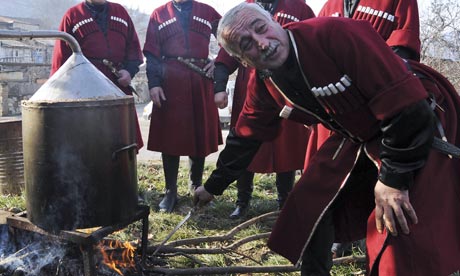
Georgia making chacha
Distilling the national spirit ... Georgian men in traditional clothes cook chacha during a holiday celebration. Photograph: Vano Shlamov/Getty
All afternoon, Lasha's attempts to describe the taste, strength and effects of chacha – Georgia's national spirit – had left us intrigued. We had spent the day touring the picturesque south Caucasian country, known for its majestic peaks, savoury cuisine and the hospitality of its locals. And Lasha, naturally, served as our source for all matters of local history and culture. But whenever the conversation turned toward chacha, a predominantly grape-based liquor reputed for its flavour and strength, he seemed at a loss for words.
So in the evening, as we headed back towards the capital of Tbilisi, a forlorn, roadside mess hut caught our attention. "Maybe they have it," Lasha wondered aloud as we pulled over.
He surveyed the kitchen, and we waited in the adjacent dining room. Minutes later, an apron-clad woman entered with a tray of khinkali, or boiled meat dumplings, and a bottle of clear, inconspicuous liquid. Success.
Once the khinkali had cooled, we raised our glasses, and toasted to one another. The subtle taste of grape tingled through my mouth as the high alcohol content registered, lighting my sinuses ablaze. A quick gulp of the salty juices from the khinkali neutralised the residual bitterness, but the satisfying burn remained. We repeated the process several times as the smile on my face grew larger. I soon realised Lasha was right: I was set.
The trip back to Tbilisi was swift. I began pulsating with excitement to explore the tree-lined streets and decaying, Tsarist-era buildings – sights we'd seen before, but not after several rounds of chacha. We bade Lasha farewell and escaped into the night, popping into one cafe after another. Somehow, the chacha changed everything. I was not drunk, but electric. My head wasn't spinning – it was sprinting ahead, along Tbilisi's winding streets.
The next morning, as we prepared to return home, Lasha appeared with a pair of two-litre water bottles filled with that same inconspicuous liquid. It was our own, home-brewed souvenir.
"Now I know you," he said with a smile. "Next time you come to Georgia, we'll celebrate properly."
• Every week Guardian Weekly publishes a Letter from one of its readers from around the world. We welcome submissions – they should focus on giving a clear sense of a place and its people. Please send them toweekly.letter.from@guardian.co.uk

Thursday, July 05, 2012

FEATURE: Islamization of Russia. Photographs and Text by Oxana Onipko (reportagebygettyimages.com)


(reportagebygettyimages.com) Russia has always bordered Europe and the Orient. Russian-led Soviet imperialism found a way to make it work. Institutionalized atheism, personality cults, the homogeneity of the working class and other forms of entrenched propaganda unified peoples of diverse ethnicities and cultures. Communism’s fall created an ideology vacuum, rekindling the latent passions of religion. Orthodox Christianity versus Islam is a new chapter in the nation’s ages old struggle of East vs. West.

In recent years, the East has gained dominance as pan-Slavism has splintered along geo-political lines. Coupled with this, the population of Russia is in decline. Meanwhile, millions of Muslims arrive from the violent Caucasus mountain region and the destitute former Soviet republics of Central Asia for cheap manual labor jobs.

The massive rise in numbers and the visible spread of Islam has sparked ethnic hatred in many. There is not enough room in Moscow's Mosques anymore so people are worshiping on the street. The World Bank estimates that 12.3 million migrants now live in Russia. Second only to the United States. “Russia for Russians!” is the new battle cry from the mouths of ultra-nationalists who see their motherland as a fortress under siege.

Violence from Islamic extremists is the principle fear among Russians. The 1990s saw continuous armed conflict throughout the Caucasus. Most notably two ferocious wars in Chechnya resulted in high casualties, long-term psychological scarring, and deep-rooted senses of mistrust, animosity and foreboding toward the entire region.

The recent March 2010 terrorist attack in Moscow by female suicide bombers from Dagestan, next to Chechnya, has crystallized many of these fears. More than 40 people were killed, and over 100 injured. The latest in a long string of violence “bleeding” from the Caucasus into Russia proper. Since the 1990s Russia has been continually struck by serious acts of terrorist violence; the Nord-Ost theatre hostage takeover and the Belsan school tragedy for example. The responsibility for these acts along with train and apartment blasts has been claimed by the self-styled mujahideen leaders of the “Caucasus Emirate” whose stated goal is to establish strict Sharia law in the region.

The movement has links to the al-Qaeda terrorist network. Foreigner fighters from the Middle East and Afghanistan have been documented fighting alongside locals. In particular, Afghanis who fought for years against the Soviet armed forces have played a significant role in the tactical training and preparation.

It is understandable why some Russians are concerned. But concern is no excuse for hate and fear-inspiring demagoguery.

Since 2009 I have been documenting Islam in Russia. I gained access to these people by spending hours at Moscow's central mosque and engaging them in long conversation. Eventually I learned about the various ethnic and cultural subgroups and made my way into people's homes and social units. The concept of "Islamization" became clear when I began to interact with a group of Russian converts to Islam from Orthodox Christianity. Their experiences and problems of fitting into society with a new religion and identity are indicative of a larger trend about Islam in Russia.

I have completed much work in Moscow and am now focusing my attention on the Caucasus region, Chechnya, Dagestan, and Ingushetia. The region is critical to my project.

Since the installation of Moscow-backed Ramzan Kadyrov as the head of the Chechen Republic, the situation has stabled considerably. Post-war reconstruction of the capital city Grozny included “Europe’s largest mosque”. Also a course of moderate Islam as religious education has been instigated in public elementary schools. While Kadyrov himself has called for all women to wear headscarves. But even with improvement, according to US human rights watchdog group Freedom House Chechnya is one of the most oppressive regimes in the world along with North Korea and Burma.

Considerably less stable than Chechnya are the territories of Dagestan and Ingushetia. Kadyrov has succeeded in pushing much of the separatist Islamic guerrilla activity into these neighboring lands.

Here Russian Federation forces continue to fight an increasingly horrific campaign against an insurgency increasing in size and tenacity. But, away from the headlines, the conflict is taking its toll on ordinary people and families.

Every month brings new disappearances and murders. Often, the family members claim their loved ones have no connection to the militants, and it almost always remains unknown what, if anything, they have done to deserve such harsh punishment. There is no rhyme or reason to the pseudo-judicial executions, as if a misplaced word here or there, is sufficient invitation for a visit by a shadowy squad of men.
There are 55 BW images in the full edit and are available upon request.

Web:  
onipko.photoshelter.com
lightstalkers.org/oxana_onipko

FEATURE: The Caucasus - A Place Seldom Seen Photographs and Text by Marko Kokic / ICRC (reportagebygettyimages.com)

Download pdf >>>

(reportagebygettyimages.com) In Spring 2011, I travelled as a staff photographer for the International Committee of the Red Cross (ICRC) to the Caucasus. This part of the world is little known. But because of the work of the ICRC I was able to visit and photograph people and places that we don’t hear much about, much less see.

My journey into South Ossetia began down a long dark guarded tunnel cut through the Greater Caucasus Mountains. Since the August 2008 hostilities, it is the only way in and the only way out. Beyond the tunnel, destroyed villages line the road leading to Tskhinval/Tskhinvali, the capital of a contested land recognized as a country by a handful of states. There are an estimated thirty thousand people remaining in South Ossetia. The most vulnerable are the elderly living scattered in destroyed and abandoned villages. They are poor, helpless and often alone. In South Ossetia the ICRC is the only international humanitarian organization providing these people with food, and other assistance.

Since the fall of the Soviet Union, the North Caucasus has been marked by bloodshed and insecurity. Over the past few years, this region of the Russian Federation has seen a spiralling of violence between members of armed opposition groups and local and federal authorities. Today the life of the population in the North Caucasus is still affected by frequent security incidents.

In Ingushetia I met people who had fled fighting in Chechnya and North Ossetia years ago. Yet they continue to live in derelict collective centres for displaced people, some of them since the early 1990's. They have little choice but to call decrepit temporary shelters home. Here elderly people are either too poor to return home or have nothing to go back to. The young have little or no opportunity to find work.

In the neighbouring Chechen Republic I saw Grozny, its capital, undergoing a massive facelift. New buildings rose from the rubble in a frenzy of construction financed in large part by Moscow. Bullet and bomb scarred walls were quickly being covered over in an effort to leave the dark past of two bloody conflicts behind. Notwithstanding the reconstruction efforts, long-lasting humanitarian consequences of past conflicts will be felt for years to come. A striking example is the problem of the missing. The authorities speak of about 700 missing security services and military personnel. In addition, the ICRC has over 2300 registered cases of missing people but has so far been unable to provide families with any answers as to the fate of their missing loved ones.

Over the past few years, as regularly reported in the local and national press but less so in international media, hundreds of people have been being killed, wounded and detained. In Dagestan I met with families who have lost their breadwinner to armed violence. The ICRC supports the most vulnerable among these families. For instance, it provides families of detainees with a means to start their own small businesses and helps family members to visit their detained relative, some of whom are held thousands of kilometres away. The ICRC itself visited people detained in relation with the situation in the North Caucasus between 1999 and 2004.

My journey ended in a small town in North Ossetia called Beslan, in a school gymnasium turned shrine in memory of hundreds of innocent children and adults who were killed during a hostage crisis in September 2004. The portraits of victims hang on scorched walls amongst candles and flowers. Handwritten epitaphs from friends, family and schoolmates adorn the same walls.

It’s impossible to adequately distil all these places, people, stories and tragedies into a single idea or conclusion, much less into a photo. But I am reminded of one unlikely image – it’s of a brick wall in Grozny with a faded message spray-painted on it. I was told that it dates back to the war years in the 1990’s when it was not uncommon for people to write on their homes in the hope that they would be spared. The message is as pertinent today as it was then. It pleads with those fighting to protect the innocent sheltered behind the wall and reminds the rest of us not to forget these people and their troubles. It’s a quiet cry for help. It reads, “people live here”.

+++


Reportage by Getty Images just published The Caucasus - A Place Seldom Seen, by ICRC staff photographer Marko Kokic.

Mr. Kokic's striking black and white photographs document life in South Ossetia, Ingushetia, Chechnya, Dagestan and North Ossetia, regions where the ICRC has been active for years.

We don't hear much about the humanitarian situation of thousands of people affected by violence, insecurity and poverty in the Caucasus, much less see it, but life is grim for many.

Among the 30,000 people who live in South Ossetia, many of them are elderly, poor and vulnerable. They often live in deserted villages. The North Caucasus continues to be affected by violence, with frequent clashes between armed groups and Russian Federation authorities. In Ingushetia, hundreds of families displaced by past conflcits still live in derelict collective centers, too often with little or no economic opportunities. In Dagestan, Mr. Kokic met with families who have lost their breadwinner to armed violence. Many are extremely vulnerable and supported by the ICRC. Grozny, in the Chechen Republic, is undergoing a massive facelift but the long-lasting humanitarian consequences of past conflicts continue to be felt. The ICRC has documented over 2,300 cases of missing people but been able to provide very few answers to surviving families.

Mr. Kokic says he chose to focus on the lives of the people we serve instead of our operations in the region, a luxury few photographers working for humanitarian agencies enjoy. The results are stark portraits of people living on the margins and trying to survive. They are hard to forget.