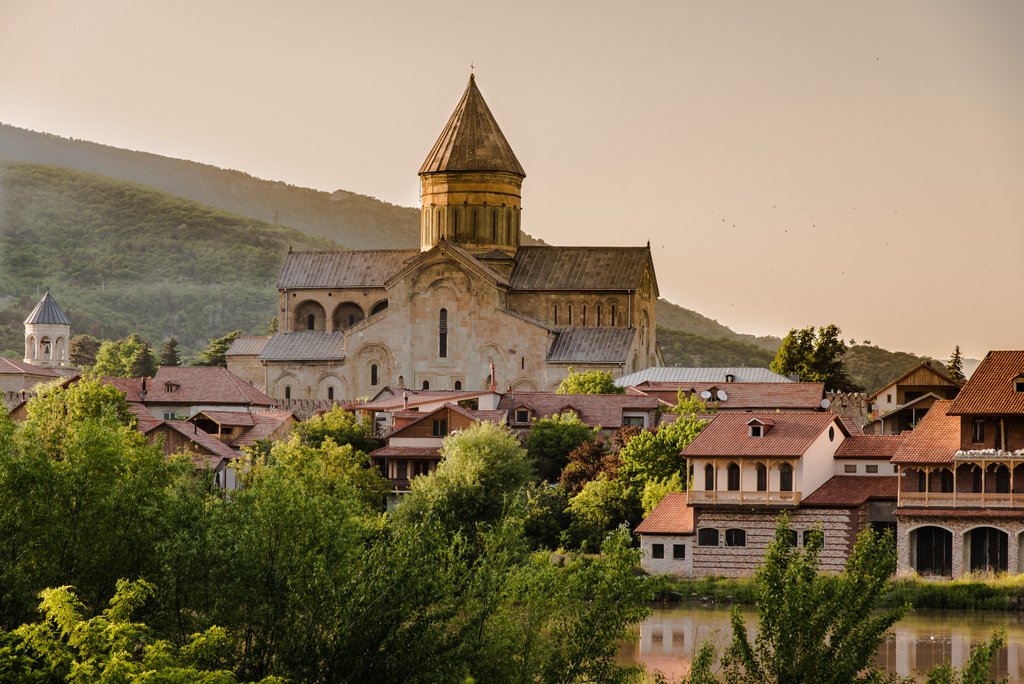
The Tusheti National Reserve is a model of administrative integration
because it performs three functions: the conservation of 28,000 hectares of forest where animals as threatened as the Caucasian Snowcock live; the protection of over 50 nomadic peoples, along with their historically valuable monuments; and the promotion of ecotourism. Tusheti, one of the most beautiful areas of Georgia, is in the north-eastern part of the country, and a visit to any of the seven main villages, such as Shenako, makes for an unusual experience. These people, who speak their own dialect, enjoy a joyful isolation and live in rudimentary houses that preserve the traditional charm of the past. They are always welcoming and they open their doors to visitors to share their everyday
household tasks, such as preparing the delicious dumpling known as “khinkali”, a ball of dough that is filled with spiced minced meat and lightly twisted before boiling.
▶ SUBSCRIBE! http://bit.ly/PlanetDoc Full Documentaries every Tuesday, Thursday and Saturday!
▶ Documentary "The secret of the Caucasus"
http://pdoc.es/GeorgiaPL
Life
in the city is completely different to surviving 2,000 metres above sea
level. Shenako, in which only two families live throughout the year,
has very harsh winters that make shepherding almost impossible. In the
face of such adversity, most Tushetian nomads move to the warm flatlands
of Kakheti, and their simple huts reflect their ability to adapt.
Vashlovani
National Park, in the south-eastern part of the country, has a
semi-desert ecosystem and is an excellent example of the varied
bio-diversity to be found in Georgia.
This Nature Reserve was created
by two Georgian scientists in 1935 and has recently been developed to
make it suitable for ecotourism. In the park there are some 60 species
of birds, 45 species of mammals and with luck, you can see an
exceptionally rare male leopard of a species that was thought to be
extinct.
One of the 13 Assyrian Holy Fathers who arrived in
Georgia in order to strengthen Christianity, David Gareja, is buried
here, and on his tomb there is a stone that symbolizes the one that the
distinguished Patriarch brought in his journey from the Holy Land. This
is why it is said that a third of Jerusalem’s holiness can be found in
this group of 19 monasteries carved out of the rock, named after their
founder, David Gareja, and that are still inhabited by monks today.
This
city, founded by David Gareja in the VI century A.D. has always been a
centre of constant pilgrimage. Notwithstanding Mongol aggression and
bloody Turkish attacks, religious activity was only interrupted during
the Soviet era, when the neighbouring lands were used as a military base
during the Afghan war.
▶SUBSCRIBE | http://bit.ly/PlanetDoc
▶FULL DOCUMENTARIES | http://planetdoc.tv/playlist-full-documentaries
▶ CULTURE | http://planetdoc.tv/playlist-culture
http://planetdoc.tv/playlist-wild-animals
▶FACEBOOK | http://bit.ly/FBPDoc
▶TWITTER | http://bit.ly/TwPDoc
▶TUMBLR | http://bit.ly/TbPlDoc
Showing posts with label Khinkali. Show all posts
Showing posts with label Khinkali. Show all posts
Sunday, January 31, 2016


Friday, January 03, 2014
DISCOVER GEORGIA: Khachapuri and Khinkali among Europe’s 55 dishes worth traveling for (thedailymeal.com)
(thedailymeal.com) Daily Mail gives a list of fifty five European Foods Worth Traveling For. Two Georgian dishes – Khachapuri and Khinkali are among them.
 ‘Even if we don’t always remember the history behind the Colosseum, the significance of Tower of London, or who commissioned Versailles, after returning home from a trip, we can almost always remember what we ate while we were there.
Of course, food memories can range from pleasurable to uncomfortable or even mediocre. Judgments aside, though, most of us travelers can agree that the times when we eat during a trip are most often also the times when we feel the most engaged. With all five senses stimulated, we not only see, hear, smell, or even touch a certain place — we taste it, too’.
Georgian dish that is on Daily Mail’s list of foods worth traveling for is Khachapuri: ‘This indulgent dish is like a blank canvas for different flavors. From Georgia, khachapuri is cheese-filled bread often topped with egg and butter. Because of its simplicity, there are many variations, and cooks often add potatoes, various cheeses, and sauces to the dish’.
Second Georgian dish on the list is Khinkali. ‘These Georgian dumplings are filled with mixtures of raw, spiced meats and various vegetables. The dumplings are prepared by being stuffed and then boiled, trapping the meat’s juice inside as the filling cooks. The result is a delicious, precious liquid that customers try not to spill as they eat the dumpling’, the Daily Mail informs.
To check other dishes worth traveling for, follow the link: thedailymeal.com
 ‘Even if we don’t always remember the history behind the Colosseum, the significance of Tower of London, or who commissioned Versailles, after returning home from a trip, we can almost always remember what we ate while we were there.
Of course, food memories can range from pleasurable to uncomfortable or even mediocre. Judgments aside, though, most of us travelers can agree that the times when we eat during a trip are most often also the times when we feel the most engaged. With all five senses stimulated, we not only see, hear, smell, or even touch a certain place — we taste it, too’.
Georgian dish that is on Daily Mail’s list of foods worth traveling for is Khachapuri: ‘This indulgent dish is like a blank canvas for different flavors. From Georgia, khachapuri is cheese-filled bread often topped with egg and butter. Because of its simplicity, there are many variations, and cooks often add potatoes, various cheeses, and sauces to the dish’.
Second Georgian dish on the list is Khinkali. ‘These Georgian dumplings are filled with mixtures of raw, spiced meats and various vegetables. The dumplings are prepared by being stuffed and then boiled, trapping the meat’s juice inside as the filling cooks. The result is a delicious, precious liquid that customers try not to spill as they eat the dumpling’, the Daily Mail informs.
To check other dishes worth traveling for, follow the link: thedailymeal.com
Monday, April 22, 2013
FOOD & WINE: Letter from Georgia: Doing the chacha. By Dan Peleschuk (guardian.co.uk)
(guardian.co.uk) A few shots of the national drink allow travellers to gaze on Tbilisi with fresh eyes
All afternoon, Lasha's attempts to describe the taste, strength and effects of chacha – Georgia's national spirit – had left us intrigued. We had spent the day touring the picturesque south Caucasian country, known for its majestic peaks, savoury cuisine and the hospitality of its locals. And Lasha, naturally, served as our source for all matters of local history and culture. But whenever the conversation turned toward chacha, a predominantly grape-based liquor reputed for its flavour and strength, he seemed at a loss for words.
Our guide, Lasha, couldn't find any other words: "Have a couple shots," he kept saying with a wry smile, "and you'll be set."
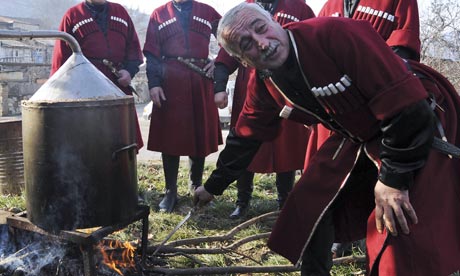 |
| Distilling the national spirit ... Georgian men in traditional clothes cook chacha during a holiday celebration. Photograph: Vano Shlamov/Getty |
So in the evening, as we headed back towards the capital of Tbilisi, a forlorn, roadside mess hut caught our attention. "Maybe they have it," Lasha wondered aloud as we pulled over.
He surveyed the kitchen, and we waited in the adjacent dining room. Minutes later, an apron-clad woman entered with a tray of khinkali, or boiled meat dumplings, and a bottle of clear, inconspicuous liquid. Success.
Once the khinkali had cooled, we raised our glasses, and toasted to one another. The subtle taste of grape tingled through my mouth as the high alcohol content registered, lighting my sinuses ablaze. A quick gulp of the salty juices from the khinkali neutralised the residual bitterness, but the satisfying burn remained. We repeated the process several times as the smile on my face grew larger. I soon realised Lasha was right: I was set.
The trip back to Tbilisi was swift. I began pulsating with excitement to explore the tree-lined streets and decaying, Tsarist-era buildings – sights we'd seen before, but not after several rounds of chacha. We bade Lasha farewell and escaped into the night, popping into one cafe after another. Somehow, the chacha changed everything. I was not drunk, but electric. My head wasn't spinning – it was sprinting ahead, along Tbilisi's winding streets.
The next morning, as we prepared to return home, Lasha appeared with a pair of two-litre water bottles filled with that same inconspicuous liquid. It was our own, home-brewed souvenir.
"Now I know you," he said with a smile. "Next time you come to Georgia, we'll celebrate properly."
• Every week Guardian Weekly publishes a Letter from one of its readers from around the world. We welcome submissions – they should focus on giving a clear sense of a place and its people. Please send them toweekly.letter.from@guardian.co.uk
Wednesday, July 04, 2012
PODCAST: Chinkali. Georgische Nudeltaschen. Von Irma Britze-Shiolashvili (funkhauseuropa.de)
(funkhauseuropa.de) Hackfleisch, Zwiebeln, Mehl, schwarzer Pfeffer, Salz und Koriander: das sind die Zutaten für Chinkali. Diese Spezialität aus der Küche Georgiens ist vergleichbar mit schwäbischen Maultauschen oder italienischen Ravioli. Jedoch sind Chinkali viel größer. Das Gericht stammt ursprünglich aus dem georgischen Hochgebirge. Die Städte Duscheti, Pasanauri und Mzcheta sind für eine besondere Qualität der Chinkali bekannt.
(12.06.12), 3'03
Chinkali+++ Zutaten
Für die Füllung:
750 g Lammhack oder gemischtes Schweine- und Rinderhack
Salz
Schwarzer Pfeffer
3 große Zwiebeln, sehr fein gehackt
1 Bund Koriander, fein gehackt
Für den Teig:
650 Mehl
ca. 150 ml Lauwarmes Salzwasser
Zubereitung
Das Hackflesich mit Salz, Pfeffer, Zwiebeln, Koriander und dem lauwarmem Wasser verkneten.
Aus Mehl und Salzwasser einen glatten Teig zubereiten, dünn ausrollen und Kreise mit einem Glas ausstechen.
Die Kreise nochmal ausrollen, so dass die Ränder dünner und die Flächen größer werden, dann einen Esslöffel gewürztes Hackfleisch in die Mitte von jedem Kreis geben.
Die Teigränder in der Mitte über der Füllung zusammenraffen und vorsichtig miteinander verkneten; so dass ein kleines Päckchen entsteht.
Die Chinkali in einen großen Topf mit kochendem, wenig gesalzenem Wasser geben und leicht sieden lassen, dabei ab und zu mit einem Holzlöffel im Wasser bewegen. Wenn die Chinkali an der Oberfläche schwimmen, noch ca. 10 Minuten weitersieden lassen. Dann mit einem Schaumlöffel aus dem Wasser heben, mit schwarzem Pfeffer bestreuen und heiß servieren.
(Irma Britze-Shiolashvili)
Saturday, June 19, 2010
VIDEO: Zu Tisch in ... Georgien (videos.arte.tv)
Ein Film von Eberhard Rühle
Der ganze Artikel mit den Rezepten >>>
Jimscher Chuzischwili und sein Sohn Avto schlendern gemächlich durch ihre Weinfelder und prüfen den Reifegrad der Trauben. Am nächsten Morgen soll die Ernte beginnen. Für beide ist die Weinlese die wichtigste Zeit im Jahr. Ein Großteil ihres Familieneinkommens hängt davon ab. "Zu Tisch in ..." dokumentiert die Zeit vor und während der Weinlese.
Alle helfen mit, die Speisen für den Ernteeinsatz und das Erntefest danach vorzubereiten. Jimschers Frau Eteri backt Brot, während Avtos Frau Manana und ihre Mutter Cinkali zubereiten, die typischen mit Fleisch gefüllten Teigtaschen Georgiens. Gleichzeitig überwacht Jimscher die Reinigung des unterirdischen Weintanks. Ein Nachbarjunge schlüpft in die tönerne Amphore und bürstet die Ablagerungen des letzten Jahrgangs von den Wänden.
Avto und Jimscher leben im Dorf Gavazi im Alazani-Tal. Die Gegend im Süden des Hohen Kaukasus war eine der reichsten Regionen der Sowjetunion. Doch seit dem Beginn der Blockadepolitik Russlands ist der Weinexport stark eingebrochen. Viele Weinberge liegen inzwischen brach. Um in der Krise zu überleben, haben Jimscher und sein Sohn versucht, neue Einkommensquellen zu erschließen. Sie mussten unabhängiger werden von der Weinproduktion. Jimscher hat dabei geholfen, so dass er schon zu Sowjetzeiten selbstständig war, ein "Kapitalist", wie er schmunzelnd sagt.
Für die großen Kolchosen hat er Schreinerarbeiten ausgeführt und nach und nach auch seinem Sohn das Tischlerhandwerk beigebracht. Inzwischen bauen die beiden Fenster, Türen und Möbel für die Dorfbewohner. Neben dem Wein ist die Tischlerei heute die Haupteinnahmequelle der Familie. Außerdem hat sich Avto das Imkern beigebracht, denn auch Honig ist ein gutes Zubrot. Seine Frau Manana arbeitet als Lehrerin in der Dorfschule.
Der Film beobachtet mit Sympathie, wie Familie Chuzischwili es schafft, die Krise zu meistern und trotz aller Widrigkeiten, die das Land Georgien in seiner Entwicklung hemmen, glücklich zu sein. Am Ende helfen alle zusammen bei der Ernte - die Familie, die Verwandten, die Nachbarn. Und trotz sengender Hitze haben die Chuzischwilis und ihre Freunde Spaß bei der Weinlese.
(Deutschland, 2008, 26mn)
ZDF
Erstausstrahlungstermin: Sa, 12. Jun 2010, 17:48
source: videos.arte.tv
Der ganze Artikel mit den Rezepten >>>
Jimscher Chuzischwili und sein Sohn Avto schlendern gemächlich durch ihre Weinfelder und prüfen den Reifegrad der Trauben. Am nächsten Morgen soll die Ernte beginnen. Für beide ist die Weinlese die wichtigste Zeit im Jahr. Ein Großteil ihres Familieneinkommens hängt davon ab. "Zu Tisch in ..." dokumentiert die Zeit vor und während der Weinlese.
Alle helfen mit, die Speisen für den Ernteeinsatz und das Erntefest danach vorzubereiten. Jimschers Frau Eteri backt Brot, während Avtos Frau Manana und ihre Mutter Cinkali zubereiten, die typischen mit Fleisch gefüllten Teigtaschen Georgiens. Gleichzeitig überwacht Jimscher die Reinigung des unterirdischen Weintanks. Ein Nachbarjunge schlüpft in die tönerne Amphore und bürstet die Ablagerungen des letzten Jahrgangs von den Wänden.
Avto und Jimscher leben im Dorf Gavazi im Alazani-Tal. Die Gegend im Süden des Hohen Kaukasus war eine der reichsten Regionen der Sowjetunion. Doch seit dem Beginn der Blockadepolitik Russlands ist der Weinexport stark eingebrochen. Viele Weinberge liegen inzwischen brach. Um in der Krise zu überleben, haben Jimscher und sein Sohn versucht, neue Einkommensquellen zu erschließen. Sie mussten unabhängiger werden von der Weinproduktion. Jimscher hat dabei geholfen, so dass er schon zu Sowjetzeiten selbstständig war, ein "Kapitalist", wie er schmunzelnd sagt.
Für die großen Kolchosen hat er Schreinerarbeiten ausgeführt und nach und nach auch seinem Sohn das Tischlerhandwerk beigebracht. Inzwischen bauen die beiden Fenster, Türen und Möbel für die Dorfbewohner. Neben dem Wein ist die Tischlerei heute die Haupteinnahmequelle der Familie. Außerdem hat sich Avto das Imkern beigebracht, denn auch Honig ist ein gutes Zubrot. Seine Frau Manana arbeitet als Lehrerin in der Dorfschule.
Der Film beobachtet mit Sympathie, wie Familie Chuzischwili es schafft, die Krise zu meistern und trotz aller Widrigkeiten, die das Land Georgien in seiner Entwicklung hemmen, glücklich zu sein. Am Ende helfen alle zusammen bei der Ernte - die Familie, die Verwandten, die Nachbarn. Und trotz sengender Hitze haben die Chuzischwilis und ihre Freunde Spaß bei der Weinlese.
(Deutschland, 2008, 26mn)
ZDF
Erstausstrahlungstermin: Sa, 12. Jun 2010, 17:48
source: videos.arte.tv
Monday, October 12, 2009
BERLIN: GEORGISCHES KOCHSTUDIO
Georgisches Kochstudio lädt ein: Freitag, den 23. Oktober um 19:30 Uhr im WEINHAUS & KUNSTGALERIE GRUSIGNAC (Mit Voranmeldug)
"Man kann durchaus sagen, dass man nirgends so viel Wein trinkt und nirgends so ausgezeichnet isst wie in Georgien..." das sagte Jean Chardin im Jahr 1686.
Überzeugen Sie sich selbst und lernen Sie die georgische Küche mit ihren Raffinessen, ihrer Einzigartigkeit kennen. Wir bieten Ihnen einen Kochkurs der besonderen Art.
Traditionale Küche aus der Hand einer georgischen Hausfrau. Tamara Kistauri zeigt Ihnen die Zubereitung der beliebtesten landestypischen Spezialitäten. Sie lehrt Ihnen mit einfachen Schritten das Herstellen der weltbekannten "Chinkali", einer Art Teigtaschen gefüllt mit verschiedenem Fleisch, Zwiebeln und einer Kräutermischung mit reichlich Koriander. (mögliche Versionen: Quark-Käse, Kartoffeln oder Champignon).
Die Zubereitung des Auberginensalats "Badrijani Nigwsit da Brozeulit", eine wahre Köstlichkeit mit gehakten Walnüssen und Granatapfelkernen, abgeschmeckt mit ausgewählten georgischen Geschmackszutaten.
Lassen Sie sich überraschen, lernen und kochen Sie mit Frau Kistauri weitere Gerichte mit dem unverwechselbaren typisch georgischen Geschmack.
Begleitet wird der Kochkurs von der Geschichte des georgischen Weins. Früher berühmt, sowie immer noch sehr beliebt in dem heutigen neuen Russland, zeigen wir Ihnen die Bandbreite dieses edlen Getränks. Wir verkosten sechs verschiedene Qualitäten und schließen den Abend mit zwei weiteren in Georgien hergestellten Spiritousen Veranstaltungsdauer: ca.3 Stunden, nur gegen Voranmeldung und Vorauskasse.
Preis pro Person € 29,50. Teilnehmeranzahl begrenzt.
WEINHAUS & KUNSTGALERIE GRUSIGNAC
Prenzlauer Allee 191, 10405 Berlin.
Tel: 030/66868136
Mail: info@grusignac.de
www.grusignac.de
www.grusignac-art.de
"Man kann durchaus sagen, dass man nirgends so viel Wein trinkt und nirgends so ausgezeichnet isst wie in Georgien..." das sagte Jean Chardin im Jahr 1686.
Überzeugen Sie sich selbst und lernen Sie die georgische Küche mit ihren Raffinessen, ihrer Einzigartigkeit kennen. Wir bieten Ihnen einen Kochkurs der besonderen Art.
Traditionale Küche aus der Hand einer georgischen Hausfrau. Tamara Kistauri zeigt Ihnen die Zubereitung der beliebtesten landestypischen Spezialitäten. Sie lehrt Ihnen mit einfachen Schritten das Herstellen der weltbekannten "Chinkali", einer Art Teigtaschen gefüllt mit verschiedenem Fleisch, Zwiebeln und einer Kräutermischung mit reichlich Koriander. (mögliche Versionen: Quark-Käse, Kartoffeln oder Champignon).
Die Zubereitung des Auberginensalats "Badrijani Nigwsit da Brozeulit", eine wahre Köstlichkeit mit gehakten Walnüssen und Granatapfelkernen, abgeschmeckt mit ausgewählten georgischen Geschmackszutaten.
Lassen Sie sich überraschen, lernen und kochen Sie mit Frau Kistauri weitere Gerichte mit dem unverwechselbaren typisch georgischen Geschmack.
Begleitet wird der Kochkurs von der Geschichte des georgischen Weins. Früher berühmt, sowie immer noch sehr beliebt in dem heutigen neuen Russland, zeigen wir Ihnen die Bandbreite dieses edlen Getränks. Wir verkosten sechs verschiedene Qualitäten und schließen den Abend mit zwei weiteren in Georgien hergestellten Spiritousen Veranstaltungsdauer: ca.3 Stunden, nur gegen Voranmeldung und Vorauskasse.
Preis pro Person € 29,50. Teilnehmeranzahl begrenzt.
WEINHAUS & KUNSTGALERIE GRUSIGNAC
Prenzlauer Allee 191, 10405 Berlin.
Tel: 030/66868136
Mail: info@grusignac.de
www.grusignac.de
www.grusignac-art.de
Friday, July 10, 2009
REZEPT: Khinkali, für Freunde gemacht in Mecklenburg-Vorpommern (sakartwelo.de)
 Zutaten:
etwa 1 kg Weizenmehl
1 kg Fleisch (500 g Rind- und 500 g Schweinefilet)
5 mittelgrosse Zwiebeln
Petersilie, Koriander, Thymian, Paprika und Salz nach Ihrem Geschmack
Schwarzen gemahlenen Pfeffer zum Bestreuen
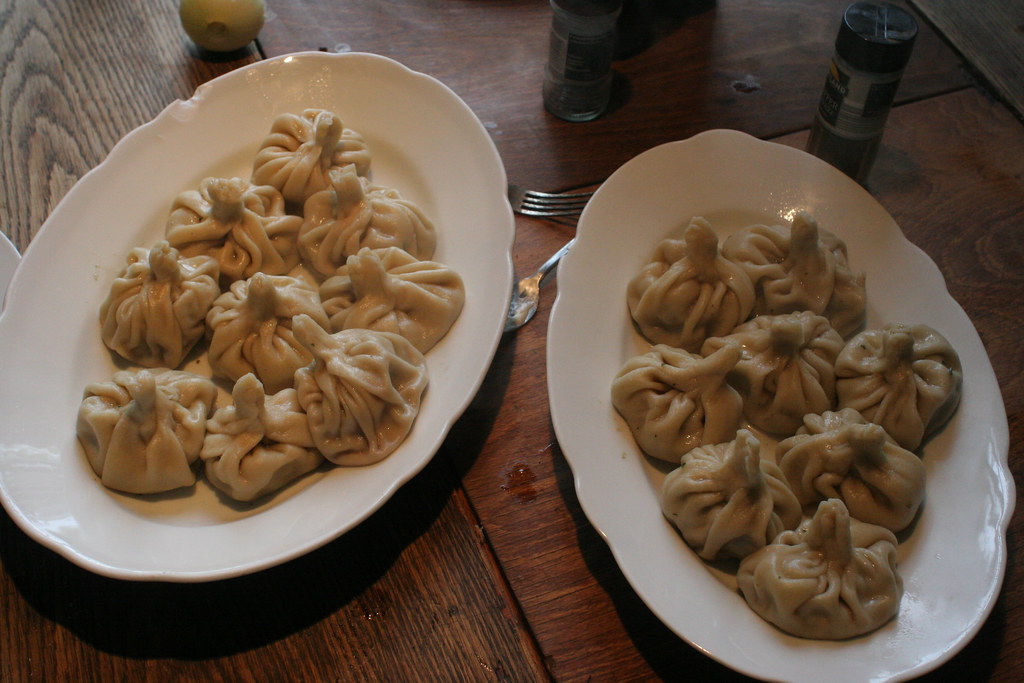
Zubereitung: Mit 0,5 l lauwarmem, nach Geschmack gesalzenen Wasser und Mehl einen harten Teig kneten. Das Fleisch zusammen mit den Zwiebeln und Kräutern durch einen Fleischwolf drehen, Paprika und Salz dazugeben und mit etwa 150-200 g warmem Wasser auffüllen.Den Teig ausrollen, kleine runde Stücke (1 cm hoch und 4 cm Durchmesser) ausschneiden, einzeln dünn ausrollen, jeweils einen Eßlöffel Fleischmasse darauf legen, als Falten zusammenziehen und den "Stiel" gut verschließen, damit der Fleischsaft nicht herausfließt. Die Chinkalis in etwa 3-4 l kochendes Salzwasser geben (die Anzahl der Teigtaschen im Topf hängt von der Größe des Topfes ab, man kann die Chinkalis halb-halb oder in drei Teile kochen ) und zudecken. Einige Male leicht umrühren, damit die Chinkalis nicht an den Topfboden kleben. Wenn das Salzwasser im Topf wieder aufkocht und alle Chinkalis an der Oberfläche schwimmen, muss Chinkali noch 5 Minuten ziehen. Dann mit einem Schaumlöffel herausnehmen, auf einen Teller legen und gleich nach Geschmack pfeffern. Chinkali wird noch heiß mit Schnaps (ChaCha) oder Bier serviert.
Mehr Rezepte hier: www.sakartwelo.de
Subscribe to:
Posts (Atom)