Showing posts with label Guardian. Show all posts

Monday, April 22, 2013

FOOD & WINE: Letter from Georgia: Doing the chacha. By Dan Peleschuk (guardian.co.uk)

(guardian.co.uk) A few shots of the national drink allow travellers to gaze on Tbilisi with fresh eyes


Our guide, Lasha, couldn't find any other words: "Have a couple shots," he kept saying with a wry smile, "and you'll be set."
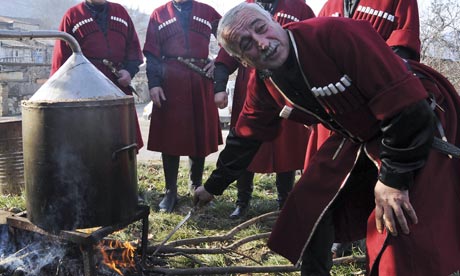
Georgia making chacha
Distilling the national spirit ... Georgian men in traditional clothes cook chacha during a holiday celebration. Photograph: Vano Shlamov/Getty
All afternoon, Lasha's attempts to describe the taste, strength and effects of chacha – Georgia's national spirit – had left us intrigued. We had spent the day touring the picturesque south Caucasian country, known for its majestic peaks, savoury cuisine and the hospitality of its locals. And Lasha, naturally, served as our source for all matters of local history and culture. But whenever the conversation turned toward chacha, a predominantly grape-based liquor reputed for its flavour and strength, he seemed at a loss for words.
So in the evening, as we headed back towards the capital of Tbilisi, a forlorn, roadside mess hut caught our attention. "Maybe they have it," Lasha wondered aloud as we pulled over.
He surveyed the kitchen, and we waited in the adjacent dining room. Minutes later, an apron-clad woman entered with a tray of khinkali, or boiled meat dumplings, and a bottle of clear, inconspicuous liquid. Success.
Once the khinkali had cooled, we raised our glasses, and toasted to one another. The subtle taste of grape tingled through my mouth as the high alcohol content registered, lighting my sinuses ablaze. A quick gulp of the salty juices from the khinkali neutralised the residual bitterness, but the satisfying burn remained. We repeated the process several times as the smile on my face grew larger. I soon realised Lasha was right: I was set.
The trip back to Tbilisi was swift. I began pulsating with excitement to explore the tree-lined streets and decaying, Tsarist-era buildings – sights we'd seen before, but not after several rounds of chacha. We bade Lasha farewell and escaped into the night, popping into one cafe after another. Somehow, the chacha changed everything. I was not drunk, but electric. My head wasn't spinning – it was sprinting ahead, along Tbilisi's winding streets.
The next morning, as we prepared to return home, Lasha appeared with a pair of two-litre water bottles filled with that same inconspicuous liquid. It was our own, home-brewed souvenir.
"Now I know you," he said with a smile. "Next time you come to Georgia, we'll celebrate properly."
• Every week Guardian Weekly publishes a Letter from one of its readers from around the world. We welcome submissions – they should focus on giving a clear sense of a place and its people. Please send them toweekly.letter.from@guardian.co.uk

Saturday, January 26, 2013

TRAVEL: Jessica Hynes: Tbilisi or bust (guardian.co.uk)

(guardian.co.uk) Jessica Hynes wanted churches, art, poetry. Her sister? Not so much. Would they get through their city break to the Georgian capital without squabbling?

The Guardian homeBy Jessica Hynes 
The Guardian,

The last time I travelled with my sister Zoe was a trip to Turkey 17 years ago. She beat all the men off the backgammon table, I tried to hire a moped without a licence and nearly crashed it, and my mother got so badly sunburned she had to stay in her hotel room. This trip was infinitely more sophisticated – not, as you might think, because we are old bags, but because Tbilisi is heaven on Earth. Not just because you can still smoke, or because the food you eat in every restaurant is fresh, seasonal and unlike anything you've ever eaten, or because you can drink usakhelauri, a wonderful light semi-sweet red wine (I am cradling a bottle to open on my sister's birthday). But also because, despite relentless onslaughts over centuries from unfriendly neighbours, the Georgian culture and spirit remain undimmed.

It was the Georgians I met while filming the BBC show World's Most Dangerous Roads whose enthusiasm, kindness and pride in their country inspired me to return. My sister is a fashion designer and jumped at the chance to join me. She and I travelled a lot as children, to stay with relatives in Canada and America in the summer holidays. As adults, we have both been all over the world for work, but rarely for pleasure. With five children between us and the busy, erratic schedules of self-employed mums, a weekend away from it all felt well overdue.

My intention was to push life's stresses from my sister's head by filling it with the wonders of the city (ie, waffle on at her) – something she let me do, a wry smile at the corner of her mouth.

First up was the Kashveti Church on Rustaveli Avenue. An eclectic array of framed religious paintings climb the walls, but beneath is a grey wash, all the original religious murals gone – the Communist contribution to this beautiful place. My sister and I refrained from whipping out our cameras and capturing a rather handsome portrait of Jesus because it felt disrespectful, but trust me, he really did look a bit like James Franco.

Next door was the National Gallery of Georgia. The gallery space is huge and grand, with comfortable benches for sitting and looking, which is what we did with great pleasure, this trip being a rare chance to evade childcare. We both loved Imeretia – My Mother, a stunning portrait of painter David Kakabadze's mother doing needlework. It made me feel desperately inadequate that I have not, as yet, ever crocheted a pair of socks.

Jessica Hynes and her sister Zoe at the Kashveti Church in Tbilisi
Photograph: Temo Bardzimashvili

Monday, October 01, 2012

ARTICLE: Georgia election on a knife edge as two visions collide. By Luke Harding (guardian.co.uk)


Luke Harding(guardian.co.uk) Billionaire Bidzina Ivanishvili's intervention has transformed the political climate on Russia's doorstep 

In a glass mountain-top palace that looms over Tbilisi like something from a Bond movie, Bidzina Ivanishvili talks fondly of his penguins. It's not true, he says, that he keeps them in a special refrigerator. "I have a breed capable of standing normal temperatures," he explains. He also owns several lemurs, a herd of deer and a pet zebra – not to mention a stunning collection of modern art, all financed with a fortune made in Russia.
The billionaire is leading the country's once-divided opposition into the most important election since the rose revolution swept the old order from power almost a decade ago. For the first time, Mikheil Saakashvili – the hero of that hour – faces a real challenge to his authority in parliamentary elections on Monday that could change the course of this corner of the Caucasus. 

Bidzina Ivanishvili
Photograph: Georgy Abdaladze/AP
The poll is bitterly contested. This small mountain nation (population: 4.7 million) on the doorstep of Russia is more polarised than at any time since 1991 and independence from the Soviet Union. At stake is whether Georgia moves towards genuine democracy, or whether the rose revolution that swept Saakashvili to power in 2003 fizzles out.

The country is also at the heart of a strategic battle between Moscow and the west. Russia insists Georgia is part of its backyard. To prove a point, it invaded in 2008 after Saakashvili unwisely tried to grab back rebel South Ossetia. Washington and the EU say Georgia is a sovereign nation that can decide its own destiny. Two geopolitical visions, Atlanticist and neo-Soviet, collide in a landscape of ancient villages, medieval towers and breathtaking mountains.

Until recently, Saakashvili and his ruling United National Movement party had been expected to cruise to victory. All this changed after the release by two opposition TV stations 12 days ago of a horrific video showing prison officers abusing inmates and sodomising them with broom handles. "When I watched it I thought it was a nightmare. The images were just awful," said Khatuna Kipiani, an opposition supporter.
The video revealed something rotten at the heart of Georgia's state. It has appalled Georgian voters, embarrassed the authorities, and led to a surge of support for Georgia's opposition and for Ivanishvili, whose $6.4bn (£4bn) fortune is put at half of Georgia's GDP. He burst on to the political scene a year ago, following years of quiet philanthropy in which he had paid for police uniforms, restored crumbling churches and funded salaries for actors and struggling artists – a sort of Georgian fairy godfather.

His Georgian Dream coalition, named after a song by his rapper son, lags behind Saakashvili's ruling party in the ratings. But it is catching up, according to the latest polls. On Saturday evening, 100,000 Georgian Dream supporters packed into Tbilisi's central Rustaveli Avenue. "It is as clear as day – we will win and achieve another victory in the history of our nation," Ivanishvili told them. "We will not let anyone separate us from civilisation, modern times and democracy."

His rise has spooked the government. It has variously dismissed him as a Kremlin stooge, a political dilettante, a "weirdo", and an old-style paternalist. Government aides mock his zoo, kept at his village home in western Georgia. They also say his sprawling coalition includes unsavoury elements, such as xenophobes and fans of Stalin, who was born in the Georgian town of Gori. But, undoubtedly, Ivanishvili has plugged into a mood of popular discontent and fatigue with Saakashvili, who critics say has become increasingly dictatorial.

Ivanishvili dismisses the government's many charges against him and says that it is Saakashvili who is the monster: "I'm very happy that I'm physically here and alive. You don't know Saakashvili's true face. He's capable of doing some atrocious things."

Thousands of observers have flooded into Georgia for the election. Lobbyists hired by Ivanishvili have bombarded members of the US Congress and other opinion-makers with emails promoting Georgian Dream and accusing Saakashvili of treachery. The Georgian government has hit back: all international visitors to Georgia, a land of ancient viniculture, receive a free bottle of Saperavi wine from passport control. The government also says that Ivanishvili is using his money, made in the 1990s, to buy the election.

In a report on Saturday, Transparency International, which describes itself as an anti-corruption organisation, blamed both sides for presenting "simplistic programmes" for increased social spending. For many voters, it is poverty and unemployment that have driven them to support Georgia's opposition.

Sitting in a Tbilisi park on a warm evening, next to a statue of Giorgi Leonidze, a Georgian poet, Manana Nizharadze said she was surviving on a state pension of just 100 lari (£37) a month. "We live very badly. Wages are low. Communal charges are high. We can't afford medicines," she said. "Saakashvili is a bad person."

Edward Saakashvili, a distant relative of the president, demurred. "He's done good things. People don't like discipline," he said, tossing back a glass of schnapps.

Many voters complain of the president's disastrous 2008 war with Russia. Both South Ossetia and Abkhazia – which broke away in the 1990s – are now home to a massive Russian military presence. Russia's president, Vladimir Putin, who famously described how he wanted to "hang Saakashvili by the balls", conducted military exercises there last week, a crude reminder to Tbilisi that Moscow could reinvade any time.

"Shevadnadze lost the whole of Abkahzia. Misha [Saakashvili] lost Ossetia. It was a big mistake," said Nizharadze.

Saakashvili's own future is unclear. He is 44 and due to step down as president in January 2013. His government has enacted constitutional changes that will transform Georgia next year from a presidential to a parliamentary republic. This has fuelled speculation that Saakashvili is planning to "do a Putin", and perform a job swap that would see him hang on to executive power by becoming prime minister.
His government colleagues, however, are sceptical of such a manoeuvre. "Politically it's impossible," said Giga Bokeria, secretary of Georgia's national security council.

Friday, September 07, 2012

ART: Artist of the week 206: Thea Djordjadze. By Skye Sherwin (guardian.co.uk)

(guardian.co.uk- By Skye Sherwin) This Georgia-born artist works quickly and intuitively, creating poetic, allusive arrangements that hint at ever-shifting stories.

Thea Djordjadze
A greenhouse emptied of plant life provides the perfect setting for Thea Djordjadze's As sagas sa. Photograph: David Meskhi ©/courtesy Sprüth Magers Berlin London
It's rare that art as apparently spartan as Thea Djordjadze's can be so tantalising. The thin wooden or metal frames and glass vitrines that frequently star in her sculptural assemblages suggest a minimalist sensibility and evoke the pristine, poker-faced displays of museums. Yet these elements of her art rub shoulders with more worn-in, personal fare, including rugs, reconfigured furniture and rough, hand-moulded lumps of uncooked clay. Things look fragile and faded, like relics from a lost civilisation.

Djordjadze's materials are worked fast and arranged intuitively, with an eye for colour, texture and lines drawn through space that hints at her early training as a painter. Growing up in former communist Georgia has also left its mark on the Berlin-based artist's sensibility. Her work often features the country's local carpets, while its pared-back appearance and flimsy materials echo the clean, definite forms of eastern-bloc architecture, belying a shaky political regime. In place of modernist purity, she creates poetic, allusive arrangements of objects, hinting at stories that never sit still.

As sagas sa, her contribution to the current Documenta (13), uses the perfect setting for her sculptural micro-universe: a cavernous greenhouse emptied of plant life, with a gravelly dry-dirt floor and stained panes. It's like a cross between some millennia-old museum's vitrine and a wasted version of the vegetation-filled glass domes travelling through space, in the 1970s sci-fi classic Silent Running.

Wandering through the installation she's created in response to the site, you're in a self-contained world. Tableaux of furniture, glass cases and paint-smeared blocks of foam suggest the enclosed realms of both domestic life and theatrical display. A faded, cheap, gauzy fabric hangs across one end of the arid greenhouse like a stage curtain, or a waterfall.

All these objects soon start to shapeshift in your head. A sharp rectangle and square become a neatly geometric bed and pillow. Yet for all its minimalist precision, the piece is made of squidgy, vulnerable foam and smeared with gooey white pigment. It's unnervingly physical, begrimed, sexual. The plastic chair sitting at its foot might be a nurse at a sickbed, or the aggressive master to this passive, prone form.

With dust underfoot and in your lungs, it's like being in an ancient burial chamber, and yet those urgent white plaster smears are very much in the present tense. There's the electric sensation that all is held in suspense, while perpetually shifting between one state and another.

Why we like her: For Deaf and Dumb Universe, which echoed the chic glass and steel architecture of Berlin's Neue Nationalgalerie, with blocky foam chairs tottering on black spidery legs, lumpy bits of clay perched on clean white shelving, and a metal frame shaped like a wendy house.

Two Heads: Beyond her solo projects, Djordjadze has long collaborated with her friend and former teacher, feminist art icon Rosemarie Trockel

Where can I see her? At Documenta (13) in Kassel, Germany, until 16 September, and Sprueth Magers, London, until 29 September.

Tuesday, August 28, 2012

ARTICLE: Letter from Azerbaijan: off the map. By Dan Peleschuk (guardian.co.uk)

(guardian.co.uk) The leafy boulevards of Stepanakert, in Nagorno-Karabakh, are beginning to attract visitors, but to most of the international community the republic doesn't exist.

Dan Peleschuk, Guardian Weekly, Tuesday 28 August 2012

letter nagorno-karabakh
Photograph: Karen Minasyan/AFP/Getty
In many ways, Stepanakert resembles a small American town on the rise. Its main boulevards have been repaved, locals stroll through the renovated central square past its elegant fountain, and hotels have sprouted on every other block to hold the new influx of visitors.

But as some people see things, it doesn't really exist, and neither does the ethnic Armenian Nagorno-Karabakh Republic, of which Stepanakert is the capital. According to the rest of the world, the region belongs to Azerbaijan, and no one – not even Armenia, Karabakh's patron state – recognises it.

But that doesn't stop the self-proclaimed country from celebrating its 20 years of de facto independence this year. Patriotic banners flutter above Stepanakert's streets, and posters of the soldiers who during a bloody war in the early 1990s helped wrest the land away from Azerbaijan line the sidewalks.

Not long ago much of the city was in ruins and the economy virtually non-existent. Today locals meander along leafy streets lined with new banks, stores and government buildings. A tourism industry is slowly taking root, as travellers from across the world descend on the tiny republic, population about 141,000, in increasing numbers.

But under the surface are scars of a war that left more than 30,000 dead and many displaced. War is the only reason the Nagorno-Karabakh Republic exists. War – the memories of it, the fears of its return – is what makes it tick. Perhaps the best reminder of this is Aghdam, the ghostly shell of a former Azeri settlement levelled by Armenian forces in 1993. Just a short drive from Stepanakert, the one-time city of around 30,000 was reduced to grassy craters and jagged stone remnants of former apartments, schools and community centres. Visible from the only road that leads north to Karabakh's famed ancient monasteries, it is easy to notice.

Yet ordinary Karabakh Armenians are trying to capitalise on the relative post-war stability. Even as border tensions have escalated in recent months, which have seen deadly skirmishes between Armenian and Azeri forces, small-time businessman Ashot Simonyan says foreign visitors have continued to stream through his spare rental apartments.

"Everyone who comes here really loves it," he says with a salesman's grin. "We have everything a tourist needs – it's completely normal here."

Every week Guardian Weekly publishes a Letter from one of its readers from around the world. We welcome submissions – they should focus on giving a clear sense of a place and its people. Send them to weekly.letter.from@guardian.co.uk

• This article was inadvertently published on the web a week early, and with a different headline.

Wednesday, July 25, 2012

IN CAUCASUS: Lo'Jo: tour de force. By Andy Morgan (guardian.co.uk)

Members of Lo'Jo
Members of Lo'Jo in Tbilisi, Georgia. Photograph: Andy Morgan/The Guardian
(guardian.co.uk/music) Globetrotting French daredevils Lo'Jo tell Andy Morgan why being shot in Chechnya only made them play harder

It's a rainy night in Georgia, but Randy Crawford is the last person on anyone's mind. This is Georgia in the Caucasus, not the US – and the French band Lo'Jo are taking the stage in a pine-filled park on the edge of Tbilisi. Someone asks our genial host, Niaz Diasamidze, master of the panduri or three-stringed Caucasian lute, if the rain usually stops Tbilisians venturing out. "It depends," he says. "If there's a revolution going on, they'll come out."

(...)

Thirty years of travelling with open ears has given Lo'Jo's sound a unique richness. They play funky dubbed-up chanson, raw yet intricate, with a bewildering variety of influences. It all adds up to a brilliant whole that scorns classification. Fronting the drums, double bass, keyboards and violin is the polyglot growl of Péan, who could be the gallic cousin of Tom Waits. Just behind him swells the sweetly disorientating vocal assault of the Nid el Mourid sisters, who come across like the Berber cousins of the B52s. In three decades of marginal music-making, Lo'Jo have picked up fans as diverse as Robert Plant, Ibrahim Ag Alhabib from Tinariwen and Robert Wyatt, who sings the opening lines of Cinema El Mundo, the band's 13th and latest album, which is out in September. The crowds at Womad will get a taste of it this weekend, when the band hits the Wiltshire festival.


A powerful curiosity drove Péan and the band to join Babel Caucase. A humanitarian caravan of musicians, film-makers, artists, circus performers and ordinary big-hearted folk, it traversed Europe in 2007 with the aim of raising awareness about the suffering of the Chechen people. The caravan, led by the French documentary-maker Mylène Saunoy, was heading for Grozny, but in the end it got stuck in Georgia, where Lo'Jo came aboard. It was their first visit to this country whose charm, according to Péan, "is beyond discussion or analysis". He found the "sober rurality" of its countryside evocative of rural France from a century ago. For singer Nadia Nid el Mourid, it was like "Africa, only white not black".
 
The band played a gig in a Chechen refugee village up in the Pankisi Gorge, a deep and strategic gash in the high mountains of eastern Georgia. It turned out to be another of those happenings that Lo'Jo specialise in: an adventure of bewildering strangeness, beauty and danger, all made possible by music. "It was very tense," Péan remembers. "There was a lot of excitement, thanks partly to alcohol, and partly to the fact that the caravan was there. I had the same feeling that I have had at times when we've played in the high-rise housing estates of the French banlieues – that slight sense of vertigo, of uh-oh, what's going to happen? We were surrounded by people whose blood was very hot, and you had to be very honest if you didn't want to be thrown out."
 
During the first song, Yamina Nid el Mourid was hit just above the eye by a pellet fired from a gun. "All these Chechen kids had these handguns because they were celebrating the Festival of Resistance," she says. "I was worried the pellet could have blinded me, but at the same time it gave me the strength to win them over, to say, 'Yes! We're here.' By the end of the gig, it was very powerful, because the audience were on our side. The music broke the barriers down. It was beautiful."
 
• Cinema El Mundo is out on World Village/Harmonia Mundi on 24 September. Lo'Jo play Womad this weekend. Follow the Guardian's daily festival coverage at guardian.co.uk/music

Saturday, April 14, 2012

INTERVIEW: Emin Milli spricht im Interview über Menschenrechte und Baku 2012 (fr-online.de)

Das Gespräch führte Patrick Schirmer Sastre. 

(fr-online.de) Aserbaidschan - "Ich habe keine Angst"

Der aserbaidschanische Blogger Emin Milli spricht im Interview über Menschenrechte und Baku 2012. Derzeit studiert Milli in London, möchte aber im September in seine Heimat zurückkehren. 


Emin Milli will sagen können, was er denkt – auch in seiner Heimat Aserbaidschan.
      Mit einem satirischen Video über einen absurd teuren Eselkauf durch die Regierung fing alles an. Kurz nach der Veröffentlichung wurde der aserbaidschanische Blogger Emin Milli im Juli 2009 verhaftet und zu zweieinhalb Jahren Gefängnis verurteilt. Nach internationalen Protesten – unter anderem setzte sich US-Präsident Barack Obama für ihn ein – kam er nach 17 Monaten frei. Zur Zeit lebt und studiert Emin Milli in London. Er ist ein bekannter und ausdauernder Kämpfer für die Menschenrechte in seinem Heimatland, das am 26. Mai den Eurovision Song Contest austrägt.
Herr Milli, haben Sie sich über den Sieg Aserbaidschans beim letzten Eurovision Song Contest gefreut?

Na ja, ich bin kein großer Fan von Eurovision. Aber ich habe erkannt, welche Möglichkeiten uns dieser Erfolg bringen wird, um international auf die Probleme in unserem Land hinzuweisen. In diesem Zusammenhang, ja, habe ich mich wirklich gefreut.

Welche Probleme sind das?

Erstens, dass Armenien die aserbaidschanische Region Bergkarabach besetzt hat. Es ist wichtig, dass die Frage um dieses Gebiet gelöst wird. Sie behindert die demokratischen Prozesse, da beide Regierungen den Konflikt als Ausrede nehmen, um Reformen zu verschleppen. Zweitens müssen diese demokratischen Reformen in Gang gebracht werden. Die politischen Gefangenen müssen freigelassen werden. Und wir brauchen eine freie Presse.

Kann eine Schlagerveranstaltung Plattform für politische Inhalte sein?

Die European Broadcasting Union, die den Eurovision Songcontest ausrichtet, behauptet, es wäre keine politische Veranstaltung. Diese Position kann man aus deren Warte verstehen. Aber wenn man die Situation in Aserbaidschan analysiert, wäre es naiv zu glauben, dass Musik nicht politisch ist. Jede Sport- oder Kulturerrungenschaft wird vom Regime als Erfolg vereinnahmt. Deshalb ist alles politisch, was dort passiert.

Aserbaidschan ist seit 2001 Mitglied im Europarat. Inwieweit sehen Sie Bemühungen Europas, die Menschenrechtssituation in Ihrem Land zu verbessern?

Leider hat die Mitgliedschaft im Europarat die Lage eher verschlechtert. Das liegt an der passiven Haltung des Europarats zur Situation in Aserbaidschan. Zugegeben, es ist ein kleines Land. Es gibt viele Konflikte auf dieser Welt, viele Länder mit größeren Problemen und schlimmeren Menschenrechtsverletzungen. Aber angesichts der Ereignisse in der arabischen Welt sollte Europa über sein Engagement für Aserbaidschan nachdenken. Insbesondere darüber, wie man demokratische Werte vermittelt.

Wie könnte das aussehen?

Wir brauchen ein unabhängiges Fernsehen. Das könnte ein Netzwerkfernsehen sein, bestehend aus verschiedenen europäischen Akteuren. Damit könnte man Hunderttausende Menschen erreichen. In Aserbaidschan empfängt man über Satellit einen iranischen Sender, der auf Aserbaidschanisch sendet. Die iranische Propaganda vermittelt so ihre Werte. Das können die demokratischen Kräfte in Aserbaidschan bislang nicht.

Sie leben in England. Wie informieren Sie sich über die Menschenrechtslage in Aserbaidschan?

Ich bin jemand, der denkt, spricht und schreibt. Durch soziale Medien wie Facebook oder Youtube bin ich gut vernetzt in Aserbaidschan. Ich informiere mich darüber, was in Aserbaidschan passiert, aber auch was in der Welt passiert und wie die Welt die Probleme in Aserbaidschan sieht. Und ebenso wie Aserbaidschan die Probleme der Welt sieht.

Hat die Haft Ihr politisches Bewusstsein gestärkt?

Eindeutig. Ich habe mich nie als politische Person gesehen, auch heute nicht. Ich bin ein Bürger und habe das Recht zu sagen, was ich denke. Das mache ich ohne Gewalt, im rechtlichen Rahmen und ich will, dass viele Menschen das Gleiche machen. Das ist zunächst nicht politisch. Aber wie in jedem autoritären System wird dort alles auf diese Weise interpretiert. Die Zeit im Gefängnis hat mir geholfen, die Absurdität dieses Systems zu verstehen.

Können Sie zurzeit nach Aserbaidschan reisen?

Im September, nach meinem Studium, werde ich in meine Heimat zurückkehren. Ich kann mir gut vorstellen, dass ich verhaftet werde, wenn ich zurückgehe. Aber ich habe keine Angst.

Werden Sie sich den Song Contest anschauen?

Ja, weil ich glaube und erwarte, dass die Sänger in einer Live-Übertragung jene Botschaften verbreiten können, die nach Meinung der Aserbaidschaner öffentlich debattiert werden sollten.


+++

Zur Person
Emin Milli wird 1979 als Emin Abdullayev in Baku geboren. Er schließt 2001 sein Studium des Völkerrechts und der Internationalen Beziehungen in Baku ab. 2002 erlangt er einen Master-Abschluss an der Universität des Saarlands.

Von 2002 bis 2004 war er Direktor der Friedrich-Ebert-Stiftung in Baku.

In seinem Blog befasst er sich mit den Menschenrechten in Aserbaidschan (www.eminmilli.posterous.com). Milli publiziert auch Gastbeiträge für internationale Zeitungen wie den Guardian.

Zurzeit lebt Milli in London. Im September will er jedoch in sein Heimatland zurückkehren.
Saturday, January 08, 2011

TRAVEL: Call of the wild in Georgia. By Kevin Rushby (guardian.co.uk)

A horse riding holiday in a remote part of Georgia seemed the perfect antidote to urban life – but then our writer got a bigger adrenaline rush than he'd bargained for

Audio slideshow: Watch more of Kevin's adventure

Kevin Rushby
The Guardian, Saturday 8 January 2011
Article history

We had come up a side valley, I remember, where patches of sunlight were slowly warming the rocks. There was forest on the southern side: thick beech, maple and mountain ash underscored with wild raspberry bushes, the fruits tiny yet intensely flavoured. I leaned from the saddle and picked them as we passed. My horse, dubbed Rocket, was a young gelding, slim in the shoulders, less steady than some, but sure-footed and strong. He needed to be. Ahead were the High Caucasus, jagged snowy ridges along the Chechen border, and we were climbing to more than 3,000m, far up into the flower-strewn summer meadows. We had stayed the night in an ancient watchtower, sleeping with our heads full of cha-cha, the local firewater, and Georgian melodies sung to an accordion by our hostess, Maya.

It was at the first crossing that the forces of chaos suddenly took a swipe at us – as they can when horses are involved. There was a mountain torrent, nothing too powerful, but the rocks were slippery and the water cold. The animals wanted to drink. Carlo, our guide, decided to check the girths. In a few seconds the orderly line of animals and riders became disorganised. My horse shoved past the one in front, determined to get at the water. By the time I hauled him to a halt we were among a bundle of riders milling in a tiny space. Finally we could hold them no longer: a group of four strode into the water and stopped. A foal, one of several horses that were tagging along, got tangled up, plunging into a deeper pool.

"Keep moving!" bellowed Carlo. Gru, an experienced rider from Norway, was halfway over and I saw her horse's rear legs sink, then slip. There was a brief desperate scrabble and she went over, eyes wide in shock. The horse fell too, but was up in an instant. Gru crawled out the water, bruised, but ready to ride.

Now I was nervous about crossings, and there were two more before I could relax. We were, however, all being more careful, maintaining the line and the gaps between horses. When I crossed the last river, I relaxed a bit. The drama was over – or so I thought.

The narrow path then led upwards, turning back across the hillside as it climbed steeply. I could see a few stragglers, loose horses, just reaching the last ford. When we were about 60m above the stream, the horse ahead of me stopped. I halted, too. There was no room to go around. I waited, looking down. There was a tussocky grassy hillside, falling steeply away to a rocky lip, then a sheer drop into the stream. We had seen gorges galore by then, and grown used to the sure-footed horses negotiating narrow paths. This spot was no different and I have no recollection of feeling any nerves, perched as I was above a spectacular drop.

I was sitting square in the saddle, holding the reins one-handed on the small iron pommel. I thought about taking a photo, but decided against it and put my camera away – a simple action that probably saved me. I glanced uphill. Still no progress. It was then I felt the horse sway. Like it was changing feet. A tiny outward movement, increasing in speed. My back straightened. "Hey!" But he kept going, falling out into the empty space.

I remember that moment in astonishing detail: the sharpness of the blue sky against the mountains; the cool, moist air rising from the torrent; most of all the sense of disbelief. "This cannot happen." But it was happening. My horse was falling and there was nothing to stop him except an icy rip of mountain water far below.

It is said that many Britons are keen to have more excitement in their lives. A poll of 3,000 people conducted for the Go Outdoors equipment superstore chain found a real thirst for more activity and adventure – hardly surprising since they also discovered that a quarter of Londoners have not walked on a natural surface in more than a year.

Sports psychologist Dr Victor Thompson noted: "Getting outdoors is vital for maximising our quality of life and as an antidote to our urban, stressful environments … A life on the sofa is incomprehensible to adrenaline junkies who get the physical and psychological stimulation that comes with the high of extreme sports."

Fine. I'm okay with that, although I don't think of myself as an adrenaline junkie at all. But I love real adventure. Not those health-and-safety sanctioned thrills that involve no danger whatsoever. There is a genuine excitement at being out there in the wilds, without a safety net, without a handrail, without a barrier …

Back on the mountainside, my horse, Rocket, made one last attempt to right himself, but failed. There was no ground under him. I felt myself rise in the stirrups, throwing myself off him as he dropped from under me like a stone. I landed on the edge of the precipice and crouched there in horror, watching the animal cartwheel down the slope: stirrups, bags, straps, reins all flapping wildly. Four, five, six complete rolls. Whites of eyes flashed, then over the lip of the final drop, and gone.

There was a long silence filled only by the roar of the torrent below. Then I saw Richard, our group leader, pushing his way through the bushes on the far side of the valley, climbing down towards where the animal must be. Someone else was there, Sue from California, watching as Richard reached the animal and then she was shouting up to us: "The horse is dead!"

Instinctively I stood up and started charging down the track. I heard someone shouting, "Get a knife!" And there was Carlo clambering down after Richard, a wicked big blade in his hand. Why did they need a knife?

A few seconds later the answer came: Richard and Carlo struggling up the slope and behind them, improbably, impossibly, Rocket. They'd cut his saddle and bridle off to get him out, but he'd survived with no more than cuts and bruises.

Later, walking up into the meadows (no one rode Rocket for the rest of the trip; I was given another horse), I chatted to Richard, our guide, and a man with considerable equine experience, including fatal incidents – he being Richard Dunwoody, former champion jockey and twice winner of the Grand National. "I've never seen anything like that before," he admitted. "These horses are tough."
Richard is definitely committed to the idea of adventure – since retiring from jump racing, he's walked to the South Pole and ridden across Mongolia. So should people take risks?

"Treks like this one do involve danger. But as long as we get people who can handle that, the benefits are huge. I mean, look at this … "

We had come over the brow of the mountain and there spread before us was all the High Caucasus in magnificent array: great soaring peaks surrounded by the clutching fingers of glacial ice. To our right was Dagestan, to our left Chechnya; below were the deep valleys of the Tusheti region of
Georgia, a wild land once inhabited by fierce tribes who battled with their neighbours, hence the 17th-century watchtowers. Christianity came here early – Georgia was converted in the fourth century – but paganism remained strong. "Love thy neighbour" was never an easy sell in a region where raiding and counter-raiding were deeply embedded in the culture: old photographs show Tushi men clutching ancient long-bore rifles, their woollen chokha coats heavily stitched with bullet-holders.

It was the Soviets who finally achieved what even the mighty Persian army had failed to do for centuries: destroy the mountain people. In the 1940s and 1950s they simply moved them out, down to the lower valleys where they could be controlled. In other areas, such as Svaneti and Chechnya, entire populations were transported far away to unsuitable deserts. After immense sufferings they returned. But for the Tushetis, transportation was less severe, only to the lower, less snow-bound, regions of Georgia. Perhaps for that reason the area has never been repopulated, except in summer when Tushetan families come back to the partially ruined villages and spend the summer riding horses, picking berries and holding impromptu outdoor dances (fuelled, inevitably, by cha-cha). By late September all but a few hardy souls head back to warmer climes and Tusheti is cut off by snow for nine months.

We stopped for lunch in a meadow, tethering the horses to wooden pegs and letting them crop the herbs and flowers. After an hour we set off once again, leading the horses down a steep track into the valley below, where we crossed a swift broad river before riding into the village of Dartlo. Here were two well-preserved watchtowers and a clutch of slate-built houses, some with newly constructed wooden balconies. We dined on aubergines spread with walnut sauce, local cheese pie, nuggets of lamb and jugs of rough Georgian wine.

Afterwards, Carlo, a man with the kind of impressive facial hair once expected of Tusheti warlords, got out his silver-tipped drinking horn, filled it with cha-cha, and told us tales of local heroes who battled against Shah Abbas of Persia in the 17th century. Memories of foreign interventions never die here, but then the tradition of foreign intervention lives on too: Georgia was effectively invaded in 2008 by Russia and forced to cede the Caucasian land of South Ossetia.

Outside, a party was brewing, with accordions and drums ringing out in the darkness. Richard, a man with a Strictly Come Dancing record, reluctantly relived his glorious, albeit brief, career as a dancer, while the rest of us tried to learn steps from the fiendishly agile children. A woman sang a wild wailing melody, a soulful fusion of east and west. After downing a hornful of cha-cha, I found the dance moves curiously demanding and crept off to bed.

Next day I was relieved to see there was a bridge for our river crossing and the subsequent days passed without drama – just wonderful landscapes and friendly villages. There was naturally some debate among the group about adventure and risk, but most were happy to accept the potential for calamity ever-present with horses, a potential magnified by the remote location. All agreed that careful research combined with knowledge of one's own limitations was essential before travelling. A few had clearly struggled with the shift from an orderly life to something more risky. They would probably not return. Nevertheless, when we drove out of Tusheti, crossing the awesome 3,000m pass that guards it from the outside world, I think we all felt a keen sense of regret at leaving that magical place.

A few weeks later, after returning to Britain, I had a call from Richard, who had just returned from another trip to Tusheti. This tour had passed without incident and the group had gone home buzzing with excitement and pleasure, vowing to be back the following year.
"I still can't believe the way that horse fell – and survived," said Richard.
"Did anyone ride him on the last trip?" I asked.
Richard chuckled. "No, he stayed behind in the meadow."

+++

Way to go
Wild Frontiers (020-7736 3968, wildfrontiers.co.uk) has a nine-day trip to Tusheti with Richard Dunwoody on 6-14 August for £1,395 excluding flights. BMI (flybmi.com) flies Heathrow-Tblisi four times a week from £409 return.
Other information
Kevin travelled from York to London with East Coast Trains (08457 225225, eastcoast.co.uk). Returns from £20. The Heathrow Express (heathrowexpress.com) from Paddington costs £32.

Friday, January 07, 2011

TRAVEL: Riding on the edge in Georgia (Tusheti) (guardian.co.uk)

Kevin Rushby faces his most hair-raising adventure yet on a horse ride with champion ex-jockey Richard Dunwoody in Georgia's Tusheti mountainsRead more about Kevin's adventure in tomorrow's Saturday Travel

Kevin Rushby
guardian.co.uk, Friday 7 January 2011 14.21 GMT
Audioslideshow >>>

Saturday, December 04, 2010

REVELATIONS: Wikileaks and The Caucasus (ianyanmag.com)

By Liana Aghajanian on November 28, 2010 7:08 pm

Wikileaks, the international organization publishing confidential and unavailable documents from anonymous sources released more than 250,000 classified US diplomatic cables to El Pais, Le Monde, Der Spiegal, Guardian and the New York Times news organization today and has so far released a miniscule 220 documents on their own site, with more on the way.
The documents have revealed a slew of information on how the U.S views the world.
“Never before in history has a superpower lost control of such vast amounts of such sensitive information — data that can help paint a picture of the foundation upon which US foreign policy is built,” the editorial staff of
Der Spiegel wrote. “Never before has the trust America’s partners have in the country been as badly shaken.”
What does this mean for the countries of the Caucasus?


Here’s a summary: www.ianyanmag.com

+++

more links:

* US embassy cables: A wedding feast, the Caucasus way: www.guardian.co.uk

* A Caucasus Wedding by Kerkko Paananen: finrosforum.fi/a-caucasus-wedding

* From Wikileaks, A Caucasus Wedding Feast to Remember: www.eurasianet.org

* Reading during a short break some recent wikileaks documents, I found one very useful for somebody interested in the history of the former communist space, but also in perceptions and misperceptions. This is the cable about a wedding in Dagestan, with short sociological and historical observations about the society, the puzzle of ethnic minorities, the origin of the new stake-holders. more here: minoritiescee.blogspot.com

* Cable Intermezzo: A Caucasus Wedding: www.sublimeoblivion.com

* Wedding in the Caucasus: The US Ambassador Learns that Cognac Is Like Wine: www.spiegel.de

* US-Depesche zu Hochzeit im Kaukasus: High-Society-Gelage mit Geldregen: www.spiegel.de

* WikiLeaks-revealed details of Russian Caucasus wedding are disputed, laughed off: www.washingtonpost.com

Saturday, May 08, 2010

BOOK: Let Our Fame Be Great: Journeys Among the Defiant People of the Caucasus. By Oliver Bullough (guardian.co.uk)

Let Our Fame Be Great: Journeys Among the Defiant People of the Caucasus by Oliver Bullough A Little War that Shook the World: Georgia, Russia, and the Future of the West by Ronald Asmus

David Hearst on Russia's role in the long and troubled history of conflict in the Caucasus

The man who sent two young women to blow themselves up in the morning rush hour on the metro in Moscow styles himself the leader of the Caucasus Emirate, an Islamic state that exists only in the minds of the very few. It has not even existed in Doku Umarov's mind for that long. The construction engineer from Moscow confessed he did not know how to pray when Chechnya first tried to break away from Moscow in 1994, and neither did his leader, Dzhokhar Dudayev, a former major general in the Soviet airforce, who asked journalists which way Mecca faced. Such is the pull of history in this ravaged part of the world that Umarov's journey of self-discovery has only one destination. When his predecessor Shamil Basayev staged the mass hostage-taking at Beslan school in 2004, Umarov said that if they resorted to such methods, none of them would be able to retain "a human face". Around 330 hostages died in the siege, half of them children. A few years down the track, with his sons dead, Umarov announced he too had changed his mind. "For me there are no civilians in Russia," he said. "Why? Because a genocide of our people is being carried out with their tacit consent."

Umarov is not the first to style himself an emir. The Imam Shamil and his murids – the "committed ones" in Arabic – kept the might of the tsar's army at bay for two and a half decades, before surrendering in 1859. He spent the rest of his life, first as an exotic celebrity in St Petersburg society and then as a prisoner in Kaluga. According to a family anecdote, Shamil said, as he was being transported through the steppe: "If I had known Russia was so big, I would never have fought against it." There is a naivety in this remark that is true of the bloodshed today. However, there is a dilemma to be faced, a 180-degree turn of the moral compass, in linking the past and the present in one continuous narrative of Russian oppression. Are there really two forms of struggle – morally defensible resistance to Russian rule, be it tsarist, Stalinist, or post-communist, to generals who have alternately conquered, ethnically cleansed, deported, or simply massacred communities in the north Caucasus; and a morally indefensible terrorist campaign whose targets are theatre-goers, schoolchildren, or commuters on the Moscow metro? At what point do the ends fail to justify the means?

full article >>>

AmazonShop: Books, Maps, Videos, Music & Gifts About The Caucasus

Tuesday, September 22, 2009

OPEN LETTER: Europe must stand up for Georgia (guardian.co.uk)

Open letter: Twenty years after half of Europe was freed, a new wall is being built – across Georgia, say Vaclav Havel and others

As Europe remembers the shame of the Ribbentrop-Molotov pact of 1939 and the Munich agreement of 1938, and as it prepares to celebrate the fall of the Berlin wall and the iron curtain in 1989, one question arises in our minds: Have we learned the lessons of history? Put another way, are we able to avoid repeating the mistakes that cast such a dark shadow over the 20th century?
To deplore or celebrate past events is a futile act if we remain blind to their lessons. Only if these events teach us how to act differently – and more wisely – do such commemorations have any value.
Looking at Europe today, it is abundantly clear that history has not come to an end and that it remains tragic. Twenty years after the emancipation of half of the continent, a new wall is being built in Europe – this time across the sovereign territory of Georgia.

full text >>>

Wednesday, September 09, 2009

PALEOANTHROPOLOGY: Fossil find in Georgia challenges theories on early humans. By Ian Sample (guardian.co.uk)

Early humans may have taken a detour into Eurasia before embarking on their epic journey out of Africa, according to new fossil evidence.
Palaeontologists in
Georgia have unearthed remains of five primitive humans that date back to 1.8m years ago, suggesting some of our oldest ancestors lived in the region at the time.
The partial skeletons, which represent the earliest humans discovered outside Africa, challenge the theory that our ancestors evolved entirely on the continent and left the cradle of humanity only 60,000 years ago.
David Lordkipanidze, director of the Georgian National Museum, said the primitive humans were short, with small brains and strongly developed legs. Other remains suggest they lived alongside predators including sabre-toothed cats.
The
fossils are thought to be early Homo erectus, a forerunner of modern humans, which lived in Africa 2m years ago. Lordkipanidze said some Homo erectus may have left Africa for Eurasia before returning much later.
The fossils were uncovered at the Dmanisi archaeological site south-west of the Georgian capital of Tbilisi. Remains thought to belong to two males and three females were found next to stone tools and animal bones bearing cut marks, suggesting the species prepared meat for food.
"The Dmanisi fossils are extremely important in showing us a very primitive stage in the
evolution of Homo erectus," said Chris Stringer, head of human origins at the Natural History Museum in London. "They raise important questions about where that species originated."
By piecing the skeletal remains together, researchers estimate they stood about 1.5 metres tall and had brains a little more than half the size of those in modern humans.
Lordkipanidze said: "The Dmanisi people were almost modern in body proportions and were highly efficient walkers and runners. Their arms moved in a different way, and their brains were tiny compared to ours. They were sophisticated tool makers with high social and cognitive skills."

text >>>

Thursday, June 11, 2009

TRAVEL: Great journeys: chess and cheese pies in Batumi. By Maxton Walker - part three (guardian.co.uk)

In the third part of his journey across Georgia, Maxton Walker takes a trip to the seaside.

full article >>>

Wednesday, June 10, 2009

TRAVEL: Great journeys: Stalin stories. By Maxton Walker - part two (guardian.co.uk)

In the second part of his journey across Georgia, Maxton Walker visits the hometown of Georgia's most famous son.

full artcile >>>

Tuesday, June 09, 2009

TRAVEL: Great journeys: touchdown in Tbilisi. By Maxton Walker - part one (guardian.co.uk)

In the first part of his journey across Georgia, Max Walker arrives in Tbilisi to find fellow tourists are few and far between - an effect of last year's war with Russia.

full article >>>

Friday, May 15, 2009

MUSIC: South Ossetia on our minds … the Georgians who fell foul of Eurovision (guardian.co.uk)

Anti-Putin song becomes international hit after being banned from competition.

more here >>>