Source & Video: bbc.com/news/world-europe
What is worth more: a unique historic site or gold that lies within it?
That is a question Georgians have been grappling with since their government gave permission for industrial excavation to start at what scientists claim is the oldest known gold mine in the world.
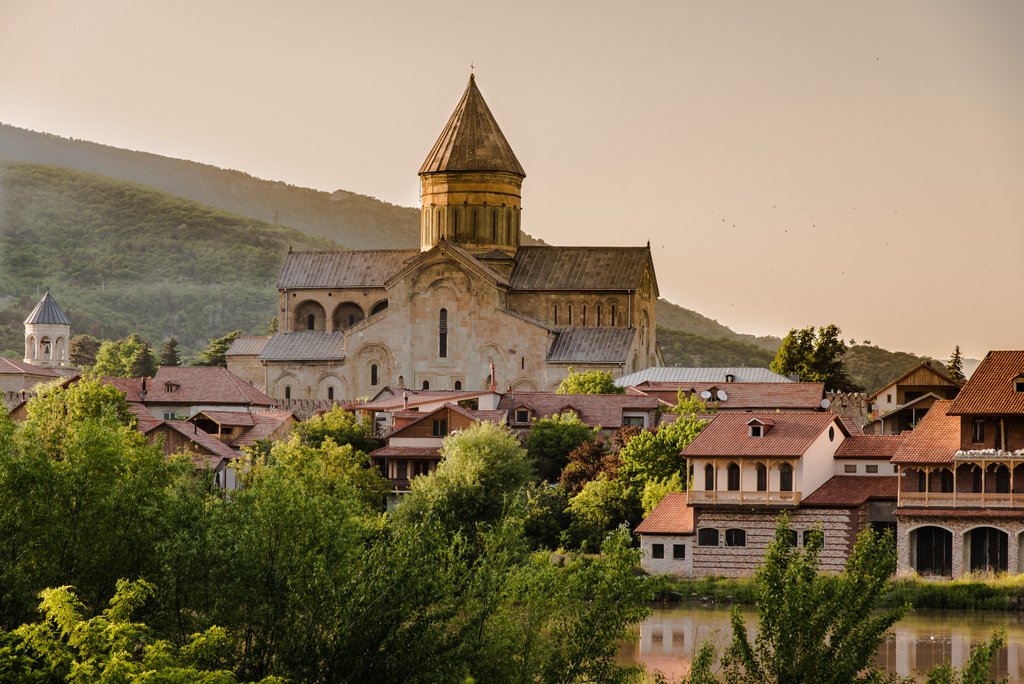
The archaeological area, known as Sakdrisi, is a small grassy hill in the Bolnisi region, in the picturesque foothills of south-eastern Georgia.
For 10 years Professor Thomas Stoellner, a leading specialist in mining archaeology from the University of Bochum, Germany, has been studying the archaeological record at Sakdrisi together with his Georgian colleagues.
"When we went to do the first survey we found hammer stones - typical mining tools - thousands of them," says Prof Stoellner, who believes that tunnels inside the hill date back 5,400 years.
"At once I realised the importance of the site. When we got the first value carbon dates, and they were around 3,000 BC, it was clear that this was an exciting find which had never occurred in pre-historic mining."
Recently discovered artefacts including a unique set of spiral gold earrings found in neighbouring Azerbaijan can be traced to Sakdrisi, according to Prof Stoellner.
'No proof'
The Georgian government used to share this excitement and Sakdrisi was a protected cultural heritage site. But that status has been removed, and Professor Stoellner's views are being challenged.
"It's not proven that Sakdrisi is an ancient gold mine - it's just an assumption," Georgia's Prime Minister Irakli Garibashvili recently said at a meeting with university students.
Does that change in position have much to do with the mine's potential as a source of employment and revenue in the region?
Sakdrisi sits on prime territory licensed to a commercial gold mining company, RMG Gold. The Russian-owned company is a major investor in the Georgian economy.
Mr Garibashvili was keen to emphasise this: "The investor has already invested $300m [£178m; 219m euros] in the Georgian economy. This company has 3,000 employees and those people represent 3,000 families."
According to RMG's commercial director, Soso Tsabadze, their products, which include copper concentrates and gold alloys, make up about 10% of Georgia's total exports.
Although Sakdrisi hill occupies only nine hectares out of 193 hectares of licensed territory, RMG says it is vital for their operation.
"We estimate the area holds a deposit of 14 tonnes of gold, 30% of which lies immediately under the hill." says Mr Tsabadze.
"Initially Sakdrisi was cut out of the licensed territory because of the archaeological site," he explains.
"We sent experts to study how far from the site we could mine. They concluded that we would not be able to use drill and blast methods within one kilometre of the protected site.
They then posed a question: is this really an ancient archaeological site? This was a legitimate question because there was no scientific evidence."
To study the issue, the government appointed a commission, which ruled that there was no scientific proof that Sakdrisi was a gold mine and that its historic status had been granted in "gross violation" of Georgian law.
Protest camp
Civil society activists in Georgia have staged protests against the site's destruction. A few dozen young students have been camped out near Sakdrisi since mid-April.
Organisers of the protests want the government to invite an independent panel of international experts to decide on Sakdrisi.
Marina Mizandari was formerly deputy culture minister. She claims she was fired for criticising the decision to allow mining to proceed at Sakdrisi, and believes there are other ways to develop the region.
"If this archaeological heritage is maintained, it could become an educational scientific centre," she says.
"We have other ancient settlements nearby from the same epoch. We can follow the gold processing step by step, develop cultural tourism and contribute towards the sustainable development of this region."
Activists have also been seeking to attract attention to the mining industry's "disastrous" environmental record in the region, and have highlighted what appears to be poor environmental practice.
A 2012 study by researchers at Ivane Javakhishvili Tbilisi State University found that heavy metal pollutants from mining processes were entering the river system in Bolnisi.
"Mining is the biggest industry in our country and it's also the biggest pollutant," says Kakha Bakhtadze from the Caucasus Environmental NGO Network.
"The problem with Bolnisi region is that it's one of the main suppliers of agricultural produce to the capital Tbilisi. There are lots of farms here and they use water from heavily polluted local rivers to irrigate their crops."
Priorities
But, RMG director Soso Tsabadze admits, dealing with environmental issues is not a priority. He says the company has already encountered losses due to delays in production over Sakdrisi.
And so, the work is under way. Mud tracks have already been formed in the ground by trucks and digging equipment passing back and forth.
To see the historic site destroyed will be a loss for the scientific community, says Prof Thomas Stoellner. He believes the oldest stages of mining have yet to be discovered: "In Western Europe we solve such problems by doing commercial rescue archaeology - excavate everything, study the details and then, okay, if there is a decision of the government, exploit the field."
The government may have already made its decision but protesters have vowed to stay on. They are hoping an independent panel of experts will be invited to judge whether this ancient mine is worth more than the gold that lies within it.
Gold rush hits Georgian mountains,
EUROPE
Showing posts with label Ivane Javakhishvili Tbilisi State University. Show all posts
Saturday, May 31, 2014
Friday, June 01, 2012
STIPENDIUM: Tutorium in der georgischen Hauptstadt Tiflis
Am Institut für Ostrecht der Universität zu Köln wird zum 15.09.2012 eine/ein Tutorin/Tutor für einen Aufenthalt in der georgischen Hauptstadt Tiflis gesucht.
Die Ivane Javakhisvili Staatsuniversität in Tiflis und die Universität zu Köln bieten mit Unterstützung des DAAD in der georgischen Hauptstadt Tiflis einen deutschsprachigen Studiengang zum deutschen Recht an. In diesem zweisemestrigen Aufbaustudiengang, der an Absolventen eines rechtswissenschaftlichen Studiums in Georgien gerichtet ist, sollen die Studierenden " georgische Masterstudenten " den Master der Universität zu Köln erwerben können.
Während die Kölner Hochschullehrer nur zu den einzelnen Lehrveranstaltungen nach Tiflis reisen, soll die Tutorin/ der Tutor während des gesamten Semesters vor Ort anwesend sein und die Kooperation zwischen beiden Universitäten unterstützen. Weitere Aufgaben sind die Übernahme einer Arbeitsgemeinschaft und die Heranführung der Studierenden an die wissenschaftliche Arbeitsweise. Vorgesehen ist zunächst ein Aufenthalt des Tutors/der Tutorin von zehn Monaten.
Voraussetzungen für die Tätigkeit als Tutor/Tutorin sind ein abgeschlossenes rechtswissenschaftliches Studium, Organisationstalent und die Fähigkeit zu selbständigem Arbeiten. Darüber hinaus sollte die Bewerberin oder der Bewerber über Kenntnisse des Russischen verfügen oder bereit sein, sich Grundkenntnisse bis zur Aufnahme der Tätigkeit anzueignen.
Die Aufenthaltskosten werden durch ein Stipendium des DAAD gedeckt.
Bewerbungen sind bis zum 30.06.2012 zu richten an:
Institut für Ostrecht der Universität zu Köln
Klosterstr. 79 d
50931 Köln
Tel.: 0221 470 5575
Fax: 0221 470 5582
E-Mail: inst.ostrecht@uni-koeln.de
Die Ivane Javakhisvili Staatsuniversität in Tiflis und die Universität zu Köln bieten mit Unterstützung des DAAD in der georgischen Hauptstadt Tiflis einen deutschsprachigen Studiengang zum deutschen Recht an. In diesem zweisemestrigen Aufbaustudiengang, der an Absolventen eines rechtswissenschaftlichen Studiums in Georgien gerichtet ist, sollen die Studierenden " georgische Masterstudenten " den Master der Universität zu Köln erwerben können.
Während die Kölner Hochschullehrer nur zu den einzelnen Lehrveranstaltungen nach Tiflis reisen, soll die Tutorin/ der Tutor während des gesamten Semesters vor Ort anwesend sein und die Kooperation zwischen beiden Universitäten unterstützen. Weitere Aufgaben sind die Übernahme einer Arbeitsgemeinschaft und die Heranführung der Studierenden an die wissenschaftliche Arbeitsweise. Vorgesehen ist zunächst ein Aufenthalt des Tutors/der Tutorin von zehn Monaten.
Voraussetzungen für die Tätigkeit als Tutor/Tutorin sind ein abgeschlossenes rechtswissenschaftliches Studium, Organisationstalent und die Fähigkeit zu selbständigem Arbeiten. Darüber hinaus sollte die Bewerberin oder der Bewerber über Kenntnisse des Russischen verfügen oder bereit sein, sich Grundkenntnisse bis zur Aufnahme der Tätigkeit anzueignen.
Die Aufenthaltskosten werden durch ein Stipendium des DAAD gedeckt.
Bewerbungen sind bis zum 30.06.2012 zu richten an:
Institut für Ostrecht der Universität zu Köln
Klosterstr. 79 d
50931 Köln
Tel.: 0221 470 5575
Fax: 0221 470 5582
E-Mail: inst.ostrecht@uni-koeln.de
Labels:
Call,
Cologne,
DAAD,
Georgia,
Ivane Javakhishvili Tbilisi State University,
Law,
Tbilisi,
University
Location:
Dimitri Uznadze St, Tbilisi, Georgia
Sunday, March 11, 2012
STUDY: Challenges to the South Caucasus regional security aftermath of Russian–Georgian conflict: Hegemonic stability or new partnership? By Kornely K. Kakachia (sciencedirect.com)
- Department of Political Science, Faculty of Social and Political Studies, Ivane Javakhishvili Tbilisi State University, Tbilisi, Georgia
- Received 4 September 2009. Accepted 10 December 2009. Available online 4 November 2010.
Abstract
And the question is now how to handle this delicate situation in a strategically and geopolitically important region. So by controlling Georgia (in case Russia reaches abovementioned aims), Russia actually will be able to cut off Central Asia and Caspian resources. It means Russia would be able to isolate and cut off Azerbaijan and Central Asian countries and it will significantly strengthen its energy monopoly over Europe with all results coming out from that fact. So it’s about major shift in the energy policy and major shift in geopolitics based on this energy policy and Russian energy monopoly. The August war in Georgia demonstrated some risks associated with the functioning of the transit energy corridor in the southern Caucasus. It also demonstrated the need for broader security guarantees for a region that is vital to European and global energy security. Paper deals with economic damage inflicted by the Russo-Georgian war in South Caucasus and its implications for regional security.
more:
-
Source: www.sciencedirect.com
Thursday, March 08, 2012
LEHRE: 5. Georgisch-deutsche Schule mit Workshop in Grundlagenforschung
Zeitraum: 06.08.2012 - 17.08.2012
Das Forschungszentrum Jülich (FZJ) plant zusammen mit den georgischen Partner-Einrichtungen, der Ivane Javakhishvili Tbilisi State University (TSU) und der Georgian Technical University (GTU) eine fünfte georgisch-deutsche Schule und Workshop in der Grundlagenforschung für Bachelor- und Masterstudenten. Der erste Teil des Workshops findet in Tiflis vom 6. bis 10. August und die Sommerschule findet in Batumi vom 13. bis 17. August statt.
Weitere Informationen zu den Themen, zum Programmablauf und der Organisation sind unter dem aufgeführten Link einzusehen.
+++
The Forschungszentrum Jülich (FZJ), Germany, together with the Georgian Partner Institutions: Ivane Javakhishvili Tbilisi State University (TSU) and Georgian Technical University (GTU) are planning a 5th Georgian-German School and Workshop in Basic Science, which will be held in Georgia, in August 2012. First part of the workshop will take place in Tbilisi during August 6 to 10, and the summer school will be held in Batumi from August 13 to 17.
The current workshop will be the follow-up of the highly successful previous meeting held in Tbilisi (May 2010), where Jülich and Georgian institutions expanded their mutual scientific cooperation in various fields of Basic Science.
For the up-coming gathering we plan to have a dedicated lecturing courses for the Bachelor and Magister students in a wide range of Natural and Engineering Sciences.
Based on the concept, called the Georgian-German Science Bridge, partners agreed to enforce the scientific and technological cooperation between two countries. The framework has been adopted during the visit of German delegation in Tbilisi, in December 2011.
Labels:
Batumi,
Education,
Forschungszentrum Jülich,
Georgia,
Germany,
Ivane Javakhishvili Tbilisi State University,
Tbilisi,
University
Location:
Tiflis, Georgien
Subscribe to:
Posts (Atom)