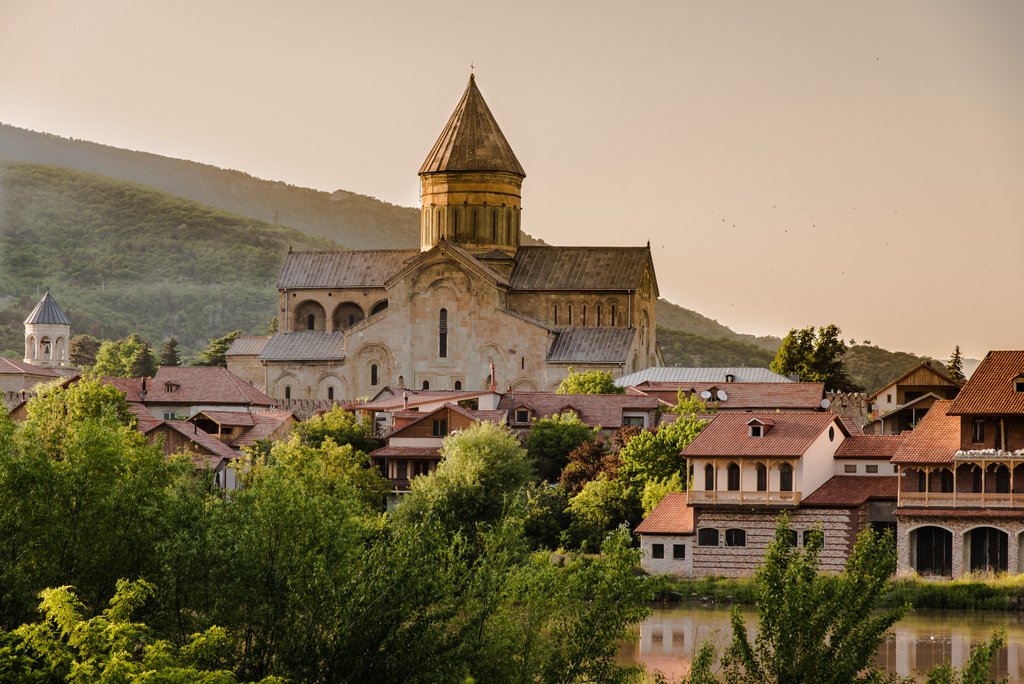
(geocities.ws) If we throw a glance through the main - Eurasian - part of the Eastern Hemisphere we can easily find the Trans-Caucasus located between the two seas. It has quite an extraordinary, I dare say, even central position on the hemisphere. In North of it, across the Great Caucasian Range, is situated Russia; in the South, genuine Near Eastern Turkey and Iran; in the West, the Black Sea divides it from Eastern Europe, and in the East, the Caspian Sea from Central Asia. Such an intermediate location of the Caucasus should be the reason of its ethno-cultural diversity noticed already by Greco-Roman authors.
Georgia (ancient Colchis and Iberia), the country of the Golden Fleece in Classical Greek mythology, is located in the central and Western parts of the Trans-Caucasus. It is chained to the Caucasus like Prometheus, who found his last abode in the same mountains. Even on the former state emblem of Georgia, under the hoofs of the horse of Tetri (White) Giorgi (the image of Georgia) the Caucasian mountains are depicted - instead of the dragon of St. George's icon - a symbol of natural challenge of the country, representing the link of its destiny with one of the main markers of the geographical, ethno-cultural and political division of the world.
Georgia and the Trans-Caucasus generally lie not only at the cross-roads of all four sides of the world, but at the cross-roads also, from the temporal standpoint, between the old and new worlds: the old world of totalitarianism and the new world of democratic society. Both these cross-roads are intertwined with each other. The areas North and East of the Caucasus are still embodiments of totalitarian societies. The areas West and South, embody societies with a democratic way of life or on the path of democratic transformation.
Numerous states were created in all parts of the world after the First and the Second World Wars and also after the collapse of the Communistic system. In our days, this process takes place mainly in new countries of the post-Soviet space and Georgia is among them. The analogous situation was created already in Georgia, due to the annihilation of the Russian Empire, when a new Democratic Republic of Georgia was created. In three-years, in February-March of 1921, Georgia was occupied by Soviet Russia, though the tradition of statehood in Georgia counts thousands of years.
It seems that the factors of geopolitical character caused not only the emergence of statehood in Central Trans-Caucasus in the Classical period, but also determined its historical development in Medieval, New and Newest times.
The main purposes of the future studies are: at first,- to outline the possible trends in political orientation of Georgia, against the background of existing tendencies (in the political life of Georgia itself, of the Trans-Caucasus generally, and of a much wider area adjacent to the basins of the Black and Caspian seas) and the second, to study /p. 215/ the character of interrelations among these trends.
Georgian politicians and public carry out discussions on how to solve the triple choice, which faces the country:
* Join the security system of the CIS (i.e. Russia);
* Declare neutrality;
* Integrate within the Euro-Atlantic democratic societies.
Pro-Russian trend actually means turning back from the process of state creation to final dissolution (though gradual) in the Russian maw – the age-long dream of Russian political circles. In spite of the decisions made on various summits, Russia tries to retain by all means its military presence in Georgia and at the same time to widen its economic and political presence in the country.
Neutral status is irrelevant for a country lying on the highway of political processes and surrounded by aggressive neighbours – primarily by Russia; Turkey and Iran to some extent, during the reinterpretation of their Caucasian policy after the breakdown of the Soviet Empire, are trying to ensure peace and security of the region, different from their old historical traditions.
The pro-Western trend seems the only option, which can secure the independent development of Georgia. But can we be sure that this choice answers to the national interests of the country? Why the pro-Western orientation become a motto of Georgian society? How trustworthy are the fears spreading among a part of Georgian public that, because of their pro-Western orientation, the country and its population are under the unforeseeable and imminent threat of punishment coming from rivals of the Western democratic societies and, therefore, in the opinion of this part of public, the political orientation of the country should be changed?
These questions show how tense and uncertain the political situation in Georgia is lately. I don’t think that there exists an easy answer to all questions, that Georgian’s face today, but historians could try to make the situation more understandable from the standpoint of the historical development of this country.
Therefore, we need to throw a glance from the historical perspective, to gain an insight into the character of developments underlying modern processes. The pointer of the political compass of Georgia was directed to various sides of the world in different times, but what kind of mechanism caused such a shift of orientation? Which point, having strong magnetic power, was most determinative for the Georgian pointer throughout the history? These are the questions that should be answered.
Unfortunately nobody paid attention, in the special literature, to the interconnection between the existence of the state power in Central Trans-Caucasus and the necessity to control the passes through the Caucasus, indicated by the historical development of the area. This is mainly due to the fact that, during the last two hundred years, the Trans-Caucasus was incorporated in the Russian and Soviet empires and no governmental employee, in charge of these totalitarian states, would allow, or encourage even in a post-Soviet time, to carry out such a study. Both these countries (the Russian /p. 216/ Empire and the Soviet Union) succeeded in total subjection of the Trans-Caucasian territory, which was of vital importance for their expansionistic plans against the entire East Mediterranean-Middle Eastern area. On the other hand, the fact, that no Caucasian nation was represented on the political map of the world over the last two centuries, with the above-mentioned short exception, is the main reason why Caucasian history was actually neglected by Western specialists, even when studying the areas adjacent to it.
The breakdown of the Communist system gave specialists of countries belonging to this system the possibility to use such methodological principles, far removed from the dogmas of Marxism-Leninism and sometimes already obsolete in other parts of the world. In connection with the early Caucasian political history, the use of Arnold Toynbee's Challenge-and-Response model seems preferable, as the emergence and development of the idea of statehood in the Caucasus finds its stimulus (Challenge) in the reaction (Response) of the local natural and social environment.
The political history of Georgia, like other Transcaucasian countries, was mainly dominated by the fact of the geographical location of the Trans-Caucasus in the South of the Great Caucasian mountainous chain, one of the most important watershed systems of the world. These mountains form a fracture (something like a geological fault-line), not only from the geographical and ethno-cultural points of view, but also from the geopolitical division of the world. The key importance of the location of the Caucasus was picturesquely stated by Pliny the Elder (Plinius Magnus), already two thousand years ago, namely that the Caucasian Gate (i.e. the Darial Pass, crossing the central part of the Great Caucasian Range), divides the world in two parts (n.h. 6, 30).
There was always a need for a barrier to be erected by the world of reasonable men against the world of barbarians, such as the Great Wall of China or Hadrian's Wall (Roman Limes). The Caucasian Gate had the same function for the Middle East. Since immemorial times, it barred the descent of the Eurasian nomads into the civilised world of common interest: the Mediterranean-Middle Eastern oikoumene.
The Caucasian Gate is frequently called the Pillars, Stronghold or Iron Gate of Alexander the Great by the Classical (Greco-Roman) authors. The linkage of Alexander's name with the emergence of the Iberian statehood, known from old Armenian and Georgian chronicles, indicates the raison d'être of this state, namely to be the outpost of the civilised world in its struggle with the realm of Gog and Magog lying beyond the Caucasian Gate.
The above-mentioned emblem of Georgia bears the sun, the moon and the five stars, supposedly bestowed on the Georgians by the legendary image of Alexander of old Georgian chronicles, as an ideological basis of their state religion. Thus, the concept of Alexander’s Iron Gate was the reflection of the concrete political function of the Georgian State: control over one of the most important strategic passes of the world.
This function seems to have been one of the main decisive factors that challenged the emergence of the Georgian State in the central part of Trans-Caucasus in the Early Hellenistic period. The location of Georgia, South of the Great Caucasian Range, /p. 217/ in the contact zone of Eurasian nomads and Middle Eastern civilised societies, had predetermined the continual external pressure from the North. A Challenge, which for its part caused a Response: the creation of a state (i.e. the Iberian Kingdom) in Central Trans-Caucasus. It is interesting that the period of replacement of the Pax Achaemenia by the Pax Macedonica marks out the emergence of Iberian (East Georgian) Kingdom.
The raison d'être not only of Iberia, but also of other new states of the Classical period, Albania and Lazica (the successive state of Colchis), were to become stronghols of the civilised world (Greek oikoumene or Roman orbis terarrum) in its struggle with the barbarian Realm of Darkness beyond the Caucasian Gate. However, there was undoubtedly a difference between the Western political orientation (the Greek states, Roman and Byzantine empires) of Iberia and also, to a certain degree, of Lazica on the one hand, and the Eastern orientation (Persia, Parthia) of Albania (together with Armenia), on the other.
The control of the Caucasian passes could create the most favourable opportunity for the preservation of Pax Romana in the Middle East. The Iberians were the most important allies of the Romans in the region, having supremacy over the Caucasian Gate. The close collaboration between the Romans and the Iberians, based on their joint strategic interests as parts of one and the same orbis terarrum, was the leit-motif of their interrelations.
At the same time, the rulers of the Iberian Kingdom successfully used the favourable strategic location of their country to balance the pressure of the powers, coming from all sides of the world, often changing the direction of their orientation. Already Tacitus noted that the Iberians were "masters of various positions" and could suddenly "pour" mercenaries from across the Caucasus against their Southern enemies (Ann. 6, 33).
The long-term aspiration of the medieval Georgian monarchy, going back presumably to the times of the Roman Empire, to bring under its sovereignty not only the Caucasian Gate, but all existing Caucasian passes from the Black to the Caspian Sea, is expressed by the formula of its territorial integrity in the Georgian chronicle of the 11th century the "Life of Georgia": "from Nikopsia to Daruband", i.e. from the North-Eastern Black Sea littoral to the Derbent gateway (the second important pass of the Caucasus), on the western shore of the Caspian Sea. This formula, emphasising especially the northern borderline along the Caucasus, enables us to interpret the main function of that kingdom in a more general context.
Faced with the necessity of effective control of the Caucasian passes, which barred the way of the northern invaders, the rulers of the states of the Eastern Mediterranean-Middle Eastern area were always eager to have in Central Trans-Caucasus - in Iberia - a political organisation with sufficient strength to fulfil such a defensive function.
The concept of the Caucasian Gate predetermined the fate of the Georgian State from the Early Hellenistic time till the beginning of the 19th century when Georgia's annexation by Russia meant the loss of this important function of this state. I think this function is the reason why Georgia, as pointed out by Cyril Toumanoff, is the only country of Christendom where socio-political and cultural development ran an uninterrupted /p. 218/ course from the Classical period to the beginning of the 19th century.
This overwhelming interest of the Near Eastern-Mediterranean societies towards Georgia was caused not only by the abstract defensive function of this country, but mainly by its concrete location at the edge of the civilised and barbarian worlds. Though Georgia and the Trans-Caucasus were open to the influences of these two opposite models of historical development, the factor of the Great Caucasian Range determined its destination to be the stronghold of the highly developed and prosperous Middle Eastern-Mediterranean oikoumene, against the vast area of Eurasian steppes: an embodiment of the powerful and aggressive forces with their slow rate of social, political, economic and cultural development. Or in other words, to be the stronghold of the civilised South and West against the barbarian North and East. On the other hand, the northern nomads required a bridgehead for their raids towards the Middle East. The territories of Georgia and the Trans-Caucasus represented the best opportunities for this task.
The constant opposition between the barbarian and civilised peoples, aggressors and producers, brigands and creators, were two firestones with the help of which the fire of statehood south of the central part of the Great Caucasian Range, in Central Trans-Caucasus, was kindled.
Back:
+++
Patriarchate of Georgian Orthodox Church
Konrad-Adenauer-Foundation
Tbilisi, 2009
On December 2-3, 2008 the Holy Synod of the Georgian Orthodox Church and the Konrad-Adenauer-Foundation held a
scientific conference on the theme: Causes of War - Prospects forPeace. The main purpose of the conference was to show
the essence of the existing conflicts in Georgia and to prepare objective scientific and information basis.
This book is a collection of conference reports
and discussion materials that on the request of the editorial board has
been presented in article format.
Publishers:
Metropolitan Ananya Japaridze
Katia Christina Plate
Bidzina Lebanidze
Nato Asatiani
Editorial board:
Archimandrite Adam
(Akhaladze), Tamaz Beradze, Rozeta Gujejiani, Roland
Topchishvili, Mariam Lordkipanidze, Lela Margiani, Tariel Putkaradze,
Bezhan Khorava
Reviewers:
Zurab Tvalchrelidze
Revaz Sherozia
Giorgi Cheishvili
Otar Janelidze