Showing posts with label Analysis. Show all posts

Sunday, August 31, 2014

BOOK-REVIEW: A Tangled Path to Europe. Written by Dustin Gilbreath (neweasterneurope.eu)

(neweasterneurope.eu) Review of Bittersweet Europe. Albanian and Georgian Discourses on Europe, 1878-2008. By: Adrian Brisku. Publisher: Berghahn Books, August 2013.

BriskuBittersweet


Since independence, Georgia has been on what has often looked like a quixotic quest towards joining the EU. Multiple wars, a resurgent Russia, breakaway territories and a consistently difficult economic situation which has gone through hyper-inflation and has had consistently high unemployment and underemployment over the last 25 years must, at the minimum, make prospects for EU integration seem distant at best to many in Brussels. Yet, with the recent signingof the Association Agreement with the European Union on June 27th 2014, Georgia is closer to its European dreams than ever. Remembering that the EuroMaiden protests, which were the match to the powder keg igniting the Ukraine Crisis, were set off by former Ukrainian president Viktor Yanukovych’s failure to sign an association agreement that would have brought Ukraine closer to Europe and considering the historical ambivalence among elites in Albania and Georgia towards Europe over the course of the last 130 years, there could not be a more important time for academics, policymakers and journalists working on the Eurasian region to read Adrian Brisku’s Bittersweet Europe.

Brisku skillfully disentangles the often competing webs of discourse on Europe coming out of Georgia over the past 130 years. The book simultaneously decentres Caucasus watchers’ purview through placing Georgian discourse on Europe in a comparative perspective with Albania’s conversations on Europe over the same period. Furthermore, by implanting the conversation in broader pan-European historical frames, the author provides valuable insight into how Georgia’s relationship to Europe has been conditioned historically.

Since the Russian imperial period, discourse on Europe has been mixed, but one of the most important points of contention in Georgia has been whether the country would “look West” on its own or look north to Russia in order to look West to what Brisku describes as the “triadic Europe.” The triadic Europe which Brisku refers to is Europe “as geopolitically important; as a torchbearer of progress; and as the symbol of civilisation and high culture”. This distinction is valuable in that it lends an understanding to the often confounding claims of Europeanness from Georgian elites due to its ambiguous geographical location on the crossroads of Europe and Asia and the sometimes questionable reasoning behind such claims by providing the polysemous meaning of Europe in Georgia.

In diametric contrast to nationalist leaders today, the Georgian “Father of the Nation” and canonized Saint in the Georgian Orthodox Church, Ilia Chavchavadze, believed that Georgia should and would move towards Europe, but through its relationship with Russia, as Georgia was a part of the Tsarist Empire at the time. In opposition to this, Noe Zhordania, another aristocrat but one who had studied in France during his first term in exile from Georgia, developing an inclination towards French Socialism in the process, and the eventual first and only president of the independent, Menshevik, Georgian Republic of 1918-1921, thought that Georgia’s relationship to Europe should not be mediated through the Russian space. The contentions surrounding Europe and Georgia as a part of Europe would not end here though.

With the First World War and the Bolshevik takeover of Georgia, the discourse shifted. As the socialist state was supposed to be the vanguard of progressivism in the world, Georgia, as part of the Soviet Union, was meant to be in a position to help the working classes of Europe towards the progress represented by socialism. Much like how Karl Marx had flipped Georg W.F. Hegel on his head in philosophy, who and what represented progress had been spun around in the Georgian discourse.

Georgia has had a pro-European policy since independence, with short exceptions, and Brisku traces this shift back to the 1975 signing of the Helsinki Accords. In Georgia, Zviad Gamsakhurdia, through co-founding the Georgian Helsinki Group, began the discursive shift towards relations with Europe directly instead of through the mediation of the Soviet state. In doing so, he set the stage for changes to come. From this point onward, with one exception, and especially after independence, a pro-European discourse emanated from Georgia.

In a strange twist of irony, the exception to Georgia’s pro-EU discourse came from the same person who re-ignited it, Zviad Gamsakhurdia. This though, was not the dissident Zviad Gamsakhurdia which founded the Helsinki Group in Tbilisi nor the man who led the anti-Soviet movement in Georgia to the Soviet Union’s collapse, but the Zviad Gamsakhurdia who was elected the first head of state of Georgia after independence. His rule was characterised by strong nationalist tendencies which alienated the country’s ethnic minorities leading to the de facto loss of control of South Ossetia for Georgia. From human rights advocate and dissident to human rights violator, Zviad Gamsakhurdia in his turn moved away from Europe due to European criticism of his human rights abuses.

The persistent question which has dominated and lay beneath the surface of the discourses on Europe in both Georgia and Albania is “Are we European?” From this underlying question, Brisku highlights the ethnocentric euro-centrism that emerged in both contexts from anxieties and insecurities and the overcompensation resulting from this question. In both contexts, prominent thinkers and politicians ended up emphasising the countries’ ancient histories and numerous invasions in order to justify their Europeanness in contrast to cultural and confessional differences compared to predominant conceptions of what it conventionally meant to be European. Mikheil Saakashvili, Georgia’s third post-Soviet elected head of state stated in European Parliament that"since the time when Prometheus was chained to our mountains and the Argonauts came to our country in search of the Golden Fleece ... we are an ancient European nation." Hyperbole not intended. 

Further contributing to these anxieties and adding to the reader’s understanding of how they emerged, the book tracks how European powers have interacted with the two countries historically. Being small countries, the feeling that interaction, and more importantly the frequent lack thereof, was based on Europe’s interests have contributed to anxieties in both nations.

The book concludes that the political and intellectual elite in Georgia and Albania have historically been “ambivalent” about their relationship to Europe. Today, in Georgia, we can see this ambivalence quite strongly. When it comes to policy, Georgian support for closer ties to the EU is unquestionable. The ruling Georgian Dream Coalition and the opposition United National Movement disagree on what seems to be just about everything, but the one thing that neither side has wavered from is their dedication to further Euro-Atlantic integration. Moreover, according to the study, “Knowledge and Attitudes towards the EU in Georgia: Changes and Trends 2009 – 2013” conducted by CRRC-Georgia for the Eurasia Partnership Foundation in 2013, 83 per cent of Georgians reported that they would vote to join the EU tomorrow if a referendum were to be held, with support consistently near these levels in recent years. At the popular and elite level, support for closer integration with Europe is clear.

Despite this clear policy direction, opposition to the recently passed anti-discrimination law, which was required for the signing of the Association Agreement with the EU, highlights that many Georgians still oppose or potentially misunderstand some features commonly associated with Europe, specifically the defence of sexual minority rights. Controversy surrounded the bill as a number of priests claimed that the bill would lead to the legalisation of gay marriage in Georgia (it wouldn’t and hasn’t), something the population of the country would largely be against. Moreover, the passing of the law at certain times was opposed by the Patriarch Illia II of the Georgian Orthodox Church, who is widely considered to be the most trusted person in Georgia. In this way, aspects of the cultural Europe, which Brisku identifies early on, are those which many Georgians today are still ambivalent about.

Overall, Bittersweet Europe offers a masterful juxtaposition of Georgian and Albanian discourses towards Europe in addition to the accompanying insecurities over Europe and Europeanness in both countries. This in conjunction to the decentring effect gained through the added context leads the reader to a better understanding of Georgia’s history and relationship to Europe - something needed now more than ever.

Dustin Gilbreath is a research consultant at CRRC-Georgia.

Thursday, December 05, 2013

EDITION: Georgia: A Political History Since Independence. By Stephen F. Jones

On 10 December, 2013 Center for Social Sciences organizes a presentation of Georgian Edition of Professor Stephen F. Jones' new book:

"Georgia: A Political History Since Independence"

Professor Stephen F. Jones is a prominent scholar and an expert on post-communist societies in the former Soviet Union and Eastern Europe. He is a Professor of Russian Studies at Mount Holyoke College. Professor Jones also is an Honorary Doctorate of Tbilisi State University, and a member of CSS International Advisory Board.

Date: 10 December, 2013

Time: 17:00-18:30

Venue: 1 Chavchavadze Ave., TSU I building, Room #115

Book Overview:

Georgia emerged from the fall of the Soviet empire in 1991 with the promise of swift economic and democratic reform. But that promise remains unfulfilled. Economic collapse, secessionist challenges, civil war and the failure to escape the legacy of Soviet rule - culminating in the 2008 war with Russia - characterize a two-decade struggle to establish democratic institutions and consolidate statehood. Here, Stephen Jones critically analyses Georgia's recent political and economic development, illustrating what its 'transition' has meant, not just for the state, but for its citizens as well. An authoritative and commanding exploration of Georgia since independence, this is essential for those interested in the post-Soviet world.

Release date of original Eglish Edition: December 24, 2012, Publisher: I. B. Tauris (ISBN-10: 1845113381; ISBN-13: 978-1845113384)

©2012 - Stephen Jones

Release date of Georgian Edition: December 2013, Publisher: Center for Social Sciences (ISBN 978-9941-0-5972-8; ISSN - 1512-4576)

©2013 - Center for Social Sciences

The Georgian translation of the book has been prepared by the CENTER FOR SOCIAL SCIENCES (CSS). Published with the financial support of the Open Society Georgia Foundation. The views, opinions and statements expressed by the authors and those providing comments are theirs only and do not necessarily reflect the position of the Foundation. Therefore, the Open Society Georgia Foundation is not responsible for the content of the information material. The book was published in cooperation with NEKERI Press.

More: Democracy in Georgia: Da Capo? By Stephen F. Jones [pdf]

AmazonShop: Books, Maps, Videos, Music & Gifts About The Caucasus

Wednesday, November 13, 2013

SYMPOSION: Die Region Kaspisches Meer am 21. November in Wien

Geopolitisch wird seit dem Untergang der Sowjetunion der weltpolitisch und ökonomisch gleichermaßen sensiblen Region „Persischer Golf“ die Region „Kaspisches Meer“ gegenüber gestellt, die ebenfalls für die Öl- und  Gasversorgung der Welt von hoher Bedeutung ist. Hier sind im Norden Russland und im Süden Iran tonangebend, gemeinsam mit den ostkaspischen Staaten Kasachstan und Turkmenistan, sowie dem an der Westküste gelegenen Aserbaidschan und unter Einbeziehung diverser Nachbarländer. Die Bedeutung dieser Region ist erst jüngst wieder mit der Affäre um das vorerst fehlgeschlagene Projekt „Nabucco“ deutlich geworden. Russland scheint politisch dominant zu sein. Iran ist das einzige Land, das zwischen „Kaspi-“ und „Golfregion“ hin und her switcht. Alle Öl- und Gasproduzenten der Region haben
gleichermaßen analoge und konkurrierende strategische Interessen.


Do, 21. November 2013
18.30-21.30 Uhr


Festsaal der Diplomatischen Akademie
1040 Wien, Favoritenstraße 15a
Eintritt: € 5,- (erm. € 3,-), für Mitglieder der ÖOG gratis


ÖSTERREICHISCHE ORIENT-GESELLSCHAFT HAMMER-PURGSTALL
1010 Wien, Dominikanerbastei 6/6 

Tel.: 01 5128936 
www.orient-gesellschaft.at

Monday, November 11, 2013

BOOK: Fear, Weakness and Power in the Post-Soviet South Caucasus. A Theoretical and Empirical Analysis. By Kevork Oskanian (us.macmillan.com)


(us.macmillan.com) This book provides a detailed, multi-level analysis of international security in the South Caucasus and considers whether this region of the former Soviet Union, with several as yet unresolved, 'frozen' separatist conflicts, can move towards a more peaceable future. Using three concepts from Regional Security Complex Theory, amity/enmity, state incoherence and great power penetration, Oskanian forms a unique conceptual expansion of the theory, providing a comprehensive examination of both material conditions and discourses of insecurity. Applying this expanded framework onto a region of considerable complexity and conflict, the book considers the hostility between the South Caucasian states, the fissures underlying their secessionist conflicts, and the regional involvement of great powers, outlining the broader narratives that pervade societies in Armenia, Azerbaijan and Georgia. The book also assesses the emergence of a security regime in the Southern Caucasus and offers a critical-prescriptive assessment of policy implications for both regional and extra-regional actors concerned with improved regional stability. 

Kevork Oskanian currently teaches at the University of Westminster, UK. He received his PhD from London School of Economics, UK and has formerly edited Millenium Journal of International Studies. His research interests include the politics of the Former Soviet Union, constructivism, the English School, regionalism, and state incoherence.

Geopolitical Map of the Caucasus
Timeline of Events in the South Caucasus 1988-2009
A Note on Transliteration and Toponymy List of Acronyms and Abbreviations List of Interviewees
1. Introduction
2. Amity and Enmity in its Regional Context
3. State Incoherence as Weakness, Instability and Failure
4. Great Powers and Their Regional Entanglements
5. A Macro-View of the Southern Caucasus
6. Discourses of Conflict in the Southern Caucasus
7. State Incoherence in Southern Caucasia
8. The Great Powers and The Southern Caucasus
9. The South Caucasus Regional Insecurity Complex

Sunday, November 10, 2013

ARMENIEN: Aufgerieben zwischen Putin und Ashton. Von Markus Bernath aus Eriwan (derstandard.at)

(derstandard.at) Armenien bezahlt als erster Staat für den neuen Ost-West-Konflikt: Brüssel manövrierte die Kaukasusrepublik in eine Position, in der sie zwischen der EU und Sicherheit durch Russland wählen musste.
 
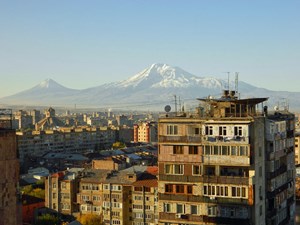
Zum Greifen nah, aber doch unerreichbar: Ähnlich wie der Ararat ist auch die EU für Armenien dahin.
foto: markus bernath
Im Entwurf steht jetzt eine Lücke. Drei Wochen vor dem Gipfeltreffen in Vilnius weiß die EU nicht, was sie mit Armenien anfangen soll. "Ich verstehe sie nicht", sagt Arsen Ghasarjan, der Großunternehmer, über die Leute in der EU-Kommission. "Ganz Europa braucht den russischen Markt. Ich auch. Welchen Sinn macht es, Russland anzugreifen? Man kann nicht über verstärkte Integration reden und die Worte des Kalten Kriegs benutzen."
Arsen Ghasarjan ist sauer auf Brüssel, und Brüssel ist verstört über die Armenier und das diplomatische Debakel. Vier Jahre haben die Kommission und die EU-Außenpolitikbeauftragte Catherine Ashton mit der kleinen Kaukasusrepublik über ein Assoziierungsabkommen und den Beitritt zu einer Freihandelszone verhandelt. Im Sommer war alles unter Dach und Fach. Dann kam Wladimir Putin. Der russische Präsident lud Armenien in die neue Zollunion von Ex-Sowjetstaaten ein. Armeniens Präsident sagte Ja. Er hatte keine Wahl. Brüssel hätte es wissen müssen.

Der fatale Punkt

"Wir haben unseren EU-Partnern immer gesagt, dass es Armeniens Anliegen ist, seine Beziehungen mit der EU zu entwickeln, jedoch niemals auf Kosten seiner strategischen Partnerschaft mit Russland", sagt Samuel Farmanjan, der die armenische Delegation in der gemeinsamen Kommission des EU-Parlaments leitet. "Wenn wir an den Punkt kommen, an dem wir eine Wahl treffen müssen, hat Armenien keine andere Option, als seine Sicherheit zu wählen."
Die russische Zollunion ist unvereinbar mit einem Beitritt zu einer Freihandelszone der EU, so hat die Außenpolitikbeauftragte Ashton schon während der Verhandlungen gewarnt. Für Brüssel ist Armenien nur ein kleiner Markt von drei Millionen Menschen, eingeklemmt zwischen der Türkei und Aserbaidschan, zwei feindseligen Nachbarn, die ihre Grenzen geschlossen halten. Der politische Schaden aber scheint nun enorm. Es geht um Brüssel gegen Moskau, um großzügige Ideen gegen harte Machtpolitik. Die EU hat die "Ostpartnerschaft", 1000 Seiten lange Assoziationsabkommen, mit denen Armenien, Georgien, Moldau oder die Ukraine näher an die Union gebracht werden sollen. Russland aber hat das Gas und die Soldaten.
In Gyumri, Armeniens zweitgrößter Stadt, liegt die 102. Basis der russischen Armee, das größte Kontingent im Südkaukasus. Für die Armenier sind die russischen Soldaten ein psychologischer Puffer zum Nachbarn Türkei und eine Art Versicherung für den Fall, dass Aserbaidschan einen Krieg beginnt; Moskau - so die Hoffnung - wird wohl bei einem Konflikt um die Enklave Berg-Karabach einschreiten. Nichts, was die Europäer tun würden. Der Kaukasuskrieg 2008 war den Armeniern eine Lehre. Als Russland in Georgien einmarschierte, sah die EU erst zu und schrieb dann einen Friedensplan auf, an den sich Moskau bis heute nicht hält.
"Wenn Armenien in den zurückliegenden Jahren nur irgendeine Sicherheitsgarantie von der EU oder den USA erhalten hätte, wäre die Lage jetzt vielleicht anders", sagt eine Armenierin, die aus der Diaspora im Westen stammt und nun in Eriwan arbeitet. "Seien wir ehrlich: Die EU hat sich nie um die Karabach-Frage gekümmert", sagt Naira Sohrabjan, die Vorsitzende des Ausschusses für EU-Integration im armenischen Parlament.
Sohrabjan, eine führende Politikerin der unternehmerorientierten früheren Regierungspartei Wohlhabendes Armenien, ist frustriert. "Ich habe den Eindruck, dass einige in Brüssel nicht richtig kalkuliert haben." Armenien hätte nie in eine Position gedrängt werden sollen, in der es sich zwischen Europa und Russland entscheiden muss.
Farmanjan, ein aufsteigender Politiker der regierenden Republikanischen Partei, sieht ein anderes Versäumnis der EU. Diese hätte Druck auf Ankara machen müssen, damit die 2009 geschlossenen Normalisierungsabkommen mit Armenien auch ratifiziert und umgesetzt würden: "Hätte die Türkei die Grenzen geöffnet, hätte dies die gesamte Geopolitik und den Integrationsprozess in der Region geändert." Aus Solidarität mit Aserbaidschan hatte die Türkei während des Karabachkriegs vor 20 Jahren die Grenze nach Armenien geschlossen.
Die Stimmung in Eriwan ist dieser Tage gedrückt. "Es schmerzt mich, dass unsere Kooperation mit der EU geschwächt ist", sagt Naira Sohrabjan: "Unser Platz ist in der europäischen Familie." Putins Zollunion aber, der derzeit neben Russland nur Weißrussland und Kasachstan angehören, bedeutet für viele Politiker und NGO-Vertreter in Eriwan Stagnation, kein Modell für die weitere Demokratisierung Armeniens.
Einige behaupten tapfer das Gegenteil. "Unsere Produkte werden billiger" , glaubt Hermine Naghdaljan, Vizepräsidentin des armenischen Parlaments. Die Hälfte der armenischen Wirtschaft hänge ja von Russland ab. Das Bild ist differenzierter: Über ein Drittel der Exporte gehen in die EU, ein Fünftel nach Russland.
Arsen Ghasarjan, Chef des größten Frachtunternehmens in Armenien und Präsident eines Industriellenverbands, kritisiert die Frontstellung der EU gegen die Zollunion. "Weshalb zieht man Mauern hoch zwischen diesen beiden Zonen? Wirtschaftlich macht es keinen Sinn. Politisch vielleicht für einige Leute in Brüssel." Was für Armenien gelte, sei ebenso richtig für die viel größere Ukraine, sagt Ghasarjan: Die Abhängigkeit vom russischen Markt sei eine Tatsache. "Wenn die Ukraine allein der EU-Freihandelszone angehört, kann man sich leicht ausrechnen, dass in einem Jahr die Hälfte ihrer Wirtschaft zusammengebrochen ist. In der EU-Kommission wird dann dafür niemand die Verantwortung übernehmen."

Kampf um die Ukraine

Der "Kampf um die Ukraine", so heißt es in Eriwan, ist das eigentliche Thema des neuen Ost-West-Konflikts. Armenien hat nur als Erster dafür bezahlt. Wie es nun weitergehen soll? "Die Tür zur EU ist zu, aber sie ist nicht verriegelt", glaubt Samuel Farmanjan. Er sieht Spielraum für ein abgespecktes Abkommen zwischen der EU und Armenien beim Gipfel in Vilnius Ende des Monats. Ähnlich vage Hoffnungen verbreitet auch die Brüsseler Kommission. (Markus Bernath aus Eriwan, DER STANDARD, 6.11.2013)

Thursday, October 31, 2013

RADIO: Margwelaschwili ist neuer Präsident Georgiens (srf.ch)


(srf.ch) Mit Georgi Margwelaschwili wählt Georgien einen Vertrauten von Premier Bidsina Iwanischwili zum Präsidenten. Dieser erhält dadurch praktisch uneingeschränkte Macht.

Mit Sekt und Autokorsos feiern die Anhänger der georgischen Regierung den Sieg ihres Kandidaten bei der Präsidentenwahl. Auch das Lager des scheidenden Amtsinhabers Michail Saakaschwili gratuliert.


Der frühere Bildungsminister Georgi Margwelaschwili hat die Präsidentenwahl mit dem absoluten Mehr gewonnen, wie die Wahlkommission in Tiflis bekannt gibt. Der Vertraute von Regierungschef Bidsina Iwanischwili leitet nun den ersten demokratischen Wechsel an der Staatsspitze ein.

Uneingeschränkte Macht für Iwanischwili

Die Abstimmung galt als wichtiger Test für Iwanischwili. Der Milliardär hatte die Parlamentswahl mit seinem Sechs-Parteien-Bündnis "Georgischer Traum" vor über einem Jahr gewonnen. Es zwang die Vereinigte Nationalbewegung Saakaschwilis in die Opposition. Mit der Wahl seines Vertrauten zum Präsidenten bekommt er der Regierungschef nun praktisch uneingeschränkte Macht.
Der neue Präsident wird künftig nur eine repräsentative Rolle spielen. Den nach der Wahl tritt eine Verfassungsänderung in Kraft, die die wichtigsten Machtbefugnisse auf das Amt des Regierungschefs überträgt. Experten warnen vor einem neuen Machtmonopol. 

Ein zuverlässiger Politiker 

Laut SRF-Korrespondent Peter Gysling haben die Georgier mit Margwelaschwili keine Person mit grosser Ausstrahlung ins Präsidentenamt gewählt.
«Das Volk hat heute vor allem sein Vertrauen ausgesprochen gegenüber dem politischen Wechsel im Land.» Viele Georgier hätten genug von allzu charismatischen Persönlichkeiten, erklärt Gysling weiter. Die Georgier wollten keine Führerfiguren, sondern zuverlässige Sachwalter und Politiker.


Wednesday, October 30, 2013

COMMENT: So Long, Saakashvili. The Presidency That Lived By Spin -- And Died By It. By Thomas de Waal (foreignaffairs.com)

Saakashvili, Clinton, and Gordon in front of a ferris wheel in Batumi.
Georgian President Mikheil Saakashvili, U.S. Secretary of State Hillary Clinton, and Philip Gordon, U.S. Assistant Secretary of State for Europe and Eurasian Affairs, stop in front of a ferris wheel as they walk through the streets of Batumi, June 5, 2012. (Saul Loeb / Courtesy Reuters)
(foreignaffairs.com) Georgia's reputation for charm has long preceded it. Travelling in the Soviet Union in 1947, the writer John Steinbeck heard Russians repeatedly evoke the “magical name of Georgia.” “They spoke of Georgians as supermen, as great drinkers, great dancers, great musicians, great workers and lovers,” Steinbeck wrote at the time.

It was the singular achievement of Mikheil “Misha” Saakashvili, elected Georgia's president in 2004, to have elevated his country's capacity for charm into the centerpiece of a grand strategy, one designed to secure power in Georgia by winning over the West in general and the White House of George W. Bush in particular. As was inevitable, the strategy eventually failed. Only a year ago, Saakashvili fully expected that he would win parliamentary elections and that his team would stay in power almost indefinitely. But defeat in the October 2013 parliamentary vote and a spate of revelations since then about abuses committed by his government have sent his popularity into a tailspin. A poll commissioned last month found that 57 percent of Georgians dislike Saakashvili; only 15 percent of the country approves of his job performance. After dominating Georgia for nine years, Saakashvili has still been head of state for the past twelve months, but in practical terms he has been virtually irrelevant.

But for Saakashvili, it always seemed that the pursuit of Western celebrity was just as important as maintaining popularity at home. In some sense, the bigger question is not why this pursuit failed but why it lasted as long as it did. And that is a question only Saakashvili's enablers in the West can answer.

PR STRATEGIST IN CHIEF

If it is hard to disentangle myth from reality in assessing Saakashvili's political legacy, that is because he intentionally blurred the lines between Georgia’s political reality and his own PR efforts. Much of Saakashvili’s presidency was a rebranding exercise along the lines of Tony Blair's “Cool Britannia” campaign in the 1990s.

The popular Rose Revolution, which Saakashvili led in November 2003, was real enough. It swept the regime of his former patron Eduard Shevardnadze from power. Two months later, Saakashvili became the youngest head of state in Europe, and he appointed one of the youngest governments, eager to try a series of state-building reforms.

But thereafter, Saakashvili himself was only intermittently involved in the day-to-day business of government. His chief responsibility was to serve two roles: ideas man and chief salesman for his reforms. Saakashvili accepted the role with enthusiasm, tirelessly promoting the idea that, thanks to the Rose Revolution, Georgia had undergone a “mental revolution,” that Georgians had managed to transcend their history and join the West in one sweeping political and psychological transformation.

Needless to say, this message was appealing to many Westerners, especially to political and media elites who were hungry for what might be described as an “anti-Russia,” a post-Soviet success story. (And Vladimir Putin duly did his part in helping promote the message by vigorously opposing it.) Saakashvili gave generous access to Western media, and in particular to publications such as the Financial Times, The Economist, and The Wall Street Journal, which they repaid by giving lavish attention to his government's economic reforms. Saakashvili may be the only person to have twice been the subject of the “Lunch with the FT” column.

Saakashvili's most fateful courtship, however, was not with the media but with a fellow head of state: George W. Bush. When Saakashvili came to Washington in February 2004, he did everything to ensure that it would be love at first sight. Visiting the White House, he told an enthusiastic audience in his rapid fluent English that, as a former George Washington University student, this was a “most special homecoming.” An hour before his first Oval Office meeting with Bush, Saakashvili is said to have been hastily studying the State of the Union speech that Bush had delivered a month earlier. When Saakashvili, in his private meeting with the president, repeated verbatim some of the phrases about freedom and democracy from that speech, Bush and his team listened in rapture. Starting at that moment, it seems, Bush concluded that Saakashvili was “our guy.” In public comments afterward, Bush told Saakashvili, “I'm proud to call you friend.”

Saakashvili perfectly fit Bush's preferred image of a transformative leader: he was young, fluent in English, familiar with the vocabulary of reform and democracy, and, not least, ready to back U.S. foreign policy goals in Afghanistan and Iraq. They were also impressed by his commitment to nation-building in Georgia itself. The first years of Saakashvili’s presidency were a great success story. In short order, he eliminated most of the country's Soviet-era bureaucracy, ushering in a new policy force, traffic police, and tax and municipal authorities. Low-level bribe-taking was stamped out. Everything from the school system to the look of the national flag was overhauled.

But the Americans seemed to be unbothered by the fact that Saakashvili's style of leadership was much more authoritarian than his liberal rhetoric. His government's modernization efforts were imposed top-down, with increasing brutality and disregard for large parts of the population. Saakashvili's interior minister, Vano Merabishvili, served as the president's enforcer-in-chief. Merabishvili rightly earned praise for a crackdown on Georgia's powerful organized-crime lords. But the machine he built turned Georgia into a police state. Heavy surveillance became routine. The law enforcement agencies’ net was cast so wide that Georgia’s prison population per capita became the largest in Europe -- and those statistics concealed thousands of people living in limbo due to a corrupt plea bargaining system that threatened to result in their imprisonment at any moment, even absent a trial. Inside the country's prisons, the government practiced institutionalized torture, including the rape of inmates by prison guards.

ALL QUIET ON THE WESTERN FRONT

By 2007, Georgia had a large constituency that felt marginalized or left out of the Saakashvili project. Western European governments had also become more skeptical. But most of Saakashvili’s supporters in the United States, as well as those in central and eastern Europe, stayed loyal.
American support served to insulate him from some of the domestic criticism -- but eventually it proved to be his undoing. Although Americans and Georgians had adopted the habit of using the word “ally” to refer to each other, there was never a formal alliance between the two countries. Saakashvili allowed his judgment to be skewed by his glowing testimonials from the Bush White House.

Saakashvili's miscalculations were tragically exposed in August 2008, when war broke out with Russia over Georgia's breakaway province of South Ossetia. We now know that the war was triggered by Saakashvili's decision to attack the South Ossetian town of Tskhinvali in a doomed attempt to reconquer the province by force, only to provoke a massive -- and well-prepared -- Russian assault on his country. Saakashvili probably believed that if he captured Tskhinvali, the United States would back him against Russia. In an interview with the BBC about the war, he tried to explain his reasoning: “Hopefully the international community would wake up and see -- we concentrate efforts, we get some kind of reversal.” We have yet to learn whether this was a blind guess or based on private assurances from supporters in Washington. Certainly, senior officials told him not to try the military option. Back in 2005, Bush himself had told Saakashvili that if he went to war with Russia, “the U.S. cavalry isn't coming over the horizon.” And once the war was underway, the United States duly did nothing to intervene.

The war also exposed the limitations of personal charm and brilliance. Foreign interlocutors said that they were both thrilled and exhausted by Saakashvili’s tendency to launch into monologues. One Western interlocutor said, “After you’ve had a discussion with him, you need to lie down. You need a drink.” Observers noticed that Saakashvili’s decision-making procedures were haphazard, and that he was negligent about maintaining a record of his government’s deliberations. Indeed, most of the government's decisions were made by a small group of advisers -- most of whom were younger than Saakashvili himself, who was only 41 in 2008 -- in meetings held after midnight (which, incidentally, meant that the Georgian government worked more or less on Washington time). Saakashvili’s informal system could not cope with the strain. Among the reasons that the Georgian military is said to have been unable to hold its lines was that it was receiving orders via cell phone, rather than via any standardized chain of command. After only five days, Georgia inevitably accepted its humiliating defeat by the Russians.

Saakashvili’s impulsive, abrasive style won him passionate admirers, but also a long list of enemies, ranging from many of his former ministers to German Chancellor Angela Merkel.

Sometime after 2008, an important addition to this list was Georgia’s richest man, Bidzina Ivanishvili. Thanks to indignation against the Russians’ bullying tactics, Saakashvili rode out the storm of the August war. But discontent was growing, and Georgians eventually rallied around Ivanishvili, who had earlier supported Saakashvili’s government and funded many of its projects but had, for reasons not yet fully apparent, angrily broken with him.

The last two years in Georgia have been dominated by a grudge match between the two men. Saakashvili first tried to do everything in his power to destroy Ivanishvili by attempting to withhold his Georgian passport, strip him of his assets, and stop his media outlets from broadcasting. Since he won the election in October 2012, Ivanishvili has done his best to destroy Saakashvili, trying to defund his presidential apparatus and having a number of his allies arrested.

GEORGIA ON THE MIND

It is to Saakashvili’s credit that, although he is no democrat, he was sufficiently conscious of his legacy to allow Georgians to experience the political change they so clearly wanted. Over the past year, Georgia has become, for want of a better word, more Georgian. It is simultaneously more democratic, more open, more nationalistic, and more Christian Orthodox. It now looks as though Saakashvili’s “mental revolution” was mostly a mirage. His much-touted de-Stalinization campaign was a case in point: its defining act was the removal of the huge statue of Stalin from the dictator’s hometown of Gori, but it was done without any public discussion, and masked the unfortunate reality that Georgians respect the memory of Stalin. (A poll, commissioned by the Carnegie Endowment last October, revealed that 45 percent of Georgians still had positive feelings about the dictator.) Now the people of Gori want to put the Stalin statue back up again.

In practical terms, the results for the new government have so far been mixed. It has made progress in tackling some of the problems Saakashvili left behind. The judiciary is being strengthened to make it free of political control. The media is far more diverse. Parliament is lively and no longer a rubber stamp for the president’s fiats. The government has facilitated much greater movement across the border with Abkhazia and has reached out to South Ossetia. But the new government lacks some of the competence of its iron-fisted predecessor. Growth rates have slowed, and Georgia’s biggest socio-economic problems, unemployment and rural poverty, have stayed at the same levels, despite Ivanishvili’s promises. Some policy changes, however long overdue, have also created new problems. A much-needed prison amnesty, which reduced Georgia’s prison population to more civilized levels, has also pushed up the crime rate. Worryingly, there have also been a number of nasty episodes of bigotry and violence against national and sexual minorities, who felt more protected by the pro-Western Saakashvili.

This week, Georgia acquired a new president with fewer constitutional powers, the former university rector Giorgi Margvelashvili. Ivanishvili is also about to step down as prime minister. As a result, Georgia will soon have two leaders, a president and a prime minister, who have almost no name recognition outside the country. But it is still unclear what will become of Saakashvili himself. The main issue now is whether he will be prosecuted upon stepping down as president. That question obviously depends on whether the prosecutor’s office can put forward evidence that is seriously incriminating. But fundamentally, the question is political. Ominously, Saakashvili’s enforcer, Vano Merabishvili, is now in detention facing criminal charges for his actions while an officer. There is a loud constituency in Georgia that would support the arrest of Saakashvili as well. That view may be shared by many in the government, including, perhaps, Ivanishvili himself.

They should be fully aware, however, that the arrest of Saakashvili would blacken Georgia’s reputation abroad. Many Georgians have cooled on Saakashvili’s charm, but it did earn him friends in countries with whom Georgia's new government will need to maintain good relations. Like it or not, Saakashvili’s successors will have to live with the fact that Saakashvili's renown will still outstrip their own, at least for the foreseeable future. Given all that, their wisest course would probably be to quietly appreciate the irony that Saakashvili's pursuit of foreign fame was likely both the source of his undoing and his final saving grace.

More by Thomas de Waal

Sunday, October 27, 2013

ANALYSIS: Georgia's Election and its Impact on the Region (iwpr.net)

(iwpr.net) Armenian and Georgian analysts link up to discuss implications.

Tuesday, September 10, 2013

PUBLIKATION: THE SOUTH CAUCASUS 2018. FACTS, TRENDS, FUTURE SCENARIOS (kas.de)

(kas.de) Die vorliegende Publikation soll zu den Zielen der Konrad-Adenauer-Stiftung beitragen,den politischen und wirtschaftlichen Transformationsprozess zu unterstützen sowie den regionalen Dialog und die Annäherung an europäische Strukturen voranzutreiben. Sie beinhaltet Beiträge von Jungwissenschaftlern und etablierten Experten aus Armenien, Aserbaidschan und Georgien.

Cover: THE SOUTH CAUCASUS 2018Die vorliegende Publikation soll zu den Zielen der Konrad-Adenauer-Stiftung beitragen, den politischen und wirtschaftlichen Transformationsprozess zu unterstützen sowie den regionalen Dialog und die Annäherung an europäische Strukturen voranzutreiben. Sie beinhaltet Beiträge von jungen Wissenschaftlern und etablierten Experten aus Armenien, Aserbaidschan und Georgien. Die Veröffentlichung wurde durch die Autoren selbst initiiert und konzipiert. Die einheitliche Struktur der Artikel erlaubt dem Leser einen Vergleich der Entwicklungen im Südkaukasus.

Das Konzept besteht in erster Linie darin, die großen Trends zu analysieren und mögliche Szenarien zu entwickeln. Das Jahr 2018 ist in dieser Hinsicht nicht nur eine symbolische Referenz zum hundertsten Jahrestag der ersten Unabhängigkeit der südkaukasischen Länder sondern auch ein realistischer Zeitraum für die Analyse von Entwicklungen.

Eine Auseinandersetzung mit dem Südkaukasus als Region impliziert automatisch die Frage, ob Armenien, Aserbaidschan und Georgien mehr als ihre Vergangenheit und die aus ihr hervorgegangenen Konflikte verbindet. Auf diese Frage geben die Autoren einige interessante Antworten. Mit der Darstellung ökonomischer und sozialer Entwicklungsmodelle, innenpolitischer Szenarios, der Rolle der EU und der Auseinandersetzung mit energiepolitischen Fragen ist “The South Caucasus 2018: Facts, Trends, Future Scenarios” eine wertvolle Quelle für Think Tanks, regionale und internationale Wissenschaftler, politische Entscheidungsträger sowie alle die an den Entwicklungen in dieser Region interessiert sind.

Gesamte Publikation (pdf) >>>

Wednesday, August 14, 2013

GEOPOLITIK: Putin markiert Präsenz. Besuch in Aserbeidschan. Von Daniel Wechlin, Moskau (nzz.ch)

(nzz.ch) Putin demonstriert mit einer Visite in Baku die Interessen Russlands an der politisch und ökonomisch umworbenen Region am Kaspischen Meer. Aserbeidschans Staatschef Alijew steht derweil vor seiner Wiederwahl.


Präsident Putin bei seinem Treffen mit dem aserbeidschanischen Amtskollegen Alijew.
Präsident Putin bei seinem Treffen mit dem aserbeidschanischen Amtskollegen Alijew. Präsident Putin bei seinem Treffen mit dem aserbeidschanischen Amtskollegen Alijew. (Bild: Keystone / AP)
Der russische Präsident Wladimir Putin ist am Dienstag zu einem Arbeitsbesuch mit seinem aserbeidschanischen Amtskollegen Ilham Alijew in Baku zusammengetroffen. Zentraler Bestandteil der Gespräche waren die Handels- und Wirtschaftsbeziehungen und damit vor allem die Zusammenarbeit im Energiesektor. Diverse Abkommen wurden ratifiziert. Auf der politischen Agenda standen unter anderem der Karabachkonflikt, Iran sowie Territorialstreitigkeiten um das Kaspische Meer. Putins Visite in der Südkaukasus-Republik fand vor dem Hintergrund statt, dass sich Baku vermehrt um politische, ökonomische und militärische Kooperationen mit dem Westen, nicht zuletzt mit den USA und der Nato, bemüht und im Land am 9. Oktober Präsidentschaftswahlen anstehen, in denen Alijew die dritte Wiederwahl anstrebt.

Russland verfolgt in der Region eine ambivalente Politik. Einerseits agiert Moskau als Schutzmacht Armeniens, mit dem Aserbeidschan im Streit um die international nicht anerkannte Republik Nagorni Karabach liegt. Das Gebiet wird von Armenien kontrolliert, das überdies Teile von sieben weiteren aserbeidschanischen Provinzen besetzt hält. Im Mediationsverfahren der Minsker Gruppe der OSZE kommt Russland eine Schlüsselposition zu. Doch die Gespräche sind seit Jahren blockiert. Andererseits liefert Moskau an Baku Waffen. Erst im Juni berichteten russische Medien, Aserbeidschan habe unlängst eine weitere Grosslieferung von Panzern und Raketensystemen erhalten. Der Kreml ringt zudem in Konkurrenz mit Baku und den anderen Anrainerstaaten des Kaspischen Meeres um territoriale Ansprüche sowie um die Exploration von Rohstoffvorkommen. Ferner ist Moskau um ein gutes Auskommen mit Iran bemüht, das ein problembeladenes Verhältnis mit Aserbeidschan hat und die Initiativen der USA in der Region mit Argwohn beobachtet.

Präsident Putin markiert in diesem vielschichtigen Interessengeflecht mit seinem Besuch Präsenz. Gleichzeitig stärkt er Alijew für die kommenden Wahlen symbolisch den Rücken. Dessen Erfolg steht jedoch praktisch bereits fest. Das repressive Regime hat die schwache Opposition fest im Griff. Regierungskritiker stehen unter massivem Druck. Proteste werden konsequent niedergeschlagen. Allein im Zusammenhang mit Aktionen rund um den bevorstehenden Urnengang spricht Amnesty International von 14 neuen politischen Gefangenen.


Die marginalisierten Oppositionsparteien versuchen sich derweil zu organisieren. Der Nationale Rat der demokratischen Kräfte hat sich auf Rustam Ibrahimbekow als Kandidaten für das Präsidentenamt verständigt. Der 74-Jährige ist ein bekannter Drehbuchautor und Kritiker der aserbeidschanischen Machtelite. Aus Angst vor einer Festnahme hält er sich gegenwärtig allerdings nicht in Aserbeidschan auf. 

Analyse: Der nutzlose Putin  

Tuesday, January 08, 2013

LECTURE: Marketing reforms: the dimension of narratives in Georgia's anti-corruption reforms. Von Lili Di Puppo (uni-jena.de)

Wir laden ein zu einem Gastvortrag von Dr. (des.) Lili Di Puppo (National Research University - Higher School of Economics Moscow/Russia) zum Thema:

Marketing reforms: the dimension of narratives in Georgia's anti-corruption reforms.

The presentation will discuss the mechanisms of the "production of success" in Georgia's fight against corruption after the Rose Revolution of November 2003. First, it will examine how the government under Georgian President Mikheil Saakashvili has sought to establish a specific frame of interpretation to read its anti-corruption activities and has promoted a particular narrative of success. Anti-corruption reforms were prioritised that could achieve quick results and "showcase success" by becoming "success stories". Second, it will analyse the process of validation of this narrative by external actors by examining cases where Georgia's image of success is sustained or questioned. The World Bank's promotion of the narrative of Georgia as a "world's top reformer" provides an illustration of a successful validation of the country's image. In contrast, the cases of the adoption of a national anti-corruption strategy and the reform of the audit institution Chamber of Control reveal the limits of the validation of this image as the government is confronted with alternative discourses. Finally, the elections' period of 2012 will be examined as revealing at the same time the "stickiness" of the reformer narrative, but also its limits as the inherent contradictions in the Saakashvili government's representation of success are increasingly brought to light during this period.

Der Vortrag wird gehalten am Mittwoch, dem 09.01.2013, 16.00 Uhr im Seminarraum 101, Jenergasse 8 (Accouchierhaus).

näheres unter: uni-jena.de

Saturday, October 20, 2012

STUDIES: A Broken Region: The Persistent Failure of Integration Projects in the South Caucasus. Thomas De Waal (tandfonline.com)

Europe-Asia Studies(tandfonline.com) This article was downloaded by: [193.22.32.200]
On: 19 October 2012, At: 09:09
Publisher: Routledge
Informa Ltd Registered in England and Wales Registered Number: 1072954 Registered
office: Mortimer House, 37-41 Mortimer Street, London W1T 3JH, UK

Europe-Asia Studies
Publication details, including instructions for authors and subscription information:
tandfonline.com

A Broken Region: The Persistent Failure of Integration Projects in the South Caucasus
Thomas De Waal (Carnegie Endownent for International Peace)
Version of record first published: 01 Oct 2012.

To cite this article: Thomas De Waal (2012): A Broken Region: The Persistent Failure of Integration
Projects in the South Caucasus, Europe-Asia Studies, 64:9, 1709-1723
To link to this article: dx.doi.org

Full terms and conditions of use: http://www.tandfonline.com/page/terms-andconditions This article may be used for research, teaching, and private study purposes. Any substantial or systematic reproduction, redistribution, reselling, loan, sub-licensing, systematic supply, or distribution in any form to anyone is expressly forbidden. The publisher does not give any warranty express or implied or make any representation that the contents will be complete or accurate or up to date. The accuracy of any instructions, formulae, and drug doses should be independently verified with primary sources. The publisher shall not be liable for any loss, actions, claims, proceedings, demand, or costs or damages whatsoever or howsoever caused arising directly or indirectly in connection with or arising out of the use of this material.

Abstract
This essay reviews failed historical attempts at regional integration in the South Caucasus since the early twentieth century, and in particular the failed Transcaucasian federations of 1918 and 1922–1936 and the breakdown of Soviet economic integration in the region. It argues that there is much that makes the South Caucasus a viable region in terms of geography, culture and economic potential, but political contradictions and persistent perceptions of insecurity make for a pattern of recurring fragmentation. Both Caucasians and outsiders have a role to play if voluntary integration is to work as a project in the future.


+++

More: 


pages 1625-1649 

pages 1650-1666 

pages 1667-1683

pages 1684-1708


pages 1739-1757

pages 1758-1779

Saturday, October 06, 2012

ANALYSIS: Prospects and Pitfalls after Georgia's Elections. By Niklas Nilsson and Svante E. Cornell (10/04/2012 issue of the CACI Analyst cacianalyst.org)

Home(cacianalyst.org) Georgia’s parliamentary elections on October 1, 2012, concluded in a clear victory for the opposition Georgian Dream (GD) coalition. President Mikheil Saakashvili conceded defeat for his United National Movement (UNM) in an election approved as largely up to standard in preliminary assessments by international monitors. This marks the first step toward a peaceful and constitutional transfer of power in Georgia, which has not experienced such a political development since independence. Yet challenges abound. The election outcome forces the new parliamentary majority to cooperate with the President in the formation of a new government and Georgia is likely to see a chaotic process ahead, which could nevertheless hold positive implications for Georgia’s political evolution. 

BACKGROUND: As the vote tally in Georgia’s parliamentary elections is about to conclude, it is becoming clear that the GD, headed by billionaire Bidzina Ivanishvili, will form Georgia’s new parliamentary majority and is therefore likely to form the next government. While final results have yet to be released, GD is likely to get at least 83 seats, with the UNM taking up to 67. The GD lead is higher than expected, firstly because most polls conducted in the weeks preceding the elections pointed to a UNM lead, and secondly due to fears, not least expressed by the GD itself, that the UNM’s superior access to administrative resources and broadcast media as well as its alleged capability and will to manipulate the elections in its favor would have a decisive outcome. 

With the benefit of hindsight, those fears now appear unfounded. The preliminary verdict of the OSCE/ODIHR international observer mission notes several problems in the pre-election process, including instances of intimidation, disproportionate media reporting favoring the UNM and the selective application of campaign finance legislation against GD. However, the election process itself received a largely positive assessment with only minor violations and the elections were termed “an important step in consolidating the conduct of democratic elections in line with OSCE and Council of Europe commitments, although certain key issues remain to be addressed.”

The UNM’s defeat can be attributed to several factors. First, the ruling party has been in power for eight consecutive years, and a large part of the Georgian population apparently developed a certain fatigue, making many willing to consider a credible alternative. President Saakashvili’s often non-deliberative style of governance may have contributed to this trend. Second, while the UNM’s time in government has provided for significant improvements of Georgian state functions as well as important aspects of the country’s economy, such progress has failed to translate into jobs and improved living standards for large parts of the population – unemployment and poverty remain among the chief concerns among Georgian voters. That said, the approval ratings of Saakashvili and leading UNM figures have been relatively high, suggesting that these factors were not sufficient in tilting the election. 

Third, during these elections the UNM faced serious competition for the first time since its advent to power. In spite of representing a broad array of political parties ranging from liberal Europeanists to nationalists, the GD managed to present a united front to the electorate under Ivanishvili’s leadership. The GD’s success can in large part be attributed to the capability of its portal figure to match the UNM’s funding and access to administrative resources by funding a comprehensive political campaign across the country and securing access to nationwide media. 

Fourth and perhaps most importantly, the release on September 18 of video footage disclosing abuse and sexual assaults on prisoners in a Tbilisi detention facility appears to have played a decisive role in tilting public opinion in the opposition’s favor, especially among undecided voters. The images became a graphic illustration of the opposition’s narrative of the government’s allegedly violent and authoritarian rule. The government’s attempts to repair the damage by dismissing the ministers of interior and corrections, among other measures, proved insufficient. 

IMPLICATIONS: Georgia has successfully conducted its first truly competitive elections and there are few doubts that the outcome reflects the will of a majority of Georgian voters. This is a significant political development in Georgia, where the previous two transitions of power since independence, the ouster of Zviad Gamsakhurdia in January 1992 and the Rose revolution in 2003, took place through a brief civil war in the first instance and a peaceful but unconstitutional takeover of parliament in the second. The fact that Saakashvili as leader of the losing party publicly conceded defeat is another novel feature of the process – the tradition in Georgia has otherwise been for unsuccessful candidates to focus on bitter contestation of election results based on both distrust in the legitimacy of the vote and a disregard for the political process. 
  
While the elections themselves have frequently been termed a litmus test for the capacity of Georgia’s political system to consolidate and democratize, the country’s political institutions now face an even greater test in managing the cleavage between two significant forces in Georgian politics. The responsibility for Georgia’s democratic deficit has frequently been placed on the Georgian government, not unreasonably so considering its virtual monopolization of power in the years since the Rose Revolution. Yet, this critique has frequently obscured the deeper needs of Georgia’s political system: the lack of sufficiently strong democratic institutions capable of peacefully managing political conflict and exercising checks and balances on political power, and a robust party system based on ideologies and political programs rather than charismatic and popular personalities. 

While the virtually uncontested rule of the UNM has so far been an obstacle to the evolution of institutions and a party system, change is more likely to come about as an effect of genuine political contestation and compromise than through top-down reforms. In this perspective, the current political situation in Georgia certainly holds some room for optimism. While the country now faces a time of political uncertainty – the GD certainly has numerous questions to address regarding domestic and foreign policy as well as the restructuring of ministries and government agencies – Georgia now has two broad and powerful factions in parliament. 

Yet, it is still early to tell what this new situation will imply. Assuming he becomes Prime Minister, Ivanishvili will now embark on a cumbersome process to assign ministerial duties among his coalition partners – while not necessarily being able to assign key ministries such as Interior and Defense, which may remain under the President’s prerogative. Ivanishvili has hinted that GD could break up into several parliamentary factions, an indication that it may prove difficult to hold the coalition together although Ivanishvili’s personal wealth and the joint purpose of defeating the UNM has so far provided a motivation for continued cooperation. The new government will also be forced to cooperate with Saakashvili, who remains president until the presidential elections next year. While this situation may well hold positive implications as outlined above, there is also a considerable risk of a Ukraine-scenario – a political stalemate stemming from animosity and obstructionism between the President and Prime Minister. 

Georgia will hence face an uncertain and vulnerable political situation in the coming year. It is of immense importance that Georgia’s international partners, primarily the U.S. and EU, engage closely with both sides in the post-election environment in order to mediate in conflicts that will inevitably emerge, facilitate cooperation and ensure that Georgia’s transition of power takes place within the framework of the constitution and political institutions. 

CONCLUSIONS: The stakes in the months ahead should not be underestimated. The UNM’s electoral defeat and Saakashvili’s concession give the lie to the oft-repeated allegations of Georgia’s authoritarian nature, which have frequently been used by skeptical forces in Europe and the U.S. to keep the country at arm’s length. If Georgia’s leading politicians succeed in taking the country forward in an orderly democratic process, it will be very difficult for anyone to maintain roadblocks on Georgia’s path to European integration. Should they fail, however, and Georgia descend into Ukrainian-style chaos, the critics arguing that Georgia is an immature country that does not really belong in Europe will have been vindicated.

In this sense, while foes domestically, Saakashvili and Ivanishvili are now joined at the hip since both now effectively represent the official governing institutions of Georgia in its interactions with the world. In at least some respects, their legacies are now intertwined. If they succeed in achieving a modus vivendi with one another, Georgia will succeed. If they fail to cooperate, it is not just they but Georgia that will fail.

AUTHOR’S BIO: Niklas Nilsson is Research Fellow and Svante E. Cornell Research Director of the Central Asia-Caucasus Institute & Silk Road Studies Program Joint Center, and Associate Editor and Editor, respectively, of the Central Asia-Caucasus Analyst. Nilsson is currently a Fulbright Visiting Researcher at IERES, George Washington University. 

more to: Svante E. Cornell