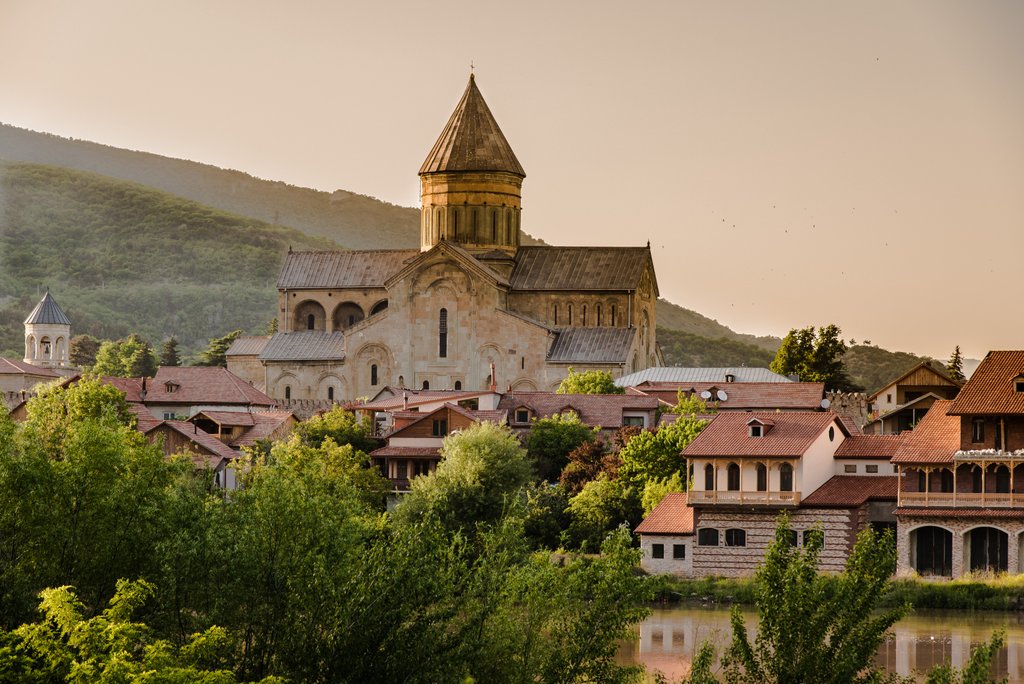
Van in Ostanatolien war Jahrtausende lang religiöses und kulturelles Zentrum der Armenier. Nach 100 Jahren kehren die einst vertriebenen armenischen Christen zurück, um einen Gottesdienst zu feiern. Die Zeichen stehen auf Versöhnung.
Showing posts with label Kurds. Show all posts
Showing posts with label Kurds. Show all posts
Friday, October 29, 2010
RADIO: Langsame Annäherung. Armenische Christen kehren nach Ostanatolien zurück. Von Susanne Güsten (dradio.de)


Wednesday, March 04, 2009
SCIENCE: Do these mysterious stones mark the site of the Garden of Eden? (dailymail.co.uk)
www.dailymail.co.uk
28 February 2009
By Tom Cox
For the old Kurdish shepherd, it was just another burning hot day in the rolling plains of eastern Turkey. Following his flock over the arid hillsides, he passed the single mulberry tree, which the locals regarded as 'sacred'. The bells on his sheep tinkled in the stillness. Then he spotted something. Crouching down, he brushed away the dust, and exposed a strange, large, oblong stone.
The man looked left and right: there were similar stone rectangles, peeping from the sands. Calling his dog to heel, the shepherd resolved to inform someone of his finds when he got back to the village. Maybe the stones were important.
They certainly were important. The solitary Kurdish man, on that summer's day in 1994, had made the greatest archaeological discovery in 50 years. Others would say he'd made the greatest archaeological discovery ever: a site that has revolutionised the way we look at human history, the origin of religion - and perhaps even the truth behind the Garden of Eden.
full text >>>
Tuesday, November 04, 2008
OFFENER BRIEF: Einige Bemerkungen zu den Veröffentlichungen der Gesellschaft für bedrohte Völker. Von Marika Lapauri-Burk.
Der Kaukasus ist ein Region in Europa, wo immer Minderheiten miteinander seit Jahrhunderten lebten. Jede politische Entscheidung im Kaukasus, die nicht dessen historisch-kulturellen Kontext berücksichtigt, hat keine Zukunft. Heute ist es die Aufgabe Europas, diese einzigartigen kleinen Völker von der Bedrohung und dem Aussterben zu schützen. Nur dann kann eine an ökonomischer Entwicklung interessierte Politik Zukunft haben. Die kulturellen Werte werden in den globalen Entwicklungen in unserer Epoche bei weitem nicht ausreichend berücksichtigt. Eine bisher orientierungslose Politik hat das Anbrechen einer neuen Ära nicht richtig erkannt. Vielleicht ist die aktuelle Krise im Kaukasus eine Chance für die Welt, um zu handeln, eine klare Vision zu entwickeln, wozu und mit welchen Mittel wir besser zusammen für unsere Zukunft sorgen können.
Der ganze Brief >>>
An
Gesellschaft für bedrohte Völker
Postfach 2024
37010 Göttingen
Von Marika Lapauri-Burk
Lile e. V.
Hamburg/Oktober 2008
Der ganze Brief >>>
An
Gesellschaft für bedrohte Völker
Postfach 2024
37010 Göttingen
Von Marika Lapauri-Burk
Lile e. V.
Hamburg/Oktober 2008
Sunday, July 27, 2008
REPORTAGE: Der mythische Berg
Der Ararat - Brennpunkt kultureller, ethnischer und religiöser Interessen
Entführung am Ararat! Wie mysteriös auch das glücklich ausgestandene Kidnapping dreier deutscher Bergsteiger durch kurdische Guerilla-Kämpfer gewesen sein mag, eines war deutlich genug: Sie schlugen nicht irgendwo, sondern am Ararat zu - und wollten damit ein Zeichen setzen. Dieser Berg ist ein kurdischer Berg! Freilich ist dieser Berg, je nach Blickwinkel, auch ein türkischer, ein armenischer oder - in einer ganz anderen Kategorie - ein biblischer Berg. Steile These: Wenn ein Berg für die Menschheit, auch für deren »nicht bergsteigenden Teil«, ein ganz besonderer ist, dann der Ararat, der im Brennpunkt kultureller, ethnischer, religiöser Interessen steht.
Der ganze Text >>>
Wednesday, July 09, 2008
NEWS: German mountaineers reported kidnapped on Mount Ararat
The governor of the eastern Turkish province of Agri says Kurdish rebels have kidnapped three German climbers on Mount Ararat. Mehmet Cetin said Kurdistan Workers' Party (PKK) rebels seized the climbers late on Tuesday in protest at the Berlin government's crackdown on PKK-affiliated bodies and supporters in Germany. The official said the climbers were part of a 13-member German team that was allowed to climb Mount Ararat believed by many to be the final resting place of the Biblical Noah's Ark. There's been no confirmation of the incident from the German embassy in Turkey. In the past, PKK rebels have abducted and released several foreign tourists and climbers in the country's southeast. The PKK has been fighting for autonomy in the region since 1984.
Source: Deutsche Welle
 Ararat am 4. November 2007 von Narek
Source: Deutsche Welle
 Ararat am 4. November 2007 von Narek
Wednesday, February 27, 2008
KONFLIKT: Kurden im Kaukasus und Rückzug der PKK-Guerilla
Einmarsch mit 10000 Soldaten
Türkische Großoffensive gegen den Nordirak. Luftangriffe auf kurdische Dörfer. Informationen von der US-Armee. Rückzug der PKK-Guerilla in den Kaukasus?
Von Nick Brauns
Türkische Großoffensive gegen den Nordirak. Luftangriffe auf kurdische Dörfer. Informationen von der US-Armee. Rückzug der PKK-Guerilla in den Kaukasus?
Von Nick Brauns
Offenbar haben zahlreiche PKK-Kämpfer in den vergangenen Monaten ihre Stützpunkte im Irak verlassen und sind in Richtung Kaukasus gezogen. Am Freitag meldeten türkische und aserbaidschanische Medien, daß die kurdische Guerilla in den von armenischen Truppen seit Anfang der neunziger Jahre besetzten, offiziell zu Aserbaidschan gehörenden Gebieten Fuzuli und Lachin aktiv sei. Der israelische Geheimdienst habe diese Informationen bestätigt, so die aserbaidschannische Presseagentur APA. Während die armenische Regierung derartige Berichte dementierte, zeigte sich der Sprecher der US-Botschaft in Baku, Jonathan Henik, gegenüber »Radio Free Europe –Radio Liberty« besorgt. Es könnte zu Anschlägen der PKK-Guerilla auf die Ölpipeline von Baku zum türkischen Mittelmeerhafen Ceyhan kommen. In Armenien und Aserbaidschan leben etwa 200000 Kurden.
Der ganze Artikel in Junge Welt >>>
Monday, February 05, 2007
The Yezidi Kurds and Assyrians of Georgia: The Problem of Diasporas and Integration into Contemporary Society
Iraklii Chikhladze, Executive Director,
International Eurokavkazasia Association, Tbilisi, Georgia
Giga Chikhladze, Executive Director,
Profile Journal, Tbilisi, Georgia
We have deliberately selected the Assyrians and the Yezidi Kurds from among numerousethnic minorities living in Georgia as a subject of this article because both have no independent national-autonomous entities except their autonomies in the north and northeast of Iraq. This shows that the diasporas cannot communicate with their historical homeland at the state level. At the same time, the expected state structure of postwar Iraq may greatly affect the life of the Kurdish and Assyrian communities in Georgia that share some of the problems with other ethnic minorities and have specific concerns of their own. There are indications that these communities have stepped up their activeness partly in response to the Georgian domestic problems and partly because of the coming geopolitical changes in the Middle East. The Southern Caucasus has been serving as home to the majority of the Kurds and Assyrians since the early 20th century when their ancestors fled Turkey.
Today their diasporas may gain more weight in the context of possible geopolitical changes that are expected soon.
More: http://www.zindamagazine.com/html/archives/2005/9.24.05/index_sat.php
Onnik Krikorian is towering with his themes and photo about the yezidi and kurds ...
Look there: Kurds & Yezidi
Monday, January 29, 2007
Response to “Kosovo's 'independence lite'”
Reuters, 26 Jan 2007 20:28:00 GMT
When the Kosovo will be independent than there are problems with Abkhazia and South Ossetia in Georgia. Another aspect of this "problematic of indepence" is the ethnic territory from the kurds ...
Darlan says:
Source: Response to “Kosovo's 'independence lite'”
Reuters, 26 Jan 2007 20:28:00 GMT
When the Kosovo will be independent than there are problems with Abkhazia and South Ossetia in Georgia. Another aspect of this "problematic of indepence" is the ethnic territory from the kurds ...
Darlan says:
"I don't think there is a ready solution to the Kosovo mess at all, and just cutting it loose, as an independent nation, sets a very dangerous precedent. Especially since both sides have very strong emotional ties to the region (Kossovo was where the Serbs first fought for independence from the Ottoman Turks in the 14th century).
For example, Russia-- which hates the former Soviet Republic of Georgia-- is pressing for both Abkhazia and South Ossetia, two regions of Georgia in which non-Georgians form the majority, to leave Georgia. If Kosovo breaks off from Serbia, then South Ossetia and Abkhazia will probably be pushed to do the same from Georgia.
Furthermore, the Kurds in Turkey would argue very loudly that they deserve the same treatment. While I have a lot of sympathy for the Kurds overall, if the Kurds press for independence-- by the same principle as Kosovo's would-be independence-- then the USA would be forced into an impossible, no-win situation of either supporting the Kurds against our erstwhile Turkish ally, or enraging the Kurds by denying them the same right."
Source: Response to “Kosovo's 'independence lite'”
Thursday, December 21, 2006
Nicolas Landru hat drei neue Artikel zu Georgien veröffentlicht
Die Yezidi-Kurden von Tbilissi
Von Nicolas LANDRU

Report: The Yezidi Kurds from Tbilisi
By Nicolas LANDRU
Kabinettsumbildung zum dritten Jahrestag der georgischen „Rosenrevolution“
Von Nicolas LANDRU
Cabinet shuffling for three years of the Georgian Rose Revolution
By Nicolas LANDRU
Georgien: die Region Tqibuli angesichts der Landflucht
Von Nicolas LANDRU
Sunday, November 05, 2006
The Yezidi Kurds' tribes & clans of south Caucasus
By Kereme Anqosi
Yezidi Kurds have been in the southern Caucasus under Russia for some 150 years now. The majority fled Ottoman oppression and discrimination in 1916-1918 to settle in Armenia and Georgia. Following the collapse of the Soviet Union, they have been leaving Georgia and Armenia to settle in Russia, Europe and elsewhere.
All of those in Georgia and Armenia have come from the two provinces of Wan and Qers [Van & Kars in official maps] in Turkey. Some reached the Russian Empire much earlier and some later. But all came to Russia and threw themselves on the mercy of the Czar for protection. Helplessness and poverty were everywhere.
South Caucasus Yezidis are divided into two main groups: the Zuquri Yezidis from the province of Wan and the Axbaran Yezidis from the province of Qers.
Yezidi communities in Armenia and Georgia are divided into many tribes and clans: the tribes of Zuquriyan, Sipkan, Xaltan, Mehemdan, Rojkan-Rojkani, Hesiniyan and the clan of Axleran.
Each tribe is further divided into clans and separate households. There are many tribes and clans, some small and some large, some powerful and some less so.
The Zuquri Yezidis say they packed up their belongings in the province of Wan (in Turkey) and settled down on the lands of Armenia and Georgia. The Yezidi Zuquris are also known as the tribe of "Cangir-axaye Mendiki." The Zuquri tribe lived on the land surrounding Lake Van and eastward to the Iranian frontier (the town of Sera). Their villages were located high up in the mountains between the rivers Ava Resh [black water] and Godirme. There were several Zuquri villages on the Iranian side of the border as well. Within the Zuquri tribe there were two prominent and highly respected families. One belonged to Cangir-axa son of Xetibaxaye Mendiki and the other belonged to Simo, son of Cheto-axaye Reshi. In reality, Simo, son of Cheto's household, was a big man, but Cangir-axa was a brave-hearted, resourceful gentleman. He was well informed and sociable. Thanks to his leadership and guidance, the Yezidis freed themselves from Ottoman discrimination and oppression. Cangir-axaye Mendiki was quite a warrior. What a shame though! He was betrayed. Yezidi musicians have composed many pieces praising his courage.
Yezidis from Qers and Axbaran (a township in Armenia around Mt Elegez) lived in villages around the cities of Qers, Bazid and Surmeli, among the villages of other Kurds and Armenians. Among the Yezidis from Qers, the households of Kok-axa (Choban-axa) and Hesen-beg of the Hesinian tribe were well known.
In this book, as far as we know, we bring to public view the names of tribes and clans and the villages from which they originate. Over time the uninformed among us are forgetting their ancestral homeland in Kurdistan and feelings of patriotism are abating as well. There have been many frustrations and difficulties over the course of collecting and documenting the names of tribes and clans. But, thanks to the Almighty, we managed the task and produced this book. Of course, there are deficiencies. Perfection is not possible. A good deal of time has passed. Our people, our elders have gone to their maker. They were unable to conduct a proper scientific study of Yezidi tribes and clans.
We believe this to be the first attempt to describe and publish the Yezidi Kurds' tribes and clans in south Caucasus (from Wan and Qers) and in Germany (those who left Turkey). Owing to lack of opportunities, the Kurdish section of this book has been written only briefly, but the Russian language section contains far wider research and commentary. [The Russian section has been translated to English; see PREFACE]
further text: The Yezidi Kurds' tribes & clans of south Caucasus
More: Onnik Krikorian has an extensive post on the Yezidi minority in Georgia, which he recently visited together with an ethno-musicologist. Onnik provides exclusive photography, interviews, and compares the minority’s situation in Georgia with that in Armenia.
More: The Yezidi Kurds and Assyrians of Georgia. The Problem of Diasporas and Integration into Contemporary Society. (www.ca-c.org)
Photos: Onnik Krikorian / Oneworld Multimedia 2006
Tuesday, February 21, 2006
The Kurds and the Caucasus
By Zorabe Budi (Aloiane)
Cultural and Religious Links in Early Modern and Modern Periods The Kurds are essentially linked to the Caucasian region by geography, history and culture. Although all these have centuries-long history (for instance, Kurdish ruling dynasties in Transcaucasia in the 9th-13th centuries), the following article summarises cultural, historical and religious links between the Kurds and the Caucasus in Early Modern and Modern periods.
[more ...]
GEORGIA. With regard to Georgia, in 1970-s and 1980-s the interest towards Kurdish theme increased and Tbilisi soon became another centre for Kurdish cultural life with classes at schools, a theatre, musical groups, publication of books, weekly radio broadcasting and the Kurdish section in the Writers' Association of Georgia. The local scholars were and are dealing with Georgian sources related to the Kurds. Thus, the latest monograph of V. Macharadze is dedicated to Georgian documents on relationships between the Georgians, Kurds, Assyrians and Russians during the reign of the King Irakli II of Georgia (the 18th century). Another Georgian author, A. Menteshashvili, has published in 1984 one of the most comprehensive studies on the Kurdish social life. Another interesting point is that while the absolute majority of the Georgia's Kurds speak in Northern (Kurmandji) dialect, the Soviet Kurdologist Q. Kurdoev recorded two short texts in Zaza dialect from the residents of a Zaza village near Batumi (Adzharian Autonomous Republic in Georgia).
Sunday, December 11, 2005
Armenia's Yezidi Kurds

Photographs by Andrei Liankevich with text by Zhanna Alexanian and Andrei Liankevich. more >>>
(Quelle: IWPR Photojournalism)
Subscribe to:
Posts (Atom)