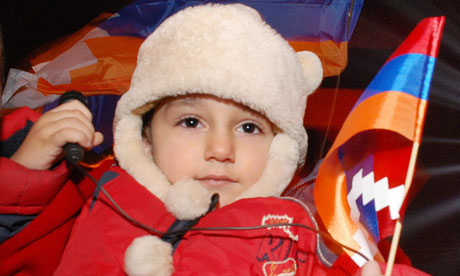
(americanphotomag.com) Offside: Football In Exile documents six Azerbaijani and Armenian lives shaped by soccer in the conflict-ridden Nagorno Karabakh disputed territory
By John Mahoney on October 18, 2012
 |
| more pics here: americanphotomag.com |
Most of you reading this have probably never heard of Nagorno Karabakh, an unrecognized republic roughly the size of Maine nestled between Armenia and Azerbaijan. I hadn’t either, before I picked up Offside: Football in Exile, a unique photobook that tells the story of this war-torn region via its two main soccer clubs, FK Qarabag Agdam and FK Karabakh Stepanakert. We watch this story unfold via the lives of six individuals and their complex relationship with both their tumultuous homeland and the game of soccer.
As the Soviet Union disintegrated in the early 1990s, Nagorno Karabakh became one of many violent flashpoints in the broader regional conflict in the Caucasus, with Armenia and Azerbaijan both battling fiercely for control of its territory. The confusion continues until this day–Nagorno Karabakh functions as an unrecognized de facto republic, and the conflict has displaced hundreds of thousands of Armenians and Azerbaijanis alike.
It’s a complicated story, to say the least. It’s wise, then, that photographer Dirk-Jan Visser and journalist Arthur Huizinga chose to narrow the story’s focus down to six lives. In Offside we meet people like Aslan Kerimov, a veteran defender for the Azerbaijani team FK Qarabag Agdam. In 1993, the team was driven from their home stadium in the heart of the disputed territory due to the violence (only in 2009 did they return to the region, from their temporary home in the Azerbaijani city of Baku). His story contrasts with David Martirosyan, a 19-year-old Armenian goalkeeper whose father was killed in the war, and whose future in the sport is uncertain, considering that the major European soccer sanctioning bodies ban his unrecognized homeland and its biggest team, FK Karabakh Stepanakert, from official competition beyond the junior level.
The book is organized around the six lives it describes, and its design features do a lot to drive the overall storytelling. Each section is introduced with a written biography by Huizinga and caption list, with all text printed in English, Armenian and Azerbaijani. The texts are also color-coded to indicate the person’s ethnic heritage (blue for Armenia, red for Azarbaijan). Visser’s photos that follow are also rigidly segmented–with photographs of important places and landscapes in color, and depictions of each person’s daily life in stark black and white. His work is presented alongside personal snapshots from years’ past provided by the subjects. The photos are often broken up across consecutive pages, with no image seen in its entirety on any single page.
At first I was a bit overwhelmed by these design choices–I felt like I couldn’t immediately solve the various puzzles the book seemed to be presenting. But of course this is intentional–you’ll not find a more complex and frustrating story to try to tell than the decades of ethnic and political conflict that have shaped this part of the world, and in presenting their stories in such a rigidly systematic way, Visser and Huizinga both emphasize this fact and at the same time attempt to impose some form of order on the chaos. I found it hardest to come around to the photos being broken up across multiple pages; the work here is often beautiful, and it was frustrating to feel deprived of any single image’s full impact. But again, the lives these photos depict could not be more fragmented, and the choice to break them up effectively mirrors that.
Ultimately I really enjoyed this book for its full-on commitment to narrative storytelling. Photographers experimenting within the documentary tradition will often shy away from communicating any single interpretation of their work. And that’s fine—forcing the viewer to interpret a series of images presented wordlessly can be a powerfully effective way to create an emotional response. I find this approach most effective in a gallery or museum setting. But in the case of Offside, Visser and Huizinga have made a work that is very much a book, exemplifying all the narrative strengths of the medium in fine form.
 Offside: Football In Exile was published by Paradox and Y Books. A gallery show with some of the work was shown in the Netherlands at Noorderlicht gallery earlier this year.
John Mahoney is a writer and web designer living in New York City. He is the web editor for American Photo magazine. On Twitter he is @mahon_e.
Offside: Football In Exile
Photos by Dirk-Jan Visser; text by Arthur Huizinga. Published by Paradox and Y Books: $50
AmazonShop: Books, Maps, Videos, Music & Gifts About The Caucasus
+++
Watch a video trailer made for the book and project.
Trailer of Noorderlicht Exhibition and Paradox / Ydoc Publishing photobook OFFSIDE - Football in Exile by photographer Dirk-Jan Visser and writer Arthur Huizinga. OFFSIDE is a documentary project on the forgotten conflict in Nagorno-Karabakh. The project adresses the conflict from the perspective of two football teams: FK Qarabag Agdam and FK Karabakh Stepanakert.
For more information see: noorderlicht.com
+++
(jmcolberg.com) After the implosion of the Soviet Union, ethnic and religious tensions that had been held in check by Communist regimes and their ruthless application of power erupted along long-dormant fault lines. It was as if things had been frozen into place in the 1940s, and the post-Communist thaw allowed them to move again. The Balkans and Caucasus regions have since seen wars and mini-wars that most people had thought of as events of the past. The Caucasus, in particular, has proven to be a veritable mine field, with, seemingly, every village being if not at war then at least in some sort of conflict with its neighbouring village (if you think that’s hyperbole read The Sochi Project’s Empty land, Promised land, Forbidden land). Westerners for the most part have had a hard time understanding and/or following the various conflicts, and regardless, most of them seem far away and thus inconsequential (people will not easily admit this, of course).
I’m not an expert on the region, but from memory the conflict around Nagorno-Karabakh is one of the earliest that erupted (just to give you an idea what we’re dealing with, the region is about 30% larger than the Rhode Island, but has only around one ninth the US state’s population). As of now, it’s mostly unresolved, with peace talks between Armenia and Azerbaijan - the two main countries involved - ongoing. The previously frozen conflict has effectively become re-frozen, with international involvement keeping it from going.
In this frozen landscape, life has been going on. Offside - Football in Exile by photographer Dirk-Jan Visser and writer Arthur Huizinga (with the book’s design by Kummer & Herrman) brings life in the region - and the unresolved conflict itself - into focus by looking at football (the actual one that Americans call “soccer”). This seems like a smart idea, since usually even the most antagonistic neighbours can be united in their love for the same kind of sport. And even though most types of sport contain a very strong tribalistic element (the same mechanism that feeds the kinds of conflicts we’re talking about here), there is more to them, with the general underlying aspirations and ideas being fairly universal.
Offside features six individuals, three from each side, talking about their lives and about football. Sport offers an escape mechanism only to some extent, and the reality of the Nagorno-Karabakh has all kinds of repercussions, resulting in often absurd restrictions. The book keeps things neatly apart, at least on the surface, by using colours (red and blue) - Armenia and Azerbaijan are blue and red, respectively, on the main map (Nagorno-Karabakh itself requires two types of hatchings), and the essays about the six individuals are printed in their country’s colour. For people like me, who enjoy things neatly organized, that’s a very simple and efficient way to convey information.
The photography, in b/w and colour (in addition, there are some archival photographs), is mixed throughout the book, so if you ignore the text you’re not going to be able to tell things apart that easily. Offside is not the first book to emerge from Holland that has a photographer working alongside a writer, and once you look through the book you realize what is to be gained from that. The overall design also neatly places the book into the contemporary Dutch context - in addition to the use of colour (and, presumably, fonts - I’m not much of an expert on that), the photographs wrap around pages. You might see part of an image on one page and then the rest on another. I do think, though, that in terms of the design less could have been a bit more. For me, the clever design gets a bit in the way of what the book is actually talking about. While great design can play an important role in photobook making, it must be content with serving the purpose of the book, and I’m not sure that’s 100 per cent the case here.
Design issues aside, Offside is another fine example of contemporary Dutch documentary photobook making. With so much hand-wringing about the state of photojournalism and about how to present documentaries, looking at recent examples coming from Holland might teach the rest of the world a lesson of what still is possible.
Offside - Football in Exile, photographs by Dirk-Jan Visser, text by Arthur Huizinga, design by Kummer & Herrman, 308 pages, Paradox, 2012
+++
(jmcolberg.com) After the implosion of the Soviet Union, ethnic and religious tensions that had been held in check by Communist regimes and their ruthless application of power erupted along long-dormant fault lines. It was as if things had been frozen into place in the 1940s, and the post-Communist thaw allowed them to move again. The Balkans and Caucasus regions have since seen wars and mini-wars that most people had thought of as events of the past. The Caucasus, in particular, has proven to be a veritable mine field, with, seemingly, every village being if not at war then at least in some sort of conflict with its neighbouring village (if you think that’s hyperbole read The Sochi Project’s Empty land, Promised land, Forbidden land). Westerners for the most part have had a hard time understanding and/or following the various conflicts, and regardless, most of them seem far away and thus inconsequential (people will not easily admit this, of course).
I’m not an expert on the region, but from memory the conflict around Nagorno-Karabakh is one of the earliest that erupted (just to give you an idea what we’re dealing with, the region is about 30% larger than the Rhode Island, but has only around one ninth the US state’s population). As of now, it’s mostly unresolved, with peace talks between Armenia and Azerbaijan - the two main countries involved - ongoing. The previously frozen conflict has effectively become re-frozen, with international involvement keeping it from going.
In this frozen landscape, life has been going on. Offside - Football in Exile by photographer Dirk-Jan Visser and writer Arthur Huizinga (with the book’s design by Kummer & Herrman) brings life in the region - and the unresolved conflict itself - into focus by looking at football (the actual one that Americans call “soccer”). This seems like a smart idea, since usually even the most antagonistic neighbours can be united in their love for the same kind of sport. And even though most types of sport contain a very strong tribalistic element (the same mechanism that feeds the kinds of conflicts we’re talking about here), there is more to them, with the general underlying aspirations and ideas being fairly universal.
Offside features six individuals, three from each side, talking about their lives and about football. Sport offers an escape mechanism only to some extent, and the reality of the Nagorno-Karabakh has all kinds of repercussions, resulting in often absurd restrictions. The book keeps things neatly apart, at least on the surface, by using colours (red and blue) - Armenia and Azerbaijan are blue and red, respectively, on the main map (Nagorno-Karabakh itself requires two types of hatchings), and the essays about the six individuals are printed in their country’s colour. For people like me, who enjoy things neatly organized, that’s a very simple and efficient way to convey information.
The photography, in b/w and colour (in addition, there are some archival photographs), is mixed throughout the book, so if you ignore the text you’re not going to be able to tell things apart that easily. Offside is not the first book to emerge from Holland that has a photographer working alongside a writer, and once you look through the book you realize what is to be gained from that. The overall design also neatly places the book into the contemporary Dutch context - in addition to the use of colour (and, presumably, fonts - I’m not much of an expert on that), the photographs wrap around pages. You might see part of an image on one page and then the rest on another. I do think, though, that in terms of the design less could have been a bit more. For me, the clever design gets a bit in the way of what the book is actually talking about. While great design can play an important role in photobook making, it must be content with serving the purpose of the book, and I’m not sure that’s 100 per cent the case here.
Design issues aside, Offside is another fine example of contemporary Dutch documentary photobook making. With so much hand-wringing about the state of photojournalism and about how to present documentaries, looking at recent examples coming from Holland might teach the rest of the world a lesson of what still is possible.
Offside - Football in Exile, photographs by Dirk-Jan Visser, text by Arthur Huizinga, design by Kummer & Herrman, 308 pages, Paradox, 2012