(cenn.org) Iakhsar (1) rushed into Lake Abudelauri after the devi (2) and killed him there with a whip. The devi shed so much blood that Iakhsar was trapped in the water for three years. The Khevsuretians became sad. They could not help their deity who had saved them. Finally, after three years, a sorcerer advised them to sacrifice a ram from the village of Blo, which had four ears and four horns. The devi's blood subsided, and Iakhsar could get out of the lake.
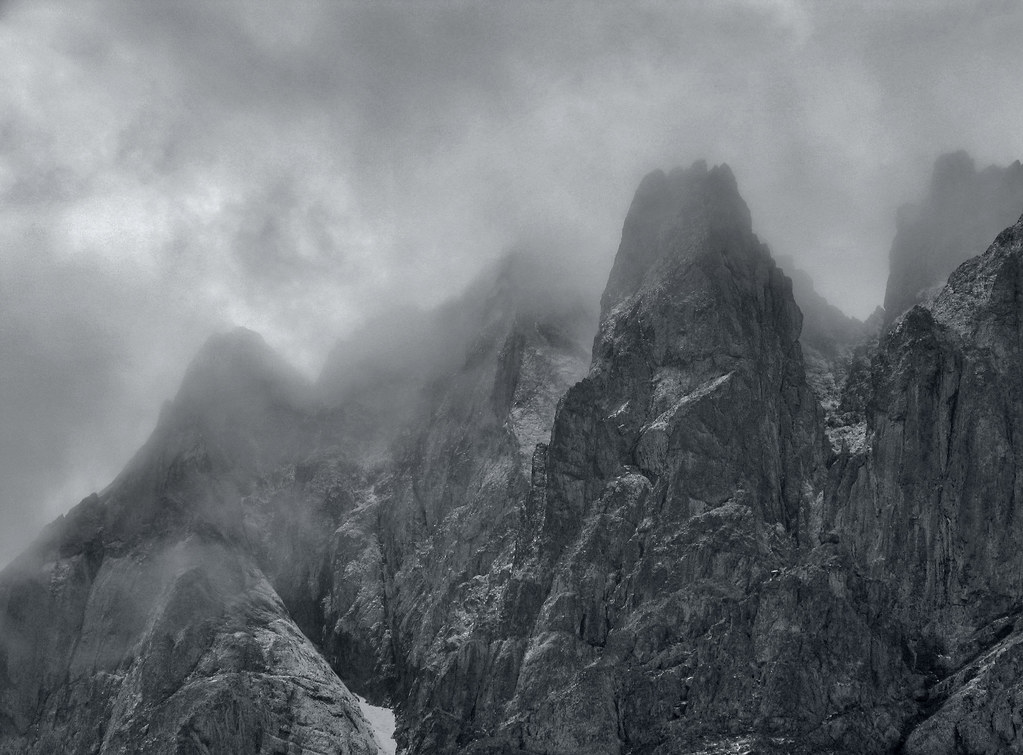
I tell Eleanor this old legend while we are sitting on the shore of the lake. Lake Abudelauri is too small to be the arena for a fight of two supernatural beings - one kind, one malicious - but the silence around us, the rocky peaks of Chaukhi (3) behind us, and a small lake at the edge of glacial moraines lost in green really create a mystical effect ...
We are in Khevsureti, a region of Georgia where myths are mixed with reality and concrete geography. A young hunter was lost on one of the peaks of Chaukhi - Sindaura when hunting for Caucasian goats. His death gave rise to many folk verses and poems. Mindia,(4) who drank snake's blood when he was in the captivity of enemies, understood the language of plants and animals and became an invincible hero and protector of the Khevsuretians, lived in the village of Amga, in the Arkhoti community, which is at a distance of one days journey from here. The legend about Mindia is one of the most popular legends in Georgia. Many famous writers in different times tried to develop this theme ...
But we do not have far to go to meet a legend. It is near, several meters from us. A high rock rises from the middle of the lake. It is cleft in two - the work of Iakhsar, rescuing the people from the devi. The first stroke of his whip missed the devi and broke the rock ...
The etymology of the word "Khevsureti" belongs to the late middle ages. Formerly, Khevsureti, together with the neighboring region Pshavi, was called Pkhovi. This ancient name is retained in the language of Chechens, neighbors of Khevsuretians, who call then "Pkhie" even now.
Today the proximity of the northern borders is felt as never before. My guest and I felt it in the first village we came to in Khevsureti and at the regional centre of Barisakho. There are a lot of people in military uniform (Khevsuretians, like other mountaineers of Georgia, undergo military training on their native land). The road going to Chechnya is controlled. A military unit is now based in Arkhoti too, where the border three years ago was protected only by several locals. We met the military helicopter several times on the road from Roshka to the lake Abudelauri. The situation is rather depressing for the average tourist, but Eleanor is not an average tourist. She is a writer and adventurer, an experienced naturalist and former member of the Greenpeace. Moreover, she comes from Ireland; therefore the only problem for her is a delicacy of the people of Pshavi - a nutritious but very greasy cottage cheese (we spent some days in Pshavi before coming to Khevsureti). Eleanor hunted for seals and whales and ate uncooked meat together with the Eskimos so as not to offend her hosts. But the cottage cheese did its work, and now she eats only potatoes in Roshka.
At the end of our path we could now see Roshka, where about twenty families sharing one surname - Tsiklauri - live. It is a very large village for Khevsureti and has a great deal of pastures and meadows. The Khevsuretians are very good mowers. They mow on very steep slopes and often have to use climbing equipment. In this regard the denizens of Roshka have easier conditions - their meadows are not so steep. They gather a good harvest of potato, a main crop of our mountains, which Eleanor knows better than I do now.
We reach Roshka in the evening, when the cattle come back from pastures. The villagers, like other Khevsuretians, breed cattle. They used to breed sheep as well, but unlike their neighbors, (the people of Pshavi, Gudamakari and especially Tusheti), they had never engaged in nomadic sheep breeding. Khevsuretians consider pigs to be foul animals, and even now refrain from breeding them. This is probably the influence of their Muslim neighbors. One old villager complained that his son, who lives on the plain, brought him pigs for rearing and offended and dishonored the old man ...
The migration of the people of Khevsureti to the plain started in the nineteenth century, but in the 1950s this voluntary migration became obligatory. At the direction of the government of that time, many high-mountainous villages were deserted. The people from these places settled for the most part in the southeast of Georgia. The majority of their descendants live there even now. As a rule, at least once a year these people visit the mountains to attend the summer pagan holidays or just to see the homeland ...
If you have an occasion to travel with a Khevsuretian going to his native land, it is an unforgettable show. As the road goes up to the mountains and his native land gets closer, the Khevsuretian becomes brighter and more cheerful. The way back to the plain is the opposite. The man who used to laugh and sing a few hours ago now becomes taciturn and sits silent in the car near you. Khevsuretians especially avoid the large capital. If they have a business there, they try to arrange everything very quickly and immediately come back without even visiting their close friends, if such live in the town.
Yesterday Eleanor and I met four Khevsuretians living in Kakheti5 on their way to Arkhoti. They rushed into the village by a car that had broken down several times during their trip, brought out drinks, and the sounds of their feast were heard all night long from the house where they stayed. Everybody knew about the presence of drunken Khevsuretians in the village. But early in the morning, they saddled their horses and headed to their villages by the road through the pass, occasionally shooting from their guns...
We are at home already. Our host Shota came back very tired: all day long he had been dragging hay with the bulls. Shota and his wife Tina have got three daughters and a three year old son Uturga who is supposed to continue the family name. The girls help their mother cook dinner. Tired Eleanor leaves to have a rest, Shota finishes his work in the courtyard. I look at the village from the balcony. I see the cattle coming back from pastures like a live current. Farther on I can see the road going to Northern Khevsureti and the mountain pass, Bears Cross. That part of Khevsureti is still illuminated by the sun, but in Roshka it is evening. An old woman comes out the verandah of the next house and looks over the village with binoculars. Perhaps her cow has not come yet. I go into the house for my camera, but the woman notices me, hides the binoculars, and enters the house grumbling ...
I am thinking about tomorrow and my way back to the large city without pleasure. It is October now and probably I will not be able to come here until next year. Most likely I will be silent and thoughtful on my way back like a real Khevsuretian ...
-----------------------------------------------------
1 A pagan deity of the people living in the mountainous region of Georgia - Tusheti, Pshavi, and Khevsureti.
2 A fabulous monster; a huge, ugly and evil creature having immense strength.
3 The mountains in the Central Caucasus.
4 A hero of Georgian legends.
5 Region in the Southeast part georgia.
Full Photoessay >>>
Archil Kikodze
He is a professional photographer, famous Georgian writer,
ethnographer and finally wildlife tracking guide. He has traveled widely
in Caucasus and knows every corner of Georgia well with its people’s
traditions and culture, that’s why his interesting stories make every
trip unforgettable.
His photographs have won many awards and have participated in various
national and international photo exhibitions. Furthermore Archil has
published various articles on environmental, ethnographic and social
themes in magazines: “Surviving Together”, “Caucasus Environment”,
Horizonti, “Mshvenieri Sakartvelo”, “Tskheli Shokoladi” Author of three
guidebooks for developing science tourism in Georgia (Khevi, Svaneti,
Bakuriani), Switzerland. At the request of Ministry of Environment of
Georgia wrote books on Kolkheti, Tusheti and Vashlovani National Parks
and Lagodekhi Reserve.
facebook.com/archil.kikodze