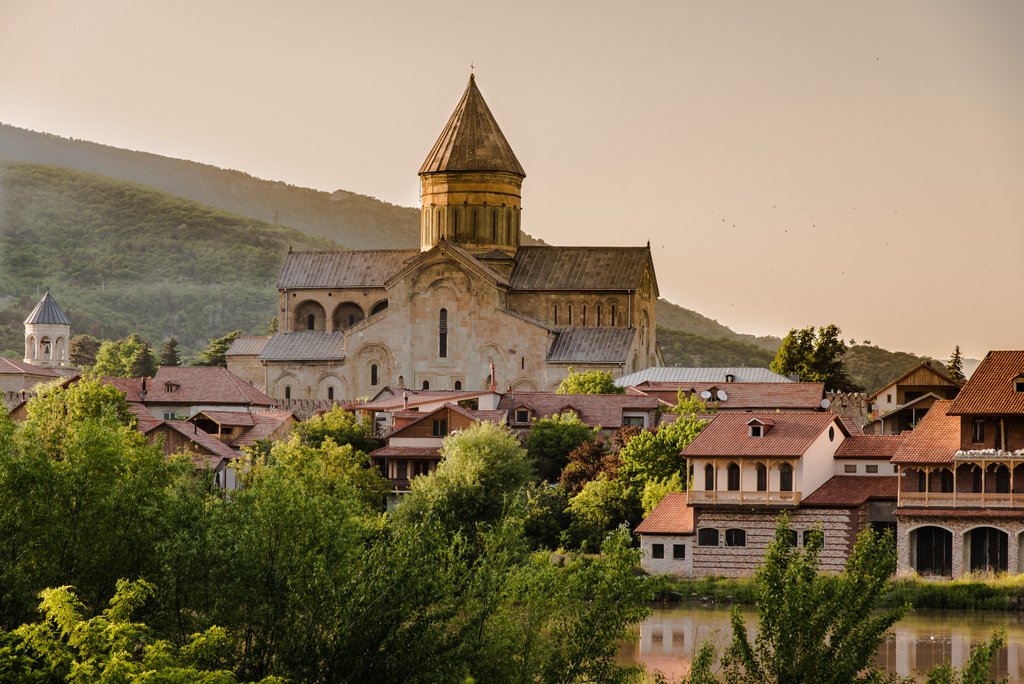
The Caucasus is often depicted as a region of peoples locked in enduring and invariant nationalist enmity. The reality is more complex and therefore more hopeful, says Thomas de Waal. (Thomas de Waal is a Senior Associate for the Caucasus at the Carnegie Endowment for International Peace in Washington.)
The south Caucasus is one of those places where people like to say that the “weight of history” lies heavily. Increasingly, I raise a dissenting voice. True, history lies all round you in this region, not least in its regular invocation by modern politicians. To name but one example: after his inauguration as president in January 2004, Mikheil Saakashvili chose to travel to the tomb of the man widely regarded as Georgia’s greatest king, David the Builder, who reigned from 1089-1125.
But the idea that the call of history determines and drives the people of this region into intractable conflict must not be taken at face value. And sometimes history is only as weighty as you allow it to be. The more you look into the Caucasian past, the more it fractures into a mosaic of different narratives, many of them ones of cooperation as well as conflict. If we take a more sceptical - even postmodern - view of the history of this region, we will be doing it a service.
I have been writing about the Caucasus for years but when I started in 2009 to research a short book about the region - which became The Caucasus: An Introduction (Oxford University Press, 2010) - even I was surprised by how some of the historical facts I learned challenged many of today’s dominant political narratives. Three examples make the point.
First, in Russia’s wars of 1820s against the Ottomans, Armenians and Azerbaijanis fought side by side in the Tsarist army. At that historical juncture, the Shi’a-Sunni divide overrode any notions of Turkic brotherhood. Alexander Pushkin himself witnessed the “Karabakh regiment” composed of Azeri cavalry in action outside Kars, and wrote an admiring poem dedicated to one of its officers, Farhad-Bek. That should caution against making any instant assumption about an eternal Azerbaijani-Turkish alliance, which often fuel political attitudes over the Nagorny Karabakh conflict (and which the Armenian-Turkish normalisation process, albeit thus far unsuccessful, has also somewhat shaken).
Second, the way that the Abkhaz-Georgian-Russian interrelationship has reshuffled since the 1850s challenges conventional wisdom. In the decades after Georgia fell was annexed by Russia in 1801, and increasingly throughout the 19th century, the Russian authorities ensured that Georgian aristocrats became loyal servants of the Tsar by allowing them to ascend the imperial career-ladder while keeping their noble status. At the same time, the Russians regarded the Abkhaz as wild pro-Turkish tribesmen and implacable enemies.
In 1852 the Russian general Grigory Filipson complained that his soldiers could not step outside their Black Sea fortress without fear of being killed by Abkhaz malcontents: “In a word, we occupy Abkhazia but we do not rule it.” In the last quarter of the 19th century the Russians’ deportation of the Abkhaz from their homeland facilitated the immigration of Georgians into Abkhazia, redrawing the demographic map and seeding the ground for conflict in the 20th century. This history raises question marks about the durability of the Abkhaz-Russian relationship, and indeed of Russian-Georgian hostility.
A third surprise to me was to learn how Georgia’s first declaration of independence in the 20th century was, in geopolitical orientation, 180 degrees different from the second. In May 1918, in the wake of the Bolshevik revolution in Russia and when Georgia was threatened by an imminent Turkish invasion, the head of the Tbilisi government, Noe Zhordania, reluctantly declared Georgia independent. Zhordania, whose Menshevik (social-democratic) party traced its roots to the split with the Bolsheviks in 1903-04, voiced his ambivalence over breaking the bond with Russia: “Our ancestors decided to turn away from the east and turn to the west. But the road to the west lay through Russia and consequently to go towards the west meant union with Russia.”
Zhordania’s independent republic lasted almost three years until Georgia’s incorporation into the Soviet Union in 1921. Amid the USSR’s slow disintegration seven decades on, Georgia embarked on a second and more successful attempt at independence. This time, Russia was called the colonialist enemy while Turkey became a newly discovered friendly neighbour. Again, this suggests that if Georgia’s striving for self-sufficiency can be regarded as a historical constant the nature of its alliances is not.
The power ledgers
“Why should we care?”, you may ask. “Aren’t these historical examples merely interesting but irrelevant anecdotes when set against the immediate tensions and problems of the region?” I don’t believe so, for two reasons.
First, these historical shifts suggest that there is nothing culturally determined about the smouldering conflicts of the Caucasus. It shows that they have nothing to do with “ethnic incompatibility” or “ancient hatreds”, but rather arise - and can fade - according to changes of interest or calculation; and it usefully refocuses our attention on the Soviet period and the two decades immediately preceding it.
For the roots of the Caucasian conflicts lie here (or so I believe): not in the distant past but in the way the Soviet system stored up problems by smothering the political grievances amongst its constituent peoples with bribes and the threat of force, rather than genuinely arbitrating between them (which might have led to a culture of accommodation and flexibility). When the policeman from Moscow abandoned his post, everyone was left in a chronic sense of insecurity - and some saw the opportunity to grasp hold of deadly historical narratives that Soviet Caucasian intellectuals had been nurturing for decades. Bad history became the ammunition for feuding regional elites.
But not everywhere - for some potential areas of tension proved the exception, showing that history can also be a resource that resists crude instrumentalisation. The Soviet crack-up reignited long-frozen conflicts in Abkhazia, South Ossetia and Nagorny Karabakh, but another conflict with roots in the pre-Soviet era - the one in Adzharia, southwestern Georgia, once part of the Ottoman empire and whose inhabitants are largely Muslim - did not revive. A major reason for this, in my view, is that the absence of Turkey and Islam as identity-markers in any Soviet-era regional quarrels meant that these couldn’t now act as catalysts for conflict between Adzharians and other Georgians.
This openness of history to surprising directions is reflected too in the Armenian-Azerbaijani conflict over the enclave of Nagorny Karabakh. This is no primordial or civilisational clash, but better described as a clash between two emerging nation-states each of which saw this totemic territory as a cause to be mobilised and a crux of their new-old identity.
There is nothing ethnically incompatible about Armenians and Azeris. They had decent rates of intermarriage in Soviet times, and today trade and interact freely on the territory of Georgia and Russia. That makes me conclude that the challenge in the Karabakh dispute is not about reconciling ordinary people but about reconciling political narratives. It comes down to both security and symbolism: if a settlement can be designed which fulfils the security needs of each side and in which their proud attachment to Karabakh is honoured, most people should have no problem in supporting it - and everyone will be a long way towards a solution.
The other stories
If the first historical lesson is that the region’s conflicts are not predestined, the second is that the Caucasus is not as bloody as it looks. The locals fight when they have to, but also have sophisticated ways of not fighting. I am not of course saying that the Caucasus is a non-violent, vegetarian kind of place. Denmark it is not. There is a strong culture of violence and weapons here, but I would argue that this is often an expressive substitute for real killing.
The conflicts of the south Caucasus in the 1990s, great tragedies as they were, exemplify the point. Their most striking feature was the vast number of displaced people - a total of almost 1.5 million in three years - rather than numbers killed (the body-count was far smaller than in the contemporaneous war in Bosnia, for example). This was a grave regional humanitarian catastrophe. But it also points to the fact that in both Karabakh and Abkhazia, advancing soldiers generally preferred to terrify civilians into flight rather than to kill them. The exceptions, such as the massacre at Khojali in February 1992 and some of the atrocities in Abkhazia, were as a rule committed by more ruthless incomers not locals.
Again, as well as the people who did not die, there were the conflicts that did not happen. To the Adzharia example could be added the mixed Armenian-Georgian region of Javakheti (which saw a brief war in 1918) and the case of the Lezghins who live on either side of the Dagestan-Azerbaijan border, but who have chosen not to agitate for reunification. Likewise, Georgians and Ossetians on the ground in South Ossetia twice (after the fighting of 1991-92 and 2004) managed to carry on living and trading together despite political conflict, before their interaction was tragically cut short by the war of August 2008.
All this underlines a deep history of pragmatism in the south Caucasus which is there, just below the surface, if you care to look for it.
Caucasian political elites who find that exploiting regional tensions is a useful means of consolidating their power have no interest in telling these stories of unglamorous pragmatic coexistence, but foreign visitors and politicians are under no such obligation. They can narrate these alternative stories when they travel to the region and spread the message that history can be light cloak as well as heavy armour.
source: www.opendemocracy.net
Showing posts with label Carnegie Research Fellowship Program. Show all posts
Showing posts with label Carnegie Research Fellowship Program. Show all posts
Friday, November 05, 2010


Wednesday, November 03, 2010
COMMENTARY: North Caucasus of the Bizarre (nationalinterest.org)
Thomas de Waal November 1, 2010
Russia’s North Caucasus is in the grip of a low-intensity civil war with a strong Islamist flavor. It is a depressing cycle of small-time jihadi violence fueled by state repression, incompetence and bureaucratic corruption.
Who do local leaders blame for the Islamist violence? The answer may surprise you: the United States. Mikhail Alexseev, a Russian scholar now working at San Diego University, presented a fascinating paper on this phenomenon at the recent Program on New Approaches to Research and Security in Eurasia conference (PONARS) in Washington.
Alexseev cited Chechen leader Ramzan Kadyrov’s statement in June 2009 that Washington was “the control center” of the Islamic insurgency in the North Caucasus (raising chuckles from the DC audience, who probably thought they had already heard every accusation thrown at their town.) Kadyrov is predictably outrageous but he was echoed by the more moderate president of Ingushetia, Yunus-Bek Yevkurov who accused British and U.S “special services” of sponsoring fatwas in the region so as “to break Russia apart, the same way the Soviet Union was broken apart.” Next door in Kabardino-Balkaria, the deputy interior minister gave voice to similar conspiracy theories.
The federal center is not bothering to correct this narrative, perhaps because some Moscow politicians, cynically or naively, harbor similar sentiments. We should recall the strange speech made by then-President Vladimir Putin after the Beslan tragedy in 2004 in which he identified the roots of the bloodshed in the end of the Soviet Union and the designs of unspecified enemies abroad (rather than the more obvious local catastrophe visited on Chechnya next door). Judging by opinion polls, most Russians think the same way. In a VTsIOM poll conducted in September 2008, respondents across Russia were asked what U.S. goals were in the North Caucasus and 60 percent answered, “military and strategic interests and deployment of military bases.”
Alexseev identified two reasons for anti-Americanism in the region itself. One is the international isolation of the North Caucasus. There is virtually no foreign investment or European presence here and very little contact even with the Muslim world. The region is like a sealed room with no windows and the locals are inclined to stick to old Cold War narratives. This combines with a more recent driver of anti-Western sentiment, the 2008 war in Georgia, during which many North Caucasians were persuaded that the United States was behind the Georgian attack on South Ossetia.
From a rational perspective this is all, of course, crazy. The North Caucasus is Russia’s gravest security problem and it is failing to cope with it. The approach of the Sochi Winter Olympics in 2014 increases the need for Russia to get a grip on the situation. However, violence has increased in the last year, especially in Chechnya. The recent militant attacks on Ramzan Kadyrov’s home village of Tsentoroi and the Chechen parliament in Grozy were strong symbolic blows against Kadyrov’s claim to have fulfilled his side of the “Chechenization” bargain he did with Putin and stabilize the republic. Alexander Khloponin, the new economic governor-general drafted in from Siberia to create jobs has also predictably failed to overcome the obstructions of local clan leaders such as Kadyrov. If it is to halt a further slide into disaster, Russia needs help. Logically that means drawing on some of the new reserves of trust built up by the “reset” and asking for U.S. assistance in intelligence gathering, tightening borders and employing new counterinsurgency practices.
Instead, the irrational prevails. The Russian leadership continues to build up Kadyrov, even though he looks increasingly more dangerous to their interests than pro-Western Chechen nationalists like Aslan Maskhadov and Akhmed Zakayev they spent years persecuting. Kadyrov’s latest reward is the reopening of international air travel in and out of Grozny airport. Meanwhile, brave individuals who are trying to make the Chechen despot accountable are being harassed. The human-rights activist Oleg Orlov, who has spent years working on behalf of ordinary North Caucasians, is currently being prosecuted for having “slandered” Kadyrov.
Georgia, which also needs stability on its northern border, is also playing the irrational card. The Georgian government has embarked on a new policy of embracing the North Caucasus, which to Russian eyes looks like a strategy to divide it from the rest of Russia. President Saakashvili unilaterally announced a visa-free regime for the North Caucasian republics and made a speech at the United Nations about his vision of a “united Caucasus,” north and south. The sentiments would have been laudable from the mouth of a poet or even a businessman. Coming from the president of Georgia, they only stoked Russian paranoia and Russian-Georgian tensions.
Unreason is the new order here until someone decides it’s time to turn the page.
Thomas de Waal is a senior associate at the Carnegie Endowment for International Peace.
Russia’s North Caucasus is in the grip of a low-intensity civil war with a strong Islamist flavor. It is a depressing cycle of small-time jihadi violence fueled by state repression, incompetence and bureaucratic corruption.
Who do local leaders blame for the Islamist violence? The answer may surprise you: the United States. Mikhail Alexseev, a Russian scholar now working at San Diego University, presented a fascinating paper on this phenomenon at the recent Program on New Approaches to Research and Security in Eurasia conference (PONARS) in Washington.
Alexseev cited Chechen leader Ramzan Kadyrov’s statement in June 2009 that Washington was “the control center” of the Islamic insurgency in the North Caucasus (raising chuckles from the DC audience, who probably thought they had already heard every accusation thrown at their town.) Kadyrov is predictably outrageous but he was echoed by the more moderate president of Ingushetia, Yunus-Bek Yevkurov who accused British and U.S “special services” of sponsoring fatwas in the region so as “to break Russia apart, the same way the Soviet Union was broken apart.” Next door in Kabardino-Balkaria, the deputy interior minister gave voice to similar conspiracy theories.
The federal center is not bothering to correct this narrative, perhaps because some Moscow politicians, cynically or naively, harbor similar sentiments. We should recall the strange speech made by then-President Vladimir Putin after the Beslan tragedy in 2004 in which he identified the roots of the bloodshed in the end of the Soviet Union and the designs of unspecified enemies abroad (rather than the more obvious local catastrophe visited on Chechnya next door). Judging by opinion polls, most Russians think the same way. In a VTsIOM poll conducted in September 2008, respondents across Russia were asked what U.S. goals were in the North Caucasus and 60 percent answered, “military and strategic interests and deployment of military bases.”
Alexseev identified two reasons for anti-Americanism in the region itself. One is the international isolation of the North Caucasus. There is virtually no foreign investment or European presence here and very little contact even with the Muslim world. The region is like a sealed room with no windows and the locals are inclined to stick to old Cold War narratives. This combines with a more recent driver of anti-Western sentiment, the 2008 war in Georgia, during which many North Caucasians were persuaded that the United States was behind the Georgian attack on South Ossetia.
From a rational perspective this is all, of course, crazy. The North Caucasus is Russia’s gravest security problem and it is failing to cope with it. The approach of the Sochi Winter Olympics in 2014 increases the need for Russia to get a grip on the situation. However, violence has increased in the last year, especially in Chechnya. The recent militant attacks on Ramzan Kadyrov’s home village of Tsentoroi and the Chechen parliament in Grozy were strong symbolic blows against Kadyrov’s claim to have fulfilled his side of the “Chechenization” bargain he did with Putin and stabilize the republic. Alexander Khloponin, the new economic governor-general drafted in from Siberia to create jobs has also predictably failed to overcome the obstructions of local clan leaders such as Kadyrov. If it is to halt a further slide into disaster, Russia needs help. Logically that means drawing on some of the new reserves of trust built up by the “reset” and asking for U.S. assistance in intelligence gathering, tightening borders and employing new counterinsurgency practices.
Instead, the irrational prevails. The Russian leadership continues to build up Kadyrov, even though he looks increasingly more dangerous to their interests than pro-Western Chechen nationalists like Aslan Maskhadov and Akhmed Zakayev they spent years persecuting. Kadyrov’s latest reward is the reopening of international air travel in and out of Grozny airport. Meanwhile, brave individuals who are trying to make the Chechen despot accountable are being harassed. The human-rights activist Oleg Orlov, who has spent years working on behalf of ordinary North Caucasians, is currently being prosecuted for having “slandered” Kadyrov.
Georgia, which also needs stability on its northern border, is also playing the irrational card. The Georgian government has embarked on a new policy of embracing the North Caucasus, which to Russian eyes looks like a strategy to divide it from the rest of Russia. President Saakashvili unilaterally announced a visa-free regime for the North Caucasian republics and made a speech at the United Nations about his vision of a “united Caucasus,” north and south. The sentiments would have been laudable from the mouth of a poet or even a businessman. Coming from the president of Georgia, they only stoked Russian paranoia and Russian-Georgian tensions.
Unreason is the new order here until someone decides it’s time to turn the page.
Thomas de Waal is a senior associate at the Carnegie Endowment for International Peace.
source: nationalinterest.org
Wednesday, October 27, 2010
BOOK: The Caucasus: A New Book by Thomas de Waal (carnegieendowment.org)
Bordered by the Black and Caspian Seas and the Greater Caucasus mountain range, the three countries of the South Caucasus, Azerbaijan, Georgia, and Armenia, still suffer from political tensions with one another and with their larger neighbors. The region, which has historically functioned as an important economic and transport corridor, is grappling with the challenges of post-Soviet independence and unresolved conflicts in the three breakaway territories of Nagorno-Karabakh, Abkhazia, and South Ossetia.
In an event to mark the launch of his new book, The Caucasus, An Introduction, Thomas de Waal discussed the South Caucasus and the misperceptions surrounding it, calling for better understanding of the South Caucasus as a single region. Susan Glasser from Foreign Policy moderated.
Ongoing Problems
With the collapse of the Soviet Union and the conflicts that accompanied it, the South Caucasus was thrown into a complicated and fractured condition, de Waal said. The borders between Armenia and Azerbaijan and between Georgia and Russia are entirely or partially shut, the result of tensions between neighboring countries. Along those borders that remain nominally open, bureaucratic barriers impede free trade. Poverty and unemployment remain high across the region, as do the numbers of refugees and displaced persons.
A Single Region
The South Caucasus is a single region and would benefit from being perceived as such, de Waal emphasized. Georgia, Armenia, and Azerbaijan are united by geography, shared culture and traditions, similar political cultures and a shared history of Russian rule. There is significant human potential across the South Caucasus that remains unrealized due to the tensions and bureaucracy that prevent the countries in this region from working together in a unified fashion. But the region still has the potential to function as a shared economic space and communications corridor.
Three Mirages
De Waal outlined three “mirages,” or misperceptions, which have informed the general wisdom on the South Caucasus but have helped to exacerbate the economic, political, and social situation in the region.
The “Great Chessboard” mirage. One inaccurate perception of the region is that outsiders manipulate the countries of the South Caucasus in order to further their own strategic interests, de Waal said. In fact, the local players are more powerful than they look and the region has remained strong enough to resist assimilation for centuries. If this misconception were true, de Waal pointed out, Azerbaijan, Armenia, and Georgia would not be independent countries today. The region is more accurately described as a castle of dominos—an unstable construction in which dislodging one piece can topple the others.
The “Russian bear” mirage. While Russia remains the most powerful outside actor in the region, its capacity to affect events in the South Caucasus is exaggerated, de Waal explained.
* Russian influence has been limited in part by geographic barriers, de Waal argued. The Greater Caucasus mountain range has limited Russian military presence south of the mountains, as well as Russian migration.
* Russia has never had absolute control over the South Caucasus. Russia always relied on local rulers, both in tsarist and Soviet times, to control the region.
* Despite the examples of the 2008 war between Russia and Georgia and Russia’s recent extension of its military alliance with Armenia, Moscow is shifting toward using economic tools, rather military power, to maintain its influence in the region.
The mirage of great strategic importance. The South Caucasus’ strategic importance for the West as an energy route and security zone is also exaggerated.
* Energy. The South Caucasus is indeed an important transport corridor for Caspian oil and gas. The Baku-Tbilisi-Ceyhan (BTC) pipeline is a significant source of revenue for Azerbaijan and gas from the Caspian Sea has decreased the region’s reliance on Russian gas. However, de Waal pointed out, many of the claims made in the 1990s made about the energy reserves of the Caspian turned out to be exaggerated. Western energy investment in the region has also failed to deliver broader prosperity, as resource extraction largely benefits elites and creates few jobs.
* NATO expansion. It is now clear that the push for NATO membership for Georgia benefited neither NATO nor Georgia. The attempt to join NATO did not boost Georgia’s security, and antagonized Abkhazia, South Ossetia and Russia. After the August war Georgia ended up with neither a NATO Membership Action Plan nor Abkhazia and South Ossetia.
Looking Forward
* An end to bilateralism. The most significant problems facing the South Caucasus are interconnected and cannot be addressed in isolation, de Waal stated. A successful approach to security issues and the economic development of the South Caucasus would favor a regional policy over bilateralism.
* Call off the “Great Game.” Security in the South Caucasus would benefit from a “truce” between Russia, the West, and, to a lesser degree, Turkey and Iran, to stop providing weapons to the region and to work together to address the conflicts in Karabakh, South Ossetia, and Abkhazia.
* Nagorny Karabakh. The ceasefire in Karabakh is fragile; if war were to break out, it would have serious implications ranging beyond Armenia and Azerbaijan. But, in contrast to Georgia, this is a conflict where Russia and Western countries are coordinating their approach well.
* Engaging Russia. In the long run, it is also possible to engage Russia on the issue of the break-away regions of Abkhazia and South Ossetia, especially now that NATO membership for Georgia is no longer an option. A deal over the two breakaway regions is in Moscow’s long-term interest, chiefly because Russia cannot stabilize the North Caucasus without help from its neighbors.
* Engaging Turkey. If Turkey wants to be a regional player in the South Caucasus, it must engage all three countries, not just Azerbaijan and Georgia. De Waal suggested that the argument should have been made more forcefully to Azerbaijan that normalization of relations between Armenia and Turkey was in Azerbaijan’s long-term best interests.
* Agents of change. Small businessmen and tradesmen are promising agents of change in the South Caucasus, but currently receive little support. De Waal cited the example of two markets that developed informally and spontaneously, the first in Ergneti between Georgians and Ossetians and the second in Sadakhlo in Georgia between Armenians and Azerbaijanis. These two markets effectively disproved the myth of “ancient hatreds” that are said to plague the South Caucasus. They were a real demonstration of how pragmatic economic interests can overcome ethnic tensions and build connections across conflict divides.
Resources for this event
Event Audio
Event Video
Wednesday, March 25, 2009
EDUCATION: Carnegie Research Fellowship Program!
CRRC is happy to announce the Carnegie Research Fellowship Program (CRFP). The program offers exceptional research opportunities in the United States for scholars from the South Caucasus.
Author: Nana
Date of Publishing: 16 March 2009
Tuesday 24 March 2009, by Emanuele G. - 6 lettureSpecifically, scholars in the social sciences and the humanities may apply for individual, non-degree research opportunities at universities and institutes in the United States. The program is directed at advanced researchers that already have a demonstrated track record in research. The research period lasts up to a full semester (4 months), starting either September 2009 or January 2010. In 2008-2009, two fellows from Georgia and one from Armenia have been sent to Harvard University, University of Chicago and University of Washington to do their research.
Individuals who are eligible to participate in the fellowship program:

NCEEER, the American Councils, and the CRRC do not discriminate on the basis of race, colour, sex, religion, national or ethnic origin, and disability. For more information please visit NCEEER website.
Applications need to be submitted in a hard copy to your local CRRC office. Deadline for applications is April 30, 5 p.m., 2009. We suggest applicants to study details in the guidelines and the application form closely, and in good time, to avoid disappointment. We will be accepting applications in the social sciences and the humanities. All costs for the scholars are covered, including round-trip airfare.
The Carnegie Research Fellowship presents an extraordinary chance to researchers that can advance their work through a period of self-directed study in the US. Note that the application process is very competitive, since a concise research proposal is expected.
In order to get application materials, go to CRRC website. If you are interested in getting further training on how to improve your application, please email nana+nceeer@crrccenters.org with ’interactive online trainings’ in the subject line.
For further information: Crrc Blog
Subscribe to:
Posts (Atom)