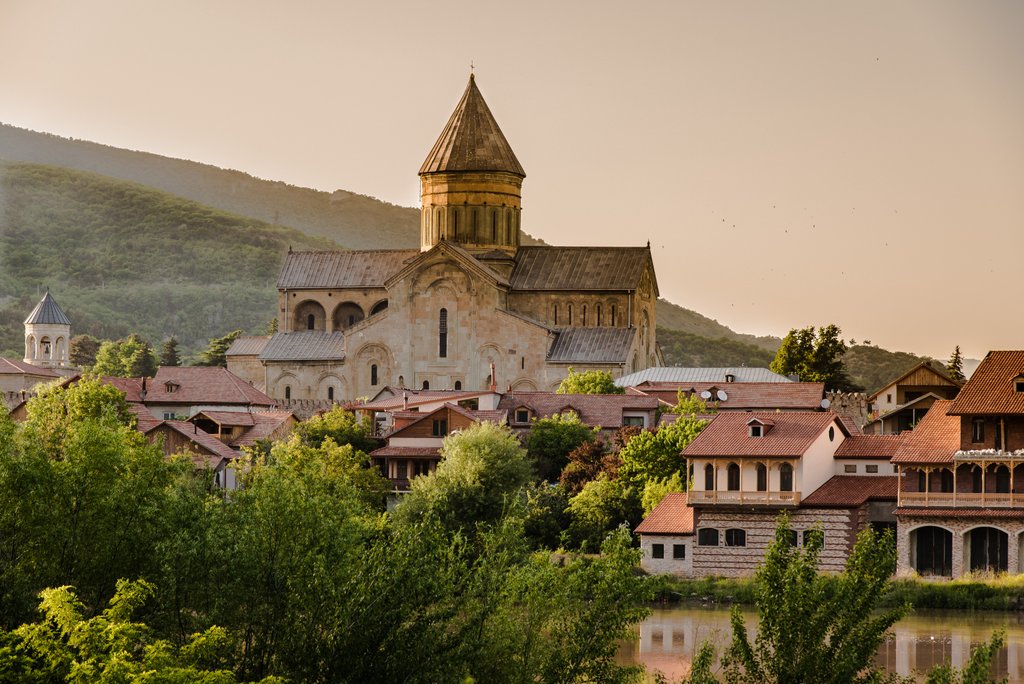
(arte.tv/metropolis) Tbilissi - Georgiens multikulturelle Hauptstadt findet zu sich selbst. Sie ist kreativ, geistreich und schön: die sich entlang der Kura in Terrassen an die weinbelaubten Hänge schmiegende 1,4-Millionen-Metropole.
Sie ist kreativ, geistreich, schön: die sich entlang der Kura in Terrassen an die weinbelaubten Hänge schmiegende 1,4 Millionen-Metropole Tbilissi, gegründet 485 durch König Wachtang I. Gorgassali. Die heutige Hauptstadt des Kaukasusstaates Georgien, der sich gerne als „Balkon Europas“ versteht und dessen Regierung derzeit die Annäherung an Europa betreibt, hat eine bewegte Geschichte. Einst an der Kreuzung der Karawanenstraßen vom Schwarzen Meer nach Persien, Indien und China gelegen, wurde Tbilissi oft von fremden Herrschern regiert, war oströmische Provinz, wurde im 7.Jht.arabisch, dann persisch, byzantinisch, seldschukisch und türkisch. 1801 annektierte der russische Zar die Stadt und machte sie zur Verwaltungszentrale für den Kaukasus, 1918 wurde Georgien Teil der Sowjetunion. Nach der Unabhängigkeit 1991 und dem Militärputsch gegen Swiad Gamsachurdia geriet das Land an den Rand des Bürgerkriegs, versank in Korruption, Kriminalität und Hoffnungslosigkeit, bis 2003 die Rosenrevolution eine reformerische Wende in Georgien brachte.
Tbilissi ist eine charmante Stadt, mit ihrer kopfsteinbepflasterten Altstadt, durch die einst die Seidenstraße führte, mit den geschnitzten Holzbalkonen und Vestibülen, ihrem 700 Jahre alten Bäderviertel, der mittelalterlichen Burgfestung, den Prachtbauten des 19.Jhts. mit dem Rustaveli- Boulevard als Flaniermeile sowie einer Vielzahl alter Gotteshäuser. Die meisten Intellektuellen und Künstler verließen in den 1990-er Jahren ihre Heimatstadt Tbilissi, wie die Eltern der heute international renommierten Geigenvirtuosin Lisa Batiashvili. Regelmäßig besucht sie ihre Familie und engagiert sich in der Musikförderung. Vor einigen Jahren zurückgekehrt nach Tbilissi ist die Filmemacherin und Drehbuchautorin Nana Ekvtimishvili, die mit ihrem deutschen Mann Simon Groß nicht nur den 0scar-nominierten Film „Die langen hellen Tage“ über die Entführung und Zwangsverheiratung eines Mädchens im Georgien der 1990-er Jahre gedreht hat, sondern auch gemeinsam mit ihm die erste Eisdiele in Tbilissi betreibt.
Tbilissi, was übersetzt „warme Quelle“ heißt, ist eine Stadt des Wandels, deren rasante Veränderung sich nicht nur im Straßenbild, sondern auch in einer quirligen Kulturszene manifestiert, in der sowohl traditionelle Folklore und die Wiederentdeckung des Jahrhunderte alten Liedguts (UNESCO-Weltkulturerbe) angesagt ist, wie hippe Experimente, moderne Kunst und zeitgenössisches Design. Da gibt es etwa das „Open Window-Projekt“ zur Förderung der neuen visuellen Kultur, das die Galeristin Irena Popiashvili leitet und Künstlern in Fenstern von leerstehenden Gebäuden Ausstellungsflächen bietet. Dokumentiert hat den Wandel auch der Fotograf Guram Tsibakhashvili. Sein besonderes Interesse gilt den Friedhöfen der Stadt, die Zeugnis ablegen von ihrer Geschichte, den unterschiedlichen Ethnien und den Gewohnheiten der Tbilisser im Wandel der Zeit.
Showing posts with label Irena Popiashvili. Show all posts
Showing posts with label Irena Popiashvili. Show all posts
Friday, May 30, 2014
FERNSEHEN: Tbilissi - Georgiens multikulturelle Hauptstadt findet zu sich selbst - Sonntag, 01. Juni um 16:50 Uhr (arte.tv/metropolis)


Sunday, October 06, 2013
ART in VIENNA: Fokus: Georgia 2:00-3:00 pm, 13.10.2013 - Georgia, supported by the Ministry of Culture and Monument Protection of Georgia (thenewcontemporary.com)
 Die Sonderausstellung trägt den Titel Unser Kaukasus, georgisch: Chveni Kavkasioni. Der Titel dieser Gruppenausstellung bezieht sich auf das Lied aus dem 1976 entstandenen Film von Tengiz Abuladze „Der Wunschbaum“. Die Show präsentiert Werke der folgenden Künstler: Marika Asatiani (more from Marika Asatiani und hier >>>), Natela Grigalashvili, Andro Eradze (androeradze.blogspot.de) Giorgi Khaniashvili, Nino Kvrivishvili, Mamuka Japaridze, Sophia Tabatadze, Koka Ramishvili, KoteSulaberidze, Maya Sumbadze, Giorgi Okropiridze, Guia Rigvava, Tamuna Sirbiladze, Tatia Skhirtladze.
Projektkuratorin: Irena Popiashvili
The special project exhibition is titled Our Caucasus i. e. “Chveni Kavkasioni“. The title of this group exhibition refers to the song from Tengiz Abuladze’s 1976 “The Wishing Tree”. The show presents the work of the following artists: Marika Asatiani, Natela Grigalashvili, Andro Eradze, Giorgi Khaniashvili, Nino Kvrivishvili, Mamuka Japaridze, Sophia Tabatadze, Koka Ramishvili, Kote Sulaberidze, Maya Sumbadze, Giorgi Okropiridze, Guia Rigvava, Tamuna Sirbiladze and Tatia Skhirtladze.
Project curated by Irena Popiashvili
 Moderator: Irena Popiashvili (Co-founder NP Gallery, co-curator of
VIENNA Duet: Our Caucasus exhibition), an independent curator dividing
her time between Tbilisi, Georgia and New York, USA.
(thenewcontemporary.com) Currently she is a consultant at the Free University in Tbilisi and runs a public art space – Popiashvili Gvaberidze Window Project in Tbilisi Georgia. Previously a founder and co-owner of Newman Popiashvili Gallery in New York (2005-2012) she served as a director of the State Academy of Arts in Tbilisi (March- November) 2012.
VIENNA Talks showcases a broad spectrum of presentations, discussions, and debates with important representatives of the contemporary art scene. This year’s Talks provides an exciting and multifaceted platform for art professionals from different Eastern focus regions – people who rarely have the chance to meet each other – to represent their countries to the fullest and evidence the unique character of the region. Each day of VIENNA Talks will reflect upon a topical theme in contemporary art.
Location: VIENNA Talks booth C23
The discussions will be in English.
13 October 2013
VIENNA Talks School of Happiness – VIENNA Duet
2:00 – 3:00 pm: FOCUS: Georgia, supported by the Ministry of Culture and Monument Protection of Georgia |
| Natela Grigalashvili from the series Doukhobors, 2013. Digital print 40 x 60 cm |
VIENNAFAIR The New Contemporary is grateful to the Ministry of
Culture and Monument Protection of Georgia and the Embassy of Georgia in
Vienna for their generous support of the special project VIENNA Duet:
Georgia “Our Caucasus i. e. Chveni Kavkasioni” curated by Irena
Popiashvili and the artistic directors of VIENNAFAIR Christina
Steinbrecher – Pfandt and Vita Zaman. “The art … Continue reading »
 |
| Maya Sumbadze Prayer Shortcuts 1, 2013. Watercolor and ink on digital print 40 x 28,5 cm |
 |
| Kote Sulaberidze My Caucasus, 2011 Watercolor, acrylic, silkscreen and tape on paper 29,7X294 cm, (detail) courtesy of the artist |
VIENNA Duet: Georgia – “Our Caucasus”. Part II
VIENNAFAIR The New Contemporary is grateful to the Ministry of Culture and Monument Protection of Georgia and the Embassy of Georgia in Vienna for their generous support of the special project VIENNA Duet: Georgia “Our Caucasus i. e. Chveni Kavkasioni” curated by Irena Popiashvili and the artistic directors of VIENNAFAIR Christina Steinbrecher–Pfandt and Vita Zaman. Continue reading »
VIENNAFAIR The New Contemporary is grateful to the Ministry of Culture and Monument Protection of Georgia and the Embassy of Georgia in Vienna for their generous support of the special project VIENNA Duet: Georgia “Our Caucasus i. e. Chveni Kavkasioni” curated by Irena Popiashvili and the artistic directors of VIENNAFAIR Christina Steinbrecher–Pfandt and Vita Zaman. Continue reading »
Elsewhere / VIENNAFAIR Diary
Christina Steinbrecher Visits Georgia
Following last year’s VIENNAFAIR The New Contemporary kick-off with
a curated section of the VIENNA Quintet program in which Georgia played
an important role and many artists came to Vienna, we promised to visit
Tibilisi. By the end of May everything was set up for the visit! Continue reading »
 “Dedicated To Franz West” – An Interview With Georgian Artist Tamuna Sirbiladze
We are proud to present our second video interview series. New
style, more Vienna impressions! We hope you enjoy our first video – as
much as we do! Continue reading »

VIENNA Duet – Länderschwerpunkte 2013: Georgien und Polen
Im Rahmen der VIENNAFAIR The New Contemporary präsentieren die künstlerischen Leiterinnen Christina Steinbrecher-Pfandt und Vita Zaman Georgien und Polen als Länderschwerpunkte und setzen damit das erfolgreich begonnene Sonderausstellungsprojekt VIENNA Quintet, das letztes Jahr zum ersten Mal auf der Kunstmesse in Wien mit KünstlerInnen aus Aserbaidschan, Kasachstan, Georgien, Ukraine und Weißrussland zu sehen war, unter den Namen VIENNA Duet fort. Die diesjährigen zwei Sonderausstellungen entstehen in enger Kooperation mit Galerien, Institutionen und Organisationen sowie ExpertInnen aus den beiden Ländern.
Die erste Sonderausstellung „Our Caucasus oder Chveni Kavkasioni“, kuratiert von den künstlerischen Leiterinnen der VIENNAFAIR The New Contemporary und Irena Popiashvili und unterstützt vom georgischen Ministerium für Kultur und Denkmalschutz, präsentiert Arbeiten von den in Wien lebenden und arbeitenden georgischen KünstlerInnen Gogi Okropiridze, Guia Rigvava, Tamuna Sirbiladze und Tatia Skhirtladze und von den in Georgien ansässigen KünstlerInnen Marika Asatiani, Andro Eradze, Giorgi Khaniashvili, Maya L. Sumbadze, Mamuka Japaridze, Sophia Tabatadze, Koka Ramishvili, Nino Kvrivishvili, Kote Sulaberidze und Natela Grigalashvili.
Der Titel der Gruppenausstellung bezieht sich auf den Film „The Wishing Tree“ von Tengiz Abuladze aus dem Jahr 1976. Der Film erzählt die Lebensgeschichte mehrerer DorfbewohnerInnen zu Beginn des 20. Jahrhunderts. Unter ihnen ist ein ungewöhnlicher Mann, der an eine bessere Zukunft und eine kommende Revolution glaubt und eine Fangemeinde unter den Dorfkindern hat. Der Refrain ihrer „Hymne“ lautet „Chveni Kavkasioni”, was „unser Kaukasus“ heißt.
Die zweite Sonderausstellung „Who Are You or The School of Happiness“, die vom Polnischen Institut Wien unterstützt wird, präsentiert unter der kuratorischen Begleitung der polnischen Kunsthistorikerin Klara Czerniewska zeitgenössische Kunstpositionen aus Polen. Teilnehmende KünstlerInnen sind: Tymek Borowski, Hubert Czerepok, Łukasz Jastrubczak, Przemek Matecki, Dominika Olszowy, Małgorzata Szymankiewicz, Maria Toboła und Jan Zamoyski.
DATUM 10. bis 13. Oktober 2013
ORT Messe Wien, Halle A
Messeplatz 1, 1020 Wien
BESUCHERINNENINFORMATION
www.viennafair.at/de
www.thenewcontemporary.com
www.facebook.com/Viennafair
ÖFFNUNGSZEITEN
Donnerstag, 10. Oktober 2013: 11 – 19 Uhr, Freitag, 11. Oktober 2013: 11 – 21 Uhr
Samstag, 12. Oktober 2013: 11 – 19 Uhr, Sonntag, 13. Oktober 2013: 11 – 18 Uhr
EINTRITT
€ 12,50 Tageskarte für Erwachsene
€ 09,00 Tagesticket / Vorverkauf und Onlinebuchung
€ 09,00 Tagesticket für KundInnen der Erste Bank
€ 09,00 After-Work-Ticket (Donnerstag/Freitag ab 16 Uhr)
€ 09,00 Ticket für SeniorInnen bei Vorweisen eines gültigen Ausweises.
€ 29,00 4-Tagesticket
Freier Eintritt für Kinder unter 14 Jahren und Studierende ab 15 Uhr bei Vorweisen eines gültigen Studentenausweises.
Messe Wien, Halle A
Messeplatz 1, 1020 Wien
Österreich
Messeplatz 1, 1020 Wien
Österreich
Saturday, August 31, 2013
ART: Publication 1st Tbilisi Triennial. Offside Effect. Out Now. (metropolism-webshop.com)
 (metropolism-webshop.com) Over the last decade, art education has been confronted time and again
with neoliberal thought and attitudes. Although the debate on artistic
research demands space for a free artistic space for thought, it also
seems necessary now to raise the question regarding the potential of
educational platforms outside the Bologna rules.
The 1st Tbilisi Triennial (Offside Effect, Tbilisi 2012), curated by Henk Slager and Wato Tsereteli, concentrated on this specific issue. In a forum-like display system, a number of keynote artists (among others Anton Vidokle, Stephan Dillemuth, Marion von Osten) and lecturers in collaboration with their students from a dozen of experimental academies from all over the world presented their strategic ways of working.
CCA Tbilisi served as the base for the 1st Tbilisi Triennial. On the outside wall of CCA, Marion von Osten created a statistic mural connecting education, migration, and debts. Frankfurt's Staedelschule realized the Crypt-bar for screenings, readings, drinks and inter-disciplinary relaxation. F+F (Zurich) developed the Unexpected Sites Effect project that transformed the neo-liberal 'living from art' into a free 'living for art'. In Mildred's Lane's (New York) living room situation visitors were invited to actively participate in a research project pointing to a revolutionary, rigorously rethinking of the contemporary art complex. Across from the CCA building, in the Vladimir Kurtishvili Memorial House, the atmosphere was more contemplative: the Maumaus program (Lisbon) reflected on a number of parameters significant for contemporary art practice.
The presentations in the Literature Museum were mainly discursive or even counter-discursive. Kaywon College (Young June Lee, Seoul) focused on a reversed educational practice. Kadir Has University's (Inci Eviner, Istanbul) performative project Acting in the Library revealed the discursive domain of archiving and descriptive knowledge. CCA Tbilisi's Informal Masters Program (Wato Tsereteli, Katharina Stadler) engaged in an exploration of exporting creativity to non-art contexts. Annette Krauss (MaHKU Utrecht) organized a test-site in the form of a para-educational department directed towards the significance of 'unlearning'.
Two context-specific case studies were presented on the second floor. One presentation dealt with the situation of the colonial adoption of art education in Africa and the significance of informal institutes for developing an alternative discourse departing from Addis Contemporary (Lucrezia Cippitelli). Another presentation by the doctoral program of the Finnish Academy of Fine Arts (Jan Kaila, Sami van Ingen) demonstrated how an art university could give an idiosyncratic interpretation of artistic freedom by giving shelter to vulnerable image productions.
For the Georgian National Museum, a clean display system was based on the vernacular architecture and its inherent curatorial logic. Rene Francisco (ISA Habana) showed documentary work related to his Pedagogia Pragmatica workshops taking place outside the art academy in Havana's urban landscape. Tiong Ang's Pavilion of Distance project (MaHKU, Utrecht) was initiated as an experimental platform to pursue a collective artistic production. Stephan Dillemuth (Munich) translated the lecture The Academy and the Corporate Public in an installation drawing attention to issues such as bohemian research and squatted institutional spaces.
The venue Europe House mainly showed archiving presentations. Some presentations gave a survey of various experimental education platforms such as the documentation of Anton Vidokle's unitednationsplaza project, a display of the curricular structure of the experimental seminar program of ICA Yerevan (Armenia), and the activities of Visual Culture Research Center (Kiev) shown in the logic of an application form. Other presentations showed documentation of the various Tbilisi Triennial workshops, such as Sarah Cowles' Ruderal Academy Project, Nedko Solakov's Selling & Buying, and Rainer Ganahl's Reading Lenin's Imperialism. Also in Europe House, Tara McDowell (San Francisco) lectured weekly on the topical meaning of historical models of alternative academies.
Previous to the Triennial's opening, the above sketched ideas, perspectives, and strategies were presented and discussed in a two-day forum in Tbilisi's Goethe Institute. Critical referents were Irena Popiashvili (Tbilisi) and Mick Wilson (Gothenburg).
The editorial logic of the Offside Effect publication follows the line-up of presentations, workshops, and seminars. The publication's ultimate goal is to not only document the 1st Tbilisi Triennial, but to also incite further diagnoses and developments in the debate on current art academies and their contexts.
Editor: Henk Slager Final Editor: Annette W. Balkema Design: Joris Kritis
More information
This publication was also made possible by the support of the Utrecht School of the Arts, the Mondriaan Fund and the Tbilisi Embassy of the Kingdom of the Netherlands.
Monday, April 29, 2013
MAGAZIN: Georgian Art: The West’s Most Eastern Frontier. By Jennifer Walker (artesmagazine.com)
(artesmagazine.com) History’s Crossroads Bring Rich Cultural Heritage to Multi-faceted Land
Posted on 28 March 2013 | By Jennifer Walker
The Former Soviet Republic of Georgia is unique in every aspect – from its varied landscape ranging from the Caucasus Mountains, the coast of the Black Sea and the deserts on the border with Azerbaijan – to its art.
Georgia’s location makes the country a crossroads of cultures, from the Asiatic influence of the Persian and Ottoman Empires, its occupation under the Russian Empire and later the Soviet Union. While geographers are uncertain whether to categorise Georgia as Europe or Asia, the country’s culture is distinctly European.
To chronicle Georgian history of art in a way that parallels the West is no easy task, especially since easel painting did not exist in the country till the late 18th century. However, Georgia’s own renaissance in the 11-13th centuries yielded some extraordinary fresco work to rival the churches in Italy to its 20th century avant-gardes who moved in the same circles as Picasso, Braque and Duchamp.
Early Georgian art is best characterised by its murals and sports some of the finest examples of frescoes from its time in Europe. It’s difficult to contextualise Georgian art without looking to the church – since Georgia declared Christianity the state religion in the 330s. The new state religion marked the important beginning into the development of arts and letters in the South Caucasian country. With Christianity spreading throughout the whole of Western Europe too, Georgia’s faith allowed the country to keep its ties with Europe and many educated members were acquainted with Western philosophy and literature.
During the middle ages, centres of culture and enlightenment were founded and some even gained international significance. It was also during this time that mural painting reached its zenith, where national schools with their own unique characters developed throughout Georgia.
While Georgian mural paintings show influences from Byzantine style, during their peak in the 11-13th centuries, Georgian hagiography really began to develop its own unique style that diverged away from the Byzantine forms.
The Georgian Orthodox and Apostolic Church promoted and sponsored the creation of artistic works of religious devotion, and the best way to get a feel for Georgian art is to travel the churches and monasteries of the country. Mostly, their subject matter includes iconography or hagiographies of Georgian saints, but works of a more secular nature do exist as well.
The frescoes at Davit Gareji are perhaps some of the most interesting examples of Georgian art. The cave-hewn Davit Gareji monastic complex dates as far back as the 6th century, and grew over the area into a variety of cave monasteries that soon became Georgia’s sacred spiritual and cultural centre. The monastery also housed the once flourishing Davit Gareji fresco school. One of the most noted monasteries in the complex is the monastery of Udabno, whose school began in the 10th century. The earlier frescoes show a limited palette combined with an austere style, but over time the artwork evolved into brilliantly coloured, stylised murals. Nowadays, these frescoes decorate abandoned caves on the ridge side looking out towards the deserts in Azerbaijan. Many of these are in poor condition now, due to the Mongol and Persian invasion and the military practices undertaken in the area by the Soviet Union.
The cave city of Vardzia, a monastic complex towards the Turkish border, houses another excellent set of 12th century art. Instead of focussing on the sandy, desert inspired colours of the Davit Gareji School, its palette consists of deep blues and rich colours. The frescoes at Vardzia were almost lost during the Ottoman takeover of the 16th century, when they set up large wax candles in the church to burn them, however the soot from the candles deposited a layer on the murals preserving them. It was only centuries later when a Greek monk discovered the hidden frescoes behind their carbon protective layer.
One thing that differentiates the churches of the Georgian Orthodox from those built in Russia is their stone construction. Where early Russian churches were built with wood, their Georgian equivalent were built in stone – for this reason, there was a development in the painting of wooden panelled icons in Russia, which did not pick up in Georgia.
Western art of the Middle Ages focussed predominantly on wooden panelled altarpieces, most notably in the schools of northern Europe like the Flemish school. While there is a difference in artistic style between the perspectives and palettes used in the Flemish school of art with the iconography from the Russian Orthodox Church, a cultural similarity between the two focuses on portable panels. Georgian churches, on the other hand, didn’t develop this tradition of icons; instead you’ll find frescoes on the walls of important churches and monasteries, like those in Gelati in Kutaisi or in Svetitskhoveli in Mtskheta near Tbilisi. In the Russian tradition, the iconostasis, the church alter, consists of tiers of icons swww.artesmagazine.comometimes going up to six rows, whereas in the Georgian church, this partition is only one story in height, where the principal image of the church is seen in the hemispherical half-dome of the church apse.
The expressions and colours of the frescoes are reminiscent of the murals from the early Italian renaissance, such as Fra Angelico. The frescoes of the Gelati monastery do not have the cold, hard lines of Byzantine iconography, yet are filled with expressive faces telling a story. In one chapel, there is a scene on a wooden plate depicting a hell that brings to mind the works of Bosch.
While the paintings found in Georgia’s early renaissance, the names of the painters are in general anonymous, however in the 14th century there came a painter whose works hold a special place in the history and development of mural and monument painting in Georgia – Damiane.
The artist whose works were at their most important during the first half of the 14th century combined traditional Georgian artistic traditions with the more advanced artistic trends from Palaeologue Byzantium, Russia and the Slavic countries of the Balkans.
Damiane’s new style was characterised by a keen interest in space and perspective, with a moderation of religious asceticism and contains a greater deal of freedom in the composition of his paintings.
The style adopted by Europe marked the beginning of a new artistic aesthetic that opposed the current medieval outlook. In Italy we saw the beginning of the Renaissance, and even in the Balkans, Russia and in Georgia realism started to seep into the art and began to develop more humanistic traits.
 In the work of Damiane, this vivid form of expression can be seen in his monumental painting, where the usual themes traditional themes in Georgian churches were expanded, bringing the life of local saints into church art. Instead of the canonical iconography seen before, these were being replaced with lifelike and expressive faces with natural proportions and deeper perspective. Classic renaissance art may not have made an obvious impression on Georgian art, but there are some hints to its influence.
Georgian artistic style diverted from European progression in the later centuries, most notably in the 17th and 18th centuries, due to the impact of neighbouring Persian influences. In the art of manuscripts and local architecture, Georgian art underwent a strong, orientalist makeover, until the influences of the Russian Empire in the late 18th century, just before the country was annexed in 1801.
 The most important point in late Georgian art history came in the mid to late 18th century – the arrival of easel painting. Until then, traditional easel painting didn’t exist in Georgia, and while the rest of Europe experienced an evolution of easel painted works, whose style and artistic trends had centuries to develop, Georgia witnessed an acceleration and uneven development in the art form. This was due to political, economic and social factors that make Georgia different from any other European country. Because of the late arrival of easel painting into Georgian art history; its easel paintings show no clearly defined stylistic development or regularities.
The formation and development of Georgian easel painting came from Western European art, either from direct contact or via the Russian schools. Initially easel painting took on the form of portraits of kings and noblemen. These paintings were unsigned and were formal in their composition.
Two important influences on Georgian art in this era firstly came from the Roman Catholic missionaries from Italy during the 17th-18th centuries in Georgia – who came to the aid of their Christian brethren in a time when they were surrounded by Muslim countries. During this time, the very first Georgian-Italian dictionary and Georgian grammar were printed in Rome, not to mention that while many of the Italian missionaries were also skillful painters. There was a huge cultural exchange between the two countries, and many Georgians travelled to Italy during that time.
Of course the other influence is without a doubt, Russia. During the period of the Russian Empire, many Georgians emigrated to Moscow, where they formed their own colony and many artistic and scientific contacts were established between Georgia and Europe. In Russia, Georgian painters began to work with artists of different nationalities and had the opportunity to master the “European manner” of painting.
In the 19th century, the Tiflis Portrait School took shape, and Georgian art developed its own style, where the European techniques give way to influences from Georgian medieval painting. In the second half of the 19th century, Georgian artists begin to work professionally.
The most exciting part of Georgian art came much later, in the beginning of the 20th century when Georgian artists began studying in Paris.
Sculptor Iacob Nikoladze went to study with Rodin, and his works show a direct influence from the French master. Other homegrown artists at the time were making their name in Paris and in the European avant-garde circles; Pirosmani for example is perhaps the most famous Georgian artist.
Niko Pirosmani was a self-taught painter famed for his primitivist style. His paintings are bright with childish lines conveying themes rooted in Georgian folk culture. His work touched Spanish artist Pablo Picasso with his childish, naïve style and even influenced his work.
 Tiflis born, Georgian-Polish Ilia Zdanevich became associated with the Dada movement in Paris. Zdanevich is classified father as pre-Dada, whose ideas were considered extreme by the Dadaists themselves. He collaborated in a variety of artist’s books along with Picasso, Max Ernst, Miró and other artists at the time, as well as having his works exhibited all around from MOMA to Tbilisi, along with his brother Kiril Zdanevich who was a cubo-futurist.
One of Georgia’s most respected artists from the 20th century, David Kakabadze, was not only a force to be reckoned with in his home country, but made waves in Paris too. He experimented in a range of styles from cubism to early forms of abstraction, and he published and displayed his works alongside Braque, Gris and Picasso – yet his name has been erased from the pages of Western art history. Kakabadze was a close friend of Duchamp and together they participated in a variety of projects. Alas, after Kakabadze’s return to Soviet Georgia his name disappeared from the Western art scene, and he was trapped into making his now famous “Imeretian landscapes” in an artistic environment where only Social Realism was allowed.
 Throughout the era of the Soviet Union, there were always artists who tried to rebel against the constraints of Social Realism, yet many avant-garde Georgian artists died in the Stalinist purges or took to Social Realism as a way to survive. Now that the Soviet Union has fallen, Georgia’s artistic life is thriving again, with many young and exciting artists coming out of the woodwork unafraid of experimentation. It’s a part of the world that is heaving with raw passion, whose unique and ancient history is bound to put Georgia on the map in art history.
By Jennifer Walker, Contributing Writer
Author’s Note: I would like to offer a very special thank you to the National Gallery and National Museum, most notably to Nino Gedevanishvili and Mariam Dvali for their help with this article, and not to mention all the valuable knowledge on Georgian Modernism I’ve learned from the expertise of Nana Kipiani, and to Irena Popiashvili at the Tbilisi State Academy of Arts.
Posted on 28 March 2013 | By Jennifer Walker
 |
| Fresco from Gelati Monastery, Kutaisi, 13th c. |
Georgia’s location makes the country a crossroads of cultures, from the Asiatic influence of the Persian and Ottoman Empires, its occupation under the Russian Empire and later the Soviet Union. While geographers are uncertain whether to categorise Georgia as Europe or Asia, the country’s culture is distinctly European.
 |
| Vardzia Frescoes, 12th century |
Early Georgian art is best characterised by its murals and sports some of the finest examples of frescoes from its time in Europe. It’s difficult to contextualise Georgian art without looking to the church – since Georgia declared Christianity the state religion in the 330s. The new state religion marked the important beginning into the development of arts and letters in the South Caucasian country. With Christianity spreading throughout the whole of Western Europe too, Georgia’s faith allowed the country to keep its ties with Europe and many educated members were acquainted with Western philosophy and literature.
 |
| Medieval Fresco of David IV, Gelati |
While Georgian mural paintings show influences from Byzantine style, during their peak in the 11-13th centuries, Georgian hagiography really began to develop its own unique style that diverged away from the Byzantine forms.
The Georgian Orthodox and Apostolic Church promoted and sponsored the creation of artistic works of religious devotion, and the best way to get a feel for Georgian art is to travel the churches and monasteries of the country. Mostly, their subject matter includes iconography or hagiographies of Georgian saints, but works of a more secular nature do exist as well.
 |
| Interior of the Gelati monastery |
The cave city of Vardzia, a monastic complex towards the Turkish border, houses another excellent set of 12th century art. Instead of focussing on the sandy, desert inspired colours of the Davit Gareji School, its palette consists of deep blues and rich colours. The frescoes at Vardzia were almost lost during the Ottoman takeover of the 16th century, when they set up large wax candles in the church to burn them, however the soot from the candles deposited a layer on the murals preserving them. It was only centuries later when a Greek monk discovered the hidden frescoes behind their carbon protective layer.
 |
| Depiction of Hell, Gelati monastery |
Western art of the Middle Ages focussed predominantly on wooden panelled altarpieces, most notably in the schools of northern Europe like the Flemish school. While there is a difference in artistic style between the perspectives and palettes used in the Flemish school of art with the iconography from the Russian Orthodox Church, a cultural similarity between the two focuses on portable panels. Georgian churches, on the other hand, didn’t develop this tradition of icons; instead you’ll find frescoes on the walls of important churches and monasteries, like those in Gelati in Kutaisi or in Svetitskhoveli in Mtskheta near Tbilisi. In the Russian tradition, the iconostasis, the church alter, consists of tiers of icons swww.artesmagazine.comometimes going up to six rows, whereas in the Georgian church, this partition is only one story in height, where the principal image of the church is seen in the hemispherical half-dome of the church apse.
The expressions and colours of the frescoes are reminiscent of the murals from the early Italian renaissance, such as Fra Angelico. The frescoes of the Gelati monastery do not have the cold, hard lines of Byzantine iconography, yet are filled with expressive faces telling a story. In one chapel, there is a scene on a wooden plate depicting a hell that brings to mind the works of Bosch.
 |
| Damiane, The Annunciation, 14th century |
The artist whose works were at their most important during the first half of the 14th century combined traditional Georgian artistic traditions with the more advanced artistic trends from Palaeologue Byzantium, Russia and the Slavic countries of the Balkans.
Damiane’s new style was characterised by a keen interest in space and perspective, with a moderation of religious asceticism and contains a greater deal of freedom in the composition of his paintings.
The style adopted by Europe marked the beginning of a new artistic aesthetic that opposed the current medieval outlook. In Italy we saw the beginning of the Renaissance, and even in the Balkans, Russia and in Georgia realism started to seep into the art and began to develop more humanistic traits.
In the work of Damiane, this vivid form of expression can be seen in his monumental painting, where the usual themes traditional themes in Georgian churches were expanded, bringing the life of local saints into church art. Instead of the canonical iconography seen before, these were being replaced with lifelike and expressive faces with natural proportions and deeper perspective. Classic renaissance art may not have made an obvious impression on Georgian art, but there are some hints to its influence.
Georgian artistic style diverted from European progression in the later centuries, most notably in the 17th and 18th centuries, due to the impact of neighbouring Persian influences. In the art of manuscripts and local architecture, Georgian art underwent a strong, orientalist makeover, until the influences of the Russian Empire in the late 18th century, just before the country was annexed in 1801.
The most important point in late Georgian art history came in the mid to late 18th century – the arrival of easel painting. Until then, traditional easel painting didn’t exist in Georgia, and while the rest of Europe experienced an evolution of easel painted works, whose style and artistic trends had centuries to develop, Georgia witnessed an acceleration and uneven development in the art form. This was due to political, economic and social factors that make Georgia different from any other European country. Because of the late arrival of easel painting into Georgian art history; its easel paintings show no clearly defined stylistic development or regularities.
The formation and development of Georgian easel painting came from Western European art, either from direct contact or via the Russian schools. Initially easel painting took on the form of portraits of kings and noblemen. These paintings were unsigned and were formal in their composition.
Two important influences on Georgian art in this era firstly came from the Roman Catholic missionaries from Italy during the 17th-18th centuries in Georgia – who came to the aid of their Christian brethren in a time when they were surrounded by Muslim countries. During this time, the very first Georgian-Italian dictionary and Georgian grammar were printed in Rome, not to mention that while many of the Italian missionaries were also skillful painters. There was a huge cultural exchange between the two countries, and many Georgians travelled to Italy during that time.
Of course the other influence is without a doubt, Russia. During the period of the Russian Empire, many Georgians emigrated to Moscow, where they formed their own colony and many artistic and scientific contacts were established between Georgia and Europe. In Russia, Georgian painters began to work with artists of different nationalities and had the opportunity to master the “European manner” of painting.
 |
| David Kakabadze, Imeretia (1917) |
The most exciting part of Georgian art came much later, in the beginning of the 20th century when Georgian artists began studying in Paris.
Sculptor Iacob Nikoladze went to study with Rodin, and his works show a direct influence from the French master. Other homegrown artists at the time were making their name in Paris and in the European avant-garde circles; Pirosmani for example is perhaps the most famous Georgian artist.
Niko Pirosmani was a self-taught painter famed for his primitivist style. His paintings are bright with childish lines conveying themes rooted in Georgian folk culture. His work touched Spanish artist Pablo Picasso with his childish, naïve style and even influenced his work.
Tiflis born, Georgian-Polish Ilia Zdanevich became associated with the Dada movement in Paris. Zdanevich is classified father as pre-Dada, whose ideas were considered extreme by the Dadaists themselves. He collaborated in a variety of artist’s books along with Picasso, Max Ernst, Miró and other artists at the time, as well as having his works exhibited all around from MOMA to Tbilisi, along with his brother Kiril Zdanevich who was a cubo-futurist.
One of Georgia’s most respected artists from the 20th century, David Kakabadze, was not only a force to be reckoned with in his home country, but made waves in Paris too. He experimented in a range of styles from cubism to early forms of abstraction, and he published and displayed his works alongside Braque, Gris and Picasso – yet his name has been erased from the pages of Western art history. Kakabadze was a close friend of Duchamp and together they participated in a variety of projects. Alas, after Kakabadze’s return to Soviet Georgia his name disappeared from the Western art scene, and he was trapped into making his now famous “Imeretian landscapes” in an artistic environment where only Social Realism was allowed.
By Jennifer Walker, Contributing Writer
Author’s Note: I would like to offer a very special thank you to the National Gallery and National Museum, most notably to Nino Gedevanishvili and Mariam Dvali for their help with this article, and not to mention all the valuable knowledge on Georgian Modernism I’ve learned from the expertise of Nana Kipiani, and to Irena Popiashvili at the Tbilisi State Academy of Arts.
Tuesday, April 23, 2013
REVIEW: Reframing the 80s" at the National Gallery in Tbilisi. By Robert Linkous (georgiatoday.ge)
(georgiatoday.ge) It has taken curator Irena Popiashvili, Rector of
Tbilisi State Academy of Arts, a year and a half to pull together the
eclectic, multifarious and utterly up-to-date collection of paintings,
photographs, and sculpture that can be seen in “Reframing the 80s:
Georgian Art at the end of the 80s and Beginning of the 90s” at the
National Gallery of Art through November 20. Groundbreaking, it is
Georgia’s first show devoted to the work of a single generation.
“This was the first generation to see Joseph Beuys
and other German artists as contemporaries,” explained Popiashvili.
“Earlier artists looked at the Impressionists.”
Niko Lomashvili’s diptych “14 Shots” was produced in
1990, at a time when violence in Tbilisi made it something of a combat
zone. On the left we see a canvas saturated with brown paint and
punctured by fourteen bullet holes, only two of which are at dead
center. On the right: a very young girl in a loose-fitting, tattered
denim jacket, staring down at a handgun clutched at waist level, and
surely intent on some dark business.
If reminded of Gerhard Richter’s 1988 photorealist
paintings of the Red Army Faction, we may imagine that it is Ulrike
Meinhof as an adolescent revolutionary.
The political turbulence of the era is also reflected
in Gia Dolidze’s large painting, “Africa” (1989). Scattered across the
canvas are images of the African menagerie – giraffe, rhinoceros,
alligator, lizard – but at the lower left is a military mangaudily
bedecked with medals, above him is a larger and more ominous soldier,
apelike in countenance, and with the unruly, bulging hairstyle ofMuammar
Gaddafi, while elsewhere on the perimeter of the painting are totemic
images redolent of traditional African art.
In the mid-1990s Gabriel Garcia Marquez’s One Hundred Years of Solitude was
finally translated into Georgian, and the diptych “Erendira” (1996)
shows that Mamuka Tsetskhladze was impressed; Erendira is a young girl
who appears in the novel, and would be forced to become a teenage
prostitute in a later work by the author.
Tsetskhladze’s bare-breasted Erendira gazes at us as
unabashedly as Manet’s Olympia, her mouth sensuous with red lipstick.
Opposite in the diptych, though, a collage-like work, thick black
horizontal and vertical lines meeting at right angles mirror perhaps too
closely for comfort what Frank Stella was doing early in his career.
Literature of the era crops up again in Karlo
Kacharava’s “H All Awed Be” (1989), a painting in which are written
lines from the Georgian translation of Allen Ginsberg’s “Footnote to
Howl,” though the connection to the primary subject of the painting – an
elegant, sophisticated young woman, chicly dressed and coiffed,
pensive, legs crossed, with long-fingered hands resting upon her right
thigh – may be enigmatic.
Lurking behind her, spying ominously from over her
right shoulder, is a satanic creature with a Ku Klux Klan-like cross
sprouting from his forehead, while to the woman’s left a somewhat
surrealistic lamp with no shade bends its bulb almost close enough to
her hair to singe it.
The American counterculture is evoked again in
Ushangi Khumarashvili’s “Time and Happenings” (1989, mixed media on
wood). Inside a frame of rough wood, Khumarashvili has produced an
abstraction comprised of torn strips of canvas, splotches of paint, a
windshield wiper, a long bolt, bits of wire, etc., seeming to have
worked much as Robert Rauschenberg did in the days when he scavenged the
streets in his Manhattan neighborhood for refuse and junk to put into
his “Combines.”
In Koka Tskhvediani’s “Self-Portrait” (1992), though,
the artist may have captured something of his own inimitable
individuality. Portraying himself with flat ears, shaved head, hollow
cheeks, and a complexion as pale as death, he gives a general impression
of dour gloominess, were it not for the radiant red of his shirt and
his lips, and the luminous blue of his eyes.
The bearer of a surname which resonates in Georgian
history, Lado Bagrationi in “Cell” (1976) has painted himself just where
the title suggests – in incarceration. During the Soviet era he refused
the work that was thrust upon him, and was deemed guilty of the crime,
as Popiashvili put it, of “being different.” From behind a massive door
he peers forlornly out a small window, very low, at about knee level; he
could be perched on a tiny stool barely adequate for a child.
At the right is shown part of the black boot and
heavy leg of a jailer, while at the left a frail hand reaches out in
supplication. But perhaps there is a glimpse of hope, in the form of a
window at the top of painting, through which can be seen a lovely blue
sky. There is a certain paradoxical duality here, as in Magritte’s
“Empire of Light;” in Bagrationi’s underworld of the prison there may be
perpetual despair, but recollection of the sunnier outside world of
life and freedom does not cease to exist.
But while most of the Georgian artists in “Reframing
the 80s” may have turned their attention outward, Irakli Maisuradze
remained attuned to Georgia’s artistic tradition. In “Wolf” (1989),
“Bear” (1988), and the “Untitled” (1988) painting of a gigantic dinosaur
on a stroll, he uses large simple images and plenty of bold color to
create beings almost docile enough for a petting zoo. In the animal
kingdom of Pirosmani they might find home turf.
The above is just a sampling, though, of the delights
to be seen among the well over a hundred works that Popiashvili has
assembled. She wanted this exhibition to be “as contemporary now as it
was then,” she said, and she has succeeded, in spades, for there is an
abundance of art that could make itself at home in the galleries of New
York’s Museum of Modern Art, London’s Tate Modern, or the Centre
Pompidou in Paris.
 |
| Avto Meskhi |
Subscribe to:
Posts (Atom)