Showing posts with label Sergej Paradshanow. Show all posts

Tuesday, November 11, 2014

FILMVORFÜHRUNG. 'Schatten vergessener Ahnen'. Von Sergei Parajanov, Berlin 17.11.2014

Im November 2014 feiert unser Kinoklub sein fünfjähriges Bestehen.

Aus diesem angenehmen Anlass laden wir Sie herzlich am 17.11. ab 18.30 Uhr zur Jubiläums-Filmvorführung unseres Ukrainischen Kinoklubs in Berlin ein.
Wir zeigen an diesem Tag einen der beeindruckendsten Filme der Filmgeschichte - "Schatten vergessener Ahnen" von Sergey Paradzhanov (1964, SU, 95', mit Untertiteln).

"Dieser Film - ist eine Dichtung über das menschliche Schicksal, geschaffen aus den huzulischen Legenden", Janusz Gazda, "Kino-Theater". 

Wann und wo:
Beginn der Veranstaltung: 18.30 Uhr
Botschaft der Ukraine in der Bundesrepublik Deutschland, Albrechtstrasse 26, 10117 Berlin

Zur Einführung wird Olga Vesnyanka (Kiewer Aktivistin und Journalistin) über die Entwicklung des ukrainischen Films in den letzten fünf Jahren sprechen.

Im Anschluss an die Filmvorführung spielen Marina Bondas (Geige) und Olga Marushchenko (Klavier) im Duett Werke von Myroslav Skoryk und Ernest Bloch.

Danach laden wir Sie mit uns beim Glas Wein die Feier ausklingen zu lassen.

Wegen der begrenzten Platzanzahl bitten wir Sie um eine Anmeldung an ukkb@gmx.de bis zum 16.11.2014, vielen Dank.

Wir freuen und Sie bei unserem Jubiläum begrüßen zu dürfen und bedanken uns an dieser Stelle bei allen Partnern und Unterstützen, die zur Bekanntmachung des ukrainischen Films in Berlin in den letzten fünf Jahren beigetragen haben. 
 
Mit freundlichen Grüßen
Oleksandra Bienert, Ingo Jakobs, Oleksandra Jakobs, Alona Karavai, Bohdanna Kindt, Lesja Seifert

Ukrainischer Kinoklub Berlin
www.ukkb.wordpress.com 

Link: Die Ukrainerin Oleksandra Bienert führt in Berlin einen Kinoklub [zeit.de]

Wednesday, October 22, 2014

BOOK: Sergei Parajanov on photographs and stories by Youri Mechitov - Fr, 24.10. in the Newsroom Caffé in Tbilisi

Newsroom Caffé in Tbilisi
Lado Asatiani 13, 0105 Tiflis
On October 24, at 7pm Newsroom Caffe is pleased to invite you at the presentation of the Biographical Album "Sergei Parajanov on photographs and stories by Youri Mechitov"

The Album was issued in three languages: English, French and Russian and is enriched with photos.

Also, photo exhibition "Marcello Mastroianni visiting Parajanov" will be held in frames of the presentation.

Don’t miss the opportunity to purchase the signed Album from the author.


Monday, January 13, 2014

BLOG: Tamada Travels: The Color of Parajanov. By Giorgi Lomsadze (eurasianet.org)

(eurasianet.org) Iconic filmmaker Sergo (Sergei) Parajanov – a man who in his lifetime gained a reputation as the Soviet Union’s Fellini – would have turned 90 today. This EurasiaNet video pays tribute to Parajanov’s legacy, which extends well beyond his native region, the South Caucasus. 

video >>>

An ethnic Armenian born in Tbilisi, Georgia, Parajanov is still widely considered to be the greatest visual poet that the Caucasus has ever produced. Relying on a cinematic style that emphasized a rich, baroque tapestry of images and the expressive silence of his film characters, Parajanov transgressed the cultural and artistic borders of his time and place. While defying Soviet censors, he managed to rise above the parochial nationalist sentiments that prevailed in the Caucasus in his time -- much like another famous cosmopolitan Tbilisi Armenian before him, the 17th century troubadour Sayat Nova, a figure who became an inspiration for Parajanov’s internationally acclaimed movie, the Color of Pomegranates.

Ultimately, Communist authorities couldn’t tolerate Parajanov’s individualist streak, and he spent several years in prison starting in the late 1970s, convicted on what were widely seen as politically motivated charges. The experience broke his health, and he succumbed to cancer in 1990 at the age of 66. One can only wonder what might have been, if he could have lived long enough to enjoy full artistic freedom during the post-Soviet era.

Editor's Note: Giorgi Lomsadze is a freelance journalist based in Tbilisi. He is a frequent contributor to EurasiaNet.org's Tamada Tales blog. 

Wednesday, April 24, 2013

CULTURE: MOVES #50: Giorgi Maisuradze - on Parajanov May 14, 2013

Sergei Parajanov (1924 born in Tbilisi, Georgia, 1990 died in Yerewan, Armenia) is one of the most important and prolific filmmakers of the 20th Century.

Under hostile conditions for independent artists, under Soviet censorship and criminal prosecution – as an artist as well as an homosexual – Parajanov succeeded in developing and completing his very own stile. With his moderate oeuvre of less than 20 films he inspired and still inspires innumerable artists, writers, musicians, and – of course – filmmakers.

Giorgi Maisuradze – a Berlin based Cultural Studies academic, writer and translator – will report in image, text and sound on Parajanov.


Oranienburger Strasse 18, 10178 Berlin

Friday, April 22, 2011

ART: Tbilisi Photo Festival 2011 25-31 May (europeanweek.ge)

Europe House Georgia and Tbilisi Photography House are pleased to organize the second annual Tbilisi Photo Festival which will take place during European Week in Georgia from 25-31 May 2011.

A contributing partner is the Arles Photo Festival (Les Rencontres Photographiques d'Arles) whose program, La Nuit de l'Année, will be presented on May 28 during the open air screenings in Old Tbilisi and includes the productions of leading p...hoto-agencies, newspapers, news agencies and magazines.

In addition, A Night of Photography - Tbilisi Photo Festival night screenings program - will present the works of various Georgian, Armenian, Azerbaijani, Russian, Turkish and Iranian photographers. As well as the LAF PROJECT and OSI Documentary photography program winners…

The Tbilisi Photo Festival is also pleased to host the following four exhibitions during European Week:

- KAVKAZ, by Thomas Dworzak, a member of the Magnum Agency

-CHANGES, a collection of images describing the events of the Egyptian, Tunisian, Georgian, Kyrgyz and Ukrainian revolutions by the leading photo-reporters – Alex Majoli, Yuri Kozyrev, Dominic Nahr, Lionel Charrier, Julien Daniel, Guillaume Binet, Justyna Mielnikiewicz...

- EXPLICATIONS - Modern Georgian Photography, a selection of images from the second part of 20th century until present

-DMITRY ERMAKOV COLLECION Georgian Photography of the end of 19th century - a selection of images of the collection Dmitry Ermakov, one of the pioneers of photography in Georgia.

The Georgian Museum of History and TBILISI PHOTO FESTIVAL are pleased to present this collection to a public audience for the first time ever.

+++

PRESS RELEASE

Following the success of the first Tbilisi Photo Festival which gathered 15,000 people in May
2010, the capital of Georgia is pleased to welcome this second edition. The festival will be held between 25 and 31 May 2011.


During the 'Night of Photography', on May 28 a Caucasian version of the Nuit de l'Année of
the Arles photography festival, ten screens will once again be set up in the streets and squares
of Tbilisi’s old town, showcasing the work of the greatest photographic associations, agencies, magazines and publications (AFP, Liberation, Noor, Reuters, MYOP, VII, etc.) from dusk to dawn.

But since Tbilisi is at the heart of the Caucasus,

at the point where the culture ofTurkey, Iran, Russia and other European countries meet, the city aims to be a space where young photographers from this diverse yet interlinked world will converge. The Festival’s screens will therefore also present – in between the work of the great names of photography – the images of many young photographers from Georgia, Armenia, Azerbaijan, Russia, Turkey, Iran..


The Photo Festival, an event jointly organised by Tbilisi Photography House and by Europe House georgia, will be part of the ‘European Week’ in Tbilisi. Europe house is foundation which aims to promote European values and culture in Georgia.

Four exhibitions will also attempt to illustrate the Caucasus as a meeting-point of different worlds which became intertwined with a Europe whose modernity was revealed to it in the 'click' of a camera shutter

Georgia at the Crossroads of Modernity – The XIXth-Century’s Ermakov Collection

A selection of images from the collection of Dimitri Ermakov (1848-1916) will be shown for the first time. Having only just finished restoring them to their former glory, Tbilisi's History Museum has lent a series of images taken by this pioneer of photography in the Caucasus to the organizers of the Tbilisi Photo Festival: pictures documenting the construction of the South Caucasus railway, portraits of members of the Georgian aristocracy, images of the art of bathing in Tbi l isi 's sulphur baths,
mountainous landscapes, pictures of Tbilisi and Batumi whose subtle charms are heightened by their mixture of the oriental and the European...


Changes

The Arab Spring of 2011, the coloured revolutions of the former Soviet Union... a world in revolt. This group exhibition, organised in partnership with the young and promising Parisian gallery La Petite Poule Noire, brings together the work of photographers who witnessed these dramatic events – from
Belgrade to Bishkek, Tbilisi to Tunis, via Kiev to Cairo. Alex Majoli, Dominic Nahr, Thomas Dworzak (Magnum), Yuri Kozyrev (Noor), Lionel Charrier, Julien Daniel and Guillaume Binet (MYOP), Justyna Mielnikiewicz...


Kavkaz by Thomas Dworzak

The famous Magnum photographer will present us with the first complete exhibition of his work, taken from his book Kavkaz. 'During the spring of 1993, I decided to live in Tbilisi for a few months before returning to university. It was then that I discovered the cultures of the Caucasus. Hospitality, the beauty of languages, the unbelievable speed of change during the post-Soviet period, war and conflict, courage and cruelty'

This German photographer – known for his brave work during the brutal wars in Chechnya – will show us 80 of his black-and-white photographs of the noisy and furious Caucasus which he captured with his lens.

Georgia - New Generation

Some began to take photographs during the Soviet Union, and others began later... but from the early 1990s onwards all of them devoted themselves body and soul to their art. This exhibition will introduce us to the work of the masters of modern photography such as Yuri Mechitov – who produced a series of portraits of film director Sergei Parajanov, Guram Tsibakhashvili and his Explanations – as well as to the images of young photographers such as Beso Uznadze, David Meskhi and Marika Asatiani, whose work is beginning to charm the European photography world. The highlight of this exhibition? A wonderful series of photographs produced by a real self-taught photographer named Shalva Alkhanaidze.

Lectures and discussions will also be held during this European Week in Tbilisi. Politicians and artists alike will share their visions of Europe, of its ties with Georgia and of the dramatic events which are shaping our world in the XXIst century.


Programme: www.europeanweek.ge

Curators
Lionel Charrier and Nestan Nijaradzé

in France
l.charrier@europehousegeorgia.org / + 33 679331460
in Georgia :
nijaradzenestan@hotmail.com / +995 99559592

Coordinator
Irma Inaridzé
inaridze@hotmail.com /+ 995 99 22 32 95

Contact press
in France
Charles van den Boogaerd,
charles@noecom.com / +33 6 31 17 65 69
in Georgia
Irma Inaridzé
inaridze@hotmail.com /+ 995 99 22 32 95

Logo for Tbilisi photo festival: © Zango Design

Friday, January 07, 2011

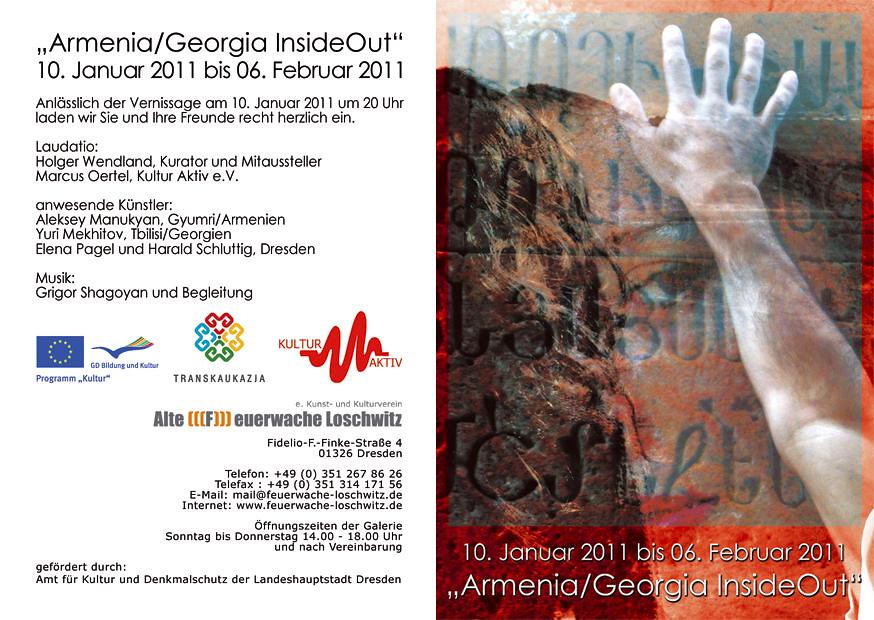
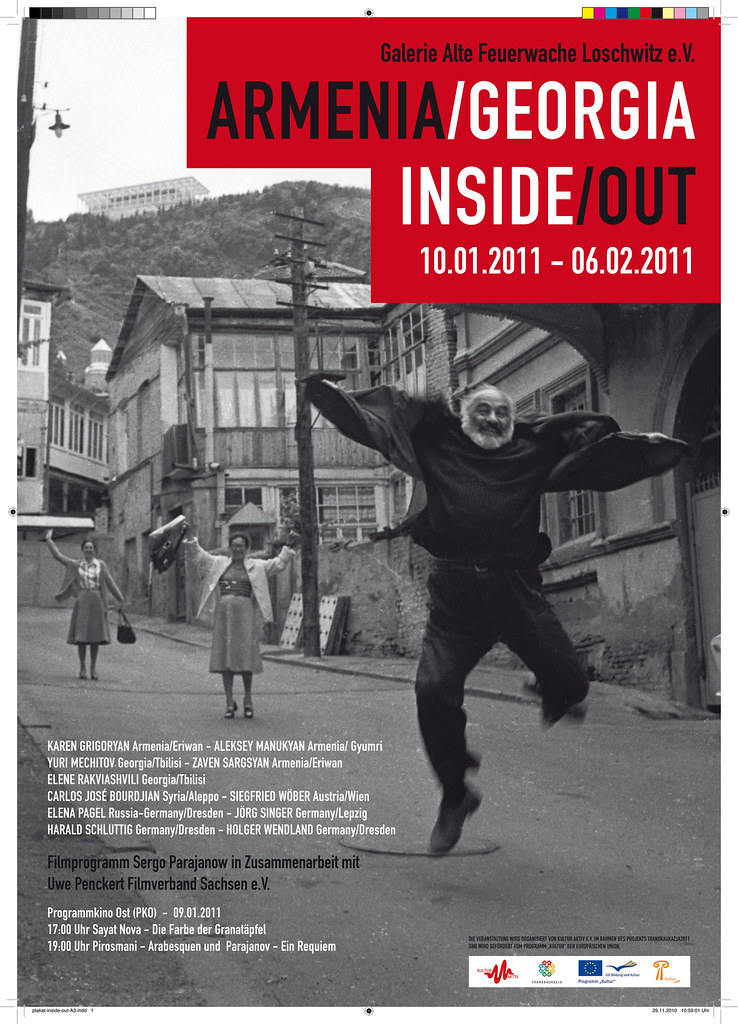
EXHIBITION: "Armenia/Georgia InsideOut" in Dresden (Germany) (transkaukazja.eu)


I'd like to introduce you exhibition in Dresden, Germany, "Armenia/Georgia InsideOut".
The opening is 10.01.2011-06.02.2011

Armenia/Georgia InsideOut
Fotoausstellung im Rahmen von Transkaukazja2011
Eröffnung am 10.01.2011, 20 Uhr,
Alte Feuerwache Loschwitz (Ausstellung vom 10.01. – 06.02.2011

Mit authentischen und faszinierenden Fotografien von zehn kaukasischen und deutschen Künstlern finden wir einen außergewöhnlichen Zugang zu Menschen, Kultur und Natur der zwei kaukasischen Republiken. Die Anwesenheit mehrerer Künstler, armenische Musik und ein nettes Büfett lassen den Abend zu einem besonderen Erlebnis werden.


With the exhibition „Armenia/Georgia InsideOut” Kultur Aktiv e.V. wants to show these two Caucasian Countries from different points of view: The artist from Armenia and Georgia with the inner view to the both countries, from Germany and Austria with the outer and from the Armenian Diaspora- with their own view.

Names of the participating artists:
Carlos Jose Bourdjian (Syria)
Karen Grigoryan (Armenia)
Aleksey Manukyan (Armenia) (present at vernisage)
Yuri Mekhitow (Georgia) (present at vernisage)
Elena Pagel (Germany/Russia) (present at vernisage)
Elene Rakviashvilli (Georgia)
Zaven Sargsyan (Armenia)
Harald Schluttig (Germany) (present at vernisage)
Holger Wendland (Germany) (present at vernisage)
Siegfried Woeber (Austria)
The Film Association of Sachsen, with Uwe Penckert personally, will start the exhibition with the evening of Sergey Paradjanov already from the 09.01.2011 at 5 pm in cinema Programmkino Ost.

Weitere Informationen unter: www.transkaukazja.eu und forum.kulturaktiv.org


+++

Marcus Oertel
KULTUR AKTIV e.V.- 1. Vorsitzender -
Mail/Post: Louisenstr. 29, D - 01099 Dresden
Visitors/Besucher *NEU*: Bautzner Str. 49, D - 01099 Dresden

tel: +49-(0)-351-811 37 55
mobil: +49-(0)-163-170 62 27
Fax: +49-(0)-351-811 37 54
mail: marcus.oertel@kulturaktiv.org
skype: marcass_
www.kulturaktiv.org

Saturday, December 04, 2010

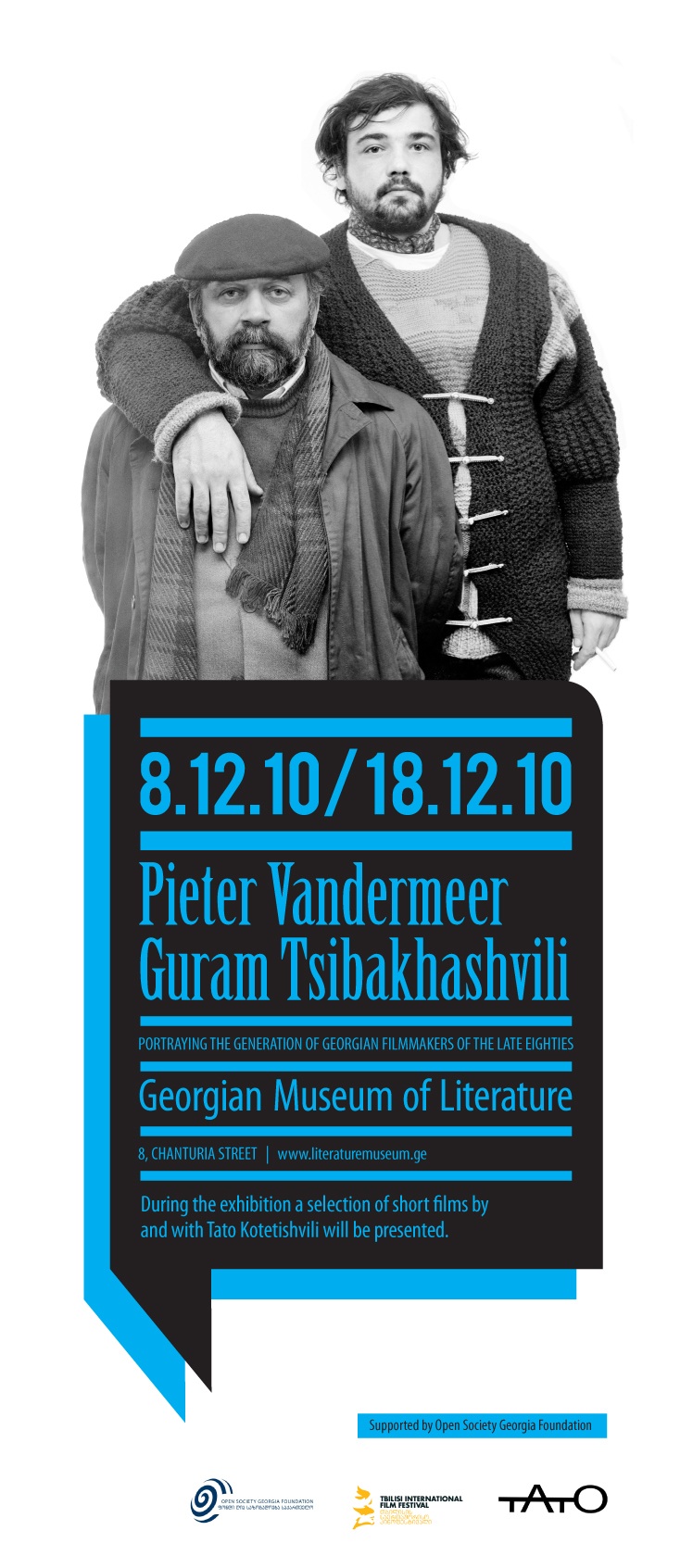
EXHBITION: L I M B O - Photographies by Guram Tsibakhashvili and Pieter Vandermeer (literaturemuseum.ge)

L I M B O

8-18 December, 2010

Georgian Museum of Literature


Cultural foundation “Tato” with financial support of Open Society-Georgia Foundation is organising an exhibition of photographs from the archives of photographers Guram Tisbakhashvili and Pieter Vandermeer. Both photographed extensively the generation of filmmakers in Perestroika time, both in Georgia, and at the International Film Festival Rotterdam, one of the first filmfestivals outside Soviet Union to show Georgian cinema.

The generation of filmmakers to which Tato Kotetishvili belongs is a generation in limbo. They were the last filmmakers to be educated in the Soviet Union, and to start their careers in the Soviet studio system. But they were also the first to be allowed to travel with their films to the west. The International Film Festival Rotterdam was one of the big festivals to receive the first Georgian delegation. Along with ‘master’ Sergej Paradjanov came filmmakers such as Tato Kotetishvili, Dato Janelidze, Dito Tsintsadze, Irakli Shavliashvili, and others. The backside of these exiting new times was, that they had to adapt very quickly to new methods and standards of filmmaking, as the studio system collapsed with the idependance of Georgia.

During the exhibition a selection of short films by and with Tato Kotetishvili will be presented.

The exhibition will be organised in cooperation with the Georgian Museum of Literature and Tbilisi 11th International Film Festival.

The exhibiton will open on 8 December, 2010 at18:00

Literature Museum of Georgia
8, Chanturia Street
0108 Tbilisi

--
Best regards, Natasha Lomouri

Projects Curator
Georgian Museum of Literature
8, Chanturia Street
0108 Tbilisi, Georgia
tel: (00995 32) 935019; mob: (00995 77) 57 32 32

www.literaturemuseum.ge

Friday, November 19, 2010

BOOK: Sergey Parajanov. Chronicle of the Dialogue. By Yuri Mechitov (mechitov.net)

Introduction

When Sergey Parajanov passed away, I was left with pain, sorrow, regret and an immense photo archive. Practically every day of our almost 12 year long relationship was filmed by me.
Sergey was fond of being photographed, quite often was the author of the compositions, which later proved to be the best. I indulged him with photographs and part of them he immediately autographed and gave away, the rest he used for his numerous collages. Parajanov praised me for my shots in every way, saying: ”Take my photographs more often, your (?!) future is in them.” But once he sent me an amazing letter.

My dear and beloved Yura!

I beg of you not to take my photographs anymore. You have created the splendid portrait of me and that is enough for a life. Don’t shoot me with your camera. You have taken approximately 1000 photographs, related to me. Even sold at 10 kopeks each it will make the sum, which I will never be able to pay. I am tired of struggling with my conscience every time I receive another set. Believe me, I spare your creative potential and love you very much!!!
S.P.

Sergey was right- even in his lifetime, and even more after his death, there was a great demand for my photographs of Parajanov for various publications, exhibitions, films, sculptural compositions… I even managed to buy my first, though second hand, automobile with the payment I got for one of them. These photographs, some copyrighted, some not, have been spread all over the world. As for me, I’ve been haunted by an ambitious thought to see my best shots of Sergey Iosifovich gathered under one cover. I made a few attempts to compose a layout, but every time something went wrong, I was not satisfied.

About two years ago my old friend, a writer and a director, Levon Grigorian advised me to give the book the title “Sergey Parajanov. The Chronicle of a Dialogue”, in which I would speak in more detail about my relationship with Parajanov. This title predetermined the concept and the architectonic of the book, and the work started.

Now the book is in front of you. It is the tribute to the memory of the great artist, who with his life and work has influenced and still continues to influence those of the new generation who crave for true, elevating art. Personally I have been taught much by Parajanov, though his lessons were at times extremely hard to take for the man who was far from the world of beauty then. While working with him I was never tired to get amazed how he got the supreme cinematographic quality by daringly putting together the most controversial things.

I would like the reader of this edition to be able to get an access to the extraordinary, fantastic world, to the universe, whose name is Sergey Parajanov.

Yuri Mechitov,
December, 2006


more about the great photographer Yuri Mechitoy on his website: www.mechitov.net

Monday, April 06, 2009

DOCUMENTARY: Nice Film about Sergej Paradshanow And Great Post In A Blog About Him (dapperfish.net)

dapperfish.net: Sergei Parajanov was a Soviet Georgian film director and artist, widely regarded as one of the 20th century's greatest masters of cinema. He invented his own unparalleled cinematic style. His oeuvre is extremely poetic, artistic and visionary and is acclaimed worldwide. - from Wikipedia.

A few days ago I randomly stumbled on a video using images of Sergei Parajanov's films. I was immediately in love. I've been searching the internet like crazy on more information, and trying to collect all his films. Today I watched Sayat Nova (The colour of Pomegranate). Every scene is like a moving painting, and it's impossible to take your eyes off of the screen.

To better understand the work of Sergei Parajanov, you should watch the following documentary that someone was kind enough to upload on youtube:


Saturday, January 17, 2009

FILMAKER: SERGEI PARAJANOV also spelled Paradzhanov or Paradjanov, (January 9, 1924 - July 20, 1990) (myspace.com)

SERGEI PARAJANOV also spelled Paradzhanov or Paradjanov, (January 9, 1924 - July 20, 1990), is considered by many to be one of the most original and critically-acclaimed filmmakers of the 20th century. His work reflected the ethnic diversity of the Caucasus where he was raised. He was born to Armenian parents Iosif Paradjanyan and Siranush Bejanyan, in Tbilisi, Georgia. In 1945, Parajanov traveled to Moscow, enrolled in the directing department at VGIK, one of the oldest and highly respected film schools of Europe, and studied under the tutelage of directors Igor Savchenko and Aleksandr Dovzhenko. In 1950 Parajanov married his first wife, Nigyar Kerimova in Moscow. She came from a Muslim Tatar family and converted to Eastern Orthodox Christianity to marry Parajanov, to terrible consequences: she was later murdered by her relatives in retaliation for her conversion. As a result of this tragic event Parajanov moved to Kiev. There he produced several ..aries (Dumka, Golden Hands, Natalia Uzhvy) and a handful of narrative films based on Ukrainian and Moldovan folktales, such as Andriesh, Ukrainian Rhapsody, and Flower on the Stone. He became fluent in Ukrainian, remarried (Svetlana Ivanovna Sherbatiuk in 1956) and had a son (Suren, 1958). In 1964 he directed Shadows of Forgotten Ancestors, which won numerous international awards including the prestigious BAFTA award given by the British Academy of Film and Television Arts. Despite the numerous awards it received and its frequent comparison with Sergei Eisenstein's The Battleship Potemkin, Parajanov's Shadows of Forgotten Ancestors did not conform to the strict standards of the Soviet board of censors. Unwilling to alter his film, Parajanov was quickly blacklisted. Parajanov departed Kiev shortly afterwards for his cultural motherland of Armenia. In 1968, Parajanov embarked on Sayat Nova, a film which many consider to be his crowning achievement. Soviet censors intervened once again and immediately banned Sayat Nova for its allegedly inflammatory content. Parajanov re-edited his footage and renamed the film, The Color of Pomegranates. It remains his best-known and the most emblematic film. By December 1973, Soviet authorities grew increasingly suspicious of Parajanov's perceived subversive proclivities and sentenced him to five years in a hard labor camp. An eclectic group of artists, filmmakers and activists protested on his behalf, but to little avail. Parajanov served four years out of his five year sentence, and many credit the poet Louis Aragon's petition to the Soviet government as instrumental in Parajanov's early release. While incarcerated Parajanov produced a large number of miniature doll-like sculptures (some of which were lost). Upon his return from prison to Tbilisi, the close watch of Soviet censors prevented him from continuing his cinematic pursuits and steered him towards artistic outlets which he had nurtured during his time in prison. He crafted extraordinarily intricate collages, created a large collection of abstract drawings and pursued numerous other avenues of non-cinematic art. By 1984, the slow thaw within the Soviet Union spurred Parajanov to resume his passion for cinema. With the encouragement of various Georgian intellectuals, Parajanov created the multi-award winning Legend of Suram Fortress based on the novella by Daniel Chonkadze, a return to cinema after an interlude of fifteen years since Sayat Nova first premiered. In 1988 Parajanov made another multi-award winning film, Ashik Kerib, based on a story by Mikhail Lermontov. Parajanov dedicated the film to his close friend Andrei Tarkovsky. Parajanov then immersed himself in a project that ultimately proved too monumental to withstand his failing health. He died of cancer in Yerevan, Armenia, on July 20, 1990, aged 66, leaving his final masterpiece, The Confession unfinished. It survives in its original negative as Paradjanov: The Last Spring, assembled by his close friend Mikhail Vartanov in 1992. He left behind a book of memoirs, also titled "

Image Hosted by ImageShack.us

It was the Ukraine where Parajanov created the film that brought him the world fame - his Ukranian masterpice Shadows of Forgotten Ancestors (1964). The succes and the importance of Sergei Parajanov's revolutionary film was compared to Sergei Einsentein's 1925 classic Battleship Potemkin . Parajanov shot the film in the Hustul (Gustul) dialect of the Ukranian language (Tini Zabutikh Predkiv) and won countless awards, including the Grand Prix of the Mar Del Plata Film Festival,Rome Film Festival and the British Academy Award, all in 1965. Shadows of Forgotten Ancestors (the most important Ukrainian film since the silent movies of Dovzhenko) was full of religious and folkloric themes and didn't conform to the dominant "social realism" of the Soviet cinema. Sergei Parajanov was blacklisted and his next film the Kiev Frescoes was stopped and banned in 1965.

Image Hosted by ImageShack.us

In 1966 Parajanov arrived in Armenia and in 1967 completed the ..ary Hakop Hovatanian (1967). That same year he met Mikhail Vartanov who began the shooting of the The Color of Armenian Land (1968) on the set of Sergei Parajanov's absolute masterpiece, the jewel of Armenian and world cinema, the magnificent Sayat Nova . Due to the film's non-conformity to the Soviet ideology, Parajanov was forced to change and rename it into the Color of Pomegranates and then ,in 1969, Soviet director Sergei Yutkevich re-edited and made the censored Russian language version of the film (Tsvet Granata) - regardless it was banned and shelved for a very long time. Sergei Parajanov's screenplays of Intermezzo, Ara the Beautiful, Demon and the Miracle of Odense, which was co-written by Viktor Shklovsky, were rejected. On the 17th of December 1973, Sergei Parajanov was arrested in Kiev and in 1974 was senteced to 5 years in the Ukranian Prison .. Parajanov continued to creat his art even there and it helped him survive. He made madly fascinating collages, drawings and wrote shocking and unbelievable letters full of wisdom.


Image Hosted by ImageShack.us

The world's prominent artists, filmmakers and activists campaigned for his release from camps. French poet Louis Aragon personally asked the Soviet leader Leonid Brezhnev to release Sergei Parajanov from the prison. On the 31st of December 1977 he became free and returned to his home town Tbilisi, Georgia, however remained blacklisted but continued to create art out of everything in his way and all around him.In 1982 Sergei Parajanov was arrested once again on the charges of brobery of an official and spent almost a year in a Georgian prison.

Image Hosted by ImageShack.us

After of uneployment, in 1984, with the help of the local elite, Parajanov was allowed to direct Legend of Suram Fortress ,his Georgian masterpiece. The picture proved that Sergei Parajanov's Talent and his unique way of expression were not affected by the long absence of cinema. The worldwide screenings of the award-winning film were followed by the first exebition of Parajanov's art works that was held in Tbilisi in 1985.

In 1986, Parajanov made the ..ary Arabesques on the Pirosmani Theme but his friend, of one the greatest masters of cinema, Andrei Tarkovsky, who considered Parajanov a genius, died in Paris, France on the 28th of December.

Image Hosted by ImageShack.us

In 1988, in the memory of Tarkovsky, Parajanov created Ashik Kerib, his Azerbaijani masterpiece based on the work of the russian poet Mikhail Lermontov, and won the European
Film Academy's Felix Award.

Image Hosted by ImageShack.us

In 1989, Parajanov began his faborite The Confession - a "film (that) can only be created by a director born in 1924 in Tiflis" - were the words of the first page of the screenplay.

Image Hosted by ImageShack.us

In 1992 Russian Academy of Cinema Arts, awarded the country's highest film honor to influetial Parajanov: The Last Spring which was started and banned in 1960s, and only completed in 1990s.It contains the footage of the first film about Parajanov and his last unfinished film The Confession.

FILMOGRAPHY: Moldovskaya skazka (1951), Andriyesh (1954), Zolotye ruki (1957) ... aka Golden Hands (1957), Natalya Ushvij (1957), Dumka (1957),Pervyj paren (1959) ... aka The First Lad, The (1959), Ukrainskaya rapsodiya (1961) ... aka Ukrainian Rhapsody (1961), Tsvetok na kamne (1962) ... aka Flower on the Stone (1962), Tini zabutykh predkiv (1964) ... aka Shadows of Forgotten Ancestors (1967) (USA), Hakob Hovnatanyan (1967), Sayat Nova (1968) ... aka The Color of Pomegranates (1968), Ambavi Suramis tsikhitsa (1984) ... aka The Legend of the Suram Fortress (1984), Arabeskebi Pirosmanis temaze (1985) ... aka Arabesques on the Pirosmani Theme (1985), Ashugi Qaribi (1988) ... aka Ashik Kerib (1988) (Soviet Union: Russian title), Parajanov: The Last Spring (1992) (segment "The Confession")

www.parajanov.com

source:
www.myspace.com/sergei_parajanov

Monday, January 12, 2009

FILM: "Die Farbe des Granatapfels". Von Sergej Paradshanow

Anläßlich des 85. Geburtstages Sergej Paradjanovs vor ein paar Tagen wird im Rahmen der Unikino-Serie an der EUV in Frankfurt (Oder) der Medien- und Kunstverein VIASION e.V. eines der größten Juwele sowjetischer Filmkunst präsentiert .
Termin: Do, 22.01.09, 20:00 Uhr, EUV FFO GD/Hs01
Eintritt: 2€, Glühwein 0,5€


Ohne jegliche Dramaturgie schuf der georgische Regisseur Sergej Paradjanov die wohl außergewöhnlichste künstlerische Filmbiographie aller Zeiten. In einer Abfolge von wie gezeichnet wirkenden Tableaus übertrug er das Leben des armenischen Dichtersängers Sayat Nova (x 1795) auf die Kinoleinwand. Geheimnisvolle Symbole und mystische tänzerische Bewegungsabläufe durchziehen diesen surrealen Film, eine sinnlich-ästhetische Ethnographie des religiösen und folkloristischen Armeniens, des ältesten christlichen Landes der Welt.


Das Drehbuch enthält weniger Handlungsanweisungen als vielmehr Choreographien und Bühnenbildzeichnungen. Auf Grund seiner starken Unkonformität mit dem staatlich verordneten Realismus mußte der Film 15 Jahre nach seiner Entstehung auf seine Uraufführung 1984 warten. Der Regisseur selbst wurde wegen (angeblicher oder tatsächlicher) Homosexualität zu 4 Jahren schwerer Lagerhaft verurteilt.


Die Farbe des Granatapfels sprengt unser westliches Empfinden von Zeit und Ästhetik und überwältigt mit seiner hypnotischen Bildersprache. Der Film ist mit den dargestellten drei Altersphasen des Dichtersängers eine allgemeine Kontemplation über Leben und Tod.


mit: Sofiko Tschiaureli, M. Arakelian, V. Galstian, G. Gegetschkori UDSSR (Armenische SSR) 1969, ca. 88min, OmeU


Link: www.parajanov.com

Sunday, May 25, 2008

KULTUR: Armenische Veranstaltungen in Leipzig - Internationale Studentische Woche. 02.-06. Juni 2008

1. Armenien 1998/2008 – Fotoausstellung
02.-06. Juni 2008, 8:00 – 20:00 Uhr
im Geisteswissenschaftlicheszentrum der Uni-Leipzig - GWZ (Foyer)

Die Fotos von Rüdiger Tonojan zeigen Szenen aus dem Alltag der armenischen Hauptstadt Jerewan aus den Jahren 1998 und 2008. Wie haben sich die Stadt und ihre Einwohner in den letzten 10 Jahren verändert? Hat sich die Lage nach der Zeit der großen Not – verursacht durch das große Erdbeben 1988, den Zusammenbruch der Sowjetunion und den Krieg mit Aserbaidschan – stabilisiert, die wirtschaftliche Situation der Menschen verbessert? Wie zeigen sich Veränderungen im Stadtbild, wie in den Gesichtern der Menschen? Was lässt sich ablesen über die Stimmung in einer Stadt, die dieses Jahr ihr 2790jähriges Jubiläum feiert, im 17. Jahr der Unabhängigkeit Armeniens?

2. Karen Jeppe und ihr Einsatz für die Armenier
Lesung und Musik
Mi. 04. Juni 2008, 15:00 Uhr
Moritzbastei – Ratstonne


Karen Jeppe gehört bis heute zu den weitgehend unbekannten Wegbereitern einer Völkerverständigung mitten in Hass und (unerklärtem) Kriegszustand. Lange vor den Neuanfängen nach 1945 oder auch der Versöhnungsarbeit Desmond Tutus in Südafrika kämpfte sie, Augenzeugin des Mordes an den Armeniern 1915/16 in Urfa, zu Beginn des 20. Jahrhunderts für Menschlichkeit und Würde des Einzelnen. Trotz ihrer angeschlagenen Gesundheit organisierte sie nach dem Ende des Ersten Weltkriegs in Syrien in Zusammenarbeit mit der arabischen Bevölkerung und u. a. dem Armenischen Hilfswerk von Dr. Johannes Lepsius und dem Flüchtlingshochkommissariat des Völkerbundes eine Hilfe für die überlebenden Armenier, die sie zur "geliebten fremden Mutter der Armenier" werden ließ.Die Lesung wird sich dieser großen Frau in Zitaten aus ihren Veröffentlichungen, ihren Briefen und literarischen Versuchen über sie nähern. Die Lesung wird durch armenische Musik begleitet.
Bettine Reichelt (Lesung) und Simone Weißenfels (Klavier)

3. Armenische Geschichte und Gegenwart als Poesie, Bild und Musik
06. Juni 2008, 15:00 Uhr
Moritzbastei - Ratstonne


Die Geschichte des armenischen Volks wurde im Laufe der Jahrhunderte in literarischen Texten dargestellt. Legende, mündliche Überlieferungen und poetische Texte, kirchliche Hymnen, Erzählungen und Gesänge bilden ein vielfältiges Gesamtgut, das die wechselreiche Geschichte und die Gegenwart der Armenier widerspiegelt. Umgeben von Großmächten sollten der kleine Staat und das kleine Volk der Armenier um ihre Unabhängigkeit und nicht selten um ihr Dasein kämpfen. Sie sollten ihre eigene Identität und Kultur mit der der umgebenden Völker in Kontakt und Kontrast halten. Dieser Prozess bildet auch die armenische Gegenwart.
In der Veranstaltung werden zuerst die jeweiligen Fakten und Daten durch kurze Einführungen dargestellt und dann kurze literarische Ausschnitte (Deutsch und Armenisch) vorgetragen. Lichtbilder und Musik begleiten die Lesungen.
Einführungen von Ischchan Tschiftdschjan.

4. Film: „Die Farbe des Granatapfels“
R.: Sergej Paradjanov, UDSSR 1969, 73 Min.
Fr. 06. Juni 2008, 18:00 Uhr
Moritzbastei – Ratstonne


„Die Farbe des Granatsapfels“ zeigt in surrealen Bildern den Lebensweg des armenischen Poeten Sayat Nova (18. Jh.). Der Regisseur Sergej Paradjanov hat sich dabei „auf eine rein poetische Form eingelassen, auf eine rätselhafte Inszenierung von Versatzstücken aus der armenischen Tradition. Orte, Kostüme, alte Folianten, Gewänder und Kulturgegenstände stellt er in einen poetischen Diskurs, der die Vorbilder mittelalterlicher Ikonenmalerei mit surrealistischen und mystischen Effekten verbindet“ (Gertrud Koch, Frankfurter Rundschau). Vor den Schauen gibt es eine umfassende Einführung in den Film und zum Regisseur, die hilft, einen Einblick in die Hintergründe und die Welt des berühmten armenischen Künstlers zu gewinnen.

Quelle: http://www.caterdev.de/~cater/isw/programmheft/Programmheft_ISW-2008.pdf

Thursday, November 01, 2007

FILM: Armenische Filmwoche vom 5.11. bis 11.11.07 im Kölner Filmhaus

Die Armenische Filmwoche begleitet die älteste christliche Nation der Welt durchdie Irren und Erschütterungen des 20. Jahrhunderts: Traumatische Erinnerungen andas Menschenschlachten während des Ersten Weltkriegs und dessen unverheilteNarben, die Wirren der kommunistischen Revolution, Stalins Terror, die Wunden des Zweiten Weltkriegs, die Aufbruchstimmung der 60er Jahre in der Sowjetunion, schließlich deren Zerfall und damit verbunden der Wiedererlangung nationaler und kultureller Souveränität.
Trotz, oder vielleicht sogar wegen dieser höchst dramatischen Opfer und Mühseligkeiten, derer sich die Armenier ausgesetzt sahen, haben sie es nicht beiden Tränen belassen. Dieses Volk hat sich Lebensfreude und Lachen bewahrt, wie auch künstlerisch nie das Verlangen aufgegeben, Wahres, Dauerhaftes, Neues undSchönes zu schaffen.
Und so bebildert die Armenische Filmwoche in allen menschlichen Facetten diejüngere Geschichte einer der ältesten Kulturen Europas, die gleichzeitig wieder zuseinen jüngsten zählt.

Freuen Sie sich auf Verblüffendes, Historisches, Poetisches und Anregendes - wir freuen uns auf Sie. Mit besten Grüßen,

Christoph Heitmann
Presse und Öffentlichkeitsarbeit
Kölner Filmhaus
Maybachstraße 111
50670 Köln
Tel.: 0221 222 710 41
Fax 0221 222 710 99
www.koelner-filmhaus.de
www.off-ticket.de

PROGRAMM:

05.11.2007
20.00 h Armen. Filmw. KAROT – RETROSPEKTIVE DES ARMENISCHEN FILMS
(5.–11.11.2007) Eröffnungsveranstaltung mit Erika Richter von ART COMBAT

21.00 h Armen. Filmw. NAMUS ARM/GE/UdSSR 1925 • 62 Min. • s/w • Stummfilm • R.: Hamo Bek-Nazarov1937 ARM 2007 • 44 Min. • Doku • Ome voice over • R.: Nora Matirosyan

06.11.2007
17.00 h Armen. Filmw.
GIKOR ARM (UdSSR) 1982 • 85 Min. • voice over • R.: Sergey Israelyan

19.00 h Armen. Filmw. SHOR UND SHORSHOR ARM/UdSSR 1926 • 61 Min. • R.: Hamo Bek-Nazarov WIR ARM/UdSSR 1969 • Doku • 27 Min • s/w • ohne Dialog • R.: Artavazad Peleshyan

21.00 h Armen. Filmw. GEBURT ARM/UdSSR 1076 • 142 Min. • s/w • voice over • R.: Frunze Dovlatyan

07.11.2007
17.00 h Armen. Filmw. EIN FRÖHLICHER BUS ARM 2001 • 110 Min. • voice over • R.: Albert Mkrtchyan

19.00 h Armen. Filmw.
PEPO ARM/UdSSR 1935 • 88 Min. • s/w • voice over • R.: Hamo Bek-Nazarov

21.00 h Armen. Filmw.
HALLO, DAS BIN ICH ARM 1965 • 136 Min. • s/w • voice over • R.: Frunze Dolatyan

08.11.2007
17.00 h Armen. Filmw.
DEUTSCHLAND UND DER GEHEIME GENOZID USA 2003 • Doku • 60 Min. • OmU • R.: J. Michael Hagopian

19.00 h Armen. Filmw. STEIN ZEIT BERÜHRUNG ARM/CAN 2007 • 71 Min • OmeU • R.: Gariné Torossian

21.00 h Armen. Filmw. SEHNSUCHT ARM 1990 • 136 Min • voice over • R.: Frunze Dovlatyan

09.11.2007
17.00 h Armen. Filmw. NAHAPET ARM/UdSSR 1977 • 92 Min. • voice over • R.: Henrik Malyan

19.00 h Armen. Filmw. APRIL UdSSR/ARM 1985 • 30 Min. • voice over • R: Vigen Chaldranyan DIE KELTER ARM/UdSSR 1973 • 76 Min. • voice over • R.: Bagrat Hovhannisyan

21.00 h Armen. Filmw. KALENDER ARM 1993 • 72 Min. • OmU• R.: Atom Egoyan

10.11.2007
17.00 h Armen. Filmw. RÜCKKEHR INS GELOBTE LAND ARM 1991 • 87 Min. • ohne Dialog • R.: Harytyun Khachatryan

19.00 h Armen. Filmw. TANGO UNSERER KINDHEIT ARM/UdSSR 1984 • 89 Min. • voice over • R.: Albert Mkrtchyan

21.00 h Armen. Filmw. AVETIK ARM 1992 • 84 Min. • OmU • R.: Don Askarian

11.11.2007
17.00 h Armen. Filmw. HAKOB HOVNATANYAN ARM/UdSSR 1976 • Doku • 10 Min. • ohne Dialog • R.: Sergey Parajanov
RÜCKKEHR DES DICHTERS ARM 2005 • Doku • 88 Min • ohne Dialog • R.: Harutyun Khachatryan

19.00 h Armen. Filmw. DER DOKUMENTARIST ARM 2003 • Doku • 80 Min • ohne Dialog • R.: Harutyun Khachatryan

21.00 h Armen. Filmw. DIE FARBE DES GRANATAPFELS ARM/UdSSR 1969 • 79 Min. • OmU • R.: Sergey Parajanov

Monday, April 30, 2007

Georgische Filme u.a. mit Otar Iosseliani vom 16.-26. Mai 2007
filmpodium
Nüschelerstrasse 11, 8001 Zürich
Tel. 044 211 66 66
Filme aus Georgien

Das Kino der Kaukasusrepublik am Schwarzen Meer stach schon zu Sowjetzeiten durch eine Freude am Fabulieren und Phantasieren hervor, die sich von keiner sozialistischen Doktrin bändigen liess. Verwurzelt in der Literatur, der Malerei und der Musik ihres Landes, schufen Filmemacher wie Sergej Paradshanow, Tengis Abuladse, Eldar und Giorgi Schengelaja eigensinnige Filme voller List und Poesie. Unsere neunzehnteilige Auswahl ermöglicht einen kleinen Einblick in dieses wunderbar reiche Filmschaffen.
Speziell freuen wir uns, Otar Iosseliani, einen der ganz Grossen, mit seinem neuesten, in Frankreich entstandenen Film Jardins en automne und mit seinem Klassiker Pastorale in
Zü­rich begrüssen zu dürfen.


Vorstellungen in Anwesenheit von Otar Iosseliani:

Mi 16.05.2007, 18.15
Pastorale Regie: Otar Iosseliani, UdSSR (Georgien) 1976 Georg/d
(Gespräch mit dt. Übersetzung)

Mi 16.05.2007, 20.45
Jardins en automne Regie: Otar Iosseliani, Frankreich / Italien 2006 F
(Gespräch auf Französisch)


Diese Filmreihe entstand in Zusammenarbeit mit Marika Lapauri-Burk, Deutsch-
Kau­kasische Gesellschaft Lile e.V., Hamburg
, und wird unterstützt von der Botschaft von Georgien in Schweiz. Herr Botschafter Levan Mikeladze wird zur Eröffnung der Film­reihe im Filmpodium anwesend sein.

Programm:

Mi 16.05.2007, 18.15 / Mi 23.05.2007, 20.45
Pastorale
(Pastorali / Pastoral)
Regie: Otar Iosseliani, UdSSR (Georgien) 1976 Georg/d

Mi 16.05.2007, 20.45 / Mo 04.06.2007, 15.00 / Fr 08.06.2007, 15.00 / Mo 11.06.2007, 20.45
Jardins en automne
Regie: Otar Iosseliani, Frankreich / Italien 2006 F

Di 22.05.2007, 18.15 / So 27.05.2007, 18.15

Wie Luft zum Atmen
Regie: Ruth Olshan, Deutschland 2005 Georg/d


Der im Film porträtierte georgische Frauenchor Tutarchela tritt u. a. am 14. Mai im Moods und am 18. Mai in der Helferei Grossmünster auf.
Details siehe
www.singfrauen-winterthur.ch und www.tutarchela.org.

Di 22.05.2007, 15.00 / Mi 30.05.2007, 20.45,
Das Gebet
Regie: Tengis Abuladse, UdSSR (Georgien) 1968 Georg/d

Mi 23.05.2007, 18.15 / Di 29.05.2007, 20.45
Eine ungewöhnliche Ausstellung
Regie: Eldar Schengelaja, UdSSR (Georgien) 1968 Georg/f


Do 24.05.2007, 20.45 / Sa 26.05.2007, 15.00
Nimm's nicht tragisch!

Regie: Georgi Danelia, UdSSR (Georgien) 1969 Georg/f


Fr 25.05.2007, 18.15 / Sa 02.06.2007, 18.15
Meine Grossmutter
Regie: Kote Mikaberidse, UdSSR (Georgien) 1929 Stummfilm mit Musik, georg./dt. Zw'titel
Vorfilm: Musiker Regie: Michail Kobachidse, UdSSR (Georgien) 1969 ohne Dialog

Mo 28.05.2007, 15.00 / Do 31.05.2007, 20.45
Blaue Berge oder Eine unwahrscheinliche Geschichte
Regie: Eldar Schengelaja, UdSSR (Georgien) 1984 Georg/d/f

Di 29.05.2007, 18.15 / Fr 01.06.2007, 15.00 / Mi 06.06.2007, 20.45
Der Mann aus der Botschaft
Regie: Dito Tsintsadse, Deutschland / Georgien 2006 D/Georg/d

Do 31.05.2007, 15.00 / So 03.06.2007, 18.15
Pirosmani
Regie: Georgi Schengelaja, UdSSR (Georgien) 1969 Russ/d


Fr 01.06.2007, 18.15 / Sa 09.06.2007, 20.45
Es war einmal eine Singdrossel
Regie: Otar Iosseliani, UdSSR (Georgien) 1970 Georg/d


Di 05.06.2007, 20.45 / Mo 11.06.2007, 15.00
26 Kommissare
Regie: Nikolai Schengelaja, UdSSR (Georgien) 1932 Stummfilm mit Musik, engl./frz. Zw'titel


Sa 09.06.2007, 15.00 / Mi 13.06.2007, 20.45 / So 24.06.2007, 18.15,
Die Legende der Festung Suram
Regie: Sergej Paradshanow / Dodo Abaschidse, UdSSR (Georgien) 1985 Georg/d/f
Vorfilm: Arabeske über Pirosmani Regie: Sergej Paradshanow, UdSSR (Georgien) 1985


Di 12.06.2007, 20.45 / So 17.06.2007, 18.15
Nächtlicher Tanz

Regie: Aleko Tsabadse, Georgien 1991 Georg/d


Sa 23.06.2007, 20.45 / Fr 29.06.2007, 18.15
Einige Interviews zu persönlichen Fragen

Regie: Lana Gogoberidse, UdSSR (Georgien) 1978 Georg/d


Di 26.06.2007, 20.45 / Do 28.06.2007, 15.00
Robinsonade oder: Mein englischer Grossvater
Regie: Nana Dshordshadse, UdSSR (Georgien) 1987 Georg/E/e
Vorfilm: Der Krug Regie: Irakli Kwirikadse, UdSSR (Georgien) 1970 Russ/f


Detaillierte Angaben zu den Filmen sowie einen Einführungstext in das georgische Kino finden Sie in unserem Programmheft im Kino und unter www.filmpodium.ch

Friday, April 20, 2007

FILM: Der Filmemacher Sergej Parajanov

Eben fand ich eine herausragende Seite zu dem armenischischen Filmemacher PARJANOV, der in Tbilisi geboren wurde. Viele namanhafte Vertreter der Filmgeschichte brachten ihm große Wertschätzung entgegen: Mehr www.parajanov.com

Wednesday, July 12, 2006

FILMMAKER: Sergei of Tbilisi: The Life of one of Armenia's greatest film makers

by David Somerset
"Sergei Paradjanov (1924 - 1990) was a visionary film maker, revered by Soviet contemporaries such as Andrei Tarkovsky, Kiri Muratova and Leonid Alekseychuk. His resolute integrity combined with a delight in the creative possibilities of cinematic art. Born to Armenian parents he lived in Tbilisi, in Georgia but worked throughout the Caucasus, despite sustained intimidation and imprisonment from Soviet bureaucrats. This region, strategically and precariously situated at a cross-roads between Asia, Europe and the Middle East is renowned for its resilience in the face of invasion and violent misrule. Armenia is described as a 'theatre of perpetual war' by 18th century historian, Edward Gibbon. Georgia, the birthplace of Stalin has for much of its history has been little more than a collection of warring petty princedoms. "
Link: