Showing posts with label Vahram Aghasyan. Show all posts

Friday, August 01, 2014

ART: Two Exhibitions Capture Life in the Caucasus. By Nevdon Jamgochian (hyperallergic.com)

(hyperallergic.com) TBILISI, Georgia — This week in Tbilisi, there are two exhibitions worth checking out. They make a nice pairing for an afternoon, as the first deals with public memory while the second is a very intimate examination of hidden experience. Both are singular in that they reflect life in the Caucasus region yet have universal relevance.

Varhram Aghasyan, “Museum of the Revolution,” in 'RE: Museum' at the National Gallery (all photos by the author for Hyperallergic)
Varhram Aghasyan, “Museum of the Revolution,” in ‘RE: Museum’ at the National Gallery (all photos by the author for Hyperallergic)
RE: Museum, showing at the Georgian National Museum’s National Gallery, was initiated by the Goethe Institute of Tbilisi and developed by Wato Tsereteli, director of the Center of Contemporary Art – Tbilisi (CCAT). He commissioned two artists, Sabina Shikhlinskaya from Azerbaijan and Vahram Aghasyan from Armenia, to co-curate 14 other artists for an exhibition reimagining a national museum. Over several months, the 17 participants, working with the Georgian National Gallery and its extensive archive, were given one set of instructions: “You are the director of the museum, you have access to everything. Make a laboratory relating to the future.”

As in any show with 17 artists and laissez-faire direction, the results are mixed — but there are more successes than duds.

The real winners in RE: Museum are the artworks that take an interesting artifact or fact of history and place it in a new context. There is a real human desire to look at neat stuff and have interesting stories told to us, but the way most museums’ structures have evolved has made attendance a chore (or a place for children), rather than seizing imagination and spurring thought.

A particularly striking example of this is “Medea’s Garden” by Mamuka Japharidze, which features ancient jars of pickled poisonous snakes in lovely vitrines on a plinth, with a projection showing the Colchian forest shot through and behind them. The installation relates to the story in the Argonautica Orphica that recounts the poisonous and healing plants of the Colchian forest, and points out that the Georgian words for poison and medicine come from the same root.

Also interesting, but more academic, are the artworks that make the viewer aware of the box-inside-a-box aspect of museums. Aghasyan’s “Museum of the Revolution” consists of a two-walled wooden shelter that looks like a hut from the front and a barricade/reader’s corner from the back. The text on the front informs the viewer about a revolutionary museum in Yerevan that was erased from history and the early Soviet idea of reader’s huts.

Tsereteli told me that the primary purpose of the show was to decolonize the museum — to make us aware of the obligations that the space of a museum imposes on us — and to return it to its original function as a place of muses. His tongue-in-cheek work underscores this: Tseretli framed a photograph of a room being remodeled at his current work in progress, the CCAT. Putting a picture of his future exhibition space/school in the show was the only way he could get the Goethe Institute to provide funding to build it. It’s a neat trick that accomplishes the goals of the exhibition nicely.

A 25 minute walk over the river, through a rundown neighborhood full of bridal dress shops, brings you to Tbilisi’s only contemporary art gallery, Nectar. Unmarked and without a sign (this seems to be something that just happens in Tbilisi — it was the third establishment I’d been to that day without a shingle out front), the gallery is currently showing Supra of Her Own by Polish PhD anthropology candidate Agnieszka Dudrak and Georgian artist Tamar Chabashvili, sponsored by the Heinrich Böll Foundation (the Germans are doing an excellent job funding arts in this region) and the Mondriaan Fund. Supra is a Georgian word that means both tablecloth and feast. In Georgian culture, supras are special tablecloths that are held onto as family treasures, despite the stains and tears and mends they accumulate.

The entire space of Nectar has been taken over by old supras, which are strung up as walls to recreate the floor plan of a house. The viewer must navigate the supras to enter the successive “rooms.” On each supra are fragments — embroidered, written on, and sewn — of stories of domestic violence recorded by the artists in Georgia. These oral histories range from acts against children or newlywed women to sustained violence that’s lasted decades.
 
Detail of Agnieszka Dudrak and Tamar Chabashvili's 'Supra of Her Own' (click to enlarge)
Agnieszka Dudrak and Tamar Chabashvili’s ‘Supra of Her Own’
Chabashvili has created different canvases for the words, some in a graphic, manic style of repeating words relating to cycles of abuse, others with cheerful-looking rose embroideries that contain an ominous phrase about the first acts of violence perpetrated immediately after a wedding. They are stunning. Also jolting is the fact that the women who told these stories donated the supras, which now have their stories embedded in them.

Capturing stories in this way is visually arresting and effective. The act of seeing the words and the stains made by perpetrators, victims, and accessories — and having to touch them in order to move through the show — made the experience more visceral than visual art and text alone could. The writing is in Georgian and Chabashvili translated for me, but I think the show could work without knowledge of what exactly was written, as abuse is a universal experience. I asked if the artists planned to take the exhibition elsewhere, but they said they were afraid of a Western reaction of seeing this as an exotic problem of the East rather than a general human failing.

RE: Museum continues at the Dmitry Shevardnadze National Gallery (11 Shota Rustaveli Ave, Tbilisi, Georgia) through the end of September. Supra of Her Own continues at Gallery Nectar (16 Agmashenebeli Ave, Tbilisi, Georgia), through July 31.

Photos are here >>>

Wednesday, April 10, 2013

EXHIBITION: Post-war Soviet architecture - Trespassing Modernities at SALT Galata (e-flux.com)

Post-war Soviet architecture at SALT
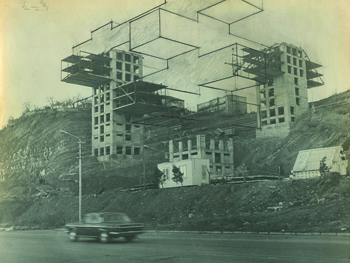
Ministry of Transportation, Tibilissi, Georgia (1974). Architects: Georgy Chakhava, Zurab Jalaghaniya, T. Tkhilava, V. Kimberg. Courtesy Georgy Chakhava’s personal archive gathered and selected by Vahram Aghasyan, Nini Palavandishvili and Lali Pertenava as part of Frozen moments: Architecture Speaks Back curated by Joanna Warsza, Tbilsi, 2010.

May 8–August 11, 2013
SALT Galata
Bankalar Caddesi 11
Karaköy 34420
Istanbul, Turkey
Hours: Tuesday–Saturday 12–8pm
Sunday 12–6pm
T +90 212 334 22 00
F +90 212 292 16 67

www.saltonline.org
(e-flux.com) Almost 25 years after the corrosion of the Soviet Union, still little is known about the social fabric that wove it together. Architecture and urbanism have been one of its strongest warps: creating a feeling of social unity and being one of the agents of its dissolution. This continent of architecture, afflicted by inner contradictions that enfolded within a homogenized space, is full of masterpieces waiting to be formally discovered. Trespassing Modernities explores this landscape and an approach of building for a fundamentally different idea of society.
Examples of practices by local architects working in the 1960s and 1970s followed by the critical approach of the Paper Architecture movement in the 1980s are brought together from the 15 countries that once made up the Soviet Union. Through a selection of scale models, drawings, photographs, films and ephemera that portray the legacy of post-war Soviet architecture, the exhibition will offer a glance at a still existing void in the canonical history of architecture. This issue will be discussed further in a conference to be held at SALT Galata on May 10–11.
Trespassing Modernities is programmed for SALT by Georg Schöllhammer with support from Ruben Arevshatyan. The exhibition is based on the research of Local Modernities, a project by Georg Schöllhammer, Ruben Arevshatyan, Klaus Ronneberger, Markus Weisbeck and Heike Ander, which initiated the exhibition Soviet Modernism 1955–1991 Unknown Stories (2012) at Architekturzentrum Wien.
Supported by Kalebodur.
subREALSALT Beyoğlu
May 8–August 11
Taiping Tianguo, A History of Possible EncountersAi Weiwei, Frog King Kwok, Tehching Hsieh and Martin Wong
SALT Beyoğlu
May 8–August 11, 2013
It was a time of conversationSALT Ulus
April 3–June 2, 2013

Monday, December 28, 2009

TEXT: RUINS OF OUR TIMES. By Joanna Warsza / Laura Palmer Foundation / Warsaw

The text will be published in Team Network magazine and in Obieg on-line.

Georgia and Armenia are full of landscapes of frozen moments. With the fall of the Communist regime, the trains stopped n mid-route, the cable car over one of the cnyons of Tbilisi has been abandoned halfway, and the housing estates of the never realized future found temporary settlers. Tracing the unwanted heritage of the Soviet past in the Caucasus, at times I had a strange sense of witnessing the future. The self-organized methods adopted in the years of post-collapse crises recall the most progressive contemporary theories of bottom-up structures and participatory urban planning: the cinema-theater Rossia in the middle of Yerevan found a secondary use as a market and mini-bus station, the never completed city of Gyumri in Armenia was finished by the motivated settlers themselves, the mikro-raion estates in Tbilisi have expanded with new parasite parts called kamikaze loggias. The Caucasus, following a process of Eastern Bloc Westernization, is fortunately still full of heterotopias, stunning ruins of our own age, and of self-organizing policies that tend to be forgotten in a time of ‘euroremonts’, and ‘Eurenovations.’


Ruines of the future, never accomplished project builidng, Mush, Armenia

FROZEN MOMENTS
On the western outskirts of Tbilisi one encounters a thrilling Caucasian picture. A cable-car supposed to link the unfinished University campus with the metro station was stopped at the very second the Soviet system collapsed in 1991. Since then it has been hanging in the air over a picturesque canyon, abandoned in the middle of its route, above the heads of people passing down in the valley who no longer even notice it. The Caucasus, with its tremendous landscapes, is full of this phantom heritage, when the Socialist reality became the past, when the world stopped and started again.
Coming myself from a post-Communist (though not post-Soviet country), I have been witnessing since 1989 how quickly the former Eastern Bloc, and Poland in particular, has been cleaning up its past. Westernization, pro-euroatlanticism and procapitalism (‘once Moscow, Brussels today’ policy), have become the new and only format for life. Georgians and Armenians have a good term for this phenomenon — the euroremont (‘eurenovation’). The Poles have performed especially well: we still live in the same housing blocks, but they were immediately repainted and wrapped in polystyrene, the streets were filled with endless early-capitalist vendor kiosks, and later with huge billboards and all sorts of advertising campaigns. Social Realist architecture in the big cities was quickly transformed, covered up, or lifted in order to be a part of a new narrative.
One of the very few examples of Polish Socialist Realist decay was the 10th-Anniversary Stadium in Warsaw. Built in 1955 from the rubble of a war-devastated city, it was to preserve Communism’s good name for forty years. In the early 1990s it fell into ruin, being at the same time “revived” by the Vietnamese intelligentsia and Russian traders, pioneers of capitalism, who established an open-air market. It became the only multicultural site in the city, a storehouse of biographies and urban legends, a piece of Land Art, a workcamp for anthropologists, botanists and archaeologists. It was in fact the one and only heterotopic zone in central Warsaw, free from the unwritten laws of westernisation and euroremonts.

KAMIKAZE LOGGIAS AND SELF-ORGANISED MICRORAYONS
The Georgian and Armenian situation was different. The Russians went home, but left behind their utopian infrastructures in the former republics. People started organically responding to the changes through a particular, self-organised relationship to the architecture. A refusal of the dominant structures, the provisional liberty, and scepticism as to all master plans led to participatory forms in the urban environment. Emergent movements started to occur, especially in the “microrayons” — the large-scale social-housing projects developed throughout the entire former Soviet Union, as well as in Vietnam and in Eastern Europe. A “microrayon”, or microdistrict, was initially supposed to be a self-sufficient unit affording its inhabitants comfort and the pleasure of living, thus realising Le Corbusier’s utopia of the collectivity and harmonious cohabitation through architectural and social engineering. If this happened it was not through a masterplan, but initiatives from the bottom-up.
At the beginning of the 1990s many owners of a block apartment would hire an engineer to design an extension to their home. This whole new parasite part, called a kamikaze loggia, would grow out one side of the building, expanding the living space. This was nothing new for Georgia; palimpsest structures and extensions have always been a commonly applied method of expanding a living surface in this country located on steep Caucasian slopes. One has to remember that Georgia was the “honey of the USSR” — the richest state, with quite oversized and representational houses. In the dark and poor Shevardnadze years after the fall of Communism, the extensions continued, even using found scrapmetal or other cheap materials of all kinds.


THE NON-EXISTENT MINISTRY OF A NON-EXISTENT COUNTRY
The Georgian palimpsest spirit is perhaps best reflected in an icon of Caucasian architecture, the former Georgian Ministry of Highways, (საქართველოს საავტომობილო გზების სამინისტროს შენობა) built in 1975 by architect George Chakhava, since last few years bought by a bank and standing empty, overgrown with vegetation. This fascinating building was meant to stand in harmony with the mountain villages. The structure consists of a monumental grid of interlocking concrete forms, five horizontal parts of two storeys each seeming to stand on top of each other.
The design is a reference to the concept of Ville Spatiale by Yona Friedman, who didn’t want to displace the city, but to raise a second city twenty meters above the existing one. Chakhava’s other reference was also a forest, with the cores as the trunk and the horizontal parts as the crowns, so as to provide a lot of free space for other living beings and nature. The former Ministry on Gagarin street also brings to mind the work of the Japanese Metabolists, whose flexible, and expandable structures built in the 1960s evoked processes of organic growth. With its unrealistic and multi-extensional structure, the building seems to be an unintended tribute to the most recent, early-capitalist architectural changes in the urban environment of Tbilisi, but carrying a long tradition of self-built palimpsests.

BACK TO THE FUTURE
Staying for two months in Georgia I sometimes had a strange sense of witnessing the future. The self-organized methods adopted in the years of crises after the collapse of the USSR recall the most progressive contemporary theories of bottomup structures and participatory urban planning. The Chilean architect and theoretician Alejandro Aravena created Elemental, a “do-tank” combining art, architecture and engineering, understanding the city to be a resource for building social equity. His statements, considered visionary, about buying half a house and filling the other half with years, are a kind of selffulfilling prophecy in Caucasus. People don’t ask themselves the developer-like question, “Where would you like to live?” but rather how to organize the city from its successive layers.

A project awarded a Golden Lion at the last Venice Architecture Biennale, The Afterlife of Buildings by Grzegorz Piatek and Jarosław Trybus, pictured an apocalyptic secondary use for famous Polish properties: a Warsaw airport terminal would be turned into a chicken farm, a Norman Foster building into a prison, or a financial centre into a crematory. Applying both theories the Caucasus could move ahead, full of secondary uses. One could cite the Yerevan cinema-theatre Rossia, build in 1979 as a youth palace, sports and concert complex, and museum, now turned into a huge market in the former screening rooms and hallways and a busy mini-bus station.
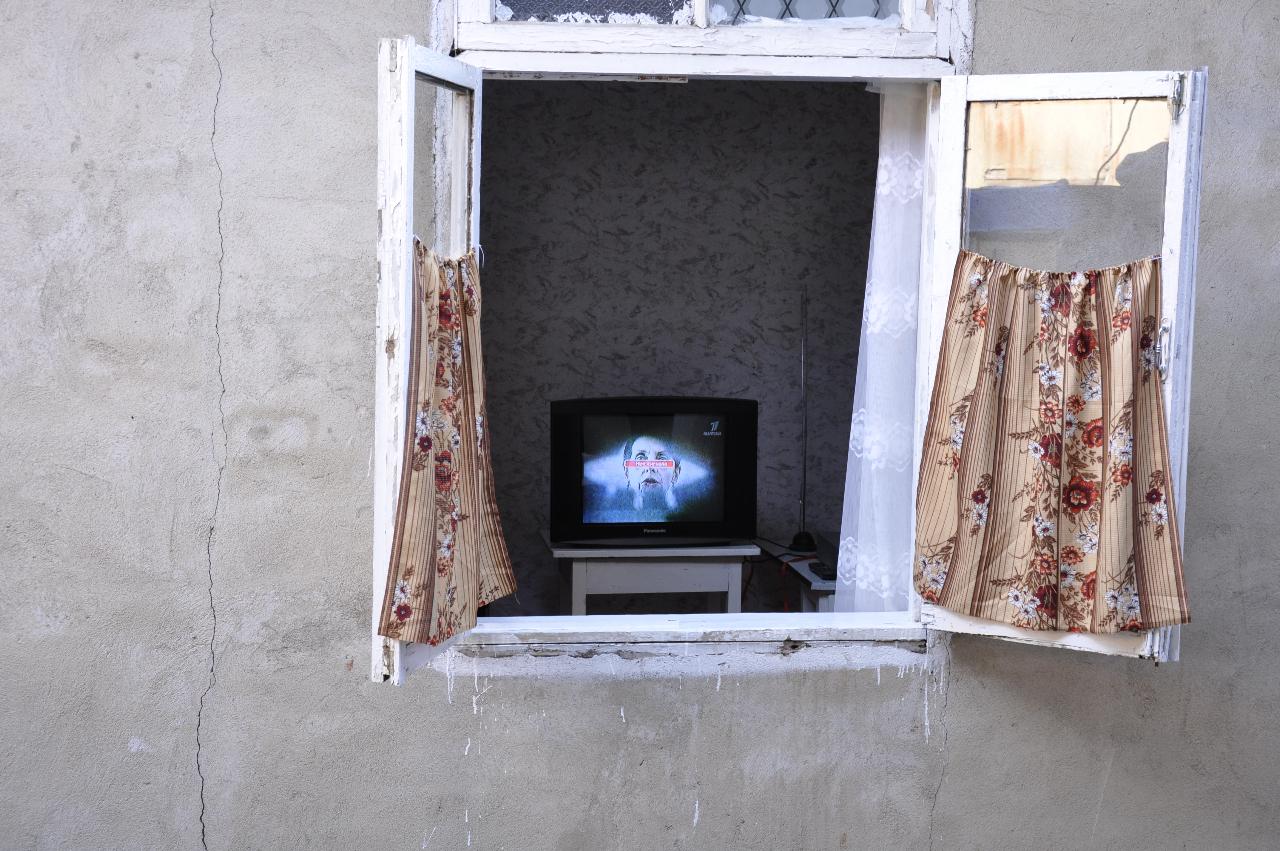
Some Caucasian artists have a great intuition of how to grasp these fantastic reality shifts. For more than ten years Georgians had no more than two hours of electricity per day — what they now call the dark years. Back then some foreign-channels were illegally broadcasting on Georgian channels frequencies. As a result two logos appeared on the screen and the quality of transmission was sometimes interrupted, bringing the image to a standstill. Rusiko Oat, a curator and the owner of the New Art Cafe in Tbilisi made an artwork resulting from the infamous electricity cuts. No Signal was an image created, as she puts it, by electro-waves. On the screen there suddenly appeared a dramatic image of the face of an old lady superimposed on a commercial and captioned with the mysterious Russian inscription Niet signala. In the logic of media marketing, this was a kind of electronic magic, allowing for one’s own interpretation of the neo-now, quite remote from the original idea of an advertising spot and bearing fantastic information.
Two Amsterdam-based artists, Rosell Heijmen and Lado Darakhvelidze, one Dutch, the other Georgian, mapped the city of Tbilisi through its endless marschrutka lines. Marschrutkas are the minibuses that serve as a means of public transport. Anyone can start a new line in a second-hand mini-van brought over from Germany. There are over 200 marschrutka tours in the city and even more in the countryside. Because they stop everywhere, they have an advantage over other public transport (regular buses and electricity have been in service only since the advent of the Saakashivili regime) but are forbidden on the main avenues. After the Rose Revolution, most of the squares and street names were changed, but the marschrutkas signs kept the old ones written in the Georgian alphabet. As a result only the citizens of Tbilisi have knowledge of where a marschrutka is heading. The destination signs somehow tell the recent history of the city. Heijmen and Darakhvelidze produced a marschrutka map in English, seeing the mini-vans as vehicles taking one back in time, letting the non-Georgian find her way, to translate the past and the present and grasp a specific reality of the city. The wide avenue leading from the airport to downtown is named after George W. Bush, and prior to his visit all the facades had been repainted and touched up only from the front side.
Sophia Tabatadze, a Georgian artist based in Berlin, has been observing the changes in post-Soviet Georgia following the transformation of one of these Tbilisi blue facades. She documented the changes on a building between 2003 and 2008. In In a Country with a Flourishing Democracy, even Plastic Flowers Will Blossom, she depicts how, while Georgia has been rushing from one system to the other, this facade has been quickly adapting and making itself look more and more European.

GHOST CITY
Gyumri is the second largest city in Armenia and suffered a terrible earthquake in 1988. In order to help those who lost their homes, the Soviet Government decided to build a new residential area called Mush, after the name of one of the Armenian cities from the Turkish genocide of 1915. The new Mush was supposed to be a large social-housing project adjacent to Gyumri. Construction began in 1988 but was never completed because of the fall of Communism in 1991. Mush stands in the middle of the fields as an unfinished city, with blocks, administration buildings, and playgrounds. The city has been left at mercy of time and weather and politics. It takes ten minutes by taxi to get there from the centre of Gyumri. A few buildings were completed by the motivated settlers themselves, who made up the variously styled windows or doors, quite often out of materials found in neighbouring empty houses. Walking through Mush one experiences a special aura. It might be a never realised “radiant future”, the obscure and difficult Armenian past, a menace of global catastrophe to come, a promise of a secondary use. Mush might recall the idea of the ‘transition towns’ created in Ireland with the aim of equipping communities for the challenges of climate change and peak oil. The chosen communities try to live in a sustainable manner and build local resilience in the near future, trying to reduce the energy use and increase their own self-reliance by repairing or re-using the old items rather than throwing them away.
Mush was brought to the arts and to public debate by Armenian artist Vahram Aghasyan who photographed the site for several months. In his thrilling series Ghost City from 2006-on going he observes the silent Mush and shows other possible scenarios to come, such as a gigantic deluge echoing the Great Flood from the Bible, which took place not far from there. In the totality of his work, as in Ruins of Our Time (deserted bus stops from the 1960s), or Ruins of Private Property (the demolition of an illegal gated community near Istanbul), he profoundly analyses the cultural and socio-political changes in Armenia through images of spectacular contemporary remnants and post-Soviet entropy.

A DERVISH ONCE SAID: BETWEEN WESTERN ALIENATION AND EASTERN SUBMISSION I’LL TAKE: A BATH*
One main critique of Edward Said’s Orientalism was that he had only examined the relations of the first and the third world, omitting the complex and never discussed hierarchical structures within the second world, meaning Eastern Europe or Euroasia. The international collective Slavs and Tatars (Kasia Korczak, Payam Sharifi, Boy Vereecken, and Victoria Camblin) takes a great lesson of emancipation from out of the culture of less visible nations and countries between the east of the former Berlin Wall and the west of the Great Wall of China, focusing on the sphere of influence shared by Slavs, Caucasians and Central Asians. Their books and installations combine scholarly research with pop culture, urban legends, their own experiences, and postcolonial studies. Their last art book Kidnapping the Mountains, addresses the complexity of identities, languages, stories and time in the Caucasus. Their previous publication, A 13th Month Against Time, was inspired by an old form of the Jalali calendar, used by the Zoroastrians and still in use in Iran and Afghanistan. Originally, in the 11th century, it added an additional month every six years. Slavs and Tatars published a calendar of the 13th month with 32 days (or pages) as a libretto of reflections on the defeatist approach to time. Their art-based research, rooted in critical theory and glamour, goes against both the superiority of Western gaze and exploration and Eastern Westerncentrism.
The Tbilisi performative-art Bouillon Group also act as selfproclaimed anthropologists, taking non-questioned culture elements as material for their artwork and seeking to reveal the conflict between comfort and nonconformity. The artists created a descriptive deconstruction of a figure of Mother Georgia, an aluminium statue overlooking Tbilisi erected in 1958 (similar ‘Mothers’ were then erected in Armenia, Ukraine and Russia), meant to protect the country. Mother Georgia holds a bowl of wine to greet those who come as friends, and a sword to defend herself from enemies. Bouillon saw the statue as a hermaphroditic and ambiguous figure, a product of Georgian circumstances.

FORMER WEST
After the long and effective process of self-applied Westernisation by many Central European countries, we now hope to witness the coming out of a cognitive East. The Warsaw Museum of Modern Art is leading a complex research project to rewrite an European art history not only with Western names, but identifying with our part of Europe. For Charles Esche, a critic and director of the Van Abbemuseum in Eindhoven, the Netherlands, to be Western stands for being short-sighted and lacking the openness and tools to experience things in their plurality. Together with several other European institutions he is launching the research platform called “Former West”. This term, never extensively employed as a counterpart to the widely used “former East”, is meant to examine what impact the events of 1989 had on the art of the “West”.
I recently participated in a conference about art-world standards where many speakers debated how to have the East change and live up to Western standards. One Ukrainian artist stood up and riposted, “And I want to ask you when the West will change?!” Eastern Europe no longer exists, though perhaps with some Georgian and Armenian exceptions.

* after the title of Slavs and Tatars’ work in: Kidnapping Mountains, Book Works, London 2009. Slavs and Tatars investigates different forms of knowledge than those available to us in the West: be it emotional, critical, spiritual, or political. Despite the rampant Islamophobia in the west, dervish and Sufism seem to remain the most palatable, ‘white’-friendly form of Islam. The dervish print addresses the East versus West divide, first as a choice and then immediately as one to be altogether avoided.

Joanna Warsza is curator on the cusp of performing and visual arts, working mostly in public space with the invisible, the ephemeral or staged situations. Recently she made two public art projects in Tbilisi, Georgia dealing with the legacy of post-soviet architecture. Director of a NGO - Laura Palmer Foundation, for projects between fiction and reality, writer for Obieg Magazine.

The research trip to Georgia and Armenia was possible with the generous help of European Culture Foundation and Open Society Institute Budapest.
www.eurocult.org
www.soros.org

links:
http://picasaweb.google.com/Laura.Palmer.Foundation
and
www.artzona.pl

House of poets where SARTRE and BEAUVOIR stayed, Lake Sevan, Armenia

Bouillon group in Supra performance debating on Mother Georgia gender issues / Betlemi mikro-raioni / October 2009 / ArtZone

Rusiko Oat, No Signal - Art created by electro-waves / Betlemi mikro-raioni curated by Joanna Warsza / ArtZone Festival, Tbilisi, October 2009

The balcony with the view over a blue apartment building referring to Sophia Tabatadze's work In Country with Flourishing Democracy, Even Plastic Flowers Will Blossom, / Betlemi mikro-raioni curated by Joanna Warsza / ArtZone Festival, Tbilisi, October 2009

Vahram Aghasyan, Ruins of private property / Betlemi mikro-raioni curated by Joanna Warsza, Tbilisi, October 2009, ArtZone festival

slideshow >>>

Tuesday, March 10, 2009

ART: Amazing Artist from Armenia - Vahram Aghasyan (kuenstlerstaette-bleckede.de)

English: Using architecture as a mirror, the Armenian artist Vahram Aghasyan focuses on cultural and historical processes taking place in his homeland. With photos, videos and installations, he predominantly examines architectural structures stemming from the former Soviet Union, which are now relieved of their functionality, in their present socio-political context. His photo series "Ruins of our time" (2007) depicts deserted bus stops built in the 1960s and 70s. With their experimental concrete casting they today appear as rudiments of traffic planning in a no-man's land. Unused, never completed and with no infrastructural purpose, they do possess relevance in regard to the politics of remembrance as monuments of a history not yet overcome. In these "bus stops monuments", Aghasyan sees the remains of an architecture that must always also be regarded against the backdrop of Soviet monumental architecture. The brief moment of photographic exposure stands in contrast to the monumentality of the stones falling to ruins.

He places a similar focus in his photo and video installation "Ghost City" (2005-2007), which deals with an urban development utopia originating from Soviet times. After an earthquake, a residential district was to be built to make up for the lack of living spaces. The construction works, which began in 1989, were never brought to an end due to the collapse of the Soviet Union. The half-completed building ruins bear witness to the goals of a glorious future that was never reached – now captured in an image of ongoing decay, which the film documentation makes succinct in its persistence and immobility.

Aghasyan's works do not document the failed attempts at launching utopias designed on the drawing board and aimed at doing justice to reality by analytically exploring the reasons for the decline, but via an archaeology of the remaining structures. It is precisely in these documents that the artist sees the unearthly ghost of modernism manifested as a part of Armenian architecture. According to Vahram Aghasyan, modernism will never completely disappear from Armenia, since it has never fully arrived there; it will remain as a witness to an historical break, which in the shortest conceivable time has not only annulled urban construction projects and their architecture, but also contributed to the disappearance of a social form, including its industry, ideology and standing in world politics.

more >>>

******************************************************

Deutsch: Der armenische Künstler Vahram Aghasyan stellt über den Spiegel der Architektur die kulturellen und historischen Prozesse seines Heimatlandes ins Zentrum seiner künstlerischen Arbeiten. Anhand von Fotos, Videos und Installationen untersucht er vor allem ihrer Funktionalität enthobene architektonische Strukturen der ehemaligen Sowjetunion in ihrem heutigen gesellschafts-politischen Kontext. Seine Fotoserie "Ruins of our time" (2007) zeigt verlassene Bushaltestellen, deren experimentelle Betongüsse, die zwischen den sechziger und siebziger Jahren gebaut wurden, mittlerweile als Rudimente verkehrspolitischer Planung im Niemandsland stehen. Unbenutzt, nicht fertig gestellt, fern jeder infrastrukturellen Bedeutung, sind sie als Monumente einer nicht einmal beseitigten Geschichte von erinnerungspolitischer Relevanz. In diesen „bus stops monuments“ sieht Aghasyan Überreste einer Architektur, die immer auch vor dem Hintergrund der sowjetischen Monumentalarchitektur betrachtet werden muss. Die Kürze des fotografischen Belichtungsmoments kontrastriert mit der Monumentalität der in Stein zerfallenden Ruinen.

Einen ähnlichen Fokus hat auch die Foto-Video-Installation "Ghost City" (2005-7), die sich mit einer städtebaulichen Utopie der Sowjetzeit beschäftigt. Nach einem Erdbeben sollte ein Wohnviertel errichtet werden, um die Wohnungsknappheit zu bewältigen. Die im Jahre 1989 begonnenen Bauarbeiten wurden durch die Auflösung der Sowjetunion nie abgeschlossen und so zeugen die halbfertigen Bauruinen von nie erreichten Zielen und einer glorreichen Zukunft, die nun in einem Anblick fortdauernden Zerfalls festgehalten ist, dessen Persistenz und Unbeweglichkeit wiederum durch die filmische Dokumentation prägnant wird.

Aghasyans Arbeiten dokumentieren die gescheiterten Versuche der Lancierung von auf dem Reißbrett entworfenen wirklichkeitsgerechten Utopien nicht durch eine analytische Recherche nach den Gründen des Niedergangs, sondern über eine Archäologie der verbliebenen Bauten. Gerade in diesen Dokumenten sieht der Künstler das geisterhafte Gespenst des Modernismus als Teil der armenischen Architektur manifestiert. Laut Vahram Aghasyan wird der Modernismus nie vollständig aus Armenien verschwinden, da er nie vollständig angekommen ist, und als Zeugnis des historischen Bruchs bestehen bleiben, der in kürzest denkbarer Zeitspanne nicht nur städtebauliche Projekte und ihre Architektur annulierte, sondern eine Gesellschaftsform inklusive ihrer Industrie, Ideologie und weltpolitischen Bedeutung verschwinden ließ.

mehr >>>

******************************************************

links:

VAHRAM AGHASYAN

Museum On The Seam | HeartQuake - Vahram Aghasyan

Vahram Aghasyan, Atatürk-Kulturzentrum. Biennale Istanbul 2007

Vahram Aghasyan

Jahresgaben