Showing posts with label Project. Show all posts
Sunday, January 10, 2016
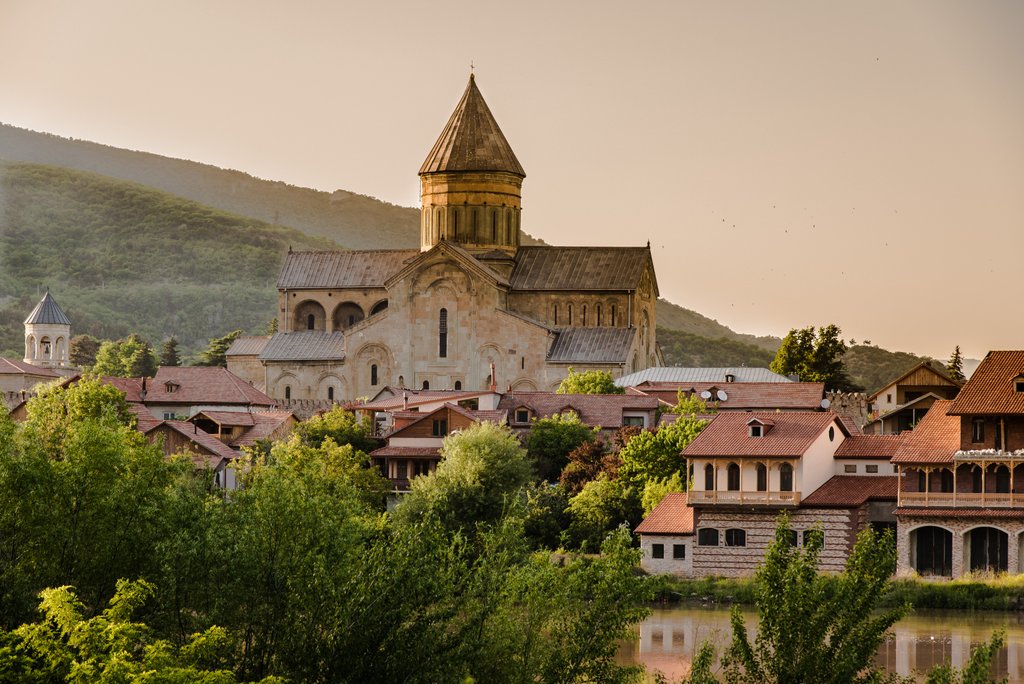
FUTURE PROJECTS: Gudiashvili Square (tdf.ge)
(tdf.ge) Gudiashvili Square and its neighboring
streets are the only place in Tbilisi, where is completely maintained
Old Tbilisi appearance. This place is especially important because Old
Tbilisian urban development style is not destroyed.
Because of its architecture Gudiashvili
square is one of the cozy and comfortable places in the city. Around
square there are 11 buildings, from which 9 has historical monument
status.
In the past, Tbilisi Development Funds
previous management was criticized from local population and
Non-Government Organizations. One of the most active NGO in this field
is “Tbilisis Hamkari” which was permanently opposed Funds activates
during years. Several protest rallies organized by “Tbilisis Hamkari”
resisted previous Fund management to destroy Gudiashvili square Old
historical appearance.
Gudiashvili square for Fund became
important after Fund management shift. Rehabilitation and reconstruction
become top priority and today with close cooperation with “Tbilisi Hamkari” square development planning process is in active phase, in
planning process are engaged professional architects and specialists in
the field.
Fund is organizing public discussions on
Gudiashvili square issue, which are transparent and all interested
parties can participate. In Tbilisi Assembly is created commission which
is working on Gudiashvili square future development concept. The
commission is led by assembly deputy Aleksandre Elisashvili.
After several meetings, participates
decided to create plan of Gudiashvili Square and its surrounding area
conservation concept. In nearest future it is planned to announce
competition on conservation concept creation, afterwards it is planned
to announce competition on conservation project.
Tuesday, February 24, 2015
CALL: JAZZ PROJECT by MANANA MENABDE in GEORGIA
Project "krimanchuly" contains masterclasses and final concert for musicians. Georgian musicians (30 people) will be chosen by professional judges. It will be held lectures and masterclasses during three months for them. The final part of project will be concert, which will be made by teachers and musicians. During the masterclasses some foreign musicians will be invited, they will make work-shops during two or three days to their listener (audience), (an hour each day, an hour will cost 200 Euro). Organization will provide guest's travel and fly expense. Organization will also provide trips and tours, visiting sightseeing, with guide and translators. Please, visit Georgia and share your experience to adults who are interested in Ethno- Jazz. Waiting with pleasure. Thank you.
Contact: lkmm@yandex.ru
Skype: mmenabde
facebook.com/Manana_Menabde
manana-menabde.golos.de
Contact: lkmm@yandex.ru
Skype: mmenabde
facebook.com/Manana_Menabde
manana-menabde.golos.de
Friday, October 03, 2014
GEOAIR: Visual Storytelling: Tbilisi Migrant Stories (geoair.blogspot.de)
(geoair.blogspot.de) This project is implemented within “Cooking Imaginations: Tbilisi Migrant Stories”
project, which addresses the issue of migrants’ lives and integration
challenges in Tbilisi. These are people who have come here within the
past decade and decided to live in Tbilisi permanently or temporarily.
However, cultural exchange and communication within “hosts” and
“newcomers” about each others’ culture is very limited, hence, some
stereotypes might prevail.
Within “Visual Storytelling: Tbilisi Migrant Stories” we are collaborating with Social Photography Caucasus Foundation, school #43 in Tbilisi - history teacher Nino Abuladze and 6 students from various grades. Schoolchildren participate in workshops, learning basics of doing ethnographic fieldwork and techniques of doing visual documentaries, with the end purpose to use art of photography and power of the image for storytelling. By visual storytelling we mean to produce images as to describe person's everyday realities that many times can not be expressed with words and may easily go unnoticed. Participating schoolchildren will create visual stories about the migrants living in their neighborhoods of Tbilisi and these stories will be presented first time parallel to the public cooking event in October.
“Cooking Imaginations: Tbilisi Migrant Stories” project is implemented with the financial support of the Prince Claus Fund.
Within “Visual Storytelling: Tbilisi Migrant Stories” we are collaborating with Social Photography Caucasus Foundation, school #43 in Tbilisi - history teacher Nino Abuladze and 6 students from various grades. Schoolchildren participate in workshops, learning basics of doing ethnographic fieldwork and techniques of doing visual documentaries, with the end purpose to use art of photography and power of the image for storytelling. By visual storytelling we mean to produce images as to describe person's everyday realities that many times can not be expressed with words and may easily go unnoticed. Participating schoolchildren will create visual stories about the migrants living in their neighborhoods of Tbilisi and these stories will be presented first time parallel to the public cooking event in October.
For more information about the project and related activities, please, visit our FB page: facebook.com/cookingimaginations
“Cooking Imaginations: Tbilisi Migrant Stories” project is implemented with the financial support of the Prince Claus Fund.
Friday, August 01, 2014
FILMPROJEKT: "Supra Paranoia". Idee von Florian Mühlfried
Im Zentrum dieses Dokumentarfilms steht ein Fremdkörper im öffentlichen Raum und die daraus folgenden sozialen Reaktionen.
Der Fremdkörper ist das georgische Bankett, genannt "supra". Fremd ist dieses Fest nur außerhalb Georgiens, als exotischer Brauch, der auf der sprichwörtlichen kaukasischen Gastfreundschaft beruht. Es geht um den Einbezug von Fremden und deren Transformation zu Freunden mittels gemeinsamen Essens und Trinkens. Die Unterhaltung wird dabei durch Trinksprüche strukturiert und von Musik begleitet.
Der öffentliche Raum befindet sich in einer von fünf ausgesuchten europäischen Städten. Es ist ein sehr belebter Raum, dessen Nutzung jedoch zunehmend eingeschränkt wird, von privaten Wachdiensten, aufdringlicher Lautsprechermusik oder unbequemen Bänken. Es geht um die Privatisierung von öffentlichem Raum und die Verdrängung problematischer Menschen. Die zunehmende Ungastlichkeit wird durch das Sinnbild von Gastlichkeit, eine reich gedeckte Tafel, hintertrieben.
Die sozialen Reaktionen gehen von dieser Tafel aus sowie von den Menschen, die an ihr sitzen. Es handelt sich dabei mehrheitlich um Georgierinnen und Georgier, die hier wohnen. Sie feiern und laden Passanten ein. Das Geschehen entfaltet sich unvorhersehbar, vielleicht treten irgendwann Ordnungskräfte hinzu.
Neben dem Geschehen stellt der Film die Orte in den Vordergrund und erzählt deren jüngere Geschichte. Auch über die feiernden Menschen wird berichtet – wer sie sind, was sie interessiert, wie sie hergekommen sind und wo sie sich sehen. Auf diese Weise entsteht ein komplexes Portrait von europäischen Städten, Menschen aus dem Kaukasus und neoliberaler Politik.
Zur Anbahnung des Films müssen fünf europäische Städte mit aussagekräftigen öffentlichen Orten sowie die Protagonistinnen und Protagonisten ausgewählt werden. Als "europäisches Projekt" kann ggf. auf europäische Geldgeber abgezielt werden. Wer Interesse an einem solchen Filmprojekt hat, möge sich bitte in Verbindung setzen mit Florian Mühlfried c/o ethno.kaukasus@gmail.com.
Labels:
Documentary,
Ethnography,
Film,
Florian Mühlfried,
Project,
Supra,
Tamada
Friday, January 03, 2014
SAVE: Help needed to locate the former German villages in Georgia (caucasusconflict.wordpress.com)
(caucasusconflict.wordpress.com) This summer 2013 we gone with CCC3 to the former German villages in the Caucasus. Most of the places and contemporary names of the former German viallages are clear, but some need to be confirmed or exactly located. In this post we ask you to help to locate some few villages in Georgia. The German villages in Azerbaijan will part of the next post.
Map: Kaukasusdeutsche Georgien
Below you find a list of the German villages with some basic information related to them. The list is in alphabetical order. Underlined are the so-called “Mutterkolonien”, i.e. the first founded places from which other colonies did emerge. Then are listed other names of the colonies and its contemporary denomination. The list contains the number of the population (F=families, P=people/persons). Then are following the coordinates and link to Wikimapia, if the exact place is known.
First you find a map with the German villages in Georgia. Inverse are the names of the villages of which the place is not confmirmed. Please note that the villages in the map and listed below are those in which Germans originating from the region of Württemberg lived. There are also other former German villages (e.g. near Sokhumi), with Germans from other origins. These villages are not of interest here.
Swabian Colonies/Villages
Alexanderdorf, founded 1918, “Mutterkolonie”, Other names: Avtochalo [?], Liebknechtsdorf, Today: თბილისი-დიდუბე [Tbilisi-Didube]), Population 1817: 23F; 1843: 36F; 1868: 44F, 239P; 1913: 790P; 1936: 879P; Coordinates 41°44’24″N – 44°47’0″E
Alexanderhilf, founded 1857 [or 1860?], resettled from Elisabethtal, Other names: Manavar (before), Rosenberg, Tschotschiani, Beshtasha, today: თრიალეთი [Trialeti]), Population 1857: 38F; 1868: 30F, 201P; 1913: 650P; 1936: 800P, Coordinates: 41°32’38″N – 44°6’28″E
TBC: Blumenfeld, founded 1905, resettled from Alexanderhilf, Other names: Blumental, Jakobli, Coordinates: it said to be near Alexanderhilf/Tsalka, but where?
Elisabethtal, founded 1818, “Mutterkolonie”, today (since 1914): ასურეთი [Asureti], Population 1818: 65F, 307P; 1843: 90F, 575P; 1868: 128F, 881P; 1886: 2440P; 1913: 2120P; 1936: 2128P, Coordinates: 41°35’30″N – 44°40’12″E
Katharinenfeld, founded 1819, “Mutterkolonie”, Other Names: Kamarlu, 1921: Luxemburg, today since 1944: ბოლნისი [Bolnisi], Population 1819: 116F; 1826: 431P; 1843: 153F, 482P; 1868: 158F, 786P; 1913: 2710P; 1936: 2713P, Coordinates: 41°27’2″N – 44°32’42″E
Marienfeld, founded 1817, “Mutterkolonie”, was later named Rosenfeld (together with Freudenthal and Petersdorf), today: სართიჭალა [Sartichala], Population 1817: 31F; 1843: 48F; 1868: 49F, 316P; 1913: 530P, 1936: 531P, Coordinates: 41°42’50″N – 45°10’22″E
TBC: Marxheim (near Marneuli), founded 1914, Population 1936: 105P, Coordinates: where is this place and how is it called today?
Neu-Tiflis, founded 1818 (?), “Mutterkolonie”, Today: Tbilisi-Kukia (suburbanized 1861), Population 1818(?): 60F; 1936: 4000P, Coordinates: 41°43’4″N – 44°48’50″E
Petersdorf, founded 1820, was later named Rosenfeld (together with Marienfeld and Freudenthal), today: სართიჭალა [Sartichala], population 1820: 17F; 1843: 12F; 1868: 21F, 149P; 1913: 300P, Coordinates: 41°42’50″N – 45°10’22″E
Steinfeld, founded 1922, Today: Kotishi, Population 1836: 95P, Coordinates: 41°31’40″N – 44°44’23″E
Traubenberg, Founded 1908, resettled from Katharinenfeld and Marienfeld, Other names: Allawar, today: თამარისი [Tamarisi]), Population 1913: 123P, 1936: 420P, Coordinates: 41°26’10″N – 44°44’36″E (is it really todays Tamarisi or the small village Alavari nearby?)
TBC Waldheim, founded 1911, Other Names: Ormashen, Bashitshet, Population 1936: 310P, Coordinates: it is said to be near Tsalka, but Ormasheni is near Dmanisi
TBC Wiesendorf, Founded 1921, Other names: Wiesenfeld, Wiesental, Marabental, Neu Marabda, Today: Akhali Marabda TBC, Population 1936: 86P, Coordinates: 41°32’2″N – 44°45’32″E
Not Clear
TBC Wiesenhof (near Asureti), Coordinates: Where is this place and how is it called today?
Left Villages
Kolonie der 12 Apostel, founded 1818; it had to be left in 1820 was was newly founded next to Marienfeld.
Non-Swabian Colonies
Freudenthal, founded 1847, Other names: Jammertal, later named Rosenfeld (together with Marienfeld and Petersdorf), today: სართიჭალა [Sartichala], population 1842: 10F; 1868: 13F, 70P; 1913: 100P; 1936: 104P, Coordinates: 41°42’50″N – 45°10’22″E
Georgsthal, founded 1910, mostly non-Swabians from the North Caucasus, but also some resettled from Katharinenfeld, today ძველი ქანდა [Dzveli Kanda] Coordinates 41°54’15″N – 44°35’57″E
TBC Gnadenberg, founded 1879, near Sokhumi, poopulation 1926: 163P
TBC Grüntal, founded 1922, other names: Neu-Grüntal, Karatapa, Karajasi, Ruisbolo (Rayon Korojazy), Population 1926: 120P, Where???
TBC Hoffnungsthal, founded 1922, other names: Karatapa, Karajasi (Rayon Karajazy), Population 1926: 92P, where???
TBC Lindau, founded 1879, where???
TBC Neudorf, founded 1879, near Sokhumi, Population 1926: 187P, where???
Please comment on any point listed above, especially those villages prececed with a TBC (to be confirmed). We will update this post with the incoming information. Any help is welcome! Thank you. (Please note: the sources which lead to the information are manifold and often even contradictous. For the sake of a clear presentation they are not listed here).
More: caucasusconflict.wordpress.com/german-villages-ccc3
Map: Kaukasusdeutsche Georgien
First you find a map with the German villages in Georgia. Inverse are the names of the villages of which the place is not confmirmed. Please note that the villages in the map and listed below are those in which Germans originating from the region of Württemberg lived. There are also other former German villages (e.g. near Sokhumi), with Germans from other origins. These villages are not of interest here.
Swabian Colonies/Villages
Alexanderdorf, founded 1918, “Mutterkolonie”, Other names: Avtochalo [?], Liebknechtsdorf, Today: თბილისი-დიდუბე [Tbilisi-Didube]), Population 1817: 23F; 1843: 36F; 1868: 44F, 239P; 1913: 790P; 1936: 879P; Coordinates 41°44’24″N – 44°47’0″E
Alexanderhilf, founded 1857 [or 1860?], resettled from Elisabethtal, Other names: Manavar (before), Rosenberg, Tschotschiani, Beshtasha, today: თრიალეთი [Trialeti]), Population 1857: 38F; 1868: 30F, 201P; 1913: 650P; 1936: 800P, Coordinates: 41°32’38″N – 44°6’28″E
TBC: Blumenfeld, founded 1905, resettled from Alexanderhilf, Other names: Blumental, Jakobli, Coordinates: it said to be near Alexanderhilf/Tsalka, but where?
Elisabethtal, founded 1818, “Mutterkolonie”, today (since 1914): ასურეთი [Asureti], Population 1818: 65F, 307P; 1843: 90F, 575P; 1868: 128F, 881P; 1886: 2440P; 1913: 2120P; 1936: 2128P, Coordinates: 41°35’30″N – 44°40’12″E
Katharinenfeld, founded 1819, “Mutterkolonie”, Other Names: Kamarlu, 1921: Luxemburg, today since 1944: ბოლნისი [Bolnisi], Population 1819: 116F; 1826: 431P; 1843: 153F, 482P; 1868: 158F, 786P; 1913: 2710P; 1936: 2713P, Coordinates: 41°27’2″N – 44°32’42″E
Marienfeld, founded 1817, “Mutterkolonie”, was later named Rosenfeld (together with Freudenthal and Petersdorf), today: სართიჭალა [Sartichala], Population 1817: 31F; 1843: 48F; 1868: 49F, 316P; 1913: 530P, 1936: 531P, Coordinates: 41°42’50″N – 45°10’22″E
TBC: Marxheim (near Marneuli), founded 1914, Population 1936: 105P, Coordinates: where is this place and how is it called today?
Neu-Tiflis, founded 1818 (?), “Mutterkolonie”, Today: Tbilisi-Kukia (suburbanized 1861), Population 1818(?): 60F; 1936: 4000P, Coordinates: 41°43’4″N – 44°48’50″E
Petersdorf, founded 1820, was later named Rosenfeld (together with Marienfeld and Freudenthal), today: სართიჭალა [Sartichala], population 1820: 17F; 1843: 12F; 1868: 21F, 149P; 1913: 300P, Coordinates: 41°42’50″N – 45°10’22″E
Steinfeld, founded 1922, Today: Kotishi, Population 1836: 95P, Coordinates: 41°31’40″N – 44°44’23″E
Traubenberg, Founded 1908, resettled from Katharinenfeld and Marienfeld, Other names: Allawar, today: თამარისი [Tamarisi]), Population 1913: 123P, 1936: 420P, Coordinates: 41°26’10″N – 44°44’36″E (is it really todays Tamarisi or the small village Alavari nearby?)
TBC Waldheim, founded 1911, Other Names: Ormashen, Bashitshet, Population 1936: 310P, Coordinates: it is said to be near Tsalka, but Ormasheni is near Dmanisi
TBC Wiesendorf, Founded 1921, Other names: Wiesenfeld, Wiesental, Marabental, Neu Marabda, Today: Akhali Marabda TBC, Population 1936: 86P, Coordinates: 41°32’2″N – 44°45’32″E
Not Clear
TBC Wiesenhof (near Asureti), Coordinates: Where is this place and how is it called today?
Left Villages
Kolonie der 12 Apostel, founded 1818; it had to be left in 1820 was was newly founded next to Marienfeld.
Non-Swabian Colonies
Freudenthal, founded 1847, Other names: Jammertal, later named Rosenfeld (together with Marienfeld and Petersdorf), today: სართიჭალა [Sartichala], population 1842: 10F; 1868: 13F, 70P; 1913: 100P; 1936: 104P, Coordinates: 41°42’50″N – 45°10’22″E
Georgsthal, founded 1910, mostly non-Swabians from the North Caucasus, but also some resettled from Katharinenfeld, today ძველი ქანდა [Dzveli Kanda] Coordinates 41°54’15″N – 44°35’57″E
TBC Gnadenberg, founded 1879, near Sokhumi, poopulation 1926: 163P
TBC Grüntal, founded 1922, other names: Neu-Grüntal, Karatapa, Karajasi, Ruisbolo (Rayon Korojazy), Population 1926: 120P, Where???
TBC Hoffnungsthal, founded 1922, other names: Karatapa, Karajasi (Rayon Karajazy), Population 1926: 92P, where???
TBC Lindau, founded 1879, where???
TBC Neudorf, founded 1879, near Sokhumi, Population 1926: 187P, where???
Please comment on any point listed above, especially those villages prececed with a TBC (to be confirmed). We will update this post with the incoming information. Any help is welcome! Thank you. (Please note: the sources which lead to the information are manifold and often even contradictous. For the sake of a clear presentation they are not listed here).
More: caucasusconflict.wordpress.com/german-villages-ccc3
Labels:
Blog,
Bolnisi,
Caucasus Conflict Culture,
German Villages,
Germans,
Project
Friday, July 12, 2013
PROJECT: Please support "Georgian ABC book" by the Photographer Natela Grigalashvili (kisskissbankbank.com)
Georgian ABC book from Natela Grigalashvili on Vimeo.
(kisskissbankbank.com) The idea of ABC Book was born when I was working on Open Society Documentary Photography Project. The theme was the life of Georgian village. A word and a photo are united in the project but the photo is not the direct illustration of the word. Dawn, sky, , "sheni chiri me" ("I love you so much, you are so dear to me that I want to shoulder your woes") these are the words which is often used by these people and represents the part of their lives.
Here is the fabulous Photo Blog by Natela Grigalashvili natelagr.blogspot.de
I was born and raised in a Georgian village and this is the main theme of my photos. In Georgian villages we can see very tensely what the country underwent in the recent past. During the last 20 years Georgia has been through three wars. This is a country with almost half of million refugees, uneven social environment and unemployment. There is especially hard situation in the villages. But despite this the people who live there beautifully carry on their traditions, kindness and simplicity. They live simply, plant and garden, fall in love, get married and never loose hope. They never loose the joy of life and the sense of humor. I think we can learn much from these people. If I have a chance with the help of KissKissBankBank, I will continue work to finish this project and publish the book. I will be very thankful if you help me to finish the project.
![]() |
| Russian family. Marneuli |
Biography: Natela Grigalashvili is a Tbilisi based professional photographer and a chronicler recording the life of the normal people in the country with her camera. She is concerned with documenting the way of living that has endured until today. She grew up in the rural environment and is very familiar with the way of people’s living there. Natela photographs her relatives, friends and simple people, who enjoy their basic life, sometimes full of happiness, sometimes burlesque. Natela Grigalashvili participated in solo and group exhibitions: ABC Book (2012), Definitions (2011), My village, Bookhouse, Tbilisi Dysfunctional Country (2004), Guest Ateliers (2003) etc.
Homepage: natelagrigalashvili.ge
Labels:
Georgia,
Georgian,
Natela Grigalashvili,
Photographer,
Photography,
Photoreportage,
Project,
Support,
Video,
vimeo
Thursday, June 20, 2013
PROJEKT: Apfelsaft aus Georgien. Von Charly Schmarn (ethicfinance.net)
(ethicfinance.net) "Hier eine kleine Geschmacksanregung mit sozialem Aspekt in Georgien, vielleicht interessiert es Euch:
2011 startete ein „sozialökologisches und unternehmerisches Jugendprojekt“ an der Grenze zur Konfliktzone mit Russland, in dem kleinen georgischen Dorf, Sobissi. Es wurde mit Jugendlichen Apfelsaft produziert. Das Ziel war es, den Jugendlichen des Dorfes über die frustrierende wirtschaftliche Realität hinaus zu zeigen, dass es möglich ist, etwas zu unternehmen. Mit einem Praxisbeispiel, dem Aufbau einer kleinen Apfelsaft-Kelterei und der Herstellung von Apfelsaft, sollten den Jugendlichen wirtschaftliche Perspektiven aufgezeigt werden.
Im Jahr 2012 wurde eine Jugendgenossenschaft gegründet und 10.000 Flaschen produziert, die im "Bioveli" Laden in der Gazapkhuli Straße 16, sowie jeden Samstag bis 16 Uhr auf dem Biomarktstand von Jean-Jacques Jacob in der Paliashvili Straße beim Gegeshidze Platz erworben werden können.
Bei Interesse findet man weiter Informationen auf der Internetseite: www.ethicfinance.net oder bei Facebook: www.facebook.com/Sobissuri.
Direkte Fragen können an sobissuri@gmail.com gesendet werden.
Labels:
Charly Schmarn,
Development,
Economy,
Food and Wine,
Georgia,
Juice,
Project,
Youth
Monday, November 05, 2012
SOVIET TBILISI: In 2011 Soviet Past Research Laboratory is working on the project “Soviet Tbilisi” (sovlab.ge/en)
A new virtual tour – Soviet Tbilisi – will be developed within the
project. The tour will include up to 20 architectural sites, places or
events connected with the history of Soviet Tbilisi depicting Soviet
lifestyle. The tour will also be placed on the web-site of Soviet Past
Research Laboratory.
The publication “Red Terror Topography” will be issued within the scope of the project. Essays of Georgian authors purposefully written for this collection will be included in the publication.
The project is funded by the Institute of International Cooperation of German Public Universities Association (DVV International).
Web:
sovlab.ge/en
Labels:
History,
Lasha Bakradze,
Project,
Research,
Soviettimes,
SOVLAB
Wednesday, October 24, 2012
AWARD: Documentary Photography Project: Winners Announced (eurasianet.org)
(eurasianet.org) OSF’s Documentary Photography Project recently announced the winners of the 2012 Production Grant for photographers from Central Asia, the South Caucasus, Afghanistan, Mongolia, and Pakistan.
Inna Mkhitaryan’s project looks at the underlying economic, social, and psychological factors that give rise to human trafficking in Armenia and seeks to challenge the stigma against trafficking victims who are often blamed for their own plight.
Arthur Lumen Gevorgyan’s project on the human costs of landslides in Armenia addresses government negligence toward people who live in landslide zones. To help policy makers plan for and prevent disasters in the future, Gevorgyan will provide visual documentation detailing how people who live in landslide zones are affected.
Sitara Ibrahimova’s project will call attention to the practice of selective abortions of girl fetuses in Azerbaijan, which reflects a prevalence of gender inequality and discrimination against girls and women that persists in much of the region.
Elyor Nematov’s project focuses on the severe living and working conditions that migrant laborers from Kyrgyzstan face when they seek better economic opportunities in Russia.
Dina Oganova’s project on Roma communities in Georgia will portray the everyday life of Roma women with the goal of dispelling stereotypes about, and intolerance for, the Roma community.
Daro Sulakauri’s study of the Samtske-Javakheti region of Georgia will look at both the ethnic Armenian and Georgian communities of this historically isolated, tense area.
Darya Komleva’s project seeks to challenge stereotypes of people with disabilities in Kazakhstan by profiling the daily lives of children with disabilities and their families, as well as their experiences with alternative education programs.
Fraidoon Poya will address the rampant problem of suicide through self-immolation in Afghanistan. An issue that is well known but considered taboo, this project will allow for a more complete understanding of why women attempt suicide in this region and what happens to them after so as to prompt much-needed dialogue and change.
Fardin Waezi’s project will portray the resilience of Afghan civilians after decades of war by providing a unique view into the varied experiences of people in Afghanistan.
For more on the winners, other ongoing and archive photo projects, and Moving Walls, visit: the OSF Documentary Photography Project Web site.
More to the project: oseweb.org
Thursday, August 09, 2012
CALL: Stories & Essays On Your Life Experiences Here In Georgia
Tatjana Montik would like to publishing a book about Georgia ... please send her articles for her project or made contacts for this ...
Dear megobarebo,
Dear megobarebo,
who of you is interested to contribute your stories/essays on your life experiences here in Georgia?
I am working on a book project, where expats share their attitudes and life experiences about living here.
Possible topics could be as follows:
• Certain aspects of life in Georgia (eating and drinking habits, special events like weddings, funerals and holidays; friendships, marriages, divorces, etc.),
• Certain places the author has visited, which were a special and unforgettable experience,
• Certain specific situations of daily life, which the author experienced and which was funny/sad/strange due to cultural differences between the author and his/hers Georgian counterparts.
| Rechts: Tatjana Montik |
Please don’t hesitate to forward your stories. I am convinced that Georgia needs book (or maybe even more?) like this.
I am also looking for a good translator from Russian into English to work on this project. Unfortunately this job can be paid only after I find some sponsors to support this project. In order to do so I need some more sample stories in addition to those I already have.
Hoping to get your responds very soon,
Tatiana Montik
Labels:
Book,
Essay,
Georgia,
Project,
Stories,
Tatiana Montik,
Travelogue
Location:
Georgien
Tuesday, June 26, 2012
WEBDOKU: Klanglandschaften. Upload from Urban and Natural Sounds zwischen 20. Juni und dem 10. Juli (arte.tv)
Sehen Sie die Weboku auf klanglandschaften.arte.tv.
Für diese „Wiederausstrahlung“ laden wir Sie ab jetzt dazu ein, an unserem „Klanglandschaften“ Wettbewerb auf Soundcloud teilzunehmen. Hören Sie genau hin, nehmen Sie die Töne in ihrer Umgebung auf und teilen Sie sie mit uns!
Eine Jury, zusammengesetzt aus Ton und Bildexperten, wird den originellsten Klang bestimmen. Zu gewinnen gibt es:
-Für den/die Sieger/in: ein Olympus LS-5 Aufnahmegerät + den dazugehörenden Antiwind Vorsatz „Windjammer“
-Der Publikumspreis wird zudem jene drei Klänge auszeichnen, die von den Usern am häufigsten als „Favoriten“ auf Soundclound genannt wurden. Die drei Gewinner erhalten Einkaufsgutscheine in der Online-Boutique LPO
Was muss ich tun, um zwischen dem 20. Juni und dem 10. Juli teilnehmen zu können?
1. Nehmen Sie Töne in den folgenden auf der Webseite
klanglandschaften.arte.tv erscheinenden Themen auf:
In der Landschaft „Stadt“: Verkehr, Summen, Park, Kulturerbe Ton
In der Landschaft „Vorstadt“: Sonntagslaute, Gezwitscher, Pause
In der Landschaft „Natur“: Am Fluss, Lagerfeuer
In der Landschaft „Einsiedelei“: Ihre Stille
Laden Sie die Klänge auf Ihr Soundcloud-Konto.
Wie lade ich Klänge hoch?
- Sie können den Ton mit Ihrem Smartphone aufnehmen und ihn mit der Soundcloud App einfach hochladen.
- Sie können den Ton ebenfalls mit einem Aufnahmegerät speichern und dann einfach auf ihren Computer und die Webseite soundcloud.com laden.
- Ihr Ton darf nicht länger als drei Minuten sein.
- Ihr Ton muss auf einmal aufgenommen worden sein und darf keine Schnitte enthalten
- Sie dürfen keine Musik aufnehmen
- Jeder Teilnehmer darf maximal nur 20 Töne abschicken
2. Um Ihren Ton zu benennen, verwenden sie folgende Namensgebung:
Klanglandschaften ARTE/ONF – [Themenname]: Titel
Beispiele: „Klanglandschaften ARTE/ONF – Park: Vogelgezwitscher“ oder „Klanglandschaften ARTE/ONF – Summen: Müllabfuhr am frühen Morgen“
NB: Eine zusätzliche Beschreibung ist nicht notwendig, aber willkommen, damit wir ein bisschen mehr darüber erfahren können, wo und warum sie Ihren Klang aufgenommen haben.
3. Fügen Sie Ihren Klang in die Soundcloud Gruppe von „Klanglandschaften“ ein:
soundcloud.com/groups/cologie-sonore-partage-de-sons
Die kompletten Teilnahmebedingungen finden Sie hier.
Haben Sie Fragen? Dann stellen Sie sie uns auf unserer Facebook Fan-Seite oder auf unserem Twitter-Account. Ein frohes Zuhören und viel Glück!
Labels:
ARTE,
Caucasus,
Documentary,
Nature,
Oecology,
Project,
Sound,
Soundcloud,
Urbanism,
Webprojects
Tuesday, January 10, 2012
LOOKING FOR FUND: MARIA AND THE OCEANS by Natalie beridze/tba and Uta Bekaia
Leipzig, 2004: Wee invited Tusia Beridze and Nika Machaidze to Germany for playing their music and sounds during our festival OFF EUROPA (bfot.de). It was amazing! It was for me the first real contact with Tusia and Nikakoi. Later I followed their artwork. There was some concerts in Germany too ... together with Gudrun Guth (www.m-enterprise.de) for example... And some years ago I could meet the people for our small film for the German TV (MDR) in Tbilisi again. (VIDEO: youtube.com)
Now I will support the new project by Natalie Beridze and Uta Bekaia. AND otherwise I recommend in facebook, twitter and in other virtual places all my friends and people to do the same for this good artists - to getting find funds!! Also a small FUND can help to realize the PROJECT: MARIA AND THE OCEANS by Natalie beridze/tba and Uta Bekaia - A Music project in New York, NY by Paata U. Bekaia
ABOUT THIS PROJECT:
"Maria and the oceans" is a music album, of 13 songs, produced by electronic music producer, composer and singer Natalie Beridze/TBA and a multimedia artist and costume designer Uta Bekaia.
This project is a long-distance collaboration between New York and Tbilisi, Georgia, which was basically created via internet. Natalie produced music and prepared the arrangement in her studio and later sent it to Uta, to NY. they worked on lyrics separately and combined them like a patchwork afterwords. in the end Uta recorded vocals and sent them back to Natalie in Tbilisi for mixing.
"Maria and the oceans" is a multimedia project, consisting of music, music videos (director Nika Machaidze) and costumes (by Uta Bekaia), which are going to be created and used exclusively for videos, cover artwork and future live performances.
The album is ready in terms of music. we need funds for shooting TWO VIDEOS, that will come along with the album.
We've chosen a visionary Georgian director and musician Nika Machaidze (nikakoi), who we've worked with many times before. We're very much hoping to receive support.
Source: kickstarters.com
Labels:
Art,
Art Club Caucasus International,
Call,
CD,
Experimental Music,
Fund,
Georgian,
Music,
New York,
Nika Machaidze,
Nikakoi,
Project,
Tusia Beridze,
Uta Bekaia
Friday, July 30, 2010
EXHIBITION: Joanna Warsza - Frozen Moments Architecture Speaks Back - in Tbilisi
Research & LeisureJuly 22–25, 2010, Tbilisi, Georgia
Public Opening: Art, architecture, talks, concerts, field trips, and more
Artists, academics, architects, curators, economists, and residents of Tbilisi in a context-responsive summer art project in the time between the former Ministry of Highways of the Soviet Republic of Georgia and the future headquarters of Bank of Georgia:
Vahram Aghasyan, Ayreen Anastas, Ei Arakawa/Mari Mukai/Gela Patashuri/Sergei Tcherepnin, Ruben Arevshatyan, Bettina Atala, Daniel Baumann, Alena Boika, Rene Gabri, Bouillon Group, Daniel Birkenmayer, George Chakhava, Josef Dabernig, Kote Jincharadze, Didier Fiuza Faustino & Mathieu Herbelin / Mésarchitecture, Yona Friedman, William Hollister, Zurab Jalaghania, Nana Kipiani, Eva Khachatryan, Agnieszka Kurant, Vicki Lee & Next Dreamhacker / Accidental Lover BoyZ, Nikolozi, Nini Palavandishvili, Lali Pertenava, Richard Reynolds, Georg Schöllhammer, Slavs and Tatars, Sophia Tabatadze, Nienke Terpsma & Rob Hamelijnck / Fucking Good Art, Wato Tsereteli, Urban Research Lab: Gio Sumbadze, Ani Chorgolashivili & Rezo Glonti, Greg Lindquist, Tamuna Karumidze, Neli Zedgenidze & Koka Ramishvili; Urban Reactor, Jan Verwoert & Melinda Braathen, Vladimir Volnovik, Aleksandra Wasilkowska, Martin Zet
A project by Joanna Warsza
The Caucasus speaks with frozen moments. With the fall of the Communist regime, trains stopped mid-route, the cable car over one of the canyons of Tbilisi was abandoned halfway, and the housing estates of the never realized future in Mush found temporary settlers. The heritage of Soviet architecture in the region has revealed its anticipatory potential of multiple secondary uses, creative economies, and the sustainable and self-organizing policies parallelly present in the cultural discourse nowadays. The Former Ministry of Highways of the Soviet Republic of Georgia, erected in 1975 by architects George Chakhava (1923–2007) and Zurab Jalaghania is one of the most stunning buildings in the world. An example of a realized utopia (a utopie réalisable), it has been productive of an augmented reality, blending the image of the future under Communism with organic, palimpsestic architecture and the concepts of a continuous, non-master-planned environment. This three-day residency of Caucasian and international artists, architects, curators, academics, and of the Tbilisi public will offer rich and fascinating sessions of research and leisure around the multiple variations of this heterotopic place. The program includes talks, workshops, art and architecture, concerts, field trips, and roof parties. The point of departure refers to the poetics of frozen images, with its inherent potential of past and future meanings — whether the legacy of modernism, a moving and walking city, plug-in concepts, ‘back-to-the-future’ policies, and much more. For three days in July this fantastic building will become a diagram for various horizontal contributions, where one spontaneous act may radically change the project. This will also be the only public opening of the building before its renovation as the future headquarters of the Bank of Georgia. Come join us in Tbilisi!
more: geoair.blogspot.com
Labels:
Architecture,
Art,
Joanna Warsza,
Project,
Tbilisi
Sunday, July 25, 2010
NEW BLOG: Baku in the 21th century - describing urban changes (urbanchange.wenedeux.com)
Now I descovered an blog about Baku with photos etc. Sebastian Burger published a book about this city on the caspian sea there. more here: urbanchange.wenedeux.com(...)
Info und Bestellung zum Buch "Baku - Stadt der schlagenden Winde" >>>
Nachdem das ASA-Projekt „Describing urban changes in Baku [2008]“ für unsere Vorgänger Oriana Kramer und Sebastian Burger so erfolgreich verlief und die Resultate unter anderem in einigen Ausstellungen und in ihren Abschlussarbeiten einflossen, sollte es ein Nachfolgeprojekt unter gleichen Namen geben – aber unter etwas anderen Aspekten.
Das diesjährige Team besteht aus dem Studenten der Stadtplanung Michael Kraus (ISR, TU Berlin) und dem Fotografen Jens Kramer. Seit Juni 2009 sind wir nun in Baku aktiv.
Unser Ziel ist es einerseits einen auf Foto und Video basierenden Überblick über die städtebauliche Entwicklungsphasen Bakus zu geben und andererseits die spannungsträchtige Thematik mit Emotionen der Bewohner Bakus zu untermalen. Dabei wollen wir durch Interviews vor allem ihre Gedanken und Empfindungen in dieser von städtebaulichen Wandel und Brüchen geprägten Stadt einfangen.
Die Ergebnisse des Projekts möchten wir in verschiedenen Medien präsentieren. Derzeit denken wir über eine interaktive Onlinepräsentation nach, aber auch multimediale Ausstellungen (Fotografien auf Paper, Film auf Monitor) und eine Publikation in Buchform können wir uns vorstellen.
Einige fotografische Arbeitsproben der vergangenen Projektwochen werden wir hier in den kommenden Tagen präsentieren. Also dran bleiben!
Labels:
Architecture,
Azerbaijan,
Baku,
Blog,
Project
Wednesday, June 23, 2010
PROJEKT: Politische Transformation im postsowjetischen Aserbaidschan: eine historisch-institutionalistische Analyse (madoc.bib.uni-mannheim.de)
Political Transition in Post-Soviet Azerbaijan: A Historical Institutionalist Analysis
Babajew, Aser
pdf-Format: Dokument 1.pdf (12.389 KB)
Das Projekt versucht, im Rahmen des historisch-institutionalistischen Analyserasters die politische Transformation eines postsowjetischen Systems am Beispiel Aserbaidschan zu erklären, insbesondere die Persistenzlogik sowjetischer Institutionen weit über den Kollaps des Sowjetsystems hinweg.Die Fragestellung wurde vor allem durch verbale Datenerhebung, Beobachtung und qualitative Inhaltsanalyse untersucht. Das wichtigste Ergebnis dabei ist die Einsicht, dass es analytisch sinnvoll ist, beim politischen Transformationsprozess neben der Unterscheidung zwischen formellen und informellen Institutionen auch zwischen neuen und alten Akteuren, die vor allem Träger der informellen Institutionen sind, zu differenzieren. Hinzu kommt, dass die informellen Institutionen, die sich kurzfristigen Umwälzungen entziehen und vielmehr mit der gesellschaftlichen Gesamtentwicklung inkremental wandeln, für politische Transformations-Outcomes viel maßgeblicher sind als die formellen.
Kurzfassung in Englisch:
The project tries to explain within the historical-institutionalist analysis framework the transition of the post-Soviet political system in Azerbaijan, in particular the logic of the persistence of soviet institutions far beyond the collapse of the soviet system.The research question is examined mainly by verbal data collection, observation and qualitative content analysis. The most important result thereby is the insight that it makes analytically sense, to distinguish during periods of political transformation, in addition to the differentiation of formal and informal institutions, between new and old actors (as bearer of informal institutions) as well. Moreover, the informal institutions resisting short-term upheavals and changing rather incrementally with the societal overall development are much more decisive for political transition outcomes than the formal ones.
Lizenz: Veröffentlichungsvertrag für Publikationen
Labels:
Analysis,
Aser Babajew,
Azerbaijan,
Experts,
History,
Politics,
Post-Soviet,
Project,
Transition,
University
Monday, December 28, 2009
TEXT: RUINS OF OUR TIMES. By Joanna Warsza / Laura Palmer Foundation / Warsaw
The text will be published in Team Network magazine and in Obieg on-line.
Georgia and Armenia are full of landscapes of frozen moments. With the fall of the Communist regime, the trains stopped n mid-route, the cable car over one of the cnyons of Tbilisi has been abandoned halfway, and the housing estates of the never realized future found temporary settlers. Tracing the unwanted heritage of the Soviet past in the Caucasus, at times I had a strange sense of witnessing the future. The self-organized methods adopted in the years of post-collapse crises recall the most progressive contemporary theories of bottom-up structures and participatory urban planning: the cinema-theater Rossia in the middle of Yerevan found a secondary use as a market and mini-bus station, the never completed city of Gyumri in Armenia was finished by the motivated settlers themselves, the mikro-raion estates in Tbilisi have expanded with new parasite parts called kamikaze loggias. The Caucasus, following a process of Eastern Bloc Westernization, is fortunately still full of heterotopias, stunning ruins of our own age, and of self-organizing policies that tend to be forgotten in a time of ‘euroremonts’, and ‘Eurenovations.’
Ruines of the future, never accomplished project builidng, Mush, Armenia
FROZEN MOMENTS
On the western outskirts of Tbilisi one encounters a thrilling Caucasian picture. A cable-car supposed to link the unfinished University campus with the metro station was stopped at the very second the Soviet system collapsed in 1991. Since then it has been hanging in the air over a picturesque canyon, abandoned in the middle of its route, above the heads of people passing down in the valley who no longer even notice it. The Caucasus, with its tremendous landscapes, is full of this phantom heritage, when the Socialist reality became the past, when the world stopped and started again.
Coming myself from a post-Communist (though not post-Soviet country), I have been witnessing since 1989 how quickly the former Eastern Bloc, and Poland in particular, has been cleaning up its past. Westernization, pro-euroatlanticism and procapitalism (‘once Moscow, Brussels today’ policy), have become the new and only format for life. Georgians and Armenians have a good term for this phenomenon — the euroremont (‘eurenovation’). The Poles have performed especially well: we still live in the same housing blocks, but they were immediately repainted and wrapped in polystyrene, the streets were filled with endless early-capitalist vendor kiosks, and later with huge billboards and all sorts of advertising campaigns. Social Realist architecture in the big cities was quickly transformed, covered up, or lifted in order to be a part of a new narrative.
One of the very few examples of Polish Socialist Realist decay was the 10th-Anniversary Stadium in Warsaw. Built in 1955 from the rubble of a war-devastated city, it was to preserve Communism’s good name for forty years. In the early 1990s it fell into ruin, being at the same time “revived” by the Vietnamese intelligentsia and Russian traders, pioneers of capitalism, who established an open-air market. It became the only multicultural site in the city, a storehouse of biographies and urban legends, a piece of Land Art, a workcamp for anthropologists, botanists and archaeologists. It was in fact the one and only heterotopic zone in central Warsaw, free from the unwritten laws of westernisation and euroremonts.
KAMIKAZE LOGGIAS AND SELF-ORGANISED MICRORAYONS
The Georgian and Armenian situation was different. The Russians went home, but left behind their utopian infrastructures in the former republics. People started organically responding to the changes through a particular, self-organised relationship to the architecture. A refusal of the dominant structures, the provisional liberty, and scepticism as to all master plans led to participatory forms in the urban environment. Emergent movements started to occur, especially in the “microrayons” — the large-scale social-housing projects developed throughout the entire former Soviet Union, as well as in Vietnam and in Eastern Europe. A “microrayon”, or microdistrict, was initially supposed to be a self-sufficient unit affording its inhabitants comfort and the pleasure of living, thus realising Le Corbusier’s utopia of the collectivity and harmonious cohabitation through architectural and social engineering. If this happened it was not through a masterplan, but initiatives from the bottom-up.
At the beginning of the 1990s many owners of a block apartment would hire an engineer to design an extension to their home. This whole new parasite part, called a kamikaze loggia, would grow out one side of the building, expanding the living space. This was nothing new for Georgia; palimpsest structures and extensions have always been a commonly applied method of expanding a living surface in this country located on steep Caucasian slopes. One has to remember that Georgia was the “honey of the USSR” — the richest state, with quite oversized and representational houses. In the dark and poor Shevardnadze years after the fall of Communism, the extensions continued, even using found scrapmetal or other cheap materials of all kinds.
THE NON-EXISTENT MINISTRY OF A NON-EXISTENT COUNTRY
The Georgian palimpsest spirit is perhaps best reflected in an icon of Caucasian architecture, the former Georgian Ministry of Highways, (საქართველოს საავტომობილო გზების სამინისტროს შენობა) built in 1975 by architect George Chakhava, since last few years bought by a bank and standing empty, overgrown with vegetation. This fascinating building was meant to stand in harmony with the mountain villages. The structure consists of a monumental grid of interlocking concrete forms, five horizontal parts of two storeys each seeming to stand on top of each other.
The design is a reference to the concept of Ville Spatiale by Yona Friedman, who didn’t want to displace the city, but to raise a second city twenty meters above the existing one. Chakhava’s other reference was also a forest, with the cores as the trunk and the horizontal parts as the crowns, so as to provide a lot of free space for other living beings and nature. The former Ministry on Gagarin street also brings to mind the work of the Japanese Metabolists, whose flexible, and expandable structures built in the 1960s evoked processes of organic growth. With its unrealistic and multi-extensional structure, the building seems to be an unintended tribute to the most recent, early-capitalist architectural changes in the urban environment of Tbilisi, but carrying a long tradition of self-built palimpsests.
BACK TO THE FUTURE
Staying for two months in Georgia I sometimes had a strange sense of witnessing the future. The self-organized methods adopted in the years of crises after the collapse of the USSR recall the most progressive contemporary theories of bottomup structures and participatory urban planning. The Chilean architect and theoretician Alejandro Aravena created Elemental, a “do-tank” combining art, architecture and engineering, understanding the city to be a resource for building social equity. His statements, considered visionary, about buying half a house and filling the other half with years, are a kind of selffulfilling prophecy in Caucasus. People don’t ask themselves the developer-like question, “Where would you like to live?” but rather how to organize the city from its successive layers.
A project awarded a Golden Lion at the last Venice Architecture Biennale, The Afterlife of Buildings by Grzegorz Piatek and Jarosław Trybus, pictured an apocalyptic secondary use for famous Polish properties: a Warsaw airport terminal would be turned into a chicken farm, a Norman Foster building into a prison, or a financial centre into a crematory. Applying both theories the Caucasus could move ahead, full of secondary uses. One could cite the Yerevan cinema-theatre Rossia, build in 1979 as a youth palace, sports and concert complex, and museum, now turned into a huge market in the former screening rooms and hallways and a busy mini-bus station.
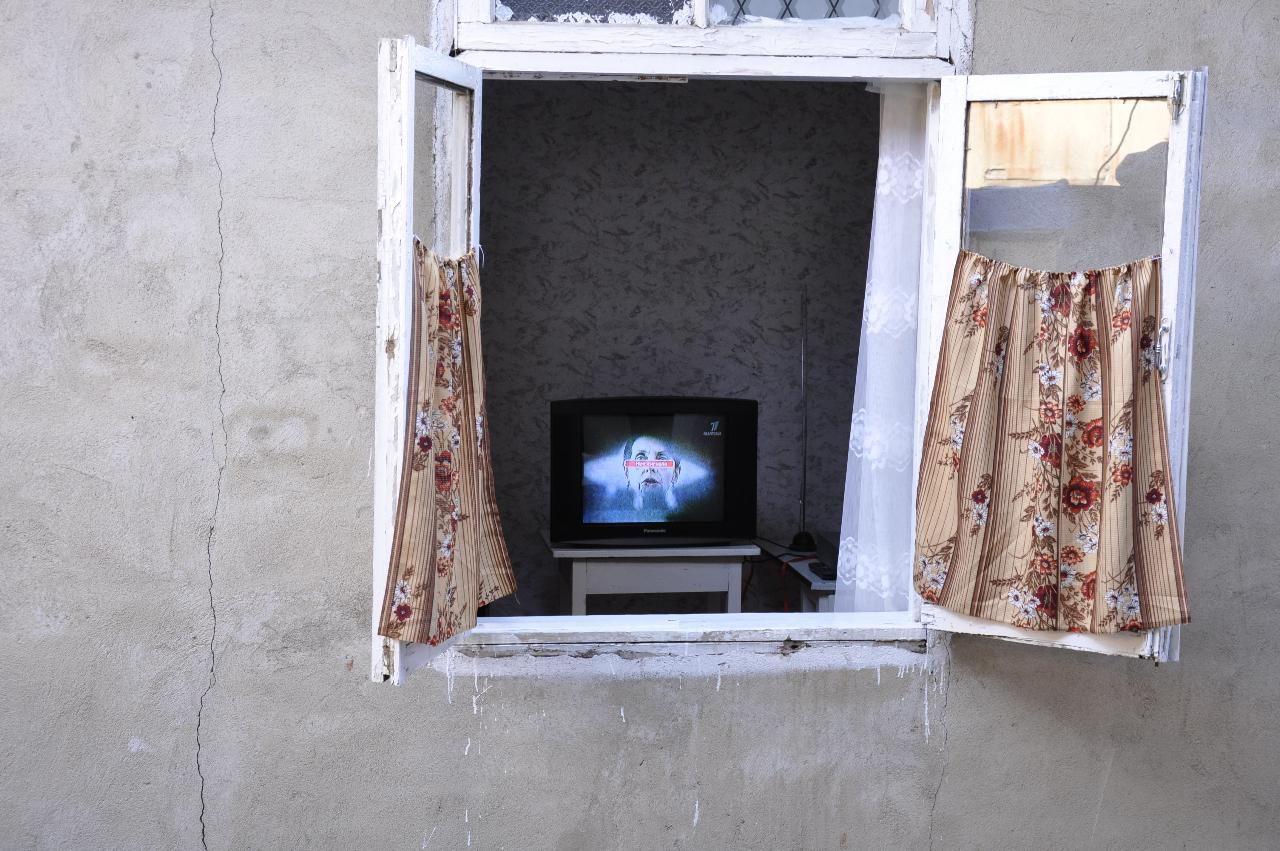
Some Caucasian artists have a great intuition of how to grasp these fantastic reality shifts. For more than ten years Georgians had no more than two hours of electricity per day — what they now call the dark years. Back then some foreign-channels were illegally broadcasting on Georgian channels frequencies. As a result two logos appeared on the screen and the quality of transmission was sometimes interrupted, bringing the image to a standstill. Rusiko Oat, a curator and the owner of the New Art Cafe in Tbilisi made an artwork resulting from the infamous electricity cuts. No Signal was an image created, as she puts it, by electro-waves. On the screen there suddenly appeared a dramatic image of the face of an old lady superimposed on a commercial and captioned with the mysterious Russian inscription Niet signala. In the logic of media marketing, this was a kind of electronic magic, allowing for one’s own interpretation of the neo-now, quite remote from the original idea of an advertising spot and bearing fantastic information.
Two Amsterdam-based artists, Rosell Heijmen and Lado Darakhvelidze, one Dutch, the other Georgian, mapped the city of Tbilisi through its endless marschrutka lines. Marschrutkas are the minibuses that serve as a means of public transport. Anyone can start a new line in a second-hand mini-van brought over from Germany. There are over 200 marschrutka tours in the city and even more in the countryside. Because they stop everywhere, they have an advantage over other public transport (regular buses and electricity have been in service only since the advent of the Saakashivili regime) but are forbidden on the main avenues. After the Rose Revolution, most of the squares and street names were changed, but the marschrutkas signs kept the old ones written in the Georgian alphabet. As a result only the citizens of Tbilisi have knowledge of where a marschrutka is heading. The destination signs somehow tell the recent history of the city. Heijmen and Darakhvelidze produced a marschrutka map in English, seeing the mini-vans as vehicles taking one back in time, letting the non-Georgian find her way, to translate the past and the present and grasp a specific reality of the city. The wide avenue leading from the airport to downtown is named after George W. Bush, and prior to his visit all the facades had been repainted and touched up only from the front side.
Sophia Tabatadze, a Georgian artist based in Berlin, has been observing the changes in post-Soviet Georgia following the transformation of one of these Tbilisi blue facades. She documented the changes on a building between 2003 and 2008. In In a Country with a Flourishing Democracy, even Plastic Flowers Will Blossom, she depicts how, while Georgia has been rushing from one system to the other, this facade has been quickly adapting and making itself look more and more European.
GHOST CITY
Gyumri is the second largest city in Armenia and suffered a terrible earthquake in 1988. In order to help those who lost their homes, the Soviet Government decided to build a new residential area called Mush, after the name of one of the Armenian cities from the Turkish genocide of 1915. The new Mush was supposed to be a large social-housing project adjacent to Gyumri. Construction began in 1988 but was never completed because of the fall of Communism in 1991. Mush stands in the middle of the fields as an unfinished city, with blocks, administration buildings, and playgrounds. The city has been left at mercy of time and weather and politics. It takes ten minutes by taxi to get there from the centre of Gyumri. A few buildings were completed by the motivated settlers themselves, who made up the variously styled windows or doors, quite often out of materials found in neighbouring empty houses. Walking through Mush one experiences a special aura. It might be a never realised “radiant future”, the obscure and difficult Armenian past, a menace of global catastrophe to come, a promise of a secondary use. Mush might recall the idea of the ‘transition towns’ created in Ireland with the aim of equipping communities for the challenges of climate change and peak oil. The chosen communities try to live in a sustainable manner and build local resilience in the near future, trying to reduce the energy use and increase their own self-reliance by repairing or re-using the old items rather than throwing them away.
Mush was brought to the arts and to public debate by Armenian artist Vahram Aghasyan who photographed the site for several months. In his thrilling series Ghost City from 2006-on going he observes the silent Mush and shows other possible scenarios to come, such as a gigantic deluge echoing the Great Flood from the Bible, which took place not far from there. In the totality of his work, as in Ruins of Our Time (deserted bus stops from the 1960s), or Ruins of Private Property (the demolition of an illegal gated community near Istanbul), he profoundly analyses the cultural and socio-political changes in Armenia through images of spectacular contemporary remnants and post-Soviet entropy.
A DERVISH ONCE SAID: BETWEEN WESTERN ALIENATION AND EASTERN SUBMISSION I’LL TAKE: A BATH*
One main critique of Edward Said’s Orientalism was that he had only examined the relations of the first and the third world, omitting the complex and never discussed hierarchical structures within the second world, meaning Eastern Europe or Euroasia. The international collective Slavs and Tatars (Kasia Korczak, Payam Sharifi, Boy Vereecken, and Victoria Camblin) takes a great lesson of emancipation from out of the culture of less visible nations and countries between the east of the former Berlin Wall and the west of the Great Wall of China, focusing on the sphere of influence shared by Slavs, Caucasians and Central Asians. Their books and installations combine scholarly research with pop culture, urban legends, their own experiences, and postcolonial studies. Their last art book Kidnapping the Mountains, addresses the complexity of identities, languages, stories and time in the Caucasus. Their previous publication, A 13th Month Against Time, was inspired by an old form of the Jalali calendar, used by the Zoroastrians and still in use in Iran and Afghanistan. Originally, in the 11th century, it added an additional month every six years. Slavs and Tatars published a calendar of the 13th month with 32 days (or pages) as a libretto of reflections on the defeatist approach to time. Their art-based research, rooted in critical theory and glamour, goes against both the superiority of Western gaze and exploration and Eastern Westerncentrism.
The Tbilisi performative-art Bouillon Group also act as selfproclaimed anthropologists, taking non-questioned culture elements as material for their artwork and seeking to reveal the conflict between comfort and nonconformity. The artists created a descriptive deconstruction of a figure of Mother Georgia, an aluminium statue overlooking Tbilisi erected in 1958 (similar ‘Mothers’ were then erected in Armenia, Ukraine and Russia), meant to protect the country. Mother Georgia holds a bowl of wine to greet those who come as friends, and a sword to defend herself from enemies. Bouillon saw the statue as a hermaphroditic and ambiguous figure, a product of Georgian circumstances.
FORMER WEST
After the long and effective process of self-applied Westernisation by many Central European countries, we now hope to witness the coming out of a cognitive East. The Warsaw Museum of Modern Art is leading a complex research project to rewrite an European art history not only with Western names, but identifying with our part of Europe. For Charles Esche, a critic and director of the Van Abbemuseum in Eindhoven, the Netherlands, to be Western stands for being short-sighted and lacking the openness and tools to experience things in their plurality. Together with several other European institutions he is launching the research platform called “Former West”. This term, never extensively employed as a counterpart to the widely used “former East”, is meant to examine what impact the events of 1989 had on the art of the “West”.
I recently participated in a conference about art-world standards where many speakers debated how to have the East change and live up to Western standards. One Ukrainian artist stood up and riposted, “And I want to ask you when the West will change?!” Eastern Europe no longer exists, though perhaps with some Georgian and Armenian exceptions.
* after the title of Slavs and Tatars’ work in: Kidnapping Mountains, Book Works, London 2009. Slavs and Tatars investigates different forms of knowledge than those available to us in the West: be it emotional, critical, spiritual, or political. Despite the rampant Islamophobia in the west, dervish and Sufism seem to remain the most palatable, ‘white’-friendly form of Islam. The dervish print addresses the East versus West divide, first as a choice and then immediately as one to be altogether avoided.
Joanna Warsza is curator on the cusp of performing and visual arts, working mostly in public space with the invisible, the ephemeral or staged situations. Recently she made two public art projects in Tbilisi, Georgia dealing with the legacy of post-soviet architecture. Director of a NGO - Laura Palmer Foundation, for projects between fiction and reality, writer for Obieg Magazine.
The research trip to Georgia and Armenia was possible with the generous help of European Culture Foundation and Open Society Institute Budapest.
www.eurocult.org
www.soros.org
links:
http://picasaweb.google.com/Laura.Palmer.Foundation
and www.artzona.pl
House of poets where SARTRE and BEAUVOIR stayed, Lake Sevan, Armenia
Bouillon group in Supra performance debating on Mother Georgia gender issues / Betlemi mikro-raioni / October 2009 / ArtZone
Georgia and Armenia are full of landscapes of frozen moments. With the fall of the Communist regime, the trains stopped n mid-route, the cable car over one of the cnyons of Tbilisi has been abandoned halfway, and the housing estates of the never realized future found temporary settlers. Tracing the unwanted heritage of the Soviet past in the Caucasus, at times I had a strange sense of witnessing the future. The self-organized methods adopted in the years of post-collapse crises recall the most progressive contemporary theories of bottom-up structures and participatory urban planning: the cinema-theater Rossia in the middle of Yerevan found a secondary use as a market and mini-bus station, the never completed city of Gyumri in Armenia was finished by the motivated settlers themselves, the mikro-raion estates in Tbilisi have expanded with new parasite parts called kamikaze loggias. The Caucasus, following a process of Eastern Bloc Westernization, is fortunately still full of heterotopias, stunning ruins of our own age, and of self-organizing policies that tend to be forgotten in a time of ‘euroremonts’, and ‘Eurenovations.’
FROZEN MOMENTS
On the western outskirts of Tbilisi one encounters a thrilling Caucasian picture. A cable-car supposed to link the unfinished University campus with the metro station was stopped at the very second the Soviet system collapsed in 1991. Since then it has been hanging in the air over a picturesque canyon, abandoned in the middle of its route, above the heads of people passing down in the valley who no longer even notice it. The Caucasus, with its tremendous landscapes, is full of this phantom heritage, when the Socialist reality became the past, when the world stopped and started again.
Coming myself from a post-Communist (though not post-Soviet country), I have been witnessing since 1989 how quickly the former Eastern Bloc, and Poland in particular, has been cleaning up its past. Westernization, pro-euroatlanticism and procapitalism (‘once Moscow, Brussels today’ policy), have become the new and only format for life. Georgians and Armenians have a good term for this phenomenon — the euroremont (‘eurenovation’). The Poles have performed especially well: we still live in the same housing blocks, but they were immediately repainted and wrapped in polystyrene, the streets were filled with endless early-capitalist vendor kiosks, and later with huge billboards and all sorts of advertising campaigns. Social Realist architecture in the big cities was quickly transformed, covered up, or lifted in order to be a part of a new narrative.
One of the very few examples of Polish Socialist Realist decay was the 10th-Anniversary Stadium in Warsaw. Built in 1955 from the rubble of a war-devastated city, it was to preserve Communism’s good name for forty years. In the early 1990s it fell into ruin, being at the same time “revived” by the Vietnamese intelligentsia and Russian traders, pioneers of capitalism, who established an open-air market. It became the only multicultural site in the city, a storehouse of biographies and urban legends, a piece of Land Art, a workcamp for anthropologists, botanists and archaeologists. It was in fact the one and only heterotopic zone in central Warsaw, free from the unwritten laws of westernisation and euroremonts.
KAMIKAZE LOGGIAS AND SELF-ORGANISED MICRORAYONS
The Georgian and Armenian situation was different. The Russians went home, but left behind their utopian infrastructures in the former republics. People started organically responding to the changes through a particular, self-organised relationship to the architecture. A refusal of the dominant structures, the provisional liberty, and scepticism as to all master plans led to participatory forms in the urban environment. Emergent movements started to occur, especially in the “microrayons” — the large-scale social-housing projects developed throughout the entire former Soviet Union, as well as in Vietnam and in Eastern Europe. A “microrayon”, or microdistrict, was initially supposed to be a self-sufficient unit affording its inhabitants comfort and the pleasure of living, thus realising Le Corbusier’s utopia of the collectivity and harmonious cohabitation through architectural and social engineering. If this happened it was not through a masterplan, but initiatives from the bottom-up.
At the beginning of the 1990s many owners of a block apartment would hire an engineer to design an extension to their home. This whole new parasite part, called a kamikaze loggia, would grow out one side of the building, expanding the living space. This was nothing new for Georgia; palimpsest structures and extensions have always been a commonly applied method of expanding a living surface in this country located on steep Caucasian slopes. One has to remember that Georgia was the “honey of the USSR” — the richest state, with quite oversized and representational houses. In the dark and poor Shevardnadze years after the fall of Communism, the extensions continued, even using found scrapmetal or other cheap materials of all kinds.
The Georgian palimpsest spirit is perhaps best reflected in an icon of Caucasian architecture, the former Georgian Ministry of Highways, (საქართველოს საავტომობილო გზების სამინისტროს შენობა) built in 1975 by architect George Chakhava, since last few years bought by a bank and standing empty, overgrown with vegetation. This fascinating building was meant to stand in harmony with the mountain villages. The structure consists of a monumental grid of interlocking concrete forms, five horizontal parts of two storeys each seeming to stand on top of each other.
The design is a reference to the concept of Ville Spatiale by Yona Friedman, who didn’t want to displace the city, but to raise a second city twenty meters above the existing one. Chakhava’s other reference was also a forest, with the cores as the trunk and the horizontal parts as the crowns, so as to provide a lot of free space for other living beings and nature. The former Ministry on Gagarin street also brings to mind the work of the Japanese Metabolists, whose flexible, and expandable structures built in the 1960s evoked processes of organic growth. With its unrealistic and multi-extensional structure, the building seems to be an unintended tribute to the most recent, early-capitalist architectural changes in the urban environment of Tbilisi, but carrying a long tradition of self-built palimpsests.
BACK TO THE FUTURE
Staying for two months in Georgia I sometimes had a strange sense of witnessing the future. The self-organized methods adopted in the years of crises after the collapse of the USSR recall the most progressive contemporary theories of bottomup structures and participatory urban planning. The Chilean architect and theoretician Alejandro Aravena created Elemental, a “do-tank” combining art, architecture and engineering, understanding the city to be a resource for building social equity. His statements, considered visionary, about buying half a house and filling the other half with years, are a kind of selffulfilling prophecy in Caucasus. People don’t ask themselves the developer-like question, “Where would you like to live?” but rather how to organize the city from its successive layers.
A project awarded a Golden Lion at the last Venice Architecture Biennale, The Afterlife of Buildings by Grzegorz Piatek and Jarosław Trybus, pictured an apocalyptic secondary use for famous Polish properties: a Warsaw airport terminal would be turned into a chicken farm, a Norman Foster building into a prison, or a financial centre into a crematory. Applying both theories the Caucasus could move ahead, full of secondary uses. One could cite the Yerevan cinema-theatre Rossia, build in 1979 as a youth palace, sports and concert complex, and museum, now turned into a huge market in the former screening rooms and hallways and a busy mini-bus station.
Some Caucasian artists have a great intuition of how to grasp these fantastic reality shifts. For more than ten years Georgians had no more than two hours of electricity per day — what they now call the dark years. Back then some foreign-channels were illegally broadcasting on Georgian channels frequencies. As a result two logos appeared on the screen and the quality of transmission was sometimes interrupted, bringing the image to a standstill. Rusiko Oat, a curator and the owner of the New Art Cafe in Tbilisi made an artwork resulting from the infamous electricity cuts. No Signal was an image created, as she puts it, by electro-waves. On the screen there suddenly appeared a dramatic image of the face of an old lady superimposed on a commercial and captioned with the mysterious Russian inscription Niet signala. In the logic of media marketing, this was a kind of electronic magic, allowing for one’s own interpretation of the neo-now, quite remote from the original idea of an advertising spot and bearing fantastic information.
Two Amsterdam-based artists, Rosell Heijmen and Lado Darakhvelidze, one Dutch, the other Georgian, mapped the city of Tbilisi through its endless marschrutka lines. Marschrutkas are the minibuses that serve as a means of public transport. Anyone can start a new line in a second-hand mini-van brought over from Germany. There are over 200 marschrutka tours in the city and even more in the countryside. Because they stop everywhere, they have an advantage over other public transport (regular buses and electricity have been in service only since the advent of the Saakashivili regime) but are forbidden on the main avenues. After the Rose Revolution, most of the squares and street names were changed, but the marschrutkas signs kept the old ones written in the Georgian alphabet. As a result only the citizens of Tbilisi have knowledge of where a marschrutka is heading. The destination signs somehow tell the recent history of the city. Heijmen and Darakhvelidze produced a marschrutka map in English, seeing the mini-vans as vehicles taking one back in time, letting the non-Georgian find her way, to translate the past and the present and grasp a specific reality of the city. The wide avenue leading from the airport to downtown is named after George W. Bush, and prior to his visit all the facades had been repainted and touched up only from the front side.
Sophia Tabatadze, a Georgian artist based in Berlin, has been observing the changes in post-Soviet Georgia following the transformation of one of these Tbilisi blue facades. She documented the changes on a building between 2003 and 2008. In In a Country with a Flourishing Democracy, even Plastic Flowers Will Blossom, she depicts how, while Georgia has been rushing from one system to the other, this facade has been quickly adapting and making itself look more and more European.
GHOST CITY
Gyumri is the second largest city in Armenia and suffered a terrible earthquake in 1988. In order to help those who lost their homes, the Soviet Government decided to build a new residential area called Mush, after the name of one of the Armenian cities from the Turkish genocide of 1915. The new Mush was supposed to be a large social-housing project adjacent to Gyumri. Construction began in 1988 but was never completed because of the fall of Communism in 1991. Mush stands in the middle of the fields as an unfinished city, with blocks, administration buildings, and playgrounds. The city has been left at mercy of time and weather and politics. It takes ten minutes by taxi to get there from the centre of Gyumri. A few buildings were completed by the motivated settlers themselves, who made up the variously styled windows or doors, quite often out of materials found in neighbouring empty houses. Walking through Mush one experiences a special aura. It might be a never realised “radiant future”, the obscure and difficult Armenian past, a menace of global catastrophe to come, a promise of a secondary use. Mush might recall the idea of the ‘transition towns’ created in Ireland with the aim of equipping communities for the challenges of climate change and peak oil. The chosen communities try to live in a sustainable manner and build local resilience in the near future, trying to reduce the energy use and increase their own self-reliance by repairing or re-using the old items rather than throwing them away.
Mush was brought to the arts and to public debate by Armenian artist Vahram Aghasyan who photographed the site for several months. In his thrilling series Ghost City from 2006-on going he observes the silent Mush and shows other possible scenarios to come, such as a gigantic deluge echoing the Great Flood from the Bible, which took place not far from there. In the totality of his work, as in Ruins of Our Time (deserted bus stops from the 1960s), or Ruins of Private Property (the demolition of an illegal gated community near Istanbul), he profoundly analyses the cultural and socio-political changes in Armenia through images of spectacular contemporary remnants and post-Soviet entropy.
A DERVISH ONCE SAID: BETWEEN WESTERN ALIENATION AND EASTERN SUBMISSION I’LL TAKE: A BATH*
One main critique of Edward Said’s Orientalism was that he had only examined the relations of the first and the third world, omitting the complex and never discussed hierarchical structures within the second world, meaning Eastern Europe or Euroasia. The international collective Slavs and Tatars (Kasia Korczak, Payam Sharifi, Boy Vereecken, and Victoria Camblin) takes a great lesson of emancipation from out of the culture of less visible nations and countries between the east of the former Berlin Wall and the west of the Great Wall of China, focusing on the sphere of influence shared by Slavs, Caucasians and Central Asians. Their books and installations combine scholarly research with pop culture, urban legends, their own experiences, and postcolonial studies. Their last art book Kidnapping the Mountains, addresses the complexity of identities, languages, stories and time in the Caucasus. Their previous publication, A 13th Month Against Time, was inspired by an old form of the Jalali calendar, used by the Zoroastrians and still in use in Iran and Afghanistan. Originally, in the 11th century, it added an additional month every six years. Slavs and Tatars published a calendar of the 13th month with 32 days (or pages) as a libretto of reflections on the defeatist approach to time. Their art-based research, rooted in critical theory and glamour, goes against both the superiority of Western gaze and exploration and Eastern Westerncentrism.
The Tbilisi performative-art Bouillon Group also act as selfproclaimed anthropologists, taking non-questioned culture elements as material for their artwork and seeking to reveal the conflict between comfort and nonconformity. The artists created a descriptive deconstruction of a figure of Mother Georgia, an aluminium statue overlooking Tbilisi erected in 1958 (similar ‘Mothers’ were then erected in Armenia, Ukraine and Russia), meant to protect the country. Mother Georgia holds a bowl of wine to greet those who come as friends, and a sword to defend herself from enemies. Bouillon saw the statue as a hermaphroditic and ambiguous figure, a product of Georgian circumstances.
FORMER WEST
After the long and effective process of self-applied Westernisation by many Central European countries, we now hope to witness the coming out of a cognitive East. The Warsaw Museum of Modern Art is leading a complex research project to rewrite an European art history not only with Western names, but identifying with our part of Europe. For Charles Esche, a critic and director of the Van Abbemuseum in Eindhoven, the Netherlands, to be Western stands for being short-sighted and lacking the openness and tools to experience things in their plurality. Together with several other European institutions he is launching the research platform called “Former West”. This term, never extensively employed as a counterpart to the widely used “former East”, is meant to examine what impact the events of 1989 had on the art of the “West”.
I recently participated in a conference about art-world standards where many speakers debated how to have the East change and live up to Western standards. One Ukrainian artist stood up and riposted, “And I want to ask you when the West will change?!” Eastern Europe no longer exists, though perhaps with some Georgian and Armenian exceptions.
* after the title of Slavs and Tatars’ work in: Kidnapping Mountains, Book Works, London 2009. Slavs and Tatars investigates different forms of knowledge than those available to us in the West: be it emotional, critical, spiritual, or political. Despite the rampant Islamophobia in the west, dervish and Sufism seem to remain the most palatable, ‘white’-friendly form of Islam. The dervish print addresses the East versus West divide, first as a choice and then immediately as one to be altogether avoided.
Joanna Warsza is curator on the cusp of performing and visual arts, working mostly in public space with the invisible, the ephemeral or staged situations. Recently she made two public art projects in Tbilisi, Georgia dealing with the legacy of post-soviet architecture. Director of a NGO - Laura Palmer Foundation, for projects between fiction and reality, writer for Obieg Magazine.
The research trip to Georgia and Armenia was possible with the generous help of European Culture Foundation and Open Society Institute Budapest.
www.eurocult.org
www.soros.org
links:
http://picasaweb.google.com/Laura.Palmer.Foundation
and www.artzona.pl
Rusiko Oat, No Signal - Art created by electro-waves / Betlemi mikro-raioni curated by Joanna Warsza / ArtZone Festival, Tbilisi, October 2009
The balcony with the view over a blue apartment building referring to Sophia Tabatadze's work In Country with Flourishing Democracy, Even Plastic Flowers Will Blossom, / Betlemi mikro-raioni curated by Joanna Warsza / ArtZone Festival, Tbilisi, October 2009
Vahram Aghasyan, Ruins of private property / Betlemi mikro-raioni curated by Joanna Warsza, Tbilisi, October 2009, ArtZone festival
slideshow >>>
Labels:
Armenia,
Art,
Bouillon group,
Georgia,
Gyumri,
Joanna Warsza,
Magazin,
Photography,
Project,
Rusiko Oat,
Sophia Tabatadze,
Vahram Aghasyan
Thursday, August 13, 2009
PROJEKT: Mitarbeit: Filmdoku-Partner f. Projekt im Suedkaukasus
Du hast die Kamera! Wir haben das Thema!
WER?
Wir sind Crisp - Crisis simulation for peace - eine NGO aus Berlin, die Konfliktsimulationen anbietet und durchführt. Dieses Jahr werden wir unter anderem im Kaukasus und im Kosovo aktiv sein, und dort entsprechende Seminare anbieten. Für filmische Dokumentation unserer Projekte suchen wir noch begeisterte und interessierte Leute, die uns vor Ort mit einer Kamera begleiten...
WAS?
Studierst du an einer Filmhochschule oder arbeitest du im Filmbusiness? Suchst du nach einem interessanten und außergewöhnlichen Thema für eine Hausarbeit, ein Filmprojekt oder
eine Abschlussarbeit? Dann haben wir vielleicht etwas für dich...
...begleite mit deiner Kamera ein Crisp-Projektteam bei der Vorbereitung, Durchführung und Nachbereitung einer Konfliktsimulation im Südkaukasus mit Teilnehmenden aus Armenien, Georgien und Aserbaidschan. Werde zu einem Teil des Teams und komm mit uns nach Tiflis in Georgien...
WANN?
Das Projekt läuft von September bis Dezember (bis dahin sollte dann auch der Film fertig sein). Das Seminar findet in Tiflis, Georgien, in der zweiten Novemberwoche 2009 statt.
Eckdaten: Vorbereitungstreffen in Tiflis: 8/9 September 2009
Konfliktsimulation in Georgien: 9-13 November 2009
Projektzeitraum: 1. September - 31. Dezember 2009
Wir bieten dir ein spannendes Projekt mit Teilfinanzierung.
Mehr Informationen über das Projekt findest Du unter: www.conflictsimulation.org
Mail: caucasus_zivik@conflictsimulation.org
Labels:
Conflict,
CRISP,
Development,
Education,
NGO,
Project,
South-Caucasus
Monday, August 10, 2009
JOB: Projektmanager/in Umweltpolitik Suedkaukasus u. Zentralasien
Adelphi Research ist ein dynamisch wachsendes und international ausgerichtetes Unternehmen für angewandte Forschung und Politikberatung im Bereich Umwelt und Entwicklung. Zu unseren Auftraggebern zaehlen alle wichtigen internationalen Organisationen, Bundesministerien und die Europaeische Kommission. Wir beschaeftigen derzeit 60 Mitarbeiter/Innen an verschiedenen Standorten.
Wir suchen für den Projektbereich "Umweltpolitik Südkaukasus und Zentralasien" ab sofort zur Verstärkung unseres Teams in Berlin eine/n kompetente/n und engagierte/n
Projektmanager/in (Vollzeit)
Tätigkeitsfeld
Wir begleiten die Regierungen der EECCA Staaten bei der Stärkung umweltpolitischer Handlungskapazitäten und beraten im Rahmen der Europäischen Nachbarschaftspolitik die Umweltministerien der Südkaukasus-Staaten bei der Annäherung an die EU-Umweltgesetzgebung.
Zu unseren Aufgaben gehören die Konzeption und Durchführung von Qualifizierungsmaßnahmen für Fach- und Führungskräfte, die Moderation von Politikdialogen, die Erstellung wissenschaftlicher Gutachten sowie Politikberatung. In Zentralasien erweitern wir unser Beratungsangebot für Regierungen in wichtigen Bereichen der Energie- und Klimapolitik sowie im Wasserbereich.
Ihre Aufgaben
* Leitung eines Weiterbildungsprogramms im Bereich Umwelt und Naturschutz für Fach- und Führungskräfte im Südkaukasus
* Kommunikation mit Projektpartnern und Auftraggebern
* Eigenständige Entwicklung von Trainingsmodulen im Bereich ökologische Industriepolitik
* Inhaltliche und strategische Weiterentwicklung des Beratungsportfolios in Zentralasien (Klima, Energie, Wasser)
Ihre Qualifikation
* Abgeschlossenes Studium der Rechts-, Sozial- oder Wirtschaftswissenschaften und mindestens zweijährige Berufserfahrung
* Kenntnisse der Umwelt- und/oder Naturschutzpolitik im Südkaukasus oder Zentralasien
* Regionalerfahrung im Südkaukasus oder Zentralasien
* Erfahrung im Projektmanagement einschließlich Veranstaltungsorganisation und Budgetverwaltung
* Sehr gute Englisch- und Russischkenntnisse
Unser Angebot
Wir bieten Ihnen eine verantwortungsvolle und vielseitige Aufgabe mit
der Möglichkeit, eigene Ideen umzusetzen.
Sie erwartet ein motiviertes Team sowie flexible Arbeitszeiten. Die Stelle ist zunächst auf 2 Jahre befristet.
Bitte füllen Sie unser Bewerbungsformular (www.adelphi-consult.com/Bewerbungen) aus und senden Sie dann Ihre Bewerbung (Anschreiben, Lebenslauf, Referenzen und Zeugnisse) samt Angabe Ihrer Gehaltsvorstellungen unter Angabe der Referenznummer MO 000 PM bis zum 20. August per Email an: jobs@adelphi-research.de.
Wir freuen uns auf Ihre Bewerbung.
_______________________________________
Janine Büscher
Office Management
Phone: +49 (30) 89 000 68 - 0, Fax: +49 (30) 89 000 68 - 10
E-Mail: office@adelphi-research.de
Web: www.adelphi-research.de
Adelphi Research gGmbH; Caspar-Theyss-Strasse 14a; D - 14193 Berlin
Sitz: Berlin; AG Charlottenburg HRB 85067; St-Nr. 27/006/10944; UST
ID: 813485763 Geschäftsführer: Alexander Carius, Walter Kahlenborn,
Mikael P. Henzler
Wir suchen für den Projektbereich "Umweltpolitik Südkaukasus und Zentralasien" ab sofort zur Verstärkung unseres Teams in Berlin eine/n kompetente/n und engagierte/n
Projektmanager/in (Vollzeit)
Tätigkeitsfeld
Wir begleiten die Regierungen der EECCA Staaten bei der Stärkung umweltpolitischer Handlungskapazitäten und beraten im Rahmen der Europäischen Nachbarschaftspolitik die Umweltministerien der Südkaukasus-Staaten bei der Annäherung an die EU-Umweltgesetzgebung.
Zu unseren Aufgaben gehören die Konzeption und Durchführung von Qualifizierungsmaßnahmen für Fach- und Führungskräfte, die Moderation von Politikdialogen, die Erstellung wissenschaftlicher Gutachten sowie Politikberatung. In Zentralasien erweitern wir unser Beratungsangebot für Regierungen in wichtigen Bereichen der Energie- und Klimapolitik sowie im Wasserbereich.
Ihre Aufgaben
* Leitung eines Weiterbildungsprogramms im Bereich Umwelt und Naturschutz für Fach- und Führungskräfte im Südkaukasus
* Kommunikation mit Projektpartnern und Auftraggebern
* Eigenständige Entwicklung von Trainingsmodulen im Bereich ökologische Industriepolitik
* Inhaltliche und strategische Weiterentwicklung des Beratungsportfolios in Zentralasien (Klima, Energie, Wasser)
Ihre Qualifikation
* Abgeschlossenes Studium der Rechts-, Sozial- oder Wirtschaftswissenschaften und mindestens zweijährige Berufserfahrung
* Kenntnisse der Umwelt- und/oder Naturschutzpolitik im Südkaukasus oder Zentralasien
* Regionalerfahrung im Südkaukasus oder Zentralasien
* Erfahrung im Projektmanagement einschließlich Veranstaltungsorganisation und Budgetverwaltung
* Sehr gute Englisch- und Russischkenntnisse
Unser Angebot
Wir bieten Ihnen eine verantwortungsvolle und vielseitige Aufgabe mit
der Möglichkeit, eigene Ideen umzusetzen.
Sie erwartet ein motiviertes Team sowie flexible Arbeitszeiten. Die Stelle ist zunächst auf 2 Jahre befristet.
Bitte füllen Sie unser Bewerbungsformular (www.adelphi-consult.com/Bewerbungen) aus und senden Sie dann Ihre Bewerbung (Anschreiben, Lebenslauf, Referenzen und Zeugnisse) samt Angabe Ihrer Gehaltsvorstellungen unter Angabe der Referenznummer MO 000 PM bis zum 20. August per Email an: jobs@adelphi-research.de.
Wir freuen uns auf Ihre Bewerbung.
Janine Büscher
Office Management
Phone: +49 (30) 89 000 68 - 0, Fax: +49 (30) 89 000 68 - 10
E-Mail: office@adelphi-research.de
Web: www.adelphi-research.de
Adelphi Research gGmbH; Caspar-Theyss-Strasse 14a; D - 14193 Berlin
Sitz: Berlin; AG Charlottenburg HRB 85067; St-Nr. 27/006/10944; UST
ID: 813485763 Geschäftsführer: Alexander Carius, Walter Kahlenborn,
Mikael P. Henzler
Labels:
Adelphi Research,
Ecology,
Jeanine Büscher,
Jobs,
Project,
Research
Subscribe to:
Posts (Atom)