Showing posts with label Post-Soviet. Show all posts

Thursday, May 11, 2017

BOOK: Georgian Portraits. Essays on the Afterlives of a Revolution. By Katrine Gotfredsen, Martin Demant Frederiksen (zero-books.net)

(zero-books.net) The ethnographic portraits telling the story of the social and political aftermaths of revolution.

Georgian Portraits chronicles everyday life in the Republic of Georgia in the decade that followed the Rose Revolution of 2003. Recent anthropological developments argue for the use of “afterlives” as an analytical notion through which to understand processes of socio-political change. Based on a series of portraits, Martin Demant Frederiksen and Katrine Bendtsen Gotfredsen employ the theory of social afterlives to examine the role of revolution in the formation of a modern Georgia. The book contributes to a deeper understanding of life in the aftermath of political reform, depicting the hopefulness of the Georgian population, but also the subsequent return to political disillusionment which lead them to a revolution in the first place.

REVIEWS & ENDORSEMENTS

What happens after a revolution, when the bright and shiny finish has worn off its ideals? Capturing the weirdness and the wonder of post-revolutionary Georgia, Frederiksen and Gotfredsen also capture people's very real struggles to get by, their fears of war and their dreams of a "European" future. Beautifully and hauntingly written, this book captures not only Georgia's politics, but its soul. ~ Elizabeth Cullen Dunn, author of Privatizing Poland: Baby Food, Big Business and the Remaking of Labor

Revolutions are as much made of dreams as real events, and these dreams have afterlives as ghosts as the revolutionary hope fades into disappointment or despair. Writing the history of a revolutionary period is difficult, especially writing one that deals with the fundamentally emergent nature of a revolutionary period, as this one does, embracing the confusion of tenses in which the present is pregnant with the future and the future becomes a past as a condition of narration. This book tracks the lively history of Rose Revolutionary Georgia in a lovely and vivid manner, an engaging narrative full of lively characters, beginning always from small things and local perspectives that show the Rose Revolutionary period as a series of hopes and dreams, programs and disappointments. Misha Saakashvili appears throughout, sometimes as a real historical person, sometimes also an imagined demiurge, sometimes a fraudulent trickster. The ways a revolution changes a society are here portrayed from many perspectives, and the way the revolutionary dreams sometimes became haunting ghosts shows how a single moment can become a whole period of social life. ~ Paul Manning, author of Love Stories: Private Love and Public Romance in Georgia

This book is crafted as a compendium of tacit knowledge about Georgia, harboring an array of insights that capture the tensions and ambiguities of a country that finds itself back from the future and poised between assembly and disassembly. The image of the portrait is therefore very accurate, reflecting the make-believe realities and re-enactments faced by the authors. Thumbing through its pages, I discovered how anthropological variations can be interwoven through biographies, social affects and political afterlives. This type of scholarship is not only inspiring and informative, but also pleasure to read. Georgia is a country for storytellers and vernacular Sisyphus of life, being Martin Demant Frederiksen and Katrine Bendtsen Gotfredsen the perfect example of this contagious ardor. The intimate and sharp look achieved by the authors makes this collection an important milestone in the discussion of contemporary social dynamics in Eastern Europe and the understanding of human condition overall. ~ Francisco Martínez, author of Playgrounds and Battlefields: Critical Perspectives of Social Engagement


+++


Katrine Bendtsen Gotfredsen holds a PhD in anthropology from the University of Copenhagen. She has done extensive fieldwork in the Republic of Georgia focusing on subjects such as history, identity, morality, and uncertainty in the context of social and political transformation. Works include her PhD dissertation, “Evasive politics: Paradoxes of history, nation, and everyday communication in the Republic of Georgia” (2013) and the journal articles “Void pasts and marginal presents: On nostalgia and obsolete futures in the Republic of Georgia” (Slavic Review, 2014) and “Enemies of the people: Theorizing dispossession and mirroring conspiracy in the Republic of Georgia” (Focaal, 2016). She is currently lecturer in Caucasus Studies at Malmö University and Programme Manager for Eastern Europe and the Caucasus in the Danish NGO Cross Cultures.


Martin Demant Frederiksen is assistant professor at the Department of Cross-Cultural and Regional Studies, University of Copenhagen, Denmark. He holds a PhD in anthropology and has conducted a total of 22 months of ethnographic fieldwork in the Republic of Georgia since 2006 in the cities Tbilisi, Batumi and Ambrolauri. His work focuses on subcultures (such as youth criminals and declared nihilists), urban development, temporality and socio-political change. He is author of the monograph "Young Men, Time, and Boredom in the Republic of Georgia" (2013) and co-editor of the anthology "Ethnographies of Grey Zones in Eastern Europe" (2015). Aside from research and teaching, he is co-founder and co-editor of the independent art-zine "a...issue".

Wednesday, January 20, 2016

DOCUMENTARY: Paul Devlin's Power Trip - "Crazy Kiosk" in chaotic post-Soviet Tbilisi, Georgia


More movies & videos at DevlinPix.com!

The dangerous chaos of stolen electricity is vividly displayed in webs of tangled wires.

Paul Devlin's Power Trip, www.powertripthemovie.org is an emotional & dramatic study of traumatic transition from communism to capitalism. Corruption, assassination, street-rioting & absurd culture clash highlight the electricity crisis in chaotic post-Soviet Tbilisi,Georgia.


Trailer & DVD

Thursday, April 24, 2014

KUNST: Taus Makhacheva: „A Walk, A Dance, A Ritual“ - in der GfZK Leipzig (gfzk-leipzig.de)

(gfzk-leipzig.de) Kunstpreis "Europas Zukunft" 2014
kuratiert von Ilina Koralova
12. April – 29. Juni 2014, Galerie für Zeitgenössische Kunst Leipzig


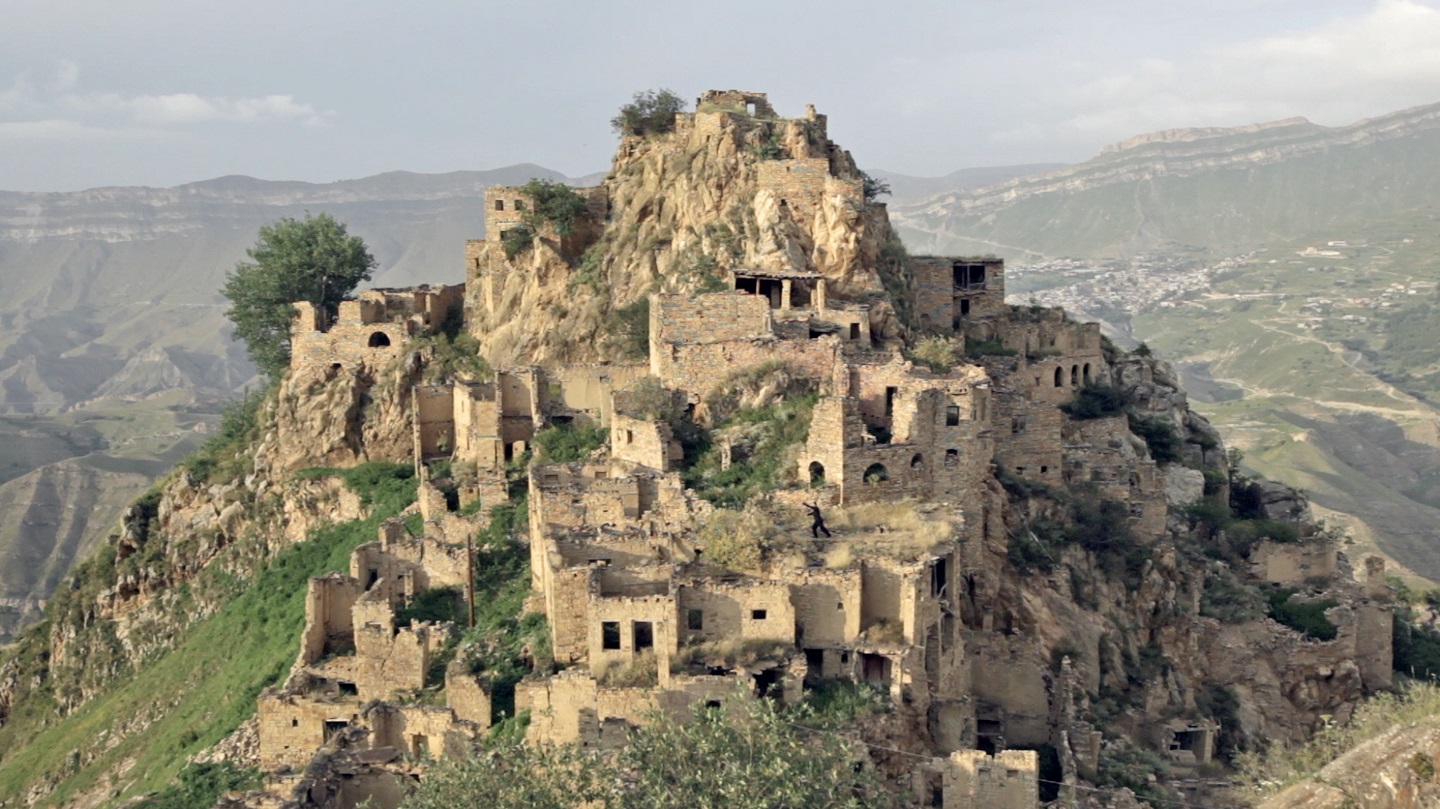
Taus Makhacheva, Gamsutl, HD video, 16.01 min, colour, sound, Dagestan, 2012


Die Ausstellung "A Walk, A Dance, A Ritual" zeigt zum ersten Mal in Deutschland eine umfangreiche Auswahl von Arbeiten Taus Makhachevas, der Preisträgerin des Kunstpreises "Europas Zukunft" 2014.

Taus Makhacheva stammt aus der russischen Republik Dagestan im Kaukasus. Ihr Interesse für die komplexe Beziehung zwischen Geschichte, Gegenwart und Erinnerungspolitik hängt mit der Geschichte des Landes zusammen und bildet den Ausgangspunkt der meisten ihrer in der GfZK präsentierten Werke. Mittels ihres bevorzugten Mediums Video, aber auch in Fotografien, Installationen und Objekten, untersucht und reflektiert sie Motive und Begriffe der Kunstgeschichte, der Anthropologie und Kulturwissenschaften. Die Aufmerksamkeit der Künstlerin richtet sich immer wieder auf Traditionen, wie sie vor der Sowjetisierung der multi-ethnischen Regionen des Kaukasus existierten. Sie beschäftigt sich mit den Fragen: Was ist von dieser Vergangenheit übrig geblieben? In welcher Weise werden die Überbleibsel dieser Zeit und ihrer Traditionen in den heutigen Alltag integriert? – wo sie den Zweck erfüllen sollen, zur Konsolidierung der postsowjetischen Gesellschaft Dagestans beizutragen.

Die Perspektive der Künstlerin ist keineswegs eine nostalgische, vielmehr erfasst sie den Prozess des Verschmelzens, der Aneignung und Einverleibung und der Interaktion zwischen dem Altvertrauten und dem Fremden. In diesem Sinne setzt Makhacheva mit ihrer Arbeit der offiziellen ideologischen Behauptung einer authentischen kulturellen Identität etwas entgegen. Sie nimmt die „wiedererfundenen“ Traditionen, etwa die inzwischen durch und durch kommerzialisierten und überaus üppigen Hochzeitsfeiern (in „A Space of Celebration“, 2009) oder das neue Initiationsritual illegaler Autorennen (in „The Fast and The Furious“, 2011) gleichsam unter die Lupe.

Der Titel der Ausstellung „A Walk, A Dance, A Ritual“ verweist auf die Handlungen und Motive, die in Makhachevas Werk immer wieder eine Rolle spielen. In der Neubelebung vergessener Rituale und Gesten erkundet der Mensch mit seinem Körper – in vielen Fällen agiert die Künstlerin selbst in ihren Videos – sein unmittelbares (soziales) Umfeld in dem Bestreben, seine Umgebung zu erfassen, eine Verbindung zu ihr herzustellen und von ihr akzeptiert zu werden. So lotet Makhachevas künstlerische Praxis eine soziale Erfahrung aus, wie man sie nicht nur in den Gesellschaften des Kaukasus machen kann: den scheinbar unauflöslichen Widerspruch, zu einer bestimmten Gesellschaft oder Gemeinschaft zu gehören und sie gleichzeitig wie ein Außenstehender zu beobachten.

Taus Makhacheva wurde 1983 in Moskau geboren. 2012 erhielt sie den "Innovation Prize", den russischen Staatspreis für zeitgenössische Kunst, in der Kategorie "New Generation", (mit dem Projekt "The Fast and The Furious"), 2011 wurde sie für den Kandinsky-Preis, Kategorie "Media Project of the Year", nominiert. Ihren Bachelor der bildenden Künste hat sie am Goldsmiths College, London, gemacht und ihren Master of Arts am Royal College of Art, London.

Ausstellungen (Auswahl): Story Demands to be Continued (2013, Ausstellungshalle der Künstlervereinigung der Republik Dagestan, Makhachkala), Love me, Love me not (2013, 55. Biennale von Venedig, Collateral Event), Re: emerge – Towards a New Cultural Cartography (2013, 11 Sharjah Biennial), Liverpool Biennial 2012: City States – Makhachkala, Topography of Masculinity (LJMU Copperas Hill Building), Rewriting Worlds (2011, The Fourth Moscow Biennale of Contemporary Art, Main Project, ArtPlay Сentre), Greater Caucasus (2011, PERMM Museum of Contemporary Art, Perm); Affirmative Action (Mimesis) (2011, Laura Bulian Gallery, Mailand), Practice for Everyday Life (2011, Calvert 22, London), History of Russian Video Art, Volume 3 (2010, Moscow Museum of Modern Art)

Der Kunstpreis >Europas Zukunft< wurde 2003 von Matthias Brühl und Dietmar Schulz in Zusammenarbeit mit der GfZK aus dem Wunsch heraus ins Leben gerufen, europäische Künstler und Künstlerinnen für ihre Arbeit auszuzeichnen. Der mit 5000 Euro dotierte Preis ist inzwischen eine wichtige Auszeichnung im Bereich der gegenwärtigen Kunst. Er ist nicht an ein konkretes künstlerisches Projekt gebunden und beinhaltet nicht den Ankauf eines Werkes, sondern ist als eine Ermutigung für Künstlerinnen und Künstler gedacht, ihren Weg fortzusetzen. Dank seiner Stifter ist der Preis zu einem Beispiel für die langfristige Verbindung zwischen Kunst und privatem Engagement geworden.

"Heute gibt es viele Konzepte darüber, was Europa ist oder sein sollte. Deutschland könnte im besten Fall eine wichtige Mittlerrolle spielen und ein friedliches Miteinander fördern. Es ist wichtig, den Austausch zu unterstützen, und in der Kunst sehen wir ein geeignetes Mittel, um sich miteinander zu beschäftigen, ohne sich gleich politisch oder wirtschaftlich zu binden." Matthias Brühl, Dietmar Schulz, Preisstifter

Mit der freundlichen Unterstützung von peri foundation.


E n d e a v o u r HD video / 9.00 min., colour, sound / Tsada mountain village, Dagestan, 2010 from Taus Makhacheva on Vimeo.


more: vimeo.com/tausmakhacheva

more links:
Her Dagestan Taus Makhacheva Profiles BY Stephanie Baile [artasiapacific.com]
Taus Makhacheva Hall of the Artists’ Union, Makhachkala, Russia [frieze.com] 

At the Crossroads: Conversation with Taus Makhacheva

Thursday, December 05, 2013

EDITION: Georgia: A Political History Since Independence. By Stephen F. Jones

On 10 December, 2013 Center for Social Sciences organizes a presentation of Georgian Edition of Professor Stephen F. Jones' new book:

"Georgia: A Political History Since Independence"

Professor Stephen F. Jones is a prominent scholar and an expert on post-communist societies in the former Soviet Union and Eastern Europe. He is a Professor of Russian Studies at Mount Holyoke College. Professor Jones also is an Honorary Doctorate of Tbilisi State University, and a member of CSS International Advisory Board.

Date: 10 December, 2013

Time: 17:00-18:30

Venue: 1 Chavchavadze Ave., TSU I building, Room #115

Book Overview:

Georgia emerged from the fall of the Soviet empire in 1991 with the promise of swift economic and democratic reform. But that promise remains unfulfilled. Economic collapse, secessionist challenges, civil war and the failure to escape the legacy of Soviet rule - culminating in the 2008 war with Russia - characterize a two-decade struggle to establish democratic institutions and consolidate statehood. Here, Stephen Jones critically analyses Georgia's recent political and economic development, illustrating what its 'transition' has meant, not just for the state, but for its citizens as well. An authoritative and commanding exploration of Georgia since independence, this is essential for those interested in the post-Soviet world.

Release date of original Eglish Edition: December 24, 2012, Publisher: I. B. Tauris (ISBN-10: 1845113381; ISBN-13: 978-1845113384)

©2012 - Stephen Jones

Release date of Georgian Edition: December 2013, Publisher: Center for Social Sciences (ISBN 978-9941-0-5972-8; ISSN - 1512-4576)

©2013 - Center for Social Sciences

The Georgian translation of the book has been prepared by the CENTER FOR SOCIAL SCIENCES (CSS). Published with the financial support of the Open Society Georgia Foundation. The views, opinions and statements expressed by the authors and those providing comments are theirs only and do not necessarily reflect the position of the Foundation. Therefore, the Open Society Georgia Foundation is not responsible for the content of the information material. The book was published in cooperation with NEKERI Press.

More: Democracy in Georgia: Da Capo? By Stephen F. Jones [pdf]

AmazonShop: Books, Maps, Videos, Music & Gifts About The Caucasus

Monday, November 11, 2013

BOOK: Fear, Weakness and Power in the Post-Soviet South Caucasus. A Theoretical and Empirical Analysis. By Kevork Oskanian (us.macmillan.com)


(us.macmillan.com) This book provides a detailed, multi-level analysis of international security in the South Caucasus and considers whether this region of the former Soviet Union, with several as yet unresolved, 'frozen' separatist conflicts, can move towards a more peaceable future. Using three concepts from Regional Security Complex Theory, amity/enmity, state incoherence and great power penetration, Oskanian forms a unique conceptual expansion of the theory, providing a comprehensive examination of both material conditions and discourses of insecurity. Applying this expanded framework onto a region of considerable complexity and conflict, the book considers the hostility between the South Caucasian states, the fissures underlying their secessionist conflicts, and the regional involvement of great powers, outlining the broader narratives that pervade societies in Armenia, Azerbaijan and Georgia. The book also assesses the emergence of a security regime in the Southern Caucasus and offers a critical-prescriptive assessment of policy implications for both regional and extra-regional actors concerned with improved regional stability. 

Kevork Oskanian currently teaches at the University of Westminster, UK. He received his PhD from London School of Economics, UK and has formerly edited Millenium Journal of International Studies. His research interests include the politics of the Former Soviet Union, constructivism, the English School, regionalism, and state incoherence.

Geopolitical Map of the Caucasus
Timeline of Events in the South Caucasus 1988-2009
A Note on Transliteration and Toponymy List of Acronyms and Abbreviations List of Interviewees
1. Introduction
2. Amity and Enmity in its Regional Context
3. State Incoherence as Weakness, Instability and Failure
4. Great Powers and Their Regional Entanglements
5. A Macro-View of the Southern Caucasus
6. Discourses of Conflict in the Southern Caucasus
7. State Incoherence in Southern Caucasia
8. The Great Powers and The Southern Caucasus
9. The South Caucasus Regional Insecurity Complex

Tuesday, October 08, 2013

BLOG: Occupation Continuum – New Berlin Wall in Georgia. By Tamar Lobjanidze (adjapsandali.wordpress.com)

“A good neighbor is a fellow who smiles at you over the back fence, but doesn’t climb over it”, Arthur Baer.
 
http://adjapsandali.files.wordpress.com/2013/10/12.jpg(adjapsandali.wordpress.com) Post-Soviet conflicts are mostly referred to as “Frozen Conflicts”, but since the August war broke out in 08.08.08 we can no longer consider the unresolved dispute in South Ossetia/Tskhinvali Region “frozen”, as the dramatic events continue to occur ever since the active armed conflict has been brought to an end by the Cease-fire Agreement on August 12th, 2008.
To follow the Michael S. Lund’s Curve of Conflict theory, after the peace enforcement, conflicts are mitigated, therefore peacekeeping is launched to terminate and engage in post-conflict peace building process, that finally brings parties to the conflict stabilization and further resolution.
In the case of South Ossetia/Tskhinvali Region, the August heat completely melted the stagnant situation, and dramatically changed the dynamics of the ethnic conflict, first broken out in the years of 1988-1989. As a result, the inhabitants of the region witnessed a second wave of ethnic cleansing, expulsion, torture, captivity, destruction and degradation of their property and many more of the physical and moral damage a human brain could imagine. Consequently, the war resulted in the occupation of 127 Georgian villages; most of which have been entirely obliterated (Tamarasheni, Avnevi, Ergneti, Kekhvi, Dzartsemi etc.), while the neighboring villages left under the control of Georgia, continually witnessed cruelty and oppression from Russian-Ossetian militias.
Particularly, during the last five years, Georgians living around the Administrative Boundary Line (ABL), have been systematically exposed to arbitrary arrests, unlawful detentions and abductions, resulting in physical abuse and other inhumane treatments. The de facto authorities, together with Russian military forces, massively discriminated the ethnic Georgians – intimidation, harassment, humiliation and other acts of ill-treatment were designed to terrorize or to push Georgians to flee from their native territories. More precisely, during last five years, due to the mass militarization of South Ossetia/Tskhinvali Region (build up of military bases, deploying around 3500 Russian troops), the local population tremendously suffered from the violation of their basic rights – freedom of movement and the adverse impact on their livelihood, destruction and plunder of their property belongings, etc. and continue to suffer, as of the so called process of building new border with Georgia.
As a matter of fact, in the post war period, efforts are made to end the hostilities and switch to peacemaking and/or conflict management process, where the outside parties engaged in peace enforcement and conflict mitigation. In the case of the Russia-Georgia war, the Six-Point Ceasefire Agreement had been reached to end hostilities and an outside party, the European Union Monitoring Mission (EUMM), was set up to seek stabilization, normalization, confidence building amongst the relevant authorities and “help make sure that the local people are living in a safe and secure environment”. The efforts to keep the conflict from re-escalation succeeded, as the fighting subsided and military conflict terminated. Therefore, post-war activities helped to reduce tensions, moving the conflict from a state of war to a state of crisis. However, the efforts at peacemaking failed, as peace enforcement never actually happened.
One of the main reason, why a state of crisis constantly fluctuates and sends signals to re-escalation, is directly related to continual land appropriation. Instead of fulfilling the obligation as stated in the principle five of the Six-Point Ceasefire Agreement: “Russian armed forces to withdraw to the positions held before hostilities began in South Ossetia.”, The Russian Authorities continue to penetrate and seize Georgian territories along the ABL. Therefore, Russia plays its own game in the Caucasus and has no interest in managing conflicts and making peace. On the contrary, it deliberately continues to destabilize the situation and create chaos that seems to suit Russia’s interests.
Therefore, the process is, fairly, called the Crawling/Creeping Occupation, as for its character of jutting about 1000 meters south, further into Georgia – drawing a new border between Georgia and its breakaway province of South Ossetia/Tskhinvali Region, by installing a new Berlin Wall – metal border fences unilaterally – impeding the freedom of movement of ethnic Georgians and the appropriation of their belongings.
The installation of barbed wires and fences started after the August War and was in progress during 2009-2012 around the villages of Gori, Kareli and Kaspi region. The process intensively continues currently in 2013, and rapidly covers the villages belonging Gori, Kareli, Akhalgori regions, which raises tensions locally and internationally.
In September, the situation turned even more dramatic. Russians and Ossetians claimed the border is in fact deeper into villages of Ditsi and Dvani, and continue to build actual fences. While local Georgian civilians, together with Georgian armed forces, have no plans to resist. As a result, residents are currently forced to evict, as their houses are crossed by the Occupation line, Russian and Ossetian forces claim to be the new borderline. Sadly, three families – Mekarishvili, Makhachashvili and Korashvili living in Dvani, were pressured to abandon their homes. Consequently, families dismantled their property, took their belongings and fled.
The fact demonstrates, that Russia will never agree to stable peace in the region. Instead of following the Six-Point Ceasefire Plan, where Russian armed forces were to pull back on the line, preceding the start of hostilities, it purposely penetrates deeply in Georgia, to tease the new government, demoralize, raise tensions and finally break the country. Moreover, instead of finding solutions for peaceful co-existence, or building confidence and reconciliation, the Russian authorities decided to build a Berlin Wall of barbed wire entanglements and, whilst,  impeding the right of return of the displaced people.
In the meantime, the Georgian society has mobilized and has been planning to take  action against the occupation of their country. During the last week of September, civil society members, journalists and students organized protests against the crawling occupation, visiting the ABL and the local population to show their support. In total around 35 foreign journalists and analysts, high profile officials, Embassy representatives in Georgia arrived in Ditsi and Dvani to evaluate situation on the ground. Also 28 Ambassadors of the EU Member States went on patrol to Ditsi, Ergneti and Zardiantkari to witness the situation along the ABL. Activism in the region significantly raised interest and concerns on local and international levels.
“We note with concern the continued and increasing activities by Russian security forces to erect fences and other physical barriers along the administrative boundary lines of the occupied territories in Georgia,” U.S. State Department spokeswoman Marie Harf said.
“It has a negative impact on the situation on the ground, and it affects the lives of those citizens of Georgia who live on either side of the administrative boundary lines,” Rasmussen stated. “I call for the removal of these barriers.” He also called upon Russia “to reverse its recognition of the South Ossetia and Abkhazia regions of Georgia as independent states.”
Catherine Ashton, the EU’s high representative for foreign affairs and security policy, called on the barriers to be removed and expressed “profound concern” over “the continued and increasing activities by Russian security forces to erect fences and other obstacles along administrative boundary lines in Georgia.”
After the strong signals and statements were voiced towards Russia, on October 3, 2013, Dvani residents noticed how Russian border forces temporarily terminated the installation of fences and took all the equipment away. Hence, international involvement and peaceful activism appears to be helpful so far, although nobody assures, Russia is going to stop building a new Berlin Wall in Georgia in the future.
Nevertheless, it is a fact, that strong international support and on time engagement could have a positive impact to prevent conflicts and keep peace. Even though, on a longer perspective, due to Russia’s irrational politics and realism in the region, it will be hard to predict, whether Georgians should wait for 30 more years to “TEAR DOWN THIS WALL”.

Saturday, May 11, 2013

FORSCHUNG: Der nüchterne Blick auf den mythischen Kaukasus (thueringen-reporter.de)

(thueringen-reporter.de) Mitarbeiter der Uni Jena präsentiert neues Buch über Kaukasus-Forschung in der Sowjetunion  

Der Blick auf den Kaukasus ist stark von Mythen und Vorurteilen verstellt. So geistert das Bild von den Inguschen als den noblen Wilden ebenso durch die Medien wie die Vorstellung vom unbändigen Freiheitswillen der Tschetschenen. Im Kontrast dazu wird das Bild von den „zivilisierten“ Kaukasiern auf die Georgier und Armenier projiziert.
 
Ein unverstellter Blick auf den Kaukasus sei die Ausnahme, konstatiert Dr. Florian Mühlfried. Der Ethnologe und Kaukasiologe von der Universität Jena hat gemeinsam mit seinem Moskauer Fachkollegen Sergey Sokolovskiy das Buch "Exploring the Edge of Empire: Soviet Era Anthropology in the Caucasus and Central Asia" herausgegeben. Versammelt sind in dem Werk Beiträge einer Konferenz des Max-Planck-Instituts für ethnologische Forschung in Halle/Saale, auf der 2009 sowjetische Forschungstraditionen zum Kaukasus und Zentralasien in den Blick genommen worden waren. "Unser Anliegen war es, einen Dialog der Kaukasusforscher anzustoßen", sagt Mühlfried. Seien doch die Vertreter der Kaukasiologie recht weit über den Globus verstreut, was den wissenschaftlichen Austausch schwierig mache.
 
Im Fokus des neuen Buches steht die Erforschung des Kaukasus und Zentralasiens in der Zeit der Sowjetunion. Die Großmacht habe sich bemüht, ein nationales Bewusstsein bei den Völkern Zentralasiens zu wecken, sagt Florian Mühlfried. "Im Kaukasus ging es Moskau vornehmlich darum, den Willen nach Unabhängigkeit zu brechen", so der Jenaer Kaukasiologe. Dabei sei es nicht zimperlich zugegangen: Diktator Josef Stalin, obwohl selbst Georgier, habe große Teile der intellektuellen und künstlerischen Elite des Landes eliminiert.
 
Die sowjetischen Kaukasus-Forscher nahmen zunächst die tiefgreifenden Umwälzungen in den Regionen in den Blick. So wurde die Kollektivierung erforscht, die starke Veränderung der Lebenswelten dokumentiert. Dazu kamen die traditionellen Themen der Ethnografen: Welche Trachten und Kostüme trugen die Einheimischen? Welche Traditionen wurden gepflegt? Mühlfried konstatiert einen starken Vergangenheitsbezug der sowjetischen Kaukasus-Forschung. In Zentralasien habe es etwas anders ausgesehen. Dort rückten der Prozess der Verstädterung und die Versuche, die Nomaden sesshaft zu machen, in den Blickpunkt der Forscher.
 
In den letzten Jahren ist das Interesse am Kaukasus auch bei uns größer geworden, sagt Dr. Mühlfried: "Die politischen Konflikte der jüngeren Vergangenheit haben den Blick wieder stark auf die Region gelenkt." Bemerkenswert sei das neue Interesse am ehemaligen "sowjetischen Orient" auch deshalb, weil es viel über unsere Wahrnehmung der Welt verrate.
Das Buch „Exploring the Edge of Empire: Soviet Era Anthropology in the Caucasus and Central Asia“ wird am Dienstag (31. Januar) beim Tag der Kaukasiologie (www.uni-jena.de/kaukasiologie50) an der Friedrich-Schiller-Universität Jena der Öffentlichkeit präsentiert. Termin ist 13.15 Uhr im Hörsaal der Thüringer Universitäts- und Landesbibliothek (Bibliotheksweg 2). Gäste sind herzlich willkommen, der Eintritt ist frei.
 
Bibliographische Angaben:
Florian Mühlfried, Sergey Sokolovskiy (Hg.): "Exploring the Edge of Empire. Soviet Era Anthropology in the Caucasus and Central Asia", LIT Verlag, Berlin 2012, 344 Seiten, Preis: 29,90 Euro, ISBN 978-3-643-90177-4
 
Kontakt:
Dr. Florian Mühlfried
Bereich Kaukasusstudien der Friedrich-Schiller-Universität Jena
Fürstengraben 27, 07743 Jena
Tel.: 03641 / 944887
E-Mail: Florian.Muehlfried@uni-jena.de

AmazonShop: Books, Maps, Videos, Music & Gifts About The Caucasus

Wednesday, April 10, 2013

EXHIBITION: Post-war Soviet architecture - Trespassing Modernities at SALT Galata (e-flux.com)

Post-war Soviet architecture at SALT
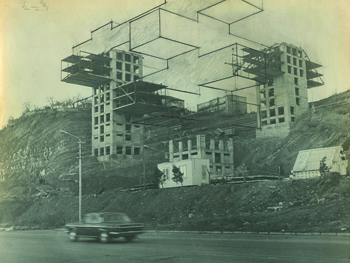
Ministry of Transportation, Tibilissi, Georgia (1974). Architects: Georgy Chakhava, Zurab Jalaghaniya, T. Tkhilava, V. Kimberg. Courtesy Georgy Chakhava’s personal archive gathered and selected by Vahram Aghasyan, Nini Palavandishvili and Lali Pertenava as part of Frozen moments: Architecture Speaks Back curated by Joanna Warsza, Tbilsi, 2010.

May 8–August 11, 2013
SALT Galata
Bankalar Caddesi 11
Karaköy 34420
Istanbul, Turkey
Hours: Tuesday–Saturday 12–8pm
Sunday 12–6pm
T +90 212 334 22 00
F +90 212 292 16 67

www.saltonline.org
(e-flux.com) Almost 25 years after the corrosion of the Soviet Union, still little is known about the social fabric that wove it together. Architecture and urbanism have been one of its strongest warps: creating a feeling of social unity and being one of the agents of its dissolution. This continent of architecture, afflicted by inner contradictions that enfolded within a homogenized space, is full of masterpieces waiting to be formally discovered. Trespassing Modernities explores this landscape and an approach of building for a fundamentally different idea of society.
Examples of practices by local architects working in the 1960s and 1970s followed by the critical approach of the Paper Architecture movement in the 1980s are brought together from the 15 countries that once made up the Soviet Union. Through a selection of scale models, drawings, photographs, films and ephemera that portray the legacy of post-war Soviet architecture, the exhibition will offer a glance at a still existing void in the canonical history of architecture. This issue will be discussed further in a conference to be held at SALT Galata on May 10–11.
Trespassing Modernities is programmed for SALT by Georg Schöllhammer with support from Ruben Arevshatyan. The exhibition is based on the research of Local Modernities, a project by Georg Schöllhammer, Ruben Arevshatyan, Klaus Ronneberger, Markus Weisbeck and Heike Ander, which initiated the exhibition Soviet Modernism 1955–1991 Unknown Stories (2012) at Architekturzentrum Wien.
Supported by Kalebodur.
subREALSALT Beyoğlu
May 8–August 11
Taiping Tianguo, A History of Possible EncountersAi Weiwei, Frog King Kwok, Tehching Hsieh and Martin Wong
SALT Beyoğlu
May 8–August 11, 2013
It was a time of conversationSALT Ulus
April 3–June 2, 2013

Wednesday, March 06, 2013

PODCAST: Why Stalin Remains Popular in Parts of Former Soviet Union (theworld.org)


People carry red flags and a portrait of the late Soviet leader Joseph Stalin during a ceremony to mark the 60th anniversary of his death in his hometown of Gori. (Photo: REUTERS/David Mdzinarishvili)
Photo: REUTERS/David Mdzinarishvili)


(theworld.org) Soviet dictator Joseph Stalin was one of the most murderous dictators of the 20th century. During his 30 year rule, tens of millions of Soviet citizens were arrested, deported, or executed. And yet a new survey of Russians and other ex-Soviets finds that far from being reviled, Stalin is widely admired, six decades after his death. That’s especially true in the former Soviet Republic of Georgia.
Tom De Waal, a senior associate at the Carnegie Endowment for International Peace, says Stalin is a figure not just of the past, but of the present.

“He’s very much there in the heads of the people all across what’s the former Soviet Union,” – which is why the Carnegie Endowment commissioned this survey on attitudes towards the dead dictator.

De Waal says support for Stalin, who died 60 years ago this week, has actually increased since the end of the Soviet Union. While Russians acknowledge that Stalin was responsible for the deaths of millions of innocent people, a majority say, more importantly, he saved the Soviet people from Nazi Germany.

That’s Russia.

But how is Stalin viewed in Georgia? After all, the most powerful dictator in Russian history was a cobbler’s son from Georgia. Traveling around Georgia, De Waal says he noticed pictures of Stalin everywhere. Yet until now, no one had ever commissioned a poll on attitudes towards Stalin in Georgia.

De Waal says they found that a whopping 45 percent of Georgians have a positive view of Stalin, “which is really quite shocking to anyone who knows Stalin as one of the great murderers of the 20th century.”
Only 20 percent had an unfavorable view of him.

“And he was really very cruel in Georgia, especially,” says Lasha Bakradze, director of the Georgian State Museum of Literature in Tbilisi.

Even though he’s Georgian, Bakradze was also taken aback to discover that so many of his countrymen admire Stalin.

“On one side, we like democracy, but on the other, we say Stalin wasn’t such a bad guy. It makes no sense.”
Bakradze says this kind of thinking is common in post-Soviet countries.

“People don’t see the big problem. They say, on one side he was killing many people, he was a butcher, but on the other side, okay, he was a big personality and somehow we like him.”

Bakradze thinks that for Georgians, this has nothing to do with nostalgia for Soviet times, nor is it a fondness for dictators.

“They are somehow proud of Stalin because he was a Georgian, and this mass murderer is a famous Georgian outside of Georgia.”

Bakradze teaches a college course on Soviet history, and he’s amazed at how little his students actually know about Georgia’s most famous — or infamous — son.

After Stalin’s death, Nikita Khrushchev denounced the crimes of his predecessor in a secret speech to Communist party officials in l956. Khrushchev also tore down all statues of Stalin, and erased his name from streets and towns across the Soviet Union.

But Stalin never really disappeared from Soviet Georgia. His childhood home in the town of Gori became something of a shrine, with a 20-foot bronze statue of him nearby.

Three years ago, Georgia’s pro-western President Mikheil Saakashvili had the statue taken down. Bakradze thought it was a bad idea, and spoke out against it.

“I think before we take down the monument,” he says, “we have to have a big discussion of Stalin period and Soviet period in Georgian history, which we haven’t ever had.”

Georgian President Saakashvili could have started that conversation, says Tom De Waal of the Carnegie Endowment, but he didn’t.

“Funnily enough, it’s exactly what Khrushchev did 50 years before, when he in the middle of night took Stalin out of the mausoleum in Red Square where he was lying next to Lenin. People woke up the next morning, and Stalin was gone. Saakashvili did the exact same thing in Gori. He took down the big Stalin statue. No public consultation.”

De Waal says that isn’t proper de-Stalinization.

“It’s removing the symptoms of Stalin, but it’s not removing the real Stalin from people’s minds.”
After the statue came down, there was a huge backlash. Now there’s a plan to put the statue back up, but just down the street.

Lasha Bakradze says Georgia, and other post Soviet countries, need to regain their historical memory.
“I think many, many problems which we have are problems coming from the Soviet times, problems of building democracy, independent thinking, and son on. And when we know better about Soviet times we will understand ourselves better. And we can solve these problems maybe easier than we are doing now.”
Stalin’s life and legacy would be a good place to start.
 

+++

In 2005, The World’s Patrick Cox visited Stalin’s home town of Gori (now in Georgia). Since then, the Georgian government has pulled down a statue of Stalin in Gori’s main square. But some local are as pro-Stalin as ever.


Read more:

Tuesday, January 15, 2013

PHOTOGRAPHY: Christoph Grill, Short Stalks at Distant Shores - Imaging Post-Soviet Space (hatjecantz.de)


(hatjecantz.de) Texte von Ulf Brunnbauer, Christoph Grill, Ulrich Tragatschnig, Gestaltung von Elke Ederer, Christoph Grill
Deutsch/Englisch
2012. 192 Seiten, 106 Abb.
34,70 x 28,80 cm
gebunden
Lieferbar
ISBN 978-3-7757-3398-4

Präzise und unbestechlich: der Blick von Christoph Grill auf die Staaten der ehemaligen Sowjetunion

Christoph Grill (*1965 in Österreich) dokumentiert in großartigen Bildern den Weg der Nachfolgestaaten der Sowjetunion in die Unabhängigkeit sowie die damit verbundenen ökologischen und ökonomischen Umwälzungen. Seine Fotografien aus Russland und Weißrussland, der Ukraine, Litauen, Lettland, Estland, der Republik Moldau, Armenien, Georgien, Aserbaidschan, Kasachstan, Turkmenistan, Usbekistan, Kirgisistan und Tadschikistan halten unsentimental den Alltag fest: In den Ruinen kommunistischer Utopien spielen Kinder, Triumphbögen stehen im Nirgendwo, in den Ritzen eines Exerzierplatzes wächst Gras. Grills fotografische Notizen verorten das auf seinen Reisen Gesehene, die Begegnungen mit den Menschen und deren Überlebenswillen, auch und gerade angesichts unübersehbarer Zerfallserscheinungen. 

AmazonShop: Books, Maps, Videos, Music & Gifts About The Caucasus

Monday, December 17, 2012

SOUTCAUCASUS: Where does Europe End? By David Rinnert (hertie-school.org)

(hertie-school.orgMore than twenty years after the Soviet Union’s disintegration, uncertainty about a border between Europe and Asia prevails. While in the North, West, and South of Europe, geographical demarcations at least simplify the discourse there is no consensus on an Eastern ‘end’ to Europe. The Urals are often viewed as a natural demarcation between Europe and Asia; however, this border is nothing more than a political and cultural construct. The following article aims to shed light on the relevance of a Eurasian continental border and thus on the question where Europe (not the EU) ends. Examining the historical developments and determinants of this border and looking at viewpoints from the South Caucasus, a region allegedly located outside of Europe, existing wisdom will be questioned.

The Borders between Europe and Asia

Despite statements in many schoolbooks to the contrary, no official geographical border between Europe and Asia exists. In terms of plate tectonics, Eurasia is one continent. But then what is ‘Europe’ and why do most of us have an opinion on its geographical scope? According to Greek mythology “Europa” was a daughter of Zeus whose name was used to describe the area of Northern Greece around 500 BC. In its modern sense, Europe was first mapped as a single entity during the 8th century; however, meanings and understandings of the term have differed widely ever since.

As Bernhard-Henri Lévy puts it, Europe has developed more as an idea than as an area. But can an idea of a collective identity flourish without physical demarcation? Most scholars researching in the field of identity agree that any construction of a unit is not possible without demarcation of something different or exterior (Krause, 2008). Construction of identity thus always means construction of alterity.

After the Thirty Years’ War in 1648 the understanding of sovereign nation states took root, which in turn resulted in a sharp increase in the usage of maps. Consequently, questions of physical demarcations and specific borders gained importance in this era, especially because they represented a new legitimation of power. As the number of alliances and treaties amongst states rose, the question of ‘Europe’s end’ also arose. Rulers began to define geographical endpoints of a European continent to divide ‘good’ from ‘evil’. For instance, in the early 16th century the French minister Sully considered “Russia as a barbarous country…in the same class with Turkey”, categorising both as non-European (Jacobs, 2012).

While many geographers came up with ideas for a Eurasian border, there was no consensus until the 1720s. At that time, Swedish officer Johann Philipp von Strahlenberg, backed by the powerful Russian tsar, proposed a continental border that has formed the basis for the understanding of Europe’s scope until today. Following the Urals, trahlenberg’s demarcation goes along the Volga and Don rivers until the Black Sea. Although intended for academics, the broader acceptance of Strahlenberg’s proposed border was namely political: the Russian tsar Peter II wanted to present his empire as European as possible, especially because the term ‘Europe’ was increasingly understood as a synonym for progress. He thus welcomed Strahlenberg’s proposition, which included a relatively large part of Russia in Europe.

Despite statements in many schoolbooks to the contrary, no official geographical border between Europeand Asia exists.

This demarcation was accepted by a majority of academics and politicians in the following two centuries while at the same time, generally the division of the world into continents became an ever more important concept in Europe. The formalisation of a continental system in the 19th century and the naturalisation of continental categories were regarded not as political constructs, but as “real geographical entities that had been ‘discovered’ through empirical inquiry” (Lewis and Wigen 1997). Western geographers such as the German Carl Ritter used the concept to show that "each continent is like itself alone…each one was so planned and formed as to have its own special function in the progress of human culture" (ibid). From today’s point of view, however, it is evident that such theories of the 19th and early 20th century were mostly used to underline European superiority in the international arena.

While from 1945 on the Iron Curtain separated Europe (as Strahlenberg defined it), politicians still held on to the previous consensus on the continental order. Only after the Cold War the ambiguity of the Eurasian border concept became apparent: with an increasingly important European Union and a new order in the post-Soviet space, politicians and academics alike were confronted with the question of Europe’s eastern ‘end’ once again. Geopolitical events—such as Turkey’s pending application for EU membership, the EU’s Neighbourhood Policy within and outside ‘Strahlenberg’s Europe’ and the emphasis of countries such as Georgia on their European roots and identity—all the more blur the existing wisdom on what is Europe.

Due to this growing uncertainty, especially within Europe, a look beyond the previously accepted border can help to cast light on the question of this continent’s ‘end’ in the east. There is no region that would be better suited for this purpose than the South Caucasus where questions about belonging to Europe or Asia have been prominent in public discourse for centuries.

Viewpoints from the South Caucasus

“Some scholars look on the area south of the Caucasian mountains as belonging to Asia, while others, in view of Transcaucasia’s cultural evolution, believe that this country should be considered part of Europe. It can therefore be said, my children, that it is partly your responsibility as to whether our [Baku] should belong to progressive Europe or to reactionary Asia”.

This passage from the Caucasus’ most famous novel “Ali & Nino”, published in 1937, shows how much the region is torn between Europe and Asia. The eventful history of the South Caucasus has certainly left its mark on the identity of Armenia, Azerbaijan and Georgia as those countries were exposed to different political and cultural forces to a much greater extent than other ‘bordering’ nations of Europe. While in the 18th and 19th century, Persia, the Osman Empire and the Russian Tsardom fought over power in this region, in 1921 the Soviet Union won control over it—against the will of the local population that partly kept up resistance during the 20th century. Thus, the USSR’s disintegration in 1991 resulted in a geopolitical and cultural reorientation of the three nations in different directions.

Since the Rose Revolution in 2003, Georgia in particular has increasingly presented itself as a country with European roots often referring to its history as one of the oldest Christian nations in the world. In his inauguration speech, President Saakashvili stated, "[the European] flag is Georgia’s flag as well, as far as it embodies our civilization, our culture, the essence of our history and perspective, and our vision for the future of Georgia…Our steady course is toward European integration” (Saakashvili, 2004). But how are such political statements also reflected by the opinion of the broader public?

While in representative surveys a majority of Georgians answer that they see themselves as Europeans and 40 percent of Armenians and a majority of Azerbaijanis remain sceptical of the EU, it is interesting to look behind these numbers. As part of a research with the “Studienkolleg zu Berlin” fellowship program, my project group recently interviewed 37 Georgians and Azerbaijanis about their viewpoints on Europe’s Eastern ‘end’. Furthermore, each interviewee was asked to draw the boarder between Europe and Asia according to her opinion, wherein two themes became apparent.

First, opinions on the location of a Eurasian border differ strongly between people across generations and employment. Second, perceived determinants of this demarcation vary even more greatly. Although religious factors are decisive for some, others define the European continent based on economic and political factors or the style of their respective traditional music as a reason for the demarcation of Europe. Abstract discussions on the scope of Europe become tangible through such individual perceptions, which in turn also reveal the difficulty of formulating coherent narratives on the continent’s demarcation.

The Non-existence of Europe’s end

Is there an ‘end’ of Europe in the east? In general, some kind of demarcation remains necessary for anything that is understood to be a connected unit since the construction of an ‘I’ or a ‘we’ is not possible without a certain separation from the outside. At the European level, identity formation follows the same principles. Considering, however, the diversity of perceived individual demarcations, one can conclude that the simplified Western discourse about one continental border as Strahlenberg defined it is no longer appropriate.

Although religious factors are decisive for some, others define the European continent based on economic and political factors or the style of their respective traditional music as a reason for the demarcation of Europe.

While the EU must set borders according to precisely defined criteria, the scope of Europe as a ‘continent’ (understood as a cultural area and/or value system) is determined by the perceived relevance of defining factors such as historical, cultural or political events, which differ widely from person to person.

Therefore, the question of how far Europe reaches can and must be answered for the clearly defined institution of the EU, but not for the undefined, overarching continent, especially as the meaning of the word continent in this context may never be agreed on. Coming back to Bernhard-Henri Lévy’s argument mentioned above, it seems likely that aside from the EU, Europe will continue to develop more as an idea than as an area. Politicians and economists alike should take this into account when making use of terms such as ‘neighbourhood’ or when referring to the ‘naturalness’ of a European continent in their decisions.

The advantages of a more flexible continental concept are manifold. Firstly, it would reduce the fear of proEuropean ‘bordering’ countries (such as Georgia) of being excluded. Secondly, it could—to a certain extent- separate the political from the cultural and historical discussions about Europe’s scope at the EU level, thereby taking pressure from EU decision-makers at a time when further enlargements are becoming more and more unlikely. Finally, such a flexible continental concept would allow for a less close-minded discourse on the integration of cultural diversity into ‘our’ value sphere.

+++

Jacobs, F. (2012). ‘Where is Europe?’, New York Times, 09 January, opinionator.blogs.nytimes.com (accessed 07 July 2012).

Krause, J. (2008). Die Konstruktion der Grenzen Europas: Das staatliche Territorialitätsprinzip und seine Extrapolation auf die supranationale Ebene. Leipzig: Universität Leipzig.

Lewis, M. and Wigen, K. (1997). The Myth of Continents. A Critique of Metageography. Berkeley: University of California Press.

Saakashvili, M. (2004). Presidential Inaugural Address in Tbilisi, 25 January 2004.

+++

This article is based on the results of a “Studienkolleg zu Berlin” (Berlin Studies Centre) project. For more information on the fellowship programm of the Studienkolleg see www.studienkolleg-zu-berlin.de

+++

David Rinnert is a MPP candidate at the Hertie School and has previously studied Social Sciences and Philosophy at the Humboldt-Universität zu Berlin, SciencesPo Paris, and the City University of New York. Currently, he works as a Young Professional at the GIZ in Moldova. Besides, he researches and publishes on the transformations of post-Soviet states.

Sunday, December 09, 2012

CFP: 2013 Annual Soyuz Symposium "Authoritarianism and Beyond? Lessons from Postsocialist Societies?"

(Harriman Institute, Columbia University, New York, March 22-23, 2013)

Theme: Authoritarianism has become the common denominator for political regimes of many contemporary postsocialist societies. Authoritarianism highlights strong presidential authority, lack of democratic succession of rule and insufficient public representation. Within this analytic, authoritarianism is the opposite of liberal democracy, deficient in terms of active civil society and critical public sphere, and plagued by state-led oppression and violence.

The 2013 SOYUZ symposium invites papers that would extend interpretive work on authoritarianism beyond this dualistic framework. We solicit field-research-based presentations that explore political and social processes in postsocialist societies in ways to complicate this top-down understanding of the state-society relationship. What kinds of alternative analytical frameworks are there to approach these processes? What kind of interpretation might the understanding of politics drawing, for example, on Foucault or Agamben offer to this conversation? Overall, we seek to extend the scope of this symposium beyond the concerns of postsocialist societies and to explore analytical limits and possibilities of the term authoritarianism itself.

Possible topics include, but are not limited to:
- working through/making sense of authoritarian pasts
- specters of the state
- agencies of state: law, the military, borders, and taxation
- the role of media and cultural production
- conjuncture of capitalism and authoritarianism
- non-state authoritarianism
- neoliberalism as a type of authoritarianism

SOYUZ, the Research Network for Postsocialist Cultural Studies, is an interdisciplinary forum for exchanging work based on field research in postsocialist countries, ranging from Eastern Europe and the former Soviet Union to Africa, Southeast Asia and Latin America. The Symposium has met annually since 1991 and offers an opportunity for scholars to interact in a more personal setting.

The deadline for abstracts is: December 15, 2012. Please send abstracts of 250 words by email to Zhanara Nauruzbayeva (zn2123@columbia.edu). Please include your full name, paper title, and academic affiliation, and write "SOYUZ 2013" in the subject line. Papers will be selected and notifications made by January 15, 2013.

Thursday, November 22, 2012

VORTRAG: „Vorherrschende Einstellungen zum Sowjetischen Architekturerbe Georgiens“ - Soviet Modernism 1955-1991. Unknown Stories

Liebe GeorgierInnen und FreundInnen von Georgien,
wir freuen uns, daß diese Woche so viel zu "Georgien" in Österreich angeboten wird und übersenden Ihnen zusätzlich zu dem Georgischen Kulturkalender Information zu dem am Samstag, den 24. Um 13:25 November geplanten Vortrag „Vorherrschende Einstellungen zum Sowjetischen Architekturerbe Georgiens“ von Levan Asabashvili (Georgien), Architekt

Im: A r c h i t e k t u r z e n t r u m  W i e n MQ
Museumsplatz 1

19. WIENER ARCHITEKTUR KONGRESS
Sowjetmoderne 1955 –1991. Unbekannte Geschichten

PROGRAMM

SAMSTAG 24. NOVEMBER 2012

KAPITALISMUS VERSUS KOMMUNISMUS. ARCHITEKTUR DER MODERNE IN OST UND WEST
Moderation: Katharina Ritter (Österreich), Kuratorin der Ausstellung

10:00 Begrüßung: Dietmar Steiner (Österreich), Direktor Az W
10:15 Einführung: Katharina Ritter (Österreich), Kuratorin der Ausstellung
10:30 Vortrag „Des Imperiums letzter Stil. Rückblicke aus dem 21. Jahrhundert“
Vladimir Belogolovsky (USA), Kurator
11:15 Vortrag „Die Moderne: Auf beiden Seiten des Eisernen Vorhangs“
Olga Kazakova (Russland), Kunsthistorikerin

12:00 Mittagspause

DAS SOWJETERBE: NATIONAL ODER RUSSISCH?
Moderation: Ekaterina Shapiro-Obermair (Russland/Österreich), Kuratorin der Ausstellung

13:00 Einführung: Ekaterina Shapiro-Obermair (Russland/Österreich), Kuratorin der Ausstellung
13:15 Vortrag „Das Erbe der Moderne. Retten oder vergessen?“
Irina Chepkunova (Russland), Vizedirektorin Forschung, Staatliches Schtschussew Museum für Architektur, Moskau
13:25 Vortrag „Vorherrschende Einstellungen zum Sowjetischen Architekturerbe Georgiens“
Levan Asabashvili (Georgien), Architekt
14:10 Vortrag „Architektonische Prototypen für das Nationale“
Dimitrij Zadorin (Weißrussland, Niederlande), Architekt
14:55 Vortrag „Rettung des Open Air Kino ‘Moskwa’ oder Paradoxe des sowjetischen und postsowjetischen öffentlichen Bewusstseins in Armenien“
Ruben Arevshatyan (Armenien), Künstler, Kunstkritiker und Kurator
15:40 Diskussionsrunde mit Ruben Arevshatyan, Levan Asabashvili, Irina Chepkunova, Ruslan Muradov, Mait Väljas, Dimitrij Zadorin

16:10 Pause

DER LETZTE KONGRESS DER ARCHITEKTINNEN DER UDSSR
Moderation: Andrey Bokov (Russland), Präsident der Architektenvereinigung Russlands

17:00 – 19:30 weitere Details siehe „Der letzte Kongress der ArchitektInnen der UdSSR“
kuratiert von Felix Novikov (Russland, USA), Architekt

SONNTAG 25. NOVEMBER 2012

LOKALE MODERNEN. ZENTRIFUGALE KRÄFTE IN DER ARCHITEKTUR DER UDSSR
Moderation: Georg Schöllhammer (Österreich), Vorstand tranzit.at / Gründer „springerin“

10:00 Einführung: Georg Schöllhammer (Österreich), Vorstand tranzit.at / Gründer „springerin“
10:15 Vortrag „Baltische Modernen“
Mart Kalm (Estland), Professor und Dekan an der Estnischen Kunstakademie
11:00 Vortrag „Lokale Moderne und globaler Orientalismus: Konstruktion eines sowjetischen Orients“
Boris Chukhovich (Usbekistan, Kanada), Kurator und Forscher
11:45 Vortrag „Kunst und Architektur in der Ukraine der späten Sowjetzeit“
Oleksandr Burlaka (Ukraine), Architekt & Oleksiy Radynski (Ukraine), Herausgeber „Politytschna Krytyka“
12:30 Diskussionsrunde mit Oleksandr Burlaka, Boris Chukhovich, Sergej Fedorov, Mart Kalm, Oleksiy Radynski

13:00 Mittagspause

GEBAUTE IDEOLOGIE
Moderation: Alexandra Wachter (Deutschland, Österreich), Kuratorin der Ausstellung

14:00 Einführung: Alexandra Wachter (Deutschland, Österreich), Kuratorin der Ausstellung
14:15 Vortrag „Stadträume einer sozialistischen Moderne“
Elke Beyer (Deutschland), Historikerin
15:00 Vortrag „Erfindung eines sowjetischen Rituals: Das Dramatische in der neuen Architektur“
Marija Drëmaitë (Litauen), Architekturhistorikerin
15:45 Vortrag „»Republik der roten Halstücher« – die Architektur von Artek“
Wolfgang Kil (Deutschland), Architekturkritiker und Publizist
16:30 Vortrag „Zwei Architektengenerationen im Kommunismus“
Vladimír Šlapeta (Tschechien), Architekt und Architekturtheoretiker

Der Kongress wird in deutscher, russischer und englischer Sprache abgehalten.

Jeder Vortrag dauert ca. 30 min, anschließend 15 min Publikumsfragen.

Änderungen vorbehalten
Aktuelle Informationen: www.azw.at/kongress

Zum Kongress erscheint die Publikation „Hintergrund 54“, voraussichtl. Erscheinungstermin 19.02.2013