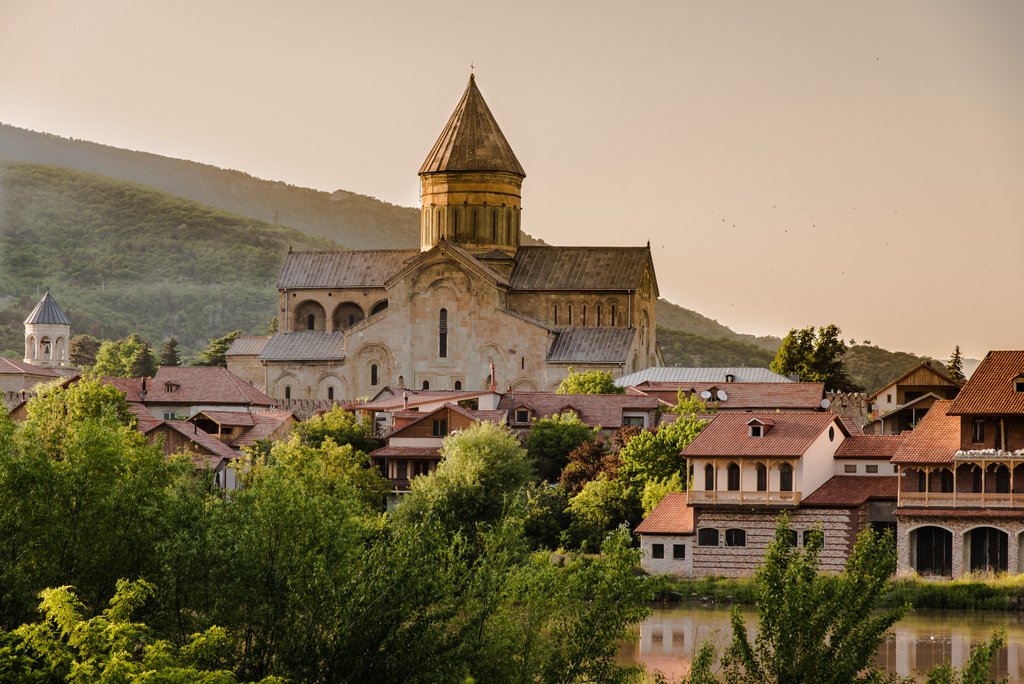
A review of RFE/RL reporting and analysis about the countries of the South Caucasus and Russia's North Caucasus region. For more stories on the Caucasus, please visit and bookmark our Caucasus page .
Who Are Kabardino-Balkaria's 'Black Hawks'? The Kabardino-Balkaria-Karchai jamaat headed by Asker Jappuyev will have to contend with a second adversary in the shape of the "Black Hawks," a band of armed, masked, black-clad men who have vowed to kill him and others for having "brought shame upon their race" by killing innocent civilians and by aligning themselves with Chechen insurgent commander Doku Umarov. More
Abkhazia Asks Georgia To Hand Over Former Guerrilla Commander The Abkhaz delegation to confidence-building talks has demanded that Georgia hand over Dato Shengelia, commander of the now-disbanded Forest Brothers guerrilla group. More
Azerbaijani Anticorruption Campaign Unfolds Before Wary Public Eyes Three weeks have passed since the Azerbaijani government launched a well-publicized anticorruption campaign, but authorities have so far failed to convince the public of the sincerity of their intentions. More
A Look Inside Kadyrov's Villa Thanks to the Internet, we now have photos of Ramzan Kadyrov's mansion in Tsentoroi. The photos don't tell us much about the man aside from a penchant for expensive, if tasteless, furnishings. More
Proposed U.S. Budget Trims Assistance To Caucasus, Central Asia While the State Department isn't experiencing the same belt-tightening pressure as other branches of the U.S. government, an effort to cut corners -- and to free up funds for Iraq, Afghanistan, and Pakistan -- has resulted in a proposed reduction in funding for assistance programs in Central Asia and the Caucasus in 2012. More
Rift Opens In Georgia Between The Church And State Georgia's plans with Turkey to sign an accord preserving religious heritage sites in the two countries has exposed a growing rift between the government and the Orthodox Church. More
Aliyev Steps Up Corruption Fight Azerbaijan's president has called for more vigilance in the fight against corruption and urged people to help heal what he called the "wounds" of sleaze. More
Rally Against Iran Held In Baku A rally took place on February 9 in front of the Iranian Embassy in Baku to protest what are widely perceived to be anti-Azerbaijani statements appearing in the Iranian media and Iran’s warmer ties with Armenia. More
Facebook Lands Activist In Hot Water An Azerbaijani opposition activist has been questioned by police after using his Facebook page to call on people to protest against the government. More
Mr. Bryza: They're Locking Up Our Youth After nearly a year and a half, a new U.S. ambassador has finally taken up residence in Baku. Matthew Bryza became the seventh U.S. ambassador to Azerbaijan last December and says he wants to deepen U.S.-Azeri ties. His timing is perfect. His arrival has coincided with a renewed government crackdown on youth activists. More
Armenian Daily Fined For Libel An Armenian court has found the country's leading pro-opposition daily newspaper guilty of libel and ordered it to pay a fine. More
Chechen Rebel Says He Ordered Russian Bombing Chechen Islamist rebel leader Doku Umarov says he ordered a suicide bombing that killed 36 people at Russia's busiest airport last month. More
Protests At Baku's Mubarak Statue A group of Azerbaijani youth activists staged a demonstration February 6 near a statue of Egyptian President Hosni Mubarak in Baku, in a gesture of solidarity with anti-Mubarak protesters in Egypt, More
Azeri Activist Detained On Drugs Charges An opposition youth activist has been detained on drugs-possession charges his supporters say are trumped up. More
Foreign Investors Eye Nagorno-Karabakh A group of entrepreneurs from Austria, the Czech Republic, and Slovakia have visited the breakaway Azerbaijani region of Nagorno-Karabakh to look at investment opportunities. More
Largest Flag Flying Again In Baku The troubled Azerbaijani flag recognized as the world's largest -- when mounted -- is flying again. More
Small Corners Of Hell Russian investigative journalist Anna Politkovskaya was gunned down in Moscow in October 2006 primarily for her articles criticizing Russian policy in Chechnya, in particular the vindictiveness, intimidation, corruption and arbitrary brutality that are the hallmarks of the pro-Moscow Chechen leadership. More
Armenia To Probe Noncombat Deaths Armenian President Serzh Sarkisian said he would pay "special attention" to investigations into noncombat army deaths after being confronted by angry parents of dead soldiers. The parents are concerned that the authorities are not telling the truth or taking the deaths seriously. More
Mubarak Sitting Pretty In Azerbaijan Despite troubles at home, Egyptian President Hosni Mubarak is still sitting pretty in Azerbaijan. More
It May Be Too Late For A New North Caucasus Policy Faced with the galloping jihadization in the region, Russian experts are ever more frequently calling for a new state policy for the North Caucasus. Such calls are misguided insofar there can be no one-size-fits-all set of measures, only individually tailored solutions for specific republics. More
Armenian Economy Rebounded In 2010 Armenia's economy grew 2.6 percent last year as it rebounded from a sharp decline in 2009 caused by the global financial crisis. Growth in 2010 was driven primarily by industry and the mining sector, which benefited from a rally in prices for nonferrous metals. More
Was Daghestan Jamaat Behind Domodedovo Bombing? No group has yet claimed responsibility for the deadly blast at Moscow's Domodedovo airport. But Russian media have floated the idea that the suicide bomber was linked to the Daghestan wing of the North Caucasus insurgency, whose leader warned last October that his men would continue to "inflict horrors on the unbelievers" on their own territory. More
Why Is Georgia So Quiet About Tunisia’s Revolution? When I asked several Georgian politicians from the ruling party what the country’s position on the recent events in Tunisia is, they were caught by surprise. It is worth saying a few things about this Georgian indifference to the so-called Jasmine Revolution. More
Azeri Activist Held Over Military Service Police detained Baxtiyar Haciyev while he was on his way to neighboring Georgia. Haciyev told RFE/RL that police kept him in the police station in the western town of Qazax until 3 a.m. He was then transferred to the western city of Ganca. More
Georgia Offers Russian-Language Alternative To Kremlin TV Georgia begins broadcasts of a new Russian-language television station that seeks to bring balanced news about the Caucasus to Russian-speaking countries around the world. The director of the Kanal PIK station says the move is meant to shed light on the strategically important region of the Caucasus by breaking the Kremlin's near-monopoly on coverage. More
Russians Rethink Security President Dmitry Medvedev vows to destroy "the nests of the bandits" who perpetrated the devastating attack on Moscow's premier airport. More
Your Responses: 'What Boorishness...It Is To Talk Politics When People Are Dying!' Russians have reacted with shock and grief to the tragic terrorist bombing of Moscow’s Domodedovo airport on January 24. Here we present translations of some of the comments left on the website of RFE/RL’s Russian Service and other popular Russian-language websites. More
Armenia Downplays Tax Revenue Armenian Finance Minister Vache Gabrielian has downplayed a more than 13 percent rise in the tax revenues, saying more needs to be done to improve tax collection in the country. More
Azerbaijani Commits Self-Immolation An Azerbaijani villager has died after setting himself and his home ablaze in desperation after police pressured him to pay a fine for chopping down trees. More
Azeri Islamic Leader Gets 90 Days The chairman of the unregistered Islamic Party of Azerbaijan (AIP), Movsum Samadov, has been sentenced to three months in pretrial detention on charges of illegal arms possession, inciting terror, and seeking to change the constitutional system, Samadov was initially detained along with several members of his party on January 7 and was held for 13 days for allegedly resisting police. Samadov's lawyer says his client will appeal the detention. More
Armenian Soldier Killed In Karabakh An Armenian soldier was shot dead in continuing truce violations at Armenian-Azerbaijani "line of contact" around the breakaway Azerbaijani region of Nagorno-Karabakh. More
Yerevan Street Traders Protest Ban Yerevan's city administration is facing angry streets protests after its decision to ban street traders, Mayor Karen Karapetian ordered the ban after taking office last month. Police began enforcing it this week. Hundreds of traders now risk losing their sole source of income. More
Showing posts with label Matthew Bryza. Show all posts
Showing posts with label Matthew Bryza. Show all posts
Saturday, February 26, 2011


Sunday, August 17, 2008
INTERVIEW: Senior U.S. Official Calls Russian Actions 'Ill-Advised And Simply Stupid'
 U.S. Deputy Assistant Secretary of State for European and Eurasian Affairs Matthew Bryza tells RFE/RL Tbilisi bureau chief Marina Vashakmadze in a face-to-face interview that Washington is committed to maintaining a partnership with both sides to the conflict. But he has harsh words for the Kremlin's military campaign in Georgia, and says Moscow faces considerable work in repairing its reputation in the eyes of the world.
Friday, August 15, 2008
RUSSIAN NEWSPAPER: THE RUSSIAN-GEORGIAN WAR WAS PREPLANNED IN MOSCOW (novayagazeta.ru / translation from russian)
By Pavel Felgenhauer
Last week military tension in Georgia's separatist region of South Ossetia escalated into all-out war. The Ossetian separatists were provoking a conflict to give the Russian military a pretext for direct intervention. Late in the evening of August 7, a heavy mortar bombardment of Georgian villages near the South Ossetian capital of Tskhinvali provoked Georgian President Mikheil Saakashvili to order a major assault. The night attack by Georgian troops outfitted with Western-made night-vision equipment flushed the Ossetian fighters out and Tskhinvali was overrun in the morning. To stop the Georgian offensive thousands of Russian troops with hundreds of pieces of armor invaded through the Roki tunnel and rushed forward. Russian jets began bombing Georgian military installations and cities (see EDM, August 7).
From August 8 to 10, the Georgian army was engaged in ferocious battles with the Russian invaders in and around Tskhinvali. On August 10, the Georgian authorities announced that they were withdrawing all their forces from South Ossetia and asked for a ceasefire and peace talks (Interfax, August 10). On August 12, Russian President Dmitry Medvedev accepted a French-brokered peace plan, and a shaky truce was established. The Georgian army concentrated its forces on defending the capital of Tbilisi. Tens of thousands of Russian troops and over a thousand pieces of armor were relocated to South Ossetia and Abkhazia. Russian troops moved out of the breakaway regions to occupy other Georgian provinces in the West (Zugdidi, Senaki, and Poti), disarming local police forces and destroying Georgian military bases (Interfax, August 13). Marauding Ossetian paramilitaries and Russian servicemen went pillaging and terrorizing the local population in and around Gori south of Tskhinvali (AP, August 13).
Moscow declared that it was forced to go to battle by the initial Georgian attack in South Ossetia (RIA-Novosti, August 8). But there is sufficient evidence that this massive invasion was preplanned beforehand for August (see EDM, June 12). The swiftness with which large Russian contingents were moved into Georgia, the rapid deployment of a Black Sea naval task force, the fact that large contingents of troops were sent to Abkhazia where there was no Georgian attack all seem to indicate a rigidly prepared battle plan. This war was not an improvised reaction to a sudden Georgian military offensive in South Ossetia, since masses of troops cannot be held for long in 24-hour battle readiness. The invasion was inevitable, no matter what the Georgians did.It seems the main drive of the Russian invasion was Georgia's aspiration to join NATO, while the separatist problem was only a pretext. Georgia occupies a key geopolitical position, and Moscow is afraid that if George joins NATO, Russia will be flushed out of Transcaucasia. The NATO summit in Bucharest, Romania, last April, where Ukraine and Georgia did not get the so-called Membership Action Plan or MAP to join the Alliance but were promised eventual membership, seems to have prompted a decision to go to war (Interfax, April 3).
Before using arms, Moscow issued ominous threats. Russia unilaterally rebuked CIS sanctions against Abkhazia (RIA-Novosti, March 6). The Kremlin-controlled State Duma passed a resolution calling for recognition of Abkhaz and South Ossetian sovereignty (RIA-Novosti, March 21). Vladimir Putin promised Abkhazia and South Ossetia "not declarative, but material support" and announced that Georgian aspirations for "speedy Atlantic integration" endangered security (http://www.mid.ru/, April 3). Russia's top military commander Yuri Baluyevsky threatened "military action to defend our interests near our borders," if Georgia and Ukraine joined NATO (RIA-Novosti, April 11). In apparently the last warning, Russian Foreign Minister Sergei Lavrov accused Georgia of failing to pass a law forbidding foreign military bases after Russia moved its bases out last November. Lavrov linked Georgian intransigence with "Western plans to pull it into NATO" (ITAR-TASS, May 5).Material military preparations were made. On May 31, Railroad troops were moved to repair the tracks south of Sokhumi to prepare the infrastructure for the invasion. On July 30, they completed their work and all was set for major combat in August, since later bad weather would impede an invasion (see EDM, June 12, July 30). The West seems to have dismissed the Russian warnings and preparations as bluff until it was too late. U.S. Deputy Assistant Secretary of State Matthew Bryza stated in Tbilisi, "Now we know" the true mission of the Railroad troops in Abkhazia (Interfax, August 11). He would have done better to subscribe to EDM.
The main task of the Russian invasion--to cause a total state failure and fully destroy the reformed Georgian army, making NATO membership impossible--has not yet been achieved, despite all the havoc. More attacks and devastation may be planned. Ballistic Tochka-U missiles with a range of 110 km have been deployed in Abkhazia and South Ossetia from which they could reach Tbilisi. Two seem to have already been fired at Western Georgia, according to statements from Abkhaz separatists (Novaya Gazeta, August 14). A missile attack, officially attributed to separatists, could kill hundreds, creating a devastating panic and possible regime collapse.
source: novayagazeta.ru >>>
Last week military tension in Georgia's separatist region of South Ossetia escalated into all-out war. The Ossetian separatists were provoking a conflict to give the Russian military a pretext for direct intervention. Late in the evening of August 7, a heavy mortar bombardment of Georgian villages near the South Ossetian capital of Tskhinvali provoked Georgian President Mikheil Saakashvili to order a major assault. The night attack by Georgian troops outfitted with Western-made night-vision equipment flushed the Ossetian fighters out and Tskhinvali was overrun in the morning. To stop the Georgian offensive thousands of Russian troops with hundreds of pieces of armor invaded through the Roki tunnel and rushed forward. Russian jets began bombing Georgian military installations and cities (see EDM, August 7).
From August 8 to 10, the Georgian army was engaged in ferocious battles with the Russian invaders in and around Tskhinvali. On August 10, the Georgian authorities announced that they were withdrawing all their forces from South Ossetia and asked for a ceasefire and peace talks (Interfax, August 10). On August 12, Russian President Dmitry Medvedev accepted a French-brokered peace plan, and a shaky truce was established. The Georgian army concentrated its forces on defending the capital of Tbilisi. Tens of thousands of Russian troops and over a thousand pieces of armor were relocated to South Ossetia and Abkhazia. Russian troops moved out of the breakaway regions to occupy other Georgian provinces in the West (Zugdidi, Senaki, and Poti), disarming local police forces and destroying Georgian military bases (Interfax, August 13). Marauding Ossetian paramilitaries and Russian servicemen went pillaging and terrorizing the local population in and around Gori south of Tskhinvali (AP, August 13).
Moscow declared that it was forced to go to battle by the initial Georgian attack in South Ossetia (RIA-Novosti, August 8). But there is sufficient evidence that this massive invasion was preplanned beforehand for August (see EDM, June 12). The swiftness with which large Russian contingents were moved into Georgia, the rapid deployment of a Black Sea naval task force, the fact that large contingents of troops were sent to Abkhazia where there was no Georgian attack all seem to indicate a rigidly prepared battle plan. This war was not an improvised reaction to a sudden Georgian military offensive in South Ossetia, since masses of troops cannot be held for long in 24-hour battle readiness. The invasion was inevitable, no matter what the Georgians did.It seems the main drive of the Russian invasion was Georgia's aspiration to join NATO, while the separatist problem was only a pretext. Georgia occupies a key geopolitical position, and Moscow is afraid that if George joins NATO, Russia will be flushed out of Transcaucasia. The NATO summit in Bucharest, Romania, last April, where Ukraine and Georgia did not get the so-called Membership Action Plan or MAP to join the Alliance but were promised eventual membership, seems to have prompted a decision to go to war (Interfax, April 3).
Before using arms, Moscow issued ominous threats. Russia unilaterally rebuked CIS sanctions against Abkhazia (RIA-Novosti, March 6). The Kremlin-controlled State Duma passed a resolution calling for recognition of Abkhaz and South Ossetian sovereignty (RIA-Novosti, March 21). Vladimir Putin promised Abkhazia and South Ossetia "not declarative, but material support" and announced that Georgian aspirations for "speedy Atlantic integration" endangered security (http://www.mid.ru/, April 3). Russia's top military commander Yuri Baluyevsky threatened "military action to defend our interests near our borders," if Georgia and Ukraine joined NATO (RIA-Novosti, April 11). In apparently the last warning, Russian Foreign Minister Sergei Lavrov accused Georgia of failing to pass a law forbidding foreign military bases after Russia moved its bases out last November. Lavrov linked Georgian intransigence with "Western plans to pull it into NATO" (ITAR-TASS, May 5).Material military preparations were made. On May 31, Railroad troops were moved to repair the tracks south of Sokhumi to prepare the infrastructure for the invasion. On July 30, they completed their work and all was set for major combat in August, since later bad weather would impede an invasion (see EDM, June 12, July 30). The West seems to have dismissed the Russian warnings and preparations as bluff until it was too late. U.S. Deputy Assistant Secretary of State Matthew Bryza stated in Tbilisi, "Now we know" the true mission of the Railroad troops in Abkhazia (Interfax, August 11). He would have done better to subscribe to EDM.
The main task of the Russian invasion--to cause a total state failure and fully destroy the reformed Georgian army, making NATO membership impossible--has not yet been achieved, despite all the havoc. More attacks and devastation may be planned. Ballistic Tochka-U missiles with a range of 110 km have been deployed in Abkhazia and South Ossetia from which they could reach Tbilisi. Two seem to have already been fired at Western Georgia, according to statements from Abkhaz separatists (Novaya Gazeta, August 14). A missile attack, officially attributed to separatists, could kill hundreds, creating a devastating panic and possible regime collapse.
source: novayagazeta.ru >>>
Saturday, August 09, 2008
EUROPA: EU diplomats fly out to mediate in Georgia-Russia war
 By PHILIPPA RUNNER
Today @ 11:01 CET
EU and US diplomats are arriving in Georgia on Saturday (9 August) to try to broker a ceasefire in a fast-escalating conflict between Georgia and Russia, after fighting intensified and spread overnight, with casualties mounting despite international appeals.
The EU delegation is being led by South Caucasus envoy Peter Semneby, with the US sending its top South Caucasus diplomat, Matthew Bryza. Lithuanian foreign minister Petras Vaitiekunas is also going on a separate, fact-finding mission for the EU.
The French EU presidency says it has had "multiple contacts" and is "in liaison with all the protagonists" to try and stop the fighting, while EU top diplomat Javier Solana has spoken by phone with the Georgian and Russian foreign ministers.
more >>>
Subscribe to:
Posts (Atom)