Showing posts with label Rusudan Gvazava. Show all posts

Wednesday, September 09, 2009

BOOK: The President, the World Champion and I. By Rusudan Gvazava (geotimes.ge)

Lali Moroshkina reveals unknown details about Mikheil Saakashvili and her ex-sweetheart Giorgi Kandelaki

The book will be launched on September 17 at the M.Berdzensihvili centre. After the presentation of the Georgian and Russian version in Georgia the book will go to Frankfurt in October to the book fair there. “Now we are negotiating with foreign publishers and hope that if there is interest it will also be published in English,” she said.


AmazonShop: Books, Maps, Videos, Music & Gifts About The Caucasus

Monday, August 10, 2009

EXHIBITION: Kissing in Summer with Maka Batiashvili. By Rusudan Gvazava (geotimes.ge)

A personal selling exhibition entitled “Kiss to Summer” by modern painter Maka Batiashvili opened in the Artlavka cafe on Sioni Street, one of the most popular hangouts in old Tbilisi on July 17, and will be open until the end of the August. Fans of Maka Batiashvili’s art, famous Georgian artists and other visitors attended the opening. Batiashvili’s paintings and drawings were on display in the exhibition space and outside the cafe reproductions of her paintings were presented on a large screen while visitors sat in the open air in front of the cafe drinking cold drinks.

“Some of these works were presented outside by animation because this is Summertime and people enjoy being in the open air more. The prices of the works are different, the small drawings mainly cost 50 GEL but the painting prices are different, and therefore were also have bilingual price lists, Georgian and English,” Bataishvili commented. She also added that it was mostly foreigners who were interested in buying the paintings and most of her previous patrons were foreigners, though she had some Georgian customers.

The idea of organising a selling exhibition of Batiashvili’s work was that of famous Georgian singer Ketato Charkviani. “She has connections with this cafe and the cafe will now be called Artlavka as a result of my exhibition. Ketato will also organise exhibitions of other Georgian painters here, though they will be personal exhibitions only as the space here is small and only allows personal exhibitions,” Batiahsvili explained. Ketato’s father-in-law Gela Charkviani, an envoy of Georgia to the United Kingdom, opened Maka’s personal exhibition in England back in May 2008 and now this exhibition has been organised by his daughter in law.

Batiashvili said that the title of the exhibition, “Kiss to Summer”, was chosen because it is Summer now and the exhibition will be held throughout whole season and will finish with it. Art lovers and Maka Batiahsvili’s particular fans can buy the pictures at the end of the summer.

One of the foreign visitors, German citizen of Czech origin Martina Tichov, said that she had discovered Maka at her friend’s house 4 years ago. “I saw her paintings and then asked my friend who has painted them. She told me that I could meet the artist and we became friends. I bought some paintings from her and have them at home, and every time I look at them I see different things. If you don’t know much about Georgia the paintings tell you what you want to know,” she explained, adding that this is a good chance for her to see Maka’s new paintings.

Famous Georgian German specialist and Politologist Lasha Bakradze, who also attended the opening, commented that he has known the painter for a long time and that in his opinion Maka is one of the best modern painters we have nowadays in Georgia. “I am always glad when she has an opportunity to exhibit some new paintings,” Bakradze explained. He added that though the exhibition was not a large scale one it still introduces her art to those unfamiliar with it."

Art is not only a means of pleasure, but also the expression and establishment of freedom, the relation of the internal world to the surrounding environment, the conflict of idealism and realism, the relation between existence and non-existence. The mentality of an artist is always related to the events around them, because these events create their art," Maka Batiashvili explained.

Batiashvili was born in Tbilisi in 1975. In 1997 she finished her studies at the State Academy of Arts, also in Tbilisi. Since then she presented her paintings and video art in various group and solo exhibitions both in Georgia and in countries such as France, the USA, Germany, Turkey, the UK, Armenia, and Holland.

Source: geotimes.ge


Painting by Maka Batiashvili: "Life", 70x60cm, 2009

Thursday, July 16, 2009

CONCERT: Katie Melua Sings for Free in Tbilisi and Batumi - Video: Spider's Web Tbilisi 09' (geotimes.ge)

By Rusudan Gvazava. (www.geotimes.ge)

About 1,000 fans will be given a treat by Katie Melua in Tbilisi as the most famous “British singer of Georgian origin” holds her first solo concert at Tbilisi’s Z. Paliashvili Opera and Ballet State Theatre.

Katie Melua will be performing for a Georgian audience at a charity concert on 14 July. The concert is called "I Believe in Love - Together We Can Save the Future!” Melua will not however be staying in the Georgian capital. She will dash to Batumi the same evening and perform another charity concert in Batumi Boulevard the next day. Iavnana, a charity founded by renowned Georgian opera singer Paata Buchuladze, Melua herself, Eastern Promotions, a local promotional company and the Ministry of Culture, Monument Protection and Sport are organising the concerts.

Almost all the tickets for the Tbilisi performance were sold out in a few days when news of it broke. A girl in the box office told GT that only 15 tickets costing 100 GEL and 165 GEL were left by about 7pm on July 3. Melua’s fans could buy them for 35 GEL, 45 GEL, 100 GEL and 165 GEL earlier. The money from ticket sales will go to Iavnana which will buy two apartments for two homeless families.

“I am preparing very particularly for this concert and am a bit anxious. I do not usually worry before concerts but this one is very important for me and it is special as all my family members will attend,” Melua commented in Georgian with a slight British accent in an interview given to TV channel Rustavi2.

Katie Melua did not make any eccentric or unusual demands when discussing the arrangements for her Georgian concerts, Kakha Kandelaki , Eastern Promotion’s Marketing and PR Manager, said. She only asked for high standard technical equipment.
Katie Melua was born in 1984 in Kutaisi inGeorgia and spent her first years with her grandparents in Tbilisi. In 1993, in the aftermath of the Georgian Civil War, the family moved to Belfast, Northern Ireland. During her time in Northern Ireland, Melua attended St. Catherine's Primary School.

Because of her upbringing in politically unstable Georgia and troubled Belfast, Melua initially planned to become either a historian or a politician. This changed in 2000, at the age of 15, when Melua took part in a talent competition on British television channel ITV called "Stars Up Their Noses" (a spoof of Stars in Their Eyes) as part of the children's programme Mad for It! Melua won the contest by singing Badfinger's "Without You". The prize was £350 worth of MFI vouchers.

At sixteen she joined the BRIT School for the Performing Arts in London, undertaking a BTEC with an A-level in music. She began to write songs at the school. Melua first met her future manager, producer Mike Batt, when studying at the school. She has won many prizes and awards. In 2007 she won the ECHO award for Best International Female Artist and the Goldene Kamera Pop International Soloist award, in 2006 the BRIT Awards Best British Female Solo Artist and the 2005 ECHO award Best International Newcomer, being also nominated for the 2006 BRIT Awards Best Pop Act and 2005 ECHO Award Best International Female Artist. Melua was the best-selling UK female artist of 2004 and 2005.

In 2006 Melua had a tulip named after her. According to VH1, Call Off The Search is the 87th best-selling British album in history.


Katie Melua - Kviteli Potlebi. Tbilisi, 14.07.09

Saturday, July 11, 2009

PHOTO MYSTERY: Look Deeper to See Georgia and Lithuania United; says Lithuanian Photographer Marius Abramavicius Neobisia. (geotimes.ge)

By Rusudan Gvazava 2009.07.06

“People in Lithuania ask me why I go to Georgia so often, what I find there and whether it bothers me to keep going so often to the same country,” says Lithuanian Photographer Marius Abramavicius Neobisia.
Neobisia explains that he has found in Georgia things which fill him and things which somehow there are not enough of in Lithuania for him. “When I come here I feel so many positive emotions, have so many good impressions, and see friends and places where I can go to experience these kinds of impressions and relationships,” the photographer says. He explains his impressions and emotions about Georgia and the similarities between it and his home country Lithuania in the Academy+Gallery on 12 Shardeni Street, surrounded by his photo exhibition Photo Mystery about the two countries.
The exhibition opened on 1 July at 17.00 P. M. and will last until 11 July. Anyone interested can visit it free of charge. It has made Shardeni Street (in Old Tbilisi), a very popular bohemian hangout, even more attractive and, it can even be said, the place where Georgia and Lithuania meet in the photo series.
The photos were mostly taken in various districts of Georgia, in Tbilisi, Batumi, Kartli, Khevsureti and cities in Lithuania. “In this photo series Georgia and Lithuania are united and in some of the photos with two captions,” Neobisia commented. He also added that he fell in love with this country at first sight and now loves it as much as his home country, which is why he decided to unite the two in his photos and opened this exhibition.
Neobisia said he was in Georgia for the first time in 2007 for a week’s visit, experienced many emotions and met Georgian painters, sculptors and other artists. Through this relationship with Georgian artists the whole of Georgia was opened up to him and he found an absolutely different artistic space. “I firmly decided then that I would come back and do artistic work here and last year I was here six times,” he added.
In an conversation in the gallery we spoke about our countries and Neobisia admitted that he loves Georgia because it is also a small country, like his. “There are many similarities between our countries and our histories as both were formerly in the Soviet Union and have experienced many of the same kind of difficulties,” he commented. When Neobisia spoke about the history of our countries I of course naturally remembered with thanks how the Baltic countries including Lithuania responded to last year’s Russian aggression and supported Georgia and peace in the country.
Neobisia explained why he has chosen to call the exhibition Photo Mystery. “This exhibition is called Photo Mystery because like Georgia you have to look at the pictures very deeply to discover their meaning, as the first impression you gain is a tourist’s impression but then you find a lot of new things. It’s not only beautiful hills and mountains which make Georgia rich but there are a lot of deep mysteries in Georgia, as in the photos,” he explained.
Neobisia added that it’s even difficult to explain what appeals him about this country but there are many things you cannot express but just feel. He revealed that he has decided to take the photo series to Lithuania as well after a while. This is not Neobisia’s first exhibition about Georgia but his second. His first was with Georgian artists Gia Bugadze and Gia Gugeshvili in Lithuania in spring last year, containing his photos and Bugadze and Gugeshvili’s paintings of Georgia. He showed the photos from that exhibition at Caucasus House this year too but the photos in Photo Mystery are absolutely new, they taken about one month ago. “They are just one month old and it can be even said that they are very fresh, like I just took them and exhibited them, although usually an exhibition is prepared for some time,” he explained.
The photographer also revealed that when he came back to Georgia this time he was told by Gia Bugadze that one of the small parks near the Mtatstminda Park was now called the Lithuanian Park. “I was very glad to hear this and I at once had an idea to create a space there where various artistic works, sculptures, paintings and so on, by Lithuanian and Georgians artists, would be displayed jointly,” he said.
The photographer was returning home on the night the exhibition opened. However he commented that he was hoping to be able to see the Lithuanian Park before leaving Tbilisi.

Wednesday, June 03, 2009

EXHIBITION: Picasso Comes to Georgia. By Rusudan Gvazava (geotimes.ge)

“Picasso” in Georgia, an exhibition of the works of Pablo Picasso, the great Spanish painter of the 20th century, opened in the city of Sighnaghi in the Kakheti region on May 30. The exhibition is organised by the Georgian National Museum and General Council of the Department of Yonne in France.

The Picasso works will be exhibited for 3 months in Sighnaghi, Tbilisi and Batumi. They will be in Sighnaghi from 30 May to 23 June, at the Art Museum in Tbilisi from 28 June to 2 August and in the Adjaran Art Museum in Batumi from 8 August to 6 September.

A complementary exhibition of Niko Pirosmani’s paintings was held at the Zervo Museum in the city of Vézelay in France in February, 2008. It was the Pirosmani exhibition which brought Picasso to Georgia.

General Director of the National Museum of Georgia Davit Lortkipanidze explained that it would be impossible to hold this exhibition in Georgia if the country did not have spaces such as the Sighnaghi Museum and if the French museum had not exhibited Pirosmani’s paintings, Georgian gold artefacts and other Georgian cultural treasures. Lortkipanidze added that he and the President of the General Council of the Yonne Department had signed a cooperation agreement which provided for the exchange of Picasso and Pirosmani exhibitions in February, 2008.

He further explained that being asked to host this scale of project means that Georgia has already gained international trust and this creates the conditions for Georgia to be part of the international cultural exchange system. “What is most important is that we are not only exporting but also importing, and we also include in the exhibition an educational programme for all visitors, especially children,” he commented.

Lortkipanidze said that the National Museum of Georgia is the home of both universal art and education. He added that the project will make a strong contribution to public education and also the country’s economy. The Ministry of Culture, Monuments Protection and Sport, Tbilisi City Hall, the Kakheti regional administration, Bank Republic and the Adjaran Culture and Education Ministry are actively involvedas partners in the project.

34 linogravures are on display, most of them made in 1962, “But we also have 3 in other media and some graphics from the thirties of the last century,” explained Daniel Perroy, Director of the Cultural Department of the Yonne Department General Council. He added that the items brought to Georgia were collected by him; “I have brought the ones I liked most and which I consider the most valuable,” he commented. He said that Pirosmani’s exhibition had had great resonance in France.

Picasso and Pirosmani never met each other, but Picasso knew Pirosmani’s art very well. “In 1969, when Pirosmani was exhibited for the first time at the Louvre in Paris, Picasso saw his paintings,” explained Irina Arsenishvili, arts specialist and Head Curator of the National Museum of Georgia. She added that Illia Zdanevich, who was also from Georgia, a famous avant-garde artist and a friend of Picasso, produced a book about Pirosmani with a calf cover. “Zdanevich asked Picasso to do a portrait of Pirosmani for the book,” she said. He did so, and the Tbilisi museum has the original.

The exhibition was attended by a huge number of people, including Sighnaghi residents, invited guests, media representatives, Government representatives and tourists. Most of them were very glad to see original Picassos and commented that they would never have believed that such an exhibition would be held in Georgia.

2009 has been declared the Year of Picasso and his works will be exhibited at museums all over the world.

Tuesday, May 26, 2009

MUSIC: Tutarchela Sings and Dances for Georgia. By Rusudan Gvazava. (geotimes.ge)

The Chorleader Tamar Buadze from Rustavi (left) - photo Ralph Hälbig

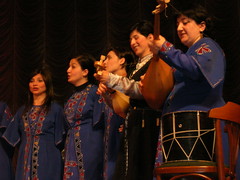
The Tutarchela Georgian Women’s Choir held its fifth anniversary concert at the Tbilisi Conservatory on May 29. Three generations of the choir performed various well-known Georgian folk songs from almost every region of Georgia.

Tutarchela is a very distinguished choir. Its repertoire mainly consists of historic Georgian male songs requiring a great deal of energy and emotion. The choir has now extended its range, not only singing but performing folk theatre.

Almost all the folk songs they sang at the concert were staged as plays, all the singers dressed in national costume, performing different Georgian national dances, and embodying different Georgian characters; daughter-in-law, mother-in-law, etcetera. A Kakhetian love song performed by the youngest members of the choir won great applause. The performances were staged by Rustavian film director Lekso Gelashvili.

All the singers have strong natural voices and at the same time sing with high and low registers. A vivid singer such as Nana Shanidze amazes spectators with her unique ability to sing and dance in a masculine way.

Tamar Buadze, the leader of the choir, says that this was the first year they had attempted to present their show as a series of folk plays. “We staged “Sashobao Alilo” here year with the male ensembles Rustaveli and Barakoni and it was a lively performance. I think it was very interesting,” she commented.

Buadze explained that in future the choir planned to stage other Georgian folk plays at the conservatory. She is very interested in staging a Georgian wedding feast, though this is rather hard work and may take some time. She added that in the near future they plan to arrange some Georgian compositons whichare close to folk songs in style and record Georgian lullabies. “We would also like to return doing to Lazic songs, as we started out performing them,” she explained.

The choir doesn’t have a choreographer and its members stage all the dances themselves. Even if Buadze composes a dance for a song, she always allows the singers to improvise on the basis of it.

Most of the members of the choir have a professional musical education and have graduated from Tbilisi State Conservatory. The group performs European and classical songs, folk songs from different countries and folk songs specific to all the regions of Georgia, including Abkhazia. Lazic folk songs take a very special place in the choir’s repertoire and are personally arranged by the head of the choir.

The choir was established at the beginning of 2004 in Rustavi and as the members of the ensemble say, it was their dream to give a concert in the Conservatory. “As our choir had been performing for five years and collected many folk songs, dances and plays and acquired our second and third generation of singers, we finally decided to conduct a concert here,” Buadze said.

In 2007 Tutarchela became a laureate of the Georgian folk festival National Inspection, where they won a prize for the best performance of Khaketian song “Tsangala”. The ensemble has held several concerts in Austria, Germany and different countries. Tamar Buadze said however that the concert at the Conservatory was the most special and exciting for them as most of the choir had graduated from there and their teachers had attended the concert.

By Rusudan Gvazava. (geotimes.ge)

Tuesday, March 17, 2009

ART: Maka Batiashvili Transforms a Bomb into a Bird (geotimes.ge)

What can a statue be made of? Bronze? Marble? Stone? Clay? Yes, but Georgian artist Maka Batiashvili has decided to use bomb shells.

“When everything calmed down after the war I contacted my friend David Andguladze, who was Deputy Minister of Culture, Monument Protection and Sport and was in Gori during the war, as I had the idea to create some installation made out of bomb fragments. I asked him if he had some which had fallen in Gori,” she recalls in an interview.

Andguladze revealed that he had a piece of a bomb which had fallen in the courtyard of Gori Theatre Batiashvili and had ben given it as a “present.” He gave this exploded bomb to Maka, who created her first installation - a “bird.”

“At first I did not know what I could make from it as it was not big, just 44 cm. across, and I also had a terrible feeling when looking at it as it had Russian writing on it,” the artist explained. However she suddenly saw a bird in it. Then she remembered that a bird is associated with peace and she wanted to create good from something evil.

Maka said the sides of the bomb fragment had taken the shape of wings and she didn’t need to change these, only the head and the tail. “I didn’t want to paint something on this theme because I wanted to express the war theme by means of an installation. This bird is not only a symbol of peace for me, but I imagined that when it fell its pieces fell like birds,” she said.

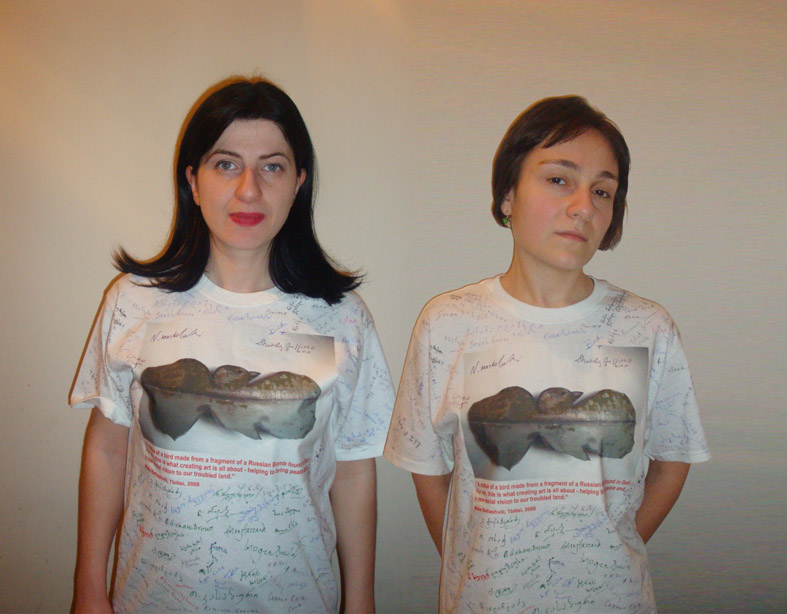
She was greatly surprised when people contacted her wanting to buy this figure and ironically the first prospective buyer was a Russian collector. But Batiashvili is not going to sell it. Furthermore, as this work got a great reaction from the public she didn’t want to advertise herself through something associated with trouble and war. Thus she kept it in her studio. However her bird was printed on T-shirts and sold in almost all the cities of England during a folklore festival. Many English friends contacted her as the organizers of the festival sold all the T-shirts and asked her for more. Later she was asked to present her “bird” in Norway at a peace festival.

Photo: Rusudan Gvazava & Maka Batiashvili

“When the emotions of the August war slightly receded I decided to send it to the festival in Norway,” she said. When the bird was being put on the plane Maka had a strange fear that her bird made out of a piece of bomb could blow up in the air and even consulted a military expert about this.

As for her sources of inspiration she says: “When I observe the world around me I am always under impression that the truth of life penetrates my mind and stays there forever.” She says life is an unending emotion which gives her the strength to create, and while working what is impossible becomes possible through art.

This year Batiashvili has an invitation to visit Lithuania and for one year she will be given an art studio and painting materials free of charge. She has not yet decided whether to go, but will certainly participate in different exhibitions held in Lithuania as this year Lithuania is the capital of culture.

She first participated in a foreign exhibition at Mama Cash Gallery, Amsterdam in 2005, where she displayed video work, and this was followed by a dozen invitations from other international galleries and festivals. In 2007 she participated in the East-West Festival, France with an exhibition of video works and photos, The Sunchild Film Festival in Yerevan, Armenia with “Force and Weakness”, The Washington Film Festival in Atlanta with “The Sorrowful Melodies of a Land filled with Sunshine,” The Spectrum Gallery in London in an exhibition of paintings by Georgian artists, and the Blumen Gallery in Leipzig where she held a solo exhibition. In 2008 she also participated in a film show in Wroclaw, Poland, called “The Nearest Mountain” and the Off Europa Festival in Germany, held a solo exhibition at the Georgian Embassy in London and exhibited photos at the Atlanta National Museum. Maka Batiashvili has also illustrated the book “Tell Us A Story” by Michael Berman.

Rusudan Gvazava, Georgian Times
2009.03.16 12:31

Tuesday, March 10, 2009

CULTURE: Polish Photographer Wins Prize for Documenting the August War (geotimes.ge)

Rusudan Gvazava (left on the photo), 2009.03.10 12:03
source: geotimes.ge

“I am a bearer of people’s stories,”
says Tbilisi-based Polish photographer Justyna Mielnikiewicz as I sit down with her to learn more about her experiences in Georgia. The way in which she bore the message about the August war victims to the world has brought her international acclaim.

Justyna Mielnikiewicz has been awarded second prize at the World Press Photo Competition in the category “People in the News” for her 12 photo storyboard about the August war. This competition is a 52-year old annual contest held in Holland which gives awards in ten categories.

The photographer submitted photos she took for the New York Times. Justyna worked in South Ossetia for three weeks, every day and night from 7 o’clock in the morning till 10 or 11 in the evening. She then edited the photos and chose 15-20 to send daily to the NYT. She was so exhausted that she could not sleep.

“It was so emotional to see so many people unhappy and in trouble, to see the war,” she says. Justyna took about 3000 photos of Georgia-Russia war in total.

Was it safe to shoot photos in South Ossetia? Of course not! Her friends and parents were worrying, telling her: “What are you doing? Are you crazy? Are you doing this to become famous?” Justyna says that she is not ambitious and war is just one of the areas where photographers have to work, but in fact she has already become a world famous photographer.

This year 62 photographers out of 5,508 who submitted portfolios made it to the final. The competition was judged over two weeks. Justyna says she did not expect to win a prize because there were so many contestants. "I was in Poland at my parents’ house and it was my father’s birthday. Suddenly my aunt told us that she had just heard on the radio news that I had been awarded a prize. I was so surprised and received a lot of congratulations," Justyna recalls.

Justyna headed for the war zone on her own initiative, without being given an assignment by a publication. The NYT contacted her asking for photos later, when she was already doing her job.

“When you are in the middle of a war you don’t have time to plan. You just move around, and whenever you see something going on you take photos. Sometimes I think what an idiot I was: I was likely to die but still had the instinct to take photos,” she said. Justyna is now enjoying peacetime in Tbilisi.

“Justyna Mielnikiewicz is an interesting photographer for everyone, and I think her photos are very similar to her character,” reads a review by German journalist Ralph Hälbig on georgien.blogspot.com. Hälbig describes her as a brave and direct person. “A big advantage is her intelligent cultural view of the immediate situation. She can see things in two or more ways,” he says. According to Halbig Justyna can very well capture complex situations in her work, balancing different aspects of everyday life, politics and strange moments in her pictures.

Though the World Press Photo Competition prize was not her first she says it is the most important she has ever earned. The best snaps from the World Press Photo Competition will tour the world and be exhibited in hundreds of places.

Justyna first came to Georgia in 2001 and in 2002 decided to stay here for one year. She has lived here ever since and worked as a freelance photographer for different foreign publications. She is a self-taught photographer. She originally graduated from the Faculty of Arts of the Jagiellonian Institue in Krakow, specializing in new media and film.

Thursday, September 04, 2008

LETTER TO THE EDITOR: My Open Letter in Georgian Times.

I was shocked and angry about the outbroken war ... In the night I wrote an open letter in my blog ... and now I could read the english version in the "Georgian Times" ... Thanks a lot to the editor Keti Khachidze and the journalist Rusudan Gvazava. Thanks also to Randall Caldwall for translating from"emotional" german into "emotional" english language .

pdf for better reading >>>

Wednesday, July 02, 2008

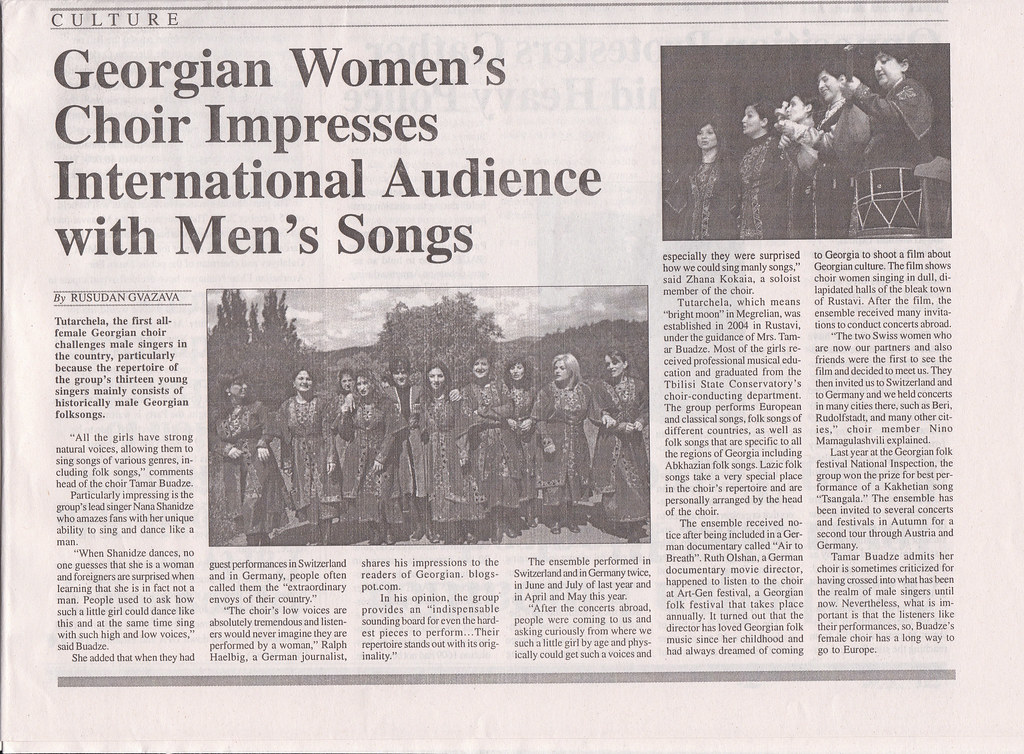
MUSIC: Georgian Woman’s choir impresses international audience with men’s songs

By Rusudan Gvazava

Georgian women’s choir an “extraordinary envoys of their country” abroad

“Tutarchela” is the first Georgian women’s choir that is throwing a challenge to male singers.

The first all female Georgian choir challenges male singers in the country, particularly because the repertoire of the group’s thirteen young singers mainly consists of historically male Georgian Folk songs requiring a great deal of energy and emotion.

“All the girls have strong natural voices, allowing them to sing songs of various genres, including folk songs,” comments head of the choir Tamar Buadze.

Particularly impressing is the group’s vivid singer Nana Shanidze who mostly amazes foreigners while abroad through unique ability to sing and dance like man.

“When Shanidze dances, no one guesses that she is a woman and foreigners become very surprised when learning that she is in fact not a man. People used to ask how such a little girl could dance like this and at the same time sing with such high and low voices,” told Buadze.

She also happily added that when they had guest performances in Switzerland and in Germany people often called them the “extraordinary envoys of their country”.

Those who had a chance to listen to attend their concerts are excited with their performance.

“The choir’s low voices are absolutely tremendous and the listener would never imagine it is performed by a woman,” Ralph Haelbig, a German journalist, shares his impressions to the readers of Georgien.blogspot.com.

In his opinion the group provides an “indispensable sounding board for even the hardest pieces to perform…Their repertoire stands out with its originality,” describes Haelbig.

The ensemble has conducted concerts in Switzerland and in Germany two times in June and July of last year and in April and May this year.

“After the concerts abroad people were coming to us and asking curiously from where we such a little girl by age and physically could get such a voices and especially they were surprised how we could sing manly songs,” said Zhana Kokaia, a soloist member of the choir.

“Tutarchela”(which means “bright moon” in Megrelian language) was established in 2004 in Rustavi, under the guidance of Mrs. Tamar Buadze. Most of the girls have a professional musical education and have graduated from Tbilisi State Conservatory’s choir-conducting department. The group performs European and classical songs, folk songs of different countries, as well as folk songs that are specific to all the regions of Georgia including Abkhazian folk songs. Lazic folk songs take a very special place in the choir’s repertoire and are personally arranged by the head of the choir.

The ensemble received a good promotion after being shot in German documentary called “Air to Breath”. Ruth Olshan, a German documentary movie director, happened to listen to the choir at Art-Gen festival, a Georgian folk festival that takes place annually. It turned out that the director loved Georgian folk music since her childhood and had always dreamed of coming to Georgia and shooting a film about Georgian culture. The film shows how choir women sing in dull, dilapidated halls of the bleak town of Rustavi. After the film was shot, the ensemble received many invitations to conduct concerts abroad.

“The two Swiss women who are now our partners and also friends were the first to see the film and decided to meet us. They then invited us to Switzerland and to Germany and we held concerts in many cities there, such as Beri, Rudolfstadt and many other cities,” one of the choir members Nino Mamagulashvili explained.

Last year “Tutarchela” became a laureate of the Georgian folk festival” National inspection” where they won a prize for best performance of a Khateian song “Tsangala”. The ensemble has been invited to several concerts and festivals in Autumn to abroad for Second tour through Austria and Germany.

Tamar Buadze admits her choir is sometimes criticized for having crossed into what has been the realm of the male singers until now. But what is important is that the listeners like their performance. So, Buadze’s female choir has a long way to go to Europe.

Monday, June 23, 2008

MUSIK: Article about Tutarchela in "The Georgian Times" - by Rusudan Gvazava

click on the pic for a larger version

www.myspace.com/tutarchelafromgeorgia

Source: www.geotimes.ge

Wednesday, May 28, 2008

FILM: Georgian cinema one hundred years old

By Rusudan Gvazava, Georgian Times , May 26

Georgia has been making films for one hundred years. Before the fall of the Soviet Union, Georgian cinema was known across Soviet blocs as being vibrant and creative. The Italian director Federico Fellini once described it as "a strange phenomenon, special, philosophically light, sophisticated, and at the same time, childishly pure.” But the economic breakdown which followed Georgian independence has made it very difficult to make films, although recently, experts say that quality Georgian filmmaking is beginning to return.

Georgian film production began at nearly the same time as European cinema. The first film festival took place in Tbilisi in 1896. In honor of the 100th anniversary of Georgian cinema, a number of exhibitions, festive events and showings of Georgian silent films have been planned. “A festive opening for Georgian cinema’s jubilee celebration will be held at Rustaveli Theater,” Nino Anjaparidze, a public relations department representative for the Georgian National Film Center, said, inviting the public to attend.

According to her, the Georgian filmmaking has begun to revive. “It turned out that the anniversary coincided with the 60 year anniversary of a well-known Georgian film Keto and Kote by Vakhtang Tabliashvili and Shalva Gedevanishvili,” Anjaparidze says.“

The film festival, will also consist of showing this film and we have newly reconstructed the film and a documentary about the period when this film was made is in the works by independent company ‘Kiono Project’ headed by Archil Geloavni,” stated Anjaparidze.

Experts widely consider 1908 the year cinema was born in Georgia, when film directors Dighmelov and Amashukeli made their first experimental shots. In 1912, Amashukeli shot the first full-length documentary movie, Akakis Mogzauroba [Akaki's Journey], about poet Akaki Tsereteli. The film was unparalleled by any other movie in world at that time as to its theme, length and artistic level. The first full-range feature film in Georgia, Kristine was shot from 1916 to 1918. The film was directed by Aleksandre Tsutsunava. In 1924 “Three Lives” by Perestiani was a great success - the film was the first attempt to provide psychological insight into the heroes.

In the mid 1920s, theatre, literature and art professionals came to the cinema. When Samanishvili's Stepmother (Marjanishvili) and Khanuma (Tsutsunava) appeared on the screen, they marked the beginning of a new genre of comedy film. Films of this period were very popular due to the first Georgian film star, Nato Vachnadze {from such films as The Story of Tariel Mklavadze, Who can Be Blamed, and others), the country's first silver screen diva.

Next came a period of new genres and style in the Georgian Cinema. One of the best representatives of the generation was Nikolai Shengelaia. Though he lived in Stalin’s epoch, watching his films we feel the directors active strive for innovation and artistic expressions in his films. Now, N. Shengelaias and N. Vachnadzes sons Eldar and Giorgi Shengelaia are also famous directors of the Georgian cinema.
The film My Grandmother by Kote Mikaberidze (1929) was also a crucial turning point for Georgian film. In this movie, for the first time in Georgian and Soviet cinematography, the principles of expressionism appeared.

The film was forbidden to appear on the screen, but many years later the film was restored and shown in La Rochelle. Soviet ideology was so pressing in the 1930s that little innovation took place. Only some films of the period were noteworthy: Siko Dolidze's Dariko (1936), David Rondeli's Lost Paradise (1937), and a few others.

Keti Dolidze a famous Georgian film director and a daughter of a well-known Georgian film director, says that she must congratulate the anniversary to the Georgian cinema in the past, and that nowadays, “Georgian cinema is in very bad condition because our government puts little money into cinema..

It is very difficult to revive after 15 years of falling and how can we overtake European cinema and even Russian cinema, as they have already produced 600 hundred movies this year because their government gives them enough money to produce films…

Businessmen will never put money into this field because if they put money in, they will have to pay more taxes on it,” Keti Dolidze claimed.
The 1970s is considered the Golden Age for Georgian cinema due to the works of directors such as Eldar and Giorgi Shengelaya, Otar Iosseliani, Rezo Chkheidze, Sergei Parajanov, and Tenguiz Abuladze, although this same period of time is also thought to be the most complicated period for Georgian Cinema. Film directors often had to use symbols, metaphors, and allegories to skirt Soviet regulations. Regardless of the influence of the soviet Union ideology, film directors from the 60-70s preserved the essentials that make up the Georgian cinema.

Chkheidze and his classmate Tenghiz Abuladze, a seminal figure in Georgian cinema, collaborated on several projects, and they directed their first feature film Magdanas Lurja [Magdana’s Donkey] in 1955, which won the 1956 Golden Palm award for best fiction film. The films of this period followed the principles of neo-realism aesthetics. Abuladze's artistic cinematography and metaphorical thinking is further developed in his films A Tree of Wishes (1976) and Repentance (1984). Repentance turned out to be the most important piece of art of the 1980s in Georgia, also known as the ‘perestroika’ period.

Mimino is a 1977 film by Georgian director Giorgi Daneliya made on Mosfilm, starring Vakhtang Kikabidze and Frunzik Mkrtchyan. It is a Soviet Era comedy, which won the 1977 Golden Prize at the Moscow International Film Festival. The writer/director Georgi Danelia and his co/writer, Victoria Tokareva created a funny, insightful, and at times, sad story with real, earthy, decent, and very human heroes.

Short films have an original and peculiar place among Georgian films and the first master of this genre was Michael Kobakhidze, who built silent miniatures according to the principles of sound film. His film Wedding (1965) won the Grand Prize at Obesrhausen. And Umbrella (1967) won Grand Prize in Krakow. His first film was Alaverdoba (1963).
Several film makers moved abroad in the 1980s 90s, including Otar Iosseliani (April, Cast Iron, There was a Singing Bird (1971), The Pastoral (1976)) Dito Tsintsadze, and Temur Babluani. Other directors, who stayed in Georgia, like Dato Koteteshvili and Gogita Chkonia has just begun to make their mark when the entire film industry – and their careers- came to an abrupt halt. In 1972, a faculty of Cinema was opened in the Tbilisi Rustaveli Theatre Institute, and later the institute was named The Tbilisi Theatre and Cinema Institute.

In the opinion of Gaga Chkheidze, deputy director of the Georgian National Film Center, one of the main problems facing Georgian cinema today is the professionalism of film directors and producers. “I think that we need a producer’s company and more schools in Georgia because it seems that our commission considers new films as less professionalism and producers are the main people shooting films; he finds a film director and conducts all the process himself. Also, film directors during the last decades faced not only money problem but also creative issues,” commented Chkheidze on the present situation of Georgian film has been lifting since 2005. “Now, we receive finances from the government every year, though it is still not much money for cinema. It equals one million and seven hundred lari and this one million more, compared to last year,” Chkeidze said.“

During Shevardnadze period, there were many promises unfulfilled. So that I think that the crisis is over, we also have a commission which holds a competition every year for film project and the winners receive finances shooting their films. Cinema receives too little attention nowadays, and I think it must be first on the list of finances from the government. For example Russia gives films nearly 0.2 percent of its budget,” Chkeidze said about the difficulties in producing films in Georgia in recent years.

But, he also praised the fact that even in the tumultuous period after independence, some films were made: “You might be surprised, but in that period, 60 films were shot even though many of them are not known for people.”Although Georgian cinema has received little world recognition recently, two films in particular are now thought to mark a revival of Georgian cinema Tbilisi-Tbilisi (2005) by the late Levan Zakareshvili and The Roof by Rezo Esadze, both of which took several years to complete. Before his death, Zakareishvili said that the reason his film took so long to complete was because “as soon as the government found out what the script was about, the sequesters began. When there was money, they used to say, ‘It is not for you, you have to wait.’ Six years passed in torture. Due to my tense relationship with the Shevardnadze government, the film took six years to shoot.”