Saturday, May 12, 2007

SCIENCE: Icebergs in the caucasus

By Meyer, Karl E
Publication: World Policy Journal Date: Summer 2001


Georgia seems an archetypal case. That it even exists is cause for wonder. Its four to five million inhabitants speak an ancient language of enigmatic origin, using a script resembling macaronic shorthand that has endured with little change for eleven centuries. Following the conversion of King Mirian III in A.D. 337, Georgia became the world's second Christian state, Armenia being the first. Georgians preserved their distinctive culture despite conquest and colonization by Greeks, Romans, Mongols, Byzantines, Persians, Arabs, Turks, and Russians. These earlier subjugations culminated, after a brief interlude of independence from 1918 to 1921, in Georgia's forcible absorption into the Soviet Union, an operation supervised by its fiercest son, Joseph Stalin.
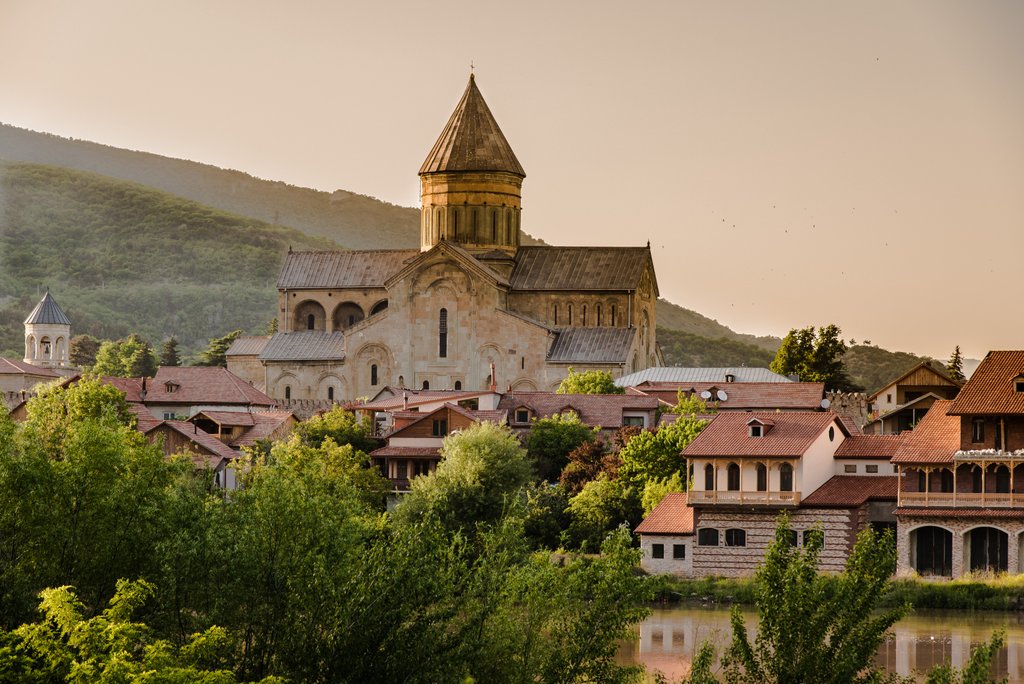
It is a history imprinted on the face of Tbilisi, the Georgian capital since the twelfth century. On encircling hills rise ancient cone-roofed churches: squat stone structures that look like and indeed served as forts. On the main avenue, named after the national poet, Shota Rustaveli, an ugly Soviet-era hotel houses Georgians displaced in unresolved civil conflicts, their laundry flapping on the balconies. Down the street in the history museum, amazing golden artifacts of pre-Christian cultures gleam in the crypt (this was the land of the Golden Fleece), but the museum's other galleries are dark for want of funds. In the art museum, an impressive cache of Persian Qajar portraits is a memento of dominion by the Peacock Throne. Nearby is a blank spot on the wall where a now-missing plaque recalled that Stalin studied theology in the same building, formerly a seminary. Passing heroic statues of medieval rulers, including the formidable Queen Tamar, a visitor wanders through a cramped old city filled with crumbling wooden houses; incongruously followed by two McDonalds, a Sheraton Hotel, agencies supplying cellular phones, internet cafes, and Prospero's, a popular English-language bookstore. The city is a palimpsest; its epochs and influences piled on top of each other.

More:
full article >>>

Source: www.allbusiness.com

SCIENCE:
The Forest Philosophers
by C. E. Bechhofer Roberts

Journalist Carl Eric Bechhofer Roberts first met Gurdjieff in Tiflis in 1919. His In Denikin's Russia and the Caucasus, 1919-1920, contains the first description of Gurdjieff published in English. He warmly recounts being guided by Gurdjieff on an unusual tour of Tiflis, especially the baths and restaurants. Roberts notes that this "curious individual named Georgi Ivanovitch Gurdjieff… was still surrounded by this strange entourage of philosophers, doctors, poets and dancers. He was not exploiting them; on the contrary, several of them were living on his diminishing means.


A Journey Through Georgia
C. E. Bechhofer Roberts

Journalist Carl Eric Bechhofer Roberts, spoke Russian and travelled widely in Russia and the Caucasus. He was acquainted with Ouspensky as a fellow journalist, when he went to report on conditions there in 1919. Roberts describes a series of engaging meetings he had with “a curious individual named Georgiy Ivanovich Gourjiev” as well as an informed assessment of the volatile social and political situations he encountered throughout the Caucasus. His skeptical but admiring observations provide the first published account in English about Gurdjieff, who gave Roberts an insider’s tour of Tiflis. Excerpted from Robert’s In Denikin’s Russia and the Caucasus, (1921).

More: Excerpted (pdf)

SCIENCE:
Reinventing the Caucasus
By de Wall, Thomas
Publication: World Policy Journal Date: Spring 2002
Location: Armenia, Azerbaijan


Thomas de Waal is Caucasus editor for the Institute of War and Peace Reporting. His book, Black Garden, on the Armenia-Azerbaijan conflict, will be published by New York University Press later this year.
In the winter of 1919 and the spring of 1920, the British journalist C. E. Bechhofer traveled around southern Russia and the southern Caucasus. His In Denikin's Russia and the Caucasus, 1919-1920 is a classic and terrifying account of a region imploding. The White armies' resistance to the Bolsheviks was crumbling and the newly independent states of Georgia, Armenia, and Azerbaijan were falling apart. Bechhofer witnessed floods of refugees, famine, typhus epidemics, and terrible massacres by all sides.
Bechhofer, a fellow freelancer, was an inspiration and guide for me as I spent much of 2000 and 2001 traveling through the south Caucasus and doing research for a book on the conflict between Armenia and Azerbaijan. Experiencing independence anew in the 1990s, the three Caucasian countries went through a depressingly similar descent into chaos and self-destructive nationalism. Ten years into their second round of independence, it frequently felt as though I was studying the sequel of the same conflicts Bechhofer had observed 80 years before. At the same time, I shared his love and excitement for a region that can be dangerous but is never dull. As he assures us in his foreword: "[L]est the reader should come to these pages in too gloomy a spirit, I venture to assure him that many of the incidents of Caucasian life during the past three years belong as much to the world of opera bouffe as to history." 1

Full Text: Reinventing the Caucasus

Notes
1. C. E. Bechhofer, In Denikin's Russia and the Caucasus, 1919-1920 (London: Collins, 1921, reprinted by Ayer, Salem, N.H., 1992), p. x.
2. Lucian Pugliaresi, Energy Security: How Valuable Is Caspian Oil? (Cambridge: Harvard University Caspian Studies Program, January 2001).
3. Bechhofer, In Denikin's Russia, p. 44.
4. Nazarbayev, interview in Nezavisimaya Gazeta, February 24, 2000, quoted in Radio Liberty's Caucasus Report.
5. For a stimulating discussion of the issues raised by the separatist statelets, see Dov Lynch, "Frozen Conflicts in Eurasian Security," The World Today (London), August/September 2001.
Map (Azerbaijan and Armenia)

Source: www.allbusiness.com

Friday, May 11, 2007

INTERNET:


CULTURE:
The Artist ELENA AKHVLEDIANI

Elena Akhvlediani, just as the other artists of her generation - David Kakabadze, Lado Gudiashvili and Keto Magalashvili - started her works in the early decades of the twentieth century. These masters' achievements, based on the legacy of national and European cultures, have largely determined the distinctive features of Georgian art and have not lost their importance to this day.
The interests of Akhvlediani were diverse and included painting, drawing, stage and costume design, and book illustration. But she has gone down in the history of Georgian art as, above all, a master of genre and lyrical landscape painting. Especially prominent in her artistic legacy are the views of Tbilisi, the city in which she had lived many years, which she loved as her own, and to the preservation of whose historical peculiarities she had given much of her energies.
The artist's studio, in one of the Tbilisi twisting streets, was indeed a cultural center. The place where artists, actors, musicians, poets and her numerous friends often gathered.
The character and inclinations of Akhvlediani had formed in her childhood and had little changed with the passing of time.

Longer Text: read more >>>

SCIENCE:

Flora of the Caucasus Region


The New York Botanical Garden in collaboration with the Institute of Botany of the Georgian Academy of Sciences is working on a project to document the flora of the Republic of Georgia and strengthen the capacity for botanical science in this floristically important part of the world.

The Caucasus Region, encompassing the entire country of Georgia and parts of neighboring Turkey, Russia, Armenia, and Azerbaijan was named one of the world's 25 biodiversity hotspots by Conservation International. Nearly one third of the flora of Georgia, comprising some 4400 species, is of special conservation concern. Many of these endemic, rare, threatened, or vulnerable plants are at risk of extinction if adequate measures are not undertaken to protect them and the ecosystems they inhabit.

A checklist of these important plants was compiled by scientists from the Institute of Botany in Tblisi and staff from Missouri Botanical Garden.


In August 2001, under the direction of Dr. Dennis Stevenson of The New York Botanical Garden, collections of Georgian plant material for floristic, systematic and phytochemical study began. These and other specimens from Georgia, housed in the Garden's William and Linda Steere Herbarium, are being databased and imaged to create this catalog. In addition, we are providing infrastructure support and training, as well as hardware and software that will enable our Georgian colleagues to begin databasing and imaging specimens from Herbaria within Georgia. The specimen data from these areas, combined in this catalog, will be accessible to Georgian researchers and to the worldwide scientific community.

To search the Flora of the Caucasus Catalog by the name of the plant (family, genus, species, or subspecific epithet), author, collector, collector number, barcode number, or type status, use the Basic Search box below. To search one or more specific fields in the database, choose the Detailed Search. further >>>

CULTURE:
Zedazeni Monastery
In The Saguramo Nature Reserve
Photo and Text by Paata Vardanashvili

To the north-west of Mtskheta on the top of Saguramo mountain ridge, the outlines of the Zedazeni Monastery are seen. The chronicler says it was founded by St. John, the leader of Thirteen Syrian Fathers. Here the first church building is dated of the 6th century. Earlier there stood a pagan idol of Georgia - Zaden (the idol of war). The Zedazeni Ridge was named after it as well as the monastery - the Zedazeni Monastery. In the Middle Ages the monastery was an important center of literary activities. Later it played an important role as a fortified castle for defense.The road to the Monastery passed Saguramo. It winds up through deciduous wood as if making a horizon line with the sky with the fence wall.
Zedazeni is the most beautiful place to have a look over the surroundings, most beautiful with then carpet of deciduous trees up to the Djvari Monastery. A narrow line of the river Aragvi sparkles like silver below. Blue surface of the Tbilisi Sea resembles emerald. A thin mist surrounds the environment like a dream.

More To The: Saguramo Nature Reserve (Is located in the East part of Georgia, Mtsketa district. (...) There are no rivers in the reserve. But there is a lot of springs and brooks there.
There are a lot of historical monuments in the reserve: Mtskheta Jvari (VI c.) Zedazeni Monastery (VIII c.), Goris Ubani, Kasauri church, Aguri church, Nadarbazevi ect. There is a museum of Ilia Chavchavadze in the village Saguramo near the reserve.
)

NEWS:
Georgia News Digest 05-11-07
Attached PDF file easily navigable with Bookmarks pane
Archives and associated files at groups-beta.google.com/group/genews/files

1. United States and Russia: In a "State of Mutual Disenchantment" [excerpt]
2. Europe's Role in the World [excerpt]
3. Get Out of Europe; Avoid a New Cold War [excerpt]
4. Tbilisi Says Russian Planes Violated Georgian Airspace
5. book review: For the love of Lenin
6. Will Sarkozy Pick a Fight with Moscow? [excerpts]
7. Polish, Georgian presidents upbeat on cooperation
8. Georgian-Estonian Business Forum and Mutual Love Fest: Saakashvili continues to look to the Baltics for inspiration
9. Georgian President Wants Estonia's Laar To Continue As Adviser
10. “Democratic Countries Must Stand Together” Estonia and Georgia declared solidarity to each other
11. Press summary for Georgia's breakaway region of Abkhazia 1- 7 May 07
12. Abkhazians weary of Georgian pig infection
13. Sanakoev Appointed as Head of S. Ossetia Administration
14. Tskhinvali’s Interim Administration: A Peaceful Way-Out?
15. A Note on South Ossetia: “Profit by instability and lack of territorial integrity”
16. U.S. 'Encourages Constructive Dialogue' over S. Ossetia
17. Will Georgian-Ossetian Negotiations Take Place?
18. Pro-Georgian South Ossetian leader gets official status
19. Saakashvili appoints Tskhinvali region administration head
20. Separatists' block central highways in conflict zone Stay tuned-and that's an order
21. Tskhinvali Says it Closes Down Roads in Conflict Zone
22. We Write "South Ossetia," We Read "Samara"
23. Will Georgian-Ossetian Negotiations Take Place?
24. De facto law enforcement bodies detain Minister of Refugees and Resettlement for one hour
25. Foreign ministries of South Ossetia and Transdniestria congratulates NKR Foreign Ministry on May 9 Victory Day
26. Georgia Falls Into Ossetian Encirclement: Eduard Kokoity Has Decided to Boycott Georgian Villages
27. Radio “Alania” Starts Broadcasting
28. Georgian Public Broadcasting Published 2006 Full Report
29. Ministry of Defense Leased TV-33
30. Ministry of Defence to launch 'patriotic' TV station
31. Stay tuned-and that's an order
32. Victory Day a Time to Ponder Battles Past and Present
33. Zugdidi Journal: Celebrating Victory Day
34. Saakashvili’s Big Independence Day in Adjara New hotels, song and dance, building projects, and a factory 35. Protestors demand Saakashvili's resignation
36. Nature became as crazy as people: The areas of deserts are expanding
37. Three Bears' Story
38. Sheep and poverty – the modern interpretation of the fable
39. Mystery pig disease strikes western Georgia
40. Military Training Damages Population
41. Whose Plot Is Georgian Army Located on?
42. Non-governmental Organizations Protest Violence on Juveniles
43. Human Rights Centre Blames the Chairwoman of the Telavi District Court for Blatant Violation of Human Rights
44. Patrol Police Harasses Press Distributors in Kakheti
45. Irakli Batiashvili's trial to finish soon - defence lawyer
46. A More Liberal Response to Drug Abuse: The philosophy of harm reduction is slowly finding more advocates
47. Change Begins At The Border
48. Forum on Vocational Education Reform within the ENP
49. EU Migration: Issues and Numbers
50. Annual inflation decreases to 8.1 percent
51. Opposition economist accuses Bendukidze of overseeing Russian annexation of Georgia's economy
52. Tbilisi Philharmonic Hall to be privatized
53. New Rights MP says Tax Department fining businesses illegally
54. Central Bank Chief Under Fire
55. Tbilisi City Hall Promotes Small Business Growth
56. The Return of the Konka: Innovative Entrepreneur Resurrects Form of 19th Century Transport
57. A Scheme to Get the Small Fries Involved in Real Estate Speculation
58. Strong acts make Eurovision final [excerpt]
59. Increased Breast Size Linked with Raised Self-esteem
60. California Diary: Surf and Turf
61. High Culture at the Diner: Keeping Classical Music Alive: The guys who supply the Paganini with your khinkhali


full digest: Georgia News Digest - Ansicht in Groups BetaNeu!

Jonathan Kulick, Ph.D., Director of Studies, Georgian Foundation for Strategic and International Studies, 3a Chitadze, Tbilisi 0108, Georgia (Republic), jonathan.kulick@gfsis.org, office: +995 32 47 35 55, mobile: +995 95 33 33 40, USA voicemail: 310.928.6814
CULTURE:
Writings about Georgia by Joe Kagle

A Fish Without A Bicycle

Feeding the Flame: Wonder and Joy in the Caucasus : Art Villa Garikula

AN AMERICAN SUPRA or Drown, Swim or Fly
A Fulbright Scholar’s Journal: Georgia, 2001-2002
Preparing To Be A Fulbright ScholarorLuck Comes To Those Prepared

AN AMERICAN SUPRA, Part Two or Drown, Swim or Fly
First Days and An International Artist’s Workshop in Kutaisi, Georgia

AN AMERICAN SUPRA, Part Three or Drown, Swim or Fly
Fulbright Scholar in Tbilisi and Other Cities After September 11, 2001

AN AMERICAN SUPRA, Part Four or Drown, Swim or Fly
Christmas In America, Return to Georgia, Teaching, Projects, Grants, Lectures, People,Events and “Joe and Friends”, an April Exhibition

AN AMERICAN SUPRA, Part Five orDrown, Swim or Fly
Turning Back To See

Here are the links:
2000 - 2004 : New View Mature Work
A Fish Without a Bicycle
A Place of Wonder and Joy in Garikula
American Supra, Part One
American Supra, Part Two
American Supra, Part Three
American Supra, Part Four
American Supra, Part Five

A SPIRITUAL ODYSSEY A Life of Creativity, Work, Study and Collecting
Joseph L. Kagle, Jr. The Writings of Joe Kagle
http://wacoart.com/writings.htm

http://wacoart.com/home.htm

SCIENCE:


Image of the week
Earth from Space: Georgia’s diversity

This image image was acquired by Envisat's Medium Resolution Imaging Spectrometer (MERIS) instrument on 26 February 2007, working in Full Resolution mode to provide a spatial resolution of 300 metres.


Source: www.esa.int

LITERATURE:
102 years old,
Lesley Blanch dies on the last Monday


She was world-known as writer, traveler and adventure-seeker. One of Ms. Blanchs well-known book is the “The Sabres of Paradise”, a life of Imam Shamyl, a 19th-century Muslim leader in the Caucasus who fought off Russian encroachment there ...

More in the nytimes.com: Lesley Blanch, an English writer and traveler best known

By MARGALIT FOX Published: May 11, 2007

For lots more on Lesley Blanch, visit LesleyBlanch.com.

Lesley Blanch Obituaries News Telegraph Lesley Blanch, who died on Monday aged 102, was the author of The Wilder Shores of Love, an enduringly popular account of the romantic fulfilment that four 19th-century European women found in Arabia; but her most romanticised creation was Lesley Blanch herself.

Lesley Blanch Obituaries Guardian Unlimited Books Lesley Blanch, writer, adventurer, journalist and fellow of the Royal Society of Literature, has died aged 102, leaving us 11 highly coloured volumes of ...

PHOTOGRAPHY:

Free Woman In Azerbaijan

So this statue called the "Free Woman" is in front of the Iran Bank Building. The woman is apparently "liberating" herself by taking off her traditional cloak.

Uploaded on May 10, 2007 by Sahil Warsi

VIDEO:
Insight with Tony Wood and Tom de Waal: Independence for Chechnya?

Tony Wood, Assistant Editor at the New Left Review, and Tom de Waal, IWPR Caucasus Editor, discuss whether independence from Russia is the best way forward for Chechnya.

The event took place in London on April 10 2007: Watch it here >>>

Thursday, May 10, 2007

PHOTOGRAPHY:
The Coast Of The Black Sea
Kobuleti, Adjara, Georgia Sakartvelo

Uploaded on February 4, 2007 by Gizo Bliadze

SCIENCE:
The rivers of the Black Sea
Technical report No 71
by Shalva Jaoshvili
This document presents the result of a study of the discharge of river water and river load into the Black Sea. The volume of river water and load is investigated by individual river, by region and in total over the whole sea. The data used here came from hydrometric observations, field studies and calculations.

This book is intended for Black Sea researchers - geographers, geologists, hydrologists and oceanologists.
Editors:
Professor I. Khomerki, Doctor of Technical Sciences
Professor G. Gigineishvili, Doctor of Geographical Sciences
Professor A. Kordzadze, Doctor of Physics and Mathematical Sciences
Contents

Introduction .....................................................................................................................3
1. River-estuary-sea: a unified natural system ......................................................... 5
2. Natural features of the black sea coastline ............................................................. 9
3. coastline and estuaries ............................................................................................ 16
4. Volume of river discharge into the Black Sea....................................................... 28
5. Freshwater balance of the Black Sea .................................................................... 36
6. River loads discharged into the Black Sea ........................................................... 38
Conclusions ................................................................................................................... 49
References .................................................................................................................... 51

Introduction
The Black Sea, or the Euxine Sea or Pontus Axeinus as it was known in antiquity, is one of the cradles of civilisation. The history of mankind is deeply rooted in its shores. It has always been a lodestone for travellers and researchers because of its strategic position and the richness of its natural resources. The Euxine Sea was well known to the peoples of the eastern Mediterranean littoral. The first records we have of the Pontus Axeinus date back to the 5th century BC. The voyage of Jason to Colchis is described with a fair degree of verisimilitude in the myth about the Argonauts, which began in the 13th–14th centuries BC, and there is a description of the Euxine Sea in Homer’s Odyssey. Herodotus, Strabo and Ptolemy have left us a host of meticulously collected information, and a detailed description of the shores and estuaries can be found in Polybius’ Histories (201–120 BC) (6, 109, 115).
Proper hydrographic study of the Black Sea was begun at the end of the 18th century. The first accurate charts of the entire sea were drawn up in 1825–36 by Captain Mangarani, and Black Sea navigational directions were published in 1851. Comprehensive studies of the Black Sea, its shores and waters, were begun in the second half of the 19th century (43,115).
The Black Sea is now one of the most studied of all the marine basins on our planet. This has engendered a requirement for more precise data from additional research such as the balance between water and river load, sediment formation and a wide range of other subjects. The situation has been made more complex in recent years by the ever-increasing level of pollution, with its links to the outflow of water and river load from the surrounding landmass.
Interest in the Black Sea stems not just from its strategic position and the biological richness of its waters. It is also of great economic significance internationally. The economic role of the Black Sea has increased over recent years since, after the disintegration of the Soviet Union, six Black Sea littoral countries (Bulgaria, Georgia, Russia, Rumania, Turkey, Ukraine) reasserted their interest in these waters. Of prime importance to the Black Sea economy is the transportation of cargo, locally and as part of the ancient Silk Route, and the
production and transportation of oil. The need to transport oil has driven the recent expansion of the existing ports and there are plans for new ports to be built.
There are many industrial and military sites located around the Black Sea. Moreover, the Black Sea was, in the recent past, an important resort and holiday destination - a fact which must not be lost sight of. While this role diminished throughout the 1990s, the Black Sea resorts and recreational areas have once again begun to attract tourists.
The international Black Sea Economic Cooperation Area (BSEC), comprising the six littoral States and Azerbaijan, Albania, Armenia, Greece and Moldova, was set up in 1992 to exert some control over these complex economic issues.
All these circumstances give support to the conclusion that a new approach to Black Sea issues is necessary, one which will entail meticulous study of the sea’s biology, all the more urgent now as human life has more and more negative impact on the already poor ecological condition of the sea.
This new raft of work will attempt to quantify the amount of river discharge — water and load — disgorging into the Black Sea. Much is expected from a study at this level. The aggregate amount of fresh water entering the sea is still known only approximately; precise information is long overdue. New data from hydrometric observations and research over recent years has enabled more precise figures to be calculated for the amount of river water entering the Black Sea; these calculations have included the effect of artificial control of the flow.
River load is the factor least studied, in the Black Sea as in other regions. There are other associated issues here, too, such as erosion of riverbanks, artificial beach formation, pollution of the sea etc. These issues are particularly topical now, when shoreline retreat, caused by a decreasing amount of bank-forming deposits, has become irreversible, and are played out against a background of observable increase in the ocean levels worldwide, with pollution in the Black Sea already reaching threatening level. Accurate quantitative assessments of river load reaching the sea are also necessary for any proper research into current sediment formation processes on the sea bottom.
It must also be remembered that the virtually locked water basin of the Black Sea is many ways similar to an ocean, especially in the relation between river load distribution and deposition. Given its more favourable conditions and the less extensive scope of work involved, the Black Sea can be regarded as a natural laboratory (110).
In recent years, with ‘new times’ entering the political situation, the spirit of new times has entered the Black Sea research arena, too, and investigations have become international in character. A Black Sea Regional Committee (BSRC) was set up in 1996 under Unesco’s Intergovernmental Oceanographic Commission, tasked with coordinating and intensifying scientific research on the Black Sea. One of its key projects (pilot project 2: Black Sea sediment fluxes) conducts research into flows of river load into the sea, and our document is part of this project.

PHOTOGRAPHY: Shkhara - The highest pick in Georgia, Upper Svaneti

CULTURA:
SU ALTO
GEORGIA
regia: Nicolai Drozdov
soggetto, sceneggiatura, fotografia: Beno Kashakashvili
attori: Beno Kashakashvili, Afi Gigani, Gela Otarashvili
produzione: BENO KASHAKASHVILI, Tiblisi
video, colore – 19‘

Il regista. Drozdov è nato in Georgia nel 1964. Laureato in Ingegneria dei metalli, è Presidente dell’ Associazione Alpinismo e Arrampicata della Georgia e vice-Presidente del “Caucasus Digital Network”. È alpinista dal 1983 ed ha scalato più di 120 cime, tra le quali: McKinley (6193m), Aconcagua (6962m), Everest (8848m), Ushba (4477m), Shkhara (5200m), Pic Karjenevski (7134m), Pobeda (7439m). Tra i film da lui diretti si ricordano: “Everest-Caucasus ‘99”, premiato al Film Festival della Montagna di Mosca; “McKinley”, “Chatin”, “Rendez-vous with El Capitan” (premiato al Film Festival di Mosca), “The most northern seven thousand summits”.
Il film è dedicato alla memoria del famoso alpinista georgiano Mikhail Khergiani che aveva anche ottenuto il massimo riconoscimento che l’ex Unione Sovietica usava attribuire. Le vie tracciate da Mikhail nel Caucaso, nelle Alpi e nel Tien Shan sono tuttora popolari tra gli alpinisti “professionali”.
Mikhail Khergiani perì nel 1969 durante la sua seconda salita sulla via Gabriel-Livanos che fu ripetuta dagli alpinisti georgiani nel 2001 e fu oggetto di un documentario. Il rispetto che gli italiani hanno mostrato nei confronti di Mikhail è provato anche dal fatto che il Club Alpino Italiano ha messo materiale di archivio a disposizione dei realizzatori di questo documentario.
The film is dedicated to the memory of the famous Georgian alpinist Mikhail Khergiani who received the maximum recognition the former Soviet Union used to award. The first ascents made by Mikhail in the Caucasus, in the Alps and in Tien Shan are still popular with ‘professional’ alpinists even today. Mikhail Khergiani died in 1969 during his second climb of the Gabriel-Livanos route that was repeated by Georgian alpinists in 2001 and is the subject of a documentary film.
The respect Italians have for Mikhail is proved by the fact that the Italian Alpine Club placed material from its archives at the disposal of the filmmakers for this documentary.


Source: http://www.mountainfilmfestival.trento.it/pagine/ita/2002/file/opere.pdf
NACHRICHTEN:
Beziehungen Deutschland Georgien:
Neue Beziehungen zwischen Brandenburg und Adscharien

(PR-inside.com 10.05.2007 00:16:17) - Auf Initiative der Brandenburgisch-Georgischen Gesellschaft e.V. besucht noch bis Freitag eine adscharische Parlaments- und Regierungsdelegation das Land Brandenburg. Adscharien ist eine autonome Republik des Staates Georgien.

Gestern traf der Vorsitzende des adscharischen Parlaments Mikheil Makharaze mit dem Präsidenten des Landtages Brandenburg Gunter Fritsch zusammen. Während des Gesprächs, an dem auch der neue Botschafter der Republik Georgien in Deutschland Levan Duchidze teilnahm, sicherte Fritsch dem jungen Parlament Adschariens allseitige Unterstützung zu. Insbesondere auf dem Gebiet der Haushaltskontrolle und der Budgetierung wolle man die georgischen Kollegen zukünftig unterstützen.

Der ganze Text: An der Universität Potsdam vereinbarte die Delegation bei einem Gespräch mit der Präsidentin der Uni Prof. Dr. Kunst und dem Leiter des Lehrstuhls Finanzwissenschaften Prof. Dr. H.-G. Petersen die Kontakte zwischen der Potsdamer Uni und der Universität in Batumi auszubauen.

Presse-Information: Brandenburgisch-Georgische-Gesellschaft e.V. Potsdam, Potsdam

Kontakt-Person: Jens Ullmann Presse/Medien

E-Mail: e-Mail Web: http://www.georgien.cabanova.com

NEWS:
Georgia News Digest 05-10-07
Attached PDF file easily navigable with Bookmarks pane
Archives and associated files at groups-beta.google.com/group/genews/files

1. Pesident Toomas Hendrik Ilves at Tbilisi State University
2. A Blank Check for Tallinn [excerpt]
3. Parliament Passes Resolution in Support of Estonia
4. Georgia follows Estonia's course
5. Estonian president on second Georgian visit in six months
6. Russian Radio Pundits Differ Over Policy Towards Former Soviet Republics
7. US has welcomed a joining of eight states to the Global Initiative to Combat Nuclear Terrorism
8. Georgia president to visit Poland May 10-12
9. Saakashvili to Attend Energy Summit in Poland
10. Czech PM to Visit Georgia
11. Georgia interested in deepening economic relations with Japan
12. My friend Nicolas Sarkozy
13. South Ossetia denies ownership of anti-aircraft gun found in conflict zone
14. Georgia reports shooting in South Ossetia ahead of planned concert
15. Georgian minister condemns shooting in South Ossetia
16. Georgian leader, speaker discuss plans for South Ossetia administration
17. OSCE Chairman Condemns Threats Against Observers in S. Ossetia
18. The traffic of Tskhinvali has been blocked by the Kokoity Government
19. State minister comments Nikozi incident
20. Incident occurred in conflict zone
21. OSCE condemns separatists' activities
22. Kokoity threatens to pull out of talks
23. Vakhtang Kikabidze holds concert in South Ossetia on Victory Day
24. Georgia, Abkhazia celebrate VE-Day
25. Georgian scholars protest against new text-book
26. Students preparing to meet former hostages
27. book excerpt: Stalin In Love
28. book review: Socialism in Georgian Colors: The European Road to Social Democracy 1883–1917
29. Faded Colors: Some press gains are reported in Georgia, Ukriane, and Kyrgyzstan [excerpts]
30. Opposition MPs in Austrian mistaken identity "misunderstanding"
31. Opposition MP Quits Inter-Faction Group on Property Issues
32. Opposition voices political demands
33. Opposition will held the protest action in front of the House of Parliament
34. Opposition begin quitting inter-factional group
35. 'Social issues' protests continue
36. Prime minister holds first session of government after operation
37. Reception for veterans held at Tbilisi City Hall
38. Georgian WWII Veterans Mark Day of Victory
39. NGOs promote family planning awareness
40. Central Bank Chief Reports on Inflation
41. No inflation danger from increased budget-government
42. President visits Guria region
43. Robbery suspects arrested: Interior Ministry official Irakli Bazerashvili has reported the details
44. Georgian Conservatives happy with their colleagues' success in France
45. MoD Leases TV Channel to Promote Army
46. Raid in Kutaisi
47. Sport Palace has new manager
48. Differentiated tariff to be imposed on water, public transport
49. Georgians don't trust court system


full digest: Georgia News Digest - Ansicht in Groups BetaNeu!

Jonathan Kulick, Ph.D., Director of Studies, Georgian Foundation for Strategic and International Studies, 3a Chitadze, Tbilisi 0108, Georgia (Republic), jonathan.kulick@gfsis.org, office: +995 32 47 35 55, mobile: +995 95 33 33 40, USA voicemail: 310.928.6814
KULTUR:
01. Juli 2007
XVII. INTERNATIONALE SOMMERFESTSPIELE BENSHEIM-AUERBACH


THE SHIN "EgAri"
Eröffnungskonzert und Tipp der Spielzeit
Festspiel Auftakt: Die Magie des Kaukasischen aus Georgien...

Ein grandioser Wurf: Zum Auftakt zelebrieren THE SHIN aus Georgien – vormals als ADIO bereits 1996 mit einem denkwürdigen Konzert bei den Festspielen auf Schloß Auerbach – mit der spezifischen Magie des Kaukasischen ein spektakuläres Erlebnis für Auge und Ohr . . .
Das außergewöhnliche Projekt „EgAri“ (JARO 4278-2) feierte im Herbst des vergangenen Jahres in Anwesenheit des georgischen Ministerpräsidenten vor mehr als 800 begeisterten Zuschauern im ausverkauften Rustaveli Theater Tiflis eine umjubelte Premiere und sorgte in der internationalen Fachwelt derart für Aufsehen, daß Einladungen zu zahlreichen Festivals in ganz Europa erfolgt sind. Das überwältigende akustisch-visuelle instrumental theatre, das die besten Musiker, Sänger und Tänzer des Landes zusammenführt, repräsentiert einen einzigartigen Beitrag zur Musikentwicklung am Beginn des 21. Jahrhunderts und verspricht ein absolutes Highlight zum FestspielAuftakt, das die Maßstäbe für die ganze Spielzeit setzt.
„EgAri” bedeutet „Genau das“ und reflektiert THE SHINS (Shin = Nach Hause/Heimweg) weltoffene Interpretation der georgischen Volksmusik mit ihrer charkteristischen Polyphonie, ihren außergewöhnlichen Harmonien und eigentümlich ibero-kaukasischen rhythmischen Strukturen. Archaischen Instrumenten wird im Spannungsfeld von sakraler Andacht und explosiver Lebensfreude mit magischer Energie neues Leben eingehaucht: Auf brillante Weise verschmelzen georgische Volksmelodien mit Jazz, der einzigartige Guruli-Gesang Georgiens mit westlichem Scat und Elementen des Flamenco – die ursprüngliche Musik des Ostens mit modernen Klängen des Westens.
Die Wiedergeburt des freien uneingeschränkten Dialogs zwischen Ost und West, alt und neu, „Unserem“ und „Nichtunserem“, der seit uralten Zeiten charakteristisch ist für die Georgische Kultur. THE SHIN begeistern mit einer meisterhaften Performance voller kultureller Zwischentöne, die vom ersten Augenblick an in den Bann zieht und – nicht ohne Witz und Humor – eine emotionale Brücke zum Publikum schlägt.

Tickets: 25,90 EUR (nummerierte Sitzplätze · An der Abendkasse 1,10 EUR Aufschlag)
Sonntag, 01. Juli 2007, 19:00 Uhr

Links:
www.jaro.de
www.theshin.de
<- Zurück zu: Programm

KULTUR:
The SHIN "EgAri" in Osnabrück im Lutherhaus
Freitag, 11.5.2007 20 Uhr
Einlass: 19.30 Uhr
Eintritt: 18 €, 15€

Lutherhaus, Jahnstraße 1, 49080 Osnabrück,
Tel 05 41.20 01 831, Fax 05 41.20 01 832, info@lutherhaus.info
So finden Sie uns!

Die Musik der Gruppe "The Shin" vereinigt auf brillante Weise Georgische Volksmelodien mit Jazz, die einzigartige Gesangstechnik Georgiens mit Scat-Gesang und Elementen des Flamenco, die ursprüngliche Musik des Ostens mit modernen Klängen des Westens.
"EgAri", das neueste Projekt von "The Shin", ist eine Zusammenarbeit von Georgischen Folklore Musikern, Sängern und Tänzern. Es basiert auf Georgischer Polyphonie, dem Einsatz traditioneller Instrumente, feurigem Kaukasischem Tanz und Europäischem Ethno-Jazz.
Der Name "Egari" bedeutet "Genau Das" und reflektiert The Shins Interpretation der Georgischen Folk Musik.Egari ist die Wiedergeburt des freien uneingeschränkten Dialogs zwischen Ost und West, der schon immer charakteristisch für die Georgische Kultur war.

In diesem Projekt der Gruppe The Shin, das auf instrumentaler Musik, traditioneller georgische Polyphonie und Tanz basiert, findet erstmals eine gelungene Synthese ursprünglich völlig separater Zweige der georgischen Kultur statt. Auf der Suche nach einem kaukasischen Gesamtklang stellt The Shin eine überregionale Fusion unterschiedlichster Stilrichtungen vor. Eine Kombination von archaischen und modernen, von kaukasischen und nicht-kaukasischen Instrumenten, zusätzlich Elemente georgischer Mehrstimmigkeit und vielfältige Klangfarben des Jazz – all das kann traditionell gesehen wohl kaum zusammenpassen!Mit einem für The Shin typischen Streben nach höchster Qualität haben sie für dieses Projekt die besten Musiker aus der nationalen Musikszene zusammengeführt, welche den archaischen Instrumenten neues Leben eingehaucht haben, bis sie in ihrer Aktualität schwer zu übertreffen waren.EgAri ist die Wiedergeburt des freien friedlichen Dialogs zwischen Ost und West, alt und neu, „Unseren“ und „Nicht-unseren“, der seit uralten Zeiten charakteristisch für die Georgische Kultur ist. Eine Wiedergeburt in der Kunst: in den Gedichten von Rustaveli, den Gemälden von Pirosmani, der multikulturellen Architektur in Tbilisi, den Choreografien von George Balanchine (Georgi Balanchivadze), den Filmen Otar Ioselianis
und ja,...

...eben in der Musik von The Shin. (Zaza Miminoshvili und Zurab Gagnidze gründeten 1998 in Deutschland, wo sie seit 1994 leben, das Musikprojket The Shin. 2002 hat sich auch Mamuka Gaganidze der Band angeschlossen. )

Mamuka Gaganidze

Zurab Gagnidze

Zaza Miminoshvili

SCIENCE:

Found now:

JSTOR: A Man's Caftan and Leggings from the North Caucasus of the ...
Mount Kasbek seen from the Military Gruzinian Highway lead- ing to the Darial ... Relief from the Georgia; he wears a belted trimmed caftan, and she wears ...
JSTOR: Journey in the Caucasus, and Ascent of Kasbek and Elbruz
arld Ascent of Kasbek and ElDruz. 51 other first-class mountains, to see how far the features ... After a stay of about 10 minutes we quitted the sllmmit, ...