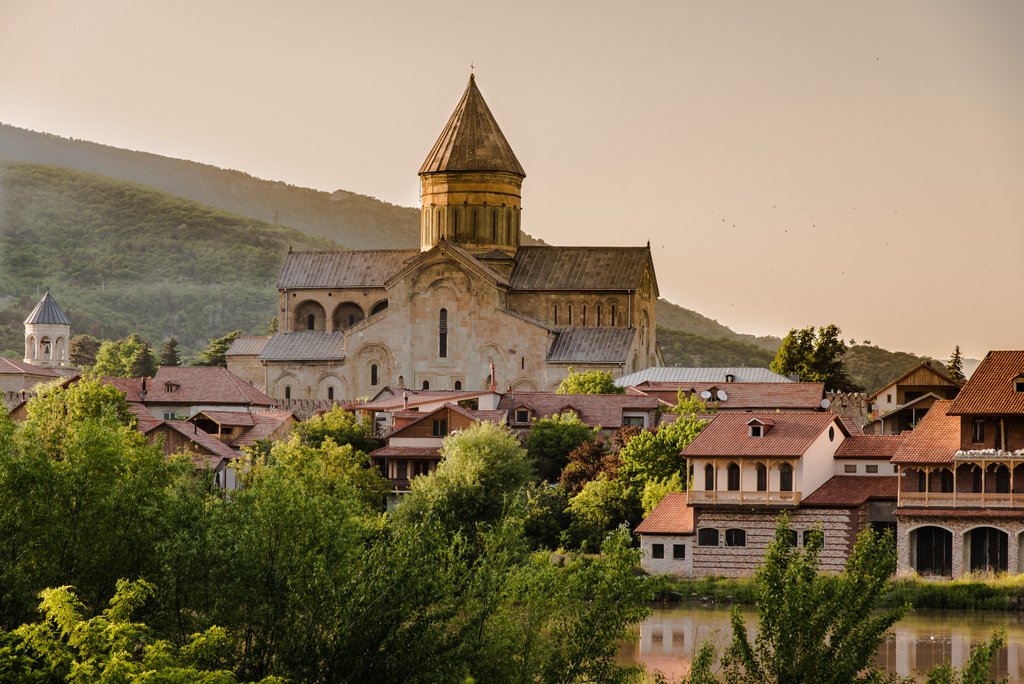
Writer Davit Gabunia travels through his native Georgia to visit the grave of his cousin, who was killed in the war against Russia in 2008. He gives us a profound and moving picture of how his country ticks.
Davit Gabunia [rowohlt.de]
Facettenreiches Spiel aus Abstoßung und Anziehung: Davit Gabunias raffiniert konstruierter und spannender Roman „Farben der Nacht“. Katrin Hillgruber [tagesspiegel.de]
Auf eine Zigarette mit... Davit Gabunia [fr.de]
Davit Gabunias Roman. Zimmer mit Aussicht auf einen Umsturz. Von Tilman Spreckelsen [faz.net]
Davit Gabunias Blick hinter Georgiens Vorhänge [wn.de]
Davit Gabunias Debütroman handelt von den Monaten vor dem Machtwechsel 2012 in Georgien [literaturkritik.de]
Writer Davit Gabunia travels through his native Georgia to visit the grave of his cousin, who was killed in the war against Russia in 2008. He gives us a profound and moving picture of how his country ticks.
On his journey, Davit talks to demonstrators in the capital Tbilisi, the curator of the bizarre Stalin Museum and with a convinced Stalinist who would like to see the statue of the Soviet dictator returned to its plinth in the city from the industrial wasteland where it was dumped. He also visits places that have a great personal meaning for him. Davit’s cousin Shalva died in the Georgian-Russian War of 2008 and he visits the grave in his hometown of Poti on the Black Sea for the first time. For ten years, he didn't dare come back here. Born in 1982, the writer looks at the conflict in his home country through the lens of the so-called "administrative frontier” between Georgia and the breakaway region of South Ossetia. Russia has occupied South Ossetia, which is internationally recognized as part of Georgia, ten years. Davit meets an old farmer's wife and learns how the conflict here affects her everyday life. There’s lots of material for Davit's black notebook, where he meticulously notes down everything that happens during the journey and so creates a panorama of contemporary Georgia.
--------------------------------------------------------------------
DW Documentary gives you knowledge beyond the headlines. Watch high-class documentaries from German broadcasters and international production companies. Meet intriguing people, travel to distant lands, get a look behind the complexities of daily life and build a deeper understanding of current affairs and global events. Subscribe and explore the world around you with DW Documentary.
Monday, April 22, 2019


Tuesday, April 09, 2019
DOCUMENT: Heidi Tagliavini report on the August 2008 Five Day War between Russia and Georgia. Briefly commented by Andreas Umland
Andreas Umland is surprised that this Report on the August 2008 Five Day War between Russia and Georgia: Independent International Fact-Finding Mission [pdf] is often referred to as supporting the claim that Georgia is to be blamed for the war. The most important passage of the report from page 20 seems to be:
"The Georgian allegations of a Russian invasion were supported, inter alia, by claims of illegal entry into South Ossetia of a large number of Russian troops and armour, prior to the commencement of the Georgian operation. According to Georgian answers to the Mission´s questions, the process of building-up of Russian forces in South Ossetia had started in early July 2008, continued in the course of August and included troops and medical personnel, tents, armoured vehicles, tanks, self-propelled artillery and artillery guns. This process allegedly intensified in the night of 6 to 7 August and in the late evening of 7 August. Georgian allegations of Russian military build-up in South Ossetia prior to 8 August 2008 were denied, however, by the Russian side. According to the Russian information provided to the Mission, the first Russian units entered the territory of South Ossetia, and Russian air force and artillery began their attacks on Georgian targets at 14.30 on 8 August, i.e. immediately after the decision for an intervention was made by the leadership of the Russian Federation. The Mission is not in a position to consider as sufficiently substantiated the Georgian claim concerning a large-scale Russian military incursion into South Ossetia before 8 August 2008. However, there are a number of reports and publications, including of Russian origin, indicating the provision by the Russian side of training and military equipment to South Ossetian and Abkhaz forces prior to the August 2008 conflict. Additionally there seems to have been an influx of volunteers or mercenaries from the territory of the Russian Federation to South Ossetia through the Roki tunnel and over the Caucasus range in early August, as well as the presence of some Russian forces in South Ossetia, other than the Russian JPKF battalion, prior to 14.30 hours on 8 August 2008. Also it seems that the Russian air force started its operations against Georgian targets, including those outside South Ossetian administrative boundaries, already in the morning of 8 August, i.e. prior to the time given in the Russian official information."
The message seems to be that there was an ongoing covert Russian paramilitary or military invasion of Georgia before the war's start (naturally denied by Russia). Should have Tbilisi reacted, as it did, militarily or not?
More: EU Report On 2008 War Tilts Against Georgia [rferl.org]
"The Georgian allegations of a Russian invasion were supported, inter alia, by claims of illegal entry into South Ossetia of a large number of Russian troops and armour, prior to the commencement of the Georgian operation. According to Georgian answers to the Mission´s questions, the process of building-up of Russian forces in South Ossetia had started in early July 2008, continued in the course of August and included troops and medical personnel, tents, armoured vehicles, tanks, self-propelled artillery and artillery guns. This process allegedly intensified in the night of 6 to 7 August and in the late evening of 7 August. Georgian allegations of Russian military build-up in South Ossetia prior to 8 August 2008 were denied, however, by the Russian side. According to the Russian information provided to the Mission, the first Russian units entered the territory of South Ossetia, and Russian air force and artillery began their attacks on Georgian targets at 14.30 on 8 August, i.e. immediately after the decision for an intervention was made by the leadership of the Russian Federation. The Mission is not in a position to consider as sufficiently substantiated the Georgian claim concerning a large-scale Russian military incursion into South Ossetia before 8 August 2008. However, there are a number of reports and publications, including of Russian origin, indicating the provision by the Russian side of training and military equipment to South Ossetian and Abkhaz forces prior to the August 2008 conflict. Additionally there seems to have been an influx of volunteers or mercenaries from the territory of the Russian Federation to South Ossetia through the Roki tunnel and over the Caucasus range in early August, as well as the presence of some Russian forces in South Ossetia, other than the Russian JPKF battalion, prior to 14.30 hours on 8 August 2008. Also it seems that the Russian air force started its operations against Georgian targets, including those outside South Ossetian administrative boundaries, already in the morning of 8 August, i.e. prior to the time given in the Russian official information."
The message seems to be that there was an ongoing covert Russian paramilitary or military invasion of Georgia before the war's start (naturally denied by Russia). Should have Tbilisi reacted, as it did, militarily or not?
More: EU Report On 2008 War Tilts Against Georgia [rferl.org]
Monday, April 08, 2019
#GEORGIANWINE: The first Qvevri Marani and Museum is opening on the grounds of the Plumpton Agricultural College, Wine department - 7th of April 2 pm
Press release. Written by Mako Abashidze
 |
Building Qvevries in Plumpton, UK, Photo: Mako Abashidze
|
The Museum of the Qvevri History and Traditional Georgian Winemaking is sponsored by the SHUMI Winery.
SHUMI winery is sending the artefacts and the Qvevri winemaking tools for the museum display and shall be curating the exhibition.
Henry Mchedlishvili, Georgian by origin, living in Britain since 90th, founder and the Director of the Artisan Cru winery (first English Qvevri Wine), has started to work on this exciting project 18 month ago. Harvest from 2017 had an excellent results- “Artisan Cru” wines are now listed in London restaurants and boutique wine shops.
“For me it’s a great responsibility and honour to work with the Plumpton College wine department. Plumpton Marani is unique collaboration of traditional Georgian Qvevri method wine production from English grapes.” Henry Mchedlishvili, Founder, Artisan Cru.
The Museum sponsored by the “SHUMI WINERY” and the Marani shall be open for the public visits; guests shall have an opportunity to taste SHUMI qvevri wines as well as an Artisan Cru English Qvevri Wines and the Plumpton wines made from the local grapes.
Main purpose of this project is to promote traditional Georgian winemaking technology in the UK and worldwide and to give opportunity to wine department students to learn about the ancient Georgian Qvevri winemaking history. This project is managed and supported by the British Georgian Chamber of Commerce and the National Georgian Wine Agency.
The official opening of the SHUMI Sponsored museum of the Qvevri and Traditional Georgian Wine Making is scheduled in April 2019.
The Memorandum of Understanding was signed on 15th of January, 2019, between the Artisan Cru, Plumpton College and The British Georgian Chamber of Commerce.
Principal at the Plumpton College, Jeremy Kerswell visited the Marani, expressed his support and enthusiasm about this project and signed the MoU.
 |
Photo by Mako Abashidze
|
Importance of the project:
Plumpton Marani and the Qvevri Museum is a unique opportunity for the students of the winemaking department to learn about the Georgian qvevri method, which had been added to the world heritage list of the UNESCO.
This is an excellent opportunity to promote and educate students and visitors about the Georgian Traditional Wine making.
Facts about the Plumpton College Wine Department
Plumpton College Wine Department is a leading educational body in the UK.
The transformation of Plumpton from a small agricultural college to a training ground on the international wine map has taken place alongside the growth in both reputation and commercial prospects of English wine.
A high proportion of the undergraduates and postgraduates at the Plumpton College Wine Centre are people seeking to switch careers and move to the wine industry.
History
Plumpton College started offering wine production courses in 1988 with the arrival of Chris Foss, the current Wine Division Manager. Chris’ mother is from Bordeaux and his family had a vineyard in the Entre-Deux-Mers region. When he first arrived, there were only two rows of vines, and Chris started teaching six students in a classroom located in the Poultry Department, making wine in Demi-Johns with bought-in grapes.
The Wine Division now has four principal activities: Four full-time undergraduate courses in wine business and production (delivered in association with the University of Brighton) attended by over 100 students. These are the only undergraduate courses in wine delivered in the UK, and the only such courses delivered in English in Europe. 20% of students come from outside the UK and graduates can be found in many wine-producing areas, all over the world.
The WineSkills industry training project, delivering courses all over the UK to around 500 students a year. These consist of the highly successful Principles of Vine growing and Principles of Winemaking programmes and one-day workshops and masterclasses. The latter are delivered by experts with international reputations.
A commercial wine production facility, Plumpton Wine Estate, producing around 30 000 bottles of wine a year in a fully equipped commercial winery, from 8 hectares of vineyard, much of it recently planted.
More: Traditional Georgian Winemaking Museum and 8,000-year-old heritage introduced in Plumpton. Posted on March 26, 2019 by Tamar Chikviladze
Wednesday, April 03, 2019
SHORTFILM: Dinola - film which are based on a true story in Georgia Svaneti. By Mariam Khatchvani
Director Mariam Khatchvani
Film Producer Vladimer Kacharava
In the cold mountains of Georgia, a widow is forced to marry another man and leave her life and child behind.
Dinola is a child living in the village of Ushguli, in Georgia. Her father has just died, and the whole village is taking part in the funeral ceremonies. Her little friend asks if her mother has already left, but the girl says no, and doesn’t even understand why she would do such a thing. In fact, though, that’s the cruel fate that awaits her: as per the local tradition, the first man to forcibly impose his will to marry the widow, will have every right to take her away – and the child will be left behind, alone and abandoned.
Based on the true experience of director Mariam-Bakacho Khatchvani (მარიამ ხაჭვანი)’s grandmother, this short film wants to give a voice to the lives of thousands of women in the region of Svaneti, Georgia, one of the remotest parts of the continent, where, until only fifty years ago, this cycle of abandonment was repeated continuously. In addition to being an act of social protest, Dinola also opens a window onto places unknown to most people, uncovering traditions and customs that have hardly ever been narrated to an international audience.
This foray into a new world is unsettling and fascinating at the same time: the blinding white of the snow-covered landscape and the stark contrast of the medieval houses that stand dark upon it are visually striking. It takes just a few frames to feel the atmosphere of this hard and traditional people, witnessed in a solemn moment of mourning, all wearing dark clothes and accepting their inescapable reality in a dignified silence.
It’s the personal and participated yet highly stylized direction that raises this short above the usual account of social issues. It ‘s rare to find this kind of careful historical and social reconstruction combined with such a unique aesthetic. We take part in the excruciating pain of the mother, we are moved by the despair of the abandoned child who tries to follow in the footsteps of her mother in the midst of the snow, but we are also overwhelmed by the beauty of the place that’s presented before our eye, an almost alien land that appears to be suspended in time.
Dinola, presented in competition in many international festivals, was recently nominated for Best Short Film at the European Film Awards. This film is another example of the power that lies in the short film medium, managing to convey information about traditions and showing remote places almost completely unknown to most people.
We interviewed the director to find out more about this world and what inspired her to tell this story.
Hi Mariam, can you tell us more about the ‘Svanish Law’ you mention at the end of the film? Is it still in effect?
There used to be a tradition that if a woman became a widow, she had to get married to whatever man asked to marry her, regardless of love or her free will, because had she refused to, the man would threaten to kill her family. If the woman got married for a second time against her will, the dead husband’s family would not allow her to take her child with her, because they didn’t want their grandchild to grow up with another family, as it was considered absolutely shameful in the village. Dinola takes place about 80 years ago, when my grandmother was a child, but this ‘law’ was still in effect until about 40-50 years ago, and now things have changed – but not so much.
So the story portrayed in Dinola is very personal to you, is it exactly what happened to your grandmother? Yes, this story is about my grandmother. When she was a child, her mother left her and when she woke up and was looking for her mother, she went outside barefoot on the snow and followed her mother’s footprints crying. When she told me her story, it was so shocking to me that I decided to make a film as close to an actual documentary as possible, to show the real difficulties in the mother-children relationship that time, because it was the same for everyone living in that area…That’s why when I was a shooting the short I did my best to put real emotions into the film. My grandmother is 90 years old now and when she saw Dinola, she told me that she found it very funny that the child in the film is wearing socks, as she was barefoot…
What are your motivations as a filmmaker?
I wanted to show the world how interesting my culture is, because no one knows about Svaneti, where I was born, even some Georgians…
What are your plans for the future? Are you gonna make a feature film inspired by Dinola?
I am working on the feature film project, DEDE, it will be focused on the woman’s life. It’ll be like a counterpart to Dinola, and the main character will be the mother of the child. The movie will be about love, traditions and the crazy, interesting and difficult life in Ushguli. Located in Svaneti, the mountainous area of Georgia, Ushguli is called the hat of Europe, because it’s the highest settlement in this continent, you can feel like touching the sky, winter lasts eight months and at during that time roads are blocked, and people became ruthless because of this strict environment and extreme conditions. I will start shooting in August, I’ll cover four seasons in the film, I want to make it like a documentary, with regular people from the area, not actors, to achieve more realism as possible. My village is the so beautiful, it is a paradise for me and this is why I think the Ushgulians never leave the area despite the hard life.
Flavia Ferrucci (Source: goodshortfilms.it/dinola)
In deutsch: filmfestivalcottbus.de
Tuesday, April 02, 2019
VIDEO: The Gokieli Sisters Duo - Elisabed Gokieli (flute) and Anano Gokieli (piano) are playing Carl Reinecke, Francis Poulenc and Otar Taktakishvili
Carl Reinecke: Sonate e-moll "Undine". IV- Finale
Francis Poulenc: Sonate pour flûte (flûte et piano). III.Presto Giocoso
Otar Taktakishvili: Sonata for flute & piano. II mov (ოთარ თაქთაქიშვილი. სონატა ფლეიტისა და ფორტეპიანოსთვის. მე-2 ნაწილი )
Monday, February 04, 2019
VIDEO: "The Last Jew in the Village". By Rufat Asadov
"Последний еврей в деревне" (Russian version): https://youtu.be/JlBEKoFt59g
Abandoned village. This is a village founded by mountain Jews in Azerbaijan in the 19th century. There is a Jewish cemetery near the village. An old man is working at the grave. He is watering a sapling and wiping the grave-stone. This is Meyer. He is the only Jew who stays in the village. There are his father's house, a small plot of earth and a household... He knows everything about this village. He remembers the persecution of the rabbinate in Soviet time, and the troubles of the 1941-1945 wartime, and the post-War years. He is a real living history of this village, and the only nexus between the Past of this Jewish village and the Present time. His parents and his wife and his neighbours as well are buried in this cemetery. He is all time looking after the graves, for they are not to be overgrown with weed and the grave-stones are not to be destroyed... He knows the life story of every Jew buried here indeed!
Abandoned village. This is a village founded by mountain Jews in Azerbaijan in the 19th century. There is a Jewish cemetery near the village. An old man is working at the grave. He is watering a sapling and wiping the grave-stone. This is Meyer. He is the only Jew who stays in the village. There are his father's house, a small plot of earth and a household... He knows everything about this village. He remembers the persecution of the rabbinate in Soviet time, and the troubles of the 1941-1945 wartime, and the post-War years. He is a real living history of this village, and the only nexus between the Past of this Jewish village and the Present time. His parents and his wife and his neighbours as well are buried in this cemetery. He is all time looking after the graves, for they are not to be overgrown with weed and the grave-stones are not to be destroyed... He knows the life story of every Jew buried here indeed!
Saturday, December 15, 2018
ELECTRONICS: Gogi Dzodzuashvili - Without You
Gogi Dzodzuashvili is one of the most famous and talented Georgian musicians. He produces music mostly under name Post Industrial Boys. Current track is not part of any of his albums.
This fantastic sound was done by greatest Georgian music artist Gogi Dzodzuashvili, specially for magic fashion show of Lasha Devdariani & Guga Kotetishvili in Rooms Hotel/Tbilisi. 11.10.2014.
Wednesday, December 12, 2018
PUBLIC LECTURE: Heinrich Boell Foundation South Caucasus regional office presents: Florian Mühlfried's "Moments of mistrust in South Caucasus". via @Boell_SC
On December 7, 2018, Heinrich Boell Foundation's South Caucasus organized a public lecture with social anthropologist Florian Muehlfried.
Moments of mistrust in South Caucasus is his article, published at Heinrich Boell Foundation's website. You can read the article here: Moments of Mistrust in the South Caucasus [ge.boell.org]
Facebook: facebook.com/hbf.caucasus
Twitter: twitter.com/Boell_SC
Website: ge.boell.org
Sunday, December 09, 2018
VIDEO: Whetstone Presents - Wild Grapes - GeorgianWine from Giorgi Natenadze
Wild Grapes is a vinous journey through the Republic of Georgia, the birthplace of wine, presented in three distinct acts. For more than 8,000 years, wine has permeated Georgian culture, and Wild Grapes, hosted by Whetstone founder and former sommelier Stephen Satterfieldrfield, is an exploration of the ways in which this considerable legacy has endured throughout the millennia.
Whetstone Founder Stephen Satterfield visits the Republic of Georgia, the cradle of wine, to explore its origins and the ways in which it continues to permeated the culture today.
More: Whetstone PRESENTS: Wild Grapes [whetstonemedia.co]
Our debut film, Wild Grapes is a vinous journey through the Republic of Georgia, the birthplace of wine, presented in three distinct acts. For more than 8,000 years, wine has permeated Georgian culture, and Wild Grapes, hosted by Whetstone founder and former sommelier Stephen Satterfield, is an exploration of the ways in which this considerable legacy has endured throughout the millennia.
Act 1: About 45 minutes north of the Turkish border, we visit Giorgi Natenzahe, a preservationist and winemaker stewarding a 400 year-old grape vine, the oldest known in the world that continues to produce wine.
In Act 2 we travel to Pankisi Gorge, a Muslim village on the Chechen border at the valley floor of the Caucasus Mountains. at Leila’s Guesthouse, a local b+b, we eat extraordinary Chechen cuisine prepared by the talented namesake proprietor, Leila Achishvili. During the stay, she describes the region’s complex history as a recruitment hub for Islamic militants, including a devastating story about the loss of her own sons.
In Act 3 we visit the village of Lagodekhi to experience the most quitessecitial of all Georgian holidays, Easter Sunday. In Georgia, the holiday is commemorated with successive days of feasting culminating with a cemetery picnic in which the entire village comes to celebrate with friends and family past and present.
Whetstone Founder Stephen Satterfield visits the Republic of Georgia, the cradle of wine, to explore its origins and the ways in which it continues to permeated the culture today.
More: Whetstone PRESENTS: Wild Grapes [whetstonemedia.co]
Our debut film, Wild Grapes is a vinous journey through the Republic of Georgia, the birthplace of wine, presented in three distinct acts. For more than 8,000 years, wine has permeated Georgian culture, and Wild Grapes, hosted by Whetstone founder and former sommelier Stephen Satterfield, is an exploration of the ways in which this considerable legacy has endured throughout the millennia.
Act 1: About 45 minutes north of the Turkish border, we visit Giorgi Natenzahe, a preservationist and winemaker stewarding a 400 year-old grape vine, the oldest known in the world that continues to produce wine.
In Act 2 we travel to Pankisi Gorge, a Muslim village on the Chechen border at the valley floor of the Caucasus Mountains. at Leila’s Guesthouse, a local b+b, we eat extraordinary Chechen cuisine prepared by the talented namesake proprietor, Leila Achishvili. During the stay, she describes the region’s complex history as a recruitment hub for Islamic militants, including a devastating story about the loss of her own sons.
In Act 3 we visit the village of Lagodekhi to experience the most quitessecitial of all Georgian holidays, Easter Sunday. In Georgia, the holiday is commemorated with successive days of feasting culminating with a cemetery picnic in which the entire village comes to celebrate with friends and family past and present.
Thursday, December 06, 2018
FOTOGRAFIE: "Eine georgischer Reise". Von Doris Peter
Am Freitag, 14. Dezember 2018 von 19.00 bis 20.30 im leeren Niesen, Korsörer Straße 13, 10437 Berlin - Prenzlauer Berg
Sieben Tage in Georgien. Mit "Marschrutkas" (Kleinbussen) unterwegs von Ort zu Ort. Von der Hauptstadt Tbilisi nach Batumi am Schwarzen Meer und weiter...
Eine Bildschau mit fotografischen Eindrücken einer faszinierenden "On the Road"-Reise.
Website: www.doris-peter.com
Sieben Tage in Georgien. Mit "Marschrutkas" (Kleinbussen) unterwegs von Ort zu Ort. Von der Hauptstadt Tbilisi nach Batumi am Schwarzen Meer und weiter...
Eine Bildschau mit fotografischen Eindrücken einer faszinierenden "On the Road"-Reise.
Website: www.doris-peter.com
 |
| Station Square Tbilisi Georgien 2018 |
 |
| Tbilisi Georgien 2018 |
 |
| Truck Tbilisi Georgien 2018 |
 |
| Kobuleti Georgien 2018 |
 |
| Batumi, Georgien 2018 |
Wednesday, December 05, 2018
BOOK LAUNCH: Mobilities, Boundaries, and Travelling Ideas. Rethinking Translocality Beyond Central Asia and the Caucasus - 6.12.2018 im ZOiS in Berlin via @ZOiS_Berlin
[facebook.com/Mobilities, Boundaries, and Travelling Ideas ]
6. December 2018 - ZOiS, Mohrenstr. 60, 10117 Berlin
With Manja Stephan-Emmrich (Humboldt-Universität zu Berlin), Philipp Schröder (Albert-Ludwigs-Universität Freiburg), Tsypylma Darieva (ZOiS, Berlin) and Katrin Bromber (Leibniz-Zentrum Moderner Orient, Berlin)
 ‘Translocality’ has become an important concept in social sciences for depicting the social and cultural representations of a globalizing world ‘from the ground’. But does the concept also have the capacity to describe, in new ways, the multiple mobilities, exchange practices and globalizing processes that link people, institutions, and goods in Central Asia and the Caucasus with others in Asia, Europe, and the Middle East?
Mobilities, Boundaries and Travelling Ideas seeks to explore this question. Collecting anthropological, historical and sociological case studies, the edited volume aims to overcome ‘territorial containers’ such as the nation‐state or local community, which have long dominated research on mobility and migration in Central Asia and the Caucasus. Following new directions in area studies, the book instead emphasizes the significance of processes of translation and negotiation for understanding how meaningful localities emerge beyond conventional boundaries.
At ZOiS, the editors and two experts will discuss the book’s contribution to new epistemological and methodological perspectives in the transdisciplinary study of mobilities, migrations, and diasporas in and beyond Central Asia and the Caucasus, two regions sharing a long history of travel, migration, and connectedness.
The book:
Manja Stephan-Emmrich and Philipp Schröder (eds.), Mobilities, Boundaries, and Travelling Ideas. Rethinking Translocality Beyond Central Asia and the Caucasus. Cambridge: Open Book Publishers, 2018 [pdf]
---
To make our programme more accessible to parents, we offer free professional child care during the event. Please register at least one week in advance, stating the age(s) of your child(ren), by emailing: Julia Braun events@zois-berlin.de.
[openbookpublishers.com] This collection brings together a variety of anthropological, historical and sociological case studies from Central Asia and the Caucasus to examine the concept of translocality. The chapters scrutinize the capacity of translocality to describe, in new ways, the multiple mobilities, exchange practices and globalizing processes that link places, people and institutions in Central Asia and the Caucasus with others in Russia, China and the United Arab Emirates.
Illuminating translocality as a productive concept for studying cross‐regional connectivities and networks, this volume is an important contribution to a lively field of academic discourse. Following new directions in Area Studies, the chapters aim to overcome ‘territorial containers’ such as the nation‐state or local community, and instead emphasize the significance of processes of translation and negotiation for understanding how meaningful localities emerge beyond conventional boundaries.
Structured by the four themes ‘crossing boundaries’, ‘travelling ideas’, ‘social and economic movements’ and ‘pious endeavours’, this volume proposes three conceptual approaches to translocality: firstly, to trace how it is embodied, narrated, virtualized or institutionalized within or in reference to physical or imagined localities; secondly, to understand locality as a relational concept rather than a geographically bounded unit; and thirdly, to consider cross‐border traders, travelling students, business people and refugees as examples of non-elite mobilities that provide alternative ways to think about what ‘global’ means today.
Mobilities, Boundaries, and Travelling Ideas will be of interest to students and scholars of the anthropology, history and sociology of Central Asia and the Caucasus, as well as for those interested in new approaches to Area Studies.
The VolkswagenStiftung (Volkswagen Foundation) has generously contributed towards the publication of this volume.
Mobilities, Boundaries, and Travelling Ideas: Rethinking Translocality Beyond Central Asia and the Caucasus
Edited by Manja Stephan-Emmrich and Philipp Schröder | April 2018
380 | 38 colour illustrations | 6.14'' x 9.21'' (156 x 234 mm)
ISBN Paperback: 9781783743339
ISBN Hardback: 9781783743346
ISBN Digital (PDF): 9781783743353
ISBN Digital ebook (epub): 9781783743360
ISBN Digital ebook (mobi): 9781783743377
ISBN Digital (XML): 9781783744992
DOI: 10.11647/OBP.0114
Subject codes: BIC: JHMC (Social and cultural anthropology, ethnography), 1FC (Central Asia), JH (Sociology and anthropology), JPS (International relations), RGCP (Political geography); BISAC: SOC002010 SOCIAL SCIENCE / Anthropology / Cultural & Social, SOC015000 SOCIAL SCIENCE / Human Geography
6. December 2018 - ZOiS, Mohrenstr. 60, 10117 Berlin
With Manja Stephan-Emmrich (Humboldt-Universität zu Berlin), Philipp Schröder (Albert-Ludwigs-Universität Freiburg), Tsypylma Darieva (ZOiS, Berlin) and Katrin Bromber (Leibniz-Zentrum Moderner Orient, Berlin)
Mobilities, Boundaries and Travelling Ideas seeks to explore this question. Collecting anthropological, historical and sociological case studies, the edited volume aims to overcome ‘territorial containers’ such as the nation‐state or local community, which have long dominated research on mobility and migration in Central Asia and the Caucasus. Following new directions in area studies, the book instead emphasizes the significance of processes of translation and negotiation for understanding how meaningful localities emerge beyond conventional boundaries.
At ZOiS, the editors and two experts will discuss the book’s contribution to new epistemological and methodological perspectives in the transdisciplinary study of mobilities, migrations, and diasporas in and beyond Central Asia and the Caucasus, two regions sharing a long history of travel, migration, and connectedness.
The book:
Manja Stephan-Emmrich and Philipp Schröder (eds.), Mobilities, Boundaries, and Travelling Ideas. Rethinking Translocality Beyond Central Asia and the Caucasus. Cambridge: Open Book Publishers, 2018 [pdf]
---
To make our programme more accessible to parents, we offer free professional child care during the event. Please register at least one week in advance, stating the age(s) of your child(ren), by emailing: Julia Braun events@zois-berlin.de.
[openbookpublishers.com] This collection brings together a variety of anthropological, historical and sociological case studies from Central Asia and the Caucasus to examine the concept of translocality. The chapters scrutinize the capacity of translocality to describe, in new ways, the multiple mobilities, exchange practices and globalizing processes that link places, people and institutions in Central Asia and the Caucasus with others in Russia, China and the United Arab Emirates.
Illuminating translocality as a productive concept for studying cross‐regional connectivities and networks, this volume is an important contribution to a lively field of academic discourse. Following new directions in Area Studies, the chapters aim to overcome ‘territorial containers’ such as the nation‐state or local community, and instead emphasize the significance of processes of translation and negotiation for understanding how meaningful localities emerge beyond conventional boundaries.
Structured by the four themes ‘crossing boundaries’, ‘travelling ideas’, ‘social and economic movements’ and ‘pious endeavours’, this volume proposes three conceptual approaches to translocality: firstly, to trace how it is embodied, narrated, virtualized or institutionalized within or in reference to physical or imagined localities; secondly, to understand locality as a relational concept rather than a geographically bounded unit; and thirdly, to consider cross‐border traders, travelling students, business people and refugees as examples of non-elite mobilities that provide alternative ways to think about what ‘global’ means today.
Mobilities, Boundaries, and Travelling Ideas will be of interest to students and scholars of the anthropology, history and sociology of Central Asia and the Caucasus, as well as for those interested in new approaches to Area Studies.
The VolkswagenStiftung (Volkswagen Foundation) has generously contributed towards the publication of this volume.
Mobilities, Boundaries, and Travelling Ideas: Rethinking Translocality Beyond Central Asia and the Caucasus
Edited by Manja Stephan-Emmrich and Philipp Schröder | April 2018
380 | 38 colour illustrations | 6.14'' x 9.21'' (156 x 234 mm)
ISBN Paperback: 9781783743339
ISBN Hardback: 9781783743346
ISBN Digital (PDF): 9781783743353
ISBN Digital ebook (epub): 9781783743360
ISBN Digital ebook (mobi): 9781783743377
ISBN Digital (XML): 9781783744992
DOI: 10.11647/OBP.0114
Subject codes: BIC: JHMC (Social and cultural anthropology, ethnography), 1FC (Central Asia), JH (Sociology and anthropology), JPS (International relations), RGCP (Political geography); BISAC: SOC002010 SOCIAL SCIENCE / Anthropology / Cultural & Social, SOC015000 SOCIAL SCIENCE / Human Geography
Monday, December 03, 2018
EXCERPT: Moments of Mistrust in the South Caucasus. By Florian Muehlfried via ge.boell.org @Boell_SC
On Friday, December 7, at 4:00 pm, Heinrich-Böll-Stiftung South Caucasus
invites you to Florian Muehlfried’s public lecture "Moments of Mistrust
in South Caucasus. click here to read more: Lecture: Moments of Mistrust in South Caucasus at the book house "Ligamus".
Florian Muehlfried’s lecture is largely based on ethnographic
vignettes of mistrust, with the material mainly stemming from Abkhazia, a
breakaway self-declared republic in the Caucasus. The largely absent
international recognition of Abkhazia makes mistrust almost endemic and a
crucial part of daily life. Mistrust materializes in the assumption
that something is hidden behind the surface, e.g. a hidden agenda. This
assumption paves the way for conspiracy theories, but also allows to get
along with distrusted others who cannot be avoided. Contrasting
vignettes from Georgia show that mistrust towards facades may also
entail the opposite assumption: that there is nothing behind.
Florian Muehlfried is a social anthropologist working on the Caucasus, particularly on Georgia, for more than twenty years. His academic publications include the monographs Schemes of Mistrust: A Global Approach (forthcoming), Being a State and States of Being in Highland Georgia (2014) and Post-Soviet Feasting: The Georgian Banquet in Transition (2006, in German) as well as the edited volumes Mistrust: Ethnographic Approximations (2018), Sacred Places, Emerging Spaces: Religious Pluralism in the Post-Soviet Caucasus (2018, coedited with Tsyplylma Darieva and Kevin Tuite) and Soviet Era Anthropology in the Caucasus and Central Asia (2012, coedited with Sergey Sokolovskiy).
Address: ილიაუნის წიგნის სახლი "ლიგამუსი" / Book House "Ligamus", 32 Chavchavadze Ave., Tbilisi
[ge.boell.org] Even time cannot be trusted in Abkhazia. On mobile phones and computers that receive data from the Internet, it is one hour earlier than on mechanical watches. The Internet forces the Abkhazians into a time zone that for them has expired: the time zone of Georgia. Abkhazia is not recognised under international law, thus Abkhazian time is not accepted in virtual space. Abkhazia has fallen out of time.
© Florian Muehlfried 2019: Schemes of Mistrust: A Global Perspective. Basingstoke: Palgrave Pivot (Chapter 5). This draft has not been copy edited yet and thus will differ from the book Version.
Walking down the street, we meet a man of about fifty years in a black suit with a badge depicting a faded image of his mother, who had died a few years ago, on his shirt; he immediately starts talking about god, that he seeks Him, that people need Him, that he hopes to find Him, that he has to talk to us ... I first believe to have a Jehovah's Witness in front of me, but then he seems like too many questions and too few certainties. Later we learn that he lives alone in a village after his mother had passed away. And that, during the war, one of his ears was cut off as he was presumed dead; ears were cut off for trophies.
This note is included in my diary for August 2017 when I visited a town whose name is being disputed.[1] Some call it Gal and see it as the westernmost city of Abkhazia. Others call it Gali and thus perceive it as a Georgian city, because the “i” is the nominative ending of Georgian nouns. Its population was displaced by Abkhazian troops after they had won a war against Georgia in the autumn of 1993. Violence came suddenly, unexpectedly and massively, people had to flee overnight.[2]
The expulsion was based on Abkhazian troops’ and leaders’ distrust of the loyalty of the population of Gal/i that almost completely consisted (and now again consists) of Megrelians. They speak a language related to Georgian, and most of them live on Georgian territory across the border. As a second language, almost all Megrelians speak Georgian, the “language of the enemy”. In the second half of the 1990s, shortly after their cleansing, a large number of Megrelians were able to return to their destroyed homes. The distrust of the Abkhazians towards the Megrelians, however, remains lively still today. Abkhazian police patrol the streets, Megrelians are not recruited. Megrelians are denied Abkhazian passports – unless they profess to have been originally Abkhazian and megrelianised later on. In 2014, Megrelians residing in Abkhazia were deprived of the right to vote. The Georgian government speaks of apartheid. And in 2015, the Georgian language was banned from usage in the schools of Gal/i. Despite their poor command, Megrelian children thus have to study school subjects in the Russian language.
Georgians, too, distrust Megrelians because their group provides numerous features that could justify national independence: a separate language, a fairly clearly demarcated settlement area, periods of political sovereignty (see Broers 2001). For this reason, Georgian scholars attach great importance to concepts: whereas the Georgians are considered an ethnic group, the Megrelians are labelled as a sub-ethnic, ethnographic or ethno-territorial group (e.g. by Chitaia 1997-2001 who prefers the notion of sub-ethnicity). Beyond academic concerns, the crucial issue here is that ethnic groups may become a nation and claim sovereignty according to international law, whereas groups allocated below the threshold of ethnic identify may not, because they already belong to a (at least potential) nation. As ethnic groups with their own languages, some may fear, Megrelians may well claim sovereignty outside of the confines of the Georgian state, and this claim would be difficult to dismiss on scholarly grounds. The background to these concerns is separatism that has lead to the de facto statehood of Abkhazia and, to a lesser extent, of South Ossetia. It is these concerns that have motivated some Georgian scholars to state that Megrelians speak a dialect of Georgian, not a language (e.g. Gogebashvili 1991), although the vast majority of linguists worldwide disagree (e.g. Harris 1991).
In the district of Gal/i, mistrust is omnipresent, mutual and reciprocal. The reciprocity of mistrust perpetuates the latter and creates spirals of suspicion that are almost impossible to escape. When mistrust encounters itself, it tends to intensify and solidify, like aggression aggravates in situations of war. Yet, the citizens of Gal/i have to find ways to get along with the presence of others they distrust and that distrust them. One coping strategy is to allocate the core of mistrust beyond subjective accountability. Instead of blaming the people in one’s surrounding personally for the unbearable situation, one may assume that there is something else behind the surface, an unknown essence that drives it all and that causes mistrust to spread.
Conspiracy Theories
Visiting a Megrelian family in Gal/i. Giorgi, a Megrelian nationalist, is seated next to me. For him, the first kingdom of the Megrelians, Colchis, represents the origin of Georgian statehood. Only the Megrelians and the “hill tribes” [so-called sub-ethnic groups of Georgian highlanders such as Tushetians, Svans, or Khevsurs] are true Georgians, he postulates, the others are a mixture of Georgians, Armenians and Azerbaijanis. He has learned Abkhazian as a child and has Abkhazian friends. In front of me are two Abkhazians who speak Abkhazian among themselves and Russian with the others. In order to explain how the war between Georgia and Abkhazia came about, Giorgi tells a story he attributes to the Georgian erudite nobleman Sulchan-Saba Orbeliani:
‘A pig lives with its piglets at the foot of a tree on which an eagle nests. Comes a fox and says to the pig: Do not leave the tree [to fetch food]; the eagle is just waiting to kill your piglets. Then he goes to the eagle and says: Do not fly away [to provide food for the chicks]; the pigs are just waiting to gnaw the root of the tree until it falls over. The pig and the eagle no longer leave the tree. The first piglet dies and is fetched by the fox, the first chick dies and is fetched by the fox. At the end, everyone is dead and the fox has filled its stomach.’
Giorgi explains: A third force is at work here, which whispers, incites and only pursues its own interests. This force was behind the war in Abkhazia, this force is behind everything: Jews, Freemasons.
Such narratives allow living with those who distrust you because they are not held responsible for this distrust. And one can agree with them about invisible enemies who are to be blamed for it all. Later on, I note: “Many conspiracy theories. Armenians, Jews, freemasons are guilty of everything, but one cannot see them and there is no evidence (a hidden power that, like god, works in secret).” As much as these conspiracy theories are based on demonising groups as Freemasons, Jews or Armenians – with potentially most harmful consequences such as pogroms, ethnic cleansing, shootings, incarceration, gasification etc., they are not least ways of getting along with the “own” others, who are apparently, so it seems, not responsible, just like oneself. Thus, conspiracy theories may open up a shared space; a space that potentially nurtures conviviality, if only in its most basic form.[3] It is the “comfort of commonly perceived enemies” (Asmussen 2011: 127) that conspiracy theories provide. The secret others become scapegoats, and their joint blaming creates commonality (see Girard 2005).
A bit earlier, I had already pencilled down: “A lot of talk about god here, the quest for god, the only one who provides meaning to life.” This entry was not merely about the man in black we met on the street, but also about Davit, our host.
Looking Behind Things
Davit had fled to Georgia during the Abkhaz war, spent several years there and intended to stay. In 2001, however, he returned to Gal/i because his father had passed away and Davit had to take over the position of head of the household: “God had other plans for me.” Professionally, he works as a bank accountant. Davit is unmarried and possesses a key to the church. When taking me along, he points to an icon of St. George in a corner of the church and explains:
In the right top corner there is God, whose light falls on George. George is a saint who guides the people, symbolised by the horse he rides on. People are both good and evil, so they need divine guidance. The dragon that George kills creeping at his feet is just evil. On this icon, the flakes of the dragon are painted in bright colours. Did you notice that Georg wears the same colours in his robe? This is because he has to know evil in order to defeat it.
The latter reference emphasises the lifeworldly importance of practical knowledge, which is not acquired by observation from a distance, but by taking part. Such knowledge requires the engagement with a world that cannot be trusted. For Davit, this “dirty” knowledge is more profound than secular knowledge derived from a safe distance. At the same time, he pays close attention to natural phenomena such as the position of the sun or its rays. He has stored several photographs of the sun on his phone, even more of stones from a nearby forest. There is a place, explains Davit, where two rivers come together, a place he usually visits with his confessor. The water has a very special composition and is not drinkable. No frogs live in the water, there is no living being around, all is quiet. This is where Davit detects stones consisting of a cosmic material and marked by signs: some looking like a star chart, others like faces. Davit is fascinated by the regularity and symmetry of these signs, which to him indicate that these stones were inscribed by humans and derive from prehistoric times (“when the dinosaurs were still alive”).
For him, these artefacts are facts he can stick to, which at the same time testify to a higher power, an ancient lost knowledge, and cosmic energies (or substances). On one of the many photographs he took of the stones, a small folding rule is placed next to the object; on others he holds a square angle to the stone in order to illustrate its perfect proportions. On a portrait depicting him with a stone in his hand, an inexplicable light appears on his back. Davit has tried to find archaeologists to study these stones, their effect and location, but in vain. For him, the messages are evident, but for others they are hidden. Perhaps they can only be seen by those who have learned to look behind things. Religions are cults of mistrust as they do not accept things or people for what they seem to be. In this sense, conspiracy theories can be construed as religious, as they too represent powers as concealed. Places like Gal/i, where insecurity is endemic, such concealed powers are everywhere, and they haunt.
Even time cannot be trusted in Abkhazia. On mobile phones and computers that receive data from the Internet, it is one hour earlier than on mechanical watches. The Internet forces the Abkhazians into a time zone that for them has expired: the time zone of Georgia. Abkhazia is not recognised under international law, thus Abkhazian time is not accepted in virtual space. Abkhazia has fallen out of time.
Facade Politics
There is also the suspicious assumption that there is no nothing behind observable reality. Everything is just a facade. By means of such facades, revolutionary projects occasionally indicate the beginning of a new era. One such project was the peaceful Rose Revolution in Georgia in November 2003. With the overthrow of the then president Shevardnadze, the post-Soviet period was declared to have come to an end. A society would emerge that freed itself from the shackles of the past. It would go from darkness to light quite literally: In the more than twenty years since independence, the frequent power cuts turned the lights off; now Georgia would shine.
The remodelling of Georgia started with fountains being dressed in pastel colours. Then the TV tower in the Georgian capital Tbilisi glittered like a Christmas tree. With the arrival of the former US President George W. Bush for a state visit in 2005, the apartment buildings adjacent to the airport were freshly painted. Blue and red rays of light illuminated the facades of old city houses along the city walls at night. After the advent of light and colours, it was the time of balconies and cobblestones. The popular old town of Tbilisi, depicted in numerous novels and repeatedly painted or photographed, became the role model. From now on, every Georgian town would need a historic centre with balconies and cobblestones. A large sum of money was invested in the development of Sighnaghi, a fortress town built on a mountainside overlooking the Caucasian mountain ridge. After cobblestonisation and balconisation, this small town developed into the most popular tourist destination in the Georgian countryside. For Georgians, Sighnaghi now symbolises regional development in the form of musealisation; for tourists, it is a symbol of Georgian authenticity.
In 2007, I visited a winemaker who works in a wine cellar in the neighbouring town of Telavi. Telavi, too, has undergone a renovation of its ancient centre. Traditionally, there were no balconies in the centre at all, but now they are attached to many facades. Asphalt roads have been torn up and then paved. Shops, cafes, guesthouses and a centre for tourist information have opened. Nevertheless, there were hardly any visitors. Telavi at that moment was a ghost town. Perhaps spirits can work miracles and convey a sense of presence where before there was nothing, I was speculating. The winemaker waved this off. Against the polished facades of the renovated centre, it would become even more apparent how poorly people live. No state funds had reached them. “It's like in the Soviet Union – just a show.”
The comparison with the Soviet Union makes the post-Soviet economy of Georgia look like a planned economy. What matters is what is in the plan, what can be sold to the media and celebrated on public events. In this vein, the Tbilisi airport was built at record-breaking speed, but once opened, its roofs began to leak. And 100 hospitals were officially inaugurated within three years (2007 – 2010), but their equipment was driven from here to there depending on the schedule of press conferences organised to document the opening of a hospital (Frederiksen and Gotfredsen 2017: 113ff.).
In the Soviet Union, the realisation of plans had also been detached from reality, dramatically so and with substantial consequences. Those who, like the economist Alexander Chayanov, held on to the power of the factual and empirically-based analyses for the development of economy, had to reckon with exile and death during the early Soviet Union years (Nikulin 2011). This procedure was successful to the extent that, during the late Soviet Union years, facts and empiricism became largely irrelevant. There was no longer anything below the surface; instead, the surface was employed as a material that could be manipulated and ironised (Yurchak 2006).
In post-Soviet Georgia, too, there is nothing behind the facades – so, at least, many Georgians assume. The role model for the faking of reality is not so much the Soviet Union, however, but rather imperial Russia with its impression policy. The painted apartment blocks close to the airport, the facades of cracking old Tbilisi houses bathed in flashy colours, hospitals with no equipment, all this rather evokes the image of Potemkin villages. These fake villages, allegedly (for it may be a rumour) built by Grigory Potemkin for Catherine the Great in 1787, represent grandezza without substance, serving to hide an undesirable presence.[4] And it is this kind of impression management which became paradigmatic under the label of “Potemkin villages” that is at stake in post-Soviet Georgia as well. Mistrust here asks for substance.
Ruins
In Abkhazia as well, there is nothing behind some facades, but for another reasons: many building have been destroyed during the war with Georgia and not been renovated yet (or only poorly so). Doric columns that have nothing to support, windows through which one can see the sky from the street, bullet holes in the walls. In several cases, the facades are deliberately left standing. The twelve-story former government seat that had caught fire due to army shelling, for example, remains as a ruin in the centre of the Abkhazian capital; in front of it an empty pedestal on which Lenin once stood. Places like these are embodiments of horror that work as a reminder to the Abkhaz citizenry of a past that is yet a presence. In most other cases, however, the reason for the existence of ruins or seriously dilapidated building is much more straightforward: lack of financial means to do something with the facades. Obviously, there is nothing behind them: no intention, no excuse, no deception. No mistrust is required to observe this. Railway stations, built as palaces for the travellers, fall into disrepair, as do factory buildings, mining shafts and conveyor belts. Mining towns have turned into ghost towns. As their architecture is pompous, the effects of decay are even stronger. These sights, however, attract tourists from Western Europe to Abkhazia and serve to illustrate their travelogues on the Internet.
On Georgian facades with nothing behind, the future should shine – a colourful, happy, somewhat loony future. They are inscribed with a fictional temporal dimension. On Abkhazian facades, likewise with nothing behind, there is no discernible future, only a past as war or a present as absence. If statehood is built on citizens’ confidence in the future, then this confidence is shaken here – and thus statehood subverted on a most basic level. This lack of faith in the capacity of the state to shape the future is not limited to Abkhazia or other post-Soviet societies, of course, it is also a symptom of the West, at least since the proclaimed end of history after the collapse of the Soviet Union (Fukuyama 1992). With no future ahead, the future now takes place in the past, captured in out-dated utopias such as those of state socialism. This is one of the reasons why places like Abkhazia are so attractive to Western visitors: it is here they can encounter a past future. It radiates from the Soviet mosaics and conjures up the departure into space or utopia on earth. If there wasn’t the suspicion that this future has expired, one would want to join these travels, too.
NGO Politics
Business or betrayal? Such is the question asked by Timur Kodori in an entry on Facebook dated 24 July 2017.[5] The author is concerned about the involvement of his Abkhaz compatriots in an international project to preserve the Abkhaz language. The project is coordinated by the Georgian-based Centre for Civil Integration and Interethnic Relations and funded by the United States Development Assistance (USAID). The participating linguists hail from the University of Frankfurt; their local partner is the “Association of Businesswomen of Abkhazia.” In his post, Kodori mentions the names of the participants as well as the amount of money they received. He then raises the question whether the Abkhazians involved in this project had been bribed by the opponents of Abkhazia. “How soon will Abkhazia lose its independence as a result of such an approach and [...] again become an appendix of Georgia?”
Another indicator of betrayal is, according to Kodori, the fact that the Abkhaz participants have accepted to be photographed in front of a logo showing Abkhazia within the confines of Georgia. This logo is part of the corporate design of the Georgian NGO responsible for the project. The homepage of this NGO does not mention this project, however, not even in their Annual Reports produced during the project term 2015-2016. And maybe it is no coincidence that the “current projects” section of the NGO’s homepage was adjusted on 25 July 2017 – one day after Kodori’s post. On the websites of those involved in Frankfurt and Abkhazia, too, not a single word can be found about this project. Only the donor has published the following description:
The aim of the project is to support the interpersonal reconciliation between Georgians and Abkhazians by protecting and promoting the endangered Abkhaz language. This goal will be achieved by: (1) mobilizing the Georgian and Abkhazian representatives of science and civil society through the common interest in treasuring and revitalising the Abkhazian language, (2) bringing together young people, the potential leaders of Abkhazia and Georgia, to represent and promote universal human values as well as encouraging mutual respect, tolerance and a peaceful neighbourhood and (3) to facilitate a meaningful dialogue between various social groups regarding issues of common interest, e.g., education, science and the promotion of joint cooperation.[6]
In addition to the promotion of cooperation, this project concerns the creation of an Abkhaz language corpus and the development of software for the linguistic processing of the Abkhaz language. The required material is provided by Abkhazians (among them writers), the scientific expertise by the specialists from Frankfurt. Abkhazian linguists are not part of this cooperation, although they too are working on the documentation of the Abkhazian language and on concepts for its promotion. A linguist and teacher of Abkhaz based in the Abkhazian capital who authored one of the few textbooks available has never heard of the project. A linguist from the Abkhaz Academy of Sciences heard of this project from his dentist. The form of collaboration this project promotes is thus asymmetric: one party delivers, the other one understands.
This colonial form of knowledge production confirms the mistrust of those who feel that Abkhazia is not taken seriously. In this way, mistrust perpetuates and intensifies the rejection to work with colleagues from abroad, as cooperation is never assumed to take place among equals. A great deal of energy is needed for mistrustful engagements with external actors, energy many Abkhazians lack after decades of isolation, stagnation and depression. Better not having anything to do with something one cannot trust and that can be avoided. Given the clouds under which the project is shrouded, another mistrust finds substantiation: one should not see what it is all really about.
Once again, mistrust is ignited by surfaces. Instead of assuming that all there are facades, with no substance behind, the suspicious assumption here is that there is something hidden behind the facade, namely a political agenda based on hostile intentions. On the surface, one can see NGO-driven civic engagements, presumably without a political purpose and directed towards a universal good (in this case, the preservation, documentation and promotion of the Abkhaz language). Underneath the surface, however, a doubtful observer such as Timur Kodori identifies a dark force, here incorporated by the Georgian state and its allies. In order for this force to work, so Kodori implies, it has to come in disguise. This disguise is provided by the NGOs involved in this project, which are essentially machinations of masquerade.
For Kodori, the research project is just a cover-up of political infiltration and indoctrination. In the Russian-speaking world (that includes Abkhazia), such activity is covered by the word pokazukha, which “refers to putting on a false show to cover up the actual state of affairs“ (Sántha and Safonova 2011: 75).[7] The aim of this show is to represent a presence that isn’t real, and a reality that is not meant to be present. Trusting the visible would mean to be trapped in illusion and to fall victim to deceit. The distrust that Kodori articulates is meant to make the show fall apart.
Distrusting Facades
In many of the cases portrayed above, facades have aroused suspicion. In the case of Georgian facade politics, the suspicion is that there is nothing behind, that the surface is all there is. This absence of substance comes in stark contrast to the message that is conveyed with these facades: that of a presence, of a thriving life, of a future and a succeeding present. In the case of Abkhazians facades (that are often those of ruins), the absence of something behind at the same time denotes an absence of the future. This absence of the future is, in a way, the essence of Abkhaz ruins. Whereas in the Georgian case, the Potemkin facades denote an attempt to manipulate public perception, in the Abkhaz case, they denote a void.
Facades may also serve to hide a secret agenda. In this vein, Timur Kodori assumes that NGOs occasionally provide the facade behind which a secret political agenda unfolds. He sees the NGOs that he is targeting as Trojan horses that allow the enemy to penetrate ones own space. What he discerns is a contradiction between visible surfaces and that what is underneath. Such kind of contradiction may be explained with the help of conspiracy theories.
Doing so also allows alleviating tensions with one’s neighbours who do not need to be held accountable for past atrocities, because another clandestine power can be blamed instead. In the context of Abkhazia, this discursive strategy fosters conviviality with those that cannot be trusted. The tension that distrust creates is distracted by conjuring up joint enemies, even if fictional ones.
Bibliography
Asmussen, Jan. 2011. Conspiracy Theories and Cypriot History: The Comfort of Commonly Perceived Enemies. Cyprus Review 23 (2): 127-145.
Broers, Laurence. 2001. Who are the Mingrelians? Language, Identity and Politics in Western Georgia. Sixth Annual Convention of the Association for the Study of Nationalities 2001. Panel: Minority Identity in Georgia (unpublished paper).
Frederiksen, Martin Demant und Katrine Bendtsen Gotfredsen. 2017. Georgian Portraits: Essays on the Afterlives of a Revolution. Winchester/Washington: Zero Books.
Fukuyama, Francis. 1992. The End of History and the Last Man. New York: The Free Press.
Girard, Réne. 2005. Violence and the Sacred. New York: Continuum.
Gogebashvili, Iakob.1990 [1902]. borot’i c’adili samegrelos shesaxeb [An Evil Intention
vis-à-vis Mingrelia]. In: rcheuli txzulebani xut t’omad [Collected Works in Five Volumes]
Vol. 2. Tbilisi: ganatleba.
Harris, Alice C. 1991. Mingrelian. In: A.C. Harris (ed.): The Indigenous Languages of the Caucasus 1: The Kartvelian Languages. Delmar NY: Caravan Books: 313–394.
Nikulin, Alexander. 2011. Tragedy of a Soviet Faust: Chaianov in Central Asia. In Exploring the Edge of Empire: Soviet Era Anthropology in the Caucasus and Central Asia, ed. by F. Mühlfried and S. Sokolovskiy. Münster: LIT Verlag: 275-293.
Sántha, István and Tatiana Safonova. 2011. Pokazukha in the House of Culture: The Pattern of Behavior in Kurumkan, Eastern Buriatiia. In: Donahoe, Brian and Joachim Otto Habeck (eds.): Reconstructing the House of Culture: Community, Self, and the Making of Culture in Russia and Beyond. New York: Berghahn: 75-96.
West, Harry G., and Todd Sanders (eds.). 2003. Transparency and Conspiracy: Ethnographies of Suspicion in the New World Order. Durham, London: Duke.
Yurchak, Alexei. 2006. Everything Was Forever, Until It Was No More: The Last Soviet Generation. Princeton, NJ: Princeton University Press.
Florian Mühlfried 2019: Schemes of Mistrust: A Global Perspective. Basingstoke: Polgrave Pivot (chapter 5)
[1] This essay is largely identical with chapter five of my book on „Schemes of Mistrust: A Global Perspective” to be published with Palgrave Pivot in spring 2019. I thank the publisher and in particular my editor Mary Al-Sayed for the permission to republish my chapter in this format.
[2] In accordance with the policy of the media portal OC Media that reports on the entire Caucasus region, I do not use qualifiers such as ‘de facto’, ‘unrecognised’, or ‘partially recognised’ when discussing institutions within Abkhazia for reasons of readability. In the same vein, the simoultanous usage of the designations Abkhazia and Georgia does not imply a position on the political status of Abkhazia, but rather follows the pragmatic goal of being able to contrast situations and developments in Abkhazia and (the rest of) Georgia without straining readability with inserted brackets.
[3] See West and Sanders 2003 for the social workings of conspiracy theories.
[4] Many thanks to Sascha Roth for raising this argument.
[5] Timur Kodori is probably a pseudonym.
[6] Source: https://www.usaid.gov/georgia/working-crises-and-conflict; later on, however, this entry also disappeared.
[7] Again, my gratitude goes to Sascha Roth for bringing this to my attention.
 |
Published by Boell Foundation, 3. December 2018,
Click on logo to read the article by Florian Muehlfried
|
Florian Muehlfried is a social anthropologist working on the Caucasus, particularly on Georgia, for more than twenty years. His academic publications include the monographs Schemes of Mistrust: A Global Approach (forthcoming), Being a State and States of Being in Highland Georgia (2014) and Post-Soviet Feasting: The Georgian Banquet in Transition (2006, in German) as well as the edited volumes Mistrust: Ethnographic Approximations (2018), Sacred Places, Emerging Spaces: Religious Pluralism in the Post-Soviet Caucasus (2018, coedited with Tsyplylma Darieva and Kevin Tuite) and Soviet Era Anthropology in the Caucasus and Central Asia (2012, coedited with Sergey Sokolovskiy).
Address: ილიაუნის წიგნის სახლი "ლიგამუსი" / Book House "Ligamus", 32 Chavchavadze Ave., Tbilisi
[ge.boell.org] Even time cannot be trusted in Abkhazia. On mobile phones and computers that receive data from the Internet, it is one hour earlier than on mechanical watches. The Internet forces the Abkhazians into a time zone that for them has expired: the time zone of Georgia. Abkhazia is not recognised under international law, thus Abkhazian time is not accepted in virtual space. Abkhazia has fallen out of time.
 |
Sukhum/i, July 2015 – Creator: Anna Dziapshipa. All rights reserved.
|
Walking down the street, we meet a man of about fifty years in a black suit with a badge depicting a faded image of his mother, who had died a few years ago, on his shirt; he immediately starts talking about god, that he seeks Him, that people need Him, that he hopes to find Him, that he has to talk to us ... I first believe to have a Jehovah's Witness in front of me, but then he seems like too many questions and too few certainties. Later we learn that he lives alone in a village after his mother had passed away. And that, during the war, one of his ears was cut off as he was presumed dead; ears were cut off for trophies.
This note is included in my diary for August 2017 when I visited a town whose name is being disputed.[1] Some call it Gal and see it as the westernmost city of Abkhazia. Others call it Gali and thus perceive it as a Georgian city, because the “i” is the nominative ending of Georgian nouns. Its population was displaced by Abkhazian troops after they had won a war against Georgia in the autumn of 1993. Violence came suddenly, unexpectedly and massively, people had to flee overnight.[2]
The expulsion was based on Abkhazian troops’ and leaders’ distrust of the loyalty of the population of Gal/i that almost completely consisted (and now again consists) of Megrelians. They speak a language related to Georgian, and most of them live on Georgian territory across the border. As a second language, almost all Megrelians speak Georgian, the “language of the enemy”. In the second half of the 1990s, shortly after their cleansing, a large number of Megrelians were able to return to their destroyed homes. The distrust of the Abkhazians towards the Megrelians, however, remains lively still today. Abkhazian police patrol the streets, Megrelians are not recruited. Megrelians are denied Abkhazian passports – unless they profess to have been originally Abkhazian and megrelianised later on. In 2014, Megrelians residing in Abkhazia were deprived of the right to vote. The Georgian government speaks of apartheid. And in 2015, the Georgian language was banned from usage in the schools of Gal/i. Despite their poor command, Megrelian children thus have to study school subjects in the Russian language.
Georgians, too, distrust Megrelians because their group provides numerous features that could justify national independence: a separate language, a fairly clearly demarcated settlement area, periods of political sovereignty (see Broers 2001). For this reason, Georgian scholars attach great importance to concepts: whereas the Georgians are considered an ethnic group, the Megrelians are labelled as a sub-ethnic, ethnographic or ethno-territorial group (e.g. by Chitaia 1997-2001 who prefers the notion of sub-ethnicity). Beyond academic concerns, the crucial issue here is that ethnic groups may become a nation and claim sovereignty according to international law, whereas groups allocated below the threshold of ethnic identify may not, because they already belong to a (at least potential) nation. As ethnic groups with their own languages, some may fear, Megrelians may well claim sovereignty outside of the confines of the Georgian state, and this claim would be difficult to dismiss on scholarly grounds. The background to these concerns is separatism that has lead to the de facto statehood of Abkhazia and, to a lesser extent, of South Ossetia. It is these concerns that have motivated some Georgian scholars to state that Megrelians speak a dialect of Georgian, not a language (e.g. Gogebashvili 1991), although the vast majority of linguists worldwide disagree (e.g. Harris 1991).
In the district of Gal/i, mistrust is omnipresent, mutual and reciprocal. The reciprocity of mistrust perpetuates the latter and creates spirals of suspicion that are almost impossible to escape. When mistrust encounters itself, it tends to intensify and solidify, like aggression aggravates in situations of war. Yet, the citizens of Gal/i have to find ways to get along with the presence of others they distrust and that distrust them. One coping strategy is to allocate the core of mistrust beyond subjective accountability. Instead of blaming the people in one’s surrounding personally for the unbearable situation, one may assume that there is something else behind the surface, an unknown essence that drives it all and that causes mistrust to spread.
Conspiracy Theories
Visiting a Megrelian family in Gal/i. Giorgi, a Megrelian nationalist, is seated next to me. For him, the first kingdom of the Megrelians, Colchis, represents the origin of Georgian statehood. Only the Megrelians and the “hill tribes” [so-called sub-ethnic groups of Georgian highlanders such as Tushetians, Svans, or Khevsurs] are true Georgians, he postulates, the others are a mixture of Georgians, Armenians and Azerbaijanis. He has learned Abkhazian as a child and has Abkhazian friends. In front of me are two Abkhazians who speak Abkhazian among themselves and Russian with the others. In order to explain how the war between Georgia and Abkhazia came about, Giorgi tells a story he attributes to the Georgian erudite nobleman Sulchan-Saba Orbeliani:
‘A pig lives with its piglets at the foot of a tree on which an eagle nests. Comes a fox and says to the pig: Do not leave the tree [to fetch food]; the eagle is just waiting to kill your piglets. Then he goes to the eagle and says: Do not fly away [to provide food for the chicks]; the pigs are just waiting to gnaw the root of the tree until it falls over. The pig and the eagle no longer leave the tree. The first piglet dies and is fetched by the fox, the first chick dies and is fetched by the fox. At the end, everyone is dead and the fox has filled its stomach.’
Giorgi explains: A third force is at work here, which whispers, incites and only pursues its own interests. This force was behind the war in Abkhazia, this force is behind everything: Jews, Freemasons.
Such narratives allow living with those who distrust you because they are not held responsible for this distrust. And one can agree with them about invisible enemies who are to be blamed for it all. Later on, I note: “Many conspiracy theories. Armenians, Jews, freemasons are guilty of everything, but one cannot see them and there is no evidence (a hidden power that, like god, works in secret).” As much as these conspiracy theories are based on demonising groups as Freemasons, Jews or Armenians – with potentially most harmful consequences such as pogroms, ethnic cleansing, shootings, incarceration, gasification etc., they are not least ways of getting along with the “own” others, who are apparently, so it seems, not responsible, just like oneself. Thus, conspiracy theories may open up a shared space; a space that potentially nurtures conviviality, if only in its most basic form.[3] It is the “comfort of commonly perceived enemies” (Asmussen 2011: 127) that conspiracy theories provide. The secret others become scapegoats, and their joint blaming creates commonality (see Girard 2005).
A bit earlier, I had already pencilled down: “A lot of talk about god here, the quest for god, the only one who provides meaning to life.” This entry was not merely about the man in black we met on the street, but also about Davit, our host.
Looking Behind Things
Davit had fled to Georgia during the Abkhaz war, spent several years there and intended to stay. In 2001, however, he returned to Gal/i because his father had passed away and Davit had to take over the position of head of the household: “God had other plans for me.” Professionally, he works as a bank accountant. Davit is unmarried and possesses a key to the church. When taking me along, he points to an icon of St. George in a corner of the church and explains:
In the right top corner there is God, whose light falls on George. George is a saint who guides the people, symbolised by the horse he rides on. People are both good and evil, so they need divine guidance. The dragon that George kills creeping at his feet is just evil. On this icon, the flakes of the dragon are painted in bright colours. Did you notice that Georg wears the same colours in his robe? This is because he has to know evil in order to defeat it.
The latter reference emphasises the lifeworldly importance of practical knowledge, which is not acquired by observation from a distance, but by taking part. Such knowledge requires the engagement with a world that cannot be trusted. For Davit, this “dirty” knowledge is more profound than secular knowledge derived from a safe distance. At the same time, he pays close attention to natural phenomena such as the position of the sun or its rays. He has stored several photographs of the sun on his phone, even more of stones from a nearby forest. There is a place, explains Davit, where two rivers come together, a place he usually visits with his confessor. The water has a very special composition and is not drinkable. No frogs live in the water, there is no living being around, all is quiet. This is where Davit detects stones consisting of a cosmic material and marked by signs: some looking like a star chart, others like faces. Davit is fascinated by the regularity and symmetry of these signs, which to him indicate that these stones were inscribed by humans and derive from prehistoric times (“when the dinosaurs were still alive”).
For him, these artefacts are facts he can stick to, which at the same time testify to a higher power, an ancient lost knowledge, and cosmic energies (or substances). On one of the many photographs he took of the stones, a small folding rule is placed next to the object; on others he holds a square angle to the stone in order to illustrate its perfect proportions. On a portrait depicting him with a stone in his hand, an inexplicable light appears on his back. Davit has tried to find archaeologists to study these stones, their effect and location, but in vain. For him, the messages are evident, but for others they are hidden. Perhaps they can only be seen by those who have learned to look behind things. Religions are cults of mistrust as they do not accept things or people for what they seem to be. In this sense, conspiracy theories can be construed as religious, as they too represent powers as concealed. Places like Gal/i, where insecurity is endemic, such concealed powers are everywhere, and they haunt.
Even time cannot be trusted in Abkhazia. On mobile phones and computers that receive data from the Internet, it is one hour earlier than on mechanical watches. The Internet forces the Abkhazians into a time zone that for them has expired: the time zone of Georgia. Abkhazia is not recognised under international law, thus Abkhazian time is not accepted in virtual space. Abkhazia has fallen out of time.
Facade Politics
There is also the suspicious assumption that there is no nothing behind observable reality. Everything is just a facade. By means of such facades, revolutionary projects occasionally indicate the beginning of a new era. One such project was the peaceful Rose Revolution in Georgia in November 2003. With the overthrow of the then president Shevardnadze, the post-Soviet period was declared to have come to an end. A society would emerge that freed itself from the shackles of the past. It would go from darkness to light quite literally: In the more than twenty years since independence, the frequent power cuts turned the lights off; now Georgia would shine.
The remodelling of Georgia started with fountains being dressed in pastel colours. Then the TV tower in the Georgian capital Tbilisi glittered like a Christmas tree. With the arrival of the former US President George W. Bush for a state visit in 2005, the apartment buildings adjacent to the airport were freshly painted. Blue and red rays of light illuminated the facades of old city houses along the city walls at night. After the advent of light and colours, it was the time of balconies and cobblestones. The popular old town of Tbilisi, depicted in numerous novels and repeatedly painted or photographed, became the role model. From now on, every Georgian town would need a historic centre with balconies and cobblestones. A large sum of money was invested in the development of Sighnaghi, a fortress town built on a mountainside overlooking the Caucasian mountain ridge. After cobblestonisation and balconisation, this small town developed into the most popular tourist destination in the Georgian countryside. For Georgians, Sighnaghi now symbolises regional development in the form of musealisation; for tourists, it is a symbol of Georgian authenticity.
In 2007, I visited a winemaker who works in a wine cellar in the neighbouring town of Telavi. Telavi, too, has undergone a renovation of its ancient centre. Traditionally, there were no balconies in the centre at all, but now they are attached to many facades. Asphalt roads have been torn up and then paved. Shops, cafes, guesthouses and a centre for tourist information have opened. Nevertheless, there were hardly any visitors. Telavi at that moment was a ghost town. Perhaps spirits can work miracles and convey a sense of presence where before there was nothing, I was speculating. The winemaker waved this off. Against the polished facades of the renovated centre, it would become even more apparent how poorly people live. No state funds had reached them. “It's like in the Soviet Union – just a show.”
The comparison with the Soviet Union makes the post-Soviet economy of Georgia look like a planned economy. What matters is what is in the plan, what can be sold to the media and celebrated on public events. In this vein, the Tbilisi airport was built at record-breaking speed, but once opened, its roofs began to leak. And 100 hospitals were officially inaugurated within three years (2007 – 2010), but their equipment was driven from here to there depending on the schedule of press conferences organised to document the opening of a hospital (Frederiksen and Gotfredsen 2017: 113ff.).
In the Soviet Union, the realisation of plans had also been detached from reality, dramatically so and with substantial consequences. Those who, like the economist Alexander Chayanov, held on to the power of the factual and empirically-based analyses for the development of economy, had to reckon with exile and death during the early Soviet Union years (Nikulin 2011). This procedure was successful to the extent that, during the late Soviet Union years, facts and empiricism became largely irrelevant. There was no longer anything below the surface; instead, the surface was employed as a material that could be manipulated and ironised (Yurchak 2006).
In post-Soviet Georgia, too, there is nothing behind the facades – so, at least, many Georgians assume. The role model for the faking of reality is not so much the Soviet Union, however, but rather imperial Russia with its impression policy. The painted apartment blocks close to the airport, the facades of cracking old Tbilisi houses bathed in flashy colours, hospitals with no equipment, all this rather evokes the image of Potemkin villages. These fake villages, allegedly (for it may be a rumour) built by Grigory Potemkin for Catherine the Great in 1787, represent grandezza without substance, serving to hide an undesirable presence.[4] And it is this kind of impression management which became paradigmatic under the label of “Potemkin villages” that is at stake in post-Soviet Georgia as well. Mistrust here asks for substance.
Ruins
In Abkhazia as well, there is nothing behind some facades, but for another reasons: many building have been destroyed during the war with Georgia and not been renovated yet (or only poorly so). Doric columns that have nothing to support, windows through which one can see the sky from the street, bullet holes in the walls. In several cases, the facades are deliberately left standing. The twelve-story former government seat that had caught fire due to army shelling, for example, remains as a ruin in the centre of the Abkhazian capital; in front of it an empty pedestal on which Lenin once stood. Places like these are embodiments of horror that work as a reminder to the Abkhaz citizenry of a past that is yet a presence. In most other cases, however, the reason for the existence of ruins or seriously dilapidated building is much more straightforward: lack of financial means to do something with the facades. Obviously, there is nothing behind them: no intention, no excuse, no deception. No mistrust is required to observe this. Railway stations, built as palaces for the travellers, fall into disrepair, as do factory buildings, mining shafts and conveyor belts. Mining towns have turned into ghost towns. As their architecture is pompous, the effects of decay are even stronger. These sights, however, attract tourists from Western Europe to Abkhazia and serve to illustrate their travelogues on the Internet.
On Georgian facades with nothing behind, the future should shine – a colourful, happy, somewhat loony future. They are inscribed with a fictional temporal dimension. On Abkhazian facades, likewise with nothing behind, there is no discernible future, only a past as war or a present as absence. If statehood is built on citizens’ confidence in the future, then this confidence is shaken here – and thus statehood subverted on a most basic level. This lack of faith in the capacity of the state to shape the future is not limited to Abkhazia or other post-Soviet societies, of course, it is also a symptom of the West, at least since the proclaimed end of history after the collapse of the Soviet Union (Fukuyama 1992). With no future ahead, the future now takes place in the past, captured in out-dated utopias such as those of state socialism. This is one of the reasons why places like Abkhazia are so attractive to Western visitors: it is here they can encounter a past future. It radiates from the Soviet mosaics and conjures up the departure into space or utopia on earth. If there wasn’t the suspicion that this future has expired, one would want to join these travels, too.
NGO Politics
Business or betrayal? Such is the question asked by Timur Kodori in an entry on Facebook dated 24 July 2017.[5] The author is concerned about the involvement of his Abkhaz compatriots in an international project to preserve the Abkhaz language. The project is coordinated by the Georgian-based Centre for Civil Integration and Interethnic Relations and funded by the United States Development Assistance (USAID). The participating linguists hail from the University of Frankfurt; their local partner is the “Association of Businesswomen of Abkhazia.” In his post, Kodori mentions the names of the participants as well as the amount of money they received. He then raises the question whether the Abkhazians involved in this project had been bribed by the opponents of Abkhazia. “How soon will Abkhazia lose its independence as a result of such an approach and [...] again become an appendix of Georgia?”
Another indicator of betrayal is, according to Kodori, the fact that the Abkhaz participants have accepted to be photographed in front of a logo showing Abkhazia within the confines of Georgia. This logo is part of the corporate design of the Georgian NGO responsible for the project. The homepage of this NGO does not mention this project, however, not even in their Annual Reports produced during the project term 2015-2016. And maybe it is no coincidence that the “current projects” section of the NGO’s homepage was adjusted on 25 July 2017 – one day after Kodori’s post. On the websites of those involved in Frankfurt and Abkhazia, too, not a single word can be found about this project. Only the donor has published the following description:
The aim of the project is to support the interpersonal reconciliation between Georgians and Abkhazians by protecting and promoting the endangered Abkhaz language. This goal will be achieved by: (1) mobilizing the Georgian and Abkhazian representatives of science and civil society through the common interest in treasuring and revitalising the Abkhazian language, (2) bringing together young people, the potential leaders of Abkhazia and Georgia, to represent and promote universal human values as well as encouraging mutual respect, tolerance and a peaceful neighbourhood and (3) to facilitate a meaningful dialogue between various social groups regarding issues of common interest, e.g., education, science and the promotion of joint cooperation.[6]
In addition to the promotion of cooperation, this project concerns the creation of an Abkhaz language corpus and the development of software for the linguistic processing of the Abkhaz language. The required material is provided by Abkhazians (among them writers), the scientific expertise by the specialists from Frankfurt. Abkhazian linguists are not part of this cooperation, although they too are working on the documentation of the Abkhazian language and on concepts for its promotion. A linguist and teacher of Abkhaz based in the Abkhazian capital who authored one of the few textbooks available has never heard of the project. A linguist from the Abkhaz Academy of Sciences heard of this project from his dentist. The form of collaboration this project promotes is thus asymmetric: one party delivers, the other one understands.
This colonial form of knowledge production confirms the mistrust of those who feel that Abkhazia is not taken seriously. In this way, mistrust perpetuates and intensifies the rejection to work with colleagues from abroad, as cooperation is never assumed to take place among equals. A great deal of energy is needed for mistrustful engagements with external actors, energy many Abkhazians lack after decades of isolation, stagnation and depression. Better not having anything to do with something one cannot trust and that can be avoided. Given the clouds under which the project is shrouded, another mistrust finds substantiation: one should not see what it is all really about.
Once again, mistrust is ignited by surfaces. Instead of assuming that all there are facades, with no substance behind, the suspicious assumption here is that there is something hidden behind the facade, namely a political agenda based on hostile intentions. On the surface, one can see NGO-driven civic engagements, presumably without a political purpose and directed towards a universal good (in this case, the preservation, documentation and promotion of the Abkhaz language). Underneath the surface, however, a doubtful observer such as Timur Kodori identifies a dark force, here incorporated by the Georgian state and its allies. In order for this force to work, so Kodori implies, it has to come in disguise. This disguise is provided by the NGOs involved in this project, which are essentially machinations of masquerade.
For Kodori, the research project is just a cover-up of political infiltration and indoctrination. In the Russian-speaking world (that includes Abkhazia), such activity is covered by the word pokazukha, which “refers to putting on a false show to cover up the actual state of affairs“ (Sántha and Safonova 2011: 75).[7] The aim of this show is to represent a presence that isn’t real, and a reality that is not meant to be present. Trusting the visible would mean to be trapped in illusion and to fall victim to deceit. The distrust that Kodori articulates is meant to make the show fall apart.
Distrusting Facades
In many of the cases portrayed above, facades have aroused suspicion. In the case of Georgian facade politics, the suspicion is that there is nothing behind, that the surface is all there is. This absence of substance comes in stark contrast to the message that is conveyed with these facades: that of a presence, of a thriving life, of a future and a succeeding present. In the case of Abkhazians facades (that are often those of ruins), the absence of something behind at the same time denotes an absence of the future. This absence of the future is, in a way, the essence of Abkhaz ruins. Whereas in the Georgian case, the Potemkin facades denote an attempt to manipulate public perception, in the Abkhaz case, they denote a void.
Facades may also serve to hide a secret agenda. In this vein, Timur Kodori assumes that NGOs occasionally provide the facade behind which a secret political agenda unfolds. He sees the NGOs that he is targeting as Trojan horses that allow the enemy to penetrate ones own space. What he discerns is a contradiction between visible surfaces and that what is underneath. Such kind of contradiction may be explained with the help of conspiracy theories.
Doing so also allows alleviating tensions with one’s neighbours who do not need to be held accountable for past atrocities, because another clandestine power can be blamed instead. In the context of Abkhazia, this discursive strategy fosters conviviality with those that cannot be trusted. The tension that distrust creates is distracted by conjuring up joint enemies, even if fictional ones.
Bibliography
Asmussen, Jan. 2011. Conspiracy Theories and Cypriot History: The Comfort of Commonly Perceived Enemies. Cyprus Review 23 (2): 127-145.
Broers, Laurence. 2001. Who are the Mingrelians? Language, Identity and Politics in Western Georgia. Sixth Annual Convention of the Association for the Study of Nationalities 2001. Panel: Minority Identity in Georgia (unpublished paper).
Frederiksen, Martin Demant und Katrine Bendtsen Gotfredsen. 2017. Georgian Portraits: Essays on the Afterlives of a Revolution. Winchester/Washington: Zero Books.
Fukuyama, Francis. 1992. The End of History and the Last Man. New York: The Free Press.
Girard, Réne. 2005. Violence and the Sacred. New York: Continuum.
Gogebashvili, Iakob.1990 [1902]. borot’i c’adili samegrelos shesaxeb [An Evil Intention
vis-à-vis Mingrelia]. In: rcheuli txzulebani xut t’omad [Collected Works in Five Volumes]
Vol. 2. Tbilisi: ganatleba.
Harris, Alice C. 1991. Mingrelian. In: A.C. Harris (ed.): The Indigenous Languages of the Caucasus 1: The Kartvelian Languages. Delmar NY: Caravan Books: 313–394.
Nikulin, Alexander. 2011. Tragedy of a Soviet Faust: Chaianov in Central Asia. In Exploring the Edge of Empire: Soviet Era Anthropology in the Caucasus and Central Asia, ed. by F. Mühlfried and S. Sokolovskiy. Münster: LIT Verlag: 275-293.
Sántha, István and Tatiana Safonova. 2011. Pokazukha in the House of Culture: The Pattern of Behavior in Kurumkan, Eastern Buriatiia. In: Donahoe, Brian and Joachim Otto Habeck (eds.): Reconstructing the House of Culture: Community, Self, and the Making of Culture in Russia and Beyond. New York: Berghahn: 75-96.
West, Harry G., and Todd Sanders (eds.). 2003. Transparency and Conspiracy: Ethnographies of Suspicion in the New World Order. Durham, London: Duke.
Yurchak, Alexei. 2006. Everything Was Forever, Until It Was No More: The Last Soviet Generation. Princeton, NJ: Princeton University Press.
Florian Mühlfried 2019: Schemes of Mistrust: A Global Perspective. Basingstoke: Polgrave Pivot (chapter 5)
[1] This essay is largely identical with chapter five of my book on „Schemes of Mistrust: A Global Perspective” to be published with Palgrave Pivot in spring 2019. I thank the publisher and in particular my editor Mary Al-Sayed for the permission to republish my chapter in this format.
[2] In accordance with the policy of the media portal OC Media that reports on the entire Caucasus region, I do not use qualifiers such as ‘de facto’, ‘unrecognised’, or ‘partially recognised’ when discussing institutions within Abkhazia for reasons of readability. In the same vein, the simoultanous usage of the designations Abkhazia and Georgia does not imply a position on the political status of Abkhazia, but rather follows the pragmatic goal of being able to contrast situations and developments in Abkhazia and (the rest of) Georgia without straining readability with inserted brackets.
[3] See West and Sanders 2003 for the social workings of conspiracy theories.
[4] Many thanks to Sascha Roth for raising this argument.
[5] Timur Kodori is probably a pseudonym.
[6] Source: https://www.usaid.gov/georgia/working-crises-and-conflict; later on, however, this entry also disappeared.
[7] Again, my gratitude goes to Sascha Roth for bringing this to my attention.
Subscribe to:
Posts (Atom)