"Последний еврей в деревне" (Russian version): https://youtu.be/JlBEKoFt59g
Abandoned village. This is a village founded by mountain Jews in Azerbaijan in the 19th century. There is a Jewish cemetery near the village. An old man is working at the grave. He is watering a sapling and wiping the grave-stone. This is Meyer. He is the only Jew who stays in the village. There are his father's house, a small plot of earth and a household... He knows everything about this village. He remembers the persecution of the rabbinate in Soviet time, and the troubles of the 1941-1945 wartime, and the post-War years. He is a real living history of this village, and the only nexus between the Past of this Jewish village and the Present time. His parents and his wife and his neighbours as well are buried in this cemetery. He is all time looking after the graves, for they are not to be overgrown with weed and the grave-stones are not to be destroyed... He knows the life story of every Jew buried here indeed!
Showing posts with label Jews. Show all posts
Showing posts with label Jews. Show all posts
Monday, February 04, 2019


Tuesday, January 05, 2016
GEORGIA: Polaroids of Rabati. By Jacopo Miglioranzi (riowang.blogspot.it)
Jacopo Miglioranzi does research in the anthropology of religion in the Southern Georgian town of Akhaltsikhe among the local Armenians and Georgians. About the Jews of the town he has earlier written in río Wang. His further essays can be read here.

Tolerance. A new word. Until some times ago, you could see it, written in great letters, on a large panel. Tolerance, this was received by the citizens and visitors who entered Rabati. The oldest neighborhood of the city of Akhaltsikhe. To enter the neighborhood, you have to cross a wide road, then take a narrow road under the bridge of the old and disused railway. Two streets. Two forms of tolerance. To the left, the fortress of Rabati, a symbol of tolerance. Tourists, travelers, backpackers, border-crossers. Young people taking photos and letting themselves be photographed. Brides dressed in white. To the right, Rabati. The neighborhood. Tourists, travelers, backpackers, border-crossers. Young people taking photos and letting themselves be photographed. Brides dressed in white, a few. Men smoke their cigarettes nervously. A yellow marshrutka, without wheels, lies dying on the railway embankment. I climb up to the dying tracks. Armenian men. Georgian men. Turkish men. Armenian taxi drivers. Georgian taxi drivers. Turkish buses. Georgian buses. Cars. Police patrol. More taxis. Shopping bags. Women with children. Armenian boys. Georgian boys. Armenian girls. Georgian girls. Russian tourists. Polish tourists. Couples on motorbikes. Cyclists.
further text here >>>
Thursday, March 19, 2015
VIDEO: The Museum of Jewish History (Tbilisi, Georgia) / ებრაული ისტორიის მუზეუმი, თბილისი (youtube.com)
While going up Abkhazi street we can see Anton Catalicos street when turning to the right. Here we find the Museum of Jewish History in Georgia named after David Baazov. The Museum is in the building of a former cupola synagogue of the 19th century. During the Soviet regime, in the 20s, the synagogue was closed. Now it is being reconstructed and is closed for a while.
Tuesday, September 10, 2013
VIDEO: We are from The Caucasus- The Mountain - Jews (youtube.com)
(youtube.com) Documental film, We are from The Caucasus- The Mountain - Jews 1993-1999
Thursday, June 27, 2013
REPORTAGE: Durchs wilde Dagestan. Inhalt Durchs wilde Dagestan Unentdecktes Land im Kaukasus. Ein Film von Ina Ruck (daserste.de)
Hier können sie das Video anschauen mediathek.daserste.de
(daserste.de) Wir wissen nur wenig von diesem Land: vom wilden Dagestan. Eine Region im Kaukasusgebirge, die zu Russland gehört – und die doch so weit von Russland entfernt scheint.
Zwischen Imam und Bergjuden
Seit Jahrtausenden ist die Gegend besiedelt, die alten Römer waren hier, Perser, Araber und Mongolen. Die Festungsstadt Derbent, malerisch am kaspischen Meer gelegen, ist die älteste Stadt des heutigen Russland. Sie ist muslimisch geprägt, gilt aber auch als Heimat der sogenannten kaukasischen Bergjuden. ARD-Korrespondentin Ina Ruck und ihr Team treffen dort einen muslimischen Imam, der seine predigten per Skype in die dagestanischen Hochgebirgstäler schickt. Einige seiner Gemeindemitglieder werden sie auf der Weiterreise besuchen.
Im atemberaubend schönen gebirgigen Hinterland leben Dutzende verschiedener Nationen – so zerklüftet sind die Berge, dass in jedem Tal eine andere Sprache, in jedem Dorf ein anderer Dialekt gesprochen wird. Und jedes Dorf hat seine Besonderheit – Kubatschi ist bekannt für seine Silberschmieden, Chutschni für seine bunten Teppiche. Und in Zowkra
beherrscht jeder den Seiltanz.
Früher gab es hier keine Brücken, man nutzte dicke gespannte Seile – bis heute lernt jedes Kind, wie man auf einem Seil läuft. Aus Zowkra kommen deshalb bis heute viele Zirkusartisten. In den Ebenen des nördlichen Dagestans werden Pferde gezüchtet – auch die berühmte Pferderasse der Achal-Tekkiner. Russlands Präsident Putin überreicht diese besonderen
Pferde gern als Gastgeschenk.
Mehr: Der Kaukasuskonflikt - Ursachen und Hintergründe
(daserste.de) Wir wissen nur wenig von diesem Land: vom wilden Dagestan. Eine Region im Kaukasusgebirge, die zu Russland gehört – und die doch so weit von Russland entfernt scheint.
 |
| Tabasaran Gebiet - Hier leben dutzende Völker und sie sprechen dutzende Sprache. Die alte Handwerkskunst ist hier erhalten. |
Seit Jahrtausenden ist die Gegend besiedelt, die alten Römer waren hier, Perser, Araber und Mongolen. Die Festungsstadt Derbent, malerisch am kaspischen Meer gelegen, ist die älteste Stadt des heutigen Russland. Sie ist muslimisch geprägt, gilt aber auch als Heimat der sogenannten kaukasischen Bergjuden. ARD-Korrespondentin Ina Ruck und ihr Team treffen dort einen muslimischen Imam, der seine predigten per Skype in die dagestanischen Hochgebirgstäler schickt. Einige seiner Gemeindemitglieder werden sie auf der Weiterreise besuchen.
 |
| In Kubatschi, liegt in 1080 Meter Höhe, herrscht eine jahrelange Tradition. Jedes Haus hat ein Zimmer voller Schätze. |
 |
| Die Wasserträgerinnen aus Kubatschi holen täglich ihr Wasser, es gibt kein fliessendes. |
Mehr: Der Kaukasuskonflikt - Ursachen und Hintergründe
Monday, June 11, 2012
ARTIKEL Israel kauft ein Flugfeld in Aserbaidschan. Von Raoul Kirschbichler (nachrichten-politik.at)
(nachrichten-politik.at) Israel kauft ein Flugfeld der alten Militärbasis Sitalcay in Aserbaidschan. Das berichtet das Magazin ´Foreign Policy´. Sitalcay ist nur 500 Kilometer von der iranischen Grenze entfernt. Israelische Luftangriffe auf iranische Atomanlagen sind nun viel leichter zu planen. Warum unterstützen die Moslems in Aserbaidschan die israelische Regierung?
“Juden gehören vernichtet oder des Landes verwiesen!” In Aserbaidschan, einem mehrheitlich moslimischen Land, sind solche Äußerungen sehr selten zu hören. Nur Mitglieder der verbotenen islamistischen Partei sind Judenhasser. Ansonsten gibt es in Aserbaidschan so gut wie keinen Antisemitismus. Die Regierung in Baku geht auch rigoros gegen Antisemiten vor. Die 20.000 Juden in Aserbaidschan fühlen sich nicht nur sicher, sondern auch akzeptiert und integriert. Deshalb gibt es auch gute diplomatische Beziehungen zwischen Aserbaidschan und Israel. Nur zwei Monate nach der Unabhängigkeitserklärung (1991) war Israel einer der ersten Staaten, der die junge Republik anerkannte.

Schon während seiner ersten Amtszeit als
Ministerpräsident (1997) hat Benjamin Netanyahu die beiden Länder eng
miteinander verbunden. Damals wurde ein Abkommen zur Modernisierung der
aserbaidschanischen Streitkräfte unterzeichnet. Erst vor drei Monaten
wurde ein Kaufvertrag in der Höhe von 1,6 Milliarden US-Dollar
unterschrieben: Die Regierung in Baku hat von Israel im Jänner unter
anderem Luft- und Raketenabwehrtechnik gekauft. Konkret bedeutet das:
Mit israelischer Hilfe umgeht Aserbaidschan ein Waffenembargo der
Organisation für Sicherheit und Zusammenarbeit in Europa (OSZE), das
wegen des Konflikts mit Armenien um die Region Berg-Karabach verhängt
wurde.
Israel ist mittlerweile der drittwichtigste Wirtschaftspartner der kaukasischen Republik:
+++
- Bereits kurz nach der Öffnung seiner Märkte sicherte sich das israelische Telekommunikationsunternehmen Bezeq den größten Teil der Betriebsrechte für Aserbaidschan.
- Israel bezieht heute ein Viertel seines Ölbedarfs von Aserbaidschan. Auch Erdgas soll künftig vom Kaukasus in den Nahen Osten transportiert werden. Aserbaidschan bezieht aus Israel wiederum hoch entwickelte Geräte zur Förderung und Entwicklung von Erdgas und Erdöl. ( Modcon Systems Ltd. hat eine große Niederlassung in Aserbaidschan eröffnet.)
+++
Bislang hat Israel sein Erdöl in erster Line aus Russland bezogen. Doch je mehr das iranische Atomprogramm die internationale Politik bestimmt, desto deutlicher wird, dass Russlands den Iran weiter unterstützt. Israel muss davon ausgehen, dass Russland den Ölhahn zudreht, sobald die israelische Luftwaffe Angriffe auf iranische Atomanlagen fliegt. Zudem: Seitdem die Türkei Hilfsgüter per Schiff nach Gaza schicken wollte, sind die israelisch-türkischen Beziehungen eingefroren. Der Pipelinebau zwischen Ceyha, im Süden der Türkei, und Haifa somit auf Eis gelegt.
“Die Israelis haben ein Flugfeld in Aserbaidschan gekauft”, schreibt das US-Magazin “Foreign Policy” unter Berufung auf vier hochrangige US-Diplomaten und Geheimdienstmitarbeiter. Dabei handelt es sich um ein Flugfeld der alten Militärbasis Sitalcay. Das ehemalige Flugfeld der Roten Armee liegt 50 Kilometer nördlich der aserbaidschanischen Hauptstadt Baku, direkt am Kaspischen Meer. Und was noch wichtiger ist: Von Sitalcay sind es nur 500 Kilometer bis zur iranischen Grenze. Israelische Luftangriffe auf iranischen Atomanlagen sind nun bedeutend leichter zu planen: Israelische F15 – und F16 Kampfjets müssten nicht in der Luft aufgetankt werden, sie benötigten weniger Treibstoff und könnten demnach mehr Bomben mit sich führen.
Doch Aserbaidschans Verteidigungsminister Safar Abijew winkt ab und erklärt: “Die Republik Aserbaidschan wird niemals einem anderen Staat erlauben, seinen Boden oder seinen Luftraum für Angriffe gegen die Islamische Republik Iran zu nutzen, die wir als unseren Freund und Bruder betrachten.” Die USA sind skeptisch. Ein Beamter des US-Militärgeheimdienstes erklärt gegenüber dem Magazin “Foreign Policy”: “Der Verteidigungsminister hat weder die Landung israelischer Flugzeuge noch die Stationierung von Such- und Rettungseinheiten explizit ausgeschlossen.”
Gegenüber der aserbaidschanische Nachrichtenagentur Turan betont Verteidigungsminister Safar Abijew: “Nur eine gute militärische Zusammenarbeit mit dem Iran kann den Frieden in dieser Region garantieren.” Doch die politische Realität sieht anders aus:
+++
Zwischen Ende Januar und dem 20. Februar sind dem Inlandsgeheimdienst in Aserbaidschan 22 iranische Spione ins Netz gegangen. Sie sollen mehrere Anschläge geplant haben. Auf westliche Botschaften, auf israelische und amerikanische Staatsbürger in Aserbaidschan.
Auf Anweisung der iranischen Revolutionsgarden hätten die Festgenommenen konspirative Wohnungen angemietet. Die Spione, die wegen Staatsverrats und illegalem Waffenbesitz unter Anklage stünden, seien in Ausbildungslagern in der Nähe von Teheran und Karadsch auf ihre Aufgabe vorbereitet worden. Bei den Festgenommenen seien zahlreiche Maschinengewehre, Pistolen, Munition und verschiedene Sprengsätze sichergestellt worden.
+++
Natürlich vermutet man zunächst einmal, dass Israel versucht, das Verhältnis zwischen Baku und Teheran zu vergiften. In erster Linie, weil Israel Aserbaidschans Starterlaubnis für Luftangriffe gegen den Iran brauchen wird. Denn der Luftraum über der Militärbasis Sitalcay ist unverkäuflich. Ohne dabei wirklich zu wissen, was Israel der Regierung in Baku im Gegenzug anbietet oder anbieten würde. Diese Ungewissheit war auch der Motor für das Außenministertreffen am letzten Sonntag in der aserbaidschanischen Enklave Nachitschewan. Hier sind die Außenminister der Türkei, Aserbaidschans und des Iran zusammengekommen um sich gegenseitig zu versichern: “Wir werden es nicht zulassen, dass das eigene Territorium für einen Angriff auf ein Nachbarland genützt wird.”
Damit musste Israel schon vor dem Kauf des Flugfeldes rechnen. So gesehen ist der Ankauf des Flugfeldes von Sitalcay vorerst einmal nur Teil einer großen Strategie, die darauf ausgerichtet ist, sich in diesem Kalten Krieg im Nahen Osten noch bessere Karten zu sichern.
Monday, May 21, 2012
ASERBAIDSCHAN: Unauffällig am Kaspischen Meer. Von Silvia Stöber (juedische-allgemeine.de)


Die Juden in Baku führen ein ungestörtes Leben – weil sie sich aus der Politik heraushalten
17.05.2012 – von Silvia Stöber (N-Ost) - www.juedische-allgemeine.de
Gelblicher Staub liegt in der Luft. Von der Mirzagha-Aliyev-Straße ist nur die Häuserzeile auf der rechten Seite geblieben. Links gähnt eine Baugrube. Ein Bagger schiebt die Trümmerreste der einstigen Wohnhäuser zusammen. Drei Männer stehen im Schatten eines grauen Flachbaus und schauen zu. Der Älteste trägt einen weißen Bart und einen schwarzen Anzug. Er stellt sich als Rabbiner Ruven Ismailov vor. Auch die beiden anderen gehören zur jüdischen Gemeinde Baku: Samuel Simantov, Mitte 40, und Zamir Ishev, Anfang 30, Lehrer an der jüdischen Schule und gelernter Programmierer.
Die drei sind sofort zu einem Gespräch bereit und bitten hinein ins Gemeindezentrum, in einen länglichen Raum, den Bücherregale, ein Lesepult und Tischreihen füllen. In der Luft liegt Knoblauchgeruch. Vor wenigen Minuten sei ein Fest mit Schülern zu Ende gegangen, entschuldigen sich die Männer für die Unordnung im Raum.
ABRISS Die Baugruben und das Chaos draußen vor dem Haus störten sie nicht, sagen die Männer. Schon seit Jahren müssten alte Wohnhäuser und ihre Bewohner modernen Gebäuden und neuen Straßen weichen. Ein von reichlichen Öleinnahmen getriebener Bauboom verändert die Stadt. Zahlreiche Bürger beklagen, sie seien nicht angemessen entschädigt worden oder hätten keine adäquate Unterkunft bekommen. Nicht so die drei Gemeindevertreter.
»Nirgendwo auf der Welt wurde für abgerissene Häuser so viel bezahlt«, betont Samuel Simantov. Ihre neue Synagoge auf der anderen Seite der Baustelle sei viel größer und schöner als die alte. Aserbaidschans Präsident Ilham Alijew habe sie 2011 errichten lassen.
»Wir sind sehr froh darüber, wie sich der Präsident um die Juden kümmert«, sagt Simantov. Man sei »sehr dankbar«. Uneinig sind sich die Männer nur darin, wie schnell der Synagogenbau voranging: sechs Monate meint Rabbiner Ismailov, drei sagt Simantov.
Dann preisen sie die Toleranz der überwiegend schiitischen Muslime Aserbaidschans gegenüber den Juden im Land. Neben den rund 10.000 Bergjuden gibt es einige Tausend georgische und europäische Juden in der früheren Sowjetrepublik.
Anpassung ist der Preis für das ungestörte Leben der Gemeinden im Land. »In politischen Fragen stehen wir immer an der Seite der Aserbaidschaner, zum Beispiel auch im Konflikt um Berg-Karabach. Entsprechend hat man uns behandelt«, erklärt Zamir Ishev. Um die Berg-Enklave Karabach führten Aserbaidschan und der Nachbar Armenien Krieg, als die Sowjetunion Anfang der 90er-Jahre zerfiel.
AUTORITÄR Ein weiterer Grund für das harmonische Zusammenleben in dem autoritär regierten Staat ist, dass sich die jüdischen Gemeinden von der Macht fernhalten. Samuel erläutert: »Uns prägt, dass wir mit der aktuellen Politik nichts zu tun haben dürfen. Hohe Ämter interessieren uns nicht. Deshalb brauchen wir auch keine sogenannten Kontakte. Kontakt haben wir zu Gott.« Gemeint sind Beziehungen, die für einen Aufstieg in höhere Positionen noch immer unerlässlich sind.
Auf der anderen Seite hat die Regierung großes Interesse daran, ihre Toleranz gegenüber religiösen Minderheiten herauszustellen. Außenpolitik ist für das Neun-Millionen-Einwohner-Land von der Größe Österreichs eine Herausforderung – liegt es doch strategisch wichtig am Kaspischen Meer zwischen Russland und dem Iran. Neben der Türkei als ebenso turksprachigem Bruderstaat spielt der Westen eine große Rolle in der Balancepolitik, die Aserbaidschan seit Jahren betreibt.
So unterhält Baku auch gute Beziehungen zu Israel – zum beiderseitigen Vorteil. Denn Aserbaidschan ist als Gas- und Öllieferant wichtig, ebenso als Verbündeter an der Nordgrenze zum Iran. Ende Februar ließ ein israelisch-aserbaidschanischer Waffendeal im Umfang von 1,6 Milliarden US-Dollar aufhorchen. Experten gehen allerdings davon aus, dass die Waffen vor allem für den Konflikt mit Armenien gedacht sind.
IRAN Trotz schwieriger Beziehungen zu Iran will die Regierung in Baku keinen Konflikt mit dem südlichen Nachbarn. Das betont Novruz Mammadov, der im Präsidentenbüro die Abteilung für Außenpolitik leitet. Als Gerücht weist er einen Bericht des Magazins »Foreign Policy« zurück. Darin heißt es, Israel könne im Falle einer militärischen Auseinandersetzung mit dem Iran aserbaidschanische Luftwaffenbasen nutzen. Zwar sind gute Beziehungen zu Israel bedeutend. Wichtiger ist es jedoch, kein Risiko gegen den Iran einzugehen, meinen Experten in Baku.
Die Juden in Aserbaidschan setzen darauf, dass das Verhältnis ihres Landes zu Israel auch in außenpolitisch schwierigen Zeiten gut bleibt. Für Samuel, der auch einen israelischen Pass hat, ist es eine »Freundschaft zwischen zwei Heimatländern. Das begünstigt unseren speziellen Status hier.«
Keine große Rolle wird es jedoch für die Gemeinde spielen, wenn Ende des Monats auch jüdische Sänger aus Israel und der Türkei zum Eurovision Song Contest nach Baku kommen, dem Großereignis in Aserbaidschan. »Um diese Zeit sind unsere religiösen Trauertage«, erklärt Rabbiner Ismailov. »Wir spielen in dieser Zeit keine Musik und sehen nicht fern.« Dann verabschieden sich die drei Herren freundlich von ihren Gästen und stellen sich wieder vor die Tür, um weiter den Abriss auf der anderen Straßenseite zu beobachten.
Tuesday, April 10, 2012
ARTIKEL Aserbeidschanische Juden etablieren sich als Immobilienkönige in Russland. By Gerald Hosp (nzz.ch)
(nzz.ch) Moskauer Milliardäre aus der «Roten Siedlung»
 |
| Das im stalinistischen Zuckerbäckerstil erbaute Hotel «Ukraine» befindet sich in aserisch-bergjüdischen Händen. (Bild: Keystone/EPA) |
Die ungekrönten Immobilienkönige Russlands stammen aus einer kleinen jüdischen Siedlung in Aserbeidschan. In der Moskauer Diaspora gibt es einige Millionäre und Milliardäre aus der bergjüdischen Gemeinde.
Von Gerald Hosp, Moskau
Ungeduldig winkt Akif Gilalow im Moskauer Nobelrestaurant «Wanil» einen seiner sieben Leibwächter herbei. Er solle ihm Visitenkarten bringen, sagt der 34-jährige Gilalow. Aus einem Bündel von unterschiedlichen Karten sucht er schliesslich eine Variante mit Schnörkelschrift in Goldfarbe aus. Warum es genau diese sein soll – die Visitenkarte ist schwer zu lesen –, bleibt sein Geheimnis. Der untersetzte, völlig in Schwarz gekleidete Gilalow liebt wohl Glamour. Nebenbei fällt die Bemerkung, er habe Michail Gorbatschew in der Schönheitsklinik La Prairie am Genfersee kennengelernt.
Marktwirtschaft am Anfang
Der Geschäftsmann Gilalow spricht nicht gerne übers Geschäft. Seine Zar Group ist vor allem in der Immobilienbranche tätig und betreibt unter anderem Einkaufszentren. Gilalow interessiert sich zudem für das Geschäft mit Metallen wie seltenen Erden. Nach seiner Angabe ist er milliardenschwer. Er ist aber auch der Präsident des Weltkongresses der Bergjuden. Die Organisation ist eine von vielen ähnlichen Vereinigungen, die mitunter auch in Konkurrenz stehen. Als Bergjuden bezeichnet man die einheimische jüdische Bevölkerung in der russischen Republik Dagestan und in Aserbeidschan. Die Vorfahren der Bergjuden sollen aus dem alten Persien stammen, die Sprache ist an Farsi angelehnt.
Anzeige:Gilalow, dessen Vater der Leiter des Rechnungshofes in der Sowjetunion war, wurde im jüdischen Viertel Krasnaja Sloboda («Rote Siedlung») der Stadt Quba im Norden Aserbeidschans geboren. Krasnaja Sloboda gilt als eine der geschlossensten jüdischen Siedlungen ausserhalb Israels. Die Bevölkerungszahl ist über die Jahre auf nun rund 3000 Einwohner gesunken; Russland, Israel, Europa und die Vereinigten Staaten lockten mit Arbeit. Das aserische Städtchen scheint aber ein gutes Pflaster für Unternehmer zu sein: Die russische Ausgabe von «Forbes» kürte vor kurzem Sarach Iliew und God Nisanow zu den Immobilienkönigen Russlands. Ihre Unternehmen sollen jährlich Mieteinnahmen von 780 Mio. $ erhalten. Beide Unternehmer sind in Krasnaja Sloboda aufgewachsen. Zu ihren Objekten in Moskau gehören das prunkvolle Hotel Ukraine und das riesige Einkaufszentrum Ewropeiski. Der ebenso reiche Telman Ismailow stammt zwar nicht aus Quba, er ist aber auch Bergjude aus Aserbeidschan und unterstützt Krasnaja Sloboda finanziell. Jakow Jakubow, die Nummer 21 in der «Forbes»-Liste der grössten Immobilienunternehmer in Russland, ist ebenso Mitglied der bergjüdischen Diaspora in Moskau. Iliew, Nisanow und Ismailow sind dabei die bekanntesten aserisch-bergjüdischen Geschäftsmänner, ihre Schicksale sind eng miteinander verknüpft.
Die Grundlage des Reichtums von Ismailow, Iliew, Nisanow, Gilalow und einigen anderen liegt in den grossen Märkten, die in Moskau nach dem Zusammenbruch der Sowjetunion gegründet worden waren. Der bekannteste darunter war der Tscherkisowo-Markt, einst Osteuropas grösster Handelsplatz. Der Markt galt als Stadt in der Stadt. Auf einer Fläche von bis zu 300 Hektaren gab es in der zweistöckigen Markthalle neben Verkaufsständen auch illegale Wohnheime, Nähstuben, Cafés, Massagesalons, Übersetzungsbüros, Arztpraxen und vieles mehr. Im Jahr 2009 wurde der Markt von der Polizei offiziell wegen Verstössen gegen Gesundheitsvorschriften und Brandschutzbestimmungen geschlossen. Gründer und Betreiber des Marktes war Ismailow, der bereits den Luschniki-Markt eröffnet hatte. Iliew war auch am Tscherkisowo tätig, aber nicht als Partner von Ismailow, wie dieser in einem seiner seltenen Interviews der Zeitung «Wedomosti» sagte. Iliew hatte Containerplätze, um diese weiterzuvermieten. Nisanow soll zunächst für Ismailow gearbeitet haben, und er spannte danach mit Iliew zusammen. Laut Akif Gilalow war auch sein Vater bei der Entwicklung des Marktes dabei.
Nichts für zarte Gemüter
Das Geschäftsmodell wandelte sich von offenen Märkten und Handelsplätzen hin zu Einkaufszentren. Die Immobilienimperien entstanden. Es kamen Restaurants, Hotels, Handelsketten und andere Beteiligungen hinzu. Das Geschäftsgebaren in Russland ist mitunter rau. Die wenig zugängliche Welt der «ethnischen Unternehmer» und deren Aufstieg in den turbulenten 1990er Jahren laden zu Spekulationen ein, mit welchen Methoden das Geld gescheffelt wurde. Gilalow hat nicht ohne Grund Leibwächter: Sein älterer Bruder Saur wurde im Jahr 2004 in Moskau erschossen, sein Vater war bereits sieben Jahre früher einem Anschlag zum Opfer gefallen. Ob es sich dabei um eine Vendetta mit einem feindlichen Clan oder um Auftragsmorde im Zusammenhang mit den Geschäften der Familie handelte, ist unklar. Akif Gilalow spricht aber von sich als von einer Generation mit einer neuen Mentalität. Er meint den Übergang zu zivilisierten Methoden, ohne es zu sagen. Grundsätzlich seien Bergjuden arbeitsam, stur, prinzipientreu und gute Händler, meint Gilalow. Bereits zu Sowjetzeiten sei Krasnaja Sloboda ein reiches Dorf gewesen, es wurde rege mit Produkten gehandelt, an denen es im kommunistischen System mangelte. In den 1980er Jahren sei es im Ort modisch gewesen, im Adidas-Trainingsanzug als Zeichen von Exklusivität zu heiraten, erinnert sich Gilalow. Der Geschäftssinn von God Nisanow war wohl auch dadurch geschärft worden, dass sein Vater zu Sowjetzeiten der Direktor der Konservenfabrik in Quba war.
Von einem quirligen Geschäftszentrum ist Krasnaja Sloboda derzeit weit entfernt. «Es gibt nicht mehr viele Leute, die hier arbeiten. Die Jungen gehen weg, nach England, nach Amerika, nach Russland», sagt Boris Simandujew, der betagte Obmann der jüdischen Gemeinde von Krasnaja Sloboda, den Zustand bedauernd. Auch seine fünf Kinder sind weggezogen und leben jetzt in Baku, Moskau, Riga und in der Ukraine; ein Enkel studiert in Israel. Simandujews Blick ist melancholisch, Traurigkeit und eine würdevolle Distanz liegen eng beisammen. Er schätzt es, dass die zu Reichtum gekommenen Geschäftsmänner der bergjüdischen Diaspora in Moskau Krasnaja Sloboda nicht vergessen haben. Für die kleine Gemeinde stehen zwei prächtig renovierte Synagogen zur Verfügung, in der Zarenzeit hatte es noch deren 13 gegeben.
Das jüdische Viertel wird nicht nur geografisch vom Rest der muslimischen Stadt Quba durch den Fluss Kudyal getrennt, auch optisch liegen Welten dazwischen. Das Strassenbild von Krasnaja Sloboda wird von Kindern und älteren Männer geprägt, die Frauen seien zu Hause, heisst es. Männer im arbeitsfähigen Alter sind selten zu sehen. Es gibt drei Teestuben, kein Restaurant. Die Strassen sind sauber asphaltiert, zweistöckige, meist leerstehende Prachtbauten reicher Auswanderer unterbrechen die monotonen Häuserreihen, der Friedhof ist herausgeputzt, die letzte Ruhestätte für jene, die sich in der Ferne nach der alten Heimat gesehnt haben. Auch der Vater von Gilalow liegt hier begraben. Der Rest der Stadt hat keine reichen Gönner.
Abschottung bringt Vertrauen
Der muslimische Teil von Quba ist eine normale aserische Kleinstadt mit Schlaglöchern in den Strassen, mit einem hektischen und bunten Treiben, die Häuser sind niedrig. Simandujew erzählt, dass es zwischen Muslimen und Juden im schiitisch geprägten Aserbeidschan keine Probleme gebe. Der aserische Präsident Ilham Alijew spricht von den Juden als seinen Freunden, von den Bergjuden als seinen Brüdern. Die Wertschätzung wird mit Loyalität gegenüber dem Präsidenten bezahlt. Die Bedrohung für das jüdische Leben in Krasnaja Sloboda liegt eher in der ökonomischen Perspektivenlosigkeit, trotz den Geldern der Milliardäre aus Moskau und aus anderen Weltgegenden.
Akif Gilalow setzt ein entwaffnendes Lächeln auf. Wenn er das Geheimnis für den Erfolg der Bergjuden aus Krasnaja Sloboda kennen würde, würde er es verkaufen, meint er. Die Lösung des Rätsels liege möglicherweise in der Abschottung und der Kleinheit der bergjüdischen Gemeinde. Die engen Verwandtschaftsverhältnisse halfen ein Grundproblem in postsowjetischen Gesellschaften zu überwinden: den Mangel an Vertrauen. Man lieh sich gegenseitig Geld, in der Fremde konnte man auf vertraute Gesichter setzen. Ein erfolgreicher Geschäftsmann kann dabei mehrere andere mitziehen. Die Bekanntschaft Ismailows und anderer Exponenten aus sowjetischer Zeit mit dem früheren Moskauer Bürgermeister Juri Luschkow wirkte wohl zusätzlich unterstützend. Gilalow geht, wie er kam: mit grosser Geste. Das iPad unter den Arm geklemmt, gestikuliert er in Richtung seiner Leibwächter und verschwindet.
Sunday, April 01, 2012
TRAVEL: Jews and Jeeps. By Judith Fein. (sdjewishjournal.com)

(sdjewishjournal.com) Every time I travel, I brace myself before learning the history of
the Jews in each country, and how they were persecuted, subjected to
pogroms, decimated and eliminated. But in Georgia, I found out, to my
delight and surprise, that Jews were welcomed, admired and integrated.
In fact, the most famous rulers of this country in the Caucasus may have
actually been Jewish themselves.
Georgia, situated below Russia and north of Turkey, Armenia and
Azerbijan, is a mountainous, multi-ethnic country with a language that
is spoken nowhere else on earth. It has dishes like khinkali, khachapuri and pkhali
that are beloved by foodies and a history of human habitation that goes
back 1.8 million years. The country threw off the yoke of the Soviets
in 1991, instituted democratic reforms after the Rose revolution of
2003, and is still struggling to get its economic mojo back after the
collapse of the Soviet system that drained and exploited it for many
decades.
Georgia prides itself on its religious tolerance; besides embracing
Jews, it was one of the earliest countries to accept Christianity.
Anxious to go there, I signed on for a trip with Medraft (http://www.medraft.com/English;
phone: +442081500687; email: contact@medraft.com), a 20-year-old,
Israeli, custom off-road company that is focused on culture, nature and
adventure. The company provides you with a four-wheel drive vehicle,
local guides and the opportunity to go off-road, off the beaten track,
drive through spectacular countryside, meet Georgians, visit their homes
and find out about their lives, culture, history, food, drink and — in
my case — for want of a better word, pro-Semitism.
After the Jeep adventure concluded, I stayed for another week so I
could experience the highlights of the country and follow the Jewish
story, which grew more fascinating every day.
Shortly after arriving in Georgia, every visitor learns about King
David IV (usually called David the Builder) and Queen Tamar (his
granddaughter; she was so powerful that she was known as King Tamar).
Members of the Bagrationi dynasty, King David IV and Queen Tamar ruled
over Georgia in the 11th and 12th centuries and
transformed it into a political, commercial, military, cultural giant
that controlled much of the Caucasus. It was the Golden Age of Georgia,
with major educational, legal and ecclesiastical reforms and expansion.
And, according to Lela Tsitsuashvili, museum curator, art historian and
specialist in the history and culture of Jews in Georgia, it is no
accident that David and Tamar are Biblical names. “The tribe of
Bagrationi considered themselves descendents of King David,” she said,
adding, “There are no documents that prove or disprove this.”
One of the first stops on the four-wheel tour was the historic site
of Didgori. Locals still go there every Aug. 12 to commemorate the
battle where David the Builder, with a force of 56,000 men, defeated a
Seljuk Empire army that numbered up to 150,000 warriors on that date in
1121. A dramatic monument at the site, symbolic swords (that resemble
fallen and wounded soldiers) stuck into the hillside, and a 360 degree
panoramic vista make the site memorable for visitors. But what made it
memorable for me was to stand there, wondering if David the Builder was
inspired by the David-and-Goliath courage and military might of his
ancestor King David.
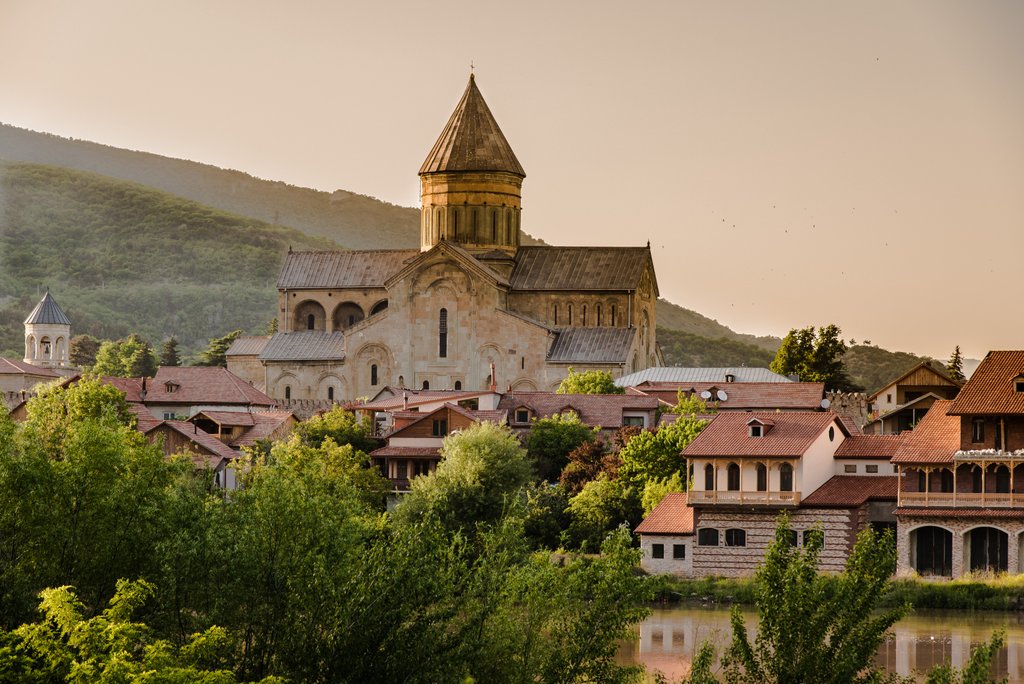
Our cars came to a halt in Mtskheta, which was the capital of Georgia
until the sixth century. There we visited the Svetitskhoveli cathedral,
which was built in the early 11th century on the site of a
fourth century wooden church. The church was a huge ecclesiastical
center, and the frescos, baptismal font, icons, tombs of kings and the
sepulcher of a devoted Christian woman named Sidonia attest to its
importance.
Sidonia was an ardent believer in Jesus, and when she was given a
piece of the robe he wore during his crucifixion (supposedly brought
back from Jerusalem by a Georgian Jew), she was so overcome by emotion
that she died, still clutching the robe in her hand. A tree sprung from
her tomb. When St. Nino of Cappadocia brought Christianity to Georgia in
the fourth century, she decided that wood from the tree would be used
to build the church in Mtskheta.
Nino, who came from Cappadoccia, had resided in Jerusalem and spoke
Aramaic or ancient Hebrew. When she arrived in Mtskheta, she could
communicate with the Jews who lived there. According to Moris Kirkheli,
who started Hillel and has studied the history of Jews in his country,
the first Jews in Georgia probably arrived in Mtskheta as early as the
eighth century B.C.E. and were followed by others who came from Babylon
in 586 B.C.E. Subsequent waves arrived until the fourth century C.E.
They adapted to Georgian society and were an integral part of it. They
spoke Georgian but prayed in Hebrew. The Hebrew language is still
reflected in modern Georgian: the word for Saturday is “Shabati” and the
days of the week are counted from Sabbath on. Sam Shabati is Tuesday.
Ot Shabati is Wednesday. Chud Shabati is Thursday, and so on. According
to Lela Tsitsuashvili, the word beit is slang for house. Some Georgian names may even be of Jewish origin.
The Jews of Mtskheta were very helpful to Nino, and, inspired by her,
some of them converted to Christianity and became Christian Jews. A
beautiful catalog called “Georgian Jews: History and Culture,”
co-written by Lela Tsitsuashvili, reports that the first priest of
Mtskheta was a local Jew named Abiathar and that the strong attachment
of Jews and Christian Jews to the holy city of Jerusalem was reflected
in local place names like Bethlehem, Golgotha, Mount Tabor and Mount of
Olives. An information panel at the small visitor center near the
cathedral says that the Jews of Mtskheta lived near the entry bridge to
the city.
In the Samtavro Valley in Mtsktheta is the largest ancient burial
site in Georgia. More than 4,000 graves have been excavated from several
layers, and they date from the eighth century B.C.E to the eighth
century C.E. Visitors can see burial mounds, hole graves, pitcher shaped
graves, tiled graves. The remains from an ancient settlement include an
oven for baking bread, a sanctuary, a dung channel, houses with niches
for idols, dishes used for sacrifices. Archeologists have found Hebrew
inscriptions on stele at this site as well as first century C.E. Jewish
relics and ritual funerary objects.
Outside of Mtskheta and majestically poised on top of a hill is Jvari
monastery, an important pilgrimage site and the first Georgian church. A
huge cross was erected by St. Nino, and, presumably, some of the
Christian Jews from Mtskheta worshipped there. Moris Krikheli pointed
out the place where two rivers meet down in the valley; “Jews lived
along the banks of the rivers,” he said.
Krikheli’s focus on Mtskheta as the locus of ancient Jewry is echoed
by Professor Guram Lordkipanidze, who presides at the Israelite center
at the State University in Tbilisi and is involved in ancient Israelite
excavations in Georgia. Although the professor was unavailable during my
visit, his assistant Nino Goisashvili told me that it is believed there
was a synagogue in Mtskheta, and digging will start soon. She
emphasized that there are different versions of Jewish history in the
country. One account has the northern tribes of Israel arriving at the
time of the Assyrian conquest in the eighth century B.C.E., and bringing
with them their knowledge of trade, carpentry, tool making and
handcrafts. They were instrumental in helping Georgia become a kingdom.
The alternate version is that Jews first arrived in the first century
C.E. Although there is archeological evidence for the latter, the former
persists in legends. It is also possible that Jews came to Georgia at
the time of the Babylonian exile, perhaps leaving Babylon by choice or
by coercion. Krikheli cited one lesser-known story about King Solomon
having a wife from Georgia and one from Armenia. The descendents of
these unions were appointed as kings from Jerusalem, and this was the
beginning of the kingdom in Georgia.
I was looking forward to visiting Kutaisi, the second biggest city in
Georgia, and I was not disappointed. David the Builder lived there,
and, according to legend, Jason sailed in the Argonaut on the local
Rioni River to get the Golden Fleece. The Bagrati Cathedral was built at
the end of the 10th century and is worth a visit. Nearby are the ruins of a military fortification, a small church and an 11th century wine house where you can still see kvevri, or clay wine vessels, in the ground. Each kvevri
is about three and a half feet across. Our guide said that surely the
Jews in Georgia used this traditional wine-making technique.
A long drive above the city took us to the 11th century
Gelati Monastery, which, like Bagrati, is a UNESCO World Heritage site.
The monastery, founded by David the Builder, was one of the great
spiritual and cultural centers of Georgia in the Middle Ages. It was
also an academy where scientists, philosophers and theologians lived and
worked. Inside are magnificent frescos, carvings and relics of saints.
The monastery was referred to as “new Athens” and, poignantly, “the
second Jerusalem.”
At the entrance of a separate building is David’s tomb, which lies
under an engraved stone slab in the ground. According to my guide, the
powerful king said he was a sinner, and that everyone should walk over
his heart! I found the story and the tomb humbling and moving.
In Kutaisi is an old Jewish cemetery with, most notably, small stones
for young children who perished. The Hebrew letters on the tombstones
are connected, without spacing between words.
One of the highlights of the trip was Vardzia, a 12-13th
century cave city that is built vertically into the hills on 13 stories
and is an architectural and engineering masterpiece. There are about 600
rooms, and it is estimated that, at Vardzia’s height, 50,000-60,000
inhabitants lived in this important economic, religious and cultural
center. Today, 10 monks still reside there. The beehive of caves
includes rock-cut chapels and churches, domed rooms, four monasteries,
underground shelters for times of strife, pharmacies, great halls,
stables, houses, secret tunnels and frescos. Not to be missed is the
striking fresco of King Tamar, which was painted in her lifetime.
Standing next to her father, she wears a magnificent jeweled robe and no
chinstrap, which signifies that she was not yet married. I was riveted
by the portrait of the Georgian queen, whose lineage may have been so
close to my own.
Another important connection to David and Tamar was in Dmanisi, an
off-the-tourist-trail destination about 90 minutes from Tbilisi. It was
first occupied before the sixth century, and in the eighth century it
was a small city. By the 12th century it was large city,
where David the Builder and King Tamar stayed in the fortified castle. I
wandered among the evocative ruins, which include Tamar’s bathroom. I
pictured her dressing in one of her jeweled robes.
A short walk from the castle ruins led to the site where the oldest
(1.8 million years) hominids in Europe were found. Nearby are
wonderfully executed sculptures of what our early ancestors looked like.
There was no Jewish connection, but there was certainly one of the
heart.
I took a private tour of the capital city of Tbilisi with Lika
Kakiashvili (lika1880@gmail.com; +995 25 6173), a very affable and
knowledgeable Georgian Jewish guide. According to her, anti-Semitism was
introduced to Georgia during the Russian tsarist era. The Russians
brought with them story that Jews used Christian blood to bake their
matzot. A few Jews were put on trial for this offense, but there was no
significant persecution of the Hebrews.
Lika said there are about 5,000 Jews left in Georgia today, and 2,000
of them live in Tbilisi. About 56,000 Jews lived in Georgia during the
Soviet occupation and, before that, there were many more. But the
Russians closed synagogues and exiled rabbis. They did the same hatchet
job on other religions as well. Lika’s mother, whom we met when Lika
took us to their modest but comfortable apartment in an old Jewish
neighborhood, summed it up this way with humor and irony: “Jews were
never repressed in Georgia before the Russians. Georgia was always busy
being repressed itself!”
We walked to the Sephardic synagogue in Tbilisi, which was built in
1904. An elder congregation member told me that about 20-25 people come
to pray each day; on Shabbat the numbers can swell to 100. The hachem or hazan
leads the service. There is a rabbi for all of Georgia in Tbilisi, but
he’s not at this synagogue (it was hard to get information from the man
about the “other,” Ashkenazi, synagogue).
When I asked how the Jews of Tbilisi could afford such an elaborate,
elegant synagogue as the one we were in — with faux marble décor,
elaborate paintings on the walls, two archways, gilding, soothing light
blue and brown hues — I was told that Georgian Jews from all over the
world donate money for the synagogue.
Continuing down the streets of Tbilisi, we passed an old yeshiva building and a former synagogue; neither is in use today.
We stopped at the Sioni church, where St. Nino’s original cross in
housed. Copies of it can be seen throughout Georgia. It has a drooping
cross branch that is attached to a vertical branch. According to legend,
Nino made the cross by tying the two branches together with strands of
her hair.
Just before twilight, Lika drove me to a Jewish cemetery on the
outskirts of Tbilisi. It was, hands down, the most startling graveyard I
have ever walked through. The deceased are portrayed in their prime as
huge, life-sized figures, taken from photographs and etched in black
stone. One man stands next to his beloved car. A woman looks like she
just wiped her hands on her apron and walked out of the kitchen. A
singer is surrounded by a microphone and musical notes. Lika said this
depiction of the dead was Georgian style and is found in Georgian
cemeteries. The photographic etchings were expenses and stand as a
testimony to the prosperous Jewish community that existed before so many
left.
The most personal, revelatory moment for me occurred when I was in a
Jeep in the Caucasus mountains. We reached the high-altitude village of
Tori, which is inaccessible to the without four-wheel drive. The roads
were unpaved, men ploughed their fields with oxen, and Medraft arranged
for us to be invited to the house of a very open-hearted villager. He
offered us chacha — the bracing Georgian liquor that is made
from grapes, sometimes with the addition of honey — and motioned to us
to sit on his wooden porch. He toasted us with an elaborate
Georgian-style toast and said we were welcome to walk around his humble
abode.
I went inside. It was almost barren except for a wood-burning stove, a
bed with a straw mattress, a rustic kitchen with a few pots, pans and
implements, and a faded, warped wooden floor. Something about the house
felt oddly familiar: it was the way I imagined my grandmother’s house in
the Ukraine, before she left the shtetl as a child and came to America.
The Medraft guide mentioned that our host originally came from the
Ukraine. I immediately remembered that my grandmother told me the floor
of her house in the shtetl was made from pressed goat excrement.
“What was the floor of your house made of in the Ukraine?” I asked.
“Goat excrement,” the man replied. “Here we use wood, but there it was pressed from the excrement of goats.”
In the impoverished mountain village, I came home to my ancestry in a way I never had before in my life.
IF YOU GO TO GEORGIA: Turkish Airlines has flights to Tbilisi, and I highly recommend them. (www.TurkishAirlines.com)
I flew New York to Istanbul and Istanbul to Tbilisi on Turkish
Airlines. They also fly from Israel to Istanbul, and from Istanbul to
Georgia.
Monday, October 18, 2010
PODCAST: Mit Kaminer durch das kaukasische Nichts. Begegnungen mit jüdischer Kultur. (hr-online.de)
Länge: 5:35 Min
Ein Bericht von Tanja Küchle - Jüdische Kulturwochen Frankfurt >>>
Quelle: © Hessischer Rundfunk, 18.10.2010
Dass Wladimir Kaminer Russe ist und eine kaukasische Schwiegermutter hat, wissen viele. Aber dass er auch Jude ist, wissen weit weniger Menschen. Der Autor ist Gast bei den "Jüdischen Kulturwochen", die Einblicke in die Kultur und das jüdische Leben geben wollen.
Wladimir Kaminer, der schon oft Gast in der Frankfurter Jüdischen Gemeinde war, ist nicht gerade ein Vorzeige-Vertreter der jüdischen Kultur. Doch er darf gerade deshalb nicht bei den "Jüdischen Kulturochen" fehlen. Kaminer liest aus seinem neuen Buch "Die kaukasische Schwiegermutter". Darin geht es bei weitem nicht nur um seine Schwiegermutter, die in der kaukasischen Steppe wohnt. "Es geht um den Kaukasus", sagt Kaminer, "da gibt es ja nichts." Vielleicht ein Restaurant, drum herum zehn Häuser. "Was von Menschenhand gebaut ist, ist reduziert", sagt er, "alles, was von Natur aus da war, ist total übertrieben." Da denkt der Schriftsteller – wie immer mit einer großen Portion Humor - an die Berge oder den übertrieben blauen Himmel.
Unter dem Motto "Begegnungen" wollen die Veranstalter - die Jüdische Gemeinde Frankfurt und das Kulturamt der Stadt Frankfurt – zeigen, wie unterschiedlich die Spielarten jüdischer Kultur sind. Das Bild des Judentums sei erst einmal mit dem Orthodoxen verbunden, mit der Religion, so Doris Adler von der Jüdischen Gemeinde Frankfurt. Diesem Klischee wollen die Veranstalter entgegenwirken. Entsprechend vielfältig ist das Programm. Die "Jüdischen Kulturwochen" bieten Literatur, Vorträge und Führungen, etwa durch das Gemeindehaus in Frankfurt. Und natürlich Musik, um vor allem nicht-jüdischen Menschen die jüdische Kultur näher zu bringen. Deshalb fehlt im Programm auch nicht die Klezmer-Musik mit dem Jiddish Swing Orchestra aus Berlin. Die Frankfurter Erfolgsautorin Stefanie Zweig liest aus "Heimkehr in die Rothschildallee", Susan Pásztor stellt mit ihrem skurril-komischen Familienroman einen "fabelhaften Lügner" vor, Rafael Seligmann spricht über seine Autobiografie "Deutschland wird dir gefallen" und der Publizist und Schriftsteller Ralph Giordano liest aus seinem Tagebuch "Mein Leben ist so sündhaft lang".
Ein Höhepunkt des Programms ist zugleich auch sein Abschluss: Am 31. Oktober 2010 präsentiert sich New Yorker Kantor Tsudik Greenwald, ein lyrischer Tenor, der als neuer Star unter den Kantoren gilt, bei einem Synagogenkonzert.
Quelle: www.hr-online.de
Friday, June 18, 2010
NEWS: RFE/RL Caucasus Report, 5/14/2010 - 6/18/2010 (rferl.org)
 A review of RFE/RL reporting and analysis about the countries of the South Caucasus and Russia's North Caucasus region. For more stories on the Caucasus, please visit and bookmark our Caucasus page .
Was Karachayevo-Cherkessia President Aide's Killing Intentional? The details that have emerged to date of the killing on May 12 of Fral Shebzukhov, a Cherkess aide to Karachayevo-Cherkessia Republic (KChR) President Boris Ebzeyev, are sketchy. But certain tentative conclusions can still be drawn, based on the killers' modus operandi and the albeit unconfirmed reports that Ebzeyev intended to name Shebzukhov prime minister. More
TV Journalists In Ingushetia Resign En Masse Over 40 television journalists employed by Ingushetia's Committee for State Radio and TV have submitted their resignations to protest what they describe as the "unhealthy working atmosphere" under Tamara Malsagova, whom Ingushetian President Yunus-Bek Yevkurov named to head the committee last year. More
Putative PM Candidate Slain In N.Caucasus Fral Shebzukhov, whom Karachayevo-Cherkessia Republic President Boris Ebzeyev is said to have nominated as the republic's next prime minister, was gunned down on the street in Cherkessk yesterday evening by three masked men. The killers managed to escape. More
New Draft Georgian Constitution Unveiled The state commission established last summer to draft further amendments to Georgia's already much-amended constitution approved on May 11 by a vote of 31 to 10 with two abstentions a new draft constitution that, if adopted, will augment the powers of the prime minister at the expense of the president. More
Embattled South Ossetian Premier Wins Reprieve The Russian leadership, which is funding postconflict reconstruction in the unrecognized republic of South Ossetia, has apparently warned President Eduard Kokoity against continuing to try to force the resignation of the republic's government, which is headed by Vadim Brovtsev, a Russian businessman from Chelyabinsk. More
Karachayevo-Cherkessia Still Without A New Prime Minister Eleven days after the deadline imposed last month by North Caucasus Federal District head Aleksandr Khloponin, it is still unclear who will succeed Vladimir Kayshev as prime minister of the Karachayevo-Cherkessia Republic. More
Armenia, Azerbaijan Mark Republic Day Armenia today marked the 92nd anniversary of the establishment of the first independent Armenian republic that emerged from the Russian Empire at the end of World War I. More
Albright Presents Strategic Concept For NATO’s Next Decade Former U.S. Secretary of State Madeline Albright, the chair of an expert committee advising NATO, says that the alliance must work quickly to become versatile, efficient, and capable of operating far from home and in partnership with others. Presenting the expert group's findings in New York, Albright also said that no one should be excluded from NATO membership -- even Russia. More
Armenian-American Group Seeks Scrutiny Of Bryza Nomination An influential Armenian-American group has called for careful scrutiny of the record of a diplomat nominated to be the next U.S. ambassador to Azerbaijan. More
Armenia Cops Fired Over Suspect Death A local Armenian police chief and three officers have been fired over the death of man in custody. More
Armenia Ruling Party: No Early Election A senior member of Armenia's ruling party has downplayed the possibility of early elections, which have been called for by the opposition. More
Armenian Government Reworks Bill On Foreign Language Schools Armenian Education Minister Armen Ashotian says a revised government bill allowing a limited number of schools in Armenia to teach in a foreign language is due to be submitted to parliament for approval soon. More
Watchdog Amnesty Harsh On 2009 Watchdog Amnesty International has warned that human rights abuses continued to plague the world in 2009, with torture or ill treatment, unfair trials and imprisonment, and restrictions on free speech among the most common violations. More
UN 'Civilizations' Forum In Brazil Hopes To Reframe Debate Over Global Culture, Politics The United Nations Alliance of Civilizations will host its third-annual forum in Rio de Janeiro from May 27-29. The conference, titled "Bridging Cultures, Building Peace," will be attended by high-level dignitaries including President Lula da Silva of Brazil, Prime Minister Recep Tayyip Erdogan of Turkey, and UN Secretary-General Ban Ki-moon. More
Saakashvili: Threat From 'Outside' Georgian President Mikheil Saakashvili today oversaw Georgia's first military parade since the 2008 war with Russia and warned against what he called a continuing threat from "outside forces." More
Embattled North Ossetian Mufti Steps Down The Spiritual Board of Muslims of North Ossetia (DUMSO) accepted late on May 24 after a prolonged discussion the letter of resignation submitted by the republic's mufti, Ali-haji Yevteyev, four days earlier. More
Armenian Opposition Holds Rally In Second-Largest City Thousands of activists from Armenia's main opposition alliance held a public rally in the country's second-largest city, Gyumri, during which they denounced the policies of the current government and called for snap elections. More
Victims Decry 'Mild' Sentence In Armenian Child-Abuse Trial Armenian rights activists and abuse victims are unhappy with the light sentence given to a teacher convicted of child abuse. More
Georgian Local Elections Focus Of Intense Scrutiny In the wake of two successive elections in 2008 that many opposition parties claim were rigged, the key issue is not so much one of policy, or even who will win most votes where, as of procedure: will President Mikheil Saakashvili's United National Movement use all the administrative resources at its disposal to preserve its hold on power, or it will it allow a vote that is truly free, fair, and democratic? More
Chechen Leader Challenges FSB Data On Insurgents Addressing a recent meeting of senior law enforcement officials, Ramzan Kadyrov questioned periodic estimates released by Russia's Federal Security Service (FSB) of the number of Islamic insurgents currently based in Chechnya, and that organization's criteria for determining who falls into that category. More
Armenian Investigators Point To Suicide In Police Custody Case An Armenian law-enforcement body investigating a suspicious death in police custody has largely endorsed police claims that the man committed suicide. More
Armenia Praises Karabakh Elections Armenia has hailed the parliamentary elections in the disputed Nagorno-Karabakh territory as a sign of the breakaway Azerbaijani region's strengthening democracy. More
New Political Party Formed In South Ossetia The founding congress of a new political party named Iron (Ossetia) took place on May 22 in Tskhinvali, capital of the unrecognized breakaway republic of South Ossetia. More
History, BP Oil Spill Haunt Caspian Sea As BP struggles to contain the massive oil leak in the Gulf of Mexico, a wary eye is being cast on offshore drilling projects around the world, especially in the Caspian Sea, where observers warn of severe consequences if steps are not taken to improve environmental oversight. More
Georgian Flights To Moscow Resume Georgian Airways resumed charter flights today between Tbilisi and Moscow. More
EU, East Meet Before Summit Ahead of a milestone EU-Russia summit next week, leading diplomats from the 27 EU governments met their counterparts from the six members of the bloc's Eastern Partnership -- Ukraine, Moldova, Belarus, Georgia, Armenia, and Azerbaijan -- in what was meant by its Polish hosts as a show of support. More
Georgian Party Accused Of Intimidation Some Georgians are accusing the ruling United National Movement of intimidating people not to vote for opposition parties in the upcoming local elections. More
Armenia Raps EU Over Karabakh Resolution Armenia has criticized the European Parliament for demanding the "withdrawal of Armenian forces from all occupied territories of Azerbaijan" in its latest resolution on the South Caucasus. More
Georgian Opposition Accuses Government Of Bribery The leader of the Georgian opposition Labor Party has accused the government of offering him 4 million euros (about $5 million) in exchange for his party's withdrawal from upcoming local elections. More
Nagorno-Karabakh Holds Elections Parliamentary elections are taking place today in Nagorno-Karabakh, the breakaway region of Azerbaijan populated mainly by ethnic Armenians. More
Mufti With Insurgent Contacts Resigns The Muslim leader in the Russian republic of North Ossetia has offered his resignation following controversial statements he made in an interview earlier this month. More
Georgian Energy Mogul Arrested Geno Malazonia, the president of JSC Energy Invest, was arrested and charged with fraud, tax evasion, and abuse of power. More
EU: Nagorno-Karabakh Elections Illegal The European Union's foreign policy chief, Catherine Ashton, has warned that planned parliamentary elections in the disputed Caucasus enclave of Nagorno-Karabakh on May 23 will not be legal. More
Controversial Armenian TV Bill Passes First Hurdle The Armenian parliament has approved a controversial bill which local press groups say enables the government to tighten its grip on broadcast media. More
Azeri Mosque Threatened With Closure Azerbaijani police have warned the clergy of a Sunni mosque outside of Baku that it may be closed because it is not officially registered. More
Georgian Daily Wants To See State Deal With Russian Energy Company The Georgian newspaper "Rezonansi" and the Young Lawyers Association (AIA) said they will continue their legal case against the Energy Ministry for not revealing details of a deal it made with a Russian energy company. More
Armenian Growth Accelerates In April Official statistics show that Armenia's ongoing economic recovery accelerated further in April. More
Azerbaijani Rights Activists Seek International Help On Torture Cases Dozens of Azerbaijani nongovernmental organizations have signed a petition urging international organizations to support an investigation into torture cases in Azerbaijan. More
Prosecutor Shot Dead In North Caucasus A local deputy prosecutor has been shot dead in Russia's republic of Kabardino-Balkaria, the latest victim of ongoing violence in the North Caucasus. More
Armenian Vow To Combat Torture Armenian Prosecutor-General Aghvan Hovsepian has told visiting Council of Europe officials that security officials are doing more to stop the mistreatment of criminal suspects. More
Suspended Sentence For South Ossetian Opposition Journalist A journalist in Tskhinvali, the capital of Georgia's breakaway region of South Ossetia, has been given a two-year suspended prison sentence after being found guilty of illegal possession of weapons. More
Armenian Journalist Released From Jail An Armenian journalist and her brother who were detained while covering an attempted opposition protest on May 31 have been released from custody. More
Karachayevo-Cherkessia Parliament Approves New Prime Minister The Karachayevo-Cherkessia Republic (KChR) parliament today approved by a vote of 47 in favor and 15 against the candidacy of Muradin Kemov as prime minister. More
The Yalta Syndrome And Its Critics Cooler heads in the Tbilisi foreign policy establishment are not as concerned about the U.S. "reset" with Russia as all the noise suggests. More
Georgia's Ruling Party Wins Vote Georgia's Central Election Commission today released the final results of municipal elections that show President Mikheil Saakashvili's United National Movement won the May 30 poll. More
KBR Supreme Court Again Calls For Abolition Of Balkar NGO The Kabardino-Balkaria Republic (KBR) Supreme Court ruled on May 31 that the unofficial Council of Elders of the Balkar People (SSBN) is an extremist organization and should be abolished. More
Tatar Police Colonel Named Karachayevo-Cherkessia Interior Minister Russian President Dmitry Medvedev on May 31 named Zhaudet Akhmetkhanov to head the Karachayevo-Cherkessia Republic (KChR) Interior Ministry. Akhmetkhanov, who is 42, has spent his entire career in the police force and has held leading positions in the criminal police in Kazan and the Criminal Investigation Department of Tatarstan's Interior Ministry. More
The EU's Declaration Of Impotence What is worrying is the degree to which Brussels' bureaucratic horizons seem to shape (and limit) its conception of foreign-policy making. That the removal of special representatives could badly wrong-foot partner governments in unstable regions never seemed to enter the heads of Ashton or her team. More
Armenian Media Groups Demand Journalist's Release Armenia's leading media associations have demanded the immediate release of a young reporter arrested while covering an opposition protest in Yerevan. More
Unusually Quiet Elections Mark End Of Revolutionary Cycle In Georgia Georgia's May 30 municipal elections marked the end of a political cycle that began in the fall of 2007, when the country's opposition collectively decided that it needed to mobilize popular discontent to unseat President Mikheil Saakashvili. More
In Georgia and Moldova, Worries That EU Special Reps -- And Their Protection -- May Vanish Officials in Moldova and Georgia are reacting with concern to speculation that the EU is poised to remove special representatives appointed to their regions. If confirmed, the change would signal a major downgrading in the EU's strategic interest in both Chisinau and the countries of the South Caucasus. More
Yerevan School Principal Fired Over Sex Abuse Scandal The principal of a Yerevan boarding school for children with special needs has been dismissed following the imprisonment of a former teacher convicted of sexually and physically abusing female students. More
EU-Russia Summit To Steer Forward Course, Without Rocking The Boat At an EU-Russia summit today in Rostov-na-Donu, the Russians will be looking to secure guarantees of visa-free European travel. The EU, for its part, will be looking for opportunities to guide Russia's economic development. Both goals are a reflection of a pragmatic new stage in EU-Russian relations -- the desire to look to the future, while keeping controversy to a minimum. More
Azerbaijan Amends Election Law Azerbaijan's parliament today passed controversial amendments to the country's election law. More
Medvedev Convenes Third Meeting Of Armenian, Azerbaijani Presidents Russian President Dmitry Medvedev met on June 17 on the sidelines of the St. Petersburg Economic Forum with the presidents of Armenia and Azerbaijan to discuss the ongoing search for a solution to the Karabakh conflict. More
Azerbaijan Evaluates Cost Of Nagorno-Karabakh War Azerbaijan says the total amount of damage suffered by the country due to the war with Armenia over the disputed region of Nagorno-Karabakh has been estimated at 70 billion manat ($87 billion). More
Armenian Opposition To Stage Sit-In Opposition activists have said they will proceed with plans to stage a sit-in in cental Yerevan on June 18 to demand the release of imprisoned opposition figures. More
Karabakh Leadership Skeptical About Armenian-Azerbaijani Summit The Armenian leadership in Nagorno-Karabakh says today's meeting between the Armenian and Azerbaijani presidents will not help find a resolution for the disputed region. More
CSTO: No Peacekeepers For Kyrgyzstan Russian-led Collective Security Treaty Organization says it will not deploy peacekeepers to Kyrgyzstan but may send security "specialists." More
'No Changes' To Armenia Broadcast Bill An Armenian government official says there will be no further changes to a controversial bill on broadcasting that has been criticized as giving the government too much control over the country's airwaves. More
Free Press in North Caucasus Continues to Deteriorate Information in Russia’s North Caucasus republics is tightly controlled by the state and the threats to independent media there continue to grow, according to prominent Russian journalist Fatima Tlisova. More
International Organizations Slam Armenian TV Law International organizations have criticized controversial Armenian legislation that media freedom groups say will allow the government to retain its control over Armenia's broadcast media. More
Armenia Fined For 'Inhuman Treatment' The European Court of Human Rights has fined Armenia's authorities 16,000 euros ($20,000) for what it regards as "inhuman" treatment of an Armenian businessman who died in prison last year More
Holier Than Thou: Ramzan Kadyrov And 'Traditional Chechen Islam' Chechen Republic head Ramzan Kadyrov, arguably the most powerful -- and dangerous -- regional leader in the Russian Federation is resorting to increasingly draconian measures to impose his own eclectic vision of what constitutes "traditional Chechen Islam," along with the code of behavior, ethics, and dress he considers one of its key components. More
Flooded Azerbaijani Villagers Want Dam Dismantled Residents of villages in central Azerbaijan still flooded from last month's heavy rains are seeking greater help from the government to lower the water level. More
Militants, Troops Killed In Daghestan Seven suspected militants and four interior ministry troops have been reported killed in two incidents today in the restive Russian republic of Daghestan. More
U.S. Jewish Groups 'No Longer Opposed' To Armenian Genocide Recognition "Washington Times" journalist Eli Lake argues that Turkey can no longer count on the backing of the powerful Jewish lobby in the United States in its efforts to block a congressional resolution recognizing the Armenian genocide. More
Armenian Opposition To Hold Sit-In An Armenian opposition group says it will proceed with plans to stage a sit-in at Yerevan's central square. More
Opposition Criticizes Ter-Petrossian Two opposition leaders today criticized opposition leader and former President Levon Ter-Petrossian. More
Russian President Arrives In Chechnya Russian President Dmitry Medvedev has arrived in Chechnya in a surprise visit following a series of attacks on police officers and civilians in the North Caucasus region. More
EU Envoys In South Caucasus, Moldova Facing End Of The Road The EU special representatives for South Caucasus and Moldova are likely to lose their jobs on August 31 under a proposal tabled by the bloc's top foreign policy official, Catherine Ashton. Despite a late fightback by some mostly Eastern European member states keen to retain both envoys, EU foreign ministers meeting in Luxembourg are set to nod through Ashton's plans. More
FSB Captures 'Legendary' Ingush Field Commander FSB Director Aleksandr Bortnikov announced on June 9 that the Ingush field commander known as Amir Magas (whose true identity remains unclear) was apprehended during a special operation earlier that day in Malgobek. The website of the Ingushetian chapter of the North Caucasus insurgency, hunafa.com, confirmed Magas's capture early on June 10. More
Armenian Government To Maintain Grip On Broadcast Media The Armenian authorities appear determined to maintain their long-standing control over the country's broadcast media by means of newly enacted legal amendments criticized by local press freedom groups and the Organization for Security and Cooperation in Europe. More
Armenian Parliament Upholds TV Bill The Armenian parliament has passed in the second and final reading a controversial bill which local press freedom groups say will fail to end strong government influence on the country's broadcast media. More
Karabakh Parliament Elects Leadership Nagorno-Karabakh's new parliament convened for the first time and elected its leadership today, more than two weeks after being elected in a vote criticized by Azerbaijan and the European Union. More
Subscribe to:
Posts (Atom)