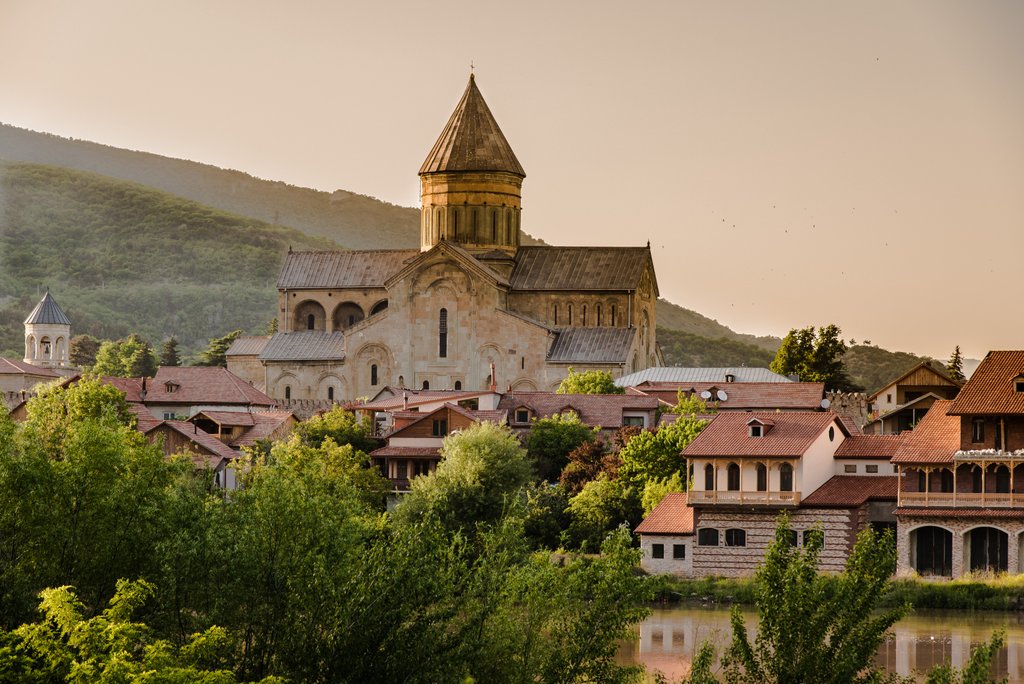
(hertie-school.org) More than twenty years after the Soviet Union’s disintegration, uncertainty about a border between Europe and Asia prevails. While in the North, West, and South of Europe, geographical demarcations at least simplify the discourse there is no consensus on an Eastern ‘end’ to Europe. The Urals are often viewed as a natural demarcation between Europe and Asia; however, this border is nothing more than a political and cultural construct. The following article aims to shed light on the relevance of a Eurasian
continental border and thus on the question where Europe (not the EU) ends. Examining the historical developments and determinants of this border and looking at viewpoints from the South Caucasus, a region allegedly located outside of Europe, existing wisdom will be questioned.
The Borders between Europe and Asia
Despite statements in many schoolbooks to the contrary, no official geographical border between Europe and Asia exists. In terms of plate tectonics, Eurasia is one continent. But then what is ‘Europe’ and why do most of us have an opinion on its geographical scope? According to Greek mythology “Europa” was a daughter of Zeus whose name was used to describe the area of Northern Greece around 500 BC. In its modern sense, Europe was first mapped as a single entity during the 8th century; however, meanings and understandings of the term have differed widely ever since.
As Bernhard-Henri Lévy puts it, Europe has developed more as an idea than as an area. But can an idea of a collective identity flourish without physical demarcation? Most scholars researching in the field of identity agree that any construction of a unit is not possible without demarcation of something different or exterior (Krause, 2008). Construction of identity thus always means construction of alterity.
After the Thirty Years’ War in 1648 the understanding of sovereign nation states took root, which in turn resulted in a sharp increase in the usage of maps. Consequently, questions of physical demarcations and specific borders gained importance in this era,
especially because they represented a new legitimation of power. As the number of alliances and treaties amongst states rose, the question of ‘Europe’s end’ also arose. Rulers began to define geographical endpoints of a European continent to divide ‘good’ from ‘evil’. For instance, in the early 16th century the French minister Sully considered “Russia as a barbarous country…in the same class with Turkey”, categorising
both as non-European (Jacobs, 2012).
While many geographers came up with ideas for a Eurasian border, there was no consensus until the 1720s. At that time, Swedish officer Johann Philipp von Strahlenberg, backed by the powerful Russian tsar, proposed a continental border that has formed the basis for the understanding of Europe’s scope until today. Following the Urals, trahlenberg’s
demarcation goes along the Volga and Don rivers until the Black Sea. Although intended for academics, the broader acceptance of Strahlenberg’s proposed border was namely political: the Russian tsar Peter II wanted to present his empire as European as possible, especially because the term ‘Europe’ was increasingly understood as a synonym for progress. He thus welcomed Strahlenberg’s proposition, which included a relatively large part of Russia in Europe.
Despite statements in many schoolbooks to the contrary, no official geographical border between Europeand Asia exists.
This demarcation was accepted by a majority of academics and politicians in the following two centuries while at the same time, generally the division of the world into continents became an ever more important concept in Europe. The formalisation of a continental system in the 19th century and the naturalisation of continental categories were regarded not as political constructs, but as “real geographical entities that had
been ‘discovered’ through empirical inquiry” (Lewis and Wigen 1997). Western geographers such as the German Carl Ritter used the concept to show that "each continent is like itself alone…each one was so planned and formed as to have its own special function in the progress of human culture" (ibid). From today’s point of view, however, it is evident that such theories of the 19th and early 20th century were
mostly used to underline European superiority in the international arena.
While from 1945 on the Iron Curtain separated Europe (as Strahlenberg defined it), politicians still held on to the previous consensus on the continental order. Only after the Cold War the ambiguity of the Eurasian border concept became apparent: with an increasingly important European Union and a new order in the post-Soviet space, politicians and academics alike were confronted with the question of Europe’s
eastern ‘end’ once again. Geopolitical events—such as Turkey’s pending application for EU membership, the EU’s Neighbourhood Policy within and outside ‘Strahlenberg’s Europe’ and the emphasis of countries such as Georgia on their European roots and identity—all the more blur the existing wisdom on what is Europe.
Due to this growing uncertainty, especially within Europe, a look beyond the previously accepted border can help to cast light on the question of this continent’s ‘end’ in the east. There is no region that would be better suited for this purpose than the South Caucasus where questions about belonging to Europe or Asia have been prominent in public discourse for centuries.
Viewpoints from the South Caucasus
“Some scholars look on the area south of the Caucasian mountains as belonging to Asia, while others, in view of Transcaucasia’s cultural evolution, believe that this country should be considered part of Europe. It can therefore be said, my children, that it is partly your responsibility as to whether our [Baku] should belong to progressive Europe or to reactionary Asia”.
This passage from the Caucasus’ most famous novel “Ali & Nino”, published in 1937, shows how much the region is torn between Europe and Asia. The eventful history of the South Caucasus has certainly left its mark on the identity of Armenia, Azerbaijan and
Georgia as those countries were exposed to different political and cultural forces to a much greater extent than other ‘bordering’ nations of Europe. While in the 18th and 19th century, Persia, the Osman Empire and the Russian Tsardom fought over power in this region, in 1921 the Soviet Union won control over it—against the will of the local population that partly kept up resistance during the 20th century. Thus, the USSR’s
disintegration in 1991 resulted in a geopolitical and cultural reorientation of the three nations in different directions.
Since the Rose Revolution in 2003, Georgia in particular has increasingly presented itself as a country with European roots often referring to its history as one of the oldest Christian nations in the world. In his inauguration speech, President Saakashvili stated, "[the European] flag is Georgia’s flag as well, as far as it embodies our civilization, our culture, the essence of our history and perspective, and our vision for the future of Georgia…Our steady course is toward European integration” (Saakashvili, 2004). But how are such political statements also reflected by the opinion of the broader public?
While in representative surveys a majority of Georgians answer that they see themselves as Europeans and 40 percent of Armenians and a majority of Azerbaijanis remain sceptical of the EU, it is interesting to look behind these numbers. As part of a research with the “Studienkolleg zu Berlin” fellowship program, my project group recently interviewed 37 Georgians and Azerbaijanis about their viewpoints on Europe’s Eastern ‘end’. Furthermore, each interviewee was asked to draw the boarder between Europe and Asia according to her opinion, wherein two themes became apparent.
First, opinions on the location of a Eurasian border differ strongly between people across generations and employment. Second, perceived determinants of this demarcation vary even more greatly. Although religious factors are decisive for some, others define
the European continent based on economic and political factors or the style of their respective traditional music as a reason for the demarcation of Europe. Abstract discussions on the scope of Europe become tangible through such individual perceptions, which in turn also reveal the difficulty of formulating coherent narratives on the continent’s demarcation.
The Non-existence of Europe’s end
Is there an ‘end’ of Europe in the east? In general, some kind of demarcation remains necessary for anything that is understood to be a connected unit since the construction of an ‘I’ or a ‘we’ is not possible without a certain separation from the outside. At the European level, identity formation follows the same principles. Considering, however, the diversity of perceived individual demarcations, one can conclude that the simplified Western discourse about one continental border as Strahlenberg defined it is no longer appropriate.
Although religious factors are decisive for some, others define the European
continent based on economic and political factors or the style of their respective traditional music as a reason for the demarcation of Europe.
While the EU must set borders according to precisely defined criteria, the scope of Europe as a ‘continent’ (understood as a cultural area and/or value system) is determined by the perceived relevance of defining factors such as historical, cultural or political events, which differ widely from person to person.
Therefore, the question of how far Europe reaches can and must be answered for the clearly defined institution of the EU, but not for the undefined, overarching continent, especially as the meaning of the word continent in this context may never be agreed on. Coming back to Bernhard-Henri Lévy’s argument mentioned above, it seems likely that aside from the EU, Europe will continue to develop more as an idea than as an area. Politicians and economists alike should take this into account when making use of terms such as ‘neighbourhood’ or when referring to the ‘naturalness’ of a European continent in their decisions.
The advantages of a more flexible continental concept are manifold. Firstly, it would reduce the fear of proEuropean ‘bordering’ countries (such as Georgia) of being excluded. Secondly, it could—to a certain extent- separate the political from the cultural and historical discussions about Europe’s scope at the EU level, thereby taking pressure from EU decision-makers at a time when further enlargements are becoming more and more unlikely. Finally, such a flexible continental concept would allow for a less close-minded discourse on the integration of cultural diversity into
‘our’ value sphere.
+++
Jacobs, F. (2012). ‘Where is Europe?’, New York Times, 09 January, opinionator.blogs.nytimes.com (accessed 07 July 2012).
Krause, J. (2008). Die Konstruktion der Grenzen Europas: Das staatliche Territorialitätsprinzip und seine Extrapolation auf die supranationale Ebene. Leipzig:
Universität Leipzig.
Lewis, M. and Wigen, K. (1997). The Myth of Continents. A Critique of Metageography. Berkeley: University of California Press.
Saakashvili, M. (2004). Presidential Inaugural Address in Tbilisi, 25 January 2004.
+++
This article is based on the results of a “Studienkolleg zu Berlin” (Berlin Studies Centre) project. For more information on the fellowship programm of the Studienkolleg see www.studienkolleg-zu-berlin.de
+++
David Rinnert is a MPP candidate at the Hertie School and has previously studied
Social Sciences and Philosophy at the Humboldt-Universität zu Berlin, SciencesPo
Paris, and the City University of New York. Currently, he works as a Young Professional
at the GIZ in Moldova. Besides, he researches and publishes on the transformations of post-Soviet states.
Showing posts with label Kurban Said. Show all posts
Showing posts with label Kurban Said. Show all posts
Monday, December 17, 2012


Wednesday, July 25, 2012
REVIEW: Fariba Zarinebaf on Ali and Nino: A Love Story (lareviewofbooks.org)
A Tale of Love and Nostalgia across Religious Divides in the Caucasus
July 17th, 2012
 (lareviewofbooks.org) "We were a very mixed lot, we forty schoolboys who were having a geography lesson one hot afternoon in the Imperial Russian Humanistic High School of Baku, Transcaucasia: thirty Mohammedans, four Armenians, two Poles, three Sectarians, and one Russian."
The opening lines of Ali and Nino takes us back to a classroom in Russian-controlled northern Azerbaijan at the wake of World War I, to Baku, an oil-boom port city on the Caspian Sea. The ethnic mosaic of Muslim Azeris (mostly Shi’i), Armenians, Jews, and Russians, the continued Russian colonial rule that dated back to early 19th century, the oil boom, and various imperial rivalries all gave rise to social, religious, and ethnic tensions that characterized not only life in Baku but in other cities across the Caucasus and the Balkans. The novel may be described as a Caucasian version of Bridge on the Drina by Ivo Andric, or of Romeo and Juliet: it tells the tale of two young lovers, an Azeri Muslim boy and a Georgian girl who try to overcome religious divides and rising ethnic tensions to preserve their love, against the odds.
The story is told from the point of view of Ali Shirvanshir, a young man who, despite his love for the Georgian Nino, closely identifies with his Muslim heritage and the Shirvanshahs, his aristocratic ancestors who once ruled the region. Romance between a Muslim and Christian is forbidden by both religions, and the two lovers face a world that is rapidly changing and increasingly polarized. The Old Town is where Ali lives, and it is a different world than that of the Outer Town, where Russian culture and control dominate. In the Outer Town:
"There were theatres, schools, hospitals, libraries, policemen and beautiful women with naked shoulders. If there was shooting in the Outer Town, it was always about money. Europe’s geographical border began in the Outer Town, and that is where Nino lived."
After two major wars against Persia in the early 19th century, Russia established its rule over the Caucasus as a whole, occupying northern Azerbaijan, Armenia, and Georgia. A massive migration of Muslim Turks to the Ottoman Empire and Iran took place in the course of the 19th century as greater Azerbaijan was divided between Iran, Russia, and the Ottoman Empire. Modern national borders were absent, and people moved between these empires frequently. In the novel, for instance, Ali’s uncle from Persia visits Baku for medical reasons, and Ali vacations at his uncle’s house in Tehran.
"Much blood has flowed through the centuries in the alleys of our town. And this blood makes us strong and brave. Zizianashvili’s Gate rises up opposite our house, and here too noble human blood has been shed, becoming part of my family’s history. That was many years ago, when our country Azerbaijan still belonged to Persia, and Hasan Kuli Khan ruled over Baku, its capital."
We were a very mixed lot, we forty schoolboys who were having a geography lesson one hot afternoon in the Imperial Russian Humanistic High School of Baku, Transcaucasia: thirty Mohammedans, four Armenians, two Poles, three Sectarians, and one Russian.
The opening lines of Ali and Nino takes us back to a classroom in Russian-controlled northern Azerbaijan at the wake of World War I, to Baku, an oil-boom port city on the Caspian Sea. The ethnic mosaic of Muslim Azeris (mostly Shi’i), Armenians, Jews, and Russians, the continued Russian colonial rule that dated back to early 19th century, the oil boom, and various imperial rivalries all gave rise to social, religious, and ethnic tensions that characterized not only life in Baku but in other cities across the Caucasus and the Balkans. The novel may be described as a Caucasian version of Bridge on the Drina by Ivo Andric, or of Romeo and Juliet: it tells the tale of two young lovers, an Azeri Muslim boy and a Georgian girl who try to overcome religious divides and rising ethnic tensions to preserve their love, against the odds.
The story is told from the point of view of Ali Shirvanshir, a young man who, despite his love for the Georgian Nino, closely identifies with his Muslim heritage and the Shirvanshahs, his aristocratic ancestors who once ruled the region. Romance between a Muslim and Christian is forbidden by both religions, and the two lovers face a world that is rapidly changing and increasingly polarized. The Old Town is where Ali lives, and it is a different world than that of the Outer Town, where Russian culture and control dominate. In the Outer Town:
There were theatres, schools, hospitals, libraries, policemen and beautiful women with naked shoulders. If there was shooting in the Outer Town, it was always about money. Europe’s geographical border began in the Outer Town, and that is where Nino lived.
After two major wars against Persia in the early 19th century, Russia established its rule over the Caucasus as a whole, occupying northern Azerbaijan, Armenia, and Georgia. A massive migration of Muslim Turks to the Ottoman Empire and Iran took place in the course of the 19th century as greater Azerbaijan was divided between Iran, Russia, and the Ottoman Empire. Modern national borders were absent, and people moved between these empires frequently. In the novel, for instance, Ali’s uncle from Persia visits Baku for medical reasons, and Ali vacations at his uncle’s house in Tehran.
Much blood has flowed through the centuries in the alleys of our town. And this blood makes us strong and brave. Zizianashvili’s Gate rises up opposite our house, and here too noble human blood has been shed, becoming part of my family’s history. That was many years ago, when our country Azerbaijan still belonged to Persia, and Hasan Kuli Khan ruled over Baku, its capital.
Old Baku is described as the beautiful maiden (Maiden’s Tower) over whom many heroic and proud men have fought for centuries against the Russians, sacrificing their flesh and shedding their blood in order to save her, to save their city and culture. But Nino, as a Christian woman, represents Europe, alien and intrusive. Nino sees Muslim culture through a Russian, western lens, with which she views the world she describes as ‘barbarian,’ though she is also deeply attracted to it and to Ali. More than anything else, she and her family are concerned about the way Muslim culture treats women. Therefore, the question of marriage to a Muslim boy raises deep-seated anxieties on both sides. The novel is punctuated by passages that place Ali and Nino worlds apart, in the Old Town of Baku and the Outer Town that represent the Muslim and Christian cultures with their ever-growing tensions and tractions.
"Our old town is full of secrets and mysteries, hidden nooks and little valleys. I love these soft night murmurs, the moon over the flat roofs, and hot quiet afternoons in the mosque’s courtyard with its atmosphere of silent meditation. God let me be born here, as a Muslim of the Shi’ite faith, in the religion of Imam Ja’far. May he be merciful and let me die here, in the same street, in the same house where I was born. Me and Nino, a Christian, who eats with knife and fork, has laughing eyes and wears filmy silk stockings."
These tensions, which are mostly hidden below the surface, emerge during World War I, when the local population is ordered to sign up and volunteer for the war on behalf of Russia. But most Muslim Azeris, like Ali, support the Ottoman Empire and are awaiting the arrival of Turkish soldiers to settle old feuds. In addition, ethnic tensions between Muslim Turks and Armenians engulf Baku and the Caucasus and threaten to pull apart the pluralist society of Baku as was the case in many Balkan and Anatolian towns. Ali is torn between his love and loyalty to Nino and his political sentiments. When an Armenian kidnaps Nino, Ali is enraged, determined to take revenge to defend his honor. He captures and marries his sweetheart. Ali and his family have strong ties to Persia, and flee there during the war. Ali and Nino end up in the Shah’s Harem on soft pillows and silk blankets, after a long journey. Ali starts writing his memoir in Persia, having a sense of the looming future in his hometown. But Nino is unhappy and forces Ali to leave the “Asiatic country,” where women are only objects of desire, to return to Baku. When the British take over Baku from Turkish forces, Azerbaijan gains a short-lived autonomy and Ali becomes the minister of foreign affairs for a brief period. The Bolshevik revolution and the ensuing civil war divide Azerbaijan once more between the Christian forces led by Russia and the weak local forces. Ali falls in a bloody battle against the Russians on a bridge dividing Ganja. Thus ends the transitory autonomy of Azerbaijan Republic.
The authorship of Ali and Nino remains a mystery despite recent debates and disputes about the real identity of Kurban Said, a pseudonym used by the author. For a long time, he was thought to be the local Azerbaijan Muslim author and diplomat, Yusuf Vazir Chamanzaminli (1887-1942), who perished in Stalin’s Gulag. But an American author by the name of Tom Reiss has argued in his book The Orientalist that the author was Essad Bey or Levi Nusinbaum (1905-1942) who converted to Islam and fled the Bolsheviks in 1920 and published the novel in Germany in 1937. Betty Blair, the editor of Azerbijan International, has recently argued that the real author was Chamanzaminli and that Essad Bey in fact revised the story and published it under his name.
Regardless of who the real author of Ali and Nino may be, it is clear that the historical and political backdrop to the novel shares several historically and politically significant features with similar novels written in the Balkans after World War I. Ali and Nino is a novel about love, nostalgia, Muslim-Christian encounters, ethnic tensions at the dawn of imperial rivalries, the rise of nationalisms that tore apart communities of faith and pluralist societies like Baku in the Caucasus and Bosnia in the Balkans, and a world and lifestyle that was once the norm but is no longer even an ideal.
Recommended Reads:
* "Lighting Darkened Corners": N.S. Morris on Tablet & Pen: Literary Landscapes from the Modern Middle East
* "Libya, 1931": Ibrahim N. Abusharif on Desert Encounter by Knud Holmboe
Friday, May 14, 2010
TRADITION - In Aserbaidschan am Fuß des Kaukasus werden noch jahrhundertealte Bräuche gepflegt (gea.de)
Bergjuden im »letzten Schtetl«
VON CARSTEN HOFFMANN
Der aserbaidschanische Rabbi Adam David empfängt Fremde mit finsterem Blick. Besucher, die es aus der Hauptstadt Baku in die etwa drei Stunden Autofahrt entfernte »Rote Siedlung« am Fuße des Kaukasus schaffen, müssen dies aber nicht persönlich nehmen. »Wir sind glücklich, aber wir zeigen es nicht«, sagt der Rabbi. Er gehört zur kleinen Minderheit der Bergjuden. »Es ist fast unmöglich, einen Bergjuden lachen zu sehen. Wir fürchten den Neid der Nachbarn. Aber wir lächeln innen«, sagt er.
Monday, August 10, 2009
REZENSION: Der leidenschaftliche Orientalist. Von Ferdinand Lughofer (kismetonline.at)
Essad Bey, Lev Nussimbaum, Kurban Said, Mohammed Essad Bey. Viele Namen ein und derselben Person. Eine spannende Biographie in der Kritik.Einer Person, über die viele nicht wussten, wer sie ist und ob es sich bei all diesen Namen nicht doch um verschiedene Personen handelte. Dem New York Times- und Wallstreet Journal-Journalisten Tom Reiss gelingt es, eine erste Antwort zu finden auf das Mysterium eines Mannes, der ständig seine Identität wechselt. Als in Baku/Aserbaidschan zu Beginn des letzten Jahrhunderts geborener Jude wächst Lev Nussimbaum unter wohlhabenden Umständen auf. Sein Vater Abraham, ein Öl-Baron, seine Mutter eine bolschewistische Revolutionärin, die sich vermutlich selbst das Leben genommen hat.
Der ganze Text >>>
AmazonShop: Books, Maps, Videos, Music & Gifts About The Caucasus
Der ganze Text >>>
AmazonShop: Books, Maps, Videos, Music & Gifts About The Caucasus
Thursday, March 19, 2009
LITERATURE: Tom Reiss, The Orientalist ... Solving The Mystery Of Strange And Dangerous Life. (tomreiss.info)
Story: The true story of a Jew who transformed himself into a Muslim prince in Nazi Germany. Lev Nussimbaum escaped the Russian Revolution in a camel caravan and, as "Essad Bey" and "Kurban Said," became a celebrated adventurer and author of the enduring novel Ali and Nino.
But his success shielded a fatal secret...
NEWS: Read about how The Orientalist has just inspired Christian Louboutin to go to Caucasia.
Der Spiegel devotes three pages to Der Orientalist which was published to widespread acclaim in Germany this spring.
Watch a short BBC documentary about The Orientalist
Listen to Tom on NPR's All Things Considered.
Read The Orientalist? Write about your reading experience on the book's Amazon webpage.
Read the entire first three notebooks of Lev Nussimbaum: Notebook1 ; Notebook2 , Notebook3
 The Author: Tom Reiss has written about politics and culture for The New Yorker, The New York Times, The Wall Street Journal and elsewhere.
Tom is currently writing a biography of General Alexandre Dumas, the father of the famous novelist, who rose from slavery to become a leading general in Napoleon’s army -- the highest ranking black military figure in history until Colin Powell, 200 years later. Dumas went to Egypt as cavalry commander but his rivalry with Napoleon ultimately left him in an Italian dungeon. His exploits were memorialized by his son, in books like The Three Musketeers and The Count of Monte Cristo.
Tom Reiss writes about international politics and culture for The New Yorker magazine. In the past, he has written for The New York Times, The Wall Street Journal, and other publications. His work often focuses on how individual lives are affected by history, and is known for its rich juxtapositions of cultures and time periods that bring forgotten people and places to life. He was born in New York City and grew up in Texas and Massachusetts, where he graduated from Harvard College. A 1998 travel magazine assignment in Baku, Azerbaijan, led him to discover the unsolved mystery of Kurban Said.
Watch a short BBC documentary about The Orientalist
Listen to Tom on NPR's ALL THINGS CONSIDERED.
 The Book: Part history, part cultural biography, and part literary mystery, The Orientalist traces the life of Lev Nussimbaum, a Jew who transformed himself into a Muslim prince and became a best-selling author in Nazi Germany.
Born in 1905 to a wealthy family in the oil-boom city of Baku, at the edge of the czarist empire, Lev escaped the Russian Revolution in a camel caravan. He found refuge in Germany, where, writing under the names Essad Bey and Kurban Said, his remarkable books about Islam, desert adventures, and global revolution, became celebrated across fascist Europe. His enduring masterpiece, Ali and Nino–a story of love across ethnic and religious boundaries, published on the eve of the Holocaust–is still in print today.
But Lev’s life grew wilder than his wildest stories. He married an international heiress who had no idea of his true identity–until she divorced him in a tabloid scandal. His closest friend in New York, George Sylvester Viereck–also a friend of both Freud’s and Einstein’s–was arrested as the leading Nazi agent in the United States. Lev was invited to be Mussolini’s official biographer–until the Fascists discovered his true origins. Under house arrest in the Amalfi cliff town of Positano, Lev wrote his last book–scrawled in tiny print in half a dozen notebooks never before read by anyone–helped by a mysterious half-German salon hostess, an Algerian weapons-smuggler, and the poet Ezra Pound.
Tom Reiss spent five years tracking down secret police records, love letters, diaries, and the deathbed notebooks. Beginning with a yearlong investigation for The New Yorker, he pursued Lev’s story across ten countries and found himself caught up in encounters as dramatic and surreal, and sometimes as heartbreaking, as his subject’s life.
Reiss’s quest for the truth buffets him from one weird character to the next: from the last heir of the Ottoman throne to a rock opera-composing baroness in an Austrian castle to an aging starlet in a Hollywood bungalow full of cats and turtles.
As he tracks down the pieces of Lev Nussimbaum’s deliberately obscured life, Reiss discovers a series of shadowy worlds–of European pan-Islamists, nihilist assassins, anti-Nazi book smugglers, Baku oil barons, Jewish Orientalists–that have also been forgotten. The result is a thoroughly unexpected picture of the twentieth century–of the origins of our ideas about race and religious self-definition, and of the roots of modern fanaticism and terrorism. Written with grace and infused with wonder, The Orientalist is an astonishing book.
Lev's world >>>
Read The Orientalist? Write about your reading experience on the book's Amazon webpage.
Contact the author:
Email: tom@theorientalist.info
Snail mail:
Tom Reissc/o Svetlana Katz
Janklow & Nesbit Associates
445 Park Ave, 13th Floor
New York
NY 10022-2606
Contact the webmaster: webmaster@theorientalist.info
But his success shielded a fatal secret...
NEWS: Read about how The Orientalist has just inspired Christian Louboutin to go to Caucasia.
Der Spiegel devotes three pages to Der Orientalist which was published to widespread acclaim in Germany this spring.
Watch a short BBC documentary about The Orientalist
Listen to Tom on NPR's All Things Considered.
Read The Orientalist? Write about your reading experience on the book's Amazon webpage.
Read the entire first three notebooks of Lev Nussimbaum: Notebook1 ; Notebook2 , Notebook3
 The Author: Tom Reiss has written about politics and culture for The New Yorker, The New York Times, The Wall Street Journal and elsewhere.
Tom is currently writing a biography of General Alexandre Dumas, the father of the famous novelist, who rose from slavery to become a leading general in Napoleon’s army -- the highest ranking black military figure in history until Colin Powell, 200 years later. Dumas went to Egypt as cavalry commander but his rivalry with Napoleon ultimately left him in an Italian dungeon. His exploits were memorialized by his son, in books like The Three Musketeers and The Count of Monte Cristo.
Tom Reiss writes about international politics and culture for The New Yorker magazine. In the past, he has written for The New York Times, The Wall Street Journal, and other publications. His work often focuses on how individual lives are affected by history, and is known for its rich juxtapositions of cultures and time periods that bring forgotten people and places to life. He was born in New York City and grew up in Texas and Massachusetts, where he graduated from Harvard College. A 1998 travel magazine assignment in Baku, Azerbaijan, led him to discover the unsolved mystery of Kurban Said.
Watch a short BBC documentary about The Orientalist
Listen to Tom on NPR's ALL THINGS CONSIDERED.
The Book: Part history, part cultural biography, and part literary mystery, The Orientalist traces the life of Lev Nussimbaum, a Jew who transformed himself into a Muslim prince and became a best-selling author in Nazi Germany.Born in 1905 to a wealthy family in the oil-boom city of Baku, at the edge of the czarist empire, Lev escaped the Russian Revolution in a camel caravan. He found refuge in Germany, where, writing under the names Essad Bey and Kurban Said, his remarkable books about Islam, desert adventures, and global revolution, became celebrated across fascist Europe. His enduring masterpiece, Ali and Nino–a story of love across ethnic and religious boundaries, published on the eve of the Holocaust–is still in print today.
But Lev’s life grew wilder than his wildest stories. He married an international heiress who had no idea of his true identity–until she divorced him in a tabloid scandal. His closest friend in New York, George Sylvester Viereck–also a friend of both Freud’s and Einstein’s–was arrested as the leading Nazi agent in the United States. Lev was invited to be Mussolini’s official biographer–until the Fascists discovered his true origins. Under house arrest in the Amalfi cliff town of Positano, Lev wrote his last book–scrawled in tiny print in half a dozen notebooks never before read by anyone–helped by a mysterious half-German salon hostess, an Algerian weapons-smuggler, and the poet Ezra Pound.
Tom Reiss spent five years tracking down secret police records, love letters, diaries, and the deathbed notebooks. Beginning with a yearlong investigation for The New Yorker, he pursued Lev’s story across ten countries and found himself caught up in encounters as dramatic and surreal, and sometimes as heartbreaking, as his subject’s life.
Reiss’s quest for the truth buffets him from one weird character to the next: from the last heir of the Ottoman throne to a rock opera-composing baroness in an Austrian castle to an aging starlet in a Hollywood bungalow full of cats and turtles.
As he tracks down the pieces of Lev Nussimbaum’s deliberately obscured life, Reiss discovers a series of shadowy worlds–of European pan-Islamists, nihilist assassins, anti-Nazi book smugglers, Baku oil barons, Jewish Orientalists–that have also been forgotten. The result is a thoroughly unexpected picture of the twentieth century–of the origins of our ideas about race and religious self-definition, and of the roots of modern fanaticism and terrorism. Written with grace and infused with wonder, The Orientalist is an astonishing book.
Lev's world >>>
Read The Orientalist? Write about your reading experience on the book's Amazon webpage.
Contact the author:
Email: tom@theorientalist.info
Snail mail:
Tom Reissc/o Svetlana Katz
Janklow & Nesbit Associates
445 Park Ave, 13th Floor
New York
NY 10022-2606
Contact the webmaster: webmaster@theorientalist.info
Wednesday, March 18, 2009
DOCUMENTARY: Film produced in Germany about Mahammad Asad Bey brought to Azerbaijan (anspress.com)
Head of the Nizami Ganjavi Culture Institute in Germany Nuride Ateshi brought “Name of Lion”, the film about outstanding Azerbaijani writer Mahammad Asad Bey (Kurban Said).
Head of the Nizami Ganjavi Culture Institute in Germany Nuride Ateshi brought “Name of Lion”, the film about outstanding Azerbaijani writer Mahammad Asad Bey (Kurban Said), Ateshi informed. She said the semi-documentary film about the Mahammad Asad Bey’s life and activity has been produced by Umweltfilm Berlin for more than 5 years. “The film was made in Germany, Austria, Italy, Azerbaijan and Georgia and sponsored by Germany, Italy and Austria”.
Ateshi said there was no discord over the Mahammad Asad Bey’s life. “There is no doubt that Mahammas Asad Bey was Kurban Said all over the world, but discords remain in Azerbaijan only. Certain people in Azerbaijan are tackling restoration of Kurban Said’s rights trying to allege his novel “Ali and Nino” to Yusif Vezir Chemenzeminli. We need to end all these discords. The film unveils all facts and archive documents”.
Ateshi said she was playing a leading role in the film as a researcher of Asad Bey’s works. “I brought this film to Azerbaijan that people and the state to know it and to know Mahammad Asad Bey, the world-known son of Azerbaijan. It will cause the extension of Azerbaijan’s image in Germany and entire Europe”.
Ateshi asked the Azerbaijani televisions to show the film. “The film is in Germany, but was synchronized in English in Tbilisi. It will be better to translate it to Azerbaijani and Russian and to show on the Azerbaijani televisions to introduce the Azerbaijan’s great son to the people”. Ateshi said the televisions intended to show the film could address her, because Germany-based Nizami Ganjavi Culture Institute has a 7-year right of broadcasting the film in CIS countries.
Source: www.anspress.com
AmazonShop: Books, Maps, Videos, Music & Gifts About The Caucasus
Thursday, January 29, 2009
REPORT: Travel Is Everything
A review of Ghost Train to the Eastern Star, by Paul Theroux
In fact Ghost Train draws so generously from other sources that it sometimes reads like a book report: Georges Simenon, Wordsworth, V.S. Pritchett, V.S. Naipaul, Greene, Kurban Said, Leonard Woolf, and a score of others make their appearance alongside the Azerbaijanis and Cambodians, the Indians, the Russians, the Japanese. There are also several long conversations with living writers—Elif Shafak, whose beauty and brains give Theroux a case of the stuttering blushes, Orhan Pamuk, Haruki Murakami, the late Sir Arthur C. Clarke, Pico Iyer.
Theroux is a cataloger, a collector, as evidenced by his exhibition of other writers’ work and the stories of people he meets (on this trip he’s also hunting a few less abstract souvenirs, namely reverse-glass paintings and religious icons). Here one catches a glimpse of the traveling mythomaniac described in Ghost Train’s first paragraphs. Hoarding stuff—even stories—is startlingly easy to understand as a vain activity, fruitless and self-absorbed (“So I guess – what? – writing’s your hobby?”). As Jean Baudrillard, the astute observer of both Americans and postmodernity, put it: “What you collect is always yourself.”
Wednesday, July 02, 2008
BUCH: Unser Mann im Orient
Mehr als ein Karl May der Weimarer Republik: Wie Lev Nussimbaum alias Essad Bey alias Kurban Said zum Orient- Experten der "Literarischen Welt" wurde.
Der Mann, der für die "Literarische Welt" des Willy Haas unter dem Namen Essad Bey durch Malaysia und Aserbaidschan gereist und aus Istanbul von einem Eunuchenkongress berichtet hatte - der Mann schien unauffindbar. Hieß der Autor zahlreicher Sachbuch-Bestseller in Wirklichkeit nicht Lev Nussimbaum und stammte aus Baku? Aber war genau dies nicht jene Sorte Gerüchte, die in der Weimarer Republik unisono von muslimischen Nationalisten, weißgardistischen Russen und Stalinisten, von deutschnationalen Publizisten aus dem Umfeld der "Konservativen Revolution" oder vom ehemaligen Generalstabschef der einst im Kaukasus stationierten Heeresgruppe Ost verbreitet wurden, um einen mondän missliebigen Recherche-Star anzuschwärzen? Wer aber war dann Kurban Said, dessen Autorenfoto auf dem Cover des Erfolgsromans "Ali und Nino" einen Mann mit markanten Gesichtszügen, aber merkwürdig fein geschwungenen Wimpern und verhangenem Blick zeigte?
Der ganze Text >>>
Thursday, June 19, 2008
BUCH: Ein Identitätskünstler zwischen Baku und Berlin
18. Juni 2008, Neue Zürcher Zeitung
Das historische Buch
Tom Reiss auf den Spuren des Bestsellerautors Essad Bey
Von David Motadel
Wahlweise trug er Turban oder osmanischen Fez. Sich selbst beschrieb er als «Muslim, Monarchisten, Orientalen». Mohammed Essad Bey war ein gefeierter Bestsellerautor der Weimarer Republik, eine prominente Persönlichkeit der avantgardistischen Kulturszene Berlins. Als Bühne dienten ihm die verqualmten Räume extravaganter Kaffeehäuser am Kurfürstendamm. Hier trafen sich die Redakteure der angesehenen Wochenzeitschrift «Literarische Welt», für die Bey über den Osten berichtete. In seinen Beiträgen informierte er das staunende deutsche Publikum über «Seine Majestät den König von Buchara», «Die Tradition im Orient» oder «Ibn Saud und die Wahhabiten». Zu internationalem Renommee gelangte Bey schliesslich durch Biografien des Propheten Mohammed, des Schahs von Persien, Atatürks und Stalins sowie durch eine Enthüllungsschrift über die bolschewistische Geheimpolizei. – «Wer ist dieser Essad Bey?», wunderte sich Leo Trotzki 1931 im Exil.
Der ganze Text >>>
Sunday, April 20, 2008
BLOG: Review about Azerbaijan by Onnik Krikorian
Nagorno Karabakh: Human Rights Ombudsperson
von Global Voices Online » Azerbaijan von Onnik Krikorian
Unzipped commends the breakaway and self-declared Republic of Nagorno Karabakh for electing its first human rights ombudsperson. Although some concerns still remain with regards to figures working in an official capacity, the blog says that recent experience in Armenia has shown that such positions are necessary for democratic development as well as human rights protection.
16.04.2008 (Vor 4 Tagen)
Caucasus: Development Index
von Global Voices Online » Azerbaijan von Onnik Krikorian
Social Science in the Caucasus examines statistics used to determine the performance of Armenia and Azerbaijan by the Millennium Challenge Corporation. Three main policy categories — namely, Ruling Justly, Investing in People, and Economic Freedom — are examined. While the blog says that Georgia is showing progress, the two other South Caucasus republics are another matter entirely.
Azerbaijan: Cuisine
von Global Voices Online » Azerbaijan von Onnik Krikorian
Carolyn & Jesse's Azerbaijan Peace Corps Blog introduces its readers to Azerbaijani cuisine. Although the blog says that the nutritional value of many of the meals on offer is questionable it concludes that there are some “real treasures in the country” and provides a culinary tour of some of them.
06.04.2008 17:26
Azerbaijan: Taza Mosque
von Global Voices Online » Azerbaijan von Onnik Krikorian
An American in Azerbaijan pays a village to the Taza Mosque in Baku. Built in the early 1900s, the mosque is currently undergoing restoration in an area of the Azerbaijani capital that few foreigners visit.
03.04.2008 22:45
Caucasus: Geopolitical Railroads
von Global Voices Online » Azerbaijan von Onnik Krikorian
Window on Eurasia says that while oil and gas pipelines through the region attract more attention, railroads might have more geopolitical significance. In particular, the blog examines what plans for a new railroad linking Iran and Azerbaijan might mean, and not least on Russian and NATO interests in Eurasia as well as the conflict between Armenia and Azerbaijan over Nagorno Karabakh.
Azerbaijan: Weak Regime Index
von Global Voices Online » Azerbaijan von Onnik Krikorian
Social Science in the Caucasus comments on the latest Brookings Index of State Weakness which ranks 141 countries according to their weakness as states. The blog examines why Azerbaijan is considered the weakest of the three South Caucasus republics.
Azerbaijan: The Nicer Side of Baku
von Global Voices Online » Azerbaijan von Onnik Krikorian
Lindsay Fincher says that contrary to popular opinion of the Azerbaijani capital as one of the dirtiest cities in the world, it isn't just oil workers interested in visiting. The blogger says that she actually found her own stay somewhat interesting.
Azerbaijan: Karabakh Resolution
von Global Voices Online » Azerbaijan von Onnik Krikorian
Archuk's blog comments on the success of an Azerbaijani-sponsored resolution adopted by the United Nations condemning the Armenian occupation of territory inside the republic and recognizing the territorial integrity of Azerbaijan. The Armenian Observer also carries the news.
11.03.2008 08:23
Caucasus: Ali and Nino
von Global Voices Online » Azerbaijan von Onnik Krikorian
The Armenian Odar Reads posts a review of Ali and Nino by Kurban Said. The book, now considered a masterpiece after its rediscovery long after its publication in 1937, is a love story and centers around Nino, a Georgian, and Ali, an Azeri. The book is also considered an interesting literary introduction to the culture and history of the region.
Caucasus: Internal & External Problems
von Global Voices Online » Azerbaijan von Onnik Krikorian
Marilisa Lorusso's blog rounds up the latest political and geopolitical developments from the South Caucasus and says that all three republics are preoccupied with seeking solutions to unresolved internal and external problems. The blog also notes that despite state of emergency restrictions on the media, activity on the Internet continues and is free from self-censorship.
Azerbaijan: Death Star Hotel
von Global Voices Online » Azerbaijan von Onnik Krikorian
It looks quite impressive and futuristic on first glance — a hotel that bears an uncanny resemblance to the Death Star from the Star Wars films. Remarkably, however, the hotel will not be built in Las Vegas or Dubai. It is instead planned for Baku, capital of the Republic of Azerbaijan.
von Global Voices Online » Azerbaijan von Onnik Krikorian
Unzipped commends the breakaway and self-declared Republic of Nagorno Karabakh for electing its first human rights ombudsperson. Although some concerns still remain with regards to figures working in an official capacity, the blog says that recent experience in Armenia has shown that such positions are necessary for democratic development as well as human rights protection.
16.04.2008 (Vor 4 Tagen)
Caucasus: Development Index
von Global Voices Online » Azerbaijan von Onnik Krikorian
Social Science in the Caucasus examines statistics used to determine the performance of Armenia and Azerbaijan by the Millennium Challenge Corporation. Three main policy categories — namely, Ruling Justly, Investing in People, and Economic Freedom — are examined. While the blog says that Georgia is showing progress, the two other South Caucasus republics are another matter entirely.
Azerbaijan: Cuisine
von Global Voices Online » Azerbaijan von Onnik Krikorian
Carolyn & Jesse's Azerbaijan Peace Corps Blog introduces its readers to Azerbaijani cuisine. Although the blog says that the nutritional value of many of the meals on offer is questionable it concludes that there are some “real treasures in the country” and provides a culinary tour of some of them.
06.04.2008 17:26
Azerbaijan: Taza Mosque
von Global Voices Online » Azerbaijan von Onnik Krikorian
An American in Azerbaijan pays a village to the Taza Mosque in Baku. Built in the early 1900s, the mosque is currently undergoing restoration in an area of the Azerbaijani capital that few foreigners visit.
03.04.2008 22:45
Caucasus: Geopolitical Railroads
von Global Voices Online » Azerbaijan von Onnik Krikorian
Window on Eurasia says that while oil and gas pipelines through the region attract more attention, railroads might have more geopolitical significance. In particular, the blog examines what plans for a new railroad linking Iran and Azerbaijan might mean, and not least on Russian and NATO interests in Eurasia as well as the conflict between Armenia and Azerbaijan over Nagorno Karabakh.
Azerbaijan: Weak Regime Index
von Global Voices Online » Azerbaijan von Onnik Krikorian
Social Science in the Caucasus comments on the latest Brookings Index of State Weakness which ranks 141 countries according to their weakness as states. The blog examines why Azerbaijan is considered the weakest of the three South Caucasus republics.
Azerbaijan: The Nicer Side of Baku
von Global Voices Online » Azerbaijan von Onnik Krikorian
Lindsay Fincher says that contrary to popular opinion of the Azerbaijani capital as one of the dirtiest cities in the world, it isn't just oil workers interested in visiting. The blogger says that she actually found her own stay somewhat interesting.
Azerbaijan: Karabakh Resolution
von Global Voices Online » Azerbaijan von Onnik Krikorian
Archuk's blog comments on the success of an Azerbaijani-sponsored resolution adopted by the United Nations condemning the Armenian occupation of territory inside the republic and recognizing the territorial integrity of Azerbaijan. The Armenian Observer also carries the news.
11.03.2008 08:23
Caucasus: Ali and Nino
von Global Voices Online » Azerbaijan von Onnik Krikorian
The Armenian Odar Reads posts a review of Ali and Nino by Kurban Said. The book, now considered a masterpiece after its rediscovery long after its publication in 1937, is a love story and centers around Nino, a Georgian, and Ali, an Azeri. The book is also considered an interesting literary introduction to the culture and history of the region.
Caucasus: Internal & External Problems
von Global Voices Online » Azerbaijan von Onnik Krikorian
Marilisa Lorusso's blog rounds up the latest political and geopolitical developments from the South Caucasus and says that all three republics are preoccupied with seeking solutions to unresolved internal and external problems. The blog also notes that despite state of emergency restrictions on the media, activity on the Internet continues and is free from self-censorship.
Azerbaijan: Death Star Hotel
von Global Voices Online » Azerbaijan von Onnik Krikorian
It looks quite impressive and futuristic on first glance — a hotel that bears an uncanny resemblance to the Death Star from the Star Wars films. Remarkably, however, the hotel will not be built in Las Vegas or Dubai. It is instead planned for Baku, capital of the Republic of Azerbaijan.
Saturday, March 15, 2008
KULTUR: Tom Reiss: Der Orientalist auf den Spuren von Essad Bey
Leider erfuhr ich etwas zu spät, dass der Publizist Tom Reiss, der eine fabelhafte Biografie über den Orientalisten mit mehreren Namen geschrieben hatte, zu Gast in Hamburg war.
Trotzdem möchte ich auf diese Lesung noch einmal hinweisen, da sie in dem neu gegründeten Jüdischen Salon Am Grindel e.V. stattfand ...
Skurrile Story im neuen Café Leonar im Grindelhof
Der neu gegründete Jüdische Salon im Café Leonar im Grindelhof hat sein Kulturprogramm aufgenommen und startete nach ersten Musikveranstaltungen jetzt mit seinen Lesungen. Der erste Gast: der New Yorker Publizist Tom Reiss. Und dieser hat in diesen Tagen ein bemerkenswertes Buch vorgelegt, das in bewährter amerikanischer Tradition die Grenzen des Sachbuchs sprengt: Sein "Der Orientalist" enthüllt die wahre Identität des aserbaidschanischen Nationaldichters Essad Bay und erzählt im Gegenzug das Leben des 1905 in Baku geborenen Lev Nussimbaum, Sohn eines jüdischen Ölmillionärs und einer Revolutionärin.
Nussimbaum gelangt in den Revolutionswirren von 1917 auf abenteuerlichem Wege nach Berlin, wo er erstmal und zur Abendschule geht, um das Abitur zu erlangen. Dann hält er sich in russischen Immigrantenkreisen auf, konvertiert bald zum Islam, gibt sich nun als Essad Bay und als Kind eines mal türkischen, mal persischen, aber in jedem Fall muslimischen Adelsgeschlechts aus, auch um seine jüdische Herkunft zu verbergen.
Schreibend ist er ungeheuer produktiv, veröffentlicht 16 Bücher, darunter den Klassiker "Ali und Nino", den in Aserbaidschan bis heute jeder kennt.
Parallel bietet Reiss' Buch ganz ausgezeichnete Einblicke in die Zeitepochen der 20er bis 40er Jahre im chaotischen Europa von eben Aserbaidschan über Deutschland bis nach Italien, wo Bay alias Nussimbaum 1942 stirbt. Nicht zuletzt erzählt der Reiss selbst unumwunden von den Mühen, den Überraschungen, aber auch Skurrilitäten seiner Recherche; etwa wenn sich eine wichtige Zeitzeugin als leicht überspannte Baroness erweist, die seit Jahren an einem Rockmusical für eine deutsch-israelische Gesellschaft arbeitet, aber selbst noch nie ein Musical besucht hat.
Quelle: welt.de
Wednesday, February 27, 2008
BUCH: „Der Orientalist“, Tom Reiss‘ fulminante Biografie über Lev Nussimbaum alias Essad Bey.
Herzblut und Öl
Ein Jude als muslimischer Prinz: „Der Orientalist“, Tom Reiss‘ fulminante Biografie über Lev Nussimbaum alias Essad Bey.
Von Ulrike Voswinckel
Als Essad Bey 1926 von der „Literarischen Welt“ in Berlin als Experte für den Orient engagiert wurde, war er gerade 21 und hatte schon so viel Weltgeschichte erlebt, dass er für den Rest seines Lebens davon erzählen konnte. Dieser Essad Bey war eine auffallende Gestalt in Berlins literarischer Szene: Er trat als kaukasischer Krieger mit Pelzmütze und Dolch auf oder im Frack mit Fez, er verkehrte in russischen Emigrantenzirkeln und war seit seiner Zeit im russischen Gymnasium in Charlottenburg mit den Nabokovs und Pasternaks befreundet.
Im Alter von 17 wählte er den Namen Mohammed Essad Bey und frequentierte dunkle Versammlungslokale der Panislamisten. „Der Wunsch, den islamischen Frieden der Menschheit zu erschließen“, bestimme sein Dasein. Sein erstes Buch „Blut und Öl im Orient“ verursachte 1930 einen Skandal unter islamistischen Organisationen, die ihn als „Geschichtsschwindler“ bezeichneten; seine weiteren Bücher unter dem Autorennamen Essad Bey wurden allesamt Bestseller in der Weimarer Republik, mit so unterschiedlichen Themen wie „Flüssiges Gold, ein Kampf um Macht“, „Mohammed“, eine Biografie des Propheten, „Zwölf Geheimnisse im Kaukasus“ und „Stalin. Die Karriere eines Fanatikers“. Diese Studie, 1931 erschienen, veranlasste Trotzki im Exil zu der Frage: Wer ist bloß dieser Essad Bey?
mehr im Tagesspiegel >>>
Thursday, February 21, 2008
BOOK: "Ali & Nino", The novel by Kurban Said
"We were a very mixed lot, we forty schoolboys
who were having a Geography lesson one hot afternoon
in the Imperial Russian Humanistic High School of Baku, Transcaucasia:
thirty Mohammedans, four Armenians, two Poles, three Sectarians, and one Russian".
[Blame the translator for the word 'Mohammedans'].
So begins Kurban Said's first of two novels, mostly set in the town of Baku and Persia, and generally on the cusps of Asia and Europe and war and peace, and it is in Baku that a young Muslim named Ali falls in love with a lovely Christian named Nino. Their relationship, if it is to be, must overcome many obstacles. In many ways Baku, with its multi-ethnic population, is a metaphorical marriage of East and West.
First published in Vienna in 1937, this classic story of romance and adventure has been compared to Dr. Zhivago and Romeo and Juliet. Out of print for nearly three decades until the hardcover re-release in 2000, Ali and Nino is Kurban Said's masterpiece. It is a captivating novel as evocative of the exotic desert landscape as it is of the passion between two people pulled apart by culture, religion, and war.
------------------------------------------------------
The Orientalist, the biography of Kurban Said, by Tom Reiss.
www.theorientalist.info by Tom Reiss
Part history, part cultural biography, and part literary mystery, The Orientalist traces the life of Lev Nussimbaum, a Jew who transformed himself into a Muslim prince and became a best-selling author in Nazi Germany.
Born in 1905 to a wealthy family in the oil-boom city of Baku, at the edge of the czarist empire, Lev escaped the Russian Revolution in a camel caravan. He found refuge in Germany, where, writing under the names Essad Bey and Kurban Said, his remarkable books about Islam, desert adventures, and global revolution, became celebrated across fascist Europe. His enduring masterpiece, Ali and Nino–a story of love across ethnic and religious boundaries, published on the eve of the Holocaust–is still in print today.
But Lev’s life grew wilder than his wildest stories. He married an international heiress who had no idea of his true identity–until she divorced him in a tabloid scandal. His closest friend in New York, George Sylvester Viereck–also a friend of both Freud’s and Einstein’s–was arrested as the leading Nazi agent in the United States. Lev was invited to be Mussolini’s official biographer–until the Fascists discovered his true origins. Under house arrest in the Amalfi cliff town of Positano, Lev wrote his last book–scrawled in tiny print in half a dozen notebooks never before read by anyone–helped by a mysterious half-German salon hostess, an Algerian weapons-smuggler, and the poet Ezra Pound.
AmazonShop: Books, Maps, Videos, Music & Gifts About The Caucasus
Monday, September 10, 2007
LITERATUR:
Das Schaffen von Kurban Said alias Essad Bey
Von Gülschan Baschirowa
Wer war eigentlich Kurban Said oder Essad Bey?
Unter dem Namen Essad Bey schrieb ein Erfolgsschriftsteller der dreißiger Jahre, der in keiner Geschichte der deutschen Literatur namentlich genannt wird. Nur wenige wussten überhaupt, woher er kam, und noch weniger, was aus ihm geworden ist. Jetzt wurde er in Amerika wiederentdeckt. Seine Biografie wurde vom amerikanischen Journalisten Tom Reiss gründlich erforscht. Dieser hat sich vor kurzem in seinem neuen Buch „The Orientalist" ausführlich mit dem Leben und Schicksal des geheimnisvollen Schriftstellers beschäftigt. Im Unterschied zur Biographie ist das Schaffen von Essad Bey dagegen nur unzureichend erforscht.
Sein ursprünglicher Name ist Lev Abramovic Noussimbaum. Das Geburtsdatum und der Geburtsort sind nachgewiesen: Er wurde am 20. Oktober 1905 in Baku geboren. Bekannt ist auch, dass er Jude war und zum Islam konvertierte.
Essad Bey besuchte das Kaiserlich-Russische Gymnasium in Baku, woran sich die aserbaidschanische Historikerin Sara Aschurbeyli und ihre Schwester Meryem noch gut erinnern konnten (ein Hinweis darauf findet sich auch in Essad Beys Buch „Ali und Nino"). Im Jahre 1920 kam er mit seinem Vater nach Berlin, wo er das Russische Gymnasium in Charlottenburg besuchte.
Im August 1922 trat Essad Bey beim Imam der damaligen Botschaft des Osmanischen Reiches in Berlin zum Islam über. Essad Bey empfand seine Konversion zum Islam als einen wichtigen Entscheidungsakt und existentielle Festlegung und lebte bis zu seinem Tod streng nach islamischen Regeln. Er wollte wie ein Muslim leben und wurde wie ein Muslim beerdigt. Zu seinem Bekenntnis zum Islam gehörte auch die
Tatsache, dass er am Orientalischen Seminar der Berliner Universität Persisch und Arabisch lernte. Er starb nach langer und qualvoller Krankheit, knapp siebenunddreißig Jahre alt, völlig vereinsamt und verarmt in Positano bei Neapel.
Der ganze Text >>>
Tuesday, August 28, 2007
SCHRIFTSTELLER: Der Mann mit den drei Namen
 Lev Abromovic Noussimbaum - Essad Bey - Kurban Said
Essad Bey, 1905 in Baku als Lev Abromovic Noussimbaum geboren, war ein Jude aus dem Kaukasus, der in Berlin zum Islam konvertierte und vor den Nazis 1938 in die Schweiz flüchtete. Zuerst nannte er sich Essad Bey, später Kurban Said, das "willige Opfer" (so der Wortsinn des Namens), das 1942 im italienischen Positano sein Leben lässt.
Biographie Essad-Bey*
Bey, Essad: Allah ist groß
Niedergang und Aufstieg der islamischen Welt
Matthes und Seitz, München 2002, ISBN 3882218312, Gebunden, 414 Seiten, 24,50 EUR
Ein Sachbuch, das die Sichten der Europäer vom Islam überraschend außer Kraft setzt. Diese erweiterte Neuausgabe des 1942 gestorbenenen Autors, der vom Judentum zum Islam konvertierte, mutet angesichts der aktuellen Ereignisse fast prophetisch an.
Einem Buch von Kurban Said widmet Anna Katharina Laggner Eine literarische Reise.
5. Station: Aserbaidschan. Bei Entführung: Tod dem Entführer, Tod der Entführten. Und wer steckt dahinter?
Ausgewählte Bücher:'Ali und Nino' ist 1937 unter dem Pseudonym Kurban Said beim jüdischen Verlag E.P. Tal in Wien und Leipzig erschienen. Die Suche nach einer Person hinter dem Pseudonym führt zu einer österreichischen Baronin, einem in Baku geborenen, angeblichen Juden und einem aserbaidschanischen Schriftsteller. Sicher ist nur, dass die österreichische Publizistin Elfriede von Ehrenfels im deutschen Gesamtkatalog als Pseudonymträgerin verzeichnet ist.
Die Ansicht, dass Elfriede von Ehrenfels und der in Baku geborene Lev Noussimbaum, der in Deutschland zum Islam konvertiert ist und als Essad Bey publiziert hat, das Buch gemeinsam geschrieben haben, ist weit verbreitet. In Aserbaidschan und der Türkei vermutet man den Schriftsteller Yusif Wäsir Tschämänsäminli hinter Kurban Said. Leela Ehrenfels, die heute die Urheberrechte von 'Ali und Nino' innehat und in Wien lebt, hält Elfriede für die alleinige Urheberin des Textes.Elfriede von Ehrenfels Umfeld war - grob skizziert - bestimmt von ihrem Schwiegervater, der als Begründer der Gestalttheorie gilt, ihrer Schwägerin Imma, die als deutschsprachige Haiku-Meisterin in Japan angesehen ist und ihrem Mann Rolf, einem Ethnologen, mit dem sie über die Stellung der Frau und den Dialog der Religionen geforscht und publiziert hat.
Elfriede von Ehrenfels kannte Essad Bey. Gut möglich, dass sie sich bei ihm informiert hat, gut möglich, dass ihr bei der Recherche zu 'Ali und Nino' jene Fehler unterlaufen sind, die darauf deuten, dass hinter dem Pseudonym Kurban Said ein Blick von außen steckt.
* Öl und Blut im Orient, 1929 - Blood and Oil in the Orient (trans. by Elsa Talmey)
* Zwölf Geheimnisse im Kaukasus, 1931 - Twelve Secrets of the Caucasus (trans. by G. Chychele Waterston)
* Der Kaukasus: Seine Berge, Völker und Geschichte, 1931
* Stalin, 1931 - Stalin: The Career of a Fanatic (trans. by Huntley Paterson)
* Das weisse Russland: Menschen ohne Heimat, 1932
* Die Verschvörung gegen die Welt, 1932 - OGPU: The Plot Against the World (trans. by Huntley Paterson)
* Mohammed, 1932 - Mohammed: A Biography (trans. Helmut L. Ripperger)
* Flüssiges Gold: ein Kampf um die Macht, 1933
* Russland and Scheideweg, 1933
* Nikolaus II: Glanz Und Untergang Des Letzten Zaren, 1935 - Nicholas II: Prisoner of the Purple (trans. by Paul Maerker Branden and Elsa Branden)
* Allah ist Gross: Niedergang und Aufstieg der Islamischen Welt, 1936
* Reza Shah: Feldherr, Kaiser, Reformator, 1936 - Reza Shah (trans. by Paul Maerker Branden and Elsa Branden)
* Lenin, 1937
* Ali und Nino, 1937 - Ali and Nino (trans. by Jenia Garman) - Ali ja Nino (suom. Irmeli Sallamo)
* Die Prinzessin vom goldenen Horn, 1938 - The Girl from the Golden Horn (trans. by Jenia Garman)
* Giustizia Rossa, 1938 (trans. by Mario Bacchelli)
Englischer Artikel:
Lev Nussimbaum (1905-1942) - pseudonyms: Essad Bey; Kurban Said
Ein interessanter Link zum Nachlass:
Wissenschaftlicher Nachlass von Prof. Dr. Gerhard Höpp
Essad Bey [12 Kisten]
•Das literarische Werk:
Zeitgenössische und aktuelle Rezensionen. Kritiken. Textauszüge. Informationen zu
unterschiedlichen Ausgaben: „Blut und Öl“, „Stalin“, „Das Mädchen vom Goldenen Horn“,
„Mohammed“, „Allah ist groß“, „Ali&Nino“, „Zwölf Geheimnisse vom Kaukasus“, „Rezah
Shah“, „Die Verschwörung gegen die Welt“, „Lenin“.
•Das geistige Umfeld:
Menschen um Essad Bey: Biographien. Notizen. Werke. Begegnungen. [A-K]
•Das geistige Umfeld:
Menschen um Essad Bey: Biographien. Notizen. Werke. Begegnungen. [K-P]
• Das geistige Umfeld:
Menschen um Essad Bey: Biographien. Notizen. Werke. Begegnungen. [P-Z]
• Das Umfeld von Essad :
Gerhard Hauptmann. Rudolf Genvkow/ Blume. Rolf Ehrenfels. Erika Loewendal. Leopold
Weiss/ Mohammed Asad. Abraham Noussimbaum. Allgemeine Informationen zur Konversion
zum Islam.
• Zur Person:
Aufsätze und Quellen zu den unterschiedlichen Identitäten von Essad Bey. Recherche und
Korrespondenz zur Frage: „Wer war Essad Bey?“ Zeitgenössische Berichte über Essad. Bilder.
Gerhard Höpp: Mohammed Essad Bey: Nur Orient für Europäer?
Noussimbaum wird Essad Bey.
Zwischenaufenthalt: Mohammed Essad Bey in Deutschland.
• Verträge und Dokumente:
Unterlagen zu Verhandlungen und Verträgen mit Agenturen und Verlagshäusern.
• Italien und USA:
Essad in Positano. Die Reise nach Amerika.
• Essad in Berlin:
Polizeiliche Akten. Vereinsarbeit in der islamischen Gemeinde in Berlin und der deutschrussischen
Liga. Essad in der zeitgenössischen Presse. Das literarische Schaffen in der Berliner
Zeit. Jüdische Schriftsteller im nationalsozialistischen Deutschland.
Essad in Berlin - Die russische Gemeinde:
Akten des Auswärtigen Amtes und des Innenministeriums. Reichsgesetzblätter zum Thema
russische Emigranten in Berlin. Allgemeines zur Situation der „Ostjuden“ in Berlin. Vertretung
des Völkerbundes für russische Flüchtlinge. Russische Kultur in Berlin - die deutsch-russische
Schule. Russische Studenten in Berlin.
• Essad in Wien:
Polizeiliche Akten und Meldeunterlagen von Essad und seinem Vater. Das Umfeld von Essad in
Wien: Der österreichische Kulturbund und die Literatenszene. Zur Situation der Juden ab 1938:
allgemeine Informationen und Wien.
• Recherche: Korrespondenz und Recherche von Gerhard Höpp über Essad.
WEBSITE: www.essadbey.de
Subscribe to:
Posts (Atom)