Politik, Kultur, Geschichte, Wirtschaft, Internet und andere Aspekte über den Süd-Kaukasus // Politic, Culture, History, Economy, Internet And Other Aspects About South-Caucasus // Re-Blogged & Posted By Ralph Hälbig
(4) Georgian Spring by Alec Soth "So for my visit, I decided to go looking for the most beautiful woman I could find. Over the course of several weeks, I traveled the entire country. In a small Northern village I found N., the most beautiful woman in Georgia." -Alec Soth
(5) Georgian Spring by Thomas Dworzak "The President was very relaxed with me, and went the extra lenght to take me places where other presidents would not take their photographers: into closed meetings, to lunches and dinners, behind the scenes at the UN..." -Thomas Dworzak
Last spring nine Magnum photographers captured Georgia in its moment of renaissance and awakening, says Thomas Dworzak.
I first went to Georgia in 1993. I knew there was a civil war. It was one of those blurry things you heard about as the Soviet Union broke apart. I wanted to be there. I felt at ease in the Caucasus. Tbilisi was love at first sight. I hadn’t been anywhere before where I felt so at home – where I felt I fitted in, could get along with people. I thought Georgia would be a war-torn country; that people would go on about how horrible the Abkhaz, the Ossetians, the Russians were, or moan about the sadness of life after the break-up of the Soviet Union. But Georgia turned out to be the perfect place for me. As a stranger I could be part of it. I came for the war, but stayed for the peace. The Georgians are the most un-Soviet people in eastern Europe. I was reminded of this during the South Ossetian war last year. When the Russians drove in – oppressed Soviet kids on their old tanks – and met the boastful Georgian cops in their new uniforms, the differences were spelt out: their body language, the way they talked, their attitudes – it was like two centuries clashing with each other.
Georgia through the lens of Magnum photographers Print version
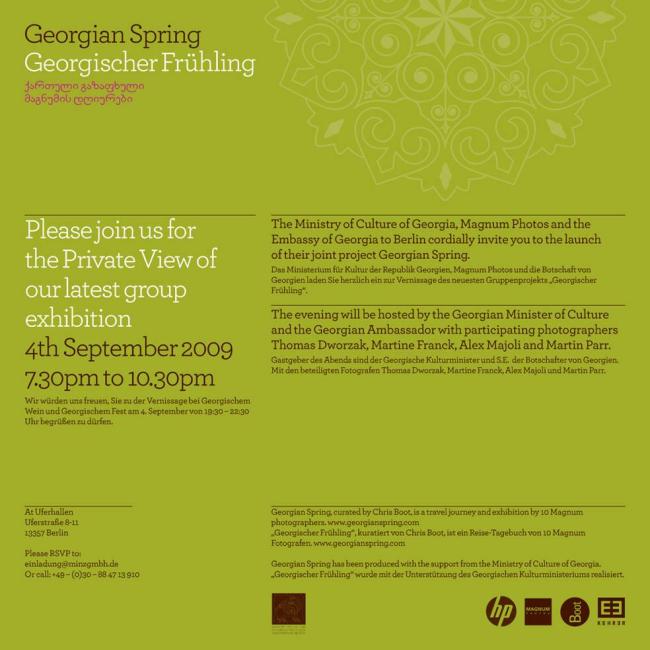
Starting Sept. 5, Berlin will host the presentation of a newly published book about Georgia.
"Georgian Spring" is the name of a photo album in which 10 Magnum photographers collaborated over their three-month stay in the country. The Culture Ministry initiated the project to “demonstrate Georgia as a European country,” according to Culture Minister Nikoloz Rurua. Rurua said he gave full freedom to the photographers to decide how to depict Georgia. “Honesty is the main value of the book,” Rurua told Georgia Today. Indeed, the album is too realistic to serve as a traditional tourist book. Beautiful postcards depicting typical sightseeing photos of the country are used only as the opening and closing details of the book. Thomas Dworzak, one of the Magnum photographers who also wrote the forward for “Georgian Springs,” said the book portrays a new, contemporary image of Georgia after the Soviet Union crackdown. “I think the book will raise awareness of Georgia,” Dworzak told Georgia Today. “European society has stereotypes toward the country, they know nothing about contemporary Georgia, but those old-fashioned pictures and images, churches, funerals, all those photographs have already been photographed and that was biggest attraction for all of us for some time.” Dworzak said he has a 17-year-old “love-story” with Georgia that started in the early 1990s. He worked in the first Georgian-Abkhazian conflict and lived in Georgia for six years. Today he said he notices numerous changes in the country and thinks the new reality should be delivered to the international community. Together with Dworzak, Jonas Bendiksen, Antoine D’Agata, Martine Franck, Alex Majoli, Martin Parr, Paolo Pellegrin, Gueorgui Pinkhassov, Mark Power and Alec Soth worked on the 264 page travel journal. Each photographer was responsible for 20 pages of the book, which includes photographs and texts that each photographer wrote about their works and journey within Georgia. Wendell Steavenson, a journalist and writer, also wrote about her own experience of living and working in Georgia. Chris Boot, a well-known photo publisher, coordinated and organized the project. Each of the photographers chose their field of interest. New generation, luxury, consumer and gambling, family portraits, construction and industry, minorities and other angles of ordinary Georgian life are showcased in the album together with photos from Abkhazia and South Ossetia. The album is realistic. The pictures capture ugly Soviet blocks and suburbs and women in the markets and streets who do not look happy or comfortable. The modest feasts in ordinary families look too vital among the everyday routine of sadness. The texts under the photos, which are written in a diary-like manner, express the bare feelings of the photographers. D’agata worked on the Industry and the Economy section of the book and after visiting Kutaisi he wrote about what he saw. “In Kutaisi, I photographed the renovation of the old town. To be fair, it was not finished and some businesses had moved back in, but the face felt like an enormous film set, strangely soulless and phoney,” he wrote. “Meanwhile on the other side of the town, the municipal market was dominated by huge (and astonishingly beautiful) Soviet frieze, which was crumbling in disrepair.” President Mikheil Saakashvili is also featured in the book. Dworzak decided to take photographs of the president that are a mix of official visits and some unofficial moments caught in various circumstances, like sitting at the UN assembly listening to world leaders. “He liked the idea and helped me a lot,” Dworzak said. “He even gave me a chance to enter places I was not allowed. When other photographers stayed behind the closed doors he managed to take me inside.” The last section of the book is reserved for the Magnum Agency archive. Among other photographs it consists of Robert Capa’s photo essay, which he made during his visit to the Soviet Union and Georgia together with John Steinbeck in 1947. There are also photos by the famous photographer Henri Cartier-Bresson. Saakashvili was the first to promote the book when he publicly presented it to U.S. Vice President Joe Biden during his visit to Georgia in July. Soon after its tour through Germany the book will be showcased in Spain and be on sale across the globe. To date, the book has been published in many languages including Georgian, English, Spanish, German and French.
www.letuscook.destellt eine zweisprachige – deutsch-georgische Webseite dar. Hier
finden Sie verschiedenste Rezepte zum Nachkochen sowie Tipps und Tricks
für Anfänger und Kochliebhaber. Die Rezepte sind schrittweise
beschrieben und mit dazugehörigen Fotos unterstützt. Ich möchte Sie gerne dazu auffordern mir Ihre Rezepte und Bilder zu schicken. Ich hoffe, dass mit Hilfe von www.letuscook.de oder www.facebook.com/Letuscook.de ein interessanter Informations- und Meinungsaustausch zwischen den beiden „Sprachseiten“ zu Stande kommt. Ihre Meinungen, Vorschläge und Verbesserungswünsche sind sehr willkommen.
Ich stehe Ihnen für die Fragen gerne zu Verfügung.
Ich hoffe, www.letuscook.de gefällt Ihnen und inspiriert Sie und natürlich hoffe ich, Sie schauen öfters mal vorbei. Viel Spaß beim Nachkochen!
Translate in your Language
OAT Gallery and artcafe 144 stairs in Tbilisi
in old tbilisi
under the narikala fortress
- artcollection
- exhibitions and events
- home cuisine
- private dinners and parties
- guest studio for rent
Lohnenswert: Dokumentarfilm von Ruth OlshanWIE LUFT ZUM ATMENist eine Reise in ein kleines Land zwischen Asien und Europa, das zu unrecht zwischen den Grenzen der Kulturen vergessen wird: Georgien, das hier in seiner ganzen Schönheit, seinem Zauber und seiner Vielfältigkeit eingefangen ist. Der Dokumentarfilm von Ruth Olshan entdeckt vor allem die beeindruckende Musik Georgiens, in der die kulturelle Identität seiner Bewohner tief verwurzelt ist. In den fast verloren gegangenen und wieder entdeckten Gesängen und Tänzen, die die UNESCO auf die Liste des Weltkulturerbes gesetzt hat, meint man Stimmen und Lieder aus einer vergangenen Zeit zu hören.
Musik sei für sie so wichtig wie die Luft zum Atmen, erzählt eine Protagonistin im Film und man versteht sie sofort. Ruth Olshans vielschichtiges Porträt eines Landes, seiner Menschen und ihrer Musik zeigt, was das Besondere an der georgischen Musik ist: die Lebendigkeit der Folklore im Alltag, die aufrecht erhaltene Tradition, die in den Texten gespeicherten Mythen, das soziale Erleben der Musik, die regionale Unterschiedlichkeit der Kultur, und die Musiker, die die Musik heute auch in Pop- und Jazzbereiche weiterführen."Großartige Bilder, sympathische Protagonisten und schöne, unvertraute Musik!" (filmdienst)
"Ruth Olshan hat einen sehr feinen Musikfilm gemacht, der einen Ort 90 Minuten zum Klingen bringt" (zitty)
"Eine berückende Hommage an ein Volk, dessen große Kultur durchströmt wird von Gesang" (Rheinischer Merkur)
"Folklore kann ganz schön cool sein!" (Die Welt)
"Ein ‚Hit’ für musikbegeisterte Weltreisende im Kino!" (programmkino.de)
Ruth Olshan in her film portrays musicians who work with different approaches: a male choir searching and cultivating old folk songs in the Caucasus region, a female choir, a school dance company and musicians who enhance Georgian folk music. There is a common denominator that links the diverse protagonists in Olshan’s film: Singing, dancing and music are crucial elements of their lifestyle. Music is as important as “air to breath,” explains the director of the female choir . The subtle camera work discreetly catches moments and spontaneous encounters, showing that the rehearsals and the singing brings moments to these women where they are taken away from their normal course of life. For life in Rustavi, a small town near Tiflis, seems bleak. The industry is dead, the unemployment rate is enormous. You ask yourself how people can live. The choir women’s beauty and positive energy exude an affirmative sign of life, even in mournful moments. Men and women sing and dance both joy and sorrow off their chest. In Georgia, music seems to be omnipresent, almost existential. Even if a young singer does not think folk music is “sexy”, he still gets hooked. It gets under his skin. The film pays tribute to this fascination, vitality, and spiritedness.
 (1) Georgian Spring by Gueorgui Pinkhassov
 (3) Georgian Spring by Antoine D'Agata