Showing posts with label Mari Bastashevski. Show all posts

Wednesday, July 25, 2012

ARTIST: The Process from Mari Bastashevski (maribastashevski.com)

I
My projects are set in regions where well-intentioned political mandates lead to corruption and abuses of power. The objective is to understand the ultra vires acts, as well as the use of information control mechanisms, and how said mechanisms facilitate the unaccountability of government officials.

II
In an attempt to engage the conventions of traditional conflict reporting, I choose to oppose the scenographic habits in photojournalism by giving equal weight to text and image. The established convention is to combine these languages; on one hand, the image is used as an illustration of text; on the other, the text explains the image in an attempt to confirm it as reality. The intention is to use these mediums separately; so that the image is treated as 'an object' open to interpretation - a trigger for hypotheses; and the text as a separate stream of information: finite and transmitable through precise repetition.

+++

In The Caucasus

File 126.The Topography of Abductions in The North Caucasus
On the 9th of December, 2001, three armed men in military uniforms and masks stormed the bedroom of newlyweds Zarema and Mohammed Edilov. They pulled Mohammed out of bed and handcuffed him. Shouting and cursing, the men dragged Mohammed out of the house and threw him into an APC. They also assaulted Zarema, who tried to block the front door. On the following morning, Zarema discovered that other residents of Valerick - Ali Vadilov, Ahambi Isaev and Rizvan Suleimanov - were also abducted during the operation. Zarema made numerous attempts to have the abductions investigated, but the case was repeatedly closed due to a lack of evidence and identifiable suspects. The whereabouts of Mohammed Edilov, Ali Valilov, Ahambi Isaev and Rizvan Suleimanov remain unknown.


Zatchistki
In May 2009, a suicide strike on MVD Grozny in Chechnya left a toll of four dead and twenty four wounded. The authorities instantly blamed Beslan Tchagiev and the terrorist cluster of Dokku Umarov for the attack. 24 hours later, the Russian Ministry of Internal Affairs (MVD) issued a press statement explaining in summary how and where the security forces ferreted out and liquidated four future suicide bombers connected with the attack. The photographs in this series were taken in the precise locations listed in the reports as the “theater of operations”, and were taken immediately after the MVD press release went online.

Zatchistki Weekend
The Russian North Caucasus tourism cluster project won prestigious MIPIM Asia Awards competition in 2011 in the category ‘Best Project of the future of Central and Western Asia. This award is important not only for the ‘Northern Caucasus Resorts’ company. This is a serious, significant victory of Russia. We have proved that they are able to realize an innovative, modern, forward-looking project.
-Director General of JSC ‘Northern Caucasus Resorts’ Alexei Nevsky.

Yuny Specnazovec (YS) is the first Russian-sponsored youth military sport camp in Chechnya, an enclave in the North Caucasus recovering from two wars against Russia. While majority of children enrolled in YS have previous criminal records, YS is not considered a punishment facility. Participation is voluntary and parents can choose to withdraw minors from the program at any time. The Russian Ministry of Internal Affairs, which was in charge of preliminary selection, says it experienced no difficulty filling the camp with volunteers. The key attractiveness of the program for the parents is that it is marketed as an opportunity for the participants to expunge their criminal records as well as to secure a future in the security forces, be it of Chechnya, or Russia.


+++

On and Off the Walls: Mari Bastashevski’s “File 126 (Disappearing in the Caucasus)” Posted by Whitney Johnson

Read more newyorker.com

Wednesday, December 22, 2010

FUND THIS CAMPAIGN: A Computer School in Pankisi Valley (indiegogo.com)

We built it. We need to run it. More here: www.indiegogo.com
so far: 43 funders
It is very easy to spend a fund for this project!! See here: www.indiegogo.com
$5,319
RAISED OF $7,000 GOAL
14 DAYS LEFT TO:

LOCATION: Duisi, Georgia
CATEGORY: Education

What is the project?
To raise $7,000, to run a computer classroom for a year.
We have built the classroom.
We need to run it.
The donations are for the cost of the IT teacher, IT support and maintenance, building maintenance, fuel for the winter, electricity.

Who are we?
A group of professionals, living and working in the country of Georgia. We manage this project on a totally voluntary basis.

Where is it?
A community of 15,000 people in the remote Pankisi Valley of Georgia, an ex Soviet Republic in the Caucasus Mountains.

Why this project?
To stabilize a region that was once famous for only lawlessness, kidnapping, weapons, drug running and a rise of Islamic extremism. The regions is still isolated. Our original English language education project is highly successful. Computer education is crucial for the children to breakout out and discover the world. We cannot take them beyond their country, but we can bring the world to them.

Why now?
The chaos that followed the collapse of the Soviet Union produced a newly independent Georgia but the country soon collapsed into a failed state. This was taken advantage of by financial and political opportunists, leaving the vulnerable population unable to maintain social order.
We focus on the young 11, 12 and 13-year-old students, teaching social and academic skills to build a stronger society. The opportunity to learn English furthers their education, breaks them out of their physical and social isolation and gives them a larger view of the outside world. The programme has already given the children confidence in themselves.

Why us?
We have been living and working in the area for a number of years and have only local teachers who we hire and train. Our education programme is highly regarded. It’s progress is monitored and evaluated by Telavi University English language faculty and all examinations are conducted through the Soros Foundation headquarters in Tbilisi, Georgia by internationally qualified examiners.
International instructors at the American Academy of Tbilisi train the teachers at their summer language school. The families in the Pankisi know us and our programme. They have confidence in us because they see the work reflected in their children, who are our greatest ambassadors.

Attention: The photos used in this presentation;
are from the generous hand and brilliant eye of Joe Harrison our super energetic volunteer. He is in Duisi now working on the online newspaper with the kids. His loving photos will be soon available as postcards.
Late update.

Here is a link to a small video featuring the wonderful Estonians who built the lab on their weekends.
http://vimeo.com/16724574 and a fun video of the annual bareback horserace. A true classic to rival the Kentucky Derby. http://vimeo.com/16828449

Watch, enjoy and donate.
Vladimir Lozinski


Pankisi Valley Computer School from vladimir Lozinski on Vimeo.

Also Find This Campaign On
LinkedIn
Website Mari Bastashevski
Perks
You're great ($5 minimum)
We will contact you with a personal email.
0 Claimed >
Claim This Perk
You're fabulous ($10 minimum)
We will send you a personal email. We will also place your name in the donor list on the wall of our classroom and in the Pankisi Times online newspaper.
3 Claimed >
Claim This Perk
You're amazing ($25 minimum)
We will send you a postcard from the Pankisi Valley by photographer Mari Bastashevski with personalized text.
18 Claimed >
Claim This Perk
You're magic ($150 minimum)
We will send you a signed print from the Pankisi Valley by photographer Mari Bastashevski. 34 x 50 cm, C-print. ed. 50.
10 Claimed >
Claim This Perk
You're stellar ($500 minimum)
We will send you a signed print from Pankisi Valley by photographer Mari Bastashevski. 81 x 69 cm, C-print. Limited ed. 4
3 Claimed >
Claim This Perk

Tuesday, July 13, 2010

PHOTOESSAY: “File 126 (Disappearing in the Caucasus)” By Mari Bastashevski (lens.blogs.nytimes.com)

Empty Chairs, Empty Tables, Empty Beds
By
ELLEN BARRY

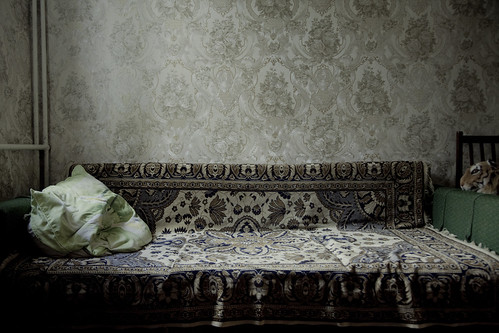
MOSCOW — The rooms depicted in Mari Bastashevski’s project, “File 126 (Disappearing in the Caucasus),” are neat as a pin, suffused with light, as carefully arranged as a brand new doll house.
You have to examine them closely to find what she calls “the dent on the pillow”: a sign that, until a minute ago, someone occupied this space; that someone stepped out expecting to return.
What is not apparent in the images, made in the southern Russian provinces of Chechnya, Dagestan and Ingushetia, is the violence of the disappearances. The narratives have a numbing sameness — 20 or 30 masked men bursting into a house at 4 a.m.; extended families ordered to lie face-down on the ground; young men in their bathrobes, forced into armored vehicles without license plates.
Ms. Bastashevski, 30, a Russian-born artist who now lives in the West, had read the case files before she began visiting families. Human rights organizations in the Russian North Caucasus have spent years documenting the abductions of young people, which they attribute to the state security forces conducting a brutal counter-insurgency campaign.
When she entered the houses, stories poured out, over cups of tea, in two- and three-hour torrents. Some verged on madness, like the genteel lady who was certain, after five years, that her sons were still alive in a secret prison in the forest, if only she could reach them.
All were infused with the desperate hope that a visitor from the West — often the first they had ever had in their homes — could somehow save their children.
Sometimes, parents who had lost a son to abduction would ask Ms. Bastashevski if she would marry another son. “We’re not talking about, ‘You’re a pretty lady, let’s make a good deal,’” she said. “It is like, ‘Could you marry my son so he could leave?’ Well, what do you say? There is nothing to say.”
What came to her was the quietest of all solutions: She would photograph the homely spaces the missing men had inhabited, many of them preserved in anticipation of their return. Five families turned into dozens and then hundreds. She edited her photos into a portfolio named after Article 126, the category for abduction in the Russian criminal code, which is being exhibited in New York and Washington by the Open Society Foundation.

It helped that she had her own nest to return to. Like most Westerners who do work in the North Caucasus, Ms. Bastashevski had planned a short trip. A month, she thought, would be enough to get what she needed. But her plans were upended when she met Natalia Estemirova, 50, a former schoolteacher who had become a one-woman human rights clearing-house in Chechnya.
A boisterously funny mother hen who shared Ms. Bastashevski’s affection for Harry Potter, Ms. Estemirova lived in a two-room apartment in central Grozny, beset by water and power outages and a half-demented cat. Ms. Estemirova knew how dangerous her work was. She had sent her 15-year-old daughter to live with relatives in central Russia. So she had room.
“Natalia turned my head around completely, so I just moved in,” Ms. Bastashevski said. They developed a routine. If Ms. Bastashevski got carried away with a photo shoot and stayed out after dark, Ms. Estemirova would chase her down to make sure she was all right, and then she would come home to the safety of the apartment, and they would sit across the kitchen table and talk about their days.
“She was taking care of me,” Ms. Bastashevski said. “It kind of always was serious, but it felt safer — she could do her job, and be O.K., and she’s looking after me, and I’m going to be careful.”
Add this to the list of empty spaces: One year ago this week, Ms. Estemirova was snatched by four men outside her apartment building and forced into a car as she left for work. Her lifeless body was found a few hours later by the side of a highway, with gunshot wounds to the head and chest.
Since then, Ms. Bastashevski has made three trips to the North Caucasus, where the unfinished work only seems to proliferate. There is nothing lighthearted about it now; she still has to stop herself from dialing Ms. Estemirova’s number when she has a question. She realizes she must return to photograph her friend’s apartment as part of her project — to capture “the gap,” as she puts it, “between life before and after.” She went as far as retrieving the keys to the apartment from a neighboring village. But she passed by several times and was unable to turn down the street.
“I couldn’t find it in myself to go there,” she said. “I kind of had to put it off.

Blog by Mari Bastashevski >>>