Showing posts with label Chokha. Show all posts

Monday, July 09, 2012

TRADITIONAL FASHION: Samoseli Pirveli – Georgian National Clothes in Vogue. By Maka Lomadze (georgianjournal.ge)

(georgianjournal.ge) As the old saying goes, everything new is a well-forgotten oldie. This is the motto of ‘Samoseli Pirveli’ founders, the people who are desperately in love with everything national and Georgian. We believe that the uniqueness of a nation lies not in the quality of adopting something foreign but rather in cherishing your own traditional merits and treasures. Such treasure is our national clothing. If earlier it used to be only associated with Georgian National dancers, preserved as stage costumes, recently national dresses seem to be gradually becoming fashionable in weddings and other festive events too. The attire that used to be the everyday garments for a century-old Georgian seems to be more or less regaining its cultural significance.

http://agora-dialogue.com/wp-content/uploads/2011/02/Ninni-Georgia-national-costumes-1.jpg
The name Samoseli Pirveli (meaning First Garment) comes from the Bible, namely, from the passage about the insatiable son. Ana Ninua, Director General of the shop explains that their choice was made because of its irreplaceable significance for the Georgian dressing culture. Old Georgians used to wear Chokhas for everyday use, the origins of this is not well known. Clothes differed according to the strata and regions of Georgia. The founders are great admirers of the Georgian culture – businessman Levan Vasadze and a friend of his Luarsab Togonidze. ‘At the beginning the shop focused on man’s clothing only - national Chokhas but later on we began to produce woman’s clothing as well. This is when I joined the team,’ Ana Ninua confesses in exclusive talks with Georgian Journal.

In this challenging but somewhat frightening process of globalization this is probably of utmost importance not to forget and highlight national virtues. As for clothes, probably India is one of the most traditional ones with its Saris. Japan too has its traditional clothes. Now maybe one day we also regain our clothes for everyday use? Who knows? But personally I was really stunned by the graciousness and mysterious splendor of dresses and sincerely wished to buy one for my wedding. Visit Samoseli Pirveli and you will want to visit it again. The atelier of Samoseli Pirveli was established in 2008 and only two years later were the shops opened. Purportedly, Georgian national clothes were very much forgotten here. It was only used on stages but not in life.

It is somehow logical that within these last years the popularity of Georgian national clothes is increasing among Georgians. They become more and more stuck to their traditions and prefer Chokas to the European ties and suits to wear as bridegrooms. Accordingly, having accompanied their future husbands, young ladies seem to be seduced too and often buy Georgian national dresses. ‘But Georgians buy our clothes for other festivals too. We have for instance Akhalukhi that can well be used for everyday wear,’ Ana adds.
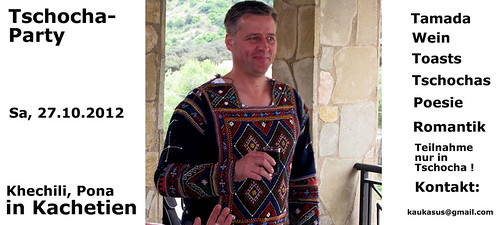
tschocha-partySamoseli Pirveli offers all kinds of traditional clothes and shoes, as well as traditional hoods and accessories. Visit it and you will find yourself in true Georgia and discover how old Georgian princes and princesses or ordinary people living in different regions of Georgia used to dress up.

As for shoes old style is preserved here and they also make contemporary shoes with old details. Traditional Chokhas were mainly destined for wars and that is why it has the small containers for bullets, (kilebi) but later on these containers became decorative utensils. Chokhas were preceded by Kalakuri Kaba (city dress) that was worn in the town.

Lately, the exhibition of Samoseli Pirveli was opened in France within the Georgian days, presented by the dancers of Rustavi ensemble. Dancers are usual models for these clothes. The exhibition that was accompanied by the podium show deserved admiration of the French spectator. An interested person can choose and order clothes from the catalogue. Reportedly, individual orders are possible too, but only with the consultations of the shop’s personnel in order not to exclude the Georgian national details that underline the profile of Samoseli Pirveli. But mainly, clients seem to be quite happy with the choice they offer. ‘We of course can make interpretations in color or material from the models that we have in shops or in the atelier. “We restore the clothes from the old photos, from the relevant literature too. It is not that we copy them, but we take the same pattern and make some slight alterations. The one thing is to design clothes for the stage – I am a stage painter myself and I know what it means – but when you want the clothes to fit to everyday wear, it is a completely different thing,‘ Ana Ninua concludes.


Thursday, February 24, 2011

PHOTOESSAY: Georgia: Love Your Country, Love Your Chokha. By Justyna Mielnikiewicz and Paul Rimple (eurasianet.org)


Slideshow with photos by Justyna Mielnikiewicz >>>

France may be known for its berets, and Spain for its mantillas, but few national costumes are linked to as strong a sense of national pride as Georgia’s chokhas.

Dating from the Middle Ages, the chokha is a calf-length, wool coat for men inherent to the Caucasus, distinguishable by the bandoliers sewn across the breast and its tapered waist cut. Accessories typically include a hood, tall leather boots and a belt holding a long, embossed dagger, called a khanjali.

But this is no party costume. Nearly every Georgian household has photos of ancestors adorned in chokhas. Once a symbol of resistance to Bolshevik Russia’s 1921 takeover of an independent Georgia, the chokha has now come to represent a Georgia reborn, a country that revels in its cultural individuality.

Increasingly worn by Georgian men at weddings and official functions, the eye-catching coat is finally experiencing a comeback.

“When you love your chokha, you love your country. When you love your country, you love your traditions,” elaborated 60-year-old Rezo Sulava, a leader of the All-Georgia Chokha Society.

The chokha revival is taking place in parallel with a resurgence of interest in other mainstays of Georgian culture – the Georgian Orthodox Church, Georgian folk dancing, and choral singing.

Holding onto the country’s chokha tradition, though, has not always been easy. By the early 20th century, European fashions had replaced the chokha; in Soviet times, the coat was largely a stage costume, mostly worn in public by Georgian folk dance ensembles.

“The chokha has been in a terrible coma and we’re trying to resurrect it,” said Luarsab Togonidze, a folklorist and co-owner of Samoseli Pirveli ( “First Clothes”), a slick Tbilisi boutique that specializes in the recreation of traditional Georgian clothing.

By studying museum collections, old photographs and private wardrobes throughout the country, Togonidze and his business partner, Levan Vasadze, created a chokha atelier (prices start at 200 lari, about $113 ) for a growing niche market.

That market – among it, the glitterati of Georgian artistic and theater circles – turned out in number at a February 6 fashion show Samoseli Pirveli staged in a champagne factory outside of Tbilisi.

Sashaying and swaying through the crowd, dancers from Georgia’s Sukhishvili and Rustavi folk dance ensembles showed off embroidered, Sleeping-Beauty-style wedding gowns for women, fitted, cropped jackets with cummerbunds for men, and, of course, chokhas.

But, unlike many Georgian traditionalists, Togonidze caters to customers looking for more contemporary takes on these long-established looks. His designers also create made-to-order dresses inspired by chokhas – a fashion statement embraced by many of the women attending the Samoseli Pirveli fashion show.

Some Georgians, however, feel that altering the design of the chokha is tantamount to sacrilege.

“Women shouldn’t wear chokhas,” asserted All- Georgia Chokha Society leader Sulava. The society’s 1,000 male members, or “chokhosanebi” (literally, “chokha people”), are headed by the powerful Patriarch Ilia II and act as the patriarch’s honorary guards, attending all religious celebrations and national festivals in uniform.

Set up in 1952 as an attempt to protect Georgian traditions from Soviet encroachment, the league today tries to preserve Georgian traditions from globalization.

“The chokha emphasizes I am a Georgian. It is a spiritual costume,” Sulava elaborated.

Sukhishvili dancer Tea Darchia, though, rebuffs that disapproval. “Pants were made for men and women wear them. Why can’t we wear the chokha?” Darchia posited.

Others, though, like event organizer Sandro Kakulia, believe that wearing the chockha has become trendy for the wrong reasons. “It’s fashionable now, not because people love the symbol, but they are following a trend. It’s elitist,” Kakulia said.

But unlike most fashion trends, wearing a chokha demands a certain responsibility. Even boutique owner Togonidze, who is not a Society member, says “there’s something magic” to wearing a chokha. “It has an effect on your behavior. People treat you differently.”

Chokhosanebi follow a code that regulates everything from the color of the chokha they wear (burgundy, white, black and gray are the standard colors), to how it is worn (with high-collared shirts always buttoned to the top), to how men must sit with their khinjalis (not dangling between their legs and not pointing up at a neighbor).

Some, however, argue that such reverence reflects an unhealthy understanding of Georgia’s traditions, by promoting living in the past rather than looking to the future.

The Indie-rock group Dervishebi (Dervishes) performs a parody of the classic Georgian song “Suliko” in electric-colored chokhas and Converse high-tops -- much to the ire of Georgian traditionalists and conservative members of the Orthodox Church.

“Everyone has their own relationship with the chokha,” said Dervishebi singer Guga Gegetchkori. “It’s only a national dress, that’s all. It’s not holy. It’s like a t-shirt.”

Boutique co-owner Togonidze concedes that “chokha radicals” can get carried away.

The chokha may be a strong representation of Georgian national pride, he commented, but fans should keep their passion in perspective. “It’s the 21st century,” he said. “You don’t have to overdo it.”

Editor's Note: Paul Rimple is a freelance reporter based in Tbilisi. Justyna Mielnikiewicz is a freelance photojournalist also based in Tbilisi. Source: eurasianet.org