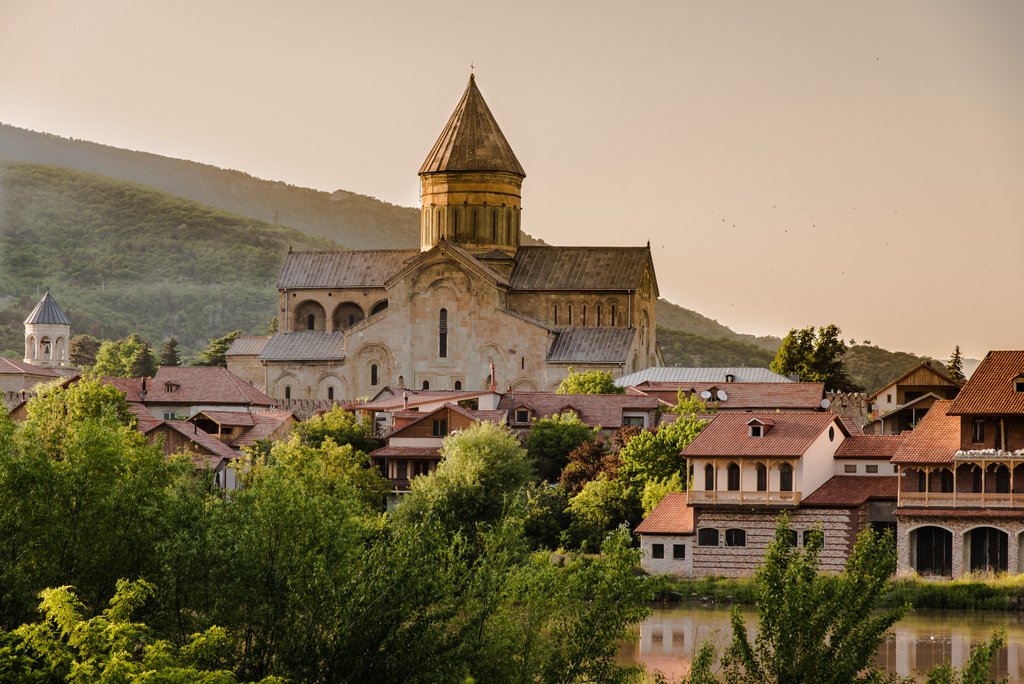
(bbc.co.uk) When several dozen Georgian Orthodox priests led tens of thousands of
people on a violent attack against a small group of gay rights activists
in Tbilisi earlier this year, much of the rest of the country was
horrified, writes journalist Paul Rimple, who has been based in the
country for 10 years.
 Georgians pride themselves on their reputation for being hospitable and tolerant, and most consider themselves Christian.
While the notion of homosexuality is not
widely understood or accepted in this deeply traditional Caucasus
nation, most Georgians were appalled by the scenes that unfolded in
Tbilisi on 17 May.
And yet, what happened clearly illustrates the importance of the Church in Georgia.
Georgia was an early adopter of Christianity making it a
state religion in 337AD. Georgians maintained their faith over the
centuries despite the waves of invading hordes, including the armies of
Ghengis Khan and Tamerlane.
Although the Soviets permitted religion to be
practised, its reach was severely limited. In 1917, there were 2,455
working churches in Georgia, but by the mid-1980s there were only 80,
along with a few monasteries and a seminary.
"During communism, the church was outdated, something for old ladies," says political analyst Ghia Nodia.
That attitude quickly changed after independence in 1991,
when the elected president, Zviad Gamsakhurdia, espoused a philosophy of
ethnic nationalism, which the Church embraced.
"During the (Gamsakhurdia) national movement, the concept
that real Georgians are Orthodox Christians spread really fast," Mr
Nodia says.
Over 80% of Georgia's 4.5 million people say they belong to the
Georgian Orthodox Church, however, experts claim only about 15% - 25%
actively participate in rituals.
Nevertheless, the Orthodox Church remains the most trusted
institution in Georgia. In a February survey carried out by the Caucasus
Resource Research Center (CRRC), 95% of respondents had a favourable
opinion of its work.
Beka Mindiashvili, a former theologian who is now head of the
Tolerance Center at the public defender's office, attributes such high
confidence in the Church to the 80-year-old Patriarch, Ilia II.
"He possesses all the right attributes. He is charismatic, he
speaks slowly and each word is regarded saintly, holy," Mr Mindiashvili
says.
"He is a person for everybody. To a simple person, he speaks
simply; to a politician, he speaks politically; to an intellectual, he
speaks of Umberto Eco and of classical music. And he acquired absolute
power in the Church all by himself."
There were only about 50 priests when Ilia II became patriarch in 1977. Today there are approximately 1,700.
His first major test in power was in 1997, when a number of
anti-ecumenical abbots threatened to break communion with him for being
too liberal. He avoided a schism by breaking off ecumenical activities
and pursuing what philosopher Zaza Piralishvili calls an "imitation of
medieval rhetoric".
Examples of the Church's ultra-conservative
interventions included warnings that yoga was full of false "charms"
that lured people away from God as well as a recent mass mobilisation
against ID cards after some Georgian Orthodox leaders claimed the cards
bore the mark of the anti-Christ.
The Church is recognised for maintaining a neutral political
stance and Ilia II is renowned for playing a significant role as
mediator in political confrontations, which in Georgia can easily turn
violent.
Professor Iago Kachkachishvili, head of the sociology
department at Tbilisi State University, says the Church's political
neutrality is a myth.
"The Church's influence comes from public opinion," he says.
"It uses the trust of the people as a source of strength. And every
government and politician uses the Georgian Orthodox Church as a source
of legitimacy."
While the constitution stipulates a separation between church
and state, a 2002 concordat defined this relationship by granting the
Church official recognition in Georgia and a special consultative role
in the government, particularly in education.
In 2009, Mikheil Saakashvili's government awarded the Church a
$15m (£10m) grant - three times the amount of the previous year - and
presented luxury sports utility vehicles to each of the 10 archbishops.
Despite the lavish gifts, many conservative elements within
the Church, who are pro-Russian, openly voiced their displeasure with
the president. They saw his pro-Western orientation as a threat to
Georgian traditions and the Church's influence on the people.
The clash of ideologies came to head in July 2011, when parliament
passed a law allowing religious minority groups in Georgia to be
registered as legal entities in public law giving them legal protection
previously only enjoyed by the Orthodox Church.
The move was applauded in the West, but the Georgian Orthodox Church saw this as an infringement on its special status.
Although Ilia II requested the clergy to maintain neutrality
in the 2012 parliamentary elections, many priests broke ranks and openly
supported the coalition of billionaire Bidzina Ivanishvili, who had
provided the funds to build Tbilisi's Sameba Cathedral, the largest
church in Georgia.
But on 13 May, Bidzina Ivanishvili who by now was prime
minister, took an independent stance and became the first Georgian
politician to declare openly that sexual minorities were equal citizens
of this country.
Three days later, Ilia II called on the authorities to ban
the 17 May demonstration. This marked the first open confrontation
between church and state and culminated in expletive-shouting priests
chasing gay activists down the main streets of the capital.
Protesters broke through barricades and police were forced to
bus the small number of activists out of the area for their protection.
The day after the attacks, Tbilisi artist Magda Guruli joined
some 100 people who rallied in the city centre to call for justice.
She believes the response to the protest was a manifestation of the patriarch's power over the state.
"I'm here to say give me back my religion," she said.
"Orthodoxy is part of our culture, but who are these people who try to
influence society and try to influence their thoughts and try to
cultivate blind faith?"

 Vino Underground offers about 100 family-produced Georgian wines, most all made much like they have been for thousands of years; in ceramic qvevris, tear-shaped vessels buried in the ground and found in nearly every basement in east Georgia’s wine region of Kakheti. But what sets this wine apart from what is normally consumed in the country is the acute care given to the vine. Vino Underground’s co-op think of themselves as grape cultivators rather than winemakers, following an intrinsic philosophy of “listening to the vines” to help them develop a resilient immune system naturally, instead of fertilizing them with chemicals. By the time the grapes get to the cellar, nothing needs to be added to help the fermentation process. You can taste the personal touch that goes into each bottle.