Showing posts with label Noravank Church. Show all posts

Saturday, November 17, 2007

REPORTAGE: Reiseabenteuer in Armenien


von Stephan Orth, in: spiegel-online

Immer wieder, wenn von Armenien die Rede ist, gibt es Meldungen von der Kontroverse zwischen der Türkei und Armenien in den Medien. Es geht um die Anerkennung des Massakers der Türken an die Armenier im Jahr 1915. Die Türkei schweigt dazu, Armenien dringt desto vehementer um die Anerkennung des Völkermordes. Ein anderes in Erinnerung gebliebenes Ereignis ist das schreckliche Erdbeben von 1988, bei dem mehr als 30.000 Menschen zu Tode kamen, oder den blutigen Konflikt um die Region Berg-Karabach mit Aserbaidschan, der immer noch angespannt ist - und keinesfalls beigelegt.
Jetzt aber hat Stephan Orth einen Reisebericht auf SPIEGEL online publiziert:


Saturday, July 14, 2007

PHOTOGRAPHY:

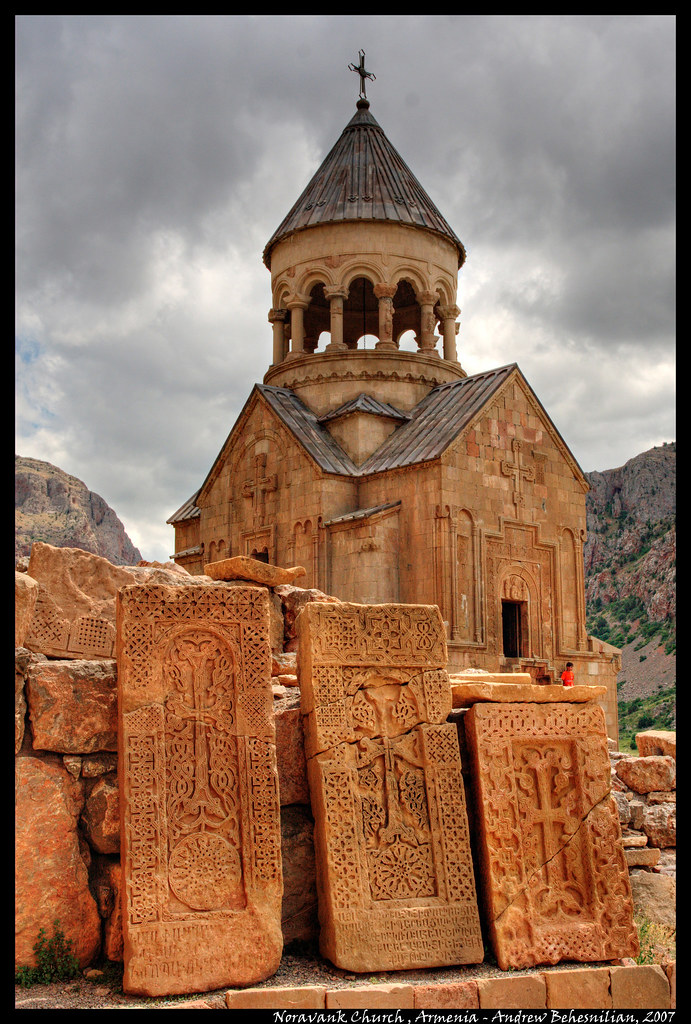
Khatchkars in Noravank Church & Monastery, Armenia

Khachkars ("Խաչքար" in Armenian, literally meaning "cross-stone") are a uniquely Armenian form of art, which evolved into incredibly ornate form which reached its peak in the 12-13th centuries. Perhaps some of the most intricate known Khachkars were designed by the great architect Momik. He also is credited with the design of the Areni Church and Noravank Monastery. Khachkars are most commonly used as tombstones, but were sometimes used as memorials. The biggest khachkar cemetery in Armenia is the Noratus Cemetery, while the biggest in the world is in Jugha, in Nakhichevan. Most khachkars do not depict Christ on the cross, but a few notable exception except. Most khachkars fall under the basic definition of a cross carved onto a stone. A few of the highly detailed and elaborate khachkars are called "lacework" khachkars. Khachkars which are freestanding crosses are called tevavor or "with arms" khachkars. Finally there are some examples of totem-pole style khachkars. The cross is usually the standard Armenian cross with two triple-loops on each arm of the cross, but can be simpler or vary.

From armeniapedia.org

Photoes uploaded on
July 10, 2007 by DrAndrew47

Noravank (Նորավանք, meaning new monastery) is a 13th century monastery, located 122 km from Yerevan in a narrow gorge made by the Darichay river, nearby the city of Yeghegnadzor, Armenia. The gorge is known for its tall, sheer, brick-red cliffs, directly across from the monastery. The monastery is best known for its two-storey S. Astvatsatsin church, which grants access to the second floor by way of narrow stones jutting out from the face of building. The monastery is sometimes called Amaghu-Noravank, Amaghu being the name of a small recently destroyed village above the canyon, in order to distinguish it from Bgheno-Noravank Monastery, near Goris. In the 13th–14th centuries the monastery became a residence of Syunik's bishops and, consequently. a major religious and, later, cultural center of Armenia closely connected with many of the local seats of learning, especially with Gladzor's famed university and library.

From armeniapedia.org

The View from Noravank Church