Showing posts with label Guide. Show all posts

Thursday, April 25, 2019

CITY TRIP: Tbilisi's Soviet Concrete Walking Tour with Brutal Tours @BrutalTours in Georgia

A Walking tour through the capital of Georgia, spiced up with more concrete and soviet architecture than you could probably handle!

Tour Runs Daily 35 EUR

Brutal Tours loves urbex, brutalism and soviet architecture. Join the people on a journey to places you won't find in other travel programs

FB facebook.com/brutaltours

FB-Group facebook.com/groups/brutaltours

Instagram instagram.com/brutaltours

Website brutaltours.com

Email: brutaltours@gmail.com


Saturday, July 15, 2017

#GEORGIANWINE: Tasting Georgia: Ein inspirierendes Buch von Carla Capalbo zur georgischen Weinkultur. Von Simon Woolf (palatepress.com)

(palatepress.com) Was fasziniert uns so an Georgien? Das Interesse an dieser kleinen Nation, die im Kaukasus liegt, scheint auf einem Allzeithoch zu sein - allein im letzten Monat wurden drei großen Bücher zum Thema Essen und Wein veröffentlicht. Und es werden weitere folgen.

Woran liegt das?: Georgien ist exotisch und liegt dort, wo sich West und Ost berühren und überschneiden. Georgien hat gerade genug westlichen Einfluss, um ein Gefühl der Vertrautheit zu verleihen, um einen Bezugsrahmen für westliche Besucher zu geben ...
Georgien gilt als die "Wiege des Weins". Die berühmten Traubenpips, die auf einem Qvevri-Fragment im Osten des Landes gefunden wurden, waren auf etwa 6.000 v. Chr. datiert (ich sage dies mit Vorsicht, da das benachbarte Armenien derzeit die ältesten archäologischen Reste eines Weinguts hat).

All dies führt zu einer sehr starken Mischung aus Kultur, Geschichte und lebendigen Traditionen wie der Supra (Fest), dem Toastmaster (Tamada), dem polyphonen Gesang und natürlich dem qvevri (amphorenähnliches Gefäß zur Gärung von alternden Wein). Es ist nicht verwunderlich, dass Georgien zu einem wichtigen Reiseziel wird, vor allem für Weinliebhaber, die mit einer der ältesten und aktivsten Weinkulturen der Welt in Berührung kommen möchten.

Carla Capalbo's "Tasting Georgia", geschrieben und recherchiert in den letzten drei Jahren, ist in ihrer Komplexität ein unvergleichbares Buch. Es inspiriert und macht neugierig in diesem wunderschönen 464 Seitenmonster zu blättern.

Capalbo ist eine erfahrene Fotografin, und die Bilder in ihrem Buch sind atemberaubend. Ihre Fotos sind beeindruckend authentisch und intim. Die Rezepte prachtvoll präsentiert, mit einladender Lebensmittelfotografie und klaren Beschreibungen. Bisher habe ich nur die Walnuss-Paste (eine Schlüsselkomponente der Küche) versucht, die ein wunderbar schmackhaftes und authentisches Ergebnis hervorgebracht hat.

Kritisiert wurde, dass das Buch Details über die Weinherstellung oder über die Winzer missen lässt. Ich bin nicht einverstanden. Die siebenseitige Einführung in den georgischen Wein und die Weinbereitung ist prägnant und absolut vollständig. Es gibt nur wenige Zusammenfassungen zu den Qvevri-Produzenten, die so detailliert sind. Capalbo sprach ausführlich mit dem Historiker und Oenologen Giorgi Barisashvili. Seine kleine schmale Bröschüre ist wohl die beste Quelle darüber, wie man Wein im Kvevri macht - welches schwer zugänglich ist, außerhalb von Georgien.

Das Buch stellt 37 traditionelle Winzer aus Georgien vor - einerseits die bekannten Winzer (Alaverdi Monastery, Pheasant’s Tears/John Wurdeman, Iago Bitarishvili) und andererseits auch neun Namen (Dasabami, Mariam Iosebidze, Nika Partsvania). Anstatt ein sperriges Buch mit Weingut-Statistik, Listen von Weinen und Sterne Bewertungen, hat sich Capalbo für ausführliche Beschreibungen und Interviews mit den Winzern und ihren Familien entschieden. Und auch die Rezepte werden gleich aus der selben Quelle geliefert.

Es ist vielleicht nicht klar für diejenigen, die das Land nicht besucht haben, warum Capalbo sich entschieden hat, Wein, Essen, Kultur gleichzeitig zu präsentieren. In Georgien treten gerade diese Lebenbereiche gleichzeitig auf. Georgier trinken nicht ohne zu essen. Sie feiern, diskutieren, singen und unterhalten sich dabei bei einer Supra. Wein und Essen sind der entscheidende Treibstoff im Leben der Georgier.

Wenn ich etwas an diesem Buch zu kritisieren hätte, wäre es der enge Fokus auf die kleinen handwerklichen Winzer, die traditionell den Wein in qvevris keltern. Während dies zweifellos der faszinierendste und einzigartigste Aspekt des georgischen Weins ist, so ist er nicht unbedingt am meisten zugänglich, und ist ein kleiner Teil der gesamten Weinproduktion Georgiens. Größere Weingüter wie Tbilvino, Khareba oder Marani machen jetzt sehr gute qvevri-fermentierte Weine mit guter internationaler Verfügbarkeit und vielleicht verdienen sie eine Erwähnung. Sie sind auch zunehmend darauf ausgerichtet, Touristen in Mengen zu empfangen, was die kleineren Weingüter unmöglich leisten könnten.

Das heißt, es ist klar, dass Georgien durch die Romantik seiner Kultur und die Authentizität seiner Tradition - nicht unbedingt wegen einer gesteigerten industriellen Weinproduktion - Herzen und Köpfe gewinnt. In diesem und allen anderen Punkten ist das Buch von Capalbo ein Triumph.


Bestellung: interlinkbooks.com

Friday, September 27, 2013

PODCAST: Tamuna Latsabidze - Fremdenführerin in Georgien (srf.ch)

(srf.ch) Tamuna Latsabidze ist Fremdenführerin in Georgien. Sie erzählt, was sie an ihrer Arbeit fasziniert, wie sie den Zusammenbruch der Sowjetunion erlebte und wie sie den engen Zusammenhalt georgischer Familien schätzt.

Eigentlich ist die 33-jährige Georgierin Diplom-Übersetzerin. Deutsch lernte sie zuerst in Georgien, und ihre Kenntnisse vertiefte sie in Deutschland an der Universität in deutscher Literatur. Wo sie aber nicht leben möchte, da ihr die Menschen zu kalt und distanziert vorkommen.

Nach ihrer Ausbildung als Fremdenführerin führt sie seit vielen Jahren Gruppen durch Georgien. Ihre Kenntnisse in Kunst und Geschichte vermittelt sie dann ebenso engagiert wie die Besonderheiten der georgischen Mentalität.


Mehr zum Thema: Tbilisi Tourist Center: Tamuna Latsabidze

Sunday, February 03, 2013

FOOD & WINE: Georgian Wine Guide 2013. By Malkhaz Kharbedia - President of the Georgian Wine Club (en.vinoge.com)


(en.vinoge.com) This is the second (2013) edition of the Georgian Wine Guide. Georgian wine culture has changed a lot since the publication of the first edition last year. Many important steps have been taken towards self-identification, and our wine-makers have realized that the traditional methods of wine-making in qvevri which were developed over thousands of years count among the country’s most important values. It is this wine which must become the image of wine in Georgia. Last year’s Guide featured only 21 traditional wines, but their number has increased significantly this year and they now have pride of place in our Guide.

One could also say that we are currently experiencing a revival of Georgian qvevri wines. If, two or three years ago, only a handful of traditional Kakhetian wines existed on the market, nowadays people can choose qvevri wine from almost every region of Georgia. 2012 was a very important year in this respect: several amateur or experienced wine-makers decided to begin to work with qvevri, and next year’s Guide will hopefully include the results of their work.


The number of quality rosé wines in Georgia has also increased quite significantly. This variety of wine re-emerged on the Georgian market several years ago, and this year’s Guide includes up to ten rosé wines. This wine has become fashionable, and every Georgian wine-maker now feels obliged to make pink wine—either from Saperavi or Tavkveri grapes, or from foreign varieties such as Cabernet or Muscat. The expression “a new broom sweeps clean” could be used for rosé wine, and I hope that the quality and diversity of these wines will be improved over time.

Unfortunately, the same cannot be said of Georgian sparkling wines; nothing new has emerged in this sector for the past two years, and the market still consists of old products. Classic (so-called “European-style”) white wines have also not done particularly well, but the country’s many red dry wines are in excellent shape and red semi-sweet wines have made Georgia famous. Appellation-controlled wines have also been particularly successful, and I imagine Georgia has never in its history produced as many high-quality Kindzmarauli and Khvanchkara wines as it does now. Georgian wine-makers must somehow have felt that 2013 would be the year the Russian market would reopen and the year they would be able to confidently send their semi-sweet wines made from the best vintages of 2011 to be sold on the Russian market.

The reopening of the Russian market is a different story, however. The matter might be resolved quite soon, enabling Georgian wines to finally return to Russia after an interlude of seven years. This would be a very important development, of course, but also a risky one, for Georgian wine will have to safeguard its newly-acquired prestige and status when returning to the Russian market and finally shake itself free from its post-Soviet image.

This edition of the Wine Guide has several new chapters. A large chapter has been devoted to wine tourism, including a list of every “oeno-touristic” destination in Georgia, a detailed wine map, reviews of this year’s harvest and other interesting information. Traditionally, the core of the Guide consists of the tasting notes, and with a few exceptions all the notes have been updated since last year. Readers will find wines in this Guide which are distinguished by their style or which show their terroir. More precisely, readers will find every kind of wine in this book—including wines which have a clear human impact as well as others which are true to their birthplace and origins.

I wish to end this introduction with a personal interpretation of the saying of the great Greek philosopher Heraclitus which I also included in last year’s Guide, ‘no man ever steps in the same river twice’—which I would paraphrase as no man ever steps into the same wine twice! This, I believe, is especially true of Georgian wine, for over the past few years Georgian wine has developed a lot and has become aware of its own existence. Remember every second you spend with Georgian wine, as the most important years are those of self-formation and self-identification. Never forget that you are witnessing the revival of an ancient wine culture. As strange as it may sound, the ancient and archaic nature of this culture can be synonymous with novelty and innovation in our modern world. Hvino News (http://s.tt/1zhwO) 

more links:
georgianwinesociety.co.uk
georgiawines.com
news.hvino.com

+++

2012 Georgian Wine Guide by Malkhaz Kharbedia
As a consumer guide the book is less useful than as a reference

(georgiatoday.ge) The fine wine of Georgia seems to merit barely a footnote, sadly, in the English language literature of wine. In his 2012 Pocket Wine Book the venerable British wine authority Hugh Johnson neglects to acknowledge the existence of Georgia, though Oz Clarke, in the 20th edition of his own pocket encyclopedia, does squeeze in some 100 words, suggesting that with “its diverse climates … and soils” Georgia might “produce every style imaginable,” and its “peppery, powerful red Saperavi could be a world-beater.” 

Even voluminous wine encyclopedias seldom exceed an overview of winegrowing regions, grape varieties, and types of wine. Where there ought to have been something like a definitive work on Georgian wine in English there was a void, until now, with the recent publication of the 2012 Georgian Wine Guide by Malkhaz Kharbedia.

Like Johnson’s, Clarke’s, and other prototypes, the guide is pocketsize for handy reference, and pocketbook-friendly, about the price of a modest bottle of Saperavi. It is bilingual – Georgian on the top half of each page, grammatical English below – and its author is president of the Wine Club, which devotes itself to the appreciation, advancement, and traditions of Georgian wine.

In the guide are intriguing narratives of wine history(for which Georgia is believed to have written the world’s first chapter) and the nation’s love affair with distilled spirits: chacha, similar to Italian grappa and undeniably as bracing, and brandy that has given cognac a run for its money. 

Also included are sections on grapes and where they are grown and vinified, the Georgian wine scene past and present, wine usage, tasting notes, and producers, organizations, festivals, etc. There are maps, quite small, not gatefolds, and much space is devoted to advertising, paid for predominantly by the makers of beverages.

Those using the guide as a Baedeker to previously unexplored territory may venture into Georgian wine country without putting a foot wrong. Kharbedia knows where, in Kakheti, to find the best micro-zones for Saperavi and Rkatsiteli. He has been to Satsivi, a “cold place” high in the Ateni Gorge in Kartli, where the “naturally low temperature” nurtures a “naturally sparkling wine.” And he has discovered the gorges in Lechkhumi in which to seek out Usakhelouri, “one of Georgia’s rarest wines.” Kharbedia convinces that he knows the terrain from east to west and top to bottom. 

The tasting notes, though, even if taken as a complement to the elucidation of Georgian grape varieties, may leave some readers wondering just what to expect from a wine they contemplate purchasing. On occasion Kharbedia helpfully tracks the transit of a wine across the palate (“The first sip” of Badagoni’s 2008 Manavi “reveals very healthy aromas and notes of lemon, loquat and persimmon giving way to a mineral, slightly salty flavor”), but often heattends more to appearance and bouquet than he does to flavor, and there is a surfeit of the “distinctive aromas of ripe pear and thyme, and notes of sun-baked vegetation, nettles and coriander” sort of thing that has been driving bewildered readers to rating systems (points, stars, and the like) for years. 

But Kharbedia rarely makes discriminating value judgments of any sort, quantitative or otherwise; he reviews over 100 wines, quite a lot considering that Georgia is a relatively small fine wine producing country, yet they all seem to bask, to one degree or another, in favorable light. Kharbedia is an enthusiast; and he has advertisers. As a consumer guide his book is less useful than as a reference.

To qvevri or not to qvevri? That is the question at the core of the book, and it crops up time and again. Vinify Georgian wine in clay vessels (known as “churi” in western Georgia) or oak barrels? “Traditional” or “European-style?” Kharbedia, it seems, would be a true believer in the qvevri if one of the “many people” who deem it “the ideal vessel in which to ferment Saperavi wine.”
He claims, “Thanks to the qvevri’s cone-like shape … the wine does not suffer from the presence of the grape pips, stems and marc … it actually benefits …” resulting in a wine “rich in tannins, with a high potential for aging…” But if tannins, as Kharbedia concedes, “are the most noticeable and unpleasant feature present in many red wines for most people,” then “traditional” Saperavi, in “stricter and more challenging markets,” may hit many a stone wall. Impatient consumers are likely to balk at astringent Saperavi that may or may not improve with cellaring, as well as at the startling tannin content of some “traditional” Rkatsiteli. 

Meanwhile, a whopping 70% of exported Georgian wine is semi-sweet red, and presently neither the United States nor Great Britain (where the taste for red is decidedly dry) are major markets. Still, Kharbedia has high hopes pinned on Georgia’s “unique grape varieties,” the distinction of being “the homeland of wine,” and the attributes of the qvevri, all of which may pique the curiosity of the uninitiated, but none of which will win brand loyalty to disappointing, overpriced wines. 

But where tradition may not be enough to make Georgian wine globally competitive, writing such as the best of Kharbedia’s may do more, captivating tasters and tourists alike, compelling them at the very most to make the pilgrimage to “the homeland of wine” and at the very least to seek out Georgian wines and give them a try.

By Robert Linkous


26.01.2012


  http://georgien.blogspot.de/2013/03/exhibition-helga-paris-in-tbilisi.html

Friday, August 31, 2012

Georgia Photo: Underground Exploration. By Temo Bardzimashvili (eurasianet.org)

Georgia Photo: Underground Exploration
Nika Gugeshashvili, a local guide, looks at a stalagmite in a cave around Oni, a major town in the mountain region of Racha, Georgia. An adjacent region to the intensively promoted Svaneti, Racha remains mostly unknown to foreign tourists.

Temo Bardzimashvili is a freelance photojournalist based in Tbilisi.

ALPINISM: Mikheil (Misha) Khergiani (1932-1969), a Georgian alpinist. (svanetitrekking.ge)


(svanetitrekking.ge) The major indiginous inhabitants of Svaneti region are Svans, they speak their own original non-written language (dialect) - Svanuri that belongs to the group of Georgian languages (dialects). Svaneti is one of the charming pieces of the multy-ethnic and cultural mozaic of Georgia.

Svans, as well as all Georgian highlanders are well acustomed to the mountain life-style. The increased risk factor, frequent avalanches, mudflows and torrents, landslides, rapidly changing climate conditions, severe winters and etc. require great endurance, shrewdness and skills from the local population. The skills and tools used by highlanders in their daily work are primitive but surprisingly rational. It's an impressive picture watching highlanders sliding huge logs or haystacks down through the curved steep slopes or accompanying a hunter up in the mountains. No wonder that Svaneti raised many high class mountaineers and alpine guides. The best proof for the abovementioned is Mikheil Khergiani!


Mikheil (Misha) Khergiani (1932-1969), a Georgian alpinist, Honoured Master of Sports of the Soviet Union (1963), USSR Master of Sports of International Class (1967), thrice USSR Champion in Alpinism and seven times USSR Champion in wall climbing, a perfect master of mountain and rock climbing. He was the most popular sportsman in the former Soviet Union and beyond its borders. Since 1976 the Khergiani memorial tournament in wall climbing has been established. In 1969 one of the nameless peaks in Turkestan Range was named after Mikheil Khergiani. In 1971 a special Khergiani prise for USSR wall climbing tournament was introduced. In 1978 a small planet N3234 discovered in the solar system was named in Mikheil Khergiani's honour.

Mikheil Khergiani's home-museum is opened in the town of Mestia, where the whole picture of his life is displayed.

Georgian highlanders have been using the Caucasus passes for traveling and transportation since ancient times. They communicated with domestic and neigbouring regions. The most remarkable example of massive movement through the Caucasus passes is the emmigration of the Georgian King Vakhtang VI and his suite, consisting of approximately 1200 nobles, to Russia (in 1724). Their route led from Notsaruli gorge through Gurdzi-Vtseki mountain pass (3400) and Pastagi glacier to the Digoria. The mentioned route still belongs to the most difficult itineraries of mountaineering tours.

It is also noteworthy, that 4100 meters above sea level on the slopes of Mkinvartsveri there is the cave of Bethlehem - the oldest monument of Christianity, the hermits abode.

Georgian folk legends and tales tell about the people who climbed up the mountains in ancient times. According to the legends in XVII century a priest Yoseb Mokheve had even climbed up Mkinvartsveri (5033 meters).

Wednesday, July 25, 2012

PHOTOESSAY: Legends of Khevsureti. By Archil Kikodze (cenn.org)

(cenn.org) Iakhsar (1) rushed into Lake Abudelauri after the devi (2) and killed him there with a whip. The devi shed so much blood that Iakhsar was trapped in the water for three years. The Khevsuretians became sad. They could not help their deity who had saved them. Finally, after three years, a sorcerer advised them to sacrifice a ram from the village of Blo, which had four ears and four horns. The devi's blood subsided, and Iakhsar could get out of the lake.

I tell Eleanor this old legend while we are sitting on the shore of the lake. Lake Abudelauri is too small to be the arena for a fight of two supernatural beings - one kind, one malicious - but the silence around us, the rocky peaks of Chaukhi (3) behind us, and a small lake at the edge of glacial moraines lost in green really create a mystical effect ...

We are in Khevsureti, a region of Georgia where myths are mixed with reality and concrete geography. A young hunter was lost on one of the peaks of Chaukhi - Sindaura when hunting for Caucasian goats. His death gave rise to many folk verses and poems. Mindia,(4) who drank snake's blood when he was in the captivity of enemies, understood the language of plants and animals and became an invincible hero and protector of the Khevsuretians, lived in the village of Amga, in the Arkhoti community, which is at a distance of one days journey from here. The legend about Mindia is one of the most popular legends in Georgia. Many famous writers in different times tried to develop this theme ...

But we do not have far to go to meet a legend. It is near, several meters from us. A high rock rises from the middle of the lake. It is cleft in two - the work of Iakhsar, rescuing the people from the devi. The first stroke of his whip missed the devi and broke the rock ...

The etymology of the word "Khevsureti" belongs to the late middle ages. Formerly, Khevsureti, together with the neighboring region Pshavi, was called Pkhovi. This ancient name is retained in the language of Chechens, neighbors of Khevsuretians, who call then "Pkhie" even now.

Today the proximity of the northern borders is felt as never before. My guest and I felt it in the first village we came to in Khevsureti and at the regional centre of Barisakho. There are a lot of people in military uniform (Khevsuretians, like other mountaineers of Georgia, undergo military training on their native land). The road going to Chechnya is controlled. A military unit is now based in Arkhoti too, where the border three years ago was protected only by several locals. We met the military helicopter several times on the road from Roshka to the lake Abudelauri. The situation is rather depressing for the average tourist, but Eleanor is not an average tourist. She is a writer and adventurer, an experienced naturalist and former member of the Greenpeace. Moreover, she comes from Ireland; therefore the only problem for her is a delicacy of the people of Pshavi - a nutritious but very greasy cottage cheese (we spent some days in Pshavi before coming to Khevsureti). Eleanor hunted for seals and whales and ate uncooked meat together with the Eskimos so as not to offend her hosts. But the cottage cheese did its work, and now she eats only potatoes in Roshka.

At the end of our path we could now see Roshka, where about twenty families sharing one surname - Tsiklauri - live. It is a very large village for Khevsureti and has a great deal of pastures and meadows. The Khevsuretians are very good mowers. They mow on very steep slopes and often have to use climbing equipment. In this regard the denizens of Roshka have easier conditions - their meadows are not so steep. They gather a good harvest of potato, a main crop of our mountains, which Eleanor knows better than I do now.

We reach Roshka in the evening, when the cattle come back from pastures. The villagers, like other Khevsuretians, breed cattle. They used to breed sheep as well, but unlike their neighbors, (the people of Pshavi, Gudamakari and especially Tusheti), they had never engaged in nomadic sheep breeding. Khevsuretians consider pigs to be foul animals, and even now refrain from breeding them. This is probably the influence of their Muslim neighbors. One old villager complained that his son, who lives on the plain, brought him pigs for rearing and offended and dishonored the old man ...

The migration of the people of Khevsureti to the plain started in the nineteenth century, but in the 1950s this voluntary migration became obligatory. At the direction of the government of that time, many high-mountainous villages were deserted. The people from these places settled for the most part in the southeast of Georgia. The majority of their descendants live there even now. As a rule, at least once a year these people visit the mountains to attend the summer pagan holidays or just to see the homeland ...

If you have an occasion to travel with a Khevsuretian going to his native land, it is an unforgettable show. As the road goes up to the mountains and his native land gets closer, the Khevsuretian becomes brighter and more cheerful. The way back to the plain is the opposite. The man who used to laugh and sing a few hours ago now becomes taciturn and sits silent in the car near you. Khevsuretians especially avoid the large capital. If they have a business there, they try to arrange everything very quickly and immediately come back without even visiting their close friends, if such live in the town.

Yesterday Eleanor and I met four Khevsuretians living in Kakheti5 on their way to Arkhoti. They rushed into the village by a car that had broken down several times during their trip, brought out drinks, and the sounds of their feast were heard all night long from the house where they stayed. Everybody knew about the presence of drunken Khevsuretians in the village. But early in the morning, they saddled their horses and headed to their villages by the road through the pass, occasionally shooting from their guns...

We are at home already. Our host Shota came back very tired: all day long he had been dragging hay with the bulls. Shota and his wife Tina have got three daughters and a three year old son Uturga who is supposed to continue the family name. The girls help their mother cook dinner. Tired Eleanor leaves to have a rest, Shota finishes his work in the courtyard. I look at the village from the balcony. I see the cattle coming back from pastures like a live current. Farther on I can see the road going to Northern Khevsureti and the mountain pass, Bears Cross. That part of Khevsureti is still illuminated by the sun, but in Roshka it is evening. An old woman comes out the verandah of the next house and looks over the village with binoculars. Perhaps her cow has not come yet. I go into the house for my camera, but the woman notices me, hides the binoculars, and enters the house grumbling ...

I am thinking about tomorrow and my way back to the large city without pleasure. It is October now and probably I will not be able to come here until next year. Most likely I will be silent and thoughtful on my way back like a real Khevsuretian ...

-----------------------------------------------------

1 A pagan deity of the people living in the mountainous region of Georgia - Tusheti, Pshavi, and Khevsureti.
2 A fabulous monster; a huge, ugly and evil creature having immense strength.
3 The mountains in the Central Caucasus.
4 A hero of Georgian legends.
5 Region in the Southeast part georgia.

Full Photoessay >>>


Archil Kikodze

He is a professional photographer, famous Georgian writer, ethnographer and finally wildlife tracking guide. He has traveled widely in Caucasus and knows every corner of Georgia well with its people’s traditions and culture, that’s why his interesting stories make every trip unforgettable. His photographs have won many awards and have participated in various national and international photo exhibitions. Furthermore Archil has published various articles on environmental, ethnographic and social themes in magazines: “Surviving Together”, “Caucasus Environment”, Horizonti, “Mshvenieri Sakartvelo”, “Tskheli Shokoladi” Author of three guidebooks for developing science tourism in Georgia (Khevi, Svaneti, Bakuriani), Switzerland. At the request of Ministry of Environment of Georgia wrote books on Kolkheti, Tusheti and Vashlovani National Parks and Lagodekhi Reserve.

facebook.com/archil.kikodze
 

Saturday, January 15, 2011

CULTURE: Guide to Caucasian Rugs (spongobongo.com)

Source: www.spongobongo.com/Caucasia

I take a stand somewhere between the two points. I suggest that the various people of the Caucasus wove distinctive patterns and structures prior to the Russian colonization of the Caucasus but that as Czarist control solidified they sought to stimulate carpet exports to pay for their occupation so that after the 1860s we see an increase in the commercialization of the Caucasian rugs and a decrease in the cultural relevance.In the 1820s the Czarist Russians divided Trans-Caucasia. into the Russian provinces of Baku, Derbent, Sheki, Karabagh, Shirvan, Talysh, and Kuba. Riad: Caucasus.

The Russians divided the region in the manner that was easiest for them to administrate and it did not necessarily follow an ethnographic approach in the division. The Czarist Russians began to solidify their hold as early as 1805 - 1820 but they did not truly control the region for many years. With the capture of the great rebel religious leader Shamyl in 1859 and the end of the rebellion in 1864 did Czarist control truly solidify regional control. In 1865 to eliminate risk of future rebellion the Russians forced 1,2 million Caucasians to move to Turkey.

At one point I suspected that areas such as Nagorno-Karabahk which were historically Moslem were depopulated and then repopulated with Armenians. As Christians the Armenians had an easier time with the Christian Russians. Lately I have come to realize that in the Caucasus' control focused on people rather than strict geographic boundaries. So with the Church and nobility to control the Armenians and Moslem rulers and Governors over the Moslem it was possible for two people to share some measure of independent rule in the same area in the same time. This tends to run counter to the European practice.To confuse the matter even more I suggest that many of the best rugs attributed to 4th quarter 19th century are actually 1st or even second quarter 20th century. A constant problem is that Rug Collecting is more about money and ego then it is a science. My hope is that by opening my notes, thoughts, and theories I may help to stimulate others to take this subject further than I can.

+++

Los Angeles Times, May 17, 1998 [for personal use only]
Trouble Is Looming for a Centuries-Old TradeCaucasus: Regional stability, mass production and modern life are ruining business for merchants of hand-woven carpets.
By VANORA BENNETT, Times Staff Writer

DERBENT, Russia -Under the fortress walls, the merchants of this honey-colored stone city at the crossroads of three empires are doing what their ancestors have done for 800 years: laying out hand-woven carpets for sale.

During centuries of conflict under Persian, Turkish and Russian empires, rug salesmen here traditionally have done lucrative business by buying family carpets from refugees on the run from warfare across the Caucasus Mountains and along the shores of the Caspian Sea. No more.

Something disastrous has started to happen to the region's hand-made carpet trade in the last two years: Peace keeps breaking out. "Look at it now," says woebegone trader Magomed Magomedov, forlornly gesturing around. Just a dozen carpets are pinned up outside the north side of the long defensive wall that Derbent's onetime Persian masters built in the 6th century.

Half a dozen men, all as small and hunched in their flapping black clothes as Magomedov, all with the same mournful expression, are waiting for buyers. "There's almost nothing left of our trade," Magomedov says. "Modern life is killing off the hand-made carpet business."

The region's carpet-making legacy from the great carpet cultures of Persia and Turkey was institutionalized under Soviet rule. Factories mass-produced carpets with approximately traditional designs, although village women went on weaving their own--and also continued the practice, frowned on by Communist Party bosses, of giving dowries of carpets at marriage.

The huge Derbent market spread across town every weekend. But the bonanza years for carpet dealers were right after the Soviet Union collapsed. The lands around Russia's southern border, a tinderbox of Christian and Muslim ethnic groups with long memories for old feuds, went up in flames.

In the five years after the 1991 Soviet collapse, there were conflicts between Armenians and Azerbaijanis, Georgians and Abkhazian separatists, and Russians and Chechen separatists. In the early 1990s, more than a million people fled shattered villages and towns, taking with them only their bedding and carpets. With no money and no homes, the dispossessed were desperate to sell even such treasured symbols of stability and collective history as the carpets to buy food.

But now stability is returning to the region. The wars have stopped or been suspended. The refugees have sold their rugs, and many have found new homes and jobs; so have many of the traders from those days. The only carpets being made by hand and sold in Derbent are those of women here in the multiethnic republic of Dagestan.

But this domestic weaving was never intended as a money-making business and is done more for private, family purposes. Magomedov's wife, Asli, is one of the weavers. She has just dismantled the huge loom that stood all winter in front of the family television set. She, her 22-year-old daughter, Zulekha, and her two 20-year-old daughters-in-law, Gyulhara and Vilayad, worked for six months on the huge blue-and-red oblong carpet that now lies on the floor.

She's planning to start weaving again in the fall. Some of the Magomedovs' carpets are dowry offerings from the family's two new daughters-in-law. A betrothed woman's family still must provide at least one big carpet, a flat-weave rug, a runner and half a dozen cushions. Her mother and sisters can help her weave them, but the designs should be her own.

Traditional Caucasus carpets differ in design from region to region, village to village. They include both Persian motifs--intricate floral patterns--and wilder, brighter, coarser Turkish-influenced designs, with jagged flame-like shapes.

But some of the modern carpets, cushions, runners and wall hangings that decorate houses here have designs that draw as much from Western pop culture as Eastern tradition. Snoopys and Snow Whites crop up, along with compositions of pink-faced children and baskets of puppies.

Asli, who was laid off from her job at the near-bankrupt Soviet-era carpet factory a few years ago, loves weaving. She collects templates--patterns of tiny crosses on squared paper--just as some Western women collect knitting patterns. She studies them in her free moments, contemplating her next adventure in quiet creativity.

But, she complains, her work doesn't bring in much money. The most she can expect her husband to get for this winter's rug, measuring 6 feet by 10 feet, is $600."

Four of us worked on it for six months," she laments. "And that means we only earned $25 a month each. A pittance.

"The worst blow of all to the trade is the flippancy with which post-Soviet Dagestanis have begun to treat their traditions. Although it's still considered crucial to transfer carpets from family to family at marriage, her husband says, it's no longer a matter of pride to give the most beautiful and costly weaving possible.

And Russia's opening of its borders means that there's new competition in the rug business from an unexpected quarter: the West.

Inside Derbent's city walls, just yards from the deserted handmade carpet market, an altogether more flourishing trade is now going on in cheap Belgian or Belarussian carpets made with synthetic fibers.

These crackling, brownish rugs, with large swirly patterns, stand rolled up against walls, or are displayed on clotheslines or cars. Surly traders with none of the traditional carpet salesman's patter say they buy them from four or five big warehouses in Moscow and bring them down to the south for sale.

They cost only one-fifth as much as hand-woven rugs. "So what do people do before a wedding?" Magomedov asks with a mixture of indignation and resignation. "They know they've got to give carpets. But they couldn't care less what kind. So they get the cheapest possible Belgian thing and palm it off on their new family.

For people like that, respect for tradition is becoming no more than a formality."
Johnson's Russia List

+++

Guides to the Caucasian Rug
Notes on Afshan Carpets
Guide to Akstafa Rugs
Notes on Alpan rugs
Guide to Baku Rugs
Guide to Bordjalou rugs
Guide to Karachopf Gardabani Rugs
A Guide To Pin-wheel Kazak
Guide to Caucasian Flatweaves
Guide to Dagestan Rugs
Guide To Dragon Carpets
Guide to Fachralo Kazak Rugs
Guide To Gendge Rugs
Guide to Zakatala rugs
Guide to Georgian Pardaghys
Guide To Karabagh Rugs
Guide To Chelaberd Kazak Rugs
Guide to Karachopf Gardabani Rugs
Guide to Kazak Rugs
Guide to Akstafa Rugs
Guide To Kuba Rugs
Notes on Alpan rugs
Guide to Seychour Rugs
Guide To Marasali Rugs
Guide to Shahsevan
Guide To Shirvan Rugs
Talish Rugs the O'Connell Guide


more: www.morandicarpets.com

Saturday, November 17, 2007

REPORTAGE: Reiseabenteuer in Armenien


von Stephan Orth, in: spiegel-online

Immer wieder, wenn von Armenien die Rede ist, gibt es Meldungen von der Kontroverse zwischen der Türkei und Armenien in den Medien. Es geht um die Anerkennung des Massakers der Türken an die Armenier im Jahr 1915. Die Türkei schweigt dazu, Armenien dringt desto vehementer um die Anerkennung des Völkermordes. Ein anderes in Erinnerung gebliebenes Ereignis ist das schreckliche Erdbeben von 1988, bei dem mehr als 30.000 Menschen zu Tode kamen, oder den blutigen Konflikt um die Region Berg-Karabach mit Aserbaidschan, der immer noch angespannt ist - und keinesfalls beigelegt.
Jetzt aber hat Stephan Orth einen Reisebericht auf SPIEGEL online publiziert:


Sunday, October 21, 2007

TOURISM: VISIT OLD TBILISI & "CAFE-TOUR"


Last evening the photographer Alexander Kedelashvili invited us in the very nice Café from the lovely Lika Karalashvili near the Betlemi Church in the old part from Tbilisi. We had a nice table and much more to the surprise of all ...

Tbilisi 2007 (Set)

Lika: Guest of Tbilisi, If you wish to look round the old historical city and walking along its streets to feel unique charm of it contact us!Our guide will make you the round of interesting place; telling legends about foundation of Tbilisi and adoption of Christianity in Georgia. You can travel in the past of Tbilisi, see a heart of the city where Orthodox, Catholic and Georgian churches, mosque and synagoge are proudly side by side. See a little dream that never forget. Combine business with pleasure.

Contact us for reserving tour every day from 10:00 to 23:00
Adresse: 3, Betlemi ascent
Tel.: 983875
mobil: 899349933
Email: visitoldtbilisi@yahoo.com

Thursday, October 18, 2007

REISE: Von Tbilisi nach Gavazi in Kakhetien

oder (Genadi): "Das Paradies, wo die Milch und der Honig fließt"

Bisher war ich dieses Jahr zweimal in Kakhetien, dem Weinanbaugebiet im Osten Georgiens, nicht weit von der aserbaidschanischen Grenze. Mit unserem Fahrer und Reisebegleiter Genadi Akhverdashvili kamen wir aus Armenien, unterbrachen die Reise in Tbilisi, um danach nach Aserbaidschan aufzubrechen.

Hinter Gurjani machten wir Rast, um unseren Hunger zu stillen. In Georgien ist es nicht üblich ein ausgiebiges Frühstück zu sich zu nehmen. Vormittags brachen wir auf und fuhren aus Tbilisi heraus in diese Region, die für ihre Küche, ihren Wein und ihre Herzlichkeit auch unter den Georgiern bekannt ist. Unserem Beifahrer knurrte der Magen, und so war es nur noch eine Frage der Gelegenheit, wann wir endlich etwas essen konnten.


An der mittlerweile gut asphaltierten Straße, sahen wir plötzlich ein pink angestrichenes Restaurant. Nebenan liefen die jungen Schweine um eine ausgebaute Schaschlik-Küche. Hier gab es vorzügliches Essen - u.a. gegrillter Fisch. Als wir wohlbeleibt in die Sonne traten und das Areal überblickten, sahen wir, dass die Renovierung noch im vollen Gange war. Direkt an der Straße lackierte ein Kakhetier die Außenanlagen pink. Unter anderem war der Bärenzwinger, der die Autofahrer zum Anhalten bewegen sollte, mit eben dieser Farbe frisch angestrichen. Da man nicht ohne weiteres den Bären ausquartieren konnte, musste er die Prozedur über sich ergehen lassen. Kurz darauf schnüffelte er weiterhin in seinem beengtem Zuhause durch den Käfig, wobei er sich eine Färbung des Fells verpasste. Wir waren etwas angetrunken, glaubten es nicht so richtig, blinzelten in die grelle Sonne, währenddessen unser Fahrer Genadi drängte, in seinem Mercedes Platz zu nehmen. Schließlich wolle er uns noch Kakhetien zeigen. Wir fuhren weiter durch die sogenannte Wintersteppe von Shiraki. Sie wird so genannt, da die Halb-Nomaden aus den tushetischen Bergen ihre Schafs- und Rinderherden hierher zum Überwintern bringen. DavidGareji war ein Ziel unser Reise bevor wir weiterfuhren, um uns die Renovierung Sighnaghi anzusehen.


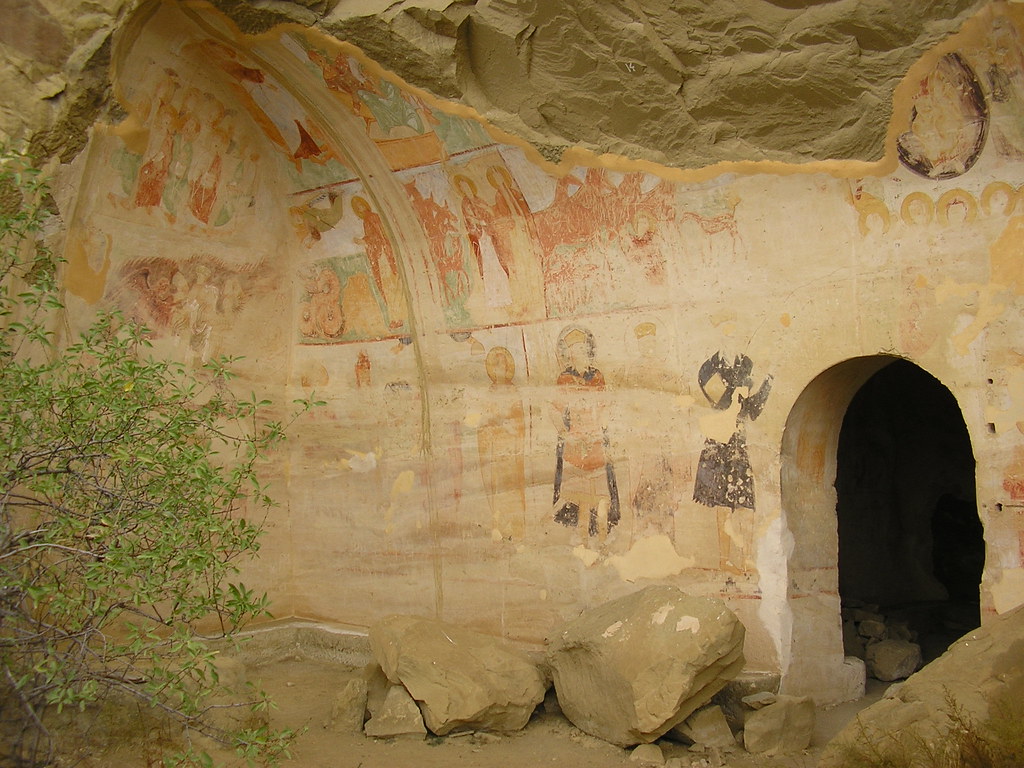
David Gareji ist ein Felsenkloster unweit der aserbaidschanischen Grenze, wobei man in dieser Landschaft alles andere als Felsen sieht. Doch plötzlich geht es zügig bergan. Ein orthodoxer Mönch vor Ort mit altem Bart und lebhaften Augen erklärte uns die christliche Sicht in diesem territorialen Bezirk und emfahl uns den Hang hinaufzusteigen, um uns die uralten christlichen Bemalungen auf der anderen Seite des Bergrückens anzusehen, die nicht mal in einem Haus beherbergt sind. Hier findet man frei zugänglich unter Überhangen und in Höhlen, auch durch keine kulturelle Initiative konserviert und beschlagnahmt, einige der ältesten christlichen Darstellungen, wobei die Farben nicht wirklich verblasst sind. Nur die Gesichter sind bis auf den Stein zerkratzt. Krieger persischer Reiterheere sollen mit ihren Säbeln diese Iconen martialisch drangsaliert haben.


Von diesem Bergrücken aus überblickt man dann die teils faltig aufgeworfene Ebene bis hinüber zu der nahe gelegenen aserbaidschanischen Grenze. Ach hier gibt es wieder Diskussion, wem wohl dieser Bereich des Kaukasus gehört. Ich frage mich, worum es dabei geht? Wollen sich manche Aserbaidschaner der Nomenklatur aus Mangel an Gelegenheiten um das christliche Erbe kümmern?

Unser Aufenthalt in Sighnaghi war dann kurz. Gehört hatte ich schon von der rühmlichen Renovierung dieses auf einem Gipfel gelegenen, beinahe italienisch anmutenden Städtchen. In Kampagnen spricht man hier von der Toskana Georgiens. Ich erlebte das alles als ein überstürztes Unterfangen. Wie an den Kulissenarbeiten eines gigantischen Filmprojektes werkelten überall Bauarbeiter und Handwerker gleichzeitig. Hier ging nichts nach und nach, sondern alles auf einmal. Erhaschte man einen Blick in eine Seitestraße, konnte man sehen, wie es dort mal aussah. Doch andererseits leben dort noch Einheimische mit ihren Lebensumständen, für die sich die Renovierungsinitiative nicht weiter interessiert. Das ganze wirkt paradox. Für wen passiert das ganze? Für die Reichen, die sich inmitten auch schwieriger sozialer Lebensumstände niederlassen wollen? Für die Amerikaner, die hier kräftig eingekauft haben sollen? Für die Touristen? Die Touristen, die bisher hierher kommen, suchen meines Erachtens noch etwas anderes ... Doch, ja ja, auch in Kroatien hat sich manches zügig verändert.


Als ich dann aus Aserbaidschan zurückkehrte, lernte ich das Leben in einem kakhetischen Dorf kennen. Gavazi hieß der belebte Ort. Klingt italienisch, doch das Leben ist hier ein ganz anderes. Jedenfalls bringen die Leute dort viel Zeit damit zu - und das selbst in der Erntezeit der Weintrauben auf den Feldern - sich gegenseitig zu besuchen, auf der Straße zu stehen, sich etwas zu erzählen, nach etwas zu fragen, einen von den vielen Cousins zu besuchen, gemeinsam für das Dorf, oder besser für die große Familie Brot zu backen, zu kochen, rumzusitzen, obwohl man mir sagte, dass der ältere Herr das Feld bewache ... Rumgestrommert wird auch, doch die Mädchen und Frauen obliegen der Obhut der Familie und der Nachbarschaft. Einen Blick zu erheischen ist eine Seltenheit, und könnte vielleicht sogar viel mehr bedeuten ... Es ist ein bisschen so, wie in alten Zeiten, obwohl man keine wirkliche Vorstellung davon hat. Man erinnert sich dabei wohl an einen gelesenen Roman des vergangenen Jahrhunderts. Manchmal auch an die drei Schwestern von Tschechow. Doch das Essen ist gut und die Kakhetier sind keinesfalls einfältig, um hier nicht einen falschen Eindruck zu hinterlassen - und nicht nur die Frauen sind von ausgemachter Schönheit. Manchmal wirken sie so beherzt aristokratisch - ich hab es nicht gesehen ... sie sind zart und hart - in jedem Fall. Hier wird sich gestreckt ... Da hat es der Mann sicher nicht immer einfach, die Frau glücklich zu machen. Da gibt es die Sehnsucht nach der großen Stadt, da gibt es die große Familie, das gibt es die Ruhe des Landes, das gibt es Begehrlichkeiten ... und auch hier, siehe, da kann man sich auch langweilen - wie überall auf der Erde!

Rechts unser Fahrer Genadi Akhverdashvili
von der Tourism Agency
www.daysingeorgia.ge

Aber eins kann ich genau sagen, es gibt dort den Wein - vielleicht nicht jahrtausende- aber jahrhundertealt. Ich wurde in einen Weingarten einer Familie geführt, wo der Wein erst drei Jahre alt war. Riesige Weintrauben gab es da. Selbst das Fernsehen sendete schon davon. Rekordverdächtig soll das sein! Alle waren begeistert, als sie meine Fotos und das Video davon sahen. "Wei me!" war ihr Ausspruch ... "Weih me, weih me!", was soviel heißt wie "Mein Gott!" ... "Mein Gott, mein Gott!"


Sunday, August 05, 2007

TRAVEL:

Xinaliq -Caucasus Mountains-

We're travelling to Azerbaijan, some days in Baku and surroundings, and some days to the Caucasus Mountains... we have found a website from a mountain guide called Kheiraddin, in Xinaliq (www.xinaliq.com ) that looks very good, and we'd like to know if someone has already been there or knows the guy.... just to have some reference. We're three women used to walk but not used to climb mountains, and we'd like to know the real level of the excursions organized by this guide. Thanks in advance......
Anyway, here again is the same answer, reproducing the detailed report I posted in 2005 about Xinaliq (and other sites in Azerbaijan) in the "Central Asia General Information" thread, indexed at the beginning of that branch. And yes - the www.xinaliq.com guy can be trusted and will organize everything for you!
**********************
A TRANS-CASPIAN REPORT: PART I, AZERBAIJAN
Okay, so finally, after many months of procrastination, I've finally gotten down to writing out a report on the two trips I made to Central Asia this year, following my initial travels in the region in April 2004, when I went from Baku, across the Caspian Sea by ferry, through western Turkmenistan and up through the desert to Konye-Urgench. And then, across Uzbekistan, from Moynaq in the West, all the way to Termez, in the South-East, facing Afghanistan across the river Oxus. For anyone interested, you can read those reports at posts #39, 40, 41 and 42 of the thread entitled "Central Asia General Information", which is indexed at the beginning of this branch.
Now, this year, 2005, I first travelled back to Azerbaijan in June, followed by an exploration of the Mangyshlak region of western Kazakhstan, and then crossing into Turkmenistan, by following the coastline along the Karabogaz basin. Quite an adventure, since my friend and I crossed some areas which have basically never seen any tourists, and also experienced some 60 C heat out in the Karakum desert - which albeit exotice in a weird, masochistic way, I don't really recommend to anyone! Let it be said that really, summer is not the best season to visit Turkmenistan.
To be most useful for everyone here, I've divided the trip into three reports, each dealing with a different country.
So, first up is Azerbaijan, a little-known country that I've grown particularly fond of over two trips there.
The best all-around travel/guide book to Azerbaijan is written by Mark Elliott, entitled simply "Azerbaijan", and published by Trailblazer (latest edition in 2004, I believe). It is simply your best resource for the country, except of course for more specialized academic / historic books. You will find listings on even the smallest village, with a hand-drawn map of that village! I particularly liked the map of Xinaliq, with the indication "old men", where indeed - two old men were to be found, sitting and staring at the mountains in the distance! This book is truly a labour of love, from someone who obviously has become totally fascinated by this country, its people and its history. Even if you're not going there, you'll enjoy the read.
Otherwise, you might want to read the famous novel "Ali and Nino", by Kurban Said, kind of a Georgian-Azerbaijan version of Romeo and Juliet, written in the early portion of th XXth century. Very evocative and nicely written. And for the even more incredible story of its author, read the recent biography of Lev Nessinbaum (a.k.a. Kurban Said), entitled "The Orientalist". It came out in 2005 - a fascinating book. The LP guide to Armenia / Georgia / Azerbaijan is also okay, although nowhere near as satisfying as the Elliott guide.
Otherwise, here are some great websites:
Now, in terms of sights and things so see and do, the obvious starting point is Baku.
I remember from last year, upon my initial contact with the city I was completely charmed by this mixture of oriental and western influences, particularly noticeable in the beautiful architecture, but also in the cuisine and the general attitude of the people living here, both curious about the outside world and rightfully proud of having maintained their own culture, despite many Iranian, Turkish and Russian invasions over the centuries.
The Old Town of Baku (Icheri Sheher) is beautiful, and has retained its original, medieval walls. Just walking through the narrow streets here is a pleasure in itself. The buildings have a slightly Ottoman appearance, but now and then, you come across a really old structure that transports you back a few centuries ago, when Baku was but a small town, with no easily available drinking water, and subject to howling winds and the capricious tides of the Caspian Sea. The better-known points of reference in the Old City are the Shirvanshah Palace, which is one of the only remaining palaces in the country (along with the one in Shekhi). The architecture is very beautiful, but the inside of the buildings is totally whitewashed, and does not retain any original finishings. Nonetheless, this is a very interesting sight to spend 30 minutes to an hour discovering. Plus, you have some beautiful views of the city from here - check out in particular the interesting juxtaposition of the modern TV tower up on the cliff towering above the city, with the centuries-old minarets of the Palace. Quite intriguing.
Then, the other unavoidable sight it the so-called Maiden Tower, a round tower, apparently unique in its construction, the function of which historians cannot properly determine. Was it a defensive structure, a Zoroastrian sacrificial altar? No one apparently knows for sure. You can climb up to the top, for some great views over the Old City, and off into the Caspian Sea. Definitely one of the must-sees of Baku. Oh, and there's a great art gallery just on the little side street next to the Tower, right next to a bookstore that's also fun to wander into. And for anyone interested in carpets, most of the shops are around here too.Otherwise, the main pleasure of the city is walking around the Old City itself, then circling its walls from the outside to admire the incredible palaces and houses that the oil barons of the early XX-th century had built for themselves. Some buildings stand out in particular, for example, the Opera House is simply breathtaking. The Philharmonic building is also quite beautiful, and in general you'll have an enjoyable full day just walking around gazing at these wonderful buildings.
A few Soviet constructions are also worth your time. For example, starting from the Maiden Tower, you can follow the Promenade along the seafront, until you reach Government House (still called "Dom Soviet" by many), an incredible product of "Gothic Stalinist" architecture, that looks like something out of an E.C. Escher sketchbook. Simply amazing, I must have taken an entire roll of film of this building. How to describe it? Try and recall the mental image you had in your mind after reading Franz Kafka's "The Castle". That'll get you started! Really, Soviet gigantism at its best!From here, walk towards the Monument to the 26 Baku Commissars - a great Soviet monument, in a rather nice park overlooking the Turkish Embassy and the National Library (itself a beautiful building - try and go inside even if you don't want to check out a book!).
Now, every city has its main focal point - and here, it's Fountain Square. This is where you'll find what few tourists there are in Baku, as well as the cinemas, the theatres, some great shops and bookstores, many restaurants, cafes, bars, and a couple of great jazz places (for ex., the Karavan Club). You also have the Nizami Literature Museum nearby, with its façade one of the most recognizable images of the city: all pastel colours, with recessed alcoves and statues of famous Azeri historical figures standing there. At night, when it's lit up, it makes for a beautiful sight.
What else? Some very good restaurants in the Old City: Mugham Club, Silk and Spice, Karavanseray Restaurant. All located in the general vicinity of the Maiden Tower, serving excellent food in wonderfully evocative settings. Otherwise, the restaurants in the Fountain Square area are also okay, albeit a little less exotic!In terms of lodging, I stayed at the Old City Inn and was very satisfied. Some brand-new "boutique" style hotels have opened recently in Baku, though, and if I went back I might try one of them for a change. You might check out these names on Google: Metropol Hotel (near Dom Soviet), Meridian Hotel (in the Old City).
Alright, so you could see most of Baku in one day, but two days will also allow you to drive out to see the oil fields which are a little to the South of the downtown area, and you might also make it up to Martyrs' Lane, with a great monument which overlooks the city and the Sea.
Outside of town, I quite enjoyed the Absheron peninsula, which is usually described as an industrial wasteland (which it is...). Use the Mark Elliott to point you around, but here a few enjoyable sights. We rented a car/driver for the day through the hotel - cost us $50, but well worth it, since none of these sights could be easily visited otherwise.
First of all, make your way to the Surakhani fire-temple (Ateshgah), an extremely evocative site, mentionned by travellers in the area for centuries, including Alexandre Dumas in his Caucasus tales. It's an old Zoroastrian (or proto-zoroastrian, to be exact) temple, built by a fire-worshipping sect from India, some members of which established themselves in the area a couple of centuries ago. Today, it's still intact, but is set in a dusty, ugly city - something which somehow adds to the anachronistic character of this place, like a long-lost remain of a bygone people. Well worth your time.
Nearby, Amirjan village is great. It holds a beautiful mosque, surrounded by old houses piled one on top of the other, as well as a few old, pre-Soviet buildings that used to belong to the oil barons, but were then turned into government buildings. I got inside one of them, and there are still a few old remains left - again, an intriguing juxtaposition of epochs and cultures. Regarding the mosque itself, when we arrived there were a few guys hanging around. They were rather curious to meet up with tourists, and amazed there was a map of their village in the Mark Elliott book! So pretty soon they got the keys to the minarets, and we were climbing up all the way to the top of these minarets which overlook the village. Fantastic views and a great experience.From here, we made our way to Ramana to view the remains of an old castle / watchtower, which now overlooks unending oil fields, with pools of oil everywhere, rickety oil derricks, oil pumps seemingly going on forever. You can't get much more environnmentaly-damaged than this! It's like a post-apocalyptic landscape.The town of Nardaran then holds a brand-new mosque, built I believe with some financial help from Saudi Arabia, and this is apparently the most conservative area of the country - and actually, the only place where I saw any woman covered up with a veil. Because in Baku itself, the norm in terms of clothing is rather revealing!From Nardaran, we made our way to the northern coast of the Absheron peninsula, where the beach is rocky. As is often the case in the former Soviet Union, industrial debris, trash, burned-out shells of cars and machinery litter the seashore - and yet, you've got some people wading into the water to swim!Finally, we drove to the flaming hillside of Yanar Dag, where some natural gas pockets were accidentally set on fire decades ago, and now burn on forever (or until the gas runs out!). Again, quite an evocative sight.
By and large, the Absheron Peninsula is well worth a day of your time. The landscape is scarred by industry beyond belief, the towns are dusty and dirty, there's trash everywhere - and yet, people live here, work here, and it just gives you a better understanding of what life can be like in these former industrial areas of the Soviet Union.
Now, last year, I visited Qobustan and the mud volcanoes, to the South of Baku. This is a must-see for anyone going to the country - for a report, read last year's post, at #39 of the thread entitled "Central Asia General Information" indexed at the beginning of this branch.
This year, we drove up North, towards the Caucasus mountains and our goal: the village of Xinaliq.
Before arriving, though, you pass through the suburbs of Sumgayit, or "Earth after Bomb". This is really what the planet will look like after all the natural resources have been depleted, the people are dead from toxic poisining, and the factories have rotted and rusted away. Driving along the highway, you are surrounded by gigantic factories, now abandonned, rail cars rusting away under the sky, enormous pipes running both under and above the road, encircling you like in a science-fiction movie. This is really what the expression "post-apocalyptic" stands for. If you're driving through around sunset, then the orange glow will give everything a ghostly feel - this is no doubt what it'll feel like when the planet finally gives up on us.Further on, we stopped at Besh Barmaq, a mountain shrine, set in a rocky outcrop rising out of the hills overlooking the Caspian coastline. This is a great place, very evocative - which although nominally Muslim, is really a testament to the animist beliefs still underpinning much of Azeri Islam. You've got "prayer flags" like in Tibet, tied around tree branches, and then in the various little caves and cracks up in the the rocks, there are pieces of cloth or other offerings left by travellers. To get there, you just leave the main highway, and drive up for about 10 minutes. Then, walk up another 15 minutes, up rickety stairs, ladders, paths, until you start reaching the main rock formations. Great views of the Caspian await you - all in all, a wonderful spot to visit.We finally arrived in the town of Quba, which is okay, but nothing special. There are a couple of old hammams in town, some nice mosques and wooden, Russian houses. Across the river is the Jewish village of Krasnaya Sloboda. You'll find a few synanogues there, and marvel at the fact that the streets are not cracked, the sidewalks are brand new, there a light posts at every corner, the houses are freshly painted and huge, and Mercedes cars are lining the streets. Quite a difference from across the river! However, the real reason to drive all the way up is the expedition to Xinaliq village, up in the Caucasus mountains. This is an unforgettable experience, that I would recommend to anyone tempted by a visit to Azerbaijan. You will truly never see such beautiful mountain scenery - the Caucasus that I dreamt of seeing, right there before my eyes! Amazing clouds suspended in a bright blue sky, green mountains, snowy peaks, a few horses, an eagle soaring up above, having lunch with some shepherds at their summer campsite, discovering a natural gas-fuelled flame, set in a natural amphitheater facing these mountains. Really, a fantastic place.
I used the services of Xheyraddin Gabbarov, a Xinaliq native who's set up a pretty efficient operation there, and was very satisfied.
You can find his website here: www.xinaliq.com.
Check out also: www.kiffer.us
For 2 persons, for a 3 day trip, with transport, lodging and food included, it ended costing us in the vicinity of $300. Yeah, it's expensive - but was it ever worth it! Certainly one of the most unforgettable places I've ever been in my life.To reach Xinaliq, you need a sturdy 4WD. Indeed, the road is spectacularly beautiful - but do realize: there is no "road" per se . At first, you follow a dirt track - ok, that's fine. But after a while, there's no track left, and your driver is just driving the jeep over rocks, crossing rivers with the water almost up to the top of the side doors. It truly feels like you're driving to the ends of the Earth. And then, when you finally reach Xinaliq after driving through this valley boxed in by mountains on each side, it is as if you'd reached one of those magical "lost" villages where time has stood still forever. The stone houses, piled one on top of each other, and the surrounding mountains, will no doubt totally captivate you.
My friend and I spent the night in the house of a local family who were so very welcoming. My Russian is quite limited, but my friend speaks fluently, so that was a really great experience. Then, the next morning, we set out on foot (our guide was on a horse) to hike up the mountain pass, over to the village of Laza on the other side.I've really never seen such breathtaking scenery anywhere. Absolutely amazing! There's a little eternal flame, set ablaze from a natural gas vent in the ground. In most guidebooks, they will call this an ateshgah (although it has nothing to do with Zoroastrianism). Again, the setting is fantastic. We had lunch at a shepherds' summer camp, close to the summit, and then walked down on the other side to Laza.
Beware, the walk down is completely exhausting, whereas the walk up was fairly straightforward. You're talking serious mountain hiking here, and way up near the pass over, the oxygen is starting to become a little more rare, so your breathing is more difficult.This takes up a full day, unless you decide to rent a horse for yourself - then of course, everything is easier and faster. If you're walking, be warned that it's a pretty strenuous expedition.Regarding Laza village, it's quite small, but the mountains around it are so spectacular it will no doubt leave a lasting impression in your mind. You can either stay in the village with local people, or at the beautiful Suvar Resort, a couple of kilometers into the mountains. When we were there, the Suvar was undergoing renovation, but its setting is fantastic, overlooking deep gorges, close to some waterfalls and facing the greenest mountainsides you'll ever see.
Driving back down South from Laza, try and stop in the charming village of Aniq, which has some great old wooden buildings, a beautiful old mosque, and a very nice cemetery with impressive mausoleums, set out in this wide grassy plateau. Truly, northern Azerbaijan is worth the trip.Anyway, from there, we drove back down all the way to Baku, to take the plane to Aktau, in western Kazakhstan - the next stage of the trip.

Source: www.lonelyplanet.com