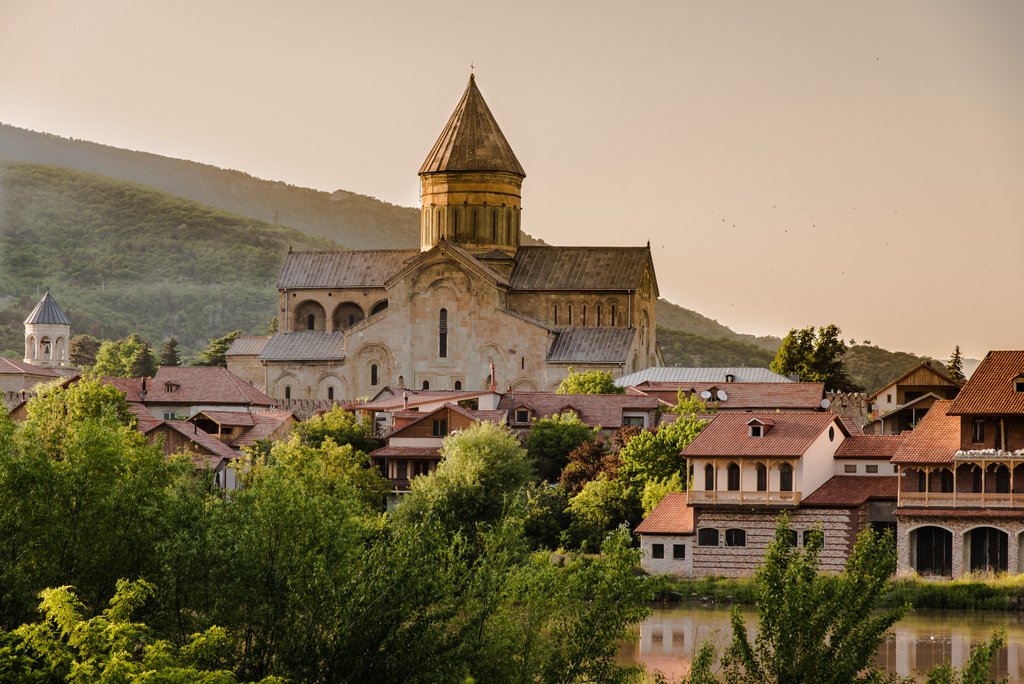
If one is describing Georgian culture, attention must surely be given to the traditional Georgian supra. At first glance it would be described as a banquet at which there is much food, wine, toasting, and singing. However, this does not describe the spiritual side of a supra.
Whenever space allows, the supra is always held at one long table, or a makeshift table of many joined together end to end, running from one room to another, if need be. The table is laden with wine jugs which are always kept full of excellent Georgian wine, and copious amounts of food of all kinds, so much so that the table surface almost disappears.
Each supra has a tamada (the closest English translation is "toastmaster") and is chosen by the host of the supra before the supra begins. Fulfilling one's role as a tamada is an art form in itself. A good tamada is a poet/wit/philosopher/social commentator/orator/singer who creatively improvises a beautiful atmosphere of community, camaraderie and love through his toasts which introduce periods of tranquility and reflection amidst the extroverted energy of table conversation. Through an adroit choice of songs which are sung after every toast, the message of each toast is given more resonance.
The order in which the toasts are given is important. Throughout most of Georgia, the first toast is always to peace, followed by a toast to parents, to brothers and sisters, to those who have passed away (especially to any friend or relative of any person present at the table), to life (especially to the lives of the children of those who have recently passed away), and then to love and friendship.
After all these toasts have been made in this order, the tamada is free to choose his own additional topics, maintaining the established creative flow, usually relating these toasts to the people present or to the occasion which prompted the supra. The topics, to name a few, might be to ancestors, to mothers, to beauty, to creativity, to absent friends who are far away, etc. After any of the evening's toasts, a guest, with the permission of the tamada, can add some thoughts of his or her own with another toast on the same topic. Starting a new topic without the tamada's permission would be a social blunder.
One important rule of the supra is that there should be no negative remarks or toasts, and it is the responsibility of the tamada to ensure that this rule is observed. Another rule of the supra is that one must not be drinking one's wine unless a toast has just been made, and so it is the tamada's responsibility to space out the toasts accordingly, so that everyone has a chance to imbibe, but not so often that people might become too intoxicated. In the hands of a good tamada, a supra is a beautiful, moving experience.
Source: darbazi.com
Showing posts with label Tamada. Show all posts
Showing posts with label Tamada. Show all posts
Sunday, August 10, 2014


Friday, August 01, 2014
FILMPROJEKT: "Supra Paranoia". Idee von Florian Mühlfried
Im Zentrum dieses Dokumentarfilms steht ein Fremdkörper im öffentlichen Raum und die daraus folgenden sozialen Reaktionen.
Der Fremdkörper ist das georgische Bankett, genannt "supra". Fremd ist dieses Fest nur außerhalb Georgiens, als exotischer Brauch, der auf der sprichwörtlichen kaukasischen Gastfreundschaft beruht. Es geht um den Einbezug von Fremden und deren Transformation zu Freunden mittels gemeinsamen Essens und Trinkens. Die Unterhaltung wird dabei durch Trinksprüche strukturiert und von Musik begleitet.
Der öffentliche Raum befindet sich in einer von fünf ausgesuchten europäischen Städten. Es ist ein sehr belebter Raum, dessen Nutzung jedoch zunehmend eingeschränkt wird, von privaten Wachdiensten, aufdringlicher Lautsprechermusik oder unbequemen Bänken. Es geht um die Privatisierung von öffentlichem Raum und die Verdrängung problematischer Menschen. Die zunehmende Ungastlichkeit wird durch das Sinnbild von Gastlichkeit, eine reich gedeckte Tafel, hintertrieben.
Die sozialen Reaktionen gehen von dieser Tafel aus sowie von den Menschen, die an ihr sitzen. Es handelt sich dabei mehrheitlich um Georgierinnen und Georgier, die hier wohnen. Sie feiern und laden Passanten ein. Das Geschehen entfaltet sich unvorhersehbar, vielleicht treten irgendwann Ordnungskräfte hinzu.
Neben dem Geschehen stellt der Film die Orte in den Vordergrund und erzählt deren jüngere Geschichte. Auch über die feiernden Menschen wird berichtet – wer sie sind, was sie interessiert, wie sie hergekommen sind und wo sie sich sehen. Auf diese Weise entsteht ein komplexes Portrait von europäischen Städten, Menschen aus dem Kaukasus und neoliberaler Politik.
Zur Anbahnung des Films müssen fünf europäische Städte mit aussagekräftigen öffentlichen Orten sowie die Protagonistinnen und Protagonisten ausgewählt werden. Als "europäisches Projekt" kann ggf. auf europäische Geldgeber abgezielt werden. Wer Interesse an einem solchen Filmprojekt hat, möge sich bitte in Verbindung setzen mit Florian Mühlfried c/o ethno.kaukasus@gmail.com.
Der Fremdkörper ist das georgische Bankett, genannt "supra". Fremd ist dieses Fest nur außerhalb Georgiens, als exotischer Brauch, der auf der sprichwörtlichen kaukasischen Gastfreundschaft beruht. Es geht um den Einbezug von Fremden und deren Transformation zu Freunden mittels gemeinsamen Essens und Trinkens. Die Unterhaltung wird dabei durch Trinksprüche strukturiert und von Musik begleitet.
Der öffentliche Raum befindet sich in einer von fünf ausgesuchten europäischen Städten. Es ist ein sehr belebter Raum, dessen Nutzung jedoch zunehmend eingeschränkt wird, von privaten Wachdiensten, aufdringlicher Lautsprechermusik oder unbequemen Bänken. Es geht um die Privatisierung von öffentlichem Raum und die Verdrängung problematischer Menschen. Die zunehmende Ungastlichkeit wird durch das Sinnbild von Gastlichkeit, eine reich gedeckte Tafel, hintertrieben.
Die sozialen Reaktionen gehen von dieser Tafel aus sowie von den Menschen, die an ihr sitzen. Es handelt sich dabei mehrheitlich um Georgierinnen und Georgier, die hier wohnen. Sie feiern und laden Passanten ein. Das Geschehen entfaltet sich unvorhersehbar, vielleicht treten irgendwann Ordnungskräfte hinzu.
Neben dem Geschehen stellt der Film die Orte in den Vordergrund und erzählt deren jüngere Geschichte. Auch über die feiernden Menschen wird berichtet – wer sie sind, was sie interessiert, wie sie hergekommen sind und wo sie sich sehen. Auf diese Weise entsteht ein komplexes Portrait von europäischen Städten, Menschen aus dem Kaukasus und neoliberaler Politik.
Zur Anbahnung des Films müssen fünf europäische Städte mit aussagekräftigen öffentlichen Orten sowie die Protagonistinnen und Protagonisten ausgewählt werden. Als "europäisches Projekt" kann ggf. auf europäische Geldgeber abgezielt werden. Wer Interesse an einem solchen Filmprojekt hat, möge sich bitte in Verbindung setzen mit Florian Mühlfried c/o ethno.kaukasus@gmail.com.
Thursday, July 31, 2014
FEIERN WIE IN GEORGIEN: Europäische Kulturtage in Dahlem werden eröffnet (stadtrand-nachrichten.de)
(stadtrand-nachrichten.de) Die Europäischen Kulturtage widmen sich 2014 der Lebenslust! “Supra – Feiern auf Georgisch” sind die Kulturtage, die am Donnerstagabend, 31. Juli, im Museum für Europäische Kultur in Dahlem eröffnet werden, überschrieben.
Die „Supra“ ist ein traditionelles georgisches Fest. Die Feiern werden aus unterschiedlichen Anlässen abgehalten und sind ein wesentlicher Bestandteil des georgischen Gesellschaftslebens. Eine reich gedeckte Tafel mit Essen und Wein sind ein unverzichtbarer Bestandteil der Feste. Bei jeder Supra wird ein Tamada (Tischleiter) ernannt, der die Festtafeln mit Trinksprüchen leitet, die bestimmten Regeln unterliegen. Es ist die Kunst des Tamadas, die Themen zu dem jeweiligen Anlass und Ort rhetorisch zu einem Kunstwerk zusammenzufügen. Die anwesenden Gäste leeren ihre Gläser, nachdem der Tamada einen Trinkspruch beendet hat, können aber diesen auch weiterführen und ergänzen. So kann ein beseelter Dialog entstehen, der durch Gesang und Tanz ergänzt werden kann.
Musik, Gesang und Tanz aber auch Vorträge erwarten die Besucher während der Kulturtage, die bis zum 30. August andauern. So gibt zum Beispiel am 9. August das Kammerorchester Georgian Sinfonietta zusammen mit der Konzertpianistin Dudana Mazmanishvili ein Konzert, am 18. August erzählt die Schriftstellerin Rusudan Gorgiladze über Herkunft und Verwendung von Lebensmitteln und Gewürzen, die den “georgischen Geschmack” ausmachen.
Ergänzt werden die Kulturtage durch die Ausstellung „Wein-Kultur“ mit 30 historischen Objekten und 40 Fotografien von Dimitri Ermakov aus dem Georgischen Nationalmuseum. Zu sehen sind Weingefäße aus dem 19. Jahrhundert aus Silber und Keramik, Trinkhörner und Zeichnungen zur Weinherstellung, der Nachbau eines Qvevris, einer Weinamphore aus Ton, in Originalgröße mit Transportwagen.
Wein kennt man in der Region des Kaukasus bereits seit 8000 Jahren. Bis heute ist dieses Getränk mit seiner kulturellen Bedeutung so sehr mit Georgien und seinen Menschen verbunden, dass die Unesco die spezielle Technik des Weinausbaus in Amphoren 2013 in die Repräsentative Liste des immateriellen Kulturerbes der Menschheit aufgenommen hat.
Die Ausstellung “Wein-Kultur” ist auch über die Kulturtage hinaus, bis zum 5. Oktober, im Museum zu sehen.
Link:
Wein - Kultur. Georgische Kulturtage (smb.museum)
Europäische Kulturtage: Supra – Feiern auf Georgisch (art-in-berlin.de)
Museum Europäischer Kulturen / Museen
Dahlem / Staatliche Museen zu Berlin
Supra-Feiern auf Georgisch 1.-31.8.14
und
Ausstellung „Wein-Kultur“ 1.8.-5.10.14
Ausstellungseröffnung Europäische Kulturtage
Supra – Feiern auf Georgisch
Georgische Kulturtage im Museum Europäischer Kulturen
1. bis 31. August 2014
Die Europäischen Kulturtage widmen sich 2014 der Lebenslust! Essen und
Trinken sind nicht nur eine Notwendigkeit, sondern oft ein Grund zum
Feiern. Leger oder mit vorgegebenen Abläufen, zeigt sich in der
Ess-Kultur ein wichtiger Bestandteil sozialen Lebens. In Georgien, dem
diesjährigen Gastland artet eine Mahlzeit auch gerne mal in einen
theatralischen Abend aus, bei dem alle Hauptdarsteller und Publikum
zugleich sein können
Supra – Feiern auf Georgisch სუფრა
Die „Supra“ ist ein traditionelles georgisches Fest. Die Feiern werden aus den unterschiedlichsten Anlässen abgehalten und sind ein wesentlicher Bestandteil des georgischen Gesellschaftslebens. Eine reich gedeckte Tafel mit Essen und Wein sind ein unverzichtbarer Bestandteil der Feste. Bei jeder Supra wird ein Tamada (Tischleiter) ernannt, der die Festtafeln mit Trinksprüchen leitet, die bestimmten Regeln unterliegen. Es ist die Kunst des Tamadas, die Themen zu dem jeweiligen Anlass und Ort rhetorisch zu einem Kunstwerk zusammenzufügen. Die anwesenden Gäste leeren ihre Gläser, nachdem der Tamada einen Trinkspruch beendet hat, können aber diesen auch weiterführen und ergänzen. So kann ein beseelter Dialog entstehen, der durch Gesang und Tanz ergänzt werden kann.
Gemeinsam Essen, Trinken, Tanzen, Singen bilden einen wesentlichen
Aspekt dieser Kultur. Die Ausstellung „Wein-Kultur“ greift dieses Thema
auf, indem historische Fotografien von Dmitri Ermakov und Ethnografika
aus dem 19. und 20. Jahrhundert Einblicke in die Wein-Kultur vermitteln.
Gemeinsam mit der Botschaft von Georgien, dem Ministerium für Kultur
und Denkmalschutz von Georgien, dem Georgischen Nationalmuseum sowie
weiteren Partnern in Georgien und Deutschland widmen sich die Kulturtage
2014 mit Musik, Tanz, Literatur, mit Vorträgen und Veranstaltungen der
vielfältigen historischen und zeitgenössischen Kultur Georgiens.
Ausstellung „Wein-Kultur“
1. August bis 5. Oktober
Die vom Georgischen Nationalmuseum präsentierte Ausstellung „Wein- Kultur“ greift das Motto der Kulturtage auf. Wein kennt man in der Region des Kaukasus bereits seit 8000 Jahren. Bis heute ist dieses Getränk mit seiner kulturellen Bedeutung so sehr mit Georgien und seinen Menschen verbunden, dass die UNESCO die spezielle Technik des Weinausbaus in Amphoren 2013 in die Repräsentative Liste des immateriellen Kulturerbes der Menschheit aufgenommen hat.
So bietet die Ausstellung mit Objekten des alltäglichen Lebens und Bildern des herausragenden Fotografen Dimitri Ermakov (1846-1916) Einblicke in den Umgang mit Wein im 19. Jahrhundert in Georgien.
BEGLEITPROGRAMM
Donnerstag, 31.7., 18 Uhr
Eröffnung mit einem Fest im Museumsgarten
Zu Gast sind The Shin, Georgiens Beitrag zum Eurovision Song Contest 2014.
The Shin sind eine der bekanntesten georgischen Musikgruppen. Gegründet wurde sie in 1998 in Deutschland, wo die Musiker noch heute leben. In ihren Kompositionen verschmelzen Elemente traditionell georgischer Musik, wie der polyphone Gesang, mit modernen Stilrichtungen, wie Jazz, Funk, Fusion, Flamenco, Ravel und Shakti, zu einer eigenen und unverkennbaren Form der Weltmusik.
Samstag, 2.8., 18 Uhr
Abchasischer Kulturabend
Abchasien ist landschaftlich durch subtropische Küsten und die Berge des Kaukasus geprägt. Die dort lebenden Menschen werden auch als „Langlebige“ bezeichnet, da überdurchschnittlich viele Menschen ein hohes Alter haben. Man vermutet, dass dieses auf gesundes und nicht zu fetthaltiges Essen zurückzuführen ist. Der abchasische Abend führt in das kulturelle, musikalische und kulinarische Leben der Region am Schwarzen Meer ein.
Donnerstag, 7.8., 18 Uhr
Abend zur Weinkultur
Mit einem Vortrag von Malkhaz Kharbedia, Präsident des Georgischen Wein-Clubs, und dem Dokumentarfilm „Cradle of wine“ von Merab Kokochoshvili, 2011
Die traditionelle Methode des Weinausbaus erfolgt in den typischen eiförmigen Tongefäßen, den Qvevri, in denen der Wein fermentiert und gelagert wird. Als Teil der kulturellen Identität georgischer Gemeinden spielt diese Tradition eine tragende Rolle im täglichen Leben und bei Feiern. Das spiegelt sich in einer Vielzahl mündlicher überlieferungen und traditioneller Lieder wider, in denen Wein und Weinreben gepriesen und besungen werden. Das Wissen um dieses Erbe wird von Familien, Nachbarn, Freunden und all denjenigen, die sich an der Ernte und Weinherstellung beteiligen, weitergegeben.
Samstag, 9.8., 18 Uhr
Musikabend
Konzert mit Georgian Sinfonietta und Dudana Mazmanishvili
Das Kammerorchester Georgian Sinfonietta wurde im Sommer 2008 gegründet und wird durch das Kulturministerium Georgiens unterstützt. Die Musiker sind Studenten in Tbilisi, St. Petersburg und Moskau. Ihr Musikrepertoire reicht von Bach, Händel und Mozart bis zu Barber, Schostakowitsch und Hindemith. Ein Schwerpunkt liegt auf georgischen Komponisten, wie Kancheli, Cincadze und Machavariani. Dudana Mazmanishvili ist Konzertpianistin und hat mit zahlreichen Orchestern weltweit gespielt. Sie hat sich bei zahlreichen internationalen Klavierwettbewerben als Preisträgerin in den Siegerlisten verewigt. 2006 erschien ihre Debut-CD bei Oehms Classics mit Werken von Bach, Busoni, Liszt und Rachmaninow. Sie ist zurzeit als Kulturattachée der Botschaft von Georgien in Berlin tätig.
Donnerstag, 14.8., 18 Uhr
Deutsche und Georgier in Geschichte(n) einer Jahrhunderte langen Beziehung
Vortrag von Dr. Manfred Nawroth
Die ersten Kontakte zwischen Deutschen und Georgiern reichen bis in das 12. Jahrhundert zurück. Besonders intensiv entwickelten sich diese im 19. und frühen 20. Jahrhundert, als sich zahlreiche Deutsche in Georgien niederließen und die Entwicklung des Landes mitprägten. In dem Vortrag wird die Geschichte der Beziehungen zwischen Deutschen und Georgiern an ausgewählten Beispielen bis in die Gegenwart skizziert.
Samstag, 16.8., 18 Uhr
Georgien kosten – eine Reise durch Zeit und Geschmack
Vortrag von Rusudan Gorgiladze
Der Vortrag beschreibt die georgische Küche und Festtradition im Kontext der Weltkultur. Die Schriftstellerin erzählt über Herkunft und Verwendung von Lebensmitteln und Gewürzen, die den „georgischen Geschmack“ ausmachen.
Dienstag, 19.8., 18 Uhr
Jugend und Geschichte in der Kaukasusregion
Podiumsdiskussion des Kulturforums östliches Europa
Über die Weltbilder, die den Jugendlichen in Georgien, Armenien und Aserbaidschan im Studium und in studienbegleitenden Kursen und Workshops vermittelt werden, diskutieren Experten aus der Praxis. Dazu gehören: Archil Abashidze, der mit seinen Studierenden immer wieder durch Besuche der Nachbarländer zu diesem Thema arbeitet; Prof. Eva-Maria Auch, die sich an ihrem Lehrstuhl für ein besseres Verständnis des Südkaukasus engagiert und über dortige deutsche Spuren gearbeitet hat; Liana Badaljan, lange Zeit an der Linguistischen Universität in Jerewan tätig, die in ihren Projekten versucht, Jugendliche mit widersprüchlichen Geschichtsbildern zu konfrontieren; S. E. Dr. Dr. h.c. Lado Chanturia, Botschafter von Georgien in der Bundesrepublik Deutschland, der Justizminister und Präsident des Obersten Gerichts war und eine DAAD-Gastdozentur an der Universität Kiel innehatte.
Moderiert wird die Diskussion von Heike Fahrun, freie Trainerin in der internationalen Jugend- und Erwachsenenbildung Berlin.
Donnerstag, 21.8., 18 Uhr
Ein wiederentdeckter Ikonenschatz in Swanetien
Vortrag von Prof. Dr. Rolf Schrade
Swanetien ist eine schwer zugängliche Region des großen Kaukasusgebirges, wo sich bis heute eine eigene Sprache erhalten hat. Rolf Schrade ist einer der besten Kenner dieser Gegend. Er erforscht und unterstützt in abgelegenen Dörfern die Restaurierung von Kirchen, Wandmalereien und Ikonen des 10. bis 14. Jahrhunderts. In dem Vortrag stellt er Ergebnisse seiner jahrzehntelangen Arbeit aus einer Region mit einer atemberaubenden Landschaft vor.
Samstag, 23.8., 18 Uhr
Literaturabend
Lesung mit Nino Haratischwili aus ihrem Roman „Mein sanfter Zwilling“ und der soeben erschienenen „Familiensaga“
Nino Haratischwili, geb. 1983, ist Theaterregisseurin, Dramatikerin und Romanautorin. Von 2000 bis 2003 studierte sie Filmregie an der staatlichen Schule für Film und Theater in Tbilisi. Darauf folgte ein Studium der Theaterregie an der Theaterakademie Hamburg, das sie 2007 erfolgreich mit ihrer Inszenierung „Mein und dein Herz. Medeia“ beendete. Sie schrieb auch mehrere Prosatexte und Stücke, die sowohl in Deutschland als auch in Georgien veröffentlicht wurden.
Donnerstag, 28.8., 18 Uhr
Konzertabend
Mit dem Ensemble Suliko und einer Einführung zum polyphonen Gesang von Dr. Susanne Ziegler
Der georgische, mehrstimmige Gesang hat eine lange Tradition. 2001 wurde er in die UNESCO Liste des immateriellen Kulturerbes der Menschheit aufgenommen. Nach einer Einführung durch die Musikethnologin Susanne Ziegler gibt die Gruppe Suliko aus Tbilisi Kostproben dieses Gesangsstils. Den Namen „Suliko“ (Seele) hat das Ensemble von einem bekannten georgischen Volkslied abgeleitet.
Samstag, 30.8., 18-22 Uhr
Finissage der Georgischen Kulturtage
Die heute autonome Region Adjara liegt im Südwesten Georgiens. Sie grenzt im Süden an die Türkei und im Westen an das Schwarze Meer. Zum Abschluss der Georgischen Kulturtage wird die durch zahlreiche Auftritte auch international bekannte Adjarian Song & Dance State Company Tänze und Lieder aus Adjara und anderen Gebieten Georgiens vorführen. Die Darbietung wird die Vielfalt der Tanzformen und des Gesangs zu verschiedenen Anlässen und aus unterschiedlichen Regionen zeigen. Im Rahmen des Festes werden auch kulinarische Leckereien der georgischen Küche angeboten und Bücher zur georgischen Landeskunde und Literatur präsentiert.
 |
| Trinkhorn - Symbol für die Weinkultur Georgiens |
Musik, Gesang und Tanz aber auch Vorträge erwarten die Besucher während der Kulturtage, die bis zum 30. August andauern. So gibt zum Beispiel am 9. August das Kammerorchester Georgian Sinfonietta zusammen mit der Konzertpianistin Dudana Mazmanishvili ein Konzert, am 18. August erzählt die Schriftstellerin Rusudan Gorgiladze über Herkunft und Verwendung von Lebensmitteln und Gewürzen, die den “georgischen Geschmack” ausmachen.
 |
| Georgisches Nationalmuseum/Dimitri Ermakov |
Wein kennt man in der Region des Kaukasus bereits seit 8000 Jahren. Bis heute ist dieses Getränk mit seiner kulturellen Bedeutung so sehr mit Georgien und seinen Menschen verbunden, dass die Unesco die spezielle Technik des Weinausbaus in Amphoren 2013 in die Repräsentative Liste des immateriellen Kulturerbes der Menschheit aufgenommen hat.
Die Ausstellung “Wein-Kultur” ist auch über die Kulturtage hinaus, bis zum 5. Oktober, im Museum zu sehen.
Link:
Wein - Kultur. Georgische Kulturtage (smb.museum)
Europäische Kulturtage: Supra – Feiern auf Georgisch (art-in-berlin.de)
Museum Europäischer Kulturen / Museen
Dahlem / Staatliche Museen zu Berlin
Supra-Feiern auf Georgisch 1.-31.8.14
und
Ausstellung „Wein-Kultur“ 1.8.-5.10.14
Ausstellungseröffnung Europäische Kulturtage
Supra – Feiern auf Georgisch
Georgische Kulturtage im Museum Europäischer Kulturen
1. bis 31. August 2014
 |
| Altstadtstraße in Tiflis. Von Dimitri Ermakov |
Supra – Feiern auf Georgisch სუფრა
Die „Supra“ ist ein traditionelles georgisches Fest. Die Feiern werden aus den unterschiedlichsten Anlässen abgehalten und sind ein wesentlicher Bestandteil des georgischen Gesellschaftslebens. Eine reich gedeckte Tafel mit Essen und Wein sind ein unverzichtbarer Bestandteil der Feste. Bei jeder Supra wird ein Tamada (Tischleiter) ernannt, der die Festtafeln mit Trinksprüchen leitet, die bestimmten Regeln unterliegen. Es ist die Kunst des Tamadas, die Themen zu dem jeweiligen Anlass und Ort rhetorisch zu einem Kunstwerk zusammenzufügen. Die anwesenden Gäste leeren ihre Gläser, nachdem der Tamada einen Trinkspruch beendet hat, können aber diesen auch weiterführen und ergänzen. So kann ein beseelter Dialog entstehen, der durch Gesang und Tanz ergänzt werden kann.
 |
| Weinhandlung in Tiflis, Dimitri Ermakov |
Ausstellung „Wein-Kultur“
1. August bis 5. Oktober
Die vom Georgischen Nationalmuseum präsentierte Ausstellung „Wein- Kultur“ greift das Motto der Kulturtage auf. Wein kennt man in der Region des Kaukasus bereits seit 8000 Jahren. Bis heute ist dieses Getränk mit seiner kulturellen Bedeutung so sehr mit Georgien und seinen Menschen verbunden, dass die UNESCO die spezielle Technik des Weinausbaus in Amphoren 2013 in die Repräsentative Liste des immateriellen Kulturerbes der Menschheit aufgenommen hat.
So bietet die Ausstellung mit Objekten des alltäglichen Lebens und Bildern des herausragenden Fotografen Dimitri Ermakov (1846-1916) Einblicke in den Umgang mit Wein im 19. Jahrhundert in Georgien.
BEGLEITPROGRAMM
Donnerstag, 31.7., 18 Uhr
Eröffnung mit einem Fest im Museumsgarten
Zu Gast sind The Shin, Georgiens Beitrag zum Eurovision Song Contest 2014.
The Shin sind eine der bekanntesten georgischen Musikgruppen. Gegründet wurde sie in 1998 in Deutschland, wo die Musiker noch heute leben. In ihren Kompositionen verschmelzen Elemente traditionell georgischer Musik, wie der polyphone Gesang, mit modernen Stilrichtungen, wie Jazz, Funk, Fusion, Flamenco, Ravel und Shakti, zu einer eigenen und unverkennbaren Form der Weltmusik.
Samstag, 2.8., 18 Uhr
Abchasischer Kulturabend
Abchasien ist landschaftlich durch subtropische Küsten und die Berge des Kaukasus geprägt. Die dort lebenden Menschen werden auch als „Langlebige“ bezeichnet, da überdurchschnittlich viele Menschen ein hohes Alter haben. Man vermutet, dass dieses auf gesundes und nicht zu fetthaltiges Essen zurückzuführen ist. Der abchasische Abend führt in das kulturelle, musikalische und kulinarische Leben der Region am Schwarzen Meer ein.
Donnerstag, 7.8., 18 Uhr
Abend zur Weinkultur
Mit einem Vortrag von Malkhaz Kharbedia, Präsident des Georgischen Wein-Clubs, und dem Dokumentarfilm „Cradle of wine“ von Merab Kokochoshvili, 2011
Die traditionelle Methode des Weinausbaus erfolgt in den typischen eiförmigen Tongefäßen, den Qvevri, in denen der Wein fermentiert und gelagert wird. Als Teil der kulturellen Identität georgischer Gemeinden spielt diese Tradition eine tragende Rolle im täglichen Leben und bei Feiern. Das spiegelt sich in einer Vielzahl mündlicher überlieferungen und traditioneller Lieder wider, in denen Wein und Weinreben gepriesen und besungen werden. Das Wissen um dieses Erbe wird von Familien, Nachbarn, Freunden und all denjenigen, die sich an der Ernte und Weinherstellung beteiligen, weitergegeben.
Samstag, 9.8., 18 Uhr
Musikabend
Konzert mit Georgian Sinfonietta und Dudana Mazmanishvili
Das Kammerorchester Georgian Sinfonietta wurde im Sommer 2008 gegründet und wird durch das Kulturministerium Georgiens unterstützt. Die Musiker sind Studenten in Tbilisi, St. Petersburg und Moskau. Ihr Musikrepertoire reicht von Bach, Händel und Mozart bis zu Barber, Schostakowitsch und Hindemith. Ein Schwerpunkt liegt auf georgischen Komponisten, wie Kancheli, Cincadze und Machavariani. Dudana Mazmanishvili ist Konzertpianistin und hat mit zahlreichen Orchestern weltweit gespielt. Sie hat sich bei zahlreichen internationalen Klavierwettbewerben als Preisträgerin in den Siegerlisten verewigt. 2006 erschien ihre Debut-CD bei Oehms Classics mit Werken von Bach, Busoni, Liszt und Rachmaninow. Sie ist zurzeit als Kulturattachée der Botschaft von Georgien in Berlin tätig.
Donnerstag, 14.8., 18 Uhr
Deutsche und Georgier in Geschichte(n) einer Jahrhunderte langen Beziehung
Vortrag von Dr. Manfred Nawroth
Die ersten Kontakte zwischen Deutschen und Georgiern reichen bis in das 12. Jahrhundert zurück. Besonders intensiv entwickelten sich diese im 19. und frühen 20. Jahrhundert, als sich zahlreiche Deutsche in Georgien niederließen und die Entwicklung des Landes mitprägten. In dem Vortrag wird die Geschichte der Beziehungen zwischen Deutschen und Georgiern an ausgewählten Beispielen bis in die Gegenwart skizziert.
Samstag, 16.8., 18 Uhr
Georgien kosten – eine Reise durch Zeit und Geschmack
Vortrag von Rusudan Gorgiladze
Der Vortrag beschreibt die georgische Küche und Festtradition im Kontext der Weltkultur. Die Schriftstellerin erzählt über Herkunft und Verwendung von Lebensmitteln und Gewürzen, die den „georgischen Geschmack“ ausmachen.
Dienstag, 19.8., 18 Uhr
Jugend und Geschichte in der Kaukasusregion
Podiumsdiskussion des Kulturforums östliches Europa
Über die Weltbilder, die den Jugendlichen in Georgien, Armenien und Aserbaidschan im Studium und in studienbegleitenden Kursen und Workshops vermittelt werden, diskutieren Experten aus der Praxis. Dazu gehören: Archil Abashidze, der mit seinen Studierenden immer wieder durch Besuche der Nachbarländer zu diesem Thema arbeitet; Prof. Eva-Maria Auch, die sich an ihrem Lehrstuhl für ein besseres Verständnis des Südkaukasus engagiert und über dortige deutsche Spuren gearbeitet hat; Liana Badaljan, lange Zeit an der Linguistischen Universität in Jerewan tätig, die in ihren Projekten versucht, Jugendliche mit widersprüchlichen Geschichtsbildern zu konfrontieren; S. E. Dr. Dr. h.c. Lado Chanturia, Botschafter von Georgien in der Bundesrepublik Deutschland, der Justizminister und Präsident des Obersten Gerichts war und eine DAAD-Gastdozentur an der Universität Kiel innehatte.
Moderiert wird die Diskussion von Heike Fahrun, freie Trainerin in der internationalen Jugend- und Erwachsenenbildung Berlin.
Donnerstag, 21.8., 18 Uhr
Ein wiederentdeckter Ikonenschatz in Swanetien
Vortrag von Prof. Dr. Rolf Schrade
Swanetien ist eine schwer zugängliche Region des großen Kaukasusgebirges, wo sich bis heute eine eigene Sprache erhalten hat. Rolf Schrade ist einer der besten Kenner dieser Gegend. Er erforscht und unterstützt in abgelegenen Dörfern die Restaurierung von Kirchen, Wandmalereien und Ikonen des 10. bis 14. Jahrhunderts. In dem Vortrag stellt er Ergebnisse seiner jahrzehntelangen Arbeit aus einer Region mit einer atemberaubenden Landschaft vor.
Samstag, 23.8., 18 Uhr
Literaturabend
Lesung mit Nino Haratischwili aus ihrem Roman „Mein sanfter Zwilling“ und der soeben erschienenen „Familiensaga“
Nino Haratischwili, geb. 1983, ist Theaterregisseurin, Dramatikerin und Romanautorin. Von 2000 bis 2003 studierte sie Filmregie an der staatlichen Schule für Film und Theater in Tbilisi. Darauf folgte ein Studium der Theaterregie an der Theaterakademie Hamburg, das sie 2007 erfolgreich mit ihrer Inszenierung „Mein und dein Herz. Medeia“ beendete. Sie schrieb auch mehrere Prosatexte und Stücke, die sowohl in Deutschland als auch in Georgien veröffentlicht wurden.
Donnerstag, 28.8., 18 Uhr
Konzertabend
Mit dem Ensemble Suliko und einer Einführung zum polyphonen Gesang von Dr. Susanne Ziegler
Der georgische, mehrstimmige Gesang hat eine lange Tradition. 2001 wurde er in die UNESCO Liste des immateriellen Kulturerbes der Menschheit aufgenommen. Nach einer Einführung durch die Musikethnologin Susanne Ziegler gibt die Gruppe Suliko aus Tbilisi Kostproben dieses Gesangsstils. Den Namen „Suliko“ (Seele) hat das Ensemble von einem bekannten georgischen Volkslied abgeleitet.
Samstag, 30.8., 18-22 Uhr
Finissage der Georgischen Kulturtage
Die heute autonome Region Adjara liegt im Südwesten Georgiens. Sie grenzt im Süden an die Türkei und im Westen an das Schwarze Meer. Zum Abschluss der Georgischen Kulturtage wird die durch zahlreiche Auftritte auch international bekannte Adjarian Song & Dance State Company Tänze und Lieder aus Adjara und anderen Gebieten Georgiens vorführen. Die Darbietung wird die Vielfalt der Tanzformen und des Gesangs zu verschiedenen Anlässen und aus unterschiedlichen Regionen zeigen. Im Rahmen des Festes werden auch kulinarische Leckereien der georgischen Küche angeboten und Bücher zur georgischen Landeskunde und Literatur präsentiert.
Wednesday, December 18, 2013
ESSAY: Short overview of wine in Georgia. Written by Ulrica Söderlind (heritagedaily.com)

(heritagedaily.com) According to a Georgian legend, God took a supper break while he was creating the world.
He became so involved in his meal that he by accident tripped over the high peaks of the Caucasus and as a result he spilled his own food onto the land below. The land below blessed with the scarps of Heavens table was Georgia.
Georgia (Sakartvelo) is a transcontinental country in the Caucasus region, situated at the dividing line between Europe and Asia. The country´s geographical location with borders to the Black Sea, the modern Russian federation, Turkey, Armenia and Azerbaijan, has meant that through pre-history and history it has been a crossroad between the East and the West.
Due to its location, the country has been invaded several times over the course of history by for example the Greeks, Persians and the Ottomans, to name just a few. The invasions mean that much of the antique and Islamic worldview still exists at the country’s borders- which are a unique cultural situation. The invasions have also left its footprints on Georgia’s food- and drinking habits and traditions. This has resulted in the existence of many different gastronomical and culinary branches in the foodway’s of today’s Georgia.
Wine
The beginning of human civilizations is closely connected to the development of agriculture and the history of cultivated plants, and Georgia played a crucial role in this process. One of the reasons for that is that wine culture in Georgia can be traced to early prehistoric times. The research of linguists indicates that the root of the Indo-European term for ‘wine’ – u(e/o) iano which means wine – might derive from the Georgian word Rvino [Rvino].
These linguists are of the opinion that the word would have been transferred into the Proto-Indo- Europian language before this language started to separate into its various branches in the fourth millenium B.C. The separation transformed the word in different ways, leading to the English ‘wine’, Italian ‘wino’, and Russian ‘vino’, to give but a few examples.
The archaeological discovery of cultivated vines in Georgia supports the linguistic theory of the origin of the word ‘wine’. Cultivated grape pips have been found on the archaeological site ‘Shulaveris Gora’ (situated in the trans-caucasus region of modern Georgia). The site is dated to sixth – fourth millienium B.C. and belongs to the Shulaveri-Shomu Tepe chalcolithic culture.
Even if there is a large time span for the culture itself C14 (Radiocarbon dating is a radiometric dating method that uses (14C) to determine the age of carbonaceous materials up to about 60,000 years old) analyses of the cultural layer where the pips were found gives a dating of 6625±210 years millenium B.C. At other sites belonging to the Shulaveri-Shomu Tepe culture a ceramic vessel which had ornamentation in relief was found. The ornamentation appears to show grapes and could very well be the earliest ‘label’ for grapes and wine that it is known of today. In the vessel also sediment was found that after analysis showed too consisted of wine residue.
After the initial evidence of cultivated grapes and of wine-making. cultivated grape pips were found in many other archaeological sites dating to the Bronze Age, Antiquity, and the Middle Ages. This indicates a situation of continuity in the cultivating grapes of Georgia. It is not until the Bronze Age that table grapes for eating are found which indicates that humans in the earlier chalcolitic societies cultivated vines and grapes for wine-making and not for eating.
Wine was, therefore, the primary reason why the vine was cultivated.
It is not only grape pips that appear in the archaeological sites that can be linked to wine. At a site belonging to the Trialeti Culture (third – second millenium B.C.) a superb example of toreutic art, a silver wine cup richly decorated, was found. This cup has become known as the “Silver Cup Of Trialeti”. There is ongoing debate about what the scene depicted on the cup means.
Some researchers state that it is a depiction of the God Mithra surrounded by worshipers, and of the tree of life. Others, however, are of the opinion that the depiction is that of the God Mithra surrounded by hops and worshippers drinking haoma . Mithra means ‘contact’ or ‘pact’ and these terms are closely associated with a God known among the Persians around 1200 B.C. Mithra was understood as a personification of the sun and a God of justice. The God Mithra is often described as a forerunner of the God Mithras who became known as a very important God in Greece and Rome during Antiquity. The people of Georgia worked not only in silver during their middle Bronze Age period; they also mastered the art of working in gold as is evident from the discovery of a wine cup made of a gold sheet dating from that period. The cup, which has a double wall and hollow legs, is richly decorated with sardonic, lapis lazuli, red jasper, agate, and amber stones. The cup is a stunning example of glass- pasted filigree work.
During an archaeological excavation in 2006 (Mtskheta, the old capital of Georgia) a small bronze figurine depicting a ‘Tamada’, holding a drinking horn in his right hand, was found. The figurine is dated to the beginning of first millennium B.C . To this day; the Tamada is the toastmaster at banquets or special dinners in Georgia. The occasions on which the Tamada is present are called ‘supra’ (table).The Tamada’s main task at the supra is to salute the toasts. The Tamada is elected at the beginning of the supra and it is considered a great honour to be so selected for this function. A supra goes on for hours and the Tamada gives the toasts in a special order.
The first toast is for the host and his family; thereafter follows a toast for the mother country of Georgia, then toast to the memory of the deceased heroes of the country and families of Georgia, followed by a toast to parents (especially mothers), friends, relatives, and the future of Georgia, to name a few of the toasts performed at a supra. Usually the guests empty their wine glasses on each toast and the glasses are filled again for the following toasts. No wine is drunk between the toasts. When the Tamada has given the last toast and rises up from the table the banquet or dinner, this is a signal that the event is over.
A special kind of artifact known as a ‘kvevris’ has been found in the course of many excavations. A kvevri is a wine vessel which became known as an amphora during Antiquity in Greece and the Roman Empire; In Georgia, however, this kind of vessels has always been termed ‘kvevris’and still is. It is known from sites that can be dated as far back as Antiquity, that the kvevris was placed up to its neck in the ground and then filled with grape juice.
The kvevris was sealed with a lid and the juice was left to ferment. The wine-farmer looked after the fermentation process until the wine was ready. The wine was then transferred to bags made of animal skins. In Georgia, there is no tradition of carrying wine in kvevris; skin bags have been used for this purpose since antiquity – perhaps even at an earlier period also.
There are many reasons for this, including the fact that it was easier to carry a skin bag full of wine on one’s back than to transport a hard kvevris. Furthermore, the skin bags did not break as easily as the kvevri did during transportation on ships or in chariots. The kvevris was mainly used for during the fermentation process of the wine. However, it is evident from several archaeological sites that, during Antiquity the kvevris were also used for non-cremation burials.
Georgia was one of the world’s first Christian countries, and dates such as 337 A.D. and 319 A.D. have been put forward for the country’s adoption of Christianity . Georgia’s conversion to Christianity is closely linked to St. Nino. According to one tradition, St. Nino was from Kolastra, Cappadocia (in today’s Turkey) and she was a relative of St. George (the patron saint of Georgia). She was said to have come to Georgia from Constantinople. Other sources claim that she came from Rome, Jerusalem or Gaul. According to legend, St. Nino saw the
Virgin Mary in a dream and she told Nino that she should enter Georgia with a cross made of the wood of vine stocks. When Nino woke up from her dream she found herself holding two pieces of wood from vine stocks and she tied them together with her own hair. With this cross made of wine she fled Roman persecution in Cappadocia and made her way into Georgia and started to teach Christianity.
The legend also tells that she performed miraculous healing and converted the Georgian queen, Nana, and eventually the pagan king, Mirian III, of Iberia. Mirian III declared Christianity an official religion in c. 327 A.D. and Nino continued her missionary activities among Georgians until her death in 338 or 340 A.D.
St. Nino’s tomb is still shown at the Bodbe Monastery in Kakheti – which is also the main wine region– in eastern Georgia. She has become one of the most venerated saints of the Georgian Orthodox Church and her attribute, a Grapevine cross, is a unique cross in the Christian world. Since, according to the legend, it was the Virgin Mary, who told St. Nino to go to Georgia and teach Christianity, the Grapevine cross became a symbol for and of Georgian Christianity.
Wine also plays a very important role in the daily lives of the Georgians (not only in a religious worship) that can be classified as sacred. One example of this is when for example a family is moving from a homestead and there is land connected to it. The family or a member of the family makes sure that a jar of wine is left in the soil and family members comes back to attend it.
As mentioned earlier in the text, Georgia as a nation has been invaded several times and other times been under occupation; for example under the Soviet era. The politics of the statesmen of the Soviet Union tried to forbid wine in Georgia during a period. This did not turn out very well since the Georgians always found a way to drink wine, both on a day to day basis and at festivas.
One way was for example to serve the wine from teapots etc. Even today the Russian government are using wine export as a mean of control since there is an embargo against Georgia to export wines to Russia and the Kremlin, even if there has been some discussion lately about letting Georgia export wine once again to Russia.
Header Image : Kvevris during an excavation at Atskuri church, Georgia , 2006. © Söderlind, Ulrica
Written by Ulrica Söderlind
HeritageDaily : Archaeology News : Archaeology Press Releases
© Copyright 2013 Ulrica Söderlind, All rights Reserved. Written For: HeritageDaily - Archaeology News
Wednesday, May 22, 2013
VIDEO: Georgian toast from "Mr. Arkadin" (Confidential Report) - (youtube.com)
(youtube.com) Mr. Arkadin, Vaso Atabadze, (first released Spain, 1955) is a French-Spanish-Swiss coproduction film written and directed by Orson Welles.
(jonathanrosenbaum.com) This essay, a revised and updated version of my article “The Seven Arkadins,” was commissioned by the Australian DVD label Madman for their DVD of Orson Welles’ Confidential Report, released last year. — J.R.
Mr. Arkadin “was just anguish from beginning to end,” Orson Welles told Peter Bogdanovich in their coauthored This is Orson Welles, and probably for this reason, Welles had less to say about this feature — known in a separate version as Confidential Report — than any of his others, either to Bogdanovich or to other interviewers. Editing This is Orson Welles in its two successive editions took me the better part of a decade (roughly, 1987-1997), and one of the biggest obstacles I faced throughout this work was the paucity of specific details that Welles was willing to offer about this film. It was plainly too painful a memory for him to linger on, and he even spoke of being blocked in remembering certain particulars.
Broadly speaking, the features of Welles fall into two categories: those he finished and released to his satisfaction and those he didn’t. In the first category are Citizen Kane, Macbeth, Othello, The Trial, Chimes at Midnight, The Immortal Story, F for Fake, and Filming “Othello”. And in the second batch are The Magnificent Ambersons, It’s All True, The Stranger, The Lady from Shanghai, Mr. Arkadin/Confidential Report, Touch of Evil, The Deep, The Other Side of the Wind, The Dreamers, and Don Quixote.
Is it correct to regard the second ten as unfinished? I believe it is — at least if we continue to regard them as films by Welles, and agree with Welles that the editing was crucial to what made them his. (Although he came relatively close to finishing half of the latter ten — Ambersons, The Stranger, The Lady from Shanghai, Touch of Evil, and Quixote — we don’t have access to any of those cuts.) Yet the standard practice has been to regard all of the ones released when he was alive as finished, regardless of whether he approved them or not. This places the matter in the hands of distributors, and every version of Mr. Arkadin, including Confidential Report, in the category of a finished work by Welles. But I think Welles himself would have disagreed.
Trying to expand the minimal material I had about Mr. Arkadin and Confidential Report through independent research, I eventually wrote and published an article entitled “The Seven Arkadins” roughly halfway through my labors on the Welles/Bogdanovich book, during the early 1990s, an updated version of which can be found in my 2007 collection Discovering Orson Welles (Berkeley: University of California Press), a piece which I could then reference and draw from in my editor’s notes in This is Orson Welles. (Some portions of that article are reycyled here.) But it wasn’t until the French Welles scholars Jean-Pierre Berthomé and François Thomas, during research for their own book Orson Welles at Work (London/New York: Phaidon, 2008), uncovered the correspondence between Welles and the film’s executive producer, Louis Dolivet, that much of the checkered history of this film and its multiple versions was uncovered. (Based in part on this research, Thomas compiled a six-page chronology of Mr. Arkadin for the 2006 Criterion DVD box set, The Complete Mr. Arkadin.)
(jonathanrosenbaum.com) This essay, a revised and updated version of my article “The Seven Arkadins,” was commissioned by the Australian DVD label Madman for their DVD of Orson Welles’ Confidential Report, released last year. — J.R.
Mr. Arkadin “was just anguish from beginning to end,” Orson Welles told Peter Bogdanovich in their coauthored This is Orson Welles, and probably for this reason, Welles had less to say about this feature — known in a separate version as Confidential Report — than any of his others, either to Bogdanovich or to other interviewers. Editing This is Orson Welles in its two successive editions took me the better part of a decade (roughly, 1987-1997), and one of the biggest obstacles I faced throughout this work was the paucity of specific details that Welles was willing to offer about this film. It was plainly too painful a memory for him to linger on, and he even spoke of being blocked in remembering certain particulars.
Broadly speaking, the features of Welles fall into two categories: those he finished and released to his satisfaction and those he didn’t. In the first category are Citizen Kane, Macbeth, Othello, The Trial, Chimes at Midnight, The Immortal Story, F for Fake, and Filming “Othello”. And in the second batch are The Magnificent Ambersons, It’s All True, The Stranger, The Lady from Shanghai, Mr. Arkadin/Confidential Report, Touch of Evil, The Deep, The Other Side of the Wind, The Dreamers, and Don Quixote.
Is it correct to regard the second ten as unfinished? I believe it is — at least if we continue to regard them as films by Welles, and agree with Welles that the editing was crucial to what made them his. (Although he came relatively close to finishing half of the latter ten — Ambersons, The Stranger, The Lady from Shanghai, Touch of Evil, and Quixote — we don’t have access to any of those cuts.) Yet the standard practice has been to regard all of the ones released when he was alive as finished, regardless of whether he approved them or not. This places the matter in the hands of distributors, and every version of Mr. Arkadin, including Confidential Report, in the category of a finished work by Welles. But I think Welles himself would have disagreed.
Trying to expand the minimal material I had about Mr. Arkadin and Confidential Report through independent research, I eventually wrote and published an article entitled “The Seven Arkadins” roughly halfway through my labors on the Welles/Bogdanovich book, during the early 1990s, an updated version of which can be found in my 2007 collection Discovering Orson Welles (Berkeley: University of California Press), a piece which I could then reference and draw from in my editor’s notes in This is Orson Welles. (Some portions of that article are reycyled here.) But it wasn’t until the French Welles scholars Jean-Pierre Berthomé and François Thomas, during research for their own book Orson Welles at Work (London/New York: Phaidon, 2008), uncovered the correspondence between Welles and the film’s executive producer, Louis Dolivet, that much of the checkered history of this film and its multiple versions was uncovered. (Based in part on this research, Thomas compiled a six-page chronology of Mr. Arkadin for the 2006 Criterion DVD box set, The Complete Mr. Arkadin.)
Saturday, May 11, 2013
NOTE: Der Tamada - Zur Trinkkultur in Georgien (wikipedia.org)
(wikipedia.org) Der Tamada (georgisch თამადა) ist ein Tischmeister, der das Geschehen bei einem georgischen oder aserbaidschanischen Bankett, der Supra, lenkt und Trinksprüche ausbringt. Seine Aufgabe ähnelt dem eines antiken Symposiarchen.
Der Tamada wird zu Beginn des georgischen Banketts gewählt. Er
entbietet den ersten Trinkspruch, der von den anderen Gästen variiert
wird. Er bringt die Trinksprüche in einer festgelegten Reihenfolge aus.
Zuerst trinkt er auf das Wohl der Familie, die eingeladen hat.
Trinksprüche auf Georgien und auf das Andenken der Verstorbenen und
Helden dürfen nicht fehlen, so zeigt man seine Heimatliebe und ehrt die
Verstorbenen. Man trinkt normalerweise auf Eltern, Freunde, Verwandte,
die Vergangenheit oder Zukunft von Georgien usw.
Tamada ist zugleich eine Marke der Firma Georgia Wine & Spirits (GWS). Sie bietet unter diesem Namen eine Reihe von georgischen Weinen an.
Qualitäten eines Tamada
Ein richtiger Tamada ist ein guter Trinker, beherrscht aber auch die traditionellen Trinksprüche und das nötige Pathos. Die Bedeutung eines Tamada für das Supra beschreibt kimeraweb.de so: „Einen Tamada, der geist- und witzlos ist und nur ans Trinken denkt, kann man sich nicht vorstellen.“ Die besten Tamadas können Spontan-Gedichte machen. Ausführliche Darstellungen dazu hat 2006 Florian Mühlfried geliefert. Der Tamada sollte eloquent, intelligent, schlagfertig und scharfsinnig mit einem guten Sinn für Humor sein, weil oft einige der Gäste versuchen in Bezug auf die Trinksprüche mit ihm zu wetteifern. Bei den georgischen Feiern überbrückt er die Lücke zwischen Vergangenheit, Gegenwart und Zukunft. Durch seine Vermittlung erscheint es so, als ob nicht nur die Gäste, sondern auch die Ahnen und die Nachkommen an der Festtafel vereint sind. Der Tamada spricht sie mit dem gleichen Affekt und Ehrfurcht an, wie die anderen Teilnehmer des Festes. Wenn ein Toast ausgebracht wird, müssen alle Männer aufstehen und in Stille mittrinken. Ein Toast wird vom Tamada ausgebracht und die anderen Anwesenden sollen die Idee dazu entwickeln, so dass reihum jeder etwas sagt, das möglichst origineller und emotionaler ist als der Spruch seines Vorgängers. Damit wird eine Art Redewettstreit begonnen. Früher hatte der Tamada mehr Kontrolle über die Festtafel. So mussten sich die Gäste bei ihm abmelden, wenn sie die Festtafel oder das Fest verlassen wollten.
Wahl eines Tamada
Bei kleinen Familienfesten sind Hausherr und Tamada identisch. Bei großen Festen, wie Hochzeiten oder Beerdigungen, wird der Tamada vorher durch die Gastgeber ausgewählt. Sie suchen einen Verwandten oder Freund, der als guter Tamada bekannt ist. Zum Teil wählt sich die Festgemeinde auch ihren Tamada selbst. In kleineren Freundesgruppen kann es vorkommen, dass die Rolle des Tamada einfach der Reihe nach an den Teilnehmern zufällt. Oder es gibt einen ‚Ältesten’ an der Tafel, dem die Rolle automatisch zufällt. In anderen Fällen wird eine würdige Persönlichkeit einen Tamada vorschlagen und wenn die anderen zustimmen und der angesprochene seine Zustimmung nicht verweigert, wird derjenige, der ihn vorgeschlagen hat, das Glas auf den Tamada erheben und den ersten Toast auf ihn ausbringen. Beispielsweise “Kotes gaumarjos” (auf Kote) oder “kargad chaatarebinos es supra – Auf dass er das Fest gut leite”. Die Gäste ziehen mit. Ab diesem Zeitpunkt ist der Tamada für die Trinksprüche zuständig. Ein guter Tamada muss auch gut organisieren können, denn der Verlauf des Festes ist in seiner Verantwortung. Er muss entscheiden, welcher Trinkspruch ausgebracht wird und wie häufig neue Trinksprüche ausgebracht werden um einen guten Rhythmus einzuhalten. Genauso muss er Gesang und Tanz anleiten, um die Gäste gut zu unterhalten. Das steht in enger Verbindung mit einer weiteren Eigenschaft: Er muss sensibel sein für die Stimmung des Festes und eine gute Atmosphäre verbreiten, in der alle Gäste teilnehmen. In Georgien sagt man: Die Festtafel muss eine gewisse Einheit ausstrahlen. Deshalb sollte er wahrnehmen, wenn Gäste unaufmerksam sind und sich zurückziehen. Er kann sie mit einem speziellen Toast ansprechen oder sie ‚alaverdi’ machen. Aus dem gleichen Grund bestimmt er das Tempo der Umtrunke und achtet darauf, dass nicht zu viel und nicht zu wenig getrunken wird. Und wenn ein gewisser Alkoholpegel erreicht ist, muss er darauf achten, dass die Trinksprüche nicht zu emotional werden. Außerdem muss er Autorität ausstrahlen, damit die Gäste auf seine Trinksprüche Acht geben, was begreiflicherweise im Laufe des Abends schwieriger wird. Letztes Qualitätsmerkmal eines guten Tamadaist: Er muss ein guter Trinker sein. Bei allen Trinksprüchen sollte er sein Gefäß leeren, aber in keinem Fall betrunken werden, denn dies würde große Schande bedeuten.
Es kommt nicht selten vor, dass ein Tamada sich "Stellvertreter" oder Assistenten unter den Gästen aussucht. Vor allem bei großen Festen, bei denen er nicht jeden Gast kennt, der Stellvertreter symbolisiert dann die restlichen Geladenen.
Trinksprüche
Trinksprüche werden ausgebracht auf alle Gäste, die am Tisch sitzen, deren Kinder und Verwandte bzw. deren Verstorbenen sowie auf das Land Georgien und auf die Vergangenheit des Landes getrunken. Bei formellen Treffen wird eine festgelegte Abfolge von Trinksprüchen (Sadregrzelo) eingehalten. Der erste Trinkspruch an einem georgischen Supra geht an den Frieden. In Zusätzen folgen die übrigen Gäste, die versuchen das interessanteste, originellste und preiswürdigste der angesprochenen Person hervorzuheben, jedoch ohne zu sehr zu schmeicheln. Dadurch werden die Anwesenden angehalten tugendhaft zu sein, weil sie für Gutes gelobt werden und dadurch Lektionen in Liebe und Menschlichkeit erfahren.
Es werden auch Geschichten erzählt, die mit dem Thema des Spruches verbunden sind, so kann ein Spruch manchmal 15 Minuten in Anspruch nehmen. Ein Trinkspruch kann ungefähr so lauten: „Ein georgisches Lied sagt uns: „Der Grund unseres Seins ist die Liebe, und das muss zweifellos stimmen. Wenn es keine Liebe wäre, könnte unsere Nation nicht überleben, deren Geschichte Jahrhunderte lang eine Geschichte von Kriegen und Kämpfen war. Georgier haben ihr Leben auf dem uralten Spruch gegründet: Der ist Feind von sich selbst, wer im Leben keinen Menschen sucht, den er lieben und von dem er geliebt werden wird. Und ich möchte jetzt eben auf die Liebe trinken. Auf die Liebe!“
Literatur
 |
| Statue eines Tamada, Tiflis. |
Tamada ist zugleich eine Marke der Firma Georgia Wine & Spirits (GWS). Sie bietet unter diesem Namen eine Reihe von georgischen Weinen an.
Qualitäten eines Tamada
Ein richtiger Tamada ist ein guter Trinker, beherrscht aber auch die traditionellen Trinksprüche und das nötige Pathos. Die Bedeutung eines Tamada für das Supra beschreibt kimeraweb.de so: „Einen Tamada, der geist- und witzlos ist und nur ans Trinken denkt, kann man sich nicht vorstellen.“ Die besten Tamadas können Spontan-Gedichte machen. Ausführliche Darstellungen dazu hat 2006 Florian Mühlfried geliefert. Der Tamada sollte eloquent, intelligent, schlagfertig und scharfsinnig mit einem guten Sinn für Humor sein, weil oft einige der Gäste versuchen in Bezug auf die Trinksprüche mit ihm zu wetteifern. Bei den georgischen Feiern überbrückt er die Lücke zwischen Vergangenheit, Gegenwart und Zukunft. Durch seine Vermittlung erscheint es so, als ob nicht nur die Gäste, sondern auch die Ahnen und die Nachkommen an der Festtafel vereint sind. Der Tamada spricht sie mit dem gleichen Affekt und Ehrfurcht an, wie die anderen Teilnehmer des Festes. Wenn ein Toast ausgebracht wird, müssen alle Männer aufstehen und in Stille mittrinken. Ein Toast wird vom Tamada ausgebracht und die anderen Anwesenden sollen die Idee dazu entwickeln, so dass reihum jeder etwas sagt, das möglichst origineller und emotionaler ist als der Spruch seines Vorgängers. Damit wird eine Art Redewettstreit begonnen. Früher hatte der Tamada mehr Kontrolle über die Festtafel. So mussten sich die Gäste bei ihm abmelden, wenn sie die Festtafel oder das Fest verlassen wollten.
Wahl eines Tamada
Bei kleinen Familienfesten sind Hausherr und Tamada identisch. Bei großen Festen, wie Hochzeiten oder Beerdigungen, wird der Tamada vorher durch die Gastgeber ausgewählt. Sie suchen einen Verwandten oder Freund, der als guter Tamada bekannt ist. Zum Teil wählt sich die Festgemeinde auch ihren Tamada selbst. In kleineren Freundesgruppen kann es vorkommen, dass die Rolle des Tamada einfach der Reihe nach an den Teilnehmern zufällt. Oder es gibt einen ‚Ältesten’ an der Tafel, dem die Rolle automatisch zufällt. In anderen Fällen wird eine würdige Persönlichkeit einen Tamada vorschlagen und wenn die anderen zustimmen und der angesprochene seine Zustimmung nicht verweigert, wird derjenige, der ihn vorgeschlagen hat, das Glas auf den Tamada erheben und den ersten Toast auf ihn ausbringen. Beispielsweise “Kotes gaumarjos” (auf Kote) oder “kargad chaatarebinos es supra – Auf dass er das Fest gut leite”. Die Gäste ziehen mit. Ab diesem Zeitpunkt ist der Tamada für die Trinksprüche zuständig. Ein guter Tamada muss auch gut organisieren können, denn der Verlauf des Festes ist in seiner Verantwortung. Er muss entscheiden, welcher Trinkspruch ausgebracht wird und wie häufig neue Trinksprüche ausgebracht werden um einen guten Rhythmus einzuhalten. Genauso muss er Gesang und Tanz anleiten, um die Gäste gut zu unterhalten. Das steht in enger Verbindung mit einer weiteren Eigenschaft: Er muss sensibel sein für die Stimmung des Festes und eine gute Atmosphäre verbreiten, in der alle Gäste teilnehmen. In Georgien sagt man: Die Festtafel muss eine gewisse Einheit ausstrahlen. Deshalb sollte er wahrnehmen, wenn Gäste unaufmerksam sind und sich zurückziehen. Er kann sie mit einem speziellen Toast ansprechen oder sie ‚alaverdi’ machen. Aus dem gleichen Grund bestimmt er das Tempo der Umtrunke und achtet darauf, dass nicht zu viel und nicht zu wenig getrunken wird. Und wenn ein gewisser Alkoholpegel erreicht ist, muss er darauf achten, dass die Trinksprüche nicht zu emotional werden. Außerdem muss er Autorität ausstrahlen, damit die Gäste auf seine Trinksprüche Acht geben, was begreiflicherweise im Laufe des Abends schwieriger wird. Letztes Qualitätsmerkmal eines guten Tamadaist: Er muss ein guter Trinker sein. Bei allen Trinksprüchen sollte er sein Gefäß leeren, aber in keinem Fall betrunken werden, denn dies würde große Schande bedeuten.
Es kommt nicht selten vor, dass ein Tamada sich "Stellvertreter" oder Assistenten unter den Gästen aussucht. Vor allem bei großen Festen, bei denen er nicht jeden Gast kennt, der Stellvertreter symbolisiert dann die restlichen Geladenen.
Trinksprüche
Trinksprüche werden ausgebracht auf alle Gäste, die am Tisch sitzen, deren Kinder und Verwandte bzw. deren Verstorbenen sowie auf das Land Georgien und auf die Vergangenheit des Landes getrunken. Bei formellen Treffen wird eine festgelegte Abfolge von Trinksprüchen (Sadregrzelo) eingehalten. Der erste Trinkspruch an einem georgischen Supra geht an den Frieden. In Zusätzen folgen die übrigen Gäste, die versuchen das interessanteste, originellste und preiswürdigste der angesprochenen Person hervorzuheben, jedoch ohne zu sehr zu schmeicheln. Dadurch werden die Anwesenden angehalten tugendhaft zu sein, weil sie für Gutes gelobt werden und dadurch Lektionen in Liebe und Menschlichkeit erfahren.
Es werden auch Geschichten erzählt, die mit dem Thema des Spruches verbunden sind, so kann ein Spruch manchmal 15 Minuten in Anspruch nehmen. Ein Trinkspruch kann ungefähr so lauten: „Ein georgisches Lied sagt uns: „Der Grund unseres Seins ist die Liebe, und das muss zweifellos stimmen. Wenn es keine Liebe wäre, könnte unsere Nation nicht überleben, deren Geschichte Jahrhunderte lang eine Geschichte von Kriegen und Kämpfen war. Georgier haben ihr Leben auf dem uralten Spruch gegründet: Der ist Feind von sich selbst, wer im Leben keinen Menschen sucht, den er lieben und von dem er geliebt werden wird. Und ich möchte jetzt eben auf die Liebe trinken. Auf die Liebe!“
Literatur
- Florian Mühlfried, Postsowjetische Feiern: Das georgische Bankett im Wandel. Stuttgart, Ibidem-Verlag 2006. ISBN 3-89821-601-2.
- Igor de Garine, Valerie de Garine (2001), Drinking: Anthropological Approaches. Berghahn Books, ISBN 1571813152.ethno
- Darra Goldstein (1999), The Georgian Feast: The Vibrant Culture and Savory Food of the Republic of Georgia. University of California Press, ISBN 0520219295.
- Jala Garibova: The Art of Toasting: The Toastmaster's Unwritten Rule Book (englisch)
- Ndoba LLC: Georgian Tamada culture (englisch)
Monday, December 03, 2012
BLOG: RAW Georgia - RAW is a two-day celebration of some of the best wine talent in the world. (rawfair.com)

(rawfair.com) About a month ago, we took a gang of food & wine
writers-cum-bloggers out to Georgia so that they could visit our RAW
artisans in situ and get a feel for what the country, its people, its
food and wines are like. RAW is lucky to be hosting the largest collection of natural wines from Georgia that have ever come together outside the country
so we thought we'd share some snippets of their foodie wisdom with you
here, starting with a piece by Tom Moggach and ending with a full
article at the bottom by Donald Edwards. We think that all the snippets
below capture the spirit of Georgia, its wine artisans and its kvevris,
and will give you a feel for what awaits you at RAW, including the chance to sample a Georgian supra of your very own...
Heard it on the grapevine: Georgian wine on its way to London
by Tom Moggach, for The Jellied Eel
...I travelled to Georgia for Jellied Eel to explore their tradition
for producing ‘natural’ wines, an approach to winemaking that’s
generating great interest here in Britain...
Made with organic or biodynamic grapes, natural winemaking demands
the absolute minimum of interventions and additives (except sulfites in
some cases), in stark contrast to many larger-volume mass market wines
that are more heavily manipulated to ensure a consistent product.
In Georgia, the ‘kvevri’ is at the heart of this process – and,
indeed, of the national psyche itself. This large clay pot, egg-like in
shape but more pointed towards the bottom, is buried in the ground,
filled and sealed.
In days gone by, they were used as a general-purpose fridge...(read the full article here)
Photo: "Nika Bakhia" by Tom Moggach
"Lets drink! For we are all Georgian!"
by Ms Marmite Lover for her blogpost: "We are all Georgian: Day 2"
"Let us toast the people of Georgia, it brings tears to my eyes
to see visitors from another country, to see your pleasure, the sparkle
when you talk."
"I would like to toast by singing a song. Let us drink to friendship"...
These were some of the shorter toasts that started at around 1pm and went on until almost midnight. This tradition of Tamada is
typically Georgian, passing around a horn from which to drink, growing
more abstract and effusive in praise as the evening wears on.
I've had a fantastic but long second day in Tbilisi. I've been struck
by the almost innocent generosity and hospitality of the Georgians.
It's the first country I've been to in a long time where if you take a
picture of someone, they smile rather than ask you for money... (read the full article here)
Photo: "Giorgi Barisashvili" (Georgia's 'Mr Organic' who is talking on Sunday at RAW) by Ms Marmite Lover
"I take off my sheet. I'm completely nude"...
by Ms Marmite Lover for her blogpost: "Sulphur and grape: Georgia Part 3"
...He tells me to lay on the marble slab then he scrubs me with a
rough glove over my entire body, back and front. At one point he points
to my arms where tiny scrolls of grey skin has formed. He nods
cheerfully to me with a wolf-like smile; the implication is clear: 'look
how dirty you are and how clean I am making you'.
I react with shock as he throws a bucket of boiling hot sulphuric water over my head...
...We have spent two days on the road to Kakheti, in Eastern Georgia,
visiting wine growers. They all have fascinating back stories: many
started making wine as a hobby, buying country houses while retaining a
base at the capital of Georgia, Tbsili. Some of them are now
professional full-time wine makers.
There is laughing Nika Bakhia,
the artist/sculptor who lived in Germany, who dresses in a curious
peasant costume, ethno-chic. He surveys his vineyards, pointing to the
black burnt patches where other local farmers, dubious of his
new-fangled bio-dynamic methods, have set fire to his property. With
tears in his eyes, he recounts how "five times" he has had to rebuild
his vineyard...
...Another sun drenched 'supra' lunch is held at Our Wine,
the surrounding grass dotted with wild parma violets and the odours
from a brush wood barbeque, is the home and vineyard of a doctor of
medicine and a linguist, Soliko Tsaishvili and Irakli Pruidze. They talk
about homeopathic methods and astrology in wine-making...
...In the morning sun, next to a babbling brook, a well, and stony houses, we taste some more wines. This guy, Khakha Berishvili, is a Georgian vegetarian, wears hippy clothing and is a big jazz fan. This inspires myself and wine blogger Donald Edwards to characterise the wines by ascribing them musician's personalities. "This one tastes like Iggy Pop, all sinews and wild eyed rocknroll", Donald gargled...(read the full article here)
Photo: "Jean-Jacques" (the amazing Frenchman who farms ancient Georgian wheat - he will be at RAW amongst our artisan food stalls!) by Ms Marmite Lover
"Have you ever considered visiting Georgia?"...
by Helen Graves, Food Stories, for her blogpost: "Georgian Food Part 1: Markets"
...I’m talking the country in the Caucasus region of Eurasia here, not the American state.
Nope, I hadn’t either. I barely had any idea where to stab my finger
on a map, let alone any knowledge of the food, the people, the wine; all
of which, I found out last week, are very loveable indeed.
The Georgians are remarkable characters, famous for their
hospitality; warm, open and generous, their eyes sparkle and their
laughter flows. My first real encounter with the locals was in the food
market we visited in Tbilisi, Georgia’s capital. The Georgians are not
yet so used to tourists that they have become jaded; they welcome you to
their stalls to taste food, without any expectations that you will
buy...(read the full article here)
Photo: Georgian market by Helen Graves - you
can taste a lot of these Georgian food goodies at the Supra we're
hosting on Monday night (21st May), including the cheeses, churchkhela,
dried fruits, plum sauce... all mentioned in Helen's blog.
"Apparently, Georgia was the first country to start making wine"...
by Helen Graves, Food Stories, for her blogpost: "Georgia: The Wine"
...they’ve been doing it for 8000 years. The way they do it is really
interesting, though. No barrels for them. They get these massive clay
pots called qvevri, and they bury them in the ground. Then they whack
everything (juice, skins, stems) in there, seal it up with clay and let
it all separate out. The wine is then drawn off the top very carefully
using a special jug on a stick. They use a really old grape variety
called Rkatsiteli which comes out freakin’ orange! Then there’s another
one, which is red and called Saperavi. They’re both native to Georgia.
The first time I tasted the orange wine, I was quite taken aback; that
stuff is just totally unlike any wine I’ve ever tasted; kinda funky but,
you know what? I got into it. By the end of that trip I think we were
all a bit Georgian...
...I found it fascinating, even despite my insecurity telling me I
couldn’t possibly be as interested in the wine as I was in the food. I
urge you to seek out some Georgian wine, because that stuff will make
you have a good old think about natural wine and wine making, if you’re
at all interested. The RAW natural wine fair is happening on May 20th
and 21st in London... (Read the full article here)
Photo: Georgia kvevris (also spelt 'qvevris'), belonging to Lagvinari (whose cuvée Lagvini will be at RAW), by Helen Graves
"Where 'natural' is a way of life"
by Erica Landin, for her blogpost: "Georgia - where 'natural' is a way of life"
A country bursting with tradition. One foot in another time and the
other firmly in the present – it was hardly worth raising an eyebrow
when a spanking new Mercedes passed a donkey-drawn cart on the way to
the same farmers market. Bordering on Russia, Armenia, Azerbaijan and
Turkey, this small country is rebuilding itself after years under Soviet
rule...
...What is special about the traditional wine making here is the use
of clay vessels called Qvevri, buried into the earth. Big enough for a
person to fit in (we tried), every Georgian family still seems to have
at least one...
...The pride in their wine and food culture is obvious; It is also
more than justified. Going to the market in the capital of Tbilisi is an
experience of pure love for every foodie. No-one speaks
English, communication works with a genuine smile and sign language. The
stall holders are proud of their wares – from fresh vegetables and
herbs to honey, dried fruits, salty cheeses, fresh walnuts and beautiful
piles of spices, and are happy to let you smell and taste... (Read the full article here)
"Let’s begin with the Orange Fanta colored wine"...
by Gabriella Opaz (who co-runs the European Wine Bloggers Conference and the AccessZone coming to RAW) for her blogpost: "The Supra and Kvevri Wines: The Soul of Traditional Georgian Gastronomy"
At the head of the table sits a small stocky man with a stoic
expression...he brought his hands together, leaned back in his chair and
began, “For 5,000 years we have been crafting wine. So this ‘funky’
color, as you call it, is far from odd. We have dozens of words to help
us describe this color, from amber to orange peel, each color is unique
onto itself.”
“But how do we get this stunning color?” he continued in a husky
voice. “We get it by having our Kvevri makers sculpt the perfect clay
vessel for our wines, a long and arduous process that takes a lifetime
to perfect. Similar to a giant amphora in shape, the interior of the
kvevri is lined with a natural beeswax, while the exterior is painted
with a lime wash to protect it from contamination. Once the Kvevri is
ready, it’s buried deep into the ground with only a hole, slightly
larger than a man’s shoulder width, exposed to receive the wine.”
Article and photos by Gabriella Opaz,
including the kvevris being built below, which Gabriella photographed
when we took her to visit a kvevri-maker. We're actually hosting a real
kvevri at RAW that has made its way over from Georgia, thanks to the NGO kvevri.org! And if you want to find out more about the art of the qvevri/kvevri why not check out the film 'THAT CRAZY FRENCH WOMAN in Georgia', which is being screened at 1:30 on Sunday and Monday at RAW.
Georgia’s New Old
The funny thing about tradition and traditional wisdom is that too often people forget where it came from.
Georgia, east of the black sea, looking north over the Caucasus
Mountains towards Russia and further east to Azerbaijan and Iran. Long
part of the Silk route east it’s a country whose dusty trails have been
trodden for millennia. It’s also as good a guess as to the birthplace of
wine as we can yet make.
When we think of wine in antiquity, we see images of painted
amphorae, long necked serving jugs and shallow communal cups. Though we
probably also see museum display cases and yellowing textbooks.
Georgia is unique in that they held onto their tradition, their
traditional grape varieties, grown little different to how they always
have been and the wine made in their kvevris (the Georgian term for
amphora) as it always was.
However Georgia, like so much of Eastern Europe, spent much of the
20th Century under the yoke of Communism, their wines relegated to
providing sweet sustenance to the Communist elite, and subject to the
policy whims of the politburo. The collapse of the USSR freed the
country to reinvent itself. To reappraise it’s traditions and re-mould
itself in whatever image it wished.
You can see this when you drive around the capital of Tblisi, there
are dazzling new bridges, gleaming hotels and cable cars preparing to
scale the hills beneath which it sits.
Yet there is another side to Georgia’s rebirth, one that I’d call a rediscovery. People like Irakli Pruidze and Soliko Tsaishvili,
friends who, nearly thirty years ago, decided to start making their own
wine together. Buying grapes from the region of Khakheti they would
drive them back to Tbilisi to vinify. Ever inquisitive their questioning
of traditional and modern practices led them to buy vineyards and to
build wineries. It got them to see the similarities between biodynamic
practices and their own patrimony of grape husbandry. They started to
query the Soviet era practice of lining the outside of their kvevris
with concrete. They started to understand the subtleties of working with
the different varieties depending of their region. In short it was a
renaissance. This is what we’d come to see.
We’d set off from Tbilisi for the Khakheti, a two-hour drive through
winding dusty roads, dodging cows and donkey driven carts. Roadside
snacks of buffalo milk yoghurts in roughly thrown clay pots. Hillside
markets where trestle tables butted up next to each other piled with
offal and spices, bathtubs of fish and somnolent rabbits. Smiling old
ladies pressed wedges of their cheese into our hands, their generosity
at times a little baffling but their friendliness in no doubt.
Our first stop was to the workshop of Lagvinari
where they were taking concrete covered kvevris and laboriously
chipping off their coatings. The rationale being that despite it giving
greater strength to the kvevri in the ground (Georgia is in a very
seismically active part of the world) it nonetheless prevents the wine
from properly interacting with its earthen berth.
At lunch we met Soliko and his friends, over khachapuri (salty cheesy
delicious flat bread), spiced pork skewers and lobio the traditional
bean stew we tasted the young vintages. Our Wine Rkatsiteli 2010, 6
months of ageing on skins in the kvevri. Floral with lifted tangerine
oil like notes, a vibrant swagger of youthful enthusiasm and fresh
acidic bite. From the western part of the country we had Ramaz Nikoladze’s
Tsitskas and Tsolikauris, both individually and in the more traditional
blend. The non skin maceration Tsitska 2011 was all fresh apples and
white flowers, while the long maceration Tsolikauri 2010 was much more
mineral with sour apples, and the bees waxy notes of its lengthy
evolution.
We then met the reds, Saperavi, muscular, tannic, deeply coloured and
prodigiously aromatic, all deep herbal black cherries and brooding
medicinal bitters, yet offset with a swarthy acidity that really woke
the palette. Inky purple from clay jugs it made short order of staining
our teeth and lips.
Nika.
Dressed in horse riding garb, straw hat and traditional scarf. Impishly
giggling at his own jokes. A sculptor based out of Berlin, switching
between Georgian, English, German and French as and when. The son of two
Physicists he found himself drawn to the Khakheti, his north facing
vineyards affording the most stunning views of the lower Caucasus’ and
giving his wines a unique freshness. In particular his magnificent
Saperavis, a bottle of his first vintage the 08 was pretty dazzling, and
seemed to show even better after a day and a half of being bumped
around in my bag.
That night we found ourselves feasting Georgian style, plate upon
plate of food arriving at the table. Toast upon toast, singing, poetry,
dancing, open wood fires, more toasting, a very late night with somewhat
hazy memories.
The Alazani river snakes through the Alazani valley, the seasonal
melt waters from the mountains giving it a battered flood cycle look of
piled boulders and diverse rivulets darting down funnels in the finely
crushed grey gravel.
Kakha Berishvili,
or Kakha’s commune, is nestled in one such bend of the river: his vines
on the plains nearby, ramshackle with nothing going to waste, it is a
little oasis of vegetarian calm. His Mtsvane/Rkatsiteli 2011 showed none
of the laid back charm of its home, all tight muscular minerally power.
Think a young Iggy Pop, all contained wildness and surprise. His
Saperavi of the same vintage was fine with a chalkiness to the tannic
structure underpinning the grapes characteristic bitter herbal glare.
We kept up the hippy feel when we visited Jean-Jaques, Alsatian
biodynamic wheat archeologist. At his homestead, with his woofer helpers
we discussed ancient wheat varieties, the spiritualism that underlies
biodynamics and our connections to the earth and the sky. Cats slunk
about the tables looking for scraps while his neighbor grilled meat
skewers over cinders of burnt vine cuttings. We ate the salty sharp
local sheep’s cheese, the sour red and green plum sauces. His heavy home
baked bread, deep and flavorsome with an almost savoury cake like
character. Certainly more intense than any bread I’ve had before.
Post lunch we got a chance to get our hands dirty with proper Alazani
valley clay while visiting one of the remaining master kvevri makers
(of which, more later). Amusingly, one of the group (who shall remain
nameless) decided to purchase a rather lovely clay serving jug, only to
demand that it be filled with wine for the return journey. Queue, much
quaffing and a general sense of communing with many millennia of
drinkers that had gone before.
A final day of much needed relaxation in Tbilisi was topped off by a
most impressive meal at Tbilisi’s newest and hottest restaurant,
Mandari. All the winemakers joined us, there were older vintages,
messily scrawled notes, and no small sadness that we were going to be
getting on a plane home come 4am that morning.
The Jakeli brothers at Jakeli Organic Vineyard
Thursday, June 28, 2012
CULTURE: The food and wine of Georgia. By Asya Pereltsvaig (geocurrents.info)
 (geocurrents.info) Georgia has a rich and woefully underappreciated culture. Its history stretches back for millennia, and its literary traditions are deep. Georgia has its own epic literature, with The Knight in the Tiger’s Skin serving as the national classic. The poet, Shota Rustaveli, was prince and treasurer at the twelfth-century court of Queen Tamar of Georgia, under whose rule Georgia reached it apogee as a major state. Considering its distinctive history, it is no surprise that Georgia has developed it own sophistical traditions of gastronomy. But despite its riches, Georgia cooking is little known to the rest of the world.
 Georgian cuisine, like those of other countries, varies by region. A complex interplay of cultural influences has divided the country east from west at the Surami Pass (see map above). The dishes found on either side of the divide feature distinct ingredients, cooking techniques, and flavorings. Western Georgia is smaller in territory than Eastern Georgia, but more varied in terms of climate, ethnography, and historical influences. The main differences in the two culinary traditions derive from the influences of Turkey (and more generally, of the Mediterranean world) on the cuisine of Western Georgia, and of Iran on that of Eastern Georgia. Western and Eastern Georgians show preferences for different types of meat and bread, and they exhibit distinct uses of herbs and spices, giving a different overall aroma and flavoring to their dishes.
In Western Georgia bread is usually made of cornmeal (called mtchadi in Georgian), while in Eastern Georgia wheat bread predominates. Georgian cuisine, like Armenian, relies on a variety of meats: muzhuzhi is made out of pork, chanakhi out of lamb, chakhokhbili out of chicken. Beef is favored for the traditional kharcho soup. But as with bread, regional differences separate Western and Eastern Georgia: in the west, the most common type of meat is fowl (mostly, chicken and guinea-hens, as geese and duck are not eaten), whereas in the east lamb is much more popular.
The Georgian table is noted for its frequent use of cheeses. However, unlike French, Dutch or Swiss cheeses, those of Georgia are typically of the brined curd variety, like the Greek feta. Cheeses produced in Western Georgia (e.g. sulguni, imereti; the latter is named after the Imereti region where it comes from) usually have more subtle flavors than those found in the east. Georgian cheeses differ from those familiar in the West not only in their flavor and consistency, but also in how they are eaten. In contrast to the typical European cheese course, where different types of cheeses are consumed “as is”, Georgian cheeses are usually cooked: stewed in milk, grilled on a spit, fried in a skillet, baked in crust, or pureed and flavored by herbs and spices. This tendency to cook cheese derives in part from the fact that Georgian cheeses are seldom fully ripened and are thus thought of as a semi-finished product. There is also a general tendency of peoples living in the mountains to use the same cooking methods for meats and cheeses alike. For example, melting, cooking and frying cheese is also common in Alps: think of the traditional Swiss fondue!
Finally, differences between Western and Eastern Georgia are also marked by the use of herbs and spices. Overall, Georgian cuisine is more savory than spicy, with cilantro, tarragon, basil, savory, leek, chives, parsley, dill, and mint playing a crucial role. The only sources of “heat” are garlic (typically finely minced) and red pepper. The latter is associated with the Turkish influence and therefore is used much more heavily in Western Georgia and especially in Abkhazia, which for nearly two and a half centuries – from 1578 to 1810 – was under the Ottoman rule. Thus, the traditional spice paste known as adjika in Western Georgia consist up to 25% of the red pepper, but as one travels from west to east, the proportion of red pepper in such preparations decreases to just 5-10%.
Most Georgians are Eastern Orthodox Christians and as such are subject to fasting on certain days of the religious calendar. While some fasts are strict, forbidding all non-plant food, oils and sugar, others are light, allowing fish and vegetable oils. Throughout the Orthodox Christian world, such fast days constitute a significant portion of the calendar: for example, Russian Church imposes some 196 to 212 fast days a year (the number varies in different years). In the Russian and Armenian traditions, a wide array of fish and mushroom dishes were developed for such occasions. Georgian “fast food”—in the religious rather than the McDonald’s sense—focuses on vegetable and fruit dishes. As a result, vegetable- and fruit-based meals became popular in Georgia. Among the most commonly consumed vegetables are beans, eggplants cabbage and cauliflower, beets, and tomatoes (the latter are not traditional, of course!). Vegetables can be served raw (in a salad), or boiled, baked, fried, stewed, marinated or pickled. In Georgia, different types of vegetables are rarely mixed. Alongside vegetables and fruit, nuts – hazelnuts, almonds and most frequently walnuts – occupy a prominent place on the Georgian table, added into spice mixes and sauces, or served with chicken, vegetables and even fish. Meat soups, sweets, salads and hot main courses alike may contain nuts. In short, if I were to pick a “secret ingredient” for a Georgian “Iron Chef” battle, it would have to be walnuts.
But Georgian food should not be imagined as a simple menu of grilled meats, boiled vegetables and nuts. Much like French cuisine, the Georgian tradition is based on complex and varied sauces. But unlike the French, who use cream (Normandy), lard (Alsace), or olive oil (Provence) to create body for their world-renowned sauces, Georgians favor sour fruit juices, soured milk (known as matsoni), eggs, and nuts to enrich their sauces. One of the best-known sauces (one can buy it in jars in ethnic food stores) is tkemali, made from sour plums of the same name. Other sour ingredients used in Georgian sauces include pomegranate juice, blackberries, barberries, and pureed tomatoes. Such sour liquids are also used to emulsify eggs for soups and sauces, in contrast to the European technique of tempering the eggs in custard-making. Such heavy reliance on sour components makes the food not only more flavorful but also more easily digested (the same motif of sour and fermented foods aiding digestion is commonly found in traditional Russian cuisine as well). Another celebrated Georgian sauce is satsivi, made from pureed nuts flavored with minced garlic and other herbs and spices. Typically, a cook selects three to four herbs among the wide assortment available; combining herbs and spices is part and parcel of the Georgian culinary sensibility and a true art. Unlike the Italians, who have strict rules for combining various sauces with different shapes of pasta, Georgians use the same sauces with different meats or vegetables; conversely, the same main ingredient may be sauced in different ways. For example, “chicken tapaka” (i.e. grilled under weight) can be sauced with satsivi, satsibeli or garo (all three based on pureed walnuts), tkemali (sour plum sauce), garlic-wine sauce, and so on. Sauces serve to flavor otherwise mostly neutral ingredients like chicken or beans.
Finally, no overview of Georgian cuisine can be complete without mentioning wine. Viticulture and viniculture have deep roots in the Caucasus; in fact, Patrick E. McGovern in his recent book Ancient Wine: The Search for the Origins of Viniculture, proposes modern-day Georgia and Armenia as the most likely sites of the domestication of the Eurasian wine grape, which occurred some 8,000 years ago. Winemaking spread from the South Caucasus into the Near East, with wines being produced in northwestern Iran (at Hajji Firuz Tepe) by 5400 BCE. A little more than 4,000 years later, Near Eastern wine culture had evolved to the point where amphoras found in the palace of Amenhotep III in western Thebes noted vintage, quality, appellation, and even the purpose or occasion for the blend. Today’s global multi-million dollar wine business apparently traces back to Georgia and Armenia. Some sources even derive our word wine, as well as the Greek oinos, the Latin vinum and the Hebrew yayin, from the Georgian word for wine, gvino.
Climatic conditions in Georgia are well-suited for viticulture: summers are warm but rarely excessively hot, while winters are mild. In addition, the mountains are full of natural springs, and rivers drain mineral-rich waters into the valleys. Topographic and climatic diversity allows Georgians to grow over 400 varieties of grape, a greater diversity than anywhere else in the world. Around 40 of these grape cultivars are used in commercial wine production. Roughy 40 million gallons (150 million liters) of wine are produced each year in Georgia, with around 45,000 hectares of vineyards under cultivation. Georgia’s wines are produced in several zones: most notably Kakheti and Kartli in the east, and Imereti, Samegrelo, Guria, Ajaria, and Abkhazia in the west. By far the most important of these areas is Kakheti, which produces 70% of all Georgian wine. In those zones, 18 Specific Viticulture Areas – a local analogy of the Controlled Appellations of Origin – are distinguished (see map above); planting density and yield in these Specific Viticulture Areas are tightly controlled. Much like French regional wines such as Bordeaux or Burgundy, Georgian wines – which are typically blended from two or more grapes varieties – traditionally carry the name of the source region, district, or village.
Unfortunately, traditional Georgian grape varieties, which are different from those cultivated widely in western Europe, are little known in the West. In fact, none of the three maps of major wine producing regions reproduced below feature Georgia at all! (The third map is from the Thirty-Fifty website.)
Not having an outlet in the West, most Georgian wines were either consumed locally or exported to Russia, but recent political tensions led to Russia’s 2006 embargo on Georgian wine. Emotions ran so high that a major Russian newspaper Komsomolskaya Pravda printed a Soviet-style poster extolling Russians to “Respect Yourself and the Motherland — DON’T DRINK Georgian Wine!”
Winemaking remains a vital part of Georgian culture and national identity. Georgian families throughout Georgia grow their own grapes and produce wine the old-fashioned way, by placing grape juice in underground clay jars, or kvevri, topped with a wooden lid, covered and sealed with earth, to ferment during the winter. This winemaking technique, especially in the colder mountainous areas, lends itself to sweet wines (both red and white): late harvest and early winter prevent complete fermentation so the wine stays sweet. In the spring, when the temperature rises, such wines tend to re-ferment and spoil. As a result, such wines were once consumed quickly and locally. Nowadays, famous Georgian semi-sweet wines such as Kindzmarauli and Khvanchkara (the latter is said to be the favorite wine of Joseph Stalin) are specifically created to preserve their high sugar content.
Georgia not only has a well developed system of viticulture and wine making, but also an elaborated tradition of wine drinking. In the local wine culture, being able to say an eloquent, intelligent, sharp-witted toast is an all-important social skill, at least for a man. Male guests at Georgian feasts typically compete in their toast-making skills and only the best of the best can be selected as the tamada, who acts as a director of the party, teacher, and drinking-policeman of the feast table (to ensure that he can carry out such duties, the tamada is supposed to drink less than the other guests). And while Georgian toast-makers try to distinguish the most interesting, original, and praiseworthy features of the person toasted, such toasts are not viewed as flattery. Rather they are suppose to ennoble the object of the toast: for example, when a person is told that he is kind and honest, he will find it difficult to do evil; when he is told he is generous, he will try not to be greedy; and telling a person than he handsome is meant to help him avoid an inferiority complex. Not only the guests present at the table can be toasted but their ancestors too. And even such abstract notions as love, life, and friendship are frequent subjects of eloquent toasts at the Georgian table.
Georgian feasts are also important venues for the country’s noted tradition of complex, polyphonic singing, but that would have be the subject for another GeoCurrents post.
AmazonShop: Books, Maps, Videos, Music & Gifts About The Caucasus
AmazonShop: Books, Maps, Videos, Music & Gifts About The Caucasus
Subscribe to:
Posts (Atom)