Showing posts with label India. Show all posts

Friday, September 07, 2012

BLOG: Georgian Locations Add Spice To Indian Movies (rferl.org)

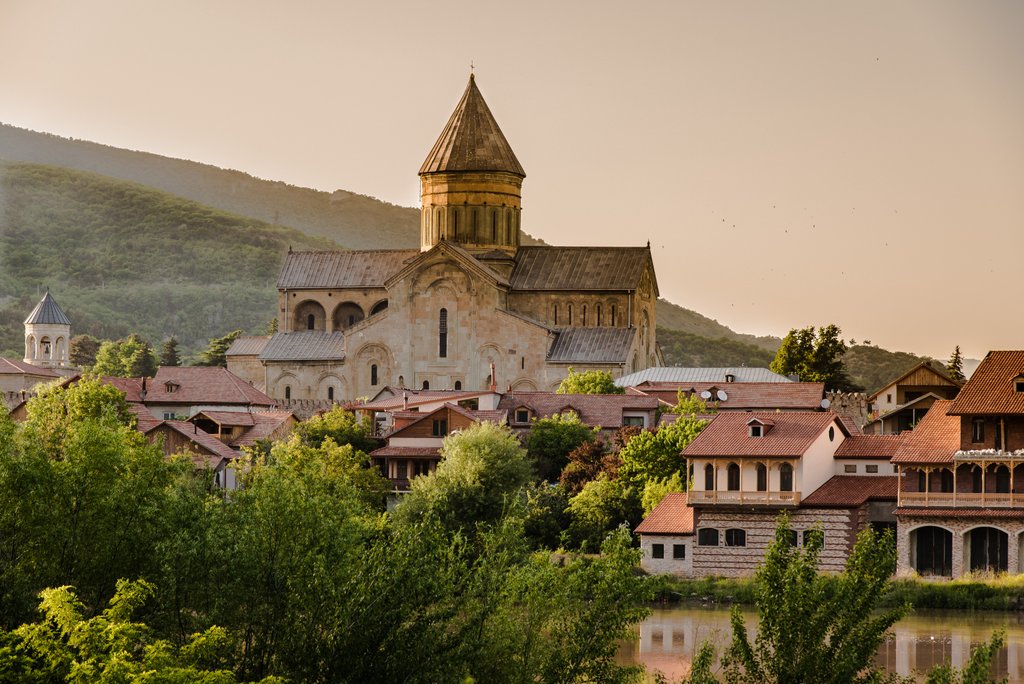
(rferl.org) With its rugged mountain scenery, spectacular Black Sea coastline, and historic capital city, Georgia has a vast array of cinematically attractive locations to entice international filmmakers.

With many beautiful, diverse locations, such as the Kazbegi valley, and relatively low labor costs, Georgia has the potential to become a mecca for foreign filmmakers.
It seems that movie producers from Bollywood may soon take note, especially now that two big-budget flicks for the Indian market have helped showcase what the Caucasus country has to offer.

The romantic dual-language Tamil-Telugu tale "A Second World" ("Irandam Ulagam") has just finished shooting in various regions around Georgia and is due for a major release in January.

It follows hot on the heels of the high-octane Tamil-gangster flick "Billa 2," which used various locations around Tbilisi for its blockbuster thrills and spills (see the trailer below).

According to eurasianet.org, Georgia's Deputy Minister of Economy and Sustainable Development Keti Bochorishvili believes these movies could have a “pulling effect” in attracting even bigger-budget Bollywood productions.

The Georgian government has long been striving to woo foreign filmmakers to the country and it seems their efforts have not been falling on deaf ears.

Indian producer Roop Naik has already praised Georgia for its "unique locations" and "diverse landscapes," which he says are among several factors that could act as a draw for foreign filmmakers.

In Naik's view, the country also has a certain novelty value compared to other parts of Europe, which he reportedly believes are over used as locations for Bollywood films.

Nonetheless, many film professionals believe that Georgia will need to put together an incentive package -- including tax rebates -- before it can hope to regularly attract big-budget movie projects from Bollywood and elsewhere.

The deputy director of Georgia's National Film Center, Salome Sepashvili, told eurasianet.org that an incentive package has actually been developed.

Although she gave no details as to when this package might be approved, there are plenty who would presumably back the move.

Georgia's National Investment Agency has already said that an increase in the number of foreign film crews in the country could give the country's movie industry a much needed shot in the arm while also having many knock-on benefits for those working in the catering, accommodation, logistics, and transportation sectors.

Friday, July 06, 2012

ARTICLE: How Stalin's daughter defected in India. By Inder Malhotra (bbc.co.uk)

(bbc.co.uk) The only daughter of Soviet dictator Josef Stalin has died in the US, aged 85. In 1967 she travelled to India to scatter the ashes of her Indian Communist lover in the river Ganges. During that visit she defected to the US causing a political sensation. Indian journalist Inder Malhotra recalls the scandal.

Stalin with his daughter Svetlana in a undated photo
Svetlana was Josef Stalin's only daughter
Svetlana Alliluyeva, also known as Lana Peters, had a strong connection with India.

She was what is known as the common law wife of Brajesh Singh, one of the many Indian Communists who made Moscow their home in the 1930s and thereafter.

In early 1967 Mr Singh died. Svetlana saw to it that he was cremated according to Hindu rites and then decided to bring his ashes to India to consign them to the Ganges river, held sacred by Hindus.

This took time because Soviet leaders tried hard to dissuade her from making that journey.

Political upheavals

Enough evidence emerged later to show that Alexi Kosygin, then prime minister, had personally told her that she was taking a grave risk as orthodox Hindus sometimes burned the widow along with her husband.

But she was determined to press ahead despite the protestations.

http://news.bbcimg.co.uk/media/images/57000000/jpg/_57000808_b.jpg
Indian Communist Brajesh Singh
An Indian visa was no problem because, apart from other reasons, Brajesh's nephew, Dinesh Singh, was a confidant of then prime minister Indira Gandhi and a member of her council of ministers.

After completing the rituals in her late husband's ancestral village in Uttar Pradesh, she arrived in Delhi at a time when India was in the throes of a general election, the first without Jawaharlal Nehru - India's first prime minister after independence.

The political upheavals consumed India: the Congress party was returned to power, though with a considerably reduced majority and there was a tense leadership struggle between Indira Gandhi and Morarji Desai, who would end up being her deputy prime minister.

It was because of the excitement over these developments that neither the media nor any of the political leaders took any interest in Svetlana's presence in Delhi.

And then the sensational news broke one morning, with nuclear force, that Stalin's daughter had defected to the United States on Indian soil.

The Soviet Union was incensed and said so but there was nothing India could do. Tension between Moscow and Delhi persisted for some time despite previously close relations.

American escape

The story of the great escape could not have been more dramatic.

Svetlana was staying at the Soviet embassy where Ambassador Nikolai Benediktov was advising her to return home.

Telling him that she was going out to finalise her travel arrangements, she called a taxi and drove straight to the American embassy, only a short distance away.

The embassy had shut for the day. She told the duty officer who she was and what she wanted.

In panic, the duty officer rang up Ambassador Chester Bowles and told him that he must come to his office immediately to deal with a matter that could not be discussed on the phone.

Mr Bowles arrived, talked to Svetlana and gave her a lined pad to write down why she wanted to go the US, not to her own country.

She duly did, and when published in her book a year later, it turned out to be a cogent and readable document.

While Svetlana was writing her piece, Ambassador Bowles sent an "Eyes Only" telegram to the Secretary of State Dean Rusk explaining the situation and asking for instructions.

He took care to conclude his cable with the words: "If I do not hear from the State Department by midnight (Indian time), I would, on my responsibility, give her the visa."

According to the ambassador's subsequent account of the incident, as he had expected, there was not a word from Washington by the deadline.

So he arranged to send Svetlana to the airport in the company of a CIA officer to catch a flight to Rome.

Only after she had reached there safely did the sensational news leak out.

Related Stories


Around the BBC

* BBC - History - Historic Figures Joseph Stalin (1879 - 1953) 
* BBC Russian 
The BBC is not responsible for the content of external Internet sites