Showing posts with label RFE/RL. Show all posts
Showing posts with label RFE/RL. Show all posts
Thursday, April 12, 2018
VIDEO: The Pankisi Stigma - documentary film. via @RFERL
Locals of Pankisi are sick and tired of asserting they are not terrorists. The dwellers of the small Georgian gorge bordering Russia believe that the stigma dates back to the late XX c., the time of Moscow’s wars in Chechnya, the so-called "boeviks" (militants) and criminals. They also say that it was largely due to Russia’s influence that the place has become a kind of international "brand" for terrorism. In their words, it’s a hindrance to the development of the region since both the businesses and tourists stay away. Against the backdrop of the ISIS activities and certain reported facts, which sometimes raise unanswered questions, the stigma grows stronger. For all the differences about the customs and heated arguments, both fervent supporters of the traditional Islam and Islamic fundamentalists are at one where the security of the gorge is concerned. According to some sources, the Salafite community of the Islamic fundamentalists, often referred to as Vahabites account for 30%-35% of Pankisi’s total Muslim population while others say they make up as much as 75%-80%. Young people form the majority of the Salafites, and it was the radical Salafites who recruited people to fight in Syria a few years ago. The community members claim they feel sidelined by the State. Regardless of their religious beliefs, the Kists (Chechens residing in Georgia) point out at their closer involvement in the public affairs as the pre-requisite of their safety. The population, mostly the Kists of the small Georgian gorge of the Akhmeta municipality Kakheti region, is reportedly as small as 6000-7000.


Monday, June 16, 2014
VORTRAG: Deutsche Kriegsgefangene in Georgien – Film und Diskussion (orient-gesellschaft.at)
 (orient-gesellschaft.at) Mag. David Kakabadze, Journalist, Redakteur und Übersetzer,
Leiter der georgischen Redaktion von Radio Free Europe
Mo, 23. Juni 2014, 18.30 Uhr
Klubsaal
Eintritt: € 4,- (erm. € 2,-), für Mitglieder der ÖOG gratis
ÖSTERREICHISCHE ORIENT-GESELLSCHAFT HAMMER-PURGSTALL
1010 Wien, Dominikanerbastei 6/6
Tel.: 01 5128936
www.orient-gesellschaft.at
Monday, December 16, 2013
GEORGIA: Iconic Georgian Writer Chabua Amirejibi Dies At 92 (rferl.org)

(rferl.org) TBILISI -- An iconic Georgian writer and Soviet-era dissident, Chabua Amirejibi, has died in Tbilisi at the age of 92.
Amirejibi became well-known in the former Soviet Union for his novel "Data Tutashkhia," which was translated into Russian in 1976.
The novel's major character, Data Tutashkhia, a Georgian outlaw of the Imperial Russian period, became a popular hero across the former Soviet Union after a blockbuster television show, "The Coasts," based on the novel, was aired in the late 1970s.
Amirejibi was also known for his lengthy gulag experience. He was arrested in 1944 on coup-plot charges and sentenced to 25 years in prison in Siberia.
After 15 years in prison, three prison escapes, and two death sentences, he was ultimately rehabilitated in 1959 and began his literary career in his late 30s.
Wednesday, December 04, 2013
AZERBAIJAN: From Yurts To Kimchi, Protecting The World's 'Intangible' Cultures. By Daisy Sindelar (rferl.org)
Yurts, Polo, And Georgian Wine Vie For UNESCO Recognition
(rferl.org) Seventy-year-old Kakesh Jumabai-Kyzy has spent her entire life working with felt.
The mother of eight lives in the mountainous Kyrgyz area of At-Bashy, where many families still tend flocks of sheep that provide the warm, fluffy wool that Jumabai-Kyzy transforms into traditional Kyrgyz clothing and the colorful felt rugs called shyrdaks.
"I learned carpet-making from my mother, and after that I continued working by myself. I make yurts, shyrdaks, kementais (wool coats for men), and kalpaks (national wool hats)," Jumabai-Kyzy says. "Dozens of my items have been sold abroad. But only my younger daughter-in-law and one of my own daughters are continuing my craft. My other children didn't learn it."
Jumabai-Kyzy is one of a dwindling number of artisans skilled in making shyrdaks and alakiyiz, an appliqued felt carpet.
The rugs, which combine rich colors and striking graphic patterns, were traditionally used for warmth and decoration in Kyrgyz households.
But Nazgul Mekeshova, a historical-legacy specialist with the Kyrgyz Culture Ministry, says the appeal of shyrdaks and alakiyiz is dying out.
"Before, the craft was thriving in our country," Mekeshova says. "For example, when young girls got married, mothers typically gave them shyrdaks and alakiyiz as gifts. But now it's foreign carpets and rugs that are selling the most at local markets. The shyrdak and alakiyiz remain only as a form of historical art."
But last year, Kyrgyzstan's unique rug-making heritage got a boost when the shyrdak and alakiyiz were recognized by the United Nations' cultural agency, UNESCO, as a cultural element in need of urgent safeguarding. UNESCO has offered protection for cultural entities for decades, most notably through its World Heritage List, which includes 981 properties -- from India's Taj Mahal to Australia's Great Barrier Reef -- deemed as having outstanding universal value.
In 2003, UNESCO passed a special convention offering protections for living, non-physical elements of culture -- something the agency calls "intangible cultural heritage." Helena Drobna, a specialist in UNESCO's culture sector, explains:
"It has to be transmitted from generation to generation, it has to be created and constantly recreated by the communities, and it has to provide them with a sense of identity and continuity -- things like oral traditions or expressions, performing arts, traditional craftsmanship, social practices and rituals, and knowledge and practices concerning nature and the universe," Drobna says.
Since then, hundreds of so-called "intangible cultural heritage elements" have applied for special UNESCO status. These include everything from Korean tightrope walking to Sicilian puppet theater to falconry, a tradition nominated by a collective group of 13 different nations.
The process of applying for addition to the UNESCO list can be grueling. Countries must demonstrate that the cultural element is essential to the identity of a community, continues to develop as it is passed through generations, and represents no threat to human rights.
Applicant countries must also describe how they plan to independently support the cultural element. UNESCO provides no automatic funding to countries that make the cultural intangible list. But Drobna says the special UNESCO designation gives many crafts and rituals the attention and momentum they need to regain importance within their community:
"The benefit of it is that it's raising awareness in the community on the local level, regional level, national level, and internationally," Drobna says. "So the idea is that as it raises awareness, it may also raise funding, in order to safeguard these elements. The local or national governments may release some funding, and they may also apply for some international support from UNESCO."
Dozens of countries have applied this year to add their intangible cultural elements to the UNESCO list.
Shrimp Fishing On Horseback
Applicants include Mongolia, which has nominated its traditional making of gers, or yurts. Belgium is hoping to call attention to its regional tradition of shrimp fishing on horseback.
The Turkish coffee culture has also been nominated, as has the South Korean tradition of making and sharing the spicy cabbage dish known as kimchi.
These cases and others are due to be considered when UNESCO convenes an intergovernmental committee for the safeguarding of intangible cultural heritage in Baku on December 2-7.
The event is expected to receive considerable publicity in Azerbaijan, whose first lady, Mehriban Aliyeva, has served as a UNESCO goodwill ambassador since 2004.
Baku is also hoping to use the December meeting to secure urgent safeguarding status for its own intangible cultural element -- chovqan, a form of polo once popular among Azeri nomads riding sturdy, short-legged Karabakh horses.
Azerbaijan's application is not without controversy. Few in the country have heard of the sport, and neighboring Iran has protested, saying polo is an international game and should not be acknowledged as a sport indigenous to any one nation.
UNESCO says its list is meant to highlight the intangible cultural heritage of individual communities, not countries -- a step that is meant to emphasize the natural diversity of most countries around the world.
But Rahman Badalov, a Baku-based philosopher and art critic, says some countries may use special designations like the UNESCO list to fuel nationalist sentiment.
He recalls the bitter "dolma dispute" between Azerbaijan and its rival neighbor, Armenia, when both tried to informally claim the savory stuffed grape leaves as their national dish.
Efforts to promote chovqan as a signature Azerbaijani sport, Badalov says, are a waste of time and money.
"It's the latest example of the government misusing budget resources," Badalov says. "They have lots of money and are looking for a kind of entertainment. Ninety-nine percent of the government's cultural initiatives are ugly, useless things. It's only cosmetic, a mask, with no content. They want to gain political favor, to show a positive side of themselves."
RFE/RL correspondents Baktygul Chynybaeva and Arifa Kazimova contributed to this piece from Bishkek and Baku
(rferl.org) Seventy-year-old Kakesh Jumabai-Kyzy has spent her entire life working with felt.
The mother of eight lives in the mountainous Kyrgyz area of At-Bashy, where many families still tend flocks of sheep that provide the warm, fluffy wool that Jumabai-Kyzy transforms into traditional Kyrgyz clothing and the colorful felt rugs called shyrdaks.
"I learned carpet-making from my mother, and after that I continued working by myself. I make yurts, shyrdaks, kementais (wool coats for men), and kalpaks (national wool hats)," Jumabai-Kyzy says. "Dozens of my items have been sold abroad. But only my younger daughter-in-law and one of my own daughters are continuing my craft. My other children didn't learn it."
Jumabai-Kyzy is one of a dwindling number of artisans skilled in making shyrdaks and alakiyiz, an appliqued felt carpet.
The rugs, which combine rich colors and striking graphic patterns, were traditionally used for warmth and decoration in Kyrgyz households.
But Nazgul Mekeshova, a historical-legacy specialist with the Kyrgyz Culture Ministry, says the appeal of shyrdaks and alakiyiz is dying out.
"Before, the craft was thriving in our country," Mekeshova says. "For example, when young girls got married, mothers typically gave them shyrdaks and alakiyiz as gifts. But now it's foreign carpets and rugs that are selling the most at local markets. The shyrdak and alakiyiz remain only as a form of historical art."
But last year, Kyrgyzstan's unique rug-making heritage got a boost when the shyrdak and alakiyiz were recognized by the United Nations' cultural agency, UNESCO, as a cultural element in need of urgent safeguarding. UNESCO has offered protection for cultural entities for decades, most notably through its World Heritage List, which includes 981 properties -- from India's Taj Mahal to Australia's Great Barrier Reef -- deemed as having outstanding universal value.
In 2003, UNESCO passed a special convention offering protections for living, non-physical elements of culture -- something the agency calls "intangible cultural heritage." Helena Drobna, a specialist in UNESCO's culture sector, explains:
"It has to be transmitted from generation to generation, it has to be created and constantly recreated by the communities, and it has to provide them with a sense of identity and continuity -- things like oral traditions or expressions, performing arts, traditional craftsmanship, social practices and rituals, and knowledge and practices concerning nature and the universe," Drobna says.
Since then, hundreds of so-called "intangible cultural heritage elements" have applied for special UNESCO status. These include everything from Korean tightrope walking to Sicilian puppet theater to falconry, a tradition nominated by a collective group of 13 different nations.
The process of applying for addition to the UNESCO list can be grueling. Countries must demonstrate that the cultural element is essential to the identity of a community, continues to develop as it is passed through generations, and represents no threat to human rights.
Applicant countries must also describe how they plan to independently support the cultural element. UNESCO provides no automatic funding to countries that make the cultural intangible list. But Drobna says the special UNESCO designation gives many crafts and rituals the attention and momentum they need to regain importance within their community:
"The benefit of it is that it's raising awareness in the community on the local level, regional level, national level, and internationally," Drobna says. "So the idea is that as it raises awareness, it may also raise funding, in order to safeguard these elements. The local or national governments may release some funding, and they may also apply for some international support from UNESCO."
Dozens of countries have applied this year to add their intangible cultural elements to the UNESCO list.
Shrimp Fishing On Horseback
Applicants include Mongolia, which has nominated its traditional making of gers, or yurts. Belgium is hoping to call attention to its regional tradition of shrimp fishing on horseback.
The Turkish coffee culture has also been nominated, as has the South Korean tradition of making and sharing the spicy cabbage dish known as kimchi.
These cases and others are due to be considered when UNESCO convenes an intergovernmental committee for the safeguarding of intangible cultural heritage in Baku on December 2-7.
The event is expected to receive considerable publicity in Azerbaijan, whose first lady, Mehriban Aliyeva, has served as a UNESCO goodwill ambassador since 2004.
Baku is also hoping to use the December meeting to secure urgent safeguarding status for its own intangible cultural element -- chovqan, a form of polo once popular among Azeri nomads riding sturdy, short-legged Karabakh horses.
Azerbaijan's application is not without controversy. Few in the country have heard of the sport, and neighboring Iran has protested, saying polo is an international game and should not be acknowledged as a sport indigenous to any one nation.
UNESCO says its list is meant to highlight the intangible cultural heritage of individual communities, not countries -- a step that is meant to emphasize the natural diversity of most countries around the world.
But Rahman Badalov, a Baku-based philosopher and art critic, says some countries may use special designations like the UNESCO list to fuel nationalist sentiment.
He recalls the bitter "dolma dispute" between Azerbaijan and its rival neighbor, Armenia, when both tried to informally claim the savory stuffed grape leaves as their national dish.
Efforts to promote chovqan as a signature Azerbaijani sport, Badalov says, are a waste of time and money.
"It's the latest example of the government misusing budget resources," Badalov says. "They have lots of money and are looking for a kind of entertainment. Ninety-nine percent of the government's cultural initiatives are ugly, useless things. It's only cosmetic, a mask, with no content. They want to gain political favor, to show a positive side of themselves."
RFE/RL correspondents Baktygul Chynybaeva and Arifa Kazimova contributed to this piece from Bishkek and Baku
AZERBAIJAN: UNESCO Adds Azerbaijani Horse Game To 'Intangible Heritage' List (rferl.org)
WATCH: The UN's cultural and educational organization, UNESCO, meets on December 2-7 to grant special designation to examples of intangible cultural heritage -- traditions, crafts, and rituals passed from generation to generation. Dozens of countries and communities are seeking recognition for their cultural traditions, ranging from the Azerbaijani horseback sport known as chovqan to the Korean spiced cabbage called kimchi. (Videos courtesy of UNESCO. Produced by RFE/RL's Daisy Sindelar and Margot Buff)
(rferl.org) BAKU -- The UN's cultural agency has named a traditional Azerbaijani horse-riding game a practice in need of urgent protection.
UNESCO, the United Nations Educational, Scientific, and Cultural Organization, decided to include the game of "chovqan" on its Intangible Cultural Heritage list at a meeting in the Azerbaijani capital, Baku, on December 3.
ALSO SEE: From Yurts To Kimchi, Protecting The World's 'Intangible' Cultures
The list comprises events from around the globe and is designed to "help demonstrate the diversity of this heritage and raise awareness about its importance."
Chovqan is a form of polo once popular among Azerbaijani nomads riding short-legged Karabakh horses.
The game is played by two competing teams of five riders and is accompanied by instrumental folk music called ''janghi.''
UNESCO said the practice and transmission of chovqan have weakened due to "socio-economic factors leading to a shortage of players, trainers, and Karabakh horses."
In 2003, UNESCO passed a special convention offering protections for living, non-physical elements of culture, what it calls "intangible cultural heritage."
Sunday, October 27, 2013
POLITIC: GOOGLE+ HANGOUT: Georgia's Presidential Elections (rferl.org)
(rferl.org) While not as dramatic as last year's parliamentary elections, Georgia's October 27 presidential polls are a milestone in the country's transition to a parliamentary republic. Although the presidency will have reduced powers under constitutional amendments adopted in 2010, a slate of 23 candidates will contest the office.
Washington-based analysts Thomas De Waal and Laura Linderman will join Tbilisi-based political analyst Ghia Nodia and Salome Asatiani of RFE/RL's Georgian Service for a live discussion of the vote. It will be moderated by RFE/RL's Brian Whitmore. (Thursday, October 24, 2013
11 am (Washington, DC) / 5 pm (Prague) / 7 pm (Tbilisi))
-----
Thomas de Waal
- is a senior associate in the Russia and Eurasia Program at the
Carnegie Endowment for International Peace, specializing primarily in
the South Caucasus region and its unresolved conflicts - Abkhazia,
Nagorno Karabakh, and South Ossetia - as well as in the wider Black Sea
region. De Waal is the author of "The Caucasus: An Introduction"
(Oxford University Press, 2010).
Laura Linderman - is the associate director of the Atlantic Council's Dinu Patriciu Eurasia Center, where she develops and shapes the Center's analytic and intellectual work on Georgia. A former Peace Corps volunteer in western Georgia, Linderman has co-authored articles on Georgian politics for the Atlantic Council and Foreign Policy.
Ghia Nodia - is the director of the International School of Caucasus Studies at Ilia State University in Tbilisi. A freelance contributor to RFE/RL's Georgian Service, Nodia served as Georgia's Minister of Education and Science from February to December 2008 and has published widely on issues of democratization, institution-building and nationalism in post-Communist countries.
Salome Asatiani - is a Prague-based broadcaster with RFE/RL's Georgian Service who has also covered Georgia for RFE/RL's Central Newsroom. Before becoming a journalist, Asatiani taught seminars at Tbilisi State University and worked as a DJ at a local rock radio station in Tbilisi.
Brian Whitmore - is Europe Desk Editor for RFE/RL's Central Newsroom in Prague and the writer of "The Power Vertical" blog
We invite you to post questions in advance and follow updates for live links to the Google+ Hangout on Twitter and Facebook.
Laura Linderman - is the associate director of the Atlantic Council's Dinu Patriciu Eurasia Center, where she develops and shapes the Center's analytic and intellectual work on Georgia. A former Peace Corps volunteer in western Georgia, Linderman has co-authored articles on Georgian politics for the Atlantic Council and Foreign Policy.
Ghia Nodia - is the director of the International School of Caucasus Studies at Ilia State University in Tbilisi. A freelance contributor to RFE/RL's Georgian Service, Nodia served as Georgia's Minister of Education and Science from February to December 2008 and has published widely on issues of democratization, institution-building and nationalism in post-Communist countries.
Salome Asatiani - is a Prague-based broadcaster with RFE/RL's Georgian Service who has also covered Georgia for RFE/RL's Central Newsroom. Before becoming a journalist, Asatiani taught seminars at Tbilisi State University and worked as a DJ at a local rock radio station in Tbilisi.
Brian Whitmore - is Europe Desk Editor for RFE/RL's Central Newsroom in Prague and the writer of "The Power Vertical" blog
We invite you to post questions in advance and follow updates for live links to the Google+ Hangout on Twitter and Facebook.
Sunday, August 18, 2013
VIDEO: Years After Russia-Georgia War, Fences And Fears Remain (youtube.com)
(youtube.com) Five years after Georgia and Russia fought a brief war over the breakaway region of South Ossetia, Russia troops remain in control of the territory, and continue to tighten the region's borders. For Georgians living in the Shida Kartli region, near the administrative border with South Ossetia, the presence of Russian troops and new barbed-wire fences has meant restricted movement and a constant fear of detention. But many say that there is no resentment between them and the civilians on the other side. Video by RFE/RL's Georgian Service
Monday, July 29, 2013
AUCH DAS GIBT ES: Alijew schenkt Reportern ein Hochhaus (diepresse.com)
 |
| Alijew / Bild: (c) APA/ROBERT JAEGER (ROBERT JAEGER) |
Als „Freund der Journalisten" rühmte eine Tafel den Präsidenten Aserbaidschans, als dieser vergangene Woche ein Hochhaus im Bakuer Bezirk Bibiheybat einweihte. Es ist nicht irgendein Hochhaus. In dem 16-stöckigen Monumentalbau mit Meerblick werden 150 Journalisten wohnen. In Apartments, die ihnen der Staat kostenlos zur Verfügung stellt.
Ilham Alijew, der einem Jahrzehnt im Amt ist und den keine lästige Begrenzung an seiner Wiederwahl im Oktober hindert, bezeichnete diese Einrichtung als „erste weltweit“. In Aserbaidschan, so die Argumentation, könnten sich Journalisten in einer teuren Stadt wie Baku keinen Wohnraum mehr leisten; daher habe man den Bedürftigen unter die Arme gegriffen. Der Staat als Wohltäter – und zudem als aufgeklärter: Der Presserat, der die Auswahl der Journalisten organisierte, betonte, dass nicht nur regierungsnahe Medien zum Zug kommen würden.

Kritiker werten die Aktion als Klientelpolitik und Versuch der Vereinnahmung. „Was sind freie Medien? Freie Medien benötigen Unabhängigkeit von den Organisationen, über die sie berichten“, sagte der Medienexperte Qulu Maharramli zum aserbaidschanischen Ableger von Radio Freies Europa. „Wie können sie die Regierung kritisieren, wenn sie von ihr ein Apartment erhalten?“
„Unsere Journalisten sind loyal“
Auch wenn Präsident Alijew in Reden gerne die große Zahl von Medien hervorhebt: Die Rahmenbedingungen für unabhängigen Journalismus in der Kaukasusrepublik sind schwierig. Auf der Rangliste zur Pressefreiheit von „Reporter ohne Grenzen“ nimmt Aserbaidschan den 156. von 179 Plätzen ein.Das „Institut für die Sicherheit und Freiheit von Reportern“ (IRFS) in Baku berichtete am vergangenen Freitag, dass die Oppositionszeitung „Azadliq“ („Freiheit“) wegen übler Nachrede zu einer Strafe von 30.800 Euro verdonnert wurde. Verleumdungsklagen, die künftig auch vermehrt im Internet angewendet werden dürften, stellen ein Mittel dar, um missliebige Stimmen zum vorsichtigeren Sprechen zu bewegen. 16 tätliche Angriffe auf Journalisten zählte IRFS im ersten Quartal 2013, sieben Journalisten sind derzeit aus politisch motivierten Gründen im Gefängnis, so die Organisation.
„Aserbaidschan wird weiterhin die Meinungsfreiheit und andere Freiheiten garantieren“, erklärte Alijew anlässlich der Eröffnung des Wohnblocks. Und dann gab er zu verstehen, welche Rolle er in seinem Staat den aserbaidschanischen Journalisten zugedacht hat. „Generell verhalten sich unsere Journalisten loyal zu den Bürgern und zum Staat“, sagte der Präsident und fügte hinzu: „Sie sollten die Interessen des Staates beschützen und nachteilige Schritte vermeiden."
(som)
Monday, July 01, 2013
RADIO: Pressefreiheit in Georgien vor Gericht. Der Fall des Journalisten Irakli Absandze. Von Thomas Franke (dradio.de)
(dradio.de) Kritische Medien gibt es in Georgien nur wenige. Für Journalisten ist das unabhängige Arbeiten seit dem Amtsantritt von Premierminister Ivanishvili schwer geworden. Nun steht der Journalist Irakli Absandze wegen angeblichen Drogenbesitzes vor Gericht. Viele vermuten, das Verfahren sei politisch motiviert.
 Irakli Absandze ist genervt. Statt zu recherchieren, steht er
stundenlang vor Gericht. Er arbeitet für Liberali, ein kritisches
Wochenmagazin in Georgien. Da gibt es genug Schwierigkeiten. Die letzte
Ausgabe erschien nur im Internet, nicht am Kiosk. Der Grund sind
Finanzschwierigkeiten der Zeitschrift. Firmen werben in Georgien ungern
in einem kritischen Umfeld. Dazu kommt: Es gibt in Georgien keine
Zeitungskultur. Die Leute sind nicht bereit, so viel Geld für ein Blatt
zu bezahlen, dass es sich daraus finanzieren könnte. Wer kann, nutzt
Internet. Kritischer Journalismus ist dringend nötig. Denn Georgier
informieren sich meist über das Fernsehen, und das ist gelenkt.
Irakli Absandze ist genervt. Statt zu recherchieren, steht er
stundenlang vor Gericht. Er arbeitet für Liberali, ein kritisches
Wochenmagazin in Georgien. Da gibt es genug Schwierigkeiten. Die letzte
Ausgabe erschien nur im Internet, nicht am Kiosk. Der Grund sind
Finanzschwierigkeiten der Zeitschrift. Firmen werben in Georgien ungern
in einem kritischen Umfeld. Dazu kommt: Es gibt in Georgien keine
Zeitungskultur. Die Leute sind nicht bereit, so viel Geld für ein Blatt
zu bezahlen, dass es sich daraus finanzieren könnte. Wer kann, nutzt
Internet. Kritischer Journalismus ist dringend nötig. Denn Georgier
informieren sich meist über das Fernsehen, und das ist gelenkt. Verlautbarungsjournalismus sei denn auch eines der größten Probleme georgischer Medien, erläutert Tamar Rukhadze, die Geschäftsführerin des Ethikrates, eines Gremiums, zu dem sich kritische Journalisten in Georgien zusammengeschlossen haben, um die Standards zu verbessern.
"Manchmal gibt die Regierung oder das Innenministerium eine Pressemitteilung heraus, und alle Medien verbreiten sie genau so. Ich erinnere mich an keinen Fall, in dem das anders war. Selbst wenn diese Mitteilung überhaupt keinen Nachrichtenwert hatte. Ich weiß nicht, warum unsere Journalisten damit nicht mal aufhören."
Tamar Rukhadze war selbst Nachrichtenchefin des Fernsehkanals TV9. Der wurde letztes Jahr im Wahlkampf von Bidzina Ivanishvili gegründet, einem georgischen Oligarchen. Man konnte dort guten Journalismus machen, sagen die Mitarbeiter - bis zum Herbst. Da gewann Ivanishvili die Wahl, wurde Premierminister, und begann, massiv Einfluss auf das Programm zu nehmen. Ein großer Teil der Journalisten verließ den Sender, auch Tamar Ruhkadze.
"Redakteure in Georgien versuchen einfach immer, gute Beziehungen zu den Mächtigen zu halten. Aber dafür musst du senden, was sie dir geben. Denn morgen brauchst du die Leute ja wieder."
Auch der angeklagte Journalist Irakli Absandze hatte für TV9 gearbeitet, bevor er zur kritischen Wochenzeitschrift Liberali wechselte. Deren Macher versuchen, sich nicht einschüchtern zu lassen. In ihren aktuellen Recherchen geht es um den Generalstaatsanwalt. Der versucht offensichtlich, Einfluss auf die Lebensmittelkontrolle nehmen, um Bestechungsgelder zu bekommen. Die Drogen wurden Absandze nicht untergeschoben, das ist mittlerweile klar. Ein wohlmeinender Bekannter schickte sie - unbedacht - aus dem Ausland. Sie sind aber ein guter Anlass, um Druck auf den Journalisten auszuüben, erläutert Absandzes Anwalt Gagi Mosiashvili:
"Das größte Problem der Staatsanwaltschaft ist, dass sie das Ziel hatte, Absandze unbedingt anzuklagen, vorher aber nicht geklärt hat, ob die Beweise ausreichen. Das ist ein Dauerproblem der Staatsanwaltschaft. Sie kann einfach nicht damit umgehen, dass jemand eventuell zu Unrecht angeklagt ist, wenn die Beweislage dünn ist. Es ist dann sehr schwierig, die Staatsanwaltschaft dazu zu bringen, die Anklage fallen zu lassen."
Die Freispruchquote liegt in Georgien unter einem Prozent. Die Juristen sind in einer Zwickmühle. In der Zeit des scheidenden Präsidenten Micheil Saakashvili wurde das Drogengesetz absurd verschärft - um eine Handhabe gegen missliebige Gegner zu haben. Der Haschischkonsum ist in Georgien recht populär. Am Tag, an dem bekannt wurde, dass Absandze verhaftet wurde, gab es deshalb auch eine Demonstration, auf der zwar keine Legalisierung der Drogen, wohl aber eine Entschärfung der Gesetze gefordert wurde. Tamar Rukhadze:
"Die Regierung fing an, darüber zu reden. Das sind gute Nachrichten. Aber es wäre schön gewesen, wenn das ohne die Verhaftung von Irakli geschehen wäre."
Allen ist bewusst, wie absurd ein Strafverfahren gegen den missliebigen Journalisten wegen 0,1 Gramm Haschisch ist. Der Staatsanwalt erschien denn auch ohne Zeugen und bat, den Prozess weiter zu vertagen. Erneut bot er einen Vergleich an. Absandze wäre dann zwar raus, aber vorbestraft. Irakli Absandze gilt als aufrichtig und glaubwürdig. Deshalb nimmt er keinen Kuhhandel an. Immer schwingt die Sorge mit, dass irgendetwas Negatives an Absandze hängen bleiben soll.
Noch einmal Absandzes Anwalt Gagi Mosiashvili:
"Die meisten Staatsanwälte und Richter sind politisch manipulierbar. Wir bezweifeln ja gar nicht deren Ermittlungsmethoden, aber es gibt überhaupt keinen Beweis, dass Absandze vorhatte, diese Drogen zu kaufen. Ich schätze den Staatsanwalt, er ist professionell. Aber er kann keine unabhängigen Entscheidungen treffen. Ich möchte gern glauben, dass es keine politische Entscheidung war, Absandze vor Gericht zu stellen. Aber es ist nichts ausgeschlossen."
Tuesday, May 28, 2013
SEMINAR: The Future of the EU as a Strategic Geopolitical Actor. - in Tbilisi
Georgian Political Science Association is pleased to invite you to its monthly seminar:
The Future of the EU as a Strategic Geopolitical Actor.
17:00, 28 May 2013
Speaker:
Ahto Lobjakas: analyst at the Estonian Foreign Policy Institute, PhD candidate at the University of Tartu. In 2000-2010, he was Radio Free Europe/Radio Liberty's correspondent in Brussels, closely covering the EU's and NATO's relations with FSU countries (as well as Afghanistan).
Abstract: The presentation will focus on the impact of the crisis on EU foreign-policy making, as well as the "balance of power" within the Union, as exemplified by the Cyprus crisis, which was treated as a purely euro-zone matter despite the potentially massive geo-strategic issues at stake. Author argues that, the EU's foreign and security policy has unraveled at this point, its only functioning structures the knee-jerk actions of the European Commission and the EEAS. Without political leadership, which will only return with a new basic EU treaty, the EU's relationships with other world powers and neighboring states will devolve to member state level.
Venue: Georgian Foundation for Strategic and International Studies (GFSIS), 3a Chitadze str. Tbilisi. Georgia
This event is free and open to the public
Seminar will be held in English
euro|topics - Ahto Lobjakas
The Future of the EU as a Strategic Geopolitical Actor.
17:00, 28 May 2013
Speaker:
Ahto Lobjakas: analyst at the Estonian Foreign Policy Institute, PhD candidate at the University of Tartu. In 2000-2010, he was Radio Free Europe/Radio Liberty's correspondent in Brussels, closely covering the EU's and NATO's relations with FSU countries (as well as Afghanistan).
Abstract: The presentation will focus on the impact of the crisis on EU foreign-policy making, as well as the "balance of power" within the Union, as exemplified by the Cyprus crisis, which was treated as a purely euro-zone matter despite the potentially massive geo-strategic issues at stake. Author argues that, the EU's foreign and security policy has unraveled at this point, its only functioning structures the knee-jerk actions of the European Commission and the EEAS. Without political leadership, which will only return with a new basic EU treaty, the EU's relationships with other world powers and neighboring states will devolve to member state level.
Venue: Georgian Foundation for Strategic and International Studies (GFSIS), 3a Chitadze str. Tbilisi. Georgia
This event is free and open to the public
Seminar will be held in English
euro|topics - Ahto Lobjakas
Saturday, April 13, 2013
ART: Armenian-American Artist Wins Posthumous Fame. By Richard Solash (rferl.org)

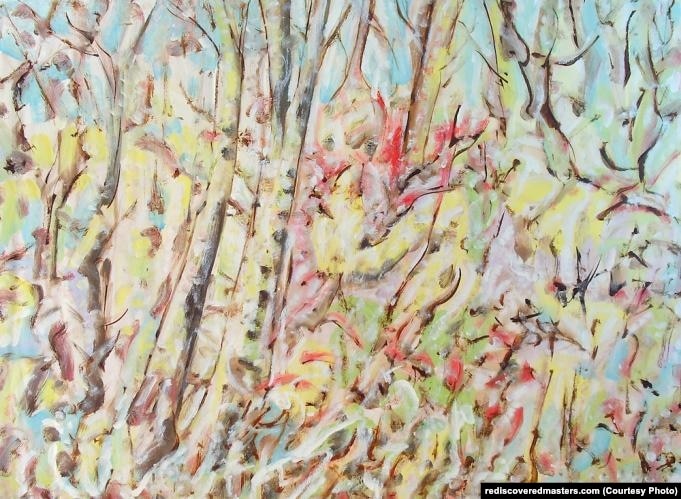
(rferl.org) A landscape dissolves into reds, yellows, and greens. A mountain in New York State is filtered through an artist's imagination, rendered on canvas in angular patches.
These were among the visions of Arthur Pinajian, an unknown Armenian-American painter whose death would prompt little more than the rental of a Dumpster. The Dumpster was to be filled with decades' worth of his writings and pencil sketches and a garage-full of paintings that numbered close to 6,000.
Today, Pinajian's work hangs on the well-lit walls of a SoHo gallery. Leading art historians say that, at his best, he ranks among the United States' finest abstract expressionists. His estate has been appraised at $30 million. After several kind twists of fates, Pinajian has been vaulted out of obscurity and is now gaining improbable posthumous fame.
The first twist came with a real estate venture by a man named Thomas Schultz. It was 2005 when Schultz stumbled upon the cottage in Bellport, New York that was the longtime home of Pinajian and his sister. She had recently died. The artist had died six years prior, at age 85.
"I came into the house to look at it with the purpose of figuring out if it was a good house to flip [to buy and resell for profit] and I walked among all of this art. I was intrigued by it because it was so vast," said Schultz.
"I knew what I was looking at was someone's life's work."
Cousins apologized to Schultz for the mess left inside -- thousands of canvases, some badly decaying, that were stuffed into the attic and piled in the garage. They said the artist, who had never been recognized in his lifetime, had left instructions for all of his work to be thrown away. A Dumpster was ready out back.
In The Right Hands
Schultz's business partner put up $300,000 for the house and offered an additional $2,500 for the entire body of artwork.
The enormous collection had not only been spared, but had fallen into the right hands. It turned out that Schultz knew a relative of the late William Innes Homer, at that time one of the most respected scholars of contemporary American art.
After several months of study, Homer made an excited call to noted American art historian and appraiser Peter Hastings Falk. In an interview with RFE/RL, Falk maintained that some of Pinajian's work ranks with the masters of American abstract expressionism.
"If you look at the history of abstraction in America, certainly the headlines are given to [Jackson] Pollock and Franz Kline and [Willem] de Kooning and all of the stars of that period who are now ensconced in the pantheon of American art history," he said.
"And it's long been thought that no one else could ever crack into that elite rank because, of course, everyone has been discovered and art historians already know everything. The really fun thing about this is here is the dean of American art historians who is just simply astonished -- and I was, too. That's what makes this such an extraordinary story."
Falk is now the exhibitions director and chief curator of Pinajian's estate.
Pinajian was born in 1914 in New Jersey. His parents had fled the mass killings of ethnic Armenians by Ottoman Turks.
He worked as a comic-book illustrator in the 1930s, creating "Madam Fatal," a character considered the first cross-dressing super hero.
He earned a Bronze Star for valor for his service in World War II before training at the Art Students League in New York. Falk says that Pinajian likely came into contact with the well-known American abstract expressionists of the day.
Painting 'Morning, Noon, And Night'
Falk says Pinajian had "some sort of breakdown" in 1948, a year in which he wrote a lengthy manifesto on what it means to be a great artist.
The art historian notes that 1948 was also the year that Arshile Gorky, the most famous Armenian-American artist, committed suicide. Some speculate that Pinajian may have met Gorky in the years before his death.
From then on, Pinajian led a near-hermetic existence, depending on his sister for financial support. Art consumed nearly every waking hour until his death.
"When we went to the house, he was always laughing and joking and talking about the old times," recalls Aram Aramian, one of Pinajian's cousins. "He had a good nature about him. But all he wanted to do was paint -- paint, paint, paint. Morning, noon, and night. Every day. Three-hundred and sixty-five days out of the year."
While Pinajian tried everything from erotica to realism, Falk says he achieved his best results in "lyric, rhythmic, abstract landscapes."
While living in the upstate New York town of Woodstock, Pinajian found his muse in Overlook Mountain. The image of the double-peaked mountain became a recurring theme in his work, progressing from a recognizable portrayal to near complete abstraction.
Falk says the mountain may have reminded Pinajian of Mount Ararat in present-day Turkey, the site where Noah’s Ark was said to have come to rest and an important symbol of Armenia.
He puts the total value of Pinajian's work at $30 million, a figure that was recently revealed to the public.
Pinajian's first New York City showing in March generated significant interest. That was the site of the highest price paid so far for one of his paintings, $100,000. "I still feel that the elevator is on the ground floor in terms of value," Falk says.
Thomas Schultz, who helped save the collection, has given up his day job to become its full-time registrar. He says "a major Los Angeles-area museum" recently acquired a piece. But he insists his work is about inspiration far more than money.
"I bought the Pinajian cottage from my partner," he says. "I'm currently living in it. I look at the trees here on the property that he captured in some of the beautiful landscapes that we now see. So it's almost like I'm on sacred ground. It's been life-changing. [My life is] all things Pinajian, basically. I wake up every day and I think of Pinajian and what I could do to bring the recognition to him that he deserves. I feel like he's finally getting that."
Armenian-American Artist Arthur Pinajian
Published 2 April 2013
Throughout his long career, artist Arthur Pinajian created thousands of vivid, abstract canvases, including landscapes, figure studies, and expressionist works. He received little recognition during his lifetime and worked mostly in obscurity. Now, however, he is gaining improbable posthumous fame with leading art historians saying that, at his best, he ranks among America's finest abstract expressionists. His estate is currently valued at $30 million. (13 PHOTOS)
Wednesday, March 06, 2013
REVIEW: Sentenced To Death In Stalin's Great Purge (rferl.org)
(rferl.org) No one knows for sure how many people were murdered during Stalin's Great Purge, but estimates put the figure at more than 1 million. During the peak period of 1937-38, Stalin's secret police executed more than 1,000 people per day, most with a shot to the back of the head. These photos show some of the victims in their last weeks or days. The original photographs were saved in FSB and GARK archives. Copies were provided by the international association Memorial in Moscow and were taken from "The Great Terror in the USSR 1937-1938" by Tomasz Kizny, in cooperation with Dominique Roynette, Les Editions Noir sur Blanc, Lausanne 2013. (8 PHOTOS)


Monday, October 29, 2012
REPORT: Caucasus Report - New Georgian Leadership To Reopen Investigation Of Ex-Prime Minister’s Death
(rferl.org) Speaking to journalists one week after her nomination as justice minister in Bidzina Ivanishvili’s new cabinet, Tea Tsulukiani said
the investigations into the deaths of banker Sandro Girgvliani and
Prime Minister Zurab Zhvania will be reopened as numerous questions
remain unanswered.
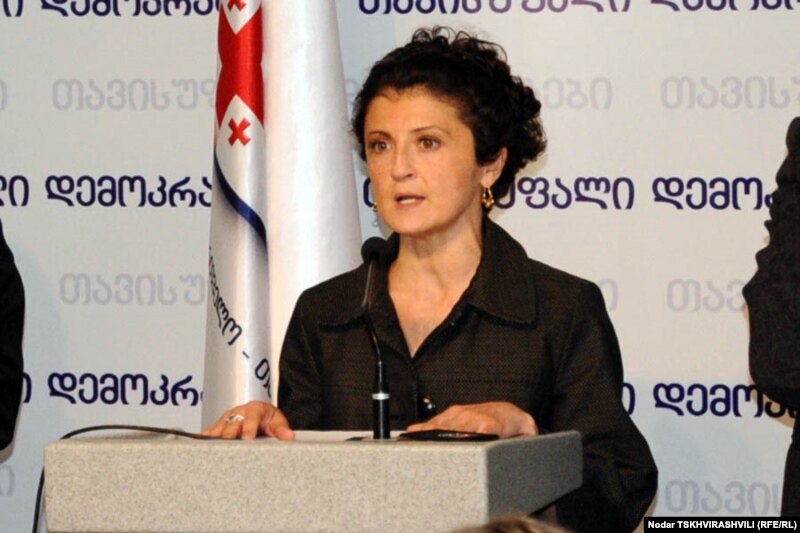 |
| Georgia's incoming Justice Minister Tea Tsulukiani (file photo) |
Girgvliani was found beaten and stabbed
in the throat on the outskirts of Tbilisi in January 2006 after an
altercation in a bar the previous night with senior Interior Ministry
personnel and the wife of Interior Minister Vano Merabishvili. Zhvania
was found dead with another man in a rented Tbilisi apartment early on
February 3, 2005. Georgian officials, including Merabishvili,
immediately said their deaths were caused by carbon monoxide poisoning
from an Iranian-manufactured heater that had been incorrectly installed.
But FBI experts who traveled to Tbilisi to assist the investigation
failed to confirm that assumption.
Zhvania’s brother Giorgi subsequently adduced circumstantial evidence
suggesting the two men died elsewhere and their bodies were then
transported to the apartment where they were found. Giorgi Zhvania has
now openly accused
Merabishvili and two other former senior officials of staging, at the
behest of President Mikhail Saakashvili, the scene at the apartment
intended to create the impression that the two men were the accidental
victims of asphyxiation. Zhvania stressed, however, that he is "not saying that it was these persons who killed my brother."
The apartment where the bodies of Zhvania and Kvemo Kartli Deputy
Governor Raul Usupov were discovered had been rented several months
previously by Misha Dzadzamia, one of Zhvania’s bodyguards, for
clandestine assignations with his mistress, according to UPI on November
28, 2005. Zhvania had requested the temporary use of it "for a secret
meeting." When Zhvania failed to make regular contact with his
bodyguards, Dzadzamia broke a window to enable another bodyguard to
enter the apartment. That man found Zurab Zhvania and Yusupov dead and
"a terrible smell...like something was burning."
Merabishvili announced within hours that the two men had died of carbon
monoxide poisoning, but carbon monoxide has no odor. Moreover, the main
gas supply to the entire street had been cut hours before the bodies
were discovered because residents had reported a suspected gas leak. FBI
experts invited to Tbilisi by the Georgian authorities failed to
confirm that the heater could have produced lethal quantities of carbon
monoxide, according to an IWPR article by investigative journalist Vakhtang Komakhidze published a year after Zhvania’s death.
In that article, Komakhidze also listed Giorgi Zhvania’s doubts that his
brother died in the apartment where his body was found. Giorgi Zhvania
had earlier pointed out repeatedly that neither his brother’s
fingerprints nor those of Yusupov were found anywhere in that apartment.
He said Zurab never smoked a cigarette to the end and always twisted it
when stubbing it out, but only one of the several dozen cigarette butts
found in the apartment had been extinguished that way. Giorgi Zhvania
also noted that the food laid out on the table (together with a bottle
of cognac) included sausage, which his brother did not eat, according to
www.rustavi2.com on April 4, 2005.
Komakhidze later made a TV documentary questioning the official version
of the circumstances of Zhvania’s death that was shown in October 2007
on Russia’s REN TV channel.
In the September 2007 TV interview in which he accused Saakashvili of
condoning corruption and the murder of political opponents, former
Defense Minister Irakli Okruashvili also said
he knows that Zhvania did not die at the location where he was found.
Zurab Noghaideli, who succeeded Zhvania as premier but fell out with
Saakashvili in 2008, has also hinted that he knows incriminating details
about Zhvania’s death, but he has not revealed them.
In his interview with Maestro TV, Giorgi Zhvania named three former top officials
who he claims engineered the transport of the bodies of his brother and
Yusupov to the apartment where they were found. The three are
Merabishvii; former Deputy Prime Minister Giorgi Baramidze, now a deputy
parliament speaker representing Saakashvili’s United National Movement
(EEM); and former Prosecutor General Zurab Adeishvili, who according to
Tsulukiani left Georgia after the EEM’s defeat in the October 1
parliamentary election.
more here: Georgia Justice Hinges On Who Is the Leader
more here: Georgia Justice Hinges On Who Is the Leader
28 October 2012 | Issue 5002
By Paul Rimple
themoscowtimes.com Tuesday, October 23, 2012
DISKUSSION: Georgien: Gelingt der demokratische Machtwechsel? (boell.de)
(boell.de) Georgien: Gelingt der demokratische Machtwechsel? Berichte und Analysen zu den georgischen Parlamentswahlen am 1. Oktober 2012
Datum: Donnerstag, 25. Oktober 2012, 19.00 Uhr
Ort: Heinrich-Böll-Stiftung, Schumannstraße 8, 10117 Berlin
Mit:
- David Zurabishvili (Koalition Georgischer Traum/ Republikanische Partei)
- Giorgi Kandelaki (Abgeordneter der Vereinten Nationalen Bewegung, ehem. Regierungspartei, nun Opposition, Tbilisi)
- Salome Asatiani (Korrespondentin des georgischen Programms von Radio Free Europe, Prag)
- Viola von Crammon (MdB Bündnis 90/Die Grünen)
Moderation: Walter Kaufmann (Heinrich-Böll-Stiftung e.V.)
 Am 1. Oktober 2012 fanden in Georgien Parlamentswahlen statt. Sie führten zu einer tiefen Zäsur in der jüngeren Geschichte des Landes: Zum ersten Mal steht Georgien vor einem regulären, durch eine demokratische Wahl herbeigeführten Machtwechsel.
Die seit der Rosenrevolution von 2003 regierende Nationale Bewegung von Präsident Micheil Saakaschwili erlitt bei der Wahl eine schwere Niederlage. Verfügte sie bis zum 1. Oktober über eine Zweidrittelmehrheit im Parlament und ein politisches Monopol auf allen Ebenen des Staates, muss sie sich nun in der Rolle der parlamentarischen Minderheit und Opposition einrichten. Gewinner der Wahlen sind die unter Führung von Bidzina Ivanischwili zusammengeschlossenen sechs Parteien des Oppositionsbündnisses 'Georgischer Traum' - sie verfügen nun über die klare Mehrheit der Mandate und können die Regierung bestimmen. Ihr Einfluss wird entscheidend verstärkt durch die nach der Präsidentschaftswahl 2013 in Kraft tretenden Verfassungsreform, durch die Georgien von einem Präsidial- zu einem parlamentarischen System wechseln wird und die zentralen Machtbefugnisse vom Präsidenten auf den vom Parlament gewählten Premierminister übertragen werden. Damit scheint die Zeit von Micheil Saakaschwili als die alles dominierende politische
Führungsfigur Georgiens vorbei zu sein - nach zwei Amtsperioden darf er nicht mehr als Präsident kandidieren.
Gelingt es der georgischen Gesellschaft, den demokratischen Machtwechsel nach einem zutiefst polarisierenden Wahlkampf friedlich zu vollenden? Worin liegen die Gründe der Wahlniederlage der zuvor dominanten Regierungspartei von Präsident Saakaschwili? Wer sind die neuen Machthaber, und wie demokratisch wird ihre politische Praxis?
Gelingt Georgien tatsächlich der Schritt zu einer pluralistischen Demokratie?
Sprache: Georgisch/Deutsch mit Simultanübersetzung.
Anmeldung: Die Teilnahme ist kostenlos, eine Anmeldung nicht erforderlich.
Information: Nina Happe, Referat Ost- und Südosteuropa, Heinrich-Böll-Stiftung Berlin, T +49 (0)30 285 34 384, E happe@boell.de
| Veranstalter | Heinrich-Böll-Stiftung, Berlin |
| Veranstaltungs- ort |
Heinrich-Böll-Stiftung, Berlin
10117 Berlin, Schumannstr. 8 Mit der S-Bahn oder mit der U-Bahn bis Bahnhof Friedrichstraße. Ausgang über die Spree, dann Albrechtstraße, Reinhardtstraße überqueren und nach links in die Schumannstraße. Lageplan |
Monday, October 08, 2012
GEORGIEN: Gelingt der demokratische Machtwechsel? - Berichte und Analysen zu den georgischen Parlamentswahlen am 1. Oktober 2012 (boell.de)
(boell.de) Podiumsdiskussion
Datum: Donnerstag, 25. Oktober 2012, 19.00 Uhr
Ort: Heinrich-Böll-Stiftung, Schumannstraße 8, 10117 Berlin
Mit:
Tea Tsulukiani (frisch gewählte Abgeordnete des Oppositionsbündnisses 'Georgischer Traum', Tbilisi)
Giorgi Kandelaki (Vereinte Nationale Bewegung, Tbilisi)
Salome Asatiani (Korrespondentin des georgischen Programms von Radio
Free Europe, Prag)
Viola von Crammon (MdB Bündnis 90/Die Grünen) angefragt
Am 1. Oktober 2012 fanden in Georgien Parlamentswahlen statt. Sie führten zu einer tiefen Zäsur in der jüngeren Geschichte des Landes: Zum ersten Mal steht Georgien vor einem regulären, durch eine demokratische Wahl herbeigeführten Machtwechsel.
Die seit der Rosenrevolution von 2003 regierende Nationale Bewegung von Präsident Micheil Saakaschwili erlitt bei der Wahl eine schwere Niederlage. Verfügte sie bis zum 1. Oktober über eine Zweidrittelmehrheit im Parlament und ein politisches Monopol auf allen Ebenen des Staates, muss sie sich nun in der Rolle der parlamentarischen Minderheit und Opposition einrichten. Gewinner der Wahlen sind die unter Führung von Bidzina Ivanischwili zusammengeschlossenen sechs Parteien des Oppositionsbündnisses 'Georgischer Traum' - sie verfügen nun über die klare Mehrheit der Mandate und können die Regierung bestimmen.
Ihr Einfluss wird entscheidend verstärkt durch die nach der Präsidentschaftswahl 2013 in Kraft tretende Verfassungsreform, durch die Georgien von einem präsidialen zu einem parlamentarischen System wechseln wird. Dadurch werden die zentralen Machtbefugnisse vom Präsidenten auf den vom Parlament gewählten Premierminister
übertragen. Damit scheint die Zeit von Micheil Saakaschwili als die alles dominierende politische Führungsfigur Georgiens vorbei zu sein - nach zwei Amtsperioden darf er nicht mehr als Präsident kandidieren.
Gelingt es der georgischen Gesellschaft, den demokratischen Machtwechsel nach einem zutiefst polarisierenden Wahlkampf friedlich zu vollenden? Gibt die Nationale Bewegung - also die mit Präsident Saakaschwili verbundene politische Elite - freiwillig ihre Macht ab? Wer sind die neuen Machthaber und wie demokratisch wird ihre politische Praxis? Gelingt Georgien tatsächlich der Schritt zu einer pluralistischen Demokratie?
Sprache: Georgisch/Deutsch mit Simultanübersetzung.
Anmeldung: Die Teilnahme ist kostenlos, eine Anmeldung nicht erforderlich.
Information: Nina Happe, Referat Ost- und Südosteuropa Heinrich-Böll-
Stiftung Berlin
T +49 (0)30 285 34 384
Monday, September 24, 2012
FEATURE: Georgia Protests: One Demonstration, With Many Interpretations (rferl.org)
(rferl.org) TBILISI -- Protesters in Georgia have gathered for a fourth consecutive day of antigovernment demonstrations calling for the ouster of President Mikheil Saakashvili.
Some 200 demonstrators camped out overnight outside the headquarters of the Georgian public television station, where they have erected tents near a makeshift stage decorated with posters reading "We are fighting for democracy" and "Misha must go."
The number of protesters has dwindled since the start of the protests on May 21. Then, thousands of protesters gathered outside the headquarters of the Georgian public television station to accuse Saakashvili of Soviet-style tactics in his running of the South Caucasus country.
The round-the-clock protests have been largely peaceful. But police on May 22 used tear gas and rubber bullets to disperse demonstrators after some protesters used metal bars to attack nearby cars.
Protesters said they were trying to help a friend who had been detained and was sitting in a police car. One woman was reportedly taken to the hospital as a result of her injuries.
The demonstrations -- the first of their kind in nearly two years -- are an attempt by the more radical branch of the Georgian opposition to assert itself on a political stage that Saakashvili has largely dominated for nearly eight years. (The more moderate Opposition 8 group, led by former UN Ambassador Irakli Alasania, has distanced itself from the protests.)
'Revolutionary' End
Nino Burjanadze, Saakashvili's key ally in the 2003 Rose Revolution that led him to power, is now among those leading the crusade for a "revolutionary" end to his presidency, which she says has been characterized by creeping authoritarianism and neglect.
Speaking to RFE/RL's Georgian Service on May 22, she said Saakashvili's stifling of the opposition made elections meaningless.
"Never in history has a nondemocratic and autocratic authority transferred power through elections. That has never happened," Burjanadze said. "As for the threat of instability, yesterday I remembered the words of a great American, John Kennedy. He said that any authority that makes peaceful revolution impossible will push for the revolution to be violent."
FLASH ANALYSIS -- Koba Liklikadze of RFE/RL's Georgian Service looks at the ongoing Georgian protests:
Burjanadze's People's Assembly opposition movement, which is behind the unfolding protests, has been joined by the Georgian Party, an opposition group led by several high-profile politicians, including former ombudsman Sozar Subari and millionaire Levan Gachechiladze.
The two groups have sparred in the past. But arriving at the protest on May 22, Gachechiladze shook Burjanadze's hand, hugged her warmly, and declared the country's future was more important than political rivalries.
"I, Levan Gachechiladze, am personally forgetting about everything for the sake of my motherland," he said, "and I would like to [greet] Mrs. Nino in front of you all."
Possible Trump Card
After joining the protests, the Georgian Party upped the ante, declaring a so-called Arab-style "Day of Rage" on May 25 and vowing Saakashvili would be ousted that day. They had also planned to introduce a possible trump card: Irakli Okruashvili, a former defense minister and onetime Saakashvili ally who fled the country in 2007 after a highly public falling out with the president, whom he accused of corruption and criminal intent.
Okruashvili, who was later was convicted in absentia of corruption charges, has been living in France, where he has political asylum. Earlier this week, he vowed to return to Georgia on May 25 -- the day Burjanadze and others have vowed to secure Saakashvili's ouster -- and "finish off this regime once and for all."
But on May 24 both he and the Georgian Party backtracked. As the protest numbers dwindled, Subari told local television the "Day of Rage" had been canceled. And Okruashvili reversed his decision to travel to Georgia, saying he did not feel Burjanadze's People's Assembly was the appropriate political partner for him and his allies.
It is unclear what Okruashvili's motivations may have been for contemplating a return. Georgian Interior Ministry officials threatened to arrest him as soon as he enters the country. And it is not certain the once-popular Okruashvili still enjoys the public support he once did.
Early on, the People's Assembly appeared unamused by the stunt, with one of its leading members, chess champion Nona Gaprindashvili, telling RFE/RL's Georgian Service that any attempt by Okruashvili to join the protests would be "unacceptable."
"We have no connection with Okruashvili. When the Georgian Party came to us, we told them that if they knew anything about Okruashvili's plans to let us know," Gaprindashvili said. "We should know for 100 percent Okruashvili's precise plans before we make any decisions, because we are not going to have any relations with Okruashvili."
No Comment From Saakashvili
The government appears unfazed by the protests. Saakashvili, who came under heavy international criticism for his crackdown on unarmed demonstrators in November 2007, has made no comment on the current demonstrations or the calls for his imminent ouster and spent May 23 in Budapest meeting with his Hungarian counterpart, Pal Schmitt.
The Georgian Foreign Ministry has reiterated that the people gathered outside the public television building have the right to peacefully protest.
Russia, meanwhile, has turned an unrelenting eye on the Georgia protests. Newscasts on the main state-run channels have given broad coverage to the demonstrations, including activated tear-gas canisters and shots of protesters overcome by the smoke during the May 22 clashes.
Moscow's relations with Saakashvili have never been warm. Kremlin leaders have repeatedly sought to chip away at the authority of the Georgian leader, who has openly sought to move his country closer to the West and further from Russia's postimperial sphere of influence.
The 2008 Russia-Georgia war, which removed the separatist Abkhaz and South Ossetian regions from Georgian jurisdiction, was considered an attempt by the Kremlin to put a chokehold on Saakashvili's ambitions.
The loss of Georgia's breakaway territories was devastating to many Georgians and dealt a severe, but not fatal, political blow to Saakashvili. There is widespread speculation that Saakashvili might take the newly empowered prime minister's position when his final presidential term expires in 2013. (Russia's Vladimir Putin made a similar move in 2008, when his second term as president ended.)
The Specter Of Russia
Many opposition leaders -- including Burjanadze, who cultivates close ties with Russia -- have used the loss of the breakaway regions as a rallying cry in the attempt to build their own base of public support.
The specter of Russia looms large in Georgia, with many in both the opposition and the ruling party convinced that Kremlin operatives are determined to steer the course of Georgian politics.
Davit Darchiashvili, a lawmaker with Saakashvili's National Movement party, told RFE/RL he did not expect a major outbreak of violence at the protests. But at the same time, he said, it was reasonable to assume any unrest would ultimately be traced to Russia.
"There is no reason to think in terms of a large-scale threat. There is not any social, systemic, or mental reason," he said. "But we can't rule out that several hundred people have coordinated with Russia in different ways and are ready to take various kinds of steps. It will be unpleasant, but any state and its law enforcement bodies should be ready for something like that."
written in Prague by Daisy Sindelar, based on reporting from Jimsher Rekhviashvili, Nona Suvarian, Bidzina Ramischwili, Niko Nergadze, Nino Kharadze, and Nino Gelashvili in Prague and Tbilisi
Thursday, September 20, 2012
GEORGIEN: Folter in georgischem Knast. „Vergewaltige auch mich“. Von Klaus-Helge Donath (taz.de)
(taz.de) Ein Video zeigt den Missbrauch eines jugendlichen Häftlings in der Hauptstadt Georgiens. Tausende demonstrieren gegen das Regime von Präsident Saakaschwili.
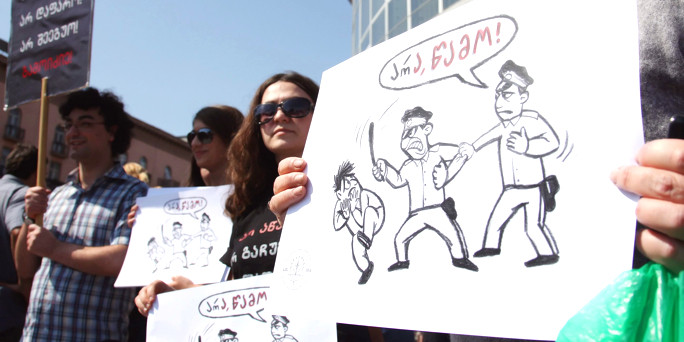 |
| Georgische Frauen protestieren mit Schildern (Bild: dpa) |
MOSKAU taz | „Bitte filmt das nicht, ich tue alles, was ihr wollt“, fleht ein jugendlicher Häftling. Justizbeamte haben ihn mit einem Besenstiel missbraucht und ihn mit Handschellen an die Gitterstäbe der Zelle gekettet. „Tut das weh?“, fragt eine Stimme leise aus dem Hintergrund.
Als diese Bilder am Dienstagabend von den oppositionellen Sendern Maestro und Channel 9 in Georgien ausgestrahlt wurden, erhob sich spontaner Protest in der Hauptstadt Tiflis.
Mehrere tausend Demonstranten zogen vor die Philharmonie in der Hauptstadt, wo Präsident Michail Saakaschwili an einer Veranstaltung teilnehmen sollte. „Wir sind wütend!“ und „Vergewaltige auch mich“ stand auf Transparenten. Im Nu weiteten sich die Proteste auch auf andere Städte des Landes aus.
Knapp zehn Tage vor den Parlamentswahlen kommt dieser Skandal einem politischen Super-GAU für die Regierung Saakaschwili gleich. Ohnehin ist die Lage vor den Wahlen angespannt, seitdem der Milliardär Bidsina Iwanischwili mit seiner Partei „Georgiens Traum“ in der Lage ist, die Partei des Präsidenten, die Nationale Bewegung (NMD), erstmals ernsthaft herauszufordern.
Menschenrechte und Menschenwürde
Menschenrechte und Menschenwürde
Präsident Saakaschwili reagierte sofort und gelobte, dass „die Täter viele Jahre im Gefängnis verbringen werden“ und er die Rechte der Häftlinge garantieren wolle. Er sei sehr verärgert „über diesen schrecklichen Affront gegen Menschenrechte und menschliche Würde“, sagte der Präsident und entließ die für den Strafvollzug zuständige Ministerin und einige leitende Beamte des Justizapparates.
Menschenrechtler hatten seit Jahren auf die fragwürdigen Zustände in den georgischen Haftanstalten hingewiesen. Die Regierung überging die Warnungen jedoch. Auch der Vorsitzende des Nationalen Sicherheitsrats Giga Bokeria musste die Versäumnisse einräumen.
Die Regierung Saakaschwili hält sich zugute, dass sie die Korruption bei der Polizei beseitigen konnte und auch in den Justizorganen für mehr Ordnung sorgte. Ein Pfund, mit dem Saakaschwili auch wuchern geht.
„Kriminelle Aktionen des Regimes“
„Kriminelle Aktionen des Regimes“
Das Material soll der frühere Justizangestellte Wladimir Bedukadse den oppositionellen Sendern zugespielt haben. Bedukadse hält sich in Belgien auf, wo er politisches Asyl beantragte. „Dieses Video entlarvt die kriminellen Aktionen Saakaschwilis und seines Regimes“, sagte er.
Der ehemalige Wächter im Gefängnis Nummer 8 in Tiflis will die Aufnahmen 2011/12 mitgeschnitten haben. Die Videos zeigen, dass Dutzende Wächter und Angestellte entweder teilnahmen oder zum Missbrauch der Häftlinge aufforderten.
Auch Verschwörungstheorien im Umfeld der NMD machen schon die Runde, wonach die Opposition das Video bewusst jetzt lanciert haben soll. Das entkräftet jedoch die Anklagen nicht. Um größeren Schaden zu verhindern, ernannte Saakaschwili am Donnerstag den Ombudsmann für Menschenrechte, Giorgi Tuguschi, zum neuen Minister des Strafvollzugs.
Mehr Links:
Folter-Videos erschüttern Georgien (dw.de)
Angebliche Foltervideos sorgen knapp zwei Wochen vor den Parlamentswahl für Empörung (derstandard.at)
Gewaltvideos treiben Georgier auf die Strasse (bazonline.ch)
A Game of Georgian Chicken (huffingtonpost.com)
Folter-Debatte vermasselt Präsident Saakaschwili den Wahlkampf (spiegel.de)
OSCE High Commissioner on National Minorities warns against demolishing ethnic-Georgian villages in South Ossetia (osce.org)
Georgia prison abuse film prompts staff suspension (bbc.co.uk)
Scandal Highlights Poor Conditions Inside Georgia's Prisons (rferl.org)
Georgia's Abu Ghraib: The horrific stories of prisoner abuse (independent.co.uk)
Kommentar: Knastfolter im Kaukasus (taz.de)
Folter im Gefängnis nachgewiesen (fr-online.de)
Mehr Links:
Folter-Videos erschüttern Georgien (dw.de)
Angebliche Foltervideos sorgen knapp zwei Wochen vor den Parlamentswahl für Empörung (derstandard.at)
Gewaltvideos treiben Georgier auf die Strasse (bazonline.ch)
A Game of Georgian Chicken (huffingtonpost.com)
Folter-Debatte vermasselt Präsident Saakaschwili den Wahlkampf (spiegel.de)
OSCE High Commissioner on National Minorities warns against demolishing ethnic-Georgian villages in South Ossetia (osce.org)
Georgia prison abuse film prompts staff suspension (bbc.co.uk)
Scandal Highlights Poor Conditions Inside Georgia's Prisons (rferl.org)
Georgia's Abu Ghraib: The horrific stories of prisoner abuse (independent.co.uk)
Kommentar: Knastfolter im Kaukasus (taz.de)
Folter im Gefängnis nachgewiesen (fr-online.de)
Subscribe to:
Posts (Atom)