 |
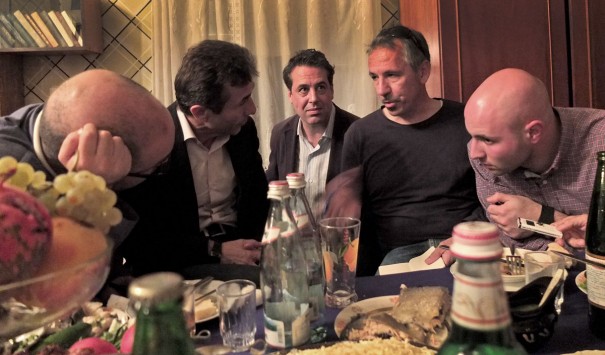
| The author, second from right, debates with Georgian billionaire Bidzina Ivanishvili, second from left. Photo by Justyna Mielnikiewicz |
(roadsandkingdoms.com) Dozens of guests are sitting around a table that is at least 20 meters long, piled high with plates of earthy east Georgian dishes. More home-cooked food is coming. I’ve got one eye on a bowl of khashlama that was just set down. So does the billionaire.
We are in Kakheti, the hilly wine region of eastern Georgia, where khashlama is the signature dish. It might look like boiled beef, but that’s like saying wine looks like vinegar. It’s actually a heroic mix of fresh herbs, salt and beef, slow-cooked in an open cauldron. The billionaire, sitting across from me, spoons a chunk onto his plate. He is the only person holding his utensils upright, like a proper European (the English journalist with us might have done the same, I suppose, but he was still holding a pen and notebook). It’s not that I hadn’t expected such upstanding usage of the cutlery—earlier I watched him taste the homemade wine as if it had been corked in France in 1981—but there are plenty of foods, including some of the herbs on the table, that are just expected to be eaten by hand in Georgia. There’s something unsettling about a man, no matter what his tax bracket, using knife and fork at a country table in Kakheti.
The billionaire is Bidzina Ivanishvili, the most serious challenger to Georgian President Mikheil “Misha” Saakashvili since the Rose Revolution put Misha in power in 2004. This is my first meeting with the contender. It’s billed as an interview, including me and journalists from Le Monde and the Financial Times, but I’m actually most excited just to just watch him eat. If you want to know who politicians really are, don’t interview them. Eat with them.
Case in point: Saakashvili. In December 2003, hours after he stormed the parliament and sent president Eduard Shevardnadze escaping out a side door and into retirement, I say next to Saakashvili at a dinner table. He did not use a knife, or even a fork. I have continued to meet Misha at dinner tables over the years, and what I’ve noticed—besides his inability to sit still—is how he devours his food without bothering to taste it. That’s exactly how he has rebuilt his country: in a hurry. Overnight the cops stopped taking bribes, electricity was restored and the greasy port town of Batumi became a bright-lights big-city tourist destination. Today, customs officers welcome you into the country with a smile and a bottle of wine after they stamp your passport.
But his tendency to stuff his face with reform has caused problems. Saakashvili’s United National Movement party has held a monopoly of power since 2004. It can amend or ignore the constitution at will. God help you if the state has an interest in your property, whether it be your house, business or garden plot. If you piss off the wrong person, you can end up in jail, unless you can pay your way out of it (one way the government funds its incarceration rate, the fourth highest in the world). The county’s 99.7% conviction rate is, well, another sign that the appetites of Saakashvili have made a bit of a mess of the judiciary.
This is why I am eating dinner with Ivanishvili.
Last year, the man who helped bankroll Saakashvili’s reforms—he clothed Misha’s army and equipped Misha’s police and paid the salaries of Misha’s parliamentarians—announced he was switching sides and would challenge Misha in the political arena.
“I’m a good analyst, I think. I began to analyze the situation and I saw the people don’t love him and that I was being lied to,” he said at the time.
When Ivanishvili went rogue, Misha flipped. He has used all the government’s resources to crush his adversary. But Ivanishvili has $6.4 billion dollars of his own resources, equal to half of Georgia’s annual national budget. Regardless of what the polls say, he’s got support from at least half of the population. In the U.S., Mitt Romney is furiously downplaying his personal wealth. But Ivanishvili doesn’t have to do that. In Georgia, there’s hope that a man as rich as him wouldn’t be beholden to anyone and wouldn’t need to use his office for more money or power. Ivanishvili also has a reputation for generosity in his home region. The rest of Georgia hopes some of that largesse will trickle down to them.
Before our khashlama meal, he had rallied at three wine region villages earlier in the day, talking about his “dream” (the name of his party) of a democratic Georgia and about his supporters who have been arrested in what he claims is pure harassment and intimidation. He has had to learn how to talk to an audience. He’s not an orator and he is not animated, but he has the charisma of a totally confident man.
“The public life is not for me,” he says. “Even having pictures taken—I’ve always hated it. Now it’s not a problem. To say it’s a pleasure, it’s not.”
Cars have parked outside and Misha’s supporters, mostly the children of state employees, are honking and whistling. Tedo Japaridze, Misha’s former foreign minister who jumped to Ivanishvili’s side, says this is good, healthy.
A woman strikes a long chord on her accordion and starts singing about the beauty of a nearby region high in the mountains by the Chechen border. Ivanishvili turns away from the journalist to listen. “I like this song,” he says in English.
I’m looking so hard for signs of a politician. I forget this guy chewing on beef that mooed this morning is also the 153rd richest man in the world. And he is entirely at ease. But perhaps more importantly, so are the people around him. Sure there’s a couple lackeys, but nobody is fawning over him. The other end of the table is hardly aware he’s here.
I’ll admit I am taken by the man. I see myself swimming in his enormous swimming pool, enjoying his massive art collection and helping myself to his monster refrigerator. Here is a rich guy I could be friends with. I move to the other side of the table to get some face time.
Several days ago, Georgian TV broadcast a series of clips revealing systematic brutality in a Tbilisi prison. Prisoners were sodomized with batons and brooms. The scandal has rocked the country senseless. But while everybody is preoccupied with the details of the abuse and the authenticity of the tapes and the counter leaks that are appearing, they forget that the scandal is a just a symptom of a dysfunctional judiciary. I want to know just what he’s going to do about this pillar of justice, should he and his party get the majority he predicts.
“I’m going to put together a team of experts. Professionals will take care of this, not politicians,” he says, folding his hands on a knee. “I’m a good manager,” he adds, as if building a democratic institution were as easy as opening up a fast food franchise.
Then we talk about his coalition; a funky melee of liberals, conservatives and xenophobes. His candidate in Batumi, Murman Dumbadze, once told a colleague he wasn’t Georgian because he was not against the construction of a mosque in Adjara, a region with a large Georgian Muslim population. Ivanishvili insists the man is good. “He made a statement in the heat of argument and apologized for that. Everything else, about the mosque, that’s Saakashvili’s doing,” the billionaire asserts. “When it comes to tolerance, we want [a] new direction.”
“What does that mean?” I say, setting my hand on his arm—this is how Georgians talk, intimate even in a dispute.
“You’re from the US, right?” he asks. He begins to tell me about America’s attitude towards tolerance. He is taking this elsewhere, not where I intended to go.
“You can’t find a single nationalistic problem here,” he insists.
We’re talking past each other, wasting time. Where’s the next course? Maybe that will tell me something he won’t. A man brings out sizzling skewers of pork—tsvadi—and lays them across the table, but none of us will get a taste. Bidzina Ivanishvili is finished. It’s time to leave. I shake his hand and thank him for his kindness, though I’m not feeling much better informed about the man. Yes, he’s personable and generous, but a billionaire-politician who intends to build democratic institutions without a plan is every bit as suspicious as a Georgian that eats only with a knife and fork.
Paul Rimple is a Tbilisi-based writer and occasional utensil aficionado.


 Quelle: klappentexterin.wordpress.com
 Nino Haratischwili wurde 1983 geboren. Sie wurde
mehrfach für ihre Arbeit als Theaterautorin und -regisseurin
ausgezeichnet. 2010 erhielt sie für ihre Theaterarbeit den Adelbert-von-Chamisso-Förderpreis. Ihr Romandebüt Juja
erschien 2010 und war für die Longlist des Deutschen Buchpreises und
die Shortlist des ZDF aspekte Literaturpreises nominiert. 2011 gewann
sie für Juja den Debütpreis des Buddenbrockhauses Lübeck. Im gleichen Jahr wurde ihr Roman Mein sanfter Zwilling mit dem Preis der Hotlist der unabhängigen Verlage ausgezeichnet. Die Autorin schreibt auf Deutsch und lebt in Hamburg.
Nino Haratischwili wurde 1983 geboren. Sie wurde
mehrfach für ihre Arbeit als Theaterautorin und -regisseurin
ausgezeichnet. 2010 erhielt sie für ihre Theaterarbeit den Adelbert-von-Chamisso-Förderpreis. Ihr Romandebüt Juja
erschien 2010 und war für die Longlist des Deutschen Buchpreises und
die Shortlist des ZDF aspekte Literaturpreises nominiert. 2011 gewann
sie für Juja den Debütpreis des Buddenbrockhauses Lübeck. Im gleichen Jahr wurde ihr Roman Mein sanfter Zwilling mit dem Preis der Hotlist der unabhängigen Verlage ausgezeichnet. Die Autorin schreibt auf Deutsch und lebt in Hamburg. Tamta Melaschwili wurde 1979 geboren. Die Autorin wuchs
in Georgien auf, lebte ein Jahr in Deutschland und begann hier zu
schreiben. 2010 erschien ihr Debütroman Abzählen und wurde im gleichen Jahr mit dem Literaturpreis “Saba” ausgezeichnet. 2012 erschien Abzählen
auf Deutsch und wurde für die Hotlist nominiert. Im gleichen Jahr war
sie für einen Monat Gast des Literarischen Colloquiums in Berlin. Tamta
Melaschwili lebt derzeit in Georgien und engagiert sich für Frauenrechte
und Genderfragen. (Foto: Nino Kharchilava)
Tamta Melaschwili wurde 1979 geboren. Die Autorin wuchs
in Georgien auf, lebte ein Jahr in Deutschland und begann hier zu
schreiben. 2010 erschien ihr Debütroman Abzählen und wurde im gleichen Jahr mit dem Literaturpreis “Saba” ausgezeichnet. 2012 erschien Abzählen
auf Deutsch und wurde für die Hotlist nominiert. Im gleichen Jahr war
sie für einen Monat Gast des Literarischen Colloquiums in Berlin. Tamta
Melaschwili lebt derzeit in Georgien und engagiert sich für Frauenrechte
und Genderfragen. (Foto: Nino Kharchilava)
 (mercichic.blogspot.de) Are you in Paris on 26th of January... I recommend to visit exhibition
"ArtGeorgia" In Paris, where you can meet talented designers' collections
from Georgia and Ukraine.
(mercichic.blogspot.de) Are you in Paris on 26th of January... I recommend to visit exhibition
"ArtGeorgia" In Paris, where you can meet talented designers' collections
from Georgia and Ukraine. 

 (meetmeherelounge.wordpress.com) One day last year I got an email from a Georgian living in the US who asked why I hated Georgia so much. Everything she read of mine in the Moscow Times was so anti-Georgian, why did I bother living here – or something to that effect. Anti-Georgian? If I didn’t love Georgia I wouldn’t write anything about it at all, let alone live here. It is precisely because I care about this beautiful place I call home so much that I write what I do. Of course I’m critical. I’m anti-hypocrisy and I’ll hold authorities to task wherever I live and will always call things as I see them. Nevertheless, I thought I’d start the new year by lightening up a bit. Georgia has been binging for a month straight and nobody has an appetite for politics right now. That’s why I decided to write a 400 word food and wine story. At least that was my intention…
 tel
in Azerbaijan. About 25 young people from different political parties,
civil society, religious community and liberal active youth participate
in this seminar.
tel
in Azerbaijan. About 25 young people from different political parties,
civil society, religious community and liberal active youth participate
in this seminar.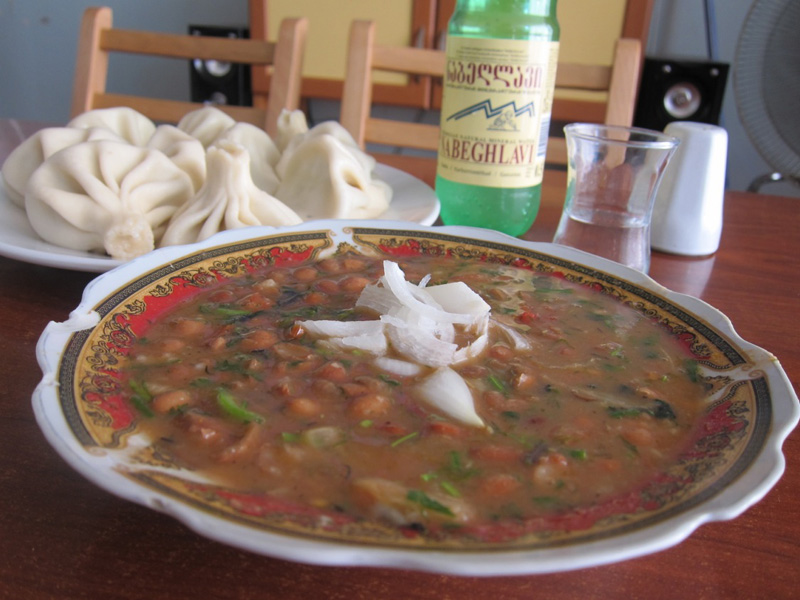
 (thecable.foreignpolicy.com) Secretary of State Hillary Clinton told Georgia's new power broker Bidzina Ivanishvili directly that the
United States is watching to make sure he plays by the rules as his Georgian
Dream coalition assumes power following their surprise victory in this week's
elections, the State Department said Thursday.
(thecable.foreignpolicy.com) Secretary of State Hillary Clinton told Georgia's new power broker Bidzina Ivanishvili directly that the
United States is watching to make sure he plays by the rules as his Georgian
Dream coalition assumes power following their surprise victory in this week's
elections, the State Department said Thursday. 

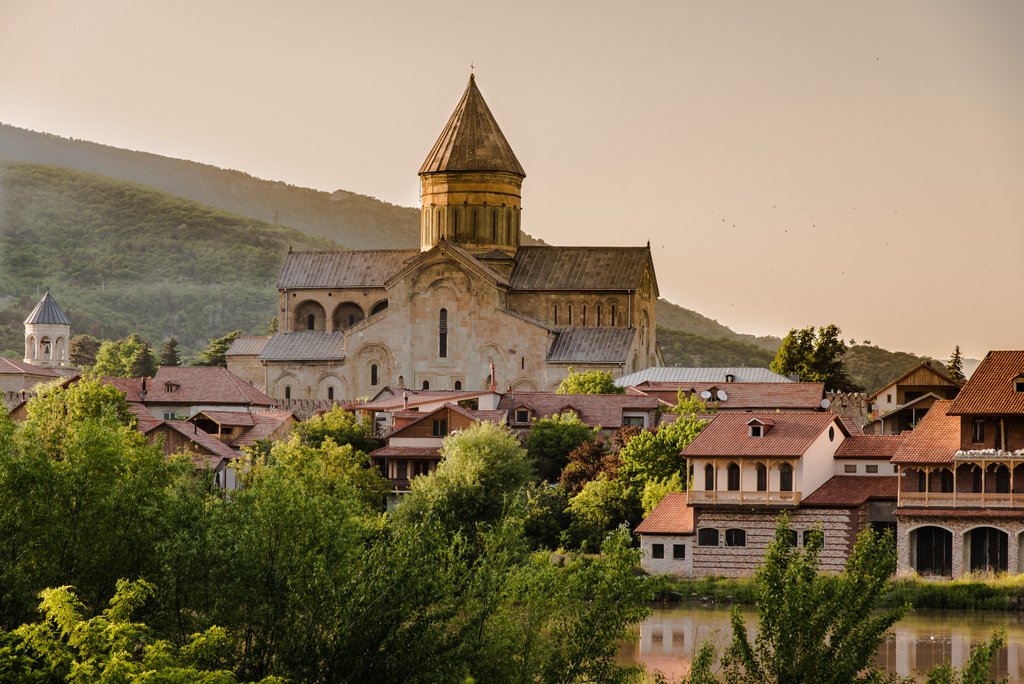


 in old tbilisi


